
PHYSICAL AND LOGICAL TIME EE 324 Lecture 11
![Vector Clock Algorithm Initially, all vectors [0, 0, …, 0] For event on process](https://slidetodoc.com/presentation_image_h2/b537597f71f2ef21c6bf73f24959b8dc/image-38.jpg "Vector Clock Algorithm Initially, all vectors [0, 0, …, 0] For event on process")
- Slides: 45
PHYSICAL AND LOGICAL TIME EE 324 Lecture 11
Assignment Start early! People who are doing well vs. Not doing well.
Last Time– RPC 3 Why remote procedure calls? � � Simple way to pass control and data Elegant transparent way to distribute application Goal: provide transparency (or hide complexity) Hard to provide true transparency � � Failures Performance Memory access Etc. What did we do in the end? give up and let programmer deal with it
Today Reading: CDK 5 chapter 14. 1 -4/ TV chapter 6. 1 -2 Understanding time in distributed systems Synchronizing physical clocks (real clocks) Logical Time/Lamport Clock
Time Example 3 Professors having dinner. 3 counters in different locations. They sneak out and pay at different counters. Who made the first payment?
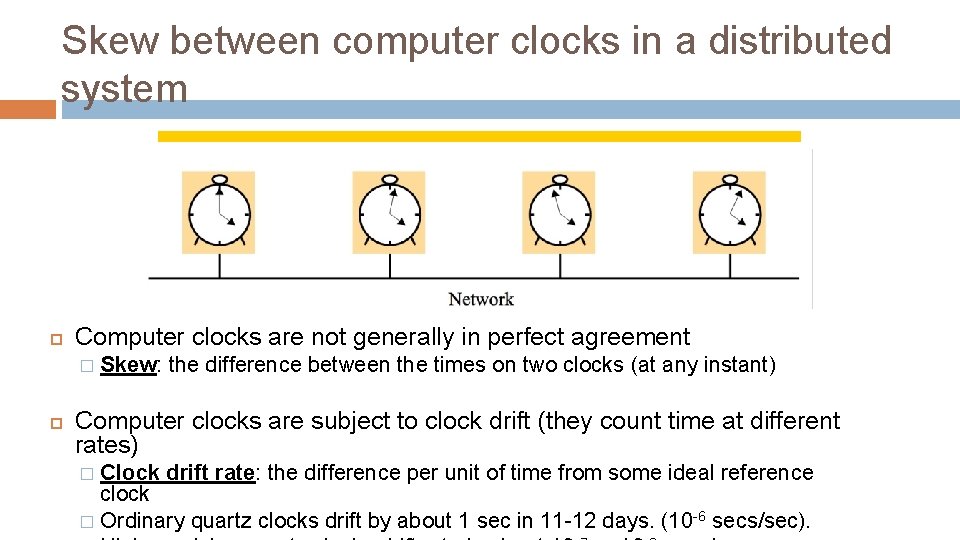
Skew between computer clocks in a distributed system Computer clocks are not generally in perfect agreement � Skew: the difference between the times on two clocks (at any instant) Computer clocks are subject to clock drift (they count time at different rates) Clock drift rate: the difference per unit of time from some ideal reference clock � Ordinary quartz clocks drift by about 1 sec in 11 -12 days. (10 -6 secs/sec). �
Coordinated Universal Time UTC is an international standard for time keeping International Atomic Time is based on very accurate physical clocks (drift rate 10 -13) It is based on atomic time, but occasionally adjusted to astronomical time It is broadcast from radio stations on land satellite (e. g. GPS) Computers with receivers can synchronize their clocks with these timing signals
Coordinated Universal Time (UTC) 8 Signals from land-based stations are accurate to about 0. 1 -10 millisecond Signals from GPS are accurate to about 1 microsecond � Why can't we put GPS receivers on all our computers?
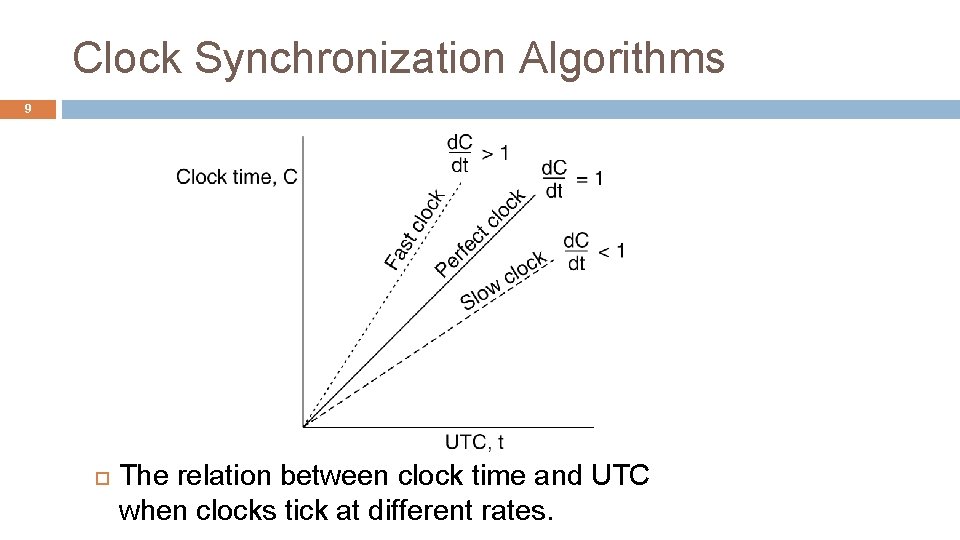
Clock Synchronization Algorithms 9 The relation between clock time and UTC when clocks tick at different rates.
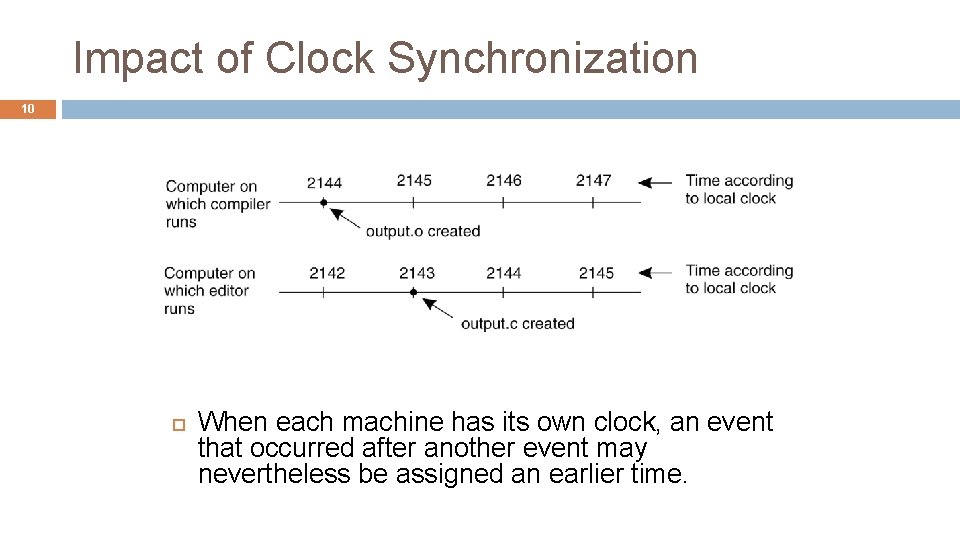
Impact of Clock Synchronization 10 When each machine has its own clock, an event that occurred after another event may nevertheless be assigned an earlier time.
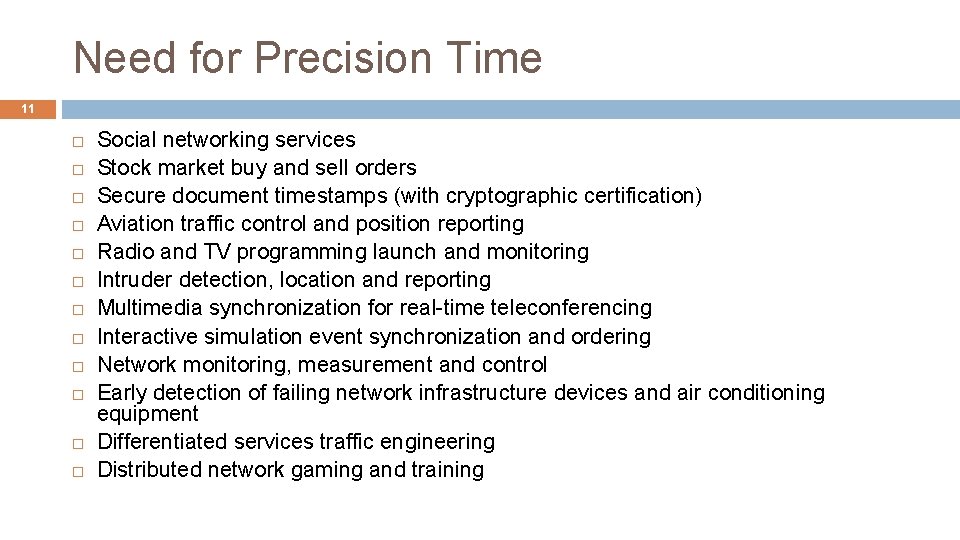
Need for Precision Time 11 Social networking services Stock market buy and sell orders Secure document timestamps (with cryptographic certification) Aviation traffic control and position reporting Radio and TV programming launch and monitoring Intruder detection, location and reporting Multimedia synchronization for real-time teleconferencing Interactive simulation event synchronization and ordering Network monitoring, measurement and control Early detection of failing network infrastructure devices and air conditioning equipment Differentiated services traffic engineering Distributed network gaming and training
Today Reading: CDK 5 chapter 14. 1 -4/ TV chapter 6. 1 -2 Understanding time in distributed systems Synchronizing physical clocks (real clocks) Logical Time/Lamport Clock
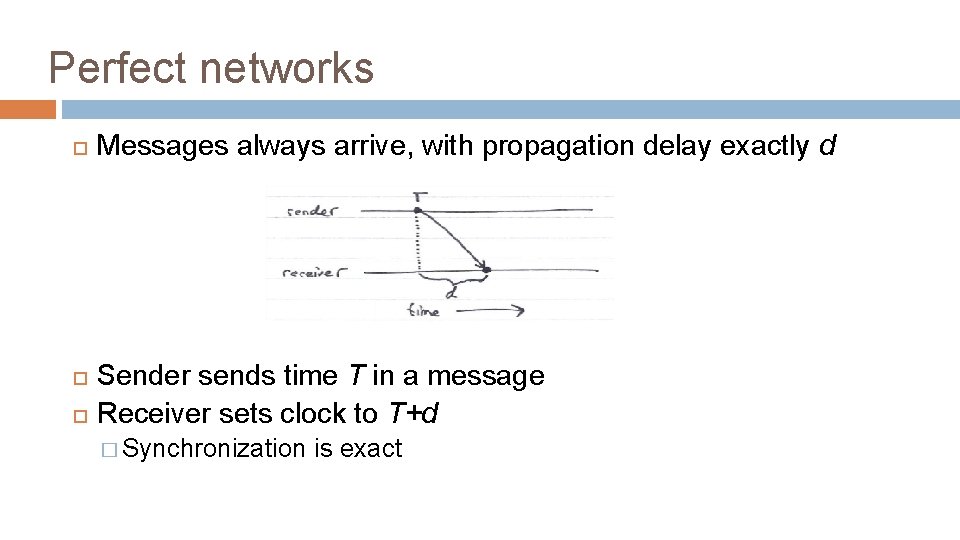
Perfect networks Messages always arrive, with propagation delay exactly d Sender sends time T in a message Receiver sets clock to T+d � Synchronization is exact
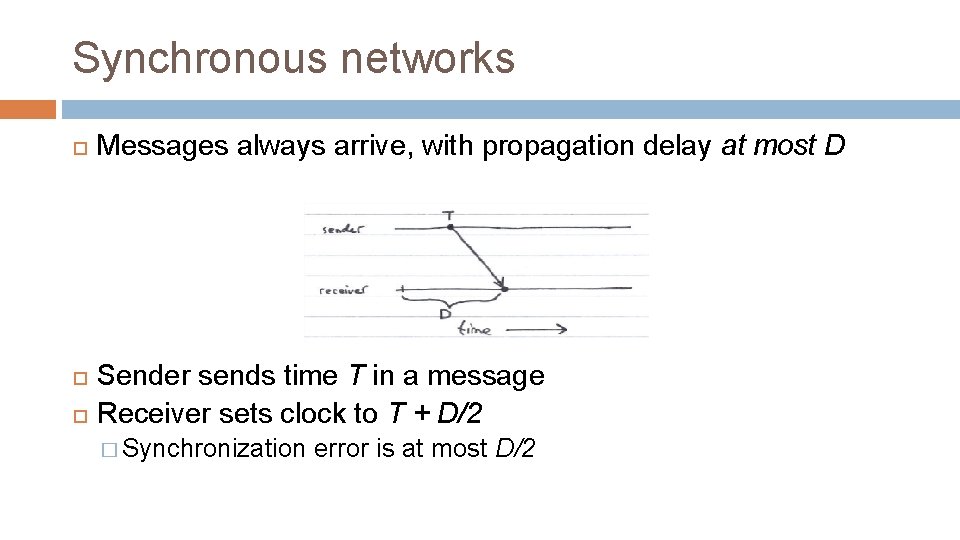
Synchronous networks Messages always arrive, with propagation delay at most D Sender sends time T in a message Receiver sets clock to T + D/2 � Synchronization error is at most D/2
Synchronization in the real world Real networks are asynchronous � Propagation delays are arbitrary Real networks are unreliable � Messages don’t always arrive
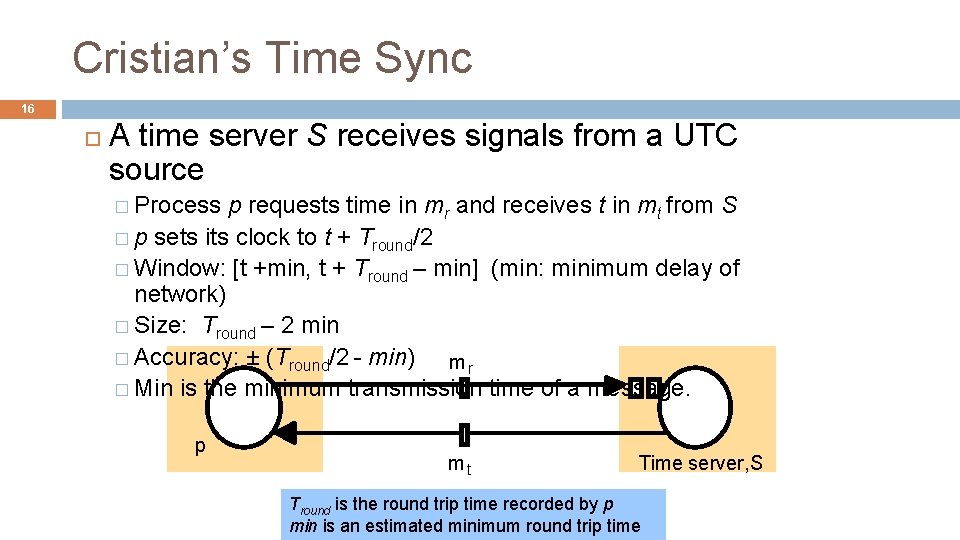
Cristian’s Time Sync 16 A time server S receives signals from a UTC source � Process p requests time in mr and receives t in mt from S � p sets its clock to t + Tround/2 � Window: [t +min, t + Tround – min] (min: minimum delay of network) � Size: Tround – 2 min � Accuracy: ± (Tround/2 - min) mr � Min is the minimum transmission time of a message. p mt Time server, S Tround is the round trip time recorded by p min is an estimated minimum round trip time
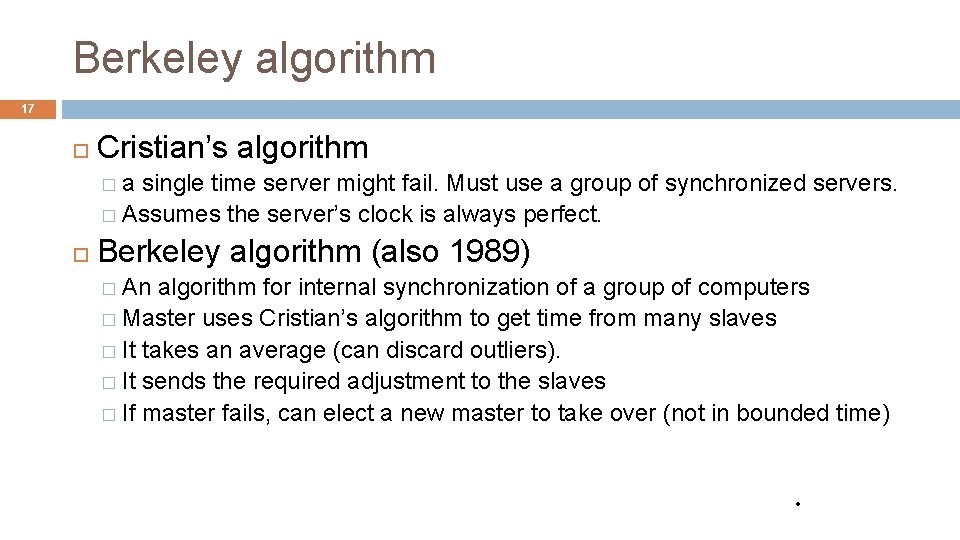
Berkeley algorithm 17 Cristian’s algorithm �a single time server might fail. Must use a group of synchronized servers. � Assumes the server’s clock is always perfect. Berkeley algorithm (also 1989) � An algorithm for internal synchronization of a group of computers � Master uses Cristian’s algorithm to get time from many slaves � It takes an average (can discard outliers). � It sends the required adjustment to the slaves � If master fails, can elect a new master to take over (not in bounded time) •
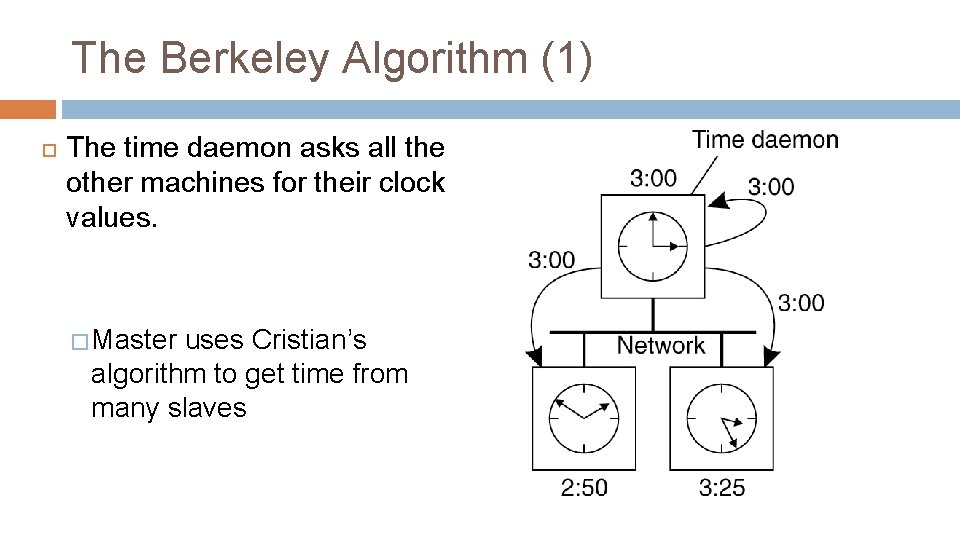
The Berkeley Algorithm (1) The time daemon asks all the other machines for their clock values. � Master uses Cristian’s algorithm to get time from many slaves
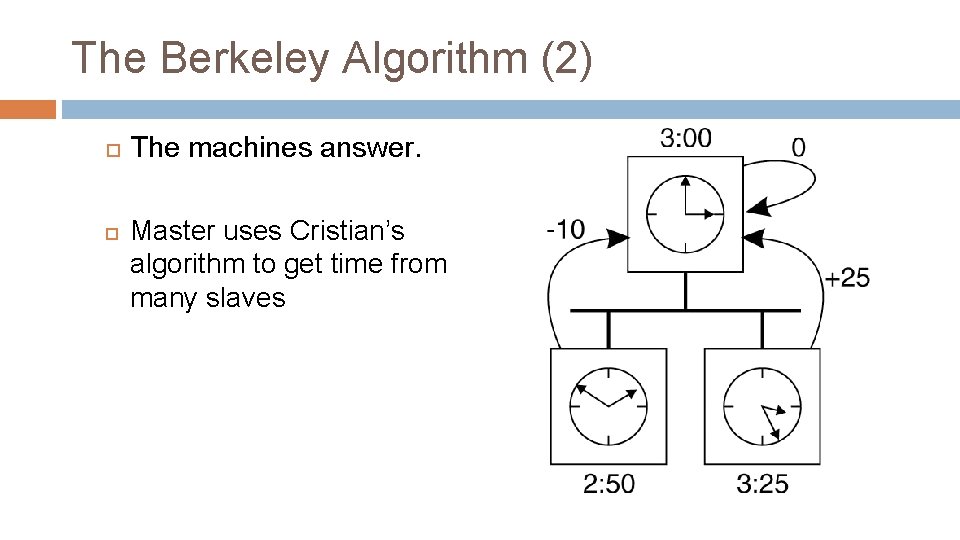
The Berkeley Algorithm (2) The machines answer. Master uses Cristian’s algorithm to get time from many slaves
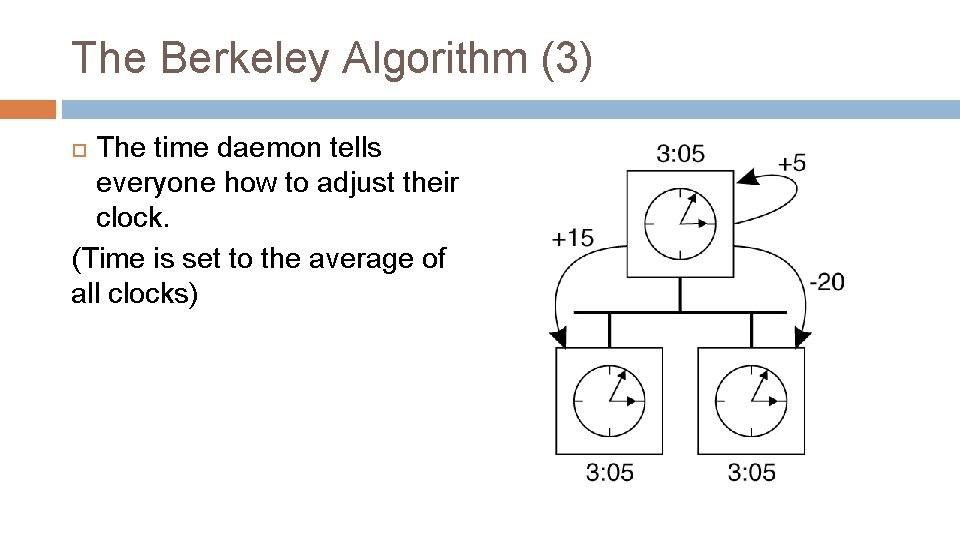
The Berkeley Algorithm (3) The time daemon tells everyone how to adjust their clock. (Time is set to the average of all clocks)
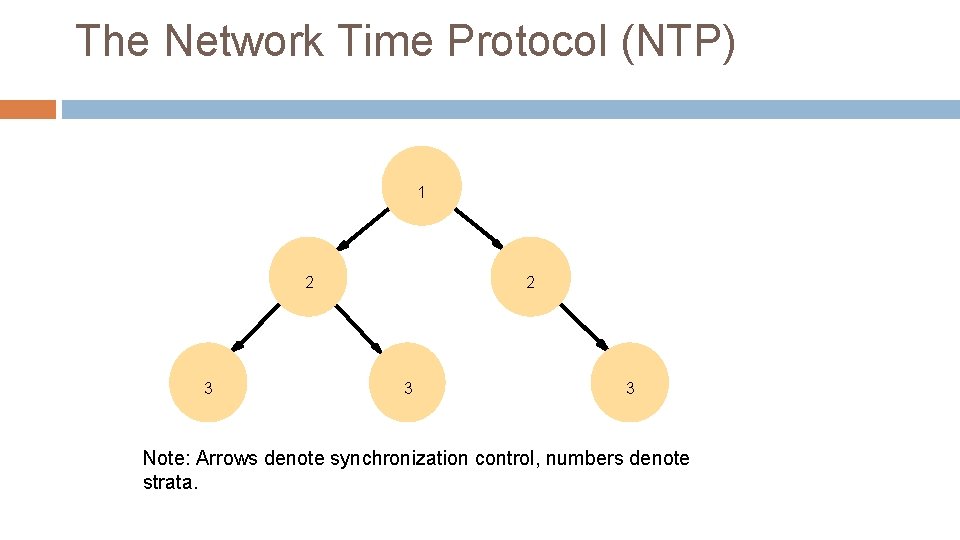
The Network Time Protocol (NTP) 1 2 3 3 Note: Arrows denote synchronization control, numbers denote strata.
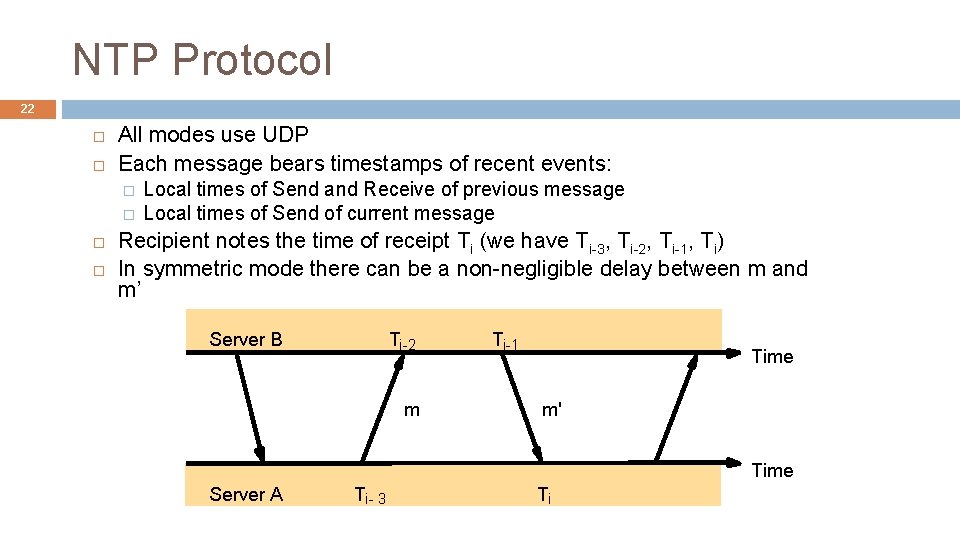
NTP Protocol 22 All modes use UDP Each message bears timestamps of recent events: � � Local times of Send and Receive of previous message Local times of Send of current message Recipient notes the time of receipt Ti (we have Ti-3, Ti-2, Ti-1, Ti) In symmetric mode there can be a non-negligible delay between m and m’ Server B Ti-2 m Ti-1 Time m' Time Server A Ti- 3 Ti
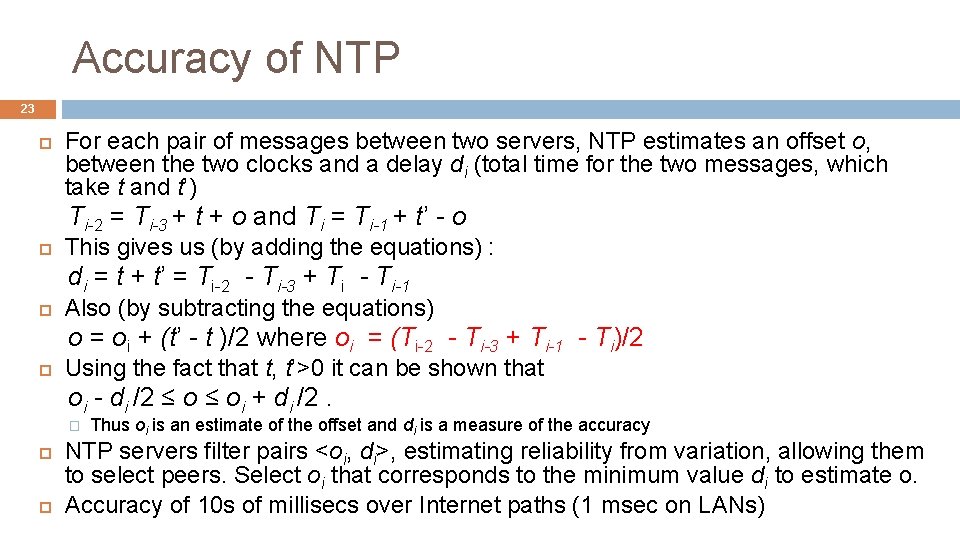
Accuracy of NTP 23 For each pair of messages between two servers, NTP estimates an offset o, between the two clocks and a delay di (total time for the two messages, which take t and t’) Ti-2 = Ti-3 + t + o and Ti = Ti-1 + t’ - o This gives us (by adding the equations) : di = t + t’ = Ti-2 - Ti-3 + Ti - Ti-1 Also (by subtracting the equations) o = oi + (t’ - t )/2 where oi = (Ti-2 - Ti-3 + Ti-1 - Ti)/2 Using the fact that t, t’>0 it can be shown that oi - di /2 ≤ oi + di /2. � Thus oi is an estimate of the offset and di is a measure of the accuracy NTP servers filter pairs <oi, di>, estimating reliability from variation, allowing them to select peers. Select oi that corresponds to the minimum value di to estimate o. Accuracy of 10 s of millisecs over Internet paths (1 msec on LANs)
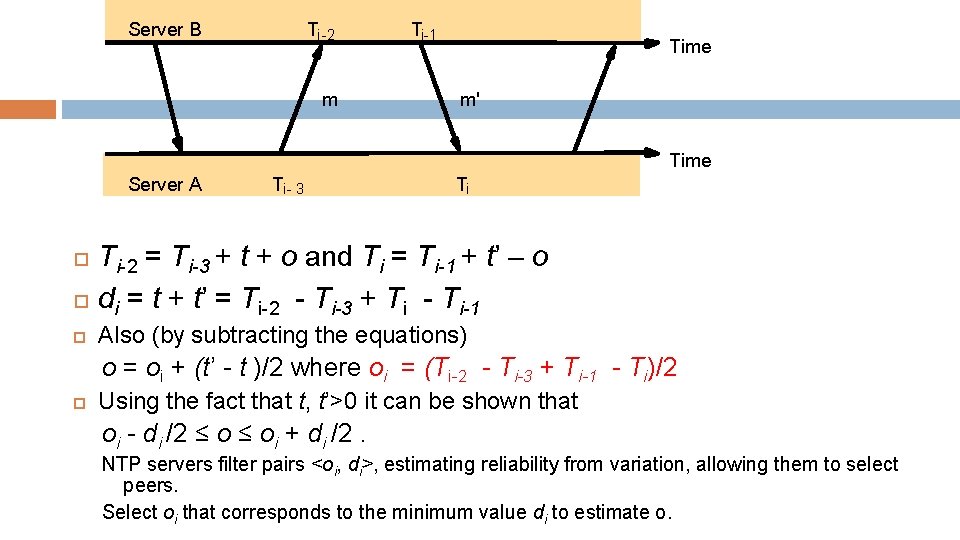
Server B Ti-2 m Ti-1 Time m' Time Server A Ti- 3 Ti Ti-2 = Ti-3 + t + o and Ti = Ti-1 + t’ – o di = t + t’ = Ti-2 - Ti-3 + Ti - Ti-1 Also (by subtracting the equations) o = oi + (t’ - t )/2 where oi = (Ti-2 - Ti-3 + Ti-1 - Ti)/2 Using the fact that t, t’>0 it can be shown that oi - di /2 ≤ oi + di /2. NTP servers filter pairs <oi, di>, estimating reliability from variation, allowing them to select peers. Select oi that corresponds to the minimum value di to estimate o.
How To Change Time 25 Can’t just change time � Why not? Change the update rate for the clock � Changes time in a more gradual fashion � Prevents inconsistent local timestamps
Summary Real synchronization is imperfect. Clocks never exactly synchronized. Often inadequate for distributed systems � might need totally-ordered events � might need millionth-of-a-second precision
Today Reading: CDK 5 chapter 14. 1 -4/ TV chapter 6. 1 -2 Understanding time in distributed systems Synchronizing physical clocks (real clocks) Logical Time/Lamport Clock
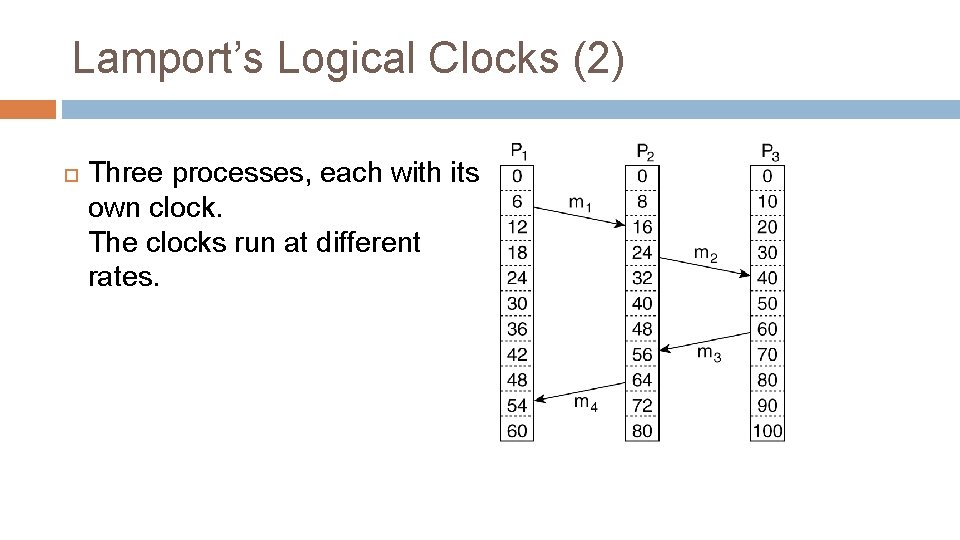
Lamport’s Logical Clocks (1) 28 The "happens-before" relation → can be observed directly in two situations: If a and b are events in the same process, and a occurs before b, then a → b is true. If a is the event of a message being sent by one process, and b is the event of the message being received by another process, then a→b
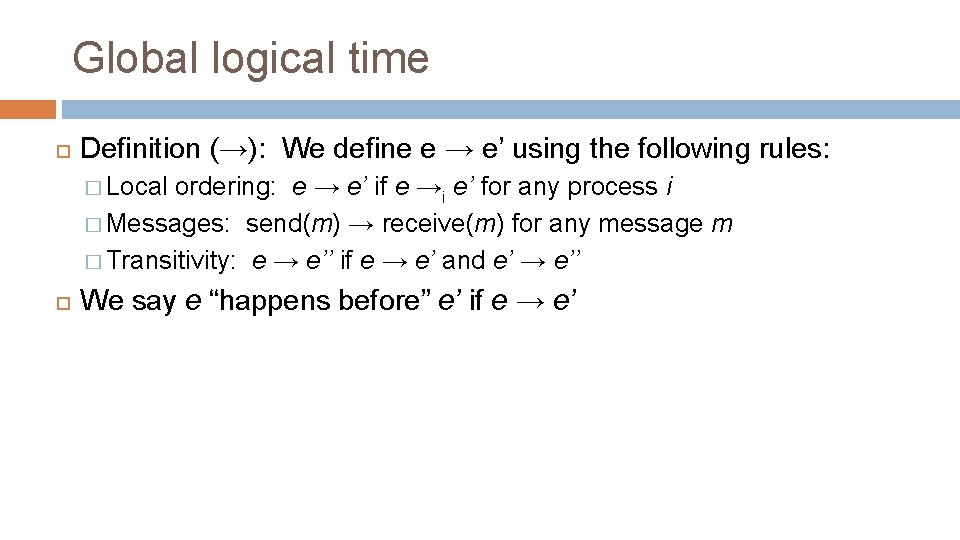
Global logical time Definition (→): We define e → e’ using the following rules: � Local ordering: e → e’ if e →i e’ for any process i � Messages: send(m) → receive(m) for any message m � Transitivity: e → e’’ if e → e’ and e’ → e’’ We say e “happens before” e’ if e → e’
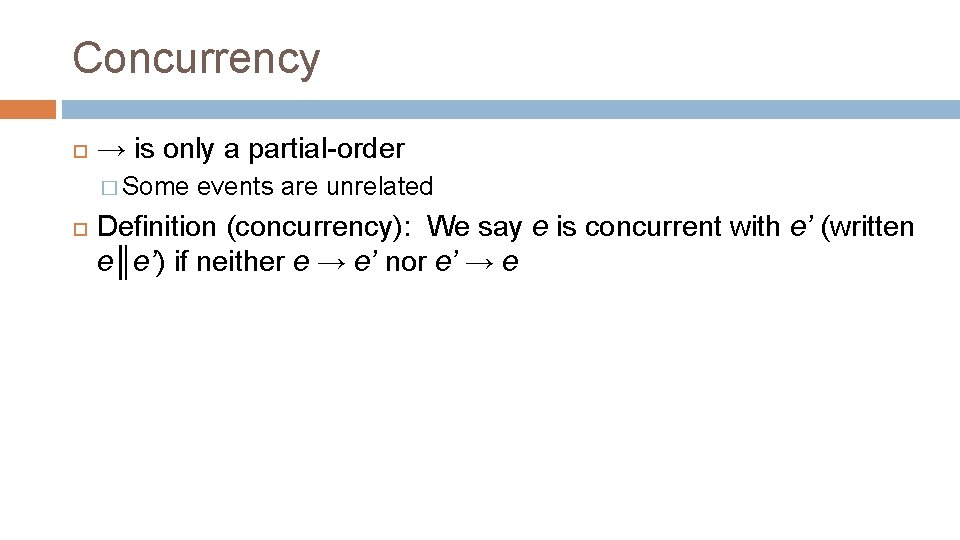
Concurrency → is only a partial-order � Some events are unrelated Definition (concurrency): We say e is concurrent with e’ (written e║e’) if neither e → e’ nor e’ → e
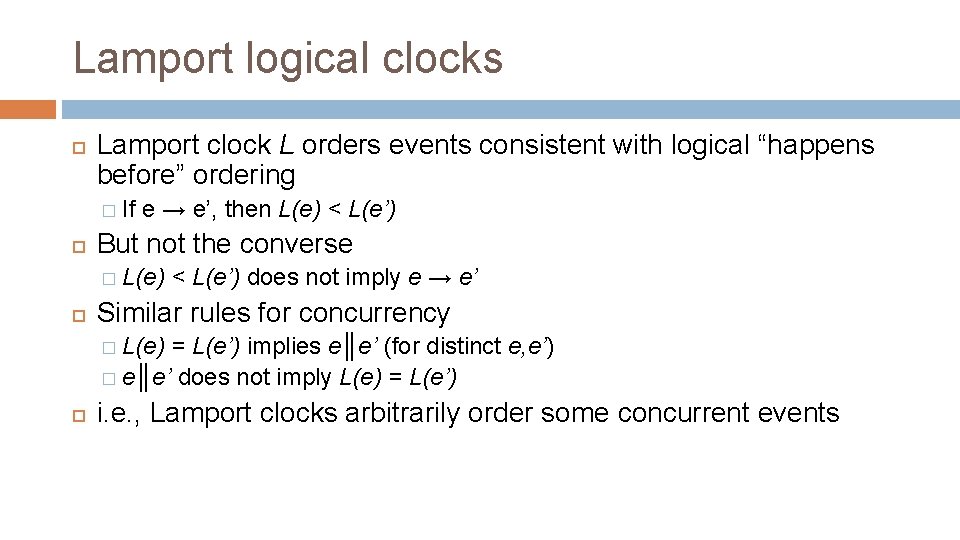
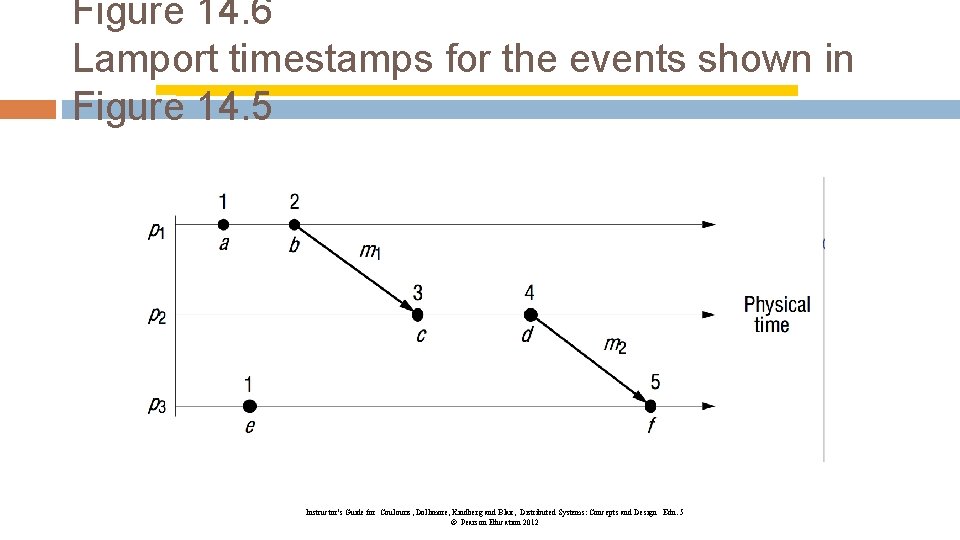
Lamport logical clocks Lamport clock L orders events consistent with logical “happens before” ordering � If e → e’, then L(e) < L(e’) But not the converse � L(e) < L(e’) does not imply e → e’ Similar rules for concurrency � L(e) = L(e’) implies e║e’ (for distinct e, e’) � e║e’ does not imply L(e) = L(e’) i. e. , Lamport clocks arbitrarily order some concurrent events
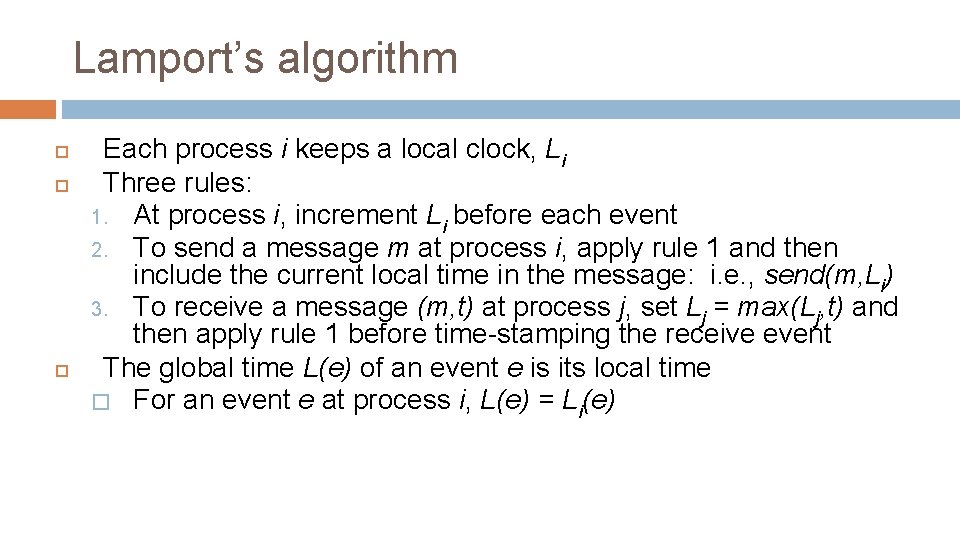
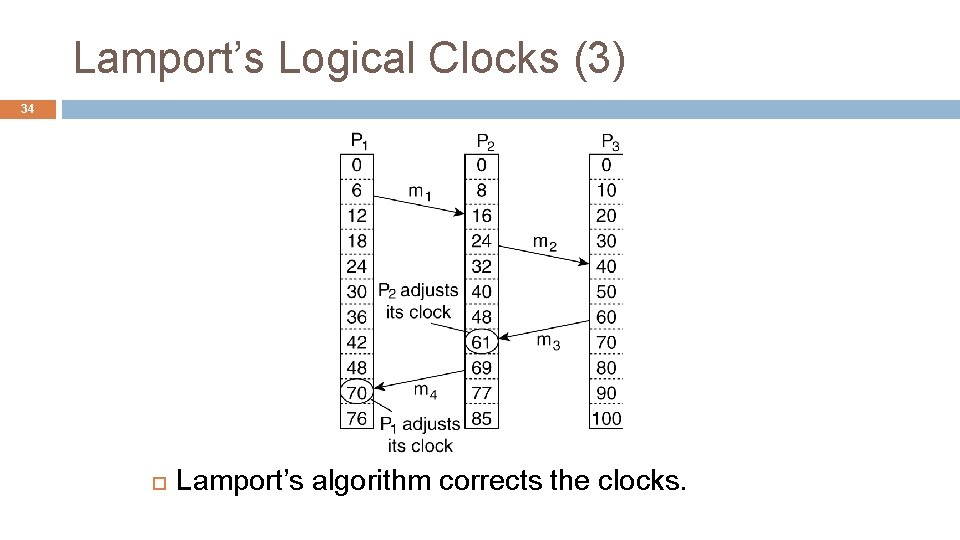
Lamport’s algorithm Each process i keeps a local clock, Li Three rules: 1. At process i, increment Li before each event 2. To send a message m at process i, apply rule 1 and then include the current local time in the message: i. e. , send(m, Li) 3. To receive a message (m, t) at process j, set Lj = max(Lj, t) and then apply rule 1 before time-stamping the receive event The global time L(e) of an event e is its local time � For an event e at process i, L(e) = Li(e)
Lamport’s Logical Clocks (2) Three processes, each with its own clock. The clocks run at different rates. 33
Lamport’s Logical Clocks (3) 34 Lamport’s algorithm corrects the clocks.
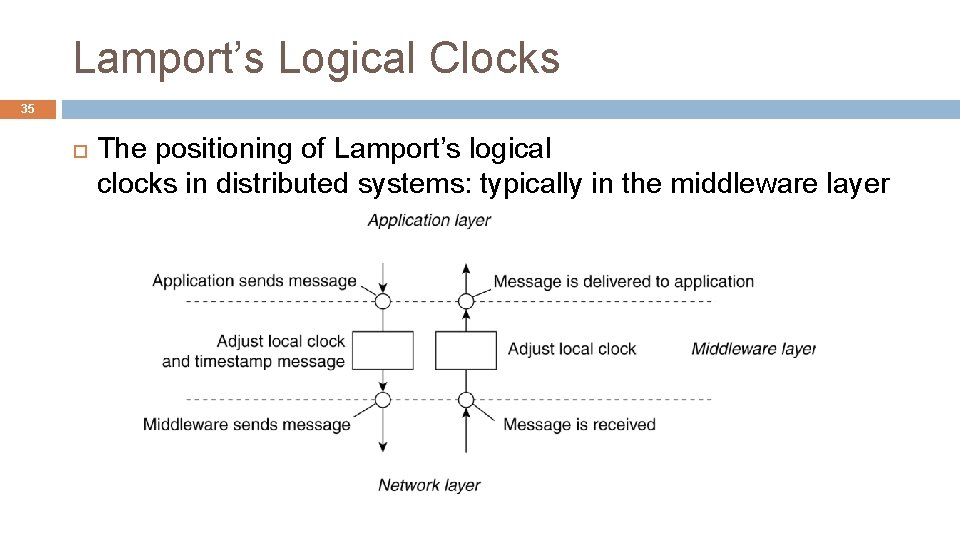
Lamport’s Logical Clocks 35 The positioning of Lamport’s logical clocks in distributed systems: typically in the middleware layer
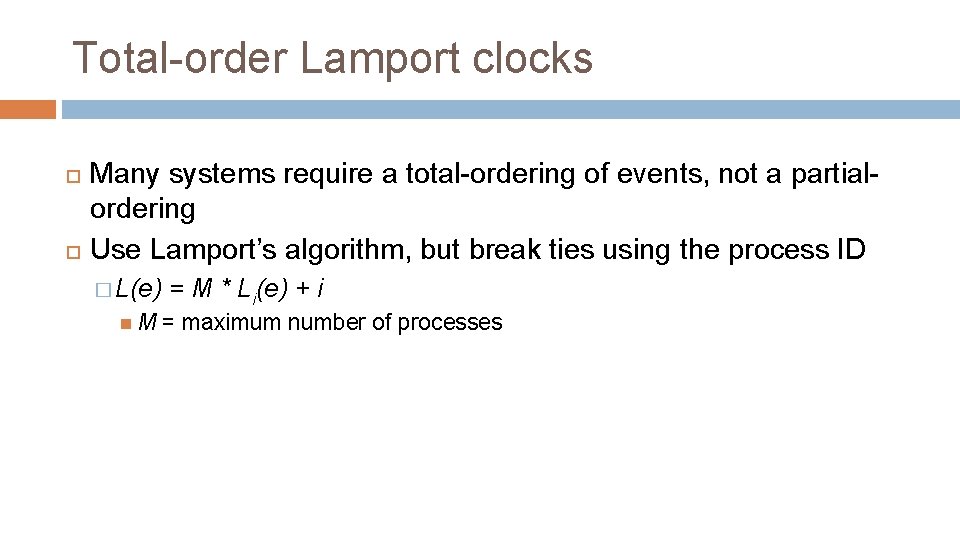
Total-order Lamport clocks Many systems require a total-ordering of events, not a partialordering Use Lamport’s algorithm, but break ties using the process ID � L(e) M = M * Li(e) + i = maximum number of processes
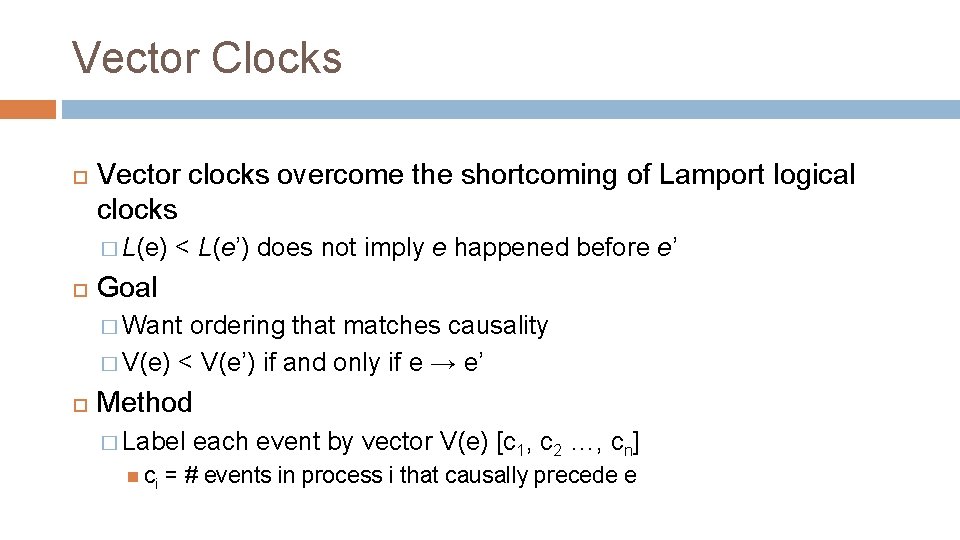
Vector Clocks Vector clocks overcome the shortcoming of Lamport logical clocks � L(e) < L(e’) does not imply e happened before e’ Goal � Want ordering that matches causality � V(e) < V(e’) if and only if e → e’ Method � Label ci each event by vector V(e) [c 1, c 2 …, cn] = # events in process i that causally precede e
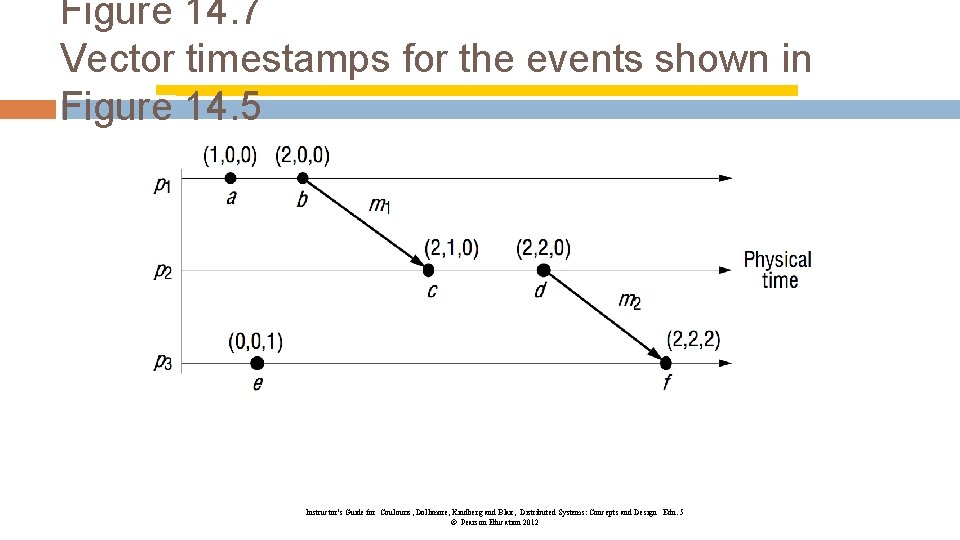
Vector Clock Algorithm Initially, all vectors [0, 0, …, 0] For event on process i, increment own ci Label message sent with local vector When process j receives message with vector [d 1, d 2, …, dn]: � Set local each local entry k to max(ck, dk) � Increment value of cj
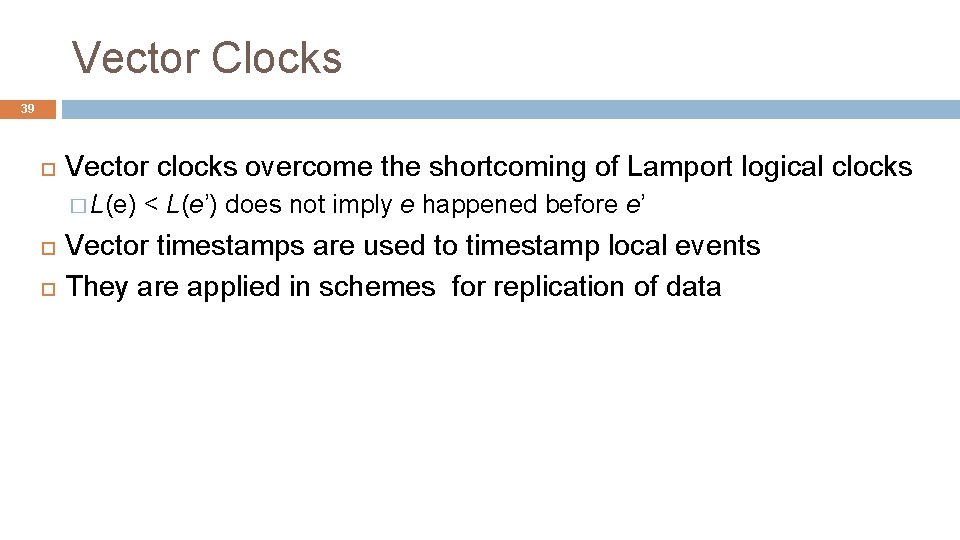
Vector Clocks 39 Vector clocks overcome the shortcoming of Lamport logical clocks � L(e) < L(e’) does not imply e happened before e’ Vector timestamps are used to timestamp local events They are applied in schemes for replication of data
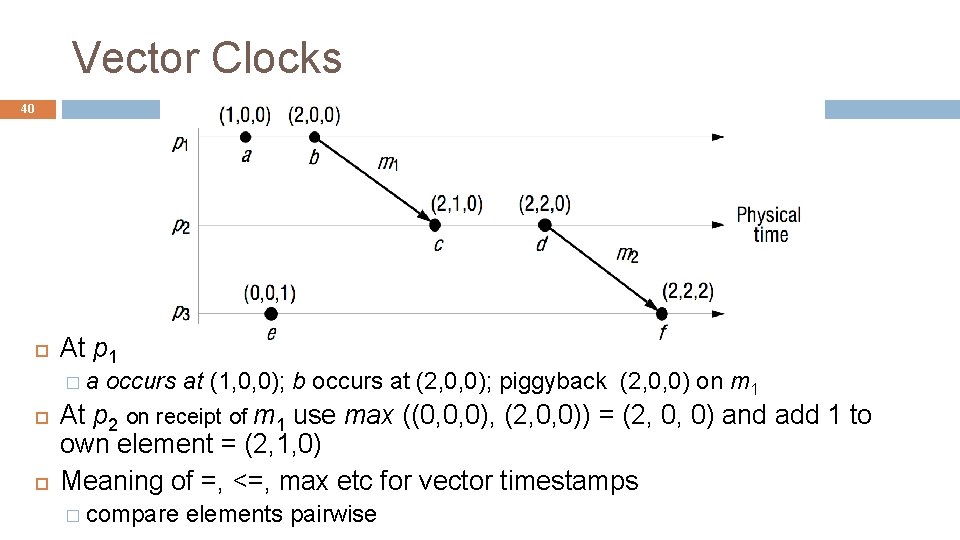
Vector Clocks 40 At p 1 �a occurs at (1, 0, 0); b occurs at (2, 0, 0); piggyback (2, 0, 0) on m 1 At p 2 on receipt of m 1 use max ((0, 0, 0), (2, 0, 0)) = (2, 0, 0) and add 1 to own element = (2, 1, 0) Meaning of =, <=, max etc for vector timestamps � compare elements pairwise
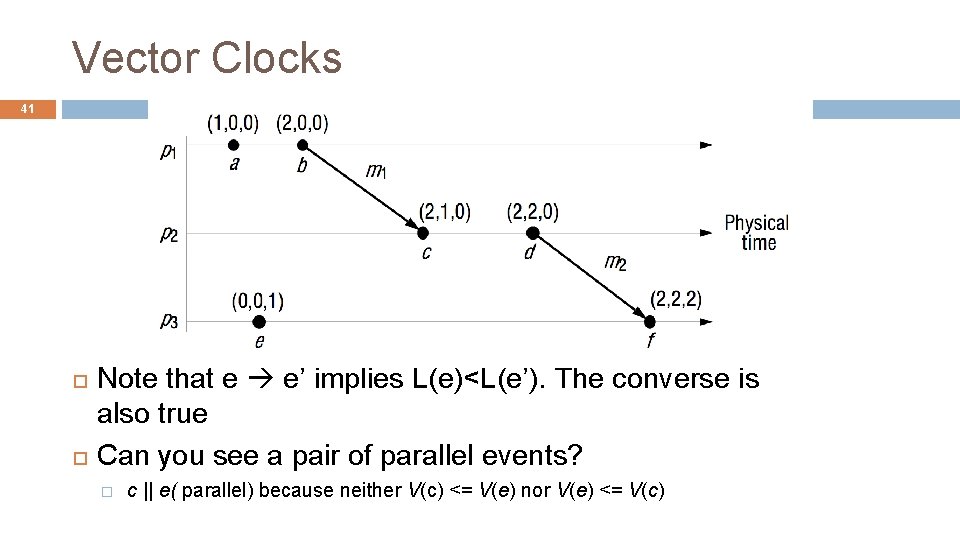
Vector Clocks 41 Note that e e’ implies L(e)<L(e’). The converse is also true Can you see a pair of parallel events? � c || e( parallel) because neither V(c) <= V(e) nor V(e) <= V(c)
Figure 14. 6 Lamport timestamps for the events shown in Figure 14. 5 Instructor’s Guide for Coulouris, Dollimore, Kindberg and Blair, Distributed Systems: Concepts and Design Edn. 5 © Pearson Education 2012
Figure 14. 7 Vector timestamps for the events shown in Figure 14. 5 Instructor’s Guide for Coulouris, Dollimore, Kindberg and Blair, Distributed Systems: Concepts and Design Edn. 5 © Pearson Education 2012
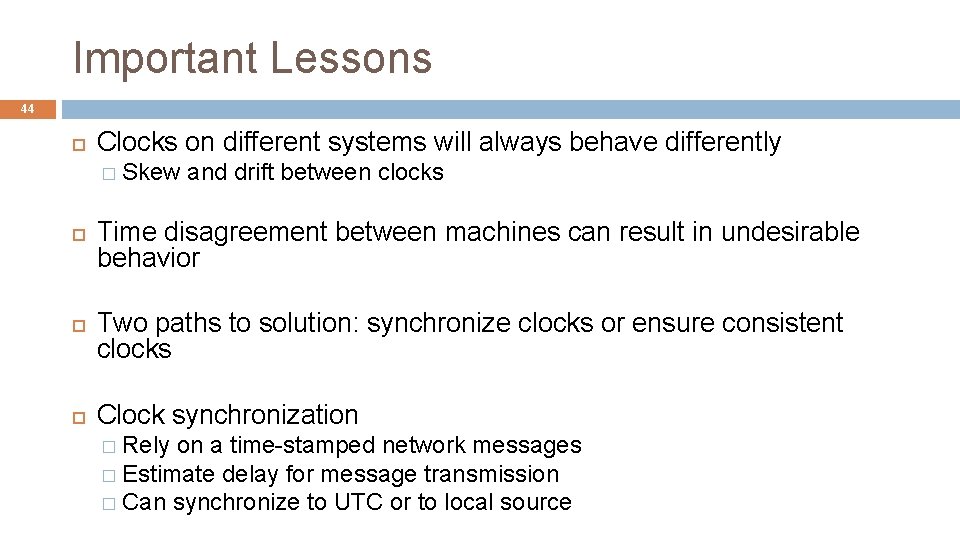
Important Lessons 44 Clocks on different systems will always behave differently � Skew and drift between clocks Time disagreement between machines can result in undesirable behavior Two paths to solution: synchronize clocks or ensure consistent clocks Clock synchronization � Rely on a time-stamped network messages � Estimate delay for message transmission � Can synchronize to UTC or to local source
Quiz Midterm.