
Physical and Cognitive Development in Middle Adulthood Kuther

- Slides: 47
Physical and Cognitive Development in Middle Adulthood Kuther, Lifespan Development. © 2017, SAGE Publications. 2
Dr. Kuther's Chalk Talks: Part VII Kuther, Lifespan Development. © 2017, SAGE Publications. 3
Sensory Changes in Middle Adulthood • Most adults notice changes in vision during their 40 s and changes in hearing at around age 50. • The use of corrective lenses aids vision problems. • Hearing aids amplify sounds, permitting better hearing. Kuther, Lifespan Development. © 2017, SAGE Publications. 4
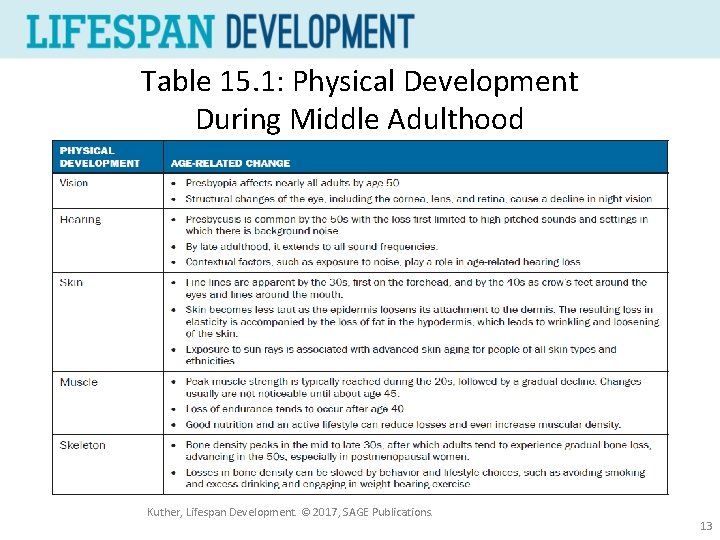
Vision • The cornea flattens. • The lens loses flexibility. • The muscle that permits the lens to change shape weakens. • All these changes result in presbyopia, also known as farsightedness. – The inability to focus the lens on close objects (such as in reading small print) Kuther, Lifespan Development. © 2017, SAGE Publications. 5
Other Vision Problems in Middle Adulthood • The ability to see in dim light declines because, with age, the lens yellows, the size of the pupil shrinks, and over middle age, most adults have lost about one half of the rods in the retina. – These changes reduces the ability to see in dim light and makes adults’ night vision decline twice as fast as their day vision. • Color discrimination becomes limited. • Night vision is reduced. Kuther, Lifespan Development. © 2017, SAGE Publications. 6
Hearing • Middle-aged adults tend to experience more difficulty hearing under conditions of background noise and perform more poorly under that condition. • Presbycusis (“old hearing”) – Age-related hearing loss becomes apparent in the 50 s. – The loss is first limited to high-pitched sounds. – By late adulthood, hearing loss extends to all sound frequencies. Kuther, Lifespan Development. © 2017, SAGE Publications. 7
Contextual Factors in Age. Related Hearing Loss • Many middle-aged adults display hearing loss that is preventable. – Noise in the workplace, at concerts, and through the use of headphones. – Men’s hearing declines more rapidly than women’s. Kuther, Lifespan Development. © 2017, SAGE Publications. 8
Changes in Skin During Middle Adulthood • Age-related changes in the skin are predictable and unavoidable. – During middle adulthood the skin becomes less taut as the epidermis (the outer layer of the skin that produces new skin cells) loosens its attachment to the thinning dermis (the middle layer of skin consisting of connective tissue that gives skin its flexibility). – The resulting loss in elasticity is accompanied by the loss of fat in the hypodermis (the innermost layer of skin composed of fat) which leads to wrinkling and loosening of the skin. Kuther, Lifespan Development. © 2017, SAGE Publications. 9
Factors Associated With Age. Related Changes in Skin • Gender – Women tend to experience age-related changes sooner and more quickly than do men as their dermis is thinner and they experience hormonal changes that exacerbate aging. • Time outdoors/exposure to the sun • Smoking Kuther, Lifespan Development. © 2017, SAGE Publications. 10
Changes in Muscles During Middle Adulthood • Changes in muscle strength usually go unnoticed until the mid to late 40’s. • The rate of decline in muscle mass and strength tends to accelerate in the 40’s. – By age 60, about 10% to 15% of maximum strength is lost. • Isometric strength tends to be retained. Kuther, Lifespan Development. © 2017, SAGE Publications. 11
Skeletal Changes in Middle Adulthood • Bone density reaches its height in the mid- to late 30’s, after which adults tend to experience gradual bone loss. • Bones become thinner, more porous, and more brittle as calcium is absorbed. • Bone loss increases in the 50’s, especially in women. • As the bones in the spinal column become thin and more brittle, the disks collapse and adults lose height (about an inch or more by age 60, and more thereafter). Kuther, Lifespan Development. © 2017, SAGE Publications. 12
Table 15. 1: Physical Development During Middle Adulthood Kuther, Lifespan Development. © 2017, SAGE Publications. 13
Menopause • The cessation of ovulation and menstruation. • Occurs at about 51 years of age on average (range in ages 42 to 58). • The timing of menopause is influenced by: – Heredity – Lifestyle choices and contextual influences • A woman is said to have reached menopause one year after her last menstrual period. Kuther, Lifespan Development. © 2017, SAGE Publications. 14
Perimenopause • The transition to menopause, extending from three years before and after menopause. • The production of reproductive hormones declines and symptoms associated with menopause first appear. – – – Shorter menstrual cycle Erratic periods Ovulation becomes less predictable Hot flashes Reduced sexual arousal and vaginal lubrication Kuther, Lifespan Development. © 2017, SAGE Publications. 15
Reproductive Changes in Men • Men’s reproductive ability declines gradually and steadily over the adult years. • Men’s bodies produce less testosterone and they become less fertile (however, about 75% of men retain testosterone levels in the normal range). • Men can father children into their 80’s. Kuther, Lifespan Development. © 2017, SAGE Publications. 16
Testosterone Deficiency • Occurs in about 6% to 10% of men. • Normative declines in testosterone are gradual, and connections between testosterone levels and health-related outcomes are weak. Kuther, Lifespan Development. © 2017, SAGE Publications. 17
Health in Middle Adulthood • Cancer is the leading cause of death in middle adulthood, followed by cardiovascular disease and accidents. • Nearly all studies of health in adulthood were conducted on men, particularly Caucasian men. – Women and minorities are underrepresented in research on prevention and treatment of illness. Kuther, Lifespan Development. © 2017, SAGE Publications. 18
Cancer • Rates of cancer have declined 20% since the mid-1990 s. • Cancer is responsible for about one third of deaths between the ages of 45 and 64. – 15% of adults between the ages of 45 and 65 will develop cancer. • Men tend to be diagnosed with cancer at a higher rate than women. Kuther, Lifespan Development. © 2017, SAGE Publications. 19
Risk Factors for Cancer • Genetics • Environmental risk factors: – Heavy alcohol use – Overweight – Use of oral contraceptives – Exposure to toxins – Low socioeconomic status Kuther, Lifespan Development. © 2017, SAGE Publications. 20
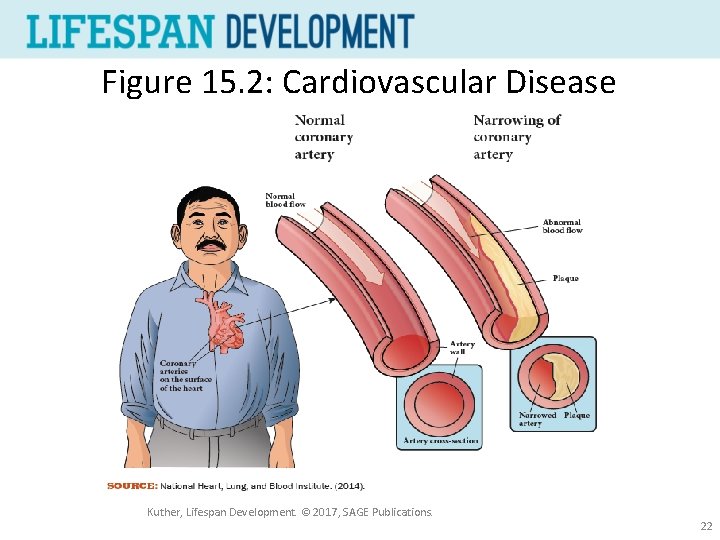
Cardiovascular Disease • Cardiovascular disease is responsible for over one quarter of deaths of middle-aged Americans each year. • Markers of cardiovascular disease include: – High blood pressure – High blood cholesterol – Plaque buildup in the arteries – Irregular heartbeat – Heart attack Kuther, Lifespan Development. © 2017, SAGE Publications. 21
Figure 15. 2: Cardiovascular Disease Kuther, Lifespan Development. © 2017, SAGE Publications. 22
Risk Factors for Cardiovascular Disease • • • Heredity Age A diet heavy in saturated and trans fatty acids Smoking Hypertension – By 2030, 40. 5% of the U. S. population is projected to have some form of cardiovascular disease. Kuther, Lifespan Development. © 2017, SAGE Publications. 23
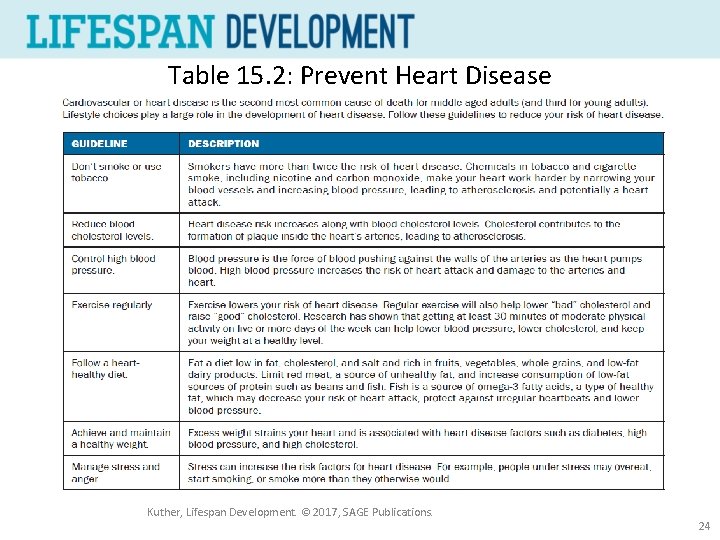
Table 15. 2: Prevent Heart Disease Kuther, Lifespan Development. © 2017, SAGE Publications. 24
Osteoporosis • A disorder entailing severe bone loss that leads to brittle and easily fractured bones. • About half of U. S. adults are affected by osteoporosis or low bone mass. • Declines in estrogen cause postmenopausal women to lose about 25% of their bone mass in the first ten years after menopause, increasing to about 50% by late adulthood. Kuther, Lifespan Development. © 2017, SAGE Publications. 25
Risk Factors for Osteoporosis • Gender (women are at greater risk) • Heredity – At least 15 genes contribute to osteoporosis susceptibility. • Lifestyle – Sedentary lifestyle – Calcium deficiency – Cigarette smoking – Heavy alcohol consumption Kuther, Lifespan Development. © 2017, SAGE Publications. 26
Preventing Osteoporosis • Consume a diet rich in calcium and vitamin D. • Engage in regular exercise from childhood through adulthood. • Avoid smoking and heavy drinking. Kuther, Lifespan Development. © 2017, SAGE Publications. 27
Wellness • Stress increases in middle-aged adults – “Sandwich generation” = middle-aged adults are pressed to meet not only the multiple demands of career and family but often the demands of caring for two generations (their children and their elderly parents). – Stress management is an important way of reducing the negative mental and physical health effects of stress. – Exercise promotes health and wellness and reduces stress. Kuther, Lifespan Development. © 2017, SAGE Publications. 28
VIDEO CASE Dealing With a Parent’s Death An important stressor that many midlife adults experience is caring for an elderly parent and the changes that come with the loss of parents. Kuther, Lifespan Development. © 2017, SAGE Publications. 29
Hardiness • Adults who are better able than others to adapt to the physical changes of midlife and the stress wrought by the changes in lifestyle that accompany midlife transitions. • Individuals who display hardiness tend to have a high sense of self-efficacy. Kuther, Lifespan Development. © 2017, SAGE Publications. 30
Fluid and Crystallized Intelligence • Crystallized intelligence – The accumulation of facts and information. • Fluid intelligence – A person’s underlying capacity to make connections among ideas and draw inferences. – Permits flexible, creative, and quick thought (improved problem-solving). – Information processing abilities influence fluid intelligence. Kuther, Lifespan Development. © 2017, SAGE Publications. 31
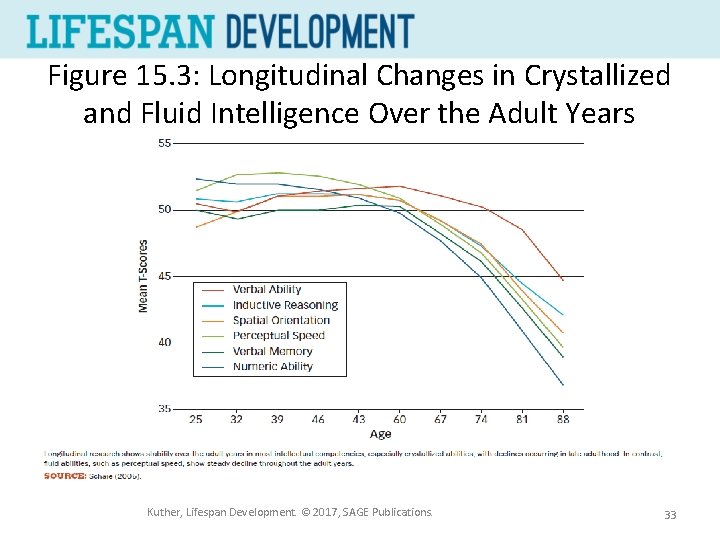
Intellectual Change Over the Adult Years • Cross-sectional studies showed clear age differences in IQ scores whereby intelligence peaked in early adulthood, declined through middle adulthood, and dropped steeply in late adulthood. • Longitudinal studies show that intelligence scores increased into middle adulthood. Kuther, Lifespan Development. © 2017, SAGE Publications. 32
Figure 15. 3: Longitudinal Changes in Crystallized and Fluid Intelligence Over the Adult Years Kuther, Lifespan Development. © 2017, SAGE Publications. 33
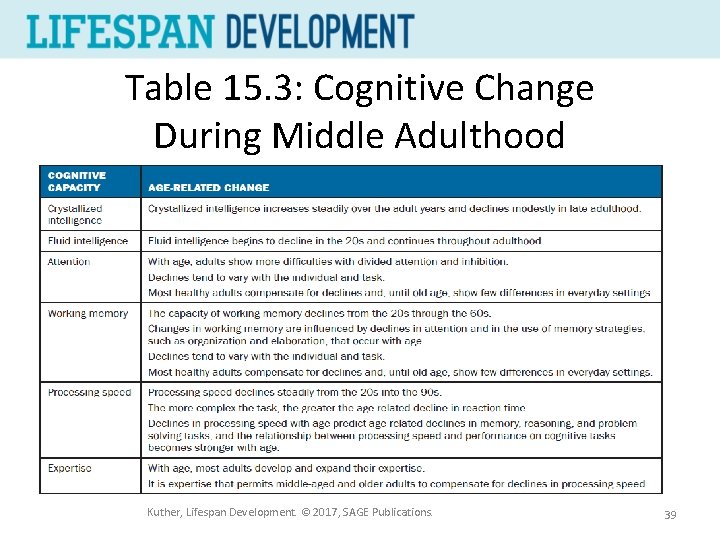
Changes in Crystallized and Fluid Intelligence • The components of crystallized intelligence, such as verbal ability and inductive reasoning, remain stable and even increase into middle adulthood. • Fluid intelligence, such as perceptual speed and spatial orientation, decreases beginning in the 20 s, suggesting that cognitive processing slows, somewhat, with age. Kuther, Lifespan Development. © 2017, SAGE Publications. 34
Attention • Attention involves: – How much information a person can attend to at once. – The ability to divide attention and change focus from one task to another in response to situational demands. – The ability to selectively attend and ignore distracters and irrelevant stimuli. • Age-related declines in attention are not uniform across adults and these differences predict variations in cognitive performance. Kuther, Lifespan Development. © 2017, SAGE Publications. 35
Inhibition • The ability to resist interference from irrelevant information to stay focused on the task at hand. • Inhibition becomes more difficult over the adult years. Kuther, Lifespan Development. © 2017, SAGE Publications. 36
Memory • Memory changes substantially over the adult years. • The capacity of working memory declines from the 20’s through the 60’s and is related to changes in attention. • With age, adults are less likely to apply the memory strategies of organization and elaboration. Kuther, Lifespan Development. © 2017, SAGE Publications. 37
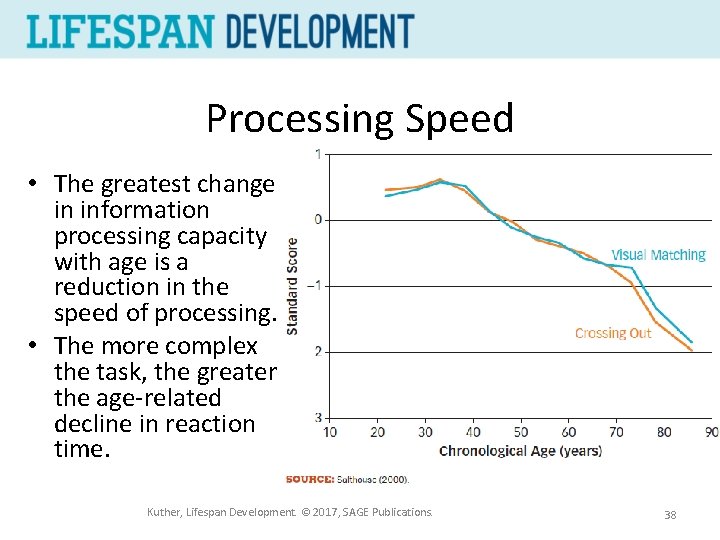
Processing Speed • The greatest change in information processing capacity with age is a reduction in the speed of processing. • The more complex the task, the greater the age-related decline in reaction time. Kuther, Lifespan Development. © 2017, SAGE Publications. 38
Table 15. 3: Cognitive Change During Middle Adulthood Kuther, Lifespan Development. © 2017, SAGE Publications. 39
Expertise • Defined as an elaborate and integrated knowledge base that underlies extraordinary proficiency in a given task and that supports gains in practical problem solving. • With age, most adults develop and expand their expertise. • Peaks in middle adulthood. • Expertise permits selective optimization with compensation. Kuther, Lifespan Development. © 2017, SAGE Publications. 40
Selective Optimization With Compensation • The ability to adapt to changes over time, optimize current functioning, and compensate for losses in order to preserve performance despite declines in fluid abilities. Kuther, Lifespan Development. © 2017, SAGE Publications. 41
Learning • In middle adulthood, career settings are important contexts for learning • A growing number of midlife adults seek formal opportunities to enhance their learning – Many employers and professional associations strongly encourage and often require that adults obtain continuing education to stay current in their fields – 42% of students enrolled in American colleges and universities are adults aged 25 and up Kuther, Lifespan Development. © 2017, SAGE Publications. 42
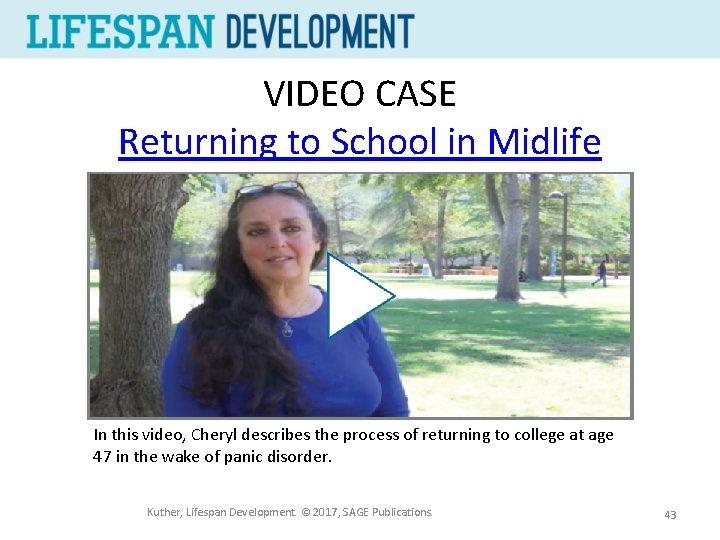
VIDEO CASE Returning to School in Midlife In this video, Cheryl describes the process of returning to college at age 47 in the wake of panic disorder. Kuther, Lifespan Development. © 2017, SAGE Publications. 43
Adults Who Enroll in Higher Education • The reasons for enrolling include: – Change careers – Improve career opportunities – Increase income – Gain personal enrichment – Life transitions (divorce, unemployment, widowhood, or children entering school) • Over two thirds of adult learners are female Kuther, Lifespan Development. © 2017, SAGE Publications. 44
Adult Learners • Approach learning differently than traditional-age students and have unique needs: – They enter learning environments with a wealth of experience on which to build. – They tend to be problem-oriented in that they typically want to know why they should learn something and how it is relevant to solving problems in their jobs and personal lives. – They tend to show more intrinsic motivation for obtaining a college education. Kuther, Lifespan Development. © 2017, SAGE Publications. 45
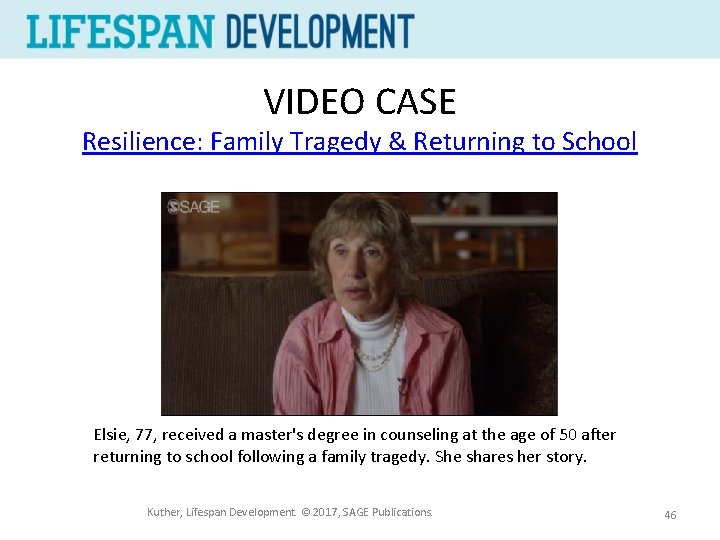
VIDEO CASE Resilience: Family Tragedy & Returning to School Elsie, 77, received a master's degree in counseling at the age of 50 after returning to school following a family tragedy. She shares her story. Kuther, Lifespan Development. © 2017, SAGE Publications. 46
Supporting Adult Learners • Support from family and friends, including emotional support. • Colleges and universities can: – Broaden the availability of classes to evenings, weekends, and online. – Provide financial aid for part time students. – Provide opportunities to develop relationships with faculty. – Provide grants opportunities and financial rewards. Kuther, Lifespan Development. © 2017, SAGE Publications. 47