
Physical and Chemical Changes Physical Change 1 The
- Slides: 9
Physical and Chemical Changes
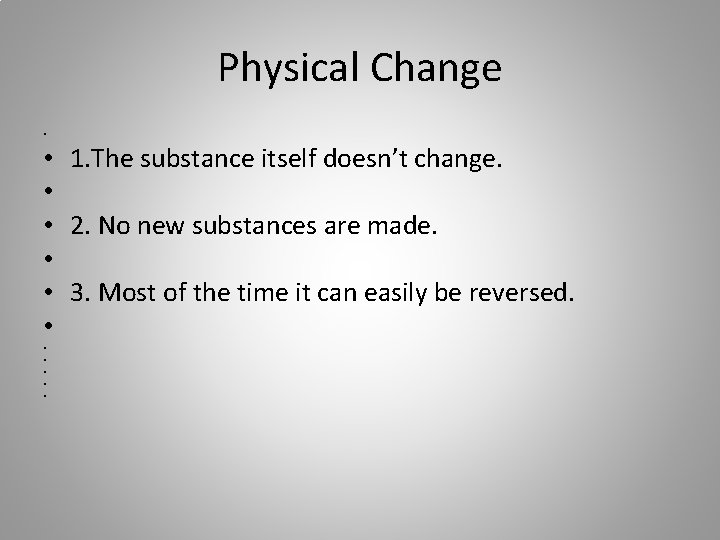
Physical Change • • 1. The substance itself doesn’t change. • • 2. No new substances are made. • • 3. Most of the time it can easily be reversed. • • •
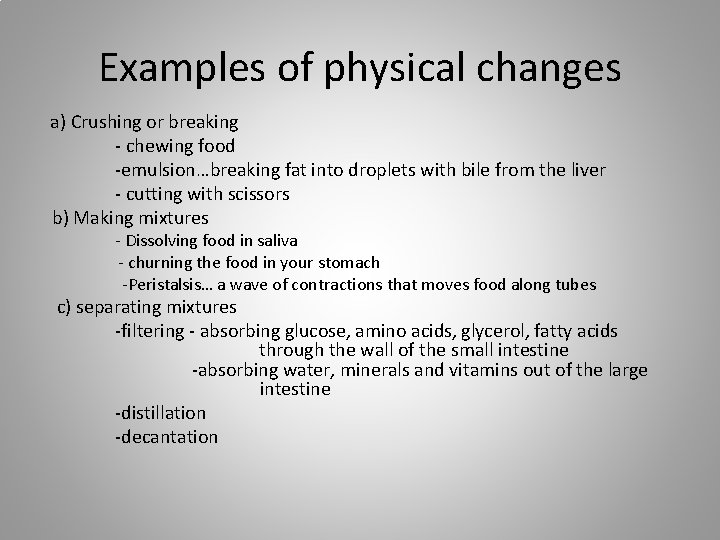
Examples of physical changes a) Crushing or breaking - chewing food -emulsion…breaking fat into droplets with bile from the liver - cutting with scissors b) Making mixtures - Dissolving food in saliva - churning the food in your stomach -Peristalsis… a wave of contractions that moves food along tubes c) separating mixtures -filtering - absorbing glucose, amino acids, glycerol, fatty acids through the wall of the small intestine -absorbing water, minerals and vitamins out of the large intestine -distillation -decantation
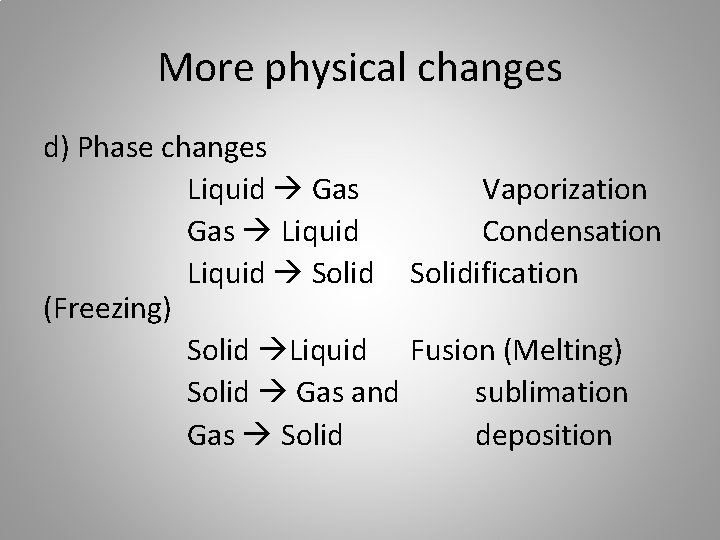
More physical changes d) Phase changes Liquid Gas Vaporization Gas Liquid Condensation Liquid Solidification (Freezing) Solid Liquid Fusion (Melting) Solid Gas and sublimation Gas Solid deposition
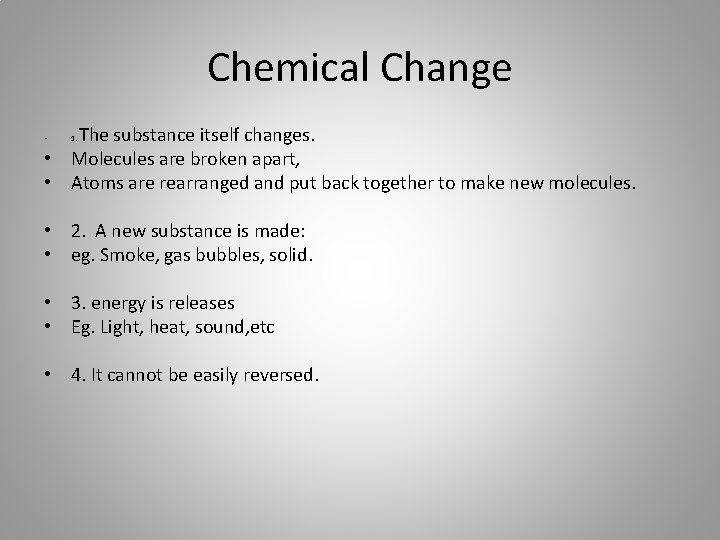
Chemical Change The substance itself changes. • Molecules are broken apart, • Atoms are rearranged and put back together to make new molecules. • 1. • 2. A new substance is made: • eg. Smoke, gas bubbles, solid. • 3. energy is releases • Eg. Light, heat, sound, etc • 4. It cannot be easily reversed.
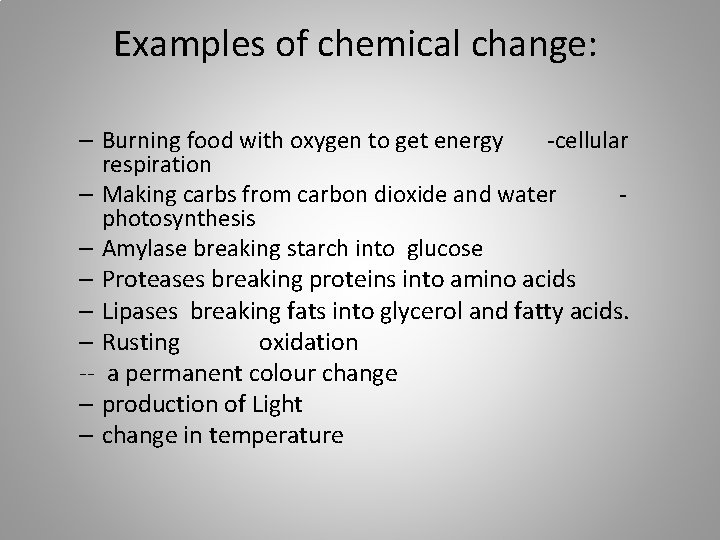
Examples of chemical change: – Burning food with oxygen to get energy -cellular respiration – Making carbs from carbon dioxide and water photosynthesis – Amylase breaking starch into glucose – Proteases breaking proteins into amino acids – Lipases breaking fats into glycerol and fatty acids. – Rusting oxidation -- a permanent colour change – production of Light – change in temperature
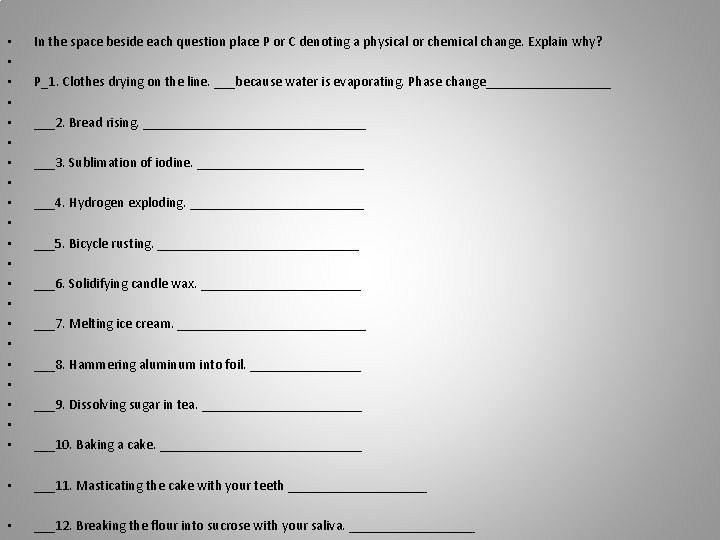
• • • • • • In the space beside each question place P or C denoting a physical or chemical change. Explain why? • ___11. Masticating the cake with your teeth __________ • ___12. Breaking the flour into sucrose with your saliva. _________ P_1. Clothes drying on the line. ___because water is evaporating. Phase change_________ ___2. Bread rising. ________________ ___3. Sublimation of iodine. ____________ ___4. Hydrogen exploding. _____________ ___5. Bicycle rusting. _______________ ___6. Solidifying candle wax. ____________ ___7. Melting ice cream. ______________ ___8. Hammering aluminum into foil. ________ ___9. Dissolving sugar in tea. ____________ ___10. Baking a cake. _______________
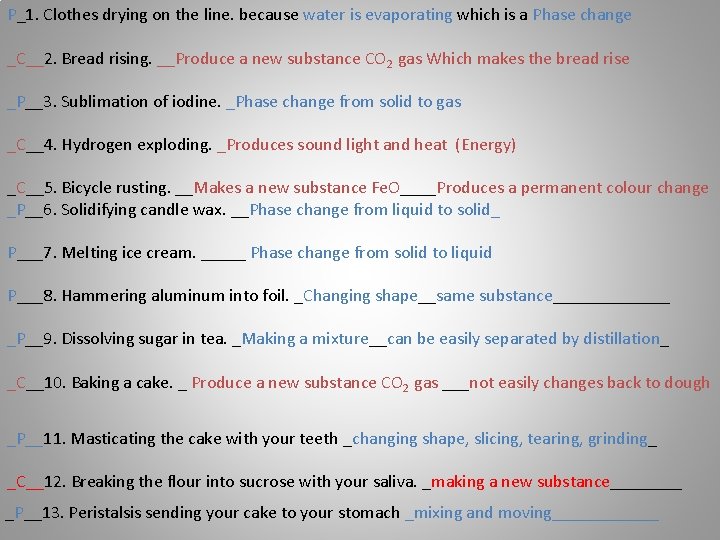
P_1. Clothes drying on the line. because water is evaporating which is a Phase change _C__2. Bread rising. __Produce a new substance CO 2 gas Which makes the bread rise _P__3. Sublimation of iodine. _Phase change from solid to gas _C__4. Hydrogen exploding. _Produces sound light and heat (Energy) _C__5. Bicycle rusting. __Makes a new substance Fe. O____Produces a permanent colour change _P__6. Solidifying candle wax. __Phase change from liquid to solid_ P___7. Melting ice cream. _____ Phase change from solid to liquid P___8. Hammering aluminum into foil. _Changing shape__same substance_______ _P__9. Dissolving sugar in tea. _Making a mixture__can be easily separated by distillation_ _C__10. Baking a cake. _ Produce a new substance CO 2 gas ___not easily changes back to dough _P__11. Masticating the cake with your teeth _changing shape, slicing, tearing, grinding_ _C__12. Breaking the flour into sucrose with your saliva. _making a new substance____ _P__13. Peristalsis sending your cake to your stomach _mixing and moving______
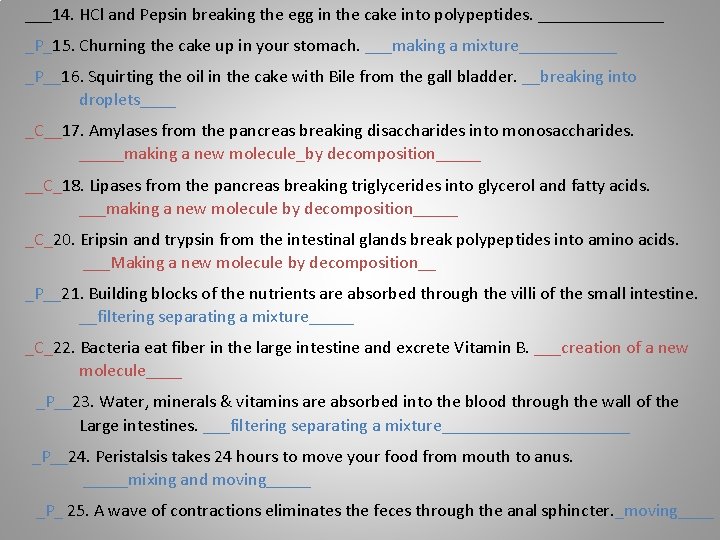
___14. HCl and Pepsin breaking the egg in the cake into polypeptides. _______ _P_15. Churning the cake up in your stomach. ___making a mixture______ _P__16. Squirting the oil in the cake with Bile from the gall bladder. __breaking into droplets____ _C__17. Amylases from the pancreas breaking disaccharides into monosaccharides. _____making a new molecule_by decomposition_____ __C_18. Lipases from the pancreas breaking triglycerides into glycerol and fatty acids. ___making a new molecule by decomposition_____ _C_20. Eripsin and trypsin from the intestinal glands break polypeptides into amino acids. ___Making a new molecule by decomposition__ _P__21. Building blocks of the nutrients are absorbed through the villi of the small intestine. __filtering separating a mixture_____ _C_22. Bacteria eat fiber in the large intestine and excrete Vitamin B. ___creation of a new molecule____ _P__23. Water, minerals & vitamins are absorbed into the blood through the wall of the Large intestines. ___filtering separating a mixture___________ _P__24. Peristalsis takes 24 hours to move your food from mouth to anus. _____mixing and moving_____ _P_ 25. A wave of contractions eliminates the feces through the anal sphincter. _moving____