
Physical activity for people with MSK conditions Benjamin

Physical activity for people with MSK conditions Benjamin Ellis Rheumatology Consultant 24 July 2019
Physical activity for MSK health Learning objectives By the end of this talk, participants will be able to: • Discuss the benefits of physical activity for people with musculoskeletal conditions • Use a framework to incorporate discussions about physical activity in clinical consultations • Describe a public health framework for providing physical activity for people with musculoskeletal conditions

Physical activity for MSK health Rising need and impact • Growing, ageing population: – 5. 9 m more by 2033/4 – ≥ 65 y growing 3 x faster than <65 y (4. 4 m more ≥ 65 y, 1. 5 m <65 y • Increasing obesity prevalence • Multimorbidity and frailty are the new norm • In 2016/17, 242, 629 joint replacements – 21, 000 more than 2015/16 • Rising biologics spend: >£ 803 m in 2015/16 Office for National Statistics (ONS), "Quarterly Labour Force Survey, July - September, 2017, " UK Data Service, 2017.
Physical activity for MSK health Different approach needed In five years’ time 38% of public spending will be on the NHS, up from 29% in 2010, 23% in 2000 Johnson P et al. Securing the future: funding health and social care to the 2030 s. The IFS. May 2018.

Physical activity for MSK health A public health approach • Shift focus from end stages of musculoskeletal disease to promotion of lifelong musculoskeletal health. • Everyone, at every age can do something to improve and maintain the health of their muscles, bones and joints. • Particularly promote physical activity and a healthy weight https: //www. versusarthritis. org/policy-reports/musculoskeletal-health/
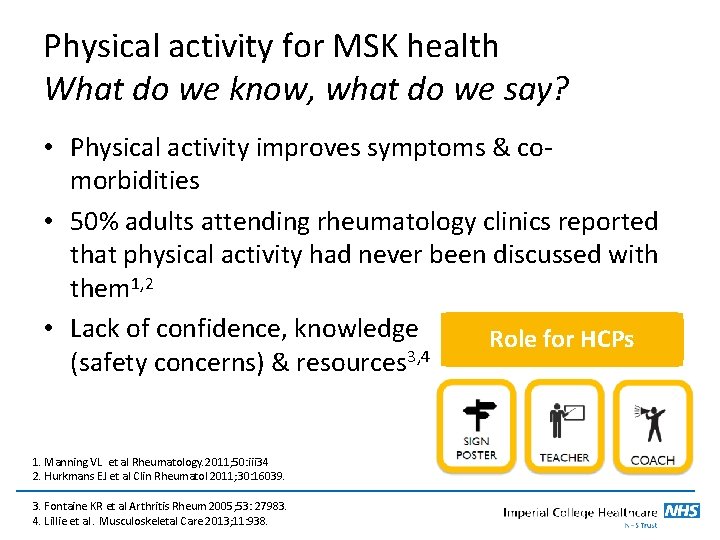
Physical activity for MSK health What do we know, what do we say? • Physical activity improves symptoms & comorbidities • 50% adults attending rheumatology clinics reported that physical activity had never been discussed with them 1, 2 • Lack of confidence, knowledge Role for HCPs (safety concerns) & resources 3, 4 1. Manning VL et al Rheumatology. 2011; 50: iii 34 2. Hurkmans EJ et al Clin Rheumatol 2011; 30: 16039. 3. Fontaine KR et al Arthritis Rheum 2005; 53: 27983. 4. Lillie et al. Musculoskeletal Care 2013; 11: 938.
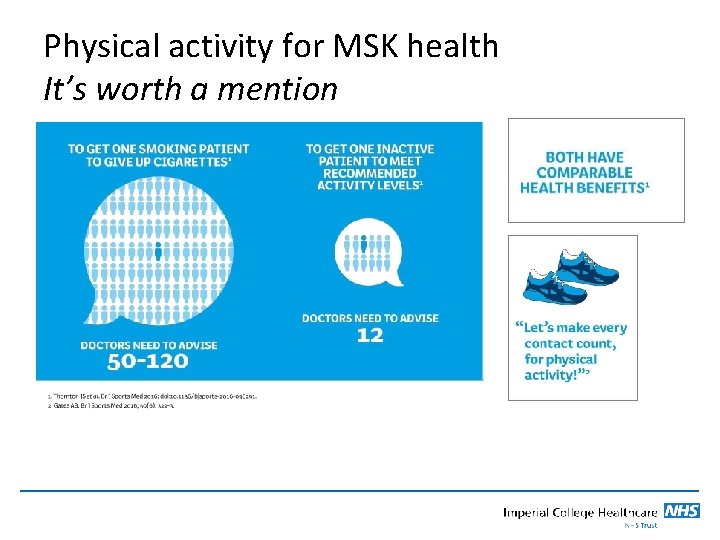
Physical activity for MSK health It’s worth a mention

Physical activity for MSK health Structuring the conversation PA history Discuss benefits & mechanism Explore barriers & motivators Address fear & safety concerns PA prescription & signposting https: //movingmedicine. ac. uk/disease/msk/

Physical activity for MSK health Benefits in rheumatoid arthritis Outcomes with Outcomes definite positive uncertain effect Outcomes with no effect Outcomes with definite negative effect • Physical • Fatigue function/ • Pain Disability (resistance • Quality of life exercise) • Strength • Disease activity • Mood/psych ological wellbeing • Pain (CVS exercise) • Radiological changes • Absence of adverse events vs controls https: //movingmedicine. ac. uk/disease/msk/

Physical activity for MSK health Benefits for common MSK conditions OA hip/knee; Back pain • Reduces stiffness • Improves physical function Chronic MSK pain • • Reduces pain Improves fatigue Improves physical function Reduces tenderness Improves self-efficacy Improves general wellbeing Improves fitness Talk about ‘wear and repair’ and not ‘wear and tear’ when giving the diagnosis of OA. Explain that, although we commonly refer to OA as wear and tear, OA is a metabolically active condition and not the simple mechanical wearing out of a joint, and so is about wear and repair. Porcheret M et al. Osteoarthritis: a modern approach to diagnosis and management. Arthritis Research UK Hands On Series 6, Issue 10, Autumn 2011

Physical activity for MSK health Structuring the conversation PA history Discuss benefits & mechanism Explore barriers & motivators Address fear & safety concerns PA prescription & signposting https: //movingmedicine. ac. uk/disease/msk/
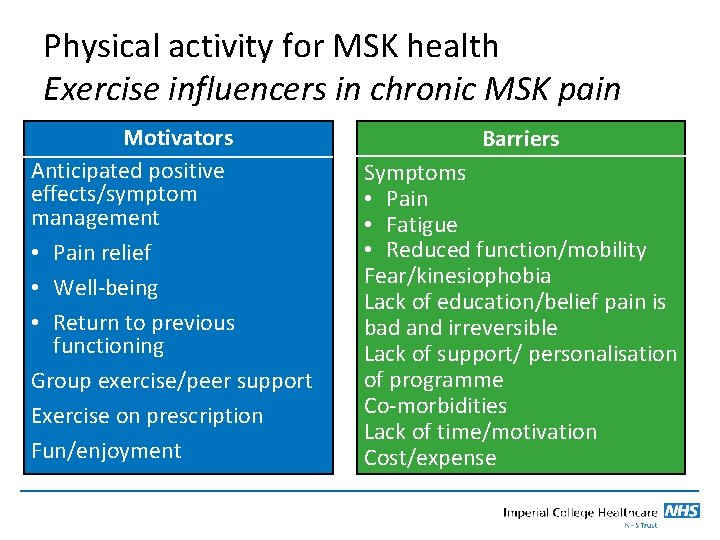
Physical activity for MSK health Exercise influencers in chronic MSK pain Motivators Anticipated positive effects/symptom management • Pain relief • Well-being • Return to previous functioning Group exercise/peer support Exercise on prescription Fun/enjoyment Barriers Symptoms • Pain • Fatigue • Reduced function/mobility Fear/kinesiophobia Lack of education/belief pain is bad and irreversible Lack of support/ personalisation of programme Co-morbidities Lack of time/motivation Cost/expense
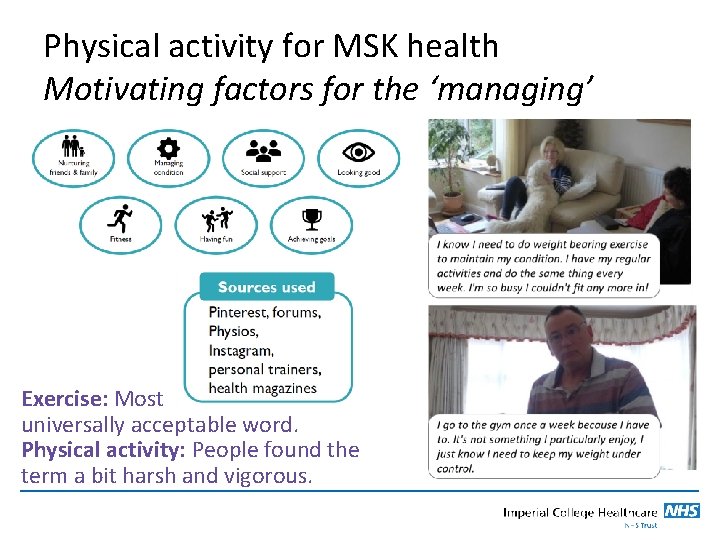
Physical activity for MSK health Motivating factors for the ‘managing’ Exercise: Most universally acceptable word. Physical activity: People found the term a bit harsh and vigorous.
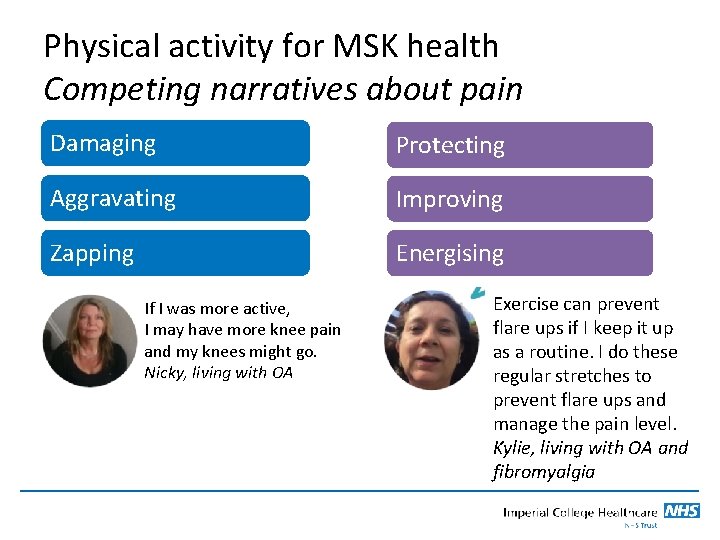
Physical activity for MSK health Competing narratives about pain Damaging Protecting Aggravating Improving Zapping Energising If I was more active, I may have more knee pain and my knees might go. Nicky, living with OA Exercise can prevent flare ups if I keep it up as a routine. I do these regular stretches to prevent flare ups and manage the pain level. Kylie, living with OA and fibromyalgia
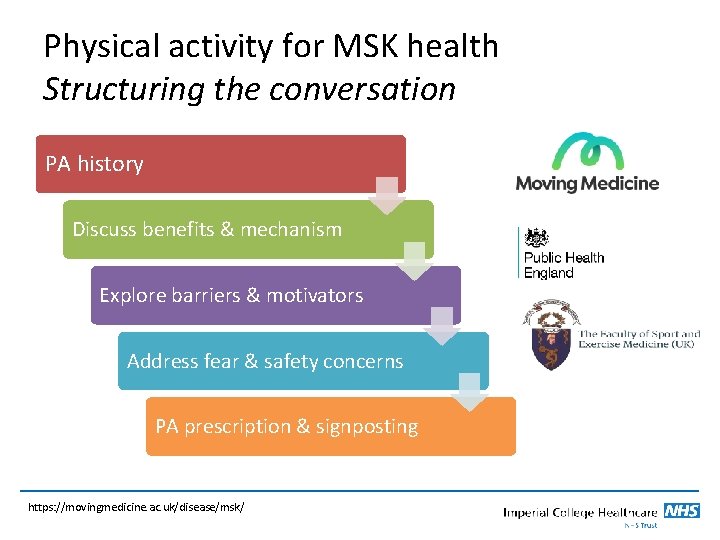
Physical activity for MSK health Structuring the conversation PA history Discuss benefits & mechanism Explore barriers & motivators Address fear & safety concerns PA prescription & signposting https: //movingmedicine. ac. uk/disease/msk/

Physical activity for MSK health Talking about the benefits Physical activity for general health benefits in disabled adults: Summary of a rapid evidence review for the UK Chief Medical Officers’ update of the physical activity guidelines …an emphasis on the dose response relationship of physical activity and benefits to health could produce wider public health benefits and have greater impact than just one touch point – that is, 150 minutes per week
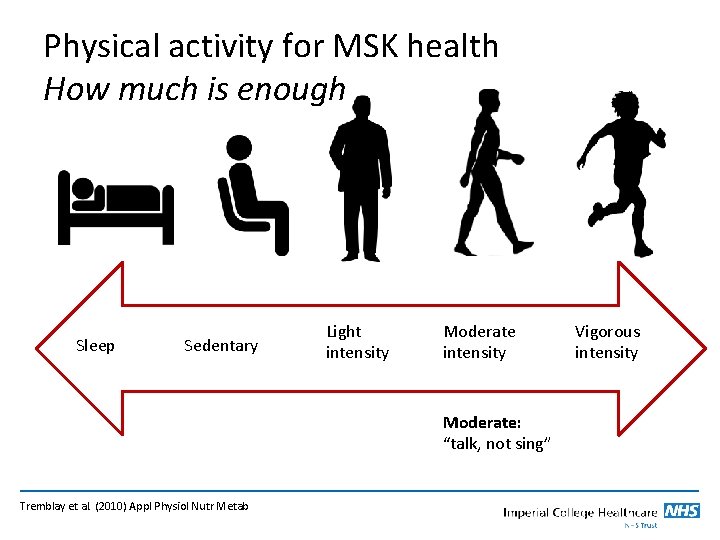
Physical activity for MSK health How much is enough Sleep Sedentary Light intensity Moderate: “talk, not sing” Tremblay et al. (2010) Appl Physiol Nutr Metab Vigorous intensity
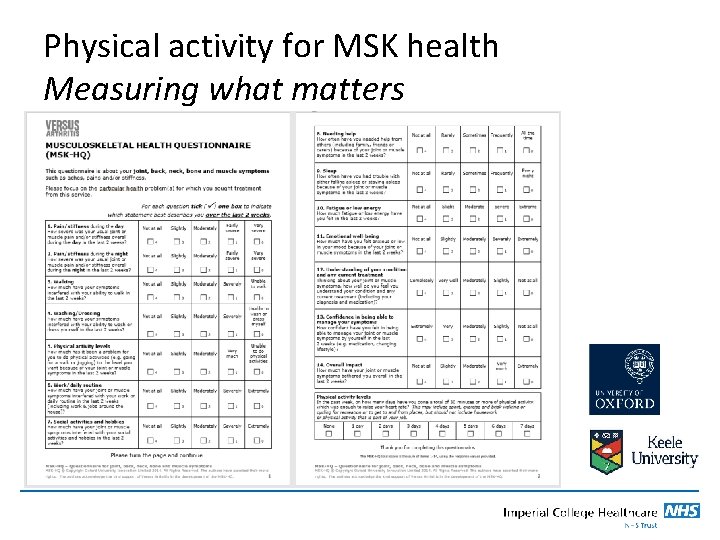
Physical activity for MSK health Measuring what matters
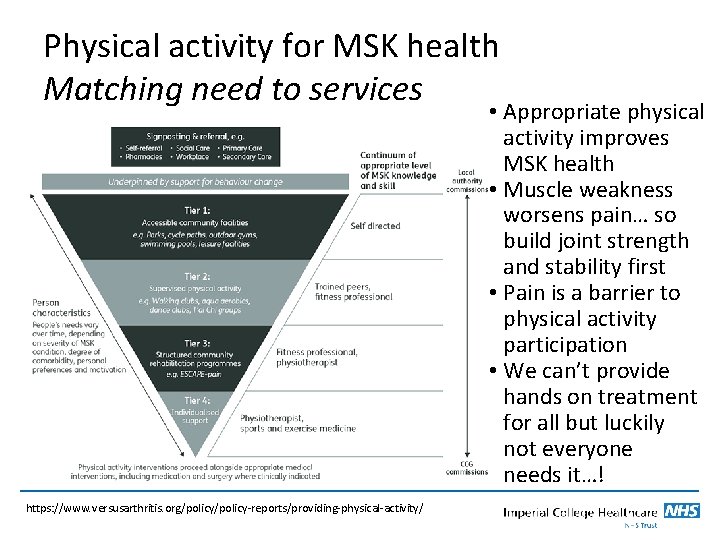
Physical activity for MSK health Matching need to services • Appropriate physical activity improves MSK health • Muscle weakness worsens pain… so build joint strength and stability first • Pain is a barrier to physical activity participation • We can’t provide hands on treatment for all but luckily not everyone needs it…! https: //www. versusarthritis. org/policy-reports/providing-physical-activity/
Physical activity for MSK health Structured programmes, example 1 Enabling Self-management and Coping with Arthritic Pain using exercise Group chronic hip/knee pain programme: ✓ Patient information Tailored advice on condition, selfmanagement, pain coping strategies, weight control; ✓ Personalised Exercise regimen Individualised, progressive, challenging • 10 -12 sessions • Supervised by physiotherapist, fitness instructor • Clinically and cost-effective • Needs large room, simple equipment http: //www. escape-pain. org/ ESCAPE-pain: Ø Reduces pain Ø Improves function Ø Improves wellbeing Ø Reduces healthcare costs (estimated annual saving of £ 1, 417 person) Ø Benefits sustained for up to 30 months
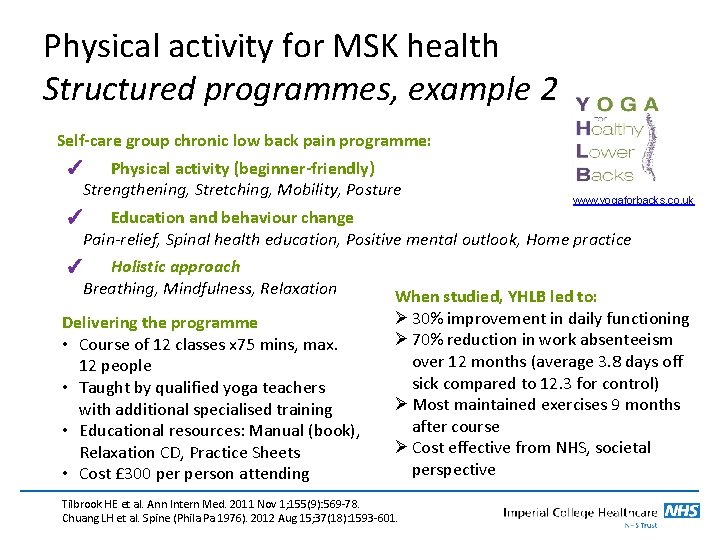
Physical activity for MSK health Structured programmes, example 2 Self-care group chronic low back pain programme: ✓ Physical activity (beginner-friendly) Strengthening, Stretching, Mobility, Posture www. yogaforbacks. co. uk ✓ Education and behaviour change Pain-relief, Spinal health education, Positive mental outlook, Home practice ✓ Holistic approach Breathing, Mindfulness, Relaxation Delivering the programme • Course of 12 classes x 75 mins, max. 12 people • Taught by qualified yoga teachers with additional specialised training • Educational resources: Manual (book), Relaxation CD, Practice Sheets • Cost £ 300 person attending When studied, YHLB led to: Ø 30% improvement in daily functioning Ø 70% reduction in work absenteeism over 12 months (average 3. 8 days off sick compared to 12. 3 for control) Ø Most maintained exercises 9 months after course Ø Cost effective from NHS, societal perspective Tilbrook HE et al. Ann Intern Med. 2011 Nov 1; 155(9): 569 -78. Chuang LH et al. Spine (Phila Pa 1976). 2012 Aug 15; 37(18): 1593 -601.
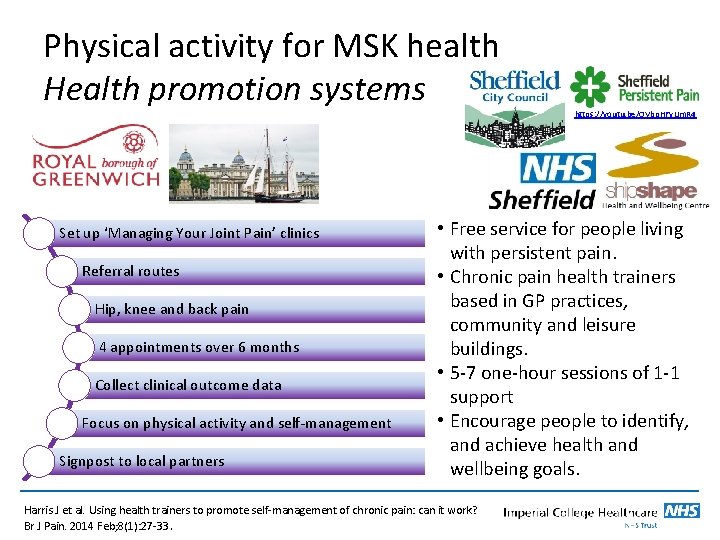
Physical activity for MSK health Health promotion systems Set up ‘Managing Your Joint Pain’ clinics Referral routes Hip, knee and back pain 4 appointments over 6 months Collect clinical outcome data Focus on physical activity and self-management Signpost to local partners https: //youtu. be/OVbp. HFy. Um. R 4 • Free service for people living with persistent pain. • Chronic pain health trainers based in GP practices, community and leisure buildings. • 5 -7 one-hour sessions of 1 -1 support • Encourage people to identify, and achieve health and wellbeing goals. Harris J et al. Using health trainers to promote self-management of chronic pain: can it work? Br J Pain. 2014 Feb; 8(1): 27 -33.
Physical activity for MSK health Learning objectives By the end of this talk, participants will be able to: • Discuss the benefits of physical activity for people with musculoskeletal conditions • Use a framework to incorporate discussions about physical activity in clinical consultations • Describe a public health framework for providing physical activity for people with musculoskeletal conditions
- Slides: 23