
Physical activity and people with intellectual disability T
Physical activity and people with intellectual disability. T 3
CONTENTS 1. 2. 3. 4. INTELLECTUAL DISABILITY: CONCEPT INITIAL CONSIDERATIONS IN Pw. ID Assessment of the motor-perceptive development. Requirements in the practice of physical activity. ADAPTATIONS AND SAFETY MEASURES IN PADP (Physical Activity with Disabled Persons) Methodology guidelines in PADP Safety measures in PADP ADAPTED SPORT / SPECIFIC SPORT Federated sports movement Special Olympics movement

1. INTELLECTUAL DISABILITY: CONCEPT l l ID formerly know as Mental Retardation. Characteristics: l l l Significant limitations in intellectual functioning Significant limitations in adaptive behaviour. It originates before age 18. Schalock et al. (2007)
2. INITIAL CONSIDERATIONS IN Pw. ID 2. 1 CHARACTERISTICS OF MOTOR DEVELOPMENT: l General problems with physical growth. l Slower motor growth with disorders in motor control. l It may lead to disorders in body mechanics, muscle tone control and physiological alterations.
2. 2 REQUIREMENTS IN PA • • • Supervision and support required. Difficulty to keep attention and anticipate. Difficulty to engage in abstractions and concepts beyond immediate context. Limitations in the use of language. Difficulty in perception of body map, organisation of feelings and perceptions, time and space adjustment. Possible physiological alterations and in body mechanics. Low efficiency in basic motor skills. Difficulty in developing social skills. Possible conduct problems. Limitations in the acquisition of hygiene habits.
3. ADAPTATIONS AND SAFETY MEASURES IN PADP (Physical Activity with Disabled Persons) 3. 1 MATHODOLOGICAL GUIDELINES l Communication and social interactions l l l - - Organized and simplified procedures Use several transmission paths of information Alternative communication systems Terminology-associated activities Pupils with behavioural problems. . . Eye contact. Instructions: one at a time, in a specific and reasoned manner, and using positive language. Once the task is accomplished, positive reinforcement is needed
l Methodology l l l Simple tasks as opposed to complex tasks. Ease environmental understanding Reinforcement methodology Await response and assess it Ritual or type of session Material l l Use content in material. In the event of perceptive or motor difficulties, the shape, colour, texture and cadence of material is to be considered.
l l Facilities l In the event of difficulties in spacial orientation, clear benchmarks are to be used. l In the event of difficulties in perception and general coordination…smooth non-slip flooring is required. Contents: l Avoid childishness. l Develop space-time and body-map organisation. l Emphasize the development of basic motor skills. l Maximize body language and creativity. l Maximize activities favoring personal autonomy and hygienic habits.
l l Facilities l In the event of difficulties in spacial orientation, clear benchmarks are to be used. l In the event of difficulties in perception and general coordination…smooth non-slip flooring is required. Contents: l Avoid childishness. l Develop space-time and body-map organisation. l Emphasize the development of basic motor skills. l Maximize body language and creativity. l Maximize activities favoring personal autonomy and hygienic habits.
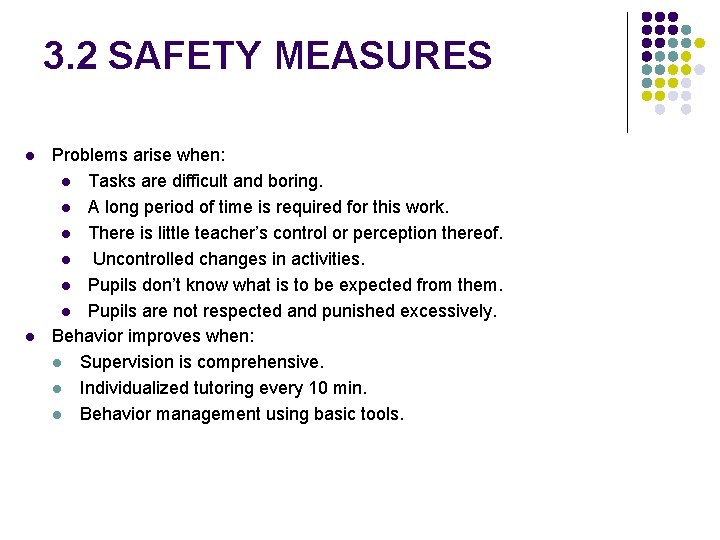
3. 2 SAFETY MEASURES l l Problems arise when: l Tasks are difficult and boring. l A long period of time is required for this work. l There is little teacher’s control or perception thereof. l Uncontrolled changes in activities. l Pupils don’t know what is to be expected from them. l Pupils are not respected and punished excessively. Behavior improves when: l Supervision is comprehensive. l Individualized tutoring every 10 min. l Behavior management using basic tools.
- Slides: 10