
Physical activity and Exercise for Health Chapter 1
- Slides: 23
Physical activity and Exercise for Health Chapter 1 Concepts of physical activity and exercise for health
There are many different ways to classify the following terms: • physical activity • exercise • physical fitness
Definition of physical activity • Physical activity is defined as any bodily movement produced by skeletal muscles that results in energy expenditure (Caspersen, Powell, & Christenson, 1985). • The amount of energy required to accomplish an activity can be measured in kilocalories (Kcal). • In other words, any movement one does is actually physical activity, such as climbing the stairs instead of taking the elevator.
Domains of physical activity • • Occupational physical activity Household physical activity Transportation physical activity Leisure time physical activity
Occupational physical activity • Definition: physical activity you do while on the job. • Some examples: • - Taking the stairs instead of taking the elevator • - Walking to another building at your workplace • - Walking during your lunch break
Household physical activity • Definition: physical activity you do at home. • Some examples: • • • - Cleaning your house - Mowing the lawn - Shoveling the snow from your driveway
Transportation physical activity • Definition: activity you do while traveling to and from work. • Some examples: • - Walking to a bus or train station • - Biking to work
Leisure time physical activity • Definition: a physical activity undertaken during an individual’s free time outside of work and home • The average person has 3 to 4 hours of “free (leisure) time” per day. • Some examples: • - Dancing at a social event • - Walking around the mall
Sport • Definition: a form of physical activity that involves competition. • The term sport may also embrace exercise and recreation (as in the UNESCO ‘Sport for All” movement) (Mc. Intosh, 1980)
Classifying Physical Activity Intensity: • • Low Intensity Physical Activity (less than 3. 5 calories per minute) • Low intensity physical activity is the lightest category of activity in terms of perceived and actual exertion and energy expenditure. Some examples include gardening, stretching, sitting, and fishing. • Moderate Intensity Physical Activity (3. 5 – 7 calories per minute) • Moderate intensity physical activities generally consists of sustained rhythmic movements. When engaged in moderate physical activity you should feel
Definition of physical fitness • Physical fitness is a measure of a person's ability to perform physical activities that require endurance, strength, or flexibility and is determined by a combination of cardiorespiratory endurance (aerobic power), flexibility, balance, and body composition (U. S. Department of Health and Human Services [USDHHS], 2008).
Definition of physically fit • “Physically fit” has been defined as "the ability to carry out daily tasks with vigor and alertness, without undue fatigue and with ample energy to enjoy leisure-time pursuits and to meet unforeseen emergencies" • Physical fitness is a set of attributes that people have or achieve. • (Caspersen, Powell, & Christenson, 1985)
Definition of Exercise • Exercise is a subcategory of physical activity. • Exercise is physical activity that is planned, structured, repetitive, and purposive in the sense that improvement or maintenance of one or more components of physical fitness is an objective (Caspersen, Powell, & Christenson, 1985). • The formula relating physical activity and exercise is: • Kcal exercise + Kcal nonexercise = Kcal total daily physical activity
Four Types of Exercises • • Endurance Strength Balance Flexibility
Endurance • Endurance, or aerobic activities increase your breathing and heart rate. • Aerobic exercise involves performing continuous movements with large muscle groups, such as your legs, for 20 minutes or more. • Some examples include: - Dancing - Jogging - Swimming - Biking - Climbing stairs or hills - Playing tennis - Playing basketball
Strength • to improve your muscle strength; "strength training" or "resistance training. “ • to increase the force your muscle contractions can generate, and may increase your strength, speed or power output. • Strength exercises include: - Lifting weights - Using a resistance band - Climbing stairs and carrying groceries
Balance • Balance exercises help prevent falls, which is a common problem in older adults. Many lower-body strength exercises also will improve your balance. • Exercises to improve your balance include: • - Standing on one foot • - Heel-to-toe walking • - Practicing Tai Chi
Flexibility • Flexibility exercise enhances the range of motion of your muscle and joint movements. Stretching is a form of flexibility exercise. • Stretching can help your body stay flexible and limber, which gives you more freedom of movement for your regular physical activity as well as for your everyday activities. • Activities to increase your flexibility: • - Shoulder and upper arm stretch • - Calf stretch • - Yoga
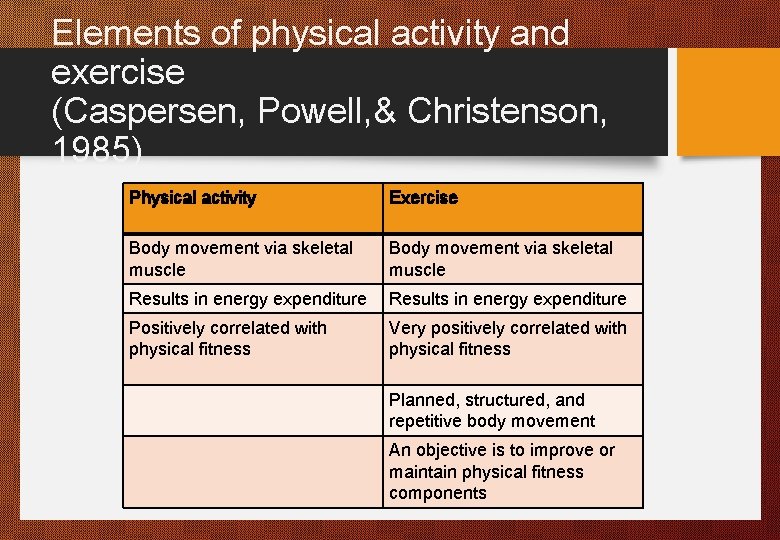
Elements of physical activity and exercise (Caspersen, Powell, & Christenson, 1985) Physical activity Exercise Body movement via skeletal muscle Results in energy expenditure Positively correlated with physical fitness Very positively correlated with physical fitness Planned, structured, and repetitive body movement An objective is to improve or maintain physical fitness components
Conclusion • The term “exercise” has been used interchangeably with “physical activity”. • Exercise, however, is not synonymous with physical activity. • Exercise is a subcategory of physical activity. (Caspersen, Powell, & Christenson, 1985)
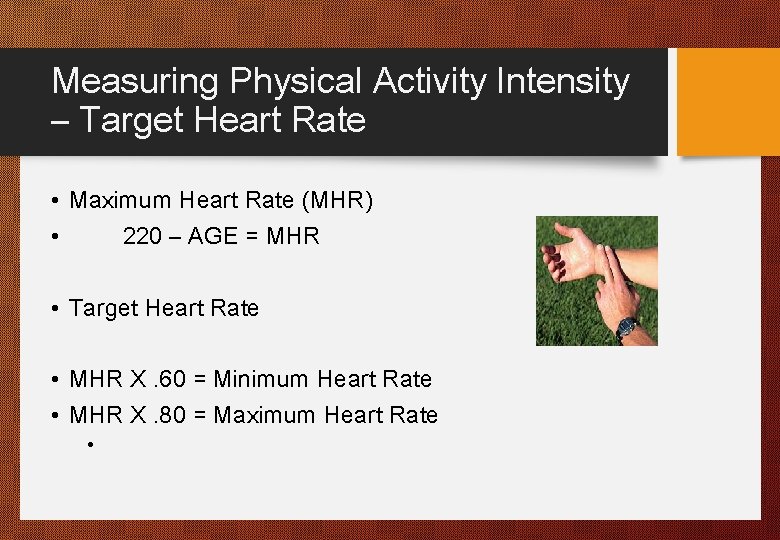
Measuring Physical Activity Intensity – Target Heart Rate • Maximum Heart Rate (MHR) • 220 – AGE = MHR • Target Heart Rate • MHR X. 60 = Minimum Heart Rate • MHR X. 80 = Maximum Heart Rate •
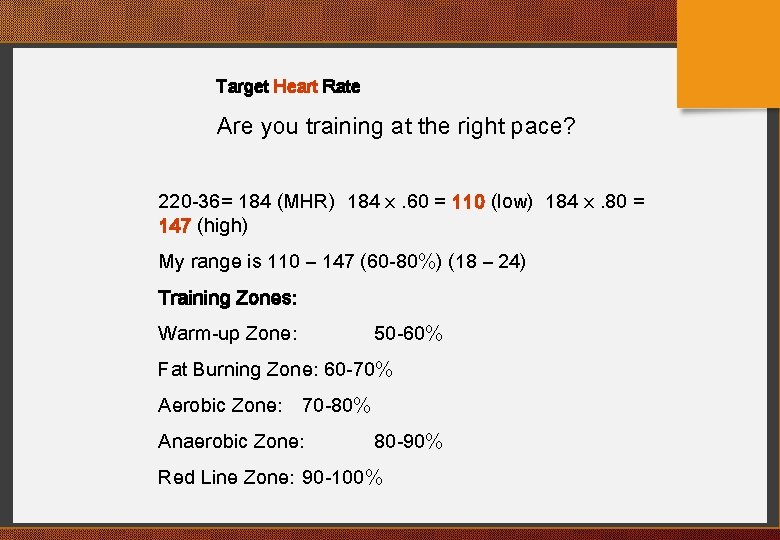
Target Heart Rate Are you training at the right pace? 220 -36= 184 (MHR) 184 x. 60 = 110 (low) 184 x. 80 = 147 (high) My range is 110 – 147 (60 -80%) (18 – 24) Training Zones: Warm-up Zone: 50 -60% Fat Burning Zone: 60 -70% Aerobic Zone: 70 -80% Anaerobic Zone: 80 -90% Red Line Zone: 90 -100%
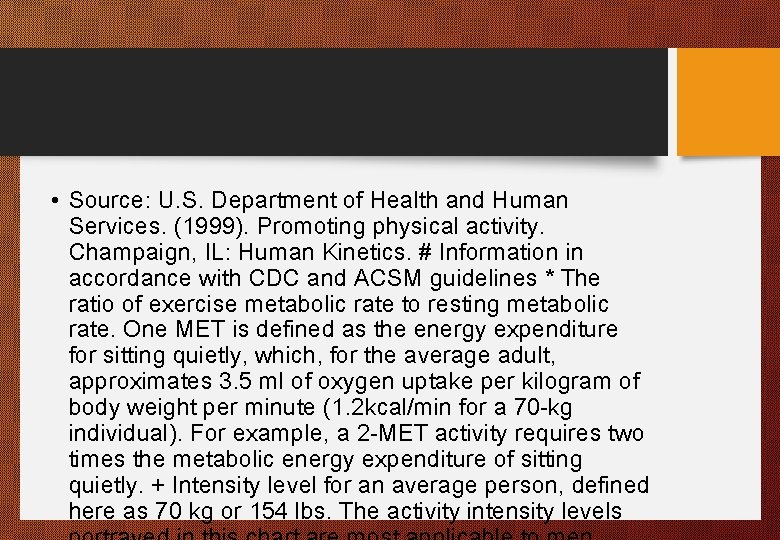
• Source: U. S. Department of Health and Human Services. (1999). Promoting physical activity. Champaign, IL: Human Kinetics. # Information in accordance with CDC and ACSM guidelines * The ratio of exercise metabolic rate to resting metabolic rate. One MET is defined as the energy expenditure for sitting quietly, which, for the average adult, approximates 3. 5 ml of oxygen uptake per kilogram of body weight per minute (1. 2 kcal/min for a 70 -kg individual). For example, a 2 -MET activity requires two times the metabolic energy expenditure of sitting quietly. + Intensity level for an average person, defined here as 70 kg or 154 lbs. The activity intensity levels