
PHYSICAL ACTIVITY AND ACADEMIC ACHIEVEMENT PRESENTATION BY TONY

PHYSICAL ACTIVITY AND ACADEMIC ACHIEVEMENT PRESENTATION BY TONY DELAIRE STUDIES ARE REGARDING ELEMENTARY STUDENTS
Curricular Physical Activity, and Academic Performance • National study from 2009 – 2012, of 545 students from 122 different school of all demographic locations. Study observed the correlation between classes that incorporated physical activity into its curriculum, and the academic success that followed. • Results concluded that have found that school environments are most important for teaching and creating good life habits by promoting physical activity. • Physical activity in school can improve the academic achievement and psychological health of children, particularly for girls. • Links between exercise, fitness, and cognition, are connected to a increase ability to learn. • Schools that have introduced physical activity into the curriculums have seen significant improvements associated with passing the national tests, especially in language and math. Bunketorp Käll, L. , Malmgren, H. , Olsson, E. , Lindén, T. , & Nilsson, M. (2015). Effects of a Curricular Physical Activity Intervention on Children's School Performance, Wellness, and Brain Development. Journal Of School Health, 85(10), 704 -713. doi: 10. 1111/josh. 12303
Fueling Learning through Exercise (FLEX) • Twenty-four public elementary schools from low-income, ethnically diverse communities around Massachusetts were recruited and randomized for the study. • For 2 years the FLEX study examined health disparities, obesity rate, and academic achievement among children associated with income as well as race/ethnicity. • FLEX found that Physical Activity (PA) is critical to preventing childhood obesity and contributes to children’s overall physical and cognitive health. • With regular PA, standardized test scores have been shown to increase positively. • School attendance was collected and found to greatly improve for individual and school levels. • Students showed increase in performance of short-term memory, attention and concentration. Wright, C. M. , Duquesnay, P. J. , Anzman-Frasca, S. , Chomitz, V. R. , Chui, K. , Economos, C. D. , &. . . Sacheck, J. M. (2016). Study protocol: the Fueling Learning through Exercise (FLEX) study - a randomized controlled trial of the impact of school-based physical activity programs on children's physical activity, cognitive function, and academic achievement. BMC Public Health, 161 -12. doi: 10. 1186/s 12889 -016 -3719 -0
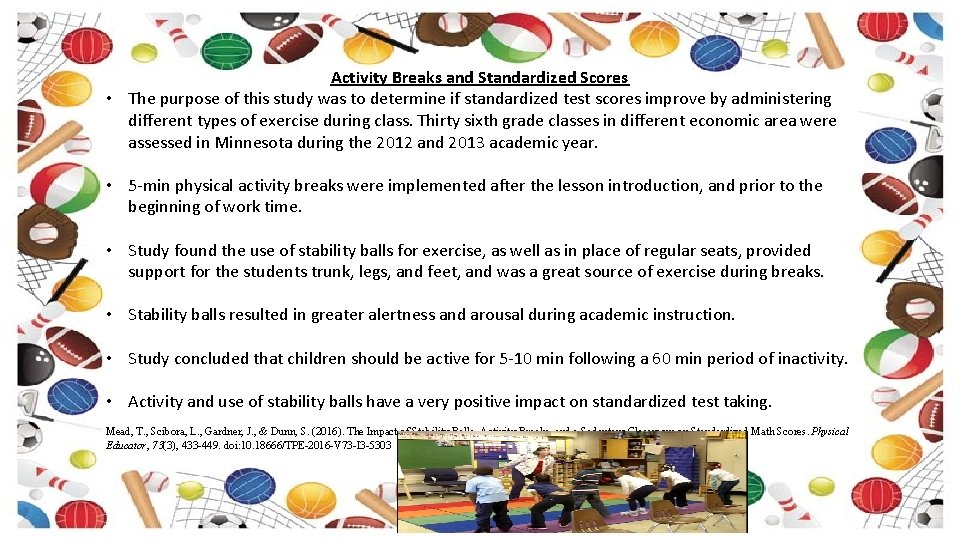
Activity Breaks and Standardized Scores • The purpose of this study was to determine if standardized test scores improve by administering different types of exercise during class. Thirty sixth grade classes in different economic area were assessed in Minnesota during the 2012 and 2013 academic year. • 5 -min physical activity breaks were implemented after the lesson introduction, and prior to the beginning of work time. • Study found the use of stability balls for exercise, as well as in place of regular seats, provided support for the students trunk, legs, and feet, and was a great source of exercise during breaks. • Stability balls resulted in greater alertness and arousal during academic instruction. • Study concluded that children should be active for 5 -10 min following a 60 min period of inactivity. • Activity and use of stability balls have a very positive impact on standardized test taking. Mead, T. , Scibora, L. , Gardner, J. , & Dunn, S. (2016). The Impact of Stability Balls, Activity Breaks, and a Sedentary Classroom on Standardized Math Scores. Physical Educator, 73(3), 433 -449. doi: 10. 18666/TPE-2016 -V 73 -I 3 -5303
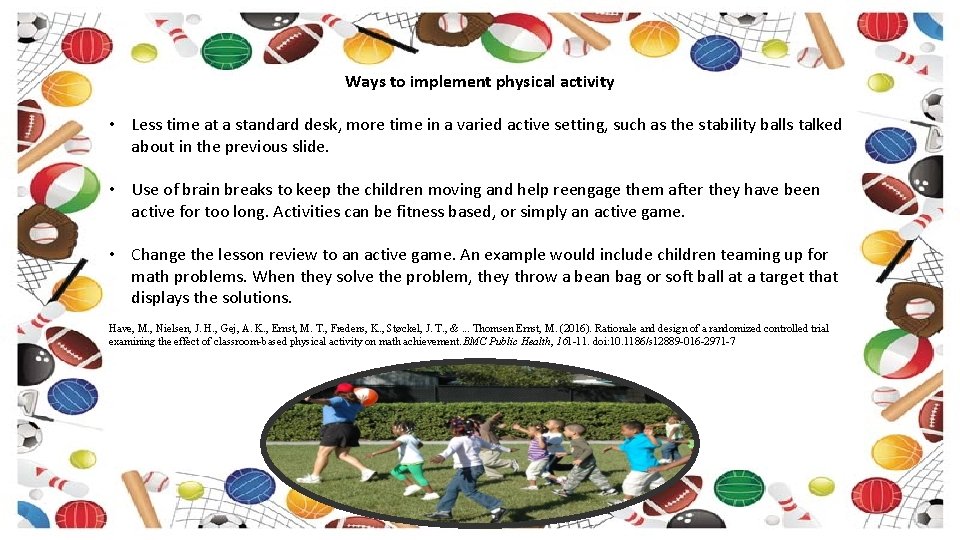
Ways to implement physical activity • Less time at a standard desk, more time in a varied active setting, such as the stability balls talked about in the previous slide. • Use of brain breaks to keep the children moving and help reengage them after they have been active for too long. Activities can be fitness based, or simply an active game. • Change the lesson review to an active game. An example would include children teaming up for math problems. When they solve the problem, they throw a bean bag or soft ball at a target that displays the solutions. Have, M. , Nielsen, J. H. , Gej, A. K. , Ernst, M. T. , Fredens, K. , Støckel, J. T. , &. . . Thomsen Ernst, M. (2016). Rationale and design of a randomized controlled trial examining the effect of classroom-based physical activity on math achievement. BMC Public Health, 161 -11. doi: 10. 1186/s 12889 -016 -2971 -7
Ways to implement physical activity continued… • Use movement to help improve memory function. When a student is moving while practicing or studying a subject they are more than likely to remember it and be able to apply it. • Use students sense of creativity. Allow students to think creatively to design three different activities, and draw task pictures. Students are to complete this individually with paper and pencil in a classroom, but activity is done in a group. After, children can present to each other the three tasks, they perform the activates designed. • • Have, M. , Nielsen, J. H. , Gej, A. K. , Ernst, M. T. , Fredens, K. , Støckel, J. T. , &. . . Thomsen Ernst, M. (2016). Rationale and design of a randomized controlled trial examining the effect of classroom-based physical activity on math achievement. BMC Public Health, 161 -11. doi: 10. 1186/s 12889 -016 -2971 -7
Addressing Behavior Get Parents involved with a “BRIEF” questionnaire - The Behavior Rating Inventory of Executive Function (BRIEF) is an assessment of behaviors at home for children and adolescents aged 5– 18 years. - One parent or guardian for each child was asked to answer the questionnaire. After 3– 4 weeks, parents return the questionnaire to the school. Parents rate their child’s behavior on a three-point Likert scale on a behavior regulation index (BRI). - This can be used to make parents aware of how their child is behaving, and if any action should be taken. This way the child can still be active at school, while hopefully having their misbehavior addressed at home. Have, M. , Nielsen, J. H. , Gej, A. K. , Ernst, M. T. , Fredens, K. , Støckel, J. T. , &. . . Thomsen Ernst, M. (2016). Rationale and design of a randomized controlled trial examining the effect of classroom-based physical activity on math achievement. BMC Public Health, 161 -11. doi: 10. 1186/s 12889 -016 -2971 -7
Resources Bunketorp Käll, L. , Malmgren, H. , Olsson, E. , Lindén, T. , & Nilsson, M. (2015). Effects of a Curricular Physical Activity Intervention on Children's School Performance, Wellness, and Brain Development. Journal Of School Health, 85(10), 704 -713. doi: 10. 1111/josh. 12303 Have, M. , Nielsen, J. H. , Gej, A. K. , Ernst, M. T. , Fredens, K. , Støckel, J. T. , &. . . Thomsen Ernst, M. (2016). Rationale and design of a randomized controlled trial examining the effect of classroom-based physical activity on math achievement. BMC Public Health, 161 -11. doi: 10. 1186/s 12889 -016 -2971 -7 Mead, T. , Scibora, L. , Gardner, J. , & Dunn, S. (2016). The Impact of Stability Balls, Activity Breaks, and a Sedentary Classroom on Standardized Math Scores. Physical Educator, 73(3), 433 -449. doi: 10. 18666/TPE-2016 -V 73 -I 3 -5303 Wright, C. M. , Duquesnay, P. J. , Anzman-Frasca, S. , Chomitz, V. R. , Chui, K. , Economos, C. D. , &. . . Sacheck, J. M. (2016). Study protocol: the Fueling Learning through Exercise (FLEX) study - a randomized controlled trial of the impact of school-based physical activity programs on children's physical activity, cognitive function, and academic achievement. BMC Public Health, 161 -12. doi: 10. 1186/s 12889 -0163719 -0
- Slides: 8