
PHYSICAL ACTIVITY A LEADING ACADEMIC INDICATOR Aaron Beighle
PHYSICAL ACTIVITY: A LEADING ACADEMIC INDICATOR Aaron Beighle, Ph. D.

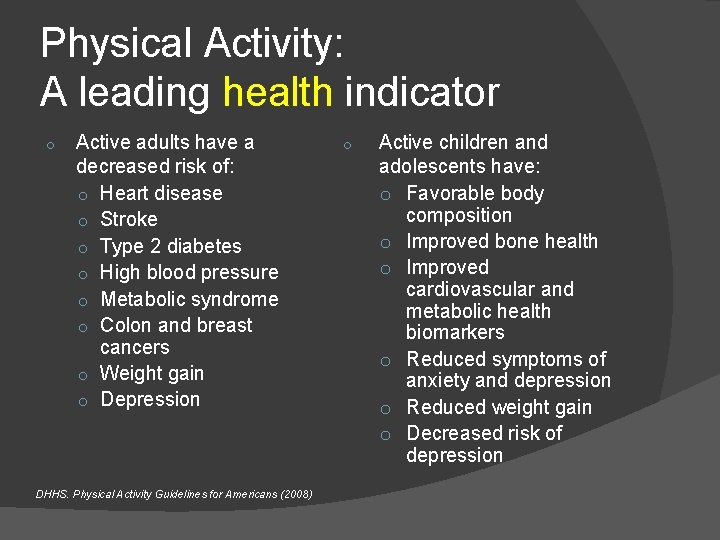
Physical Activity: A leading health indicator o Active adults have a decreased risk of: o Heart disease o Stroke o Type 2 diabetes o High blood pressure o Metabolic syndrome o Colon and breast cancers o Weight gain o Depression DHHS. Physical Activity Guidelines for Americans (2008) o Active children and adolescents have: o Favorable body composition o Improved bone health o Improved cardiovascular and metabolic health biomarkers o Reduced symptoms of anxiety and depression o Reduced weight gain o Decreased risk of depression
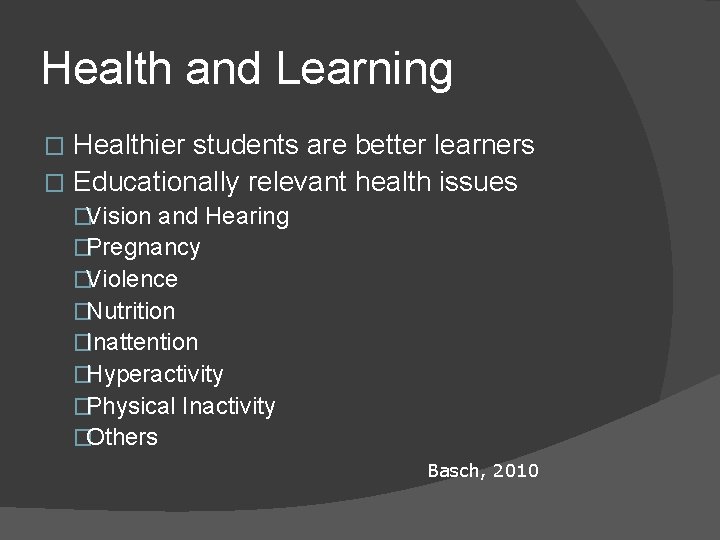
Health and Learning Healthier students are better learners � Educationally relevant health issues � �Vision and Hearing �Pregnancy �Violence �Nutrition �Inattention �Hyperactivity �Physical Inactivity �Others Basch, 2010
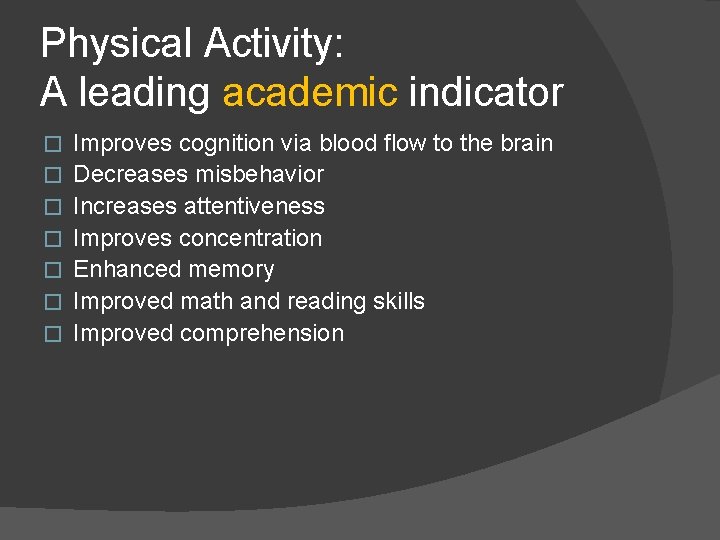
Physical Activity: A leading academic indicator � � � � Improves cognition via blood flow to the brain Decreases misbehavior Increases attentiveness Improves concentration Enhanced memory Improved math and reading skills Improved comprehension
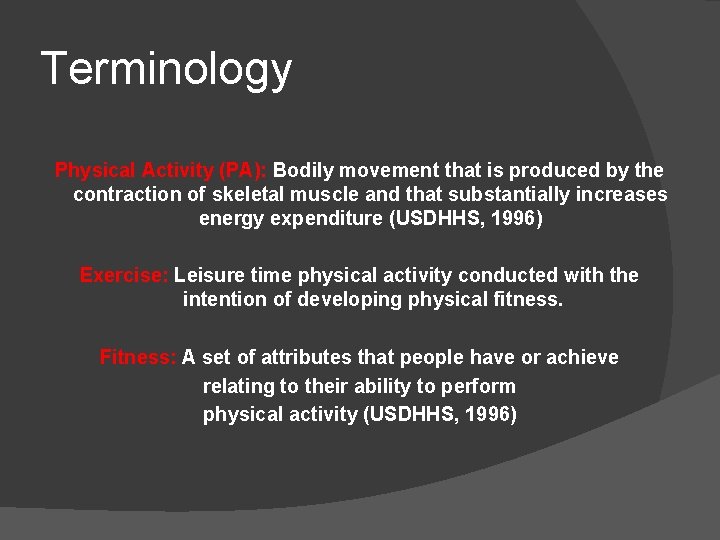
Terminology Physical Activity (PA): Bodily movement that is produced by the contraction of skeletal muscle and that substantially increases energy expenditure (USDHHS, 1996) Exercise: Leisure time physical activity conducted with the intention of developing physical fitness. Fitness: A set of attributes that people have or achieve relating to their ability to perform physical activity (USDHHS, 1996)
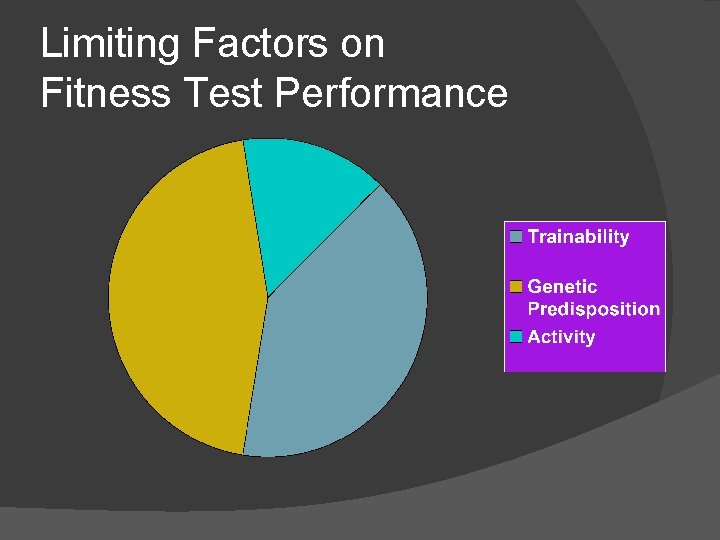
Limiting Factors on Fitness Test Performance
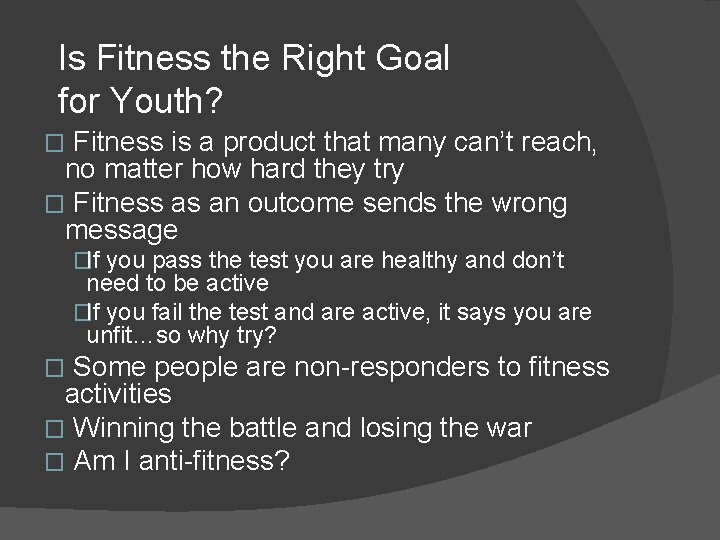
Is Fitness the Right Goal for Youth? Fitness is a product that many can’t reach, no matter how hard they try � Fitness as an outcome sends the wrong message � �If you pass the test you are healthy and don’t need to be active �If you fail the test and are active, it says you are unfit…so why try? Some people are non-responders to fitness activities � Winning the battle and losing the war � Am I anti-fitness? �
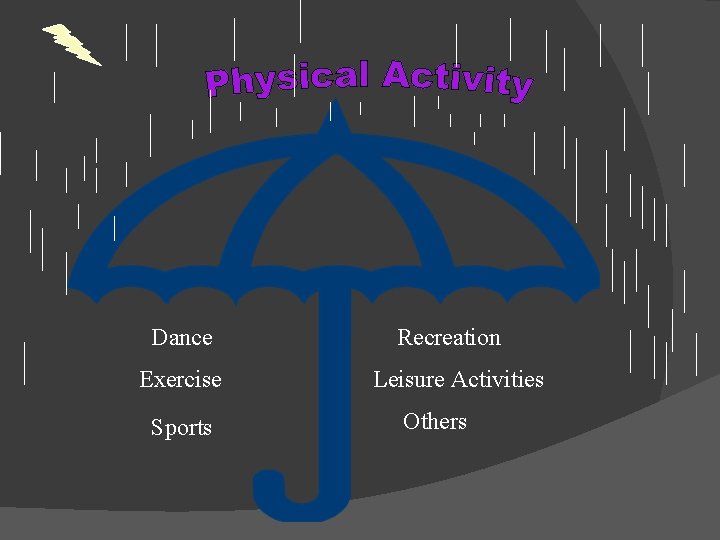
Dance Exercise Sports Recreation Leisure Activities Others
CDC’s Review of School Physical Activity and Academic Performance � Association between school-based PA and academic performance �Cognitive abilities and attitudes �Academic behaviors �Academic performance � Areas included: �Physical education classes �Recess �Classroom breaks �Extracurricular
Big Picture Findings The 43 articles (50 studies) included 251 tested associations between physical activity and academic performance � The most commonly measured indicator of academic performance was cognitive skills an abilities (112 of 251 associations tested) � 50. 5% of all associations tested were positive. � 1. 5% of all associations tested were negative (4 of 251) �
So What? � PA can impact academic performance � PA can have an impact on cognitive skills and attitudes and academic behavior � Time allocated for PA or PE does not appear to adversely impact, academic performance

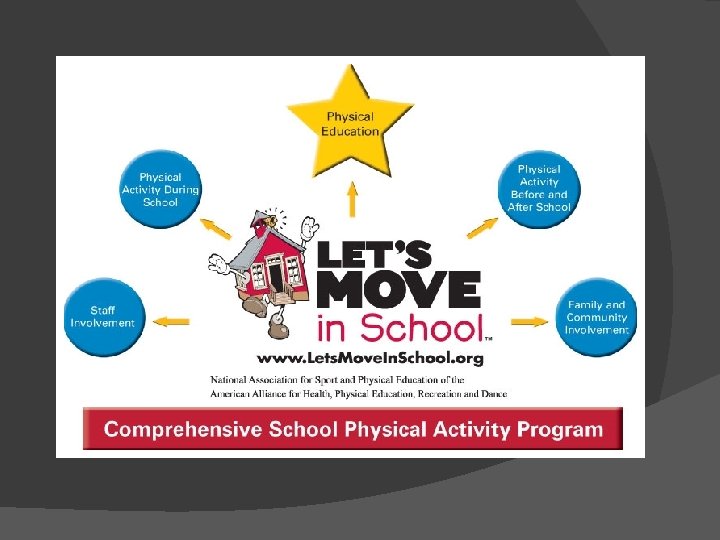
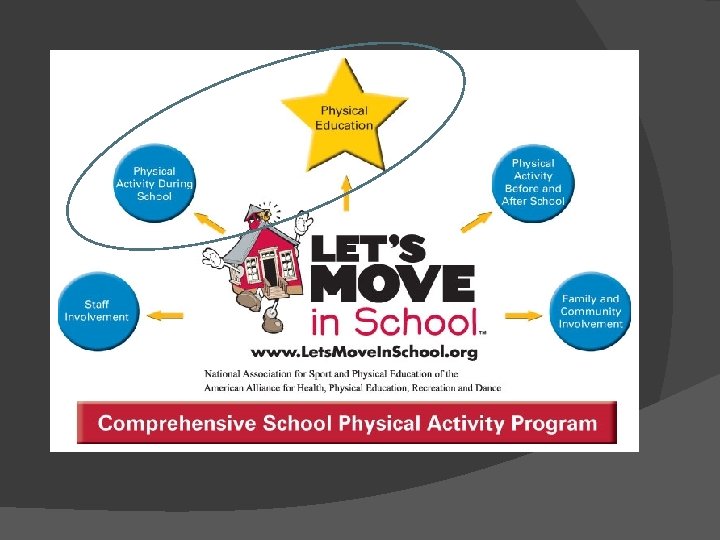
National Support � � � National Physical Activity Plan National Association for Sport and Physical Education American Heart Association Centers for Disease Control and Prevention National Football League
The Need for a Champion If schools are leaders, who leads the leader? � Who has the training and background? � Who can be a champion? � �Physical educator �Health educator �Extension agents/Family resource personnel �Nurses �Parents � A village?

Quality Physical Education
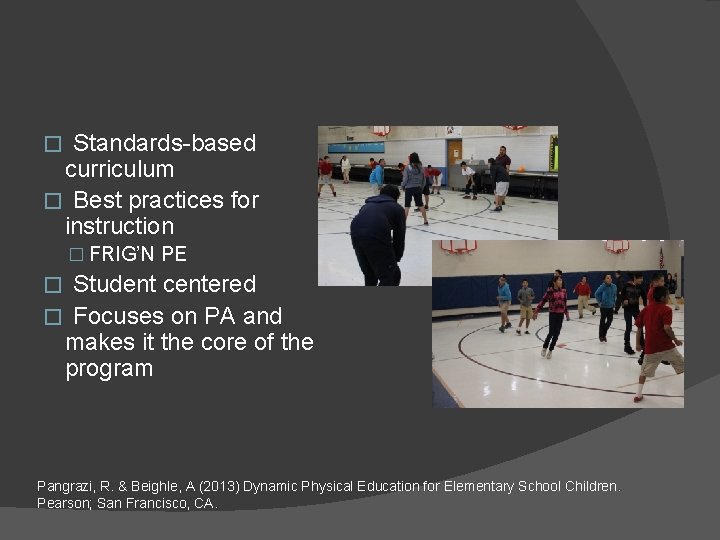
Standards-based curriculum � Best practices for instruction � � FRIG’N PE Student centered � Focuses on PA and makes it the core of the program � Pangrazi, R. & Beighle, A (2013) Dynamic Physical Education for Elementary School Children. Pearson; San Francisco, CA.
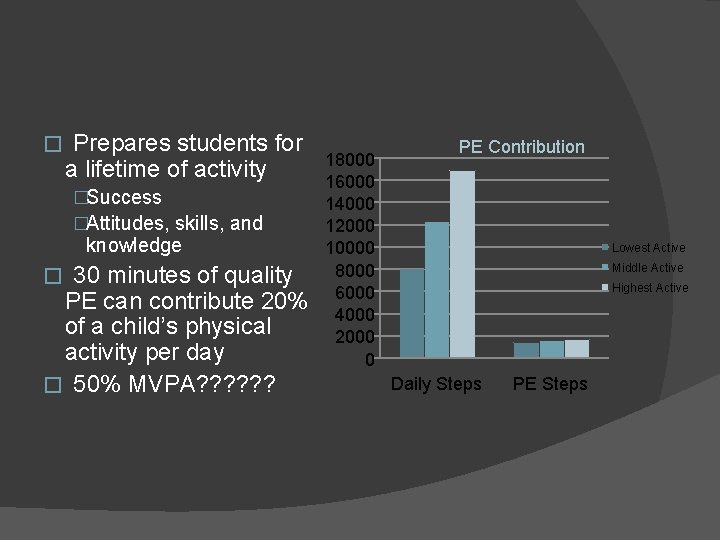
� Prepares students for a lifetime of activity �Success �Attitudes, skills, and knowledge 30 minutes of quality PE can contribute 20% of a child’s physical activity per day � 50% MVPA? ? ? � 18000 16000 14000 12000 10000 8000 6000 4000 2000 0 PE Contribution Lowest Active Middle Active Highest Active Daily Steps PE Steps
Classroom Physical Activity
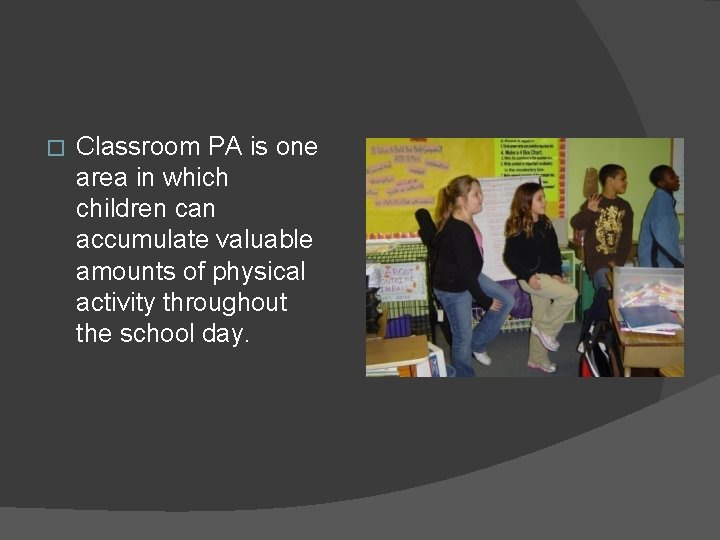
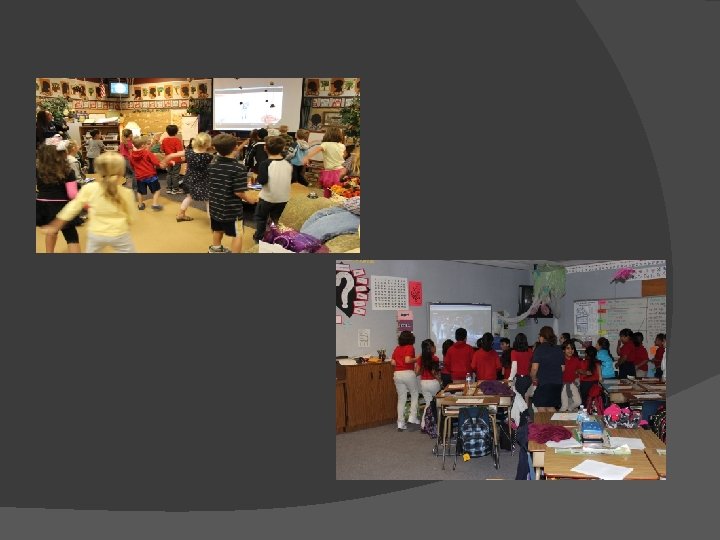
� Classroom PA is one area in which children can accumulate valuable amounts of physical activity throughout the school day.

� Likewise, PA provides an alternative context in which teachers can introduce academic content.
Physical Activity Levels � Integration provides valuable amounts of PA at various intensity levels for children (Erwin et al. , in press; Oliver, Schofield, & Mc. Evoy, 2006; Stewart et al. , 2004) � Value and enjoyment of PA (Lowden et al. , 2001)
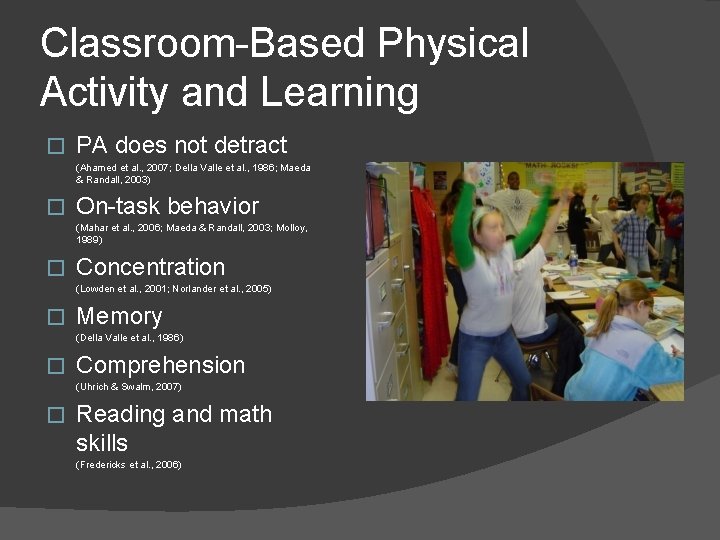
Classroom-Based Physical Activity and Learning � PA does not detract (Ahamed et al. , 2007; Della Valle et al. , 1986; Maeda & Randall, 2003) � On-task behavior (Mahar et al. , 2006; Maeda & Randall, 2003; Molloy, 1989) � Concentration (Lowden et al. , 2001; Norlander et al. , 2005) � Memory (Della Valle et al. , 1986) � Comprehension (Uhrich & Swalm, 2007) � Reading and math skills (Fredericks et al. , 2006)
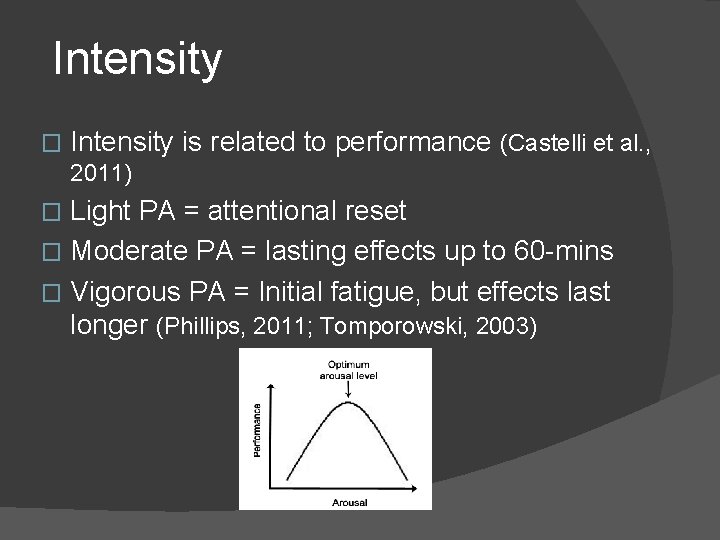
Intensity � Intensity is related to performance (Castelli et al. , 2011) Light PA = attentional reset � Moderate PA = lasting effects up to 60 -mins � Vigorous PA = Initial fatigue, but effects last longer (Phillips, 2011; Tomporowski, 2003) �
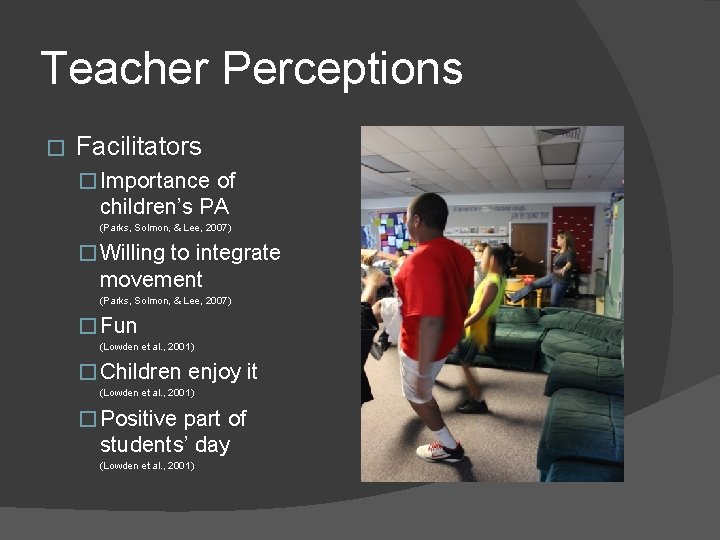
Teacher Perceptions � Facilitators � Importance of children’s PA (Parks, Solmon, & Lee, 2007) � Willing to integrate movement (Parks, Solmon, & Lee, 2007) � Fun (Lowden et al. , 2001) � Children enjoy it (Lowden et al. , 2001) � Positive part of students’ day (Lowden et al. , 2001)
Teacher Perceptions � Barriers �Low priority for health/physical education (Dwyer et al. , 2001) �High priority for standardized testing ○ PA/PE not tested �Lack of significant infrastructure ○ Inadequate facilities and/or equipment
Teacher Perceptions � Teachers employing little or no integration of movement into classrooms (Parks, Solmon, & Lee, 2007) � Need support to successfully integrate (Parks, Solmon, & Lee, 2007)

Practical Strategies � Tie PA to academic content
Deal or No Deal February 22, 2012 � � Math Grade Level – 4 th Formation – Scattered Equipment: None Rules/Directions: � Write math expression on board (this can be a basic problem up to inequalities or order of operations). � If the problem is true, the students do a locomotor activity. If it is false they do a non-locomotor activity. � If false, they must decide how to make the statement true. They must then tell a neighbor how to make it true and explain the correct answer.
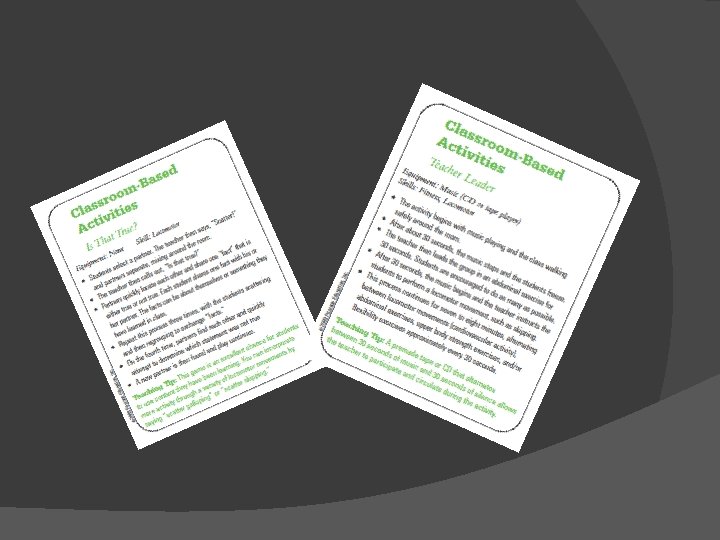
Practical Strategies Tie PA to academic content � Use available resources � � Activity Cards � (Pangrazi, Beighle, & Pangrazi, 2009) Word movement collection
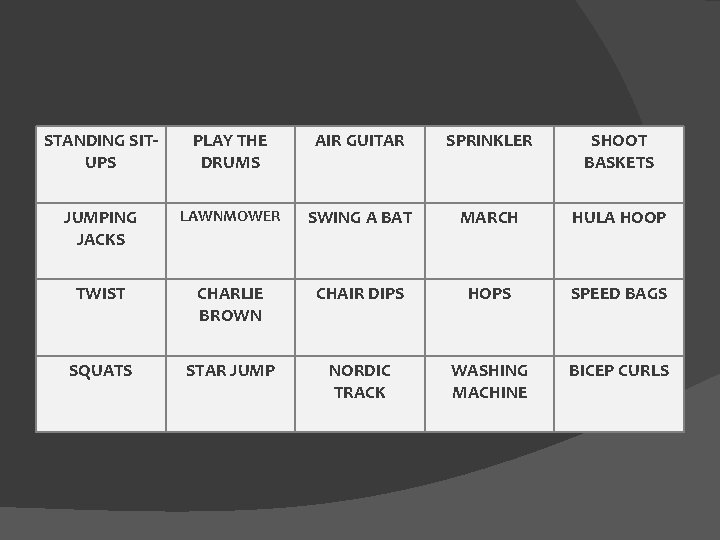
STANDING SITUPS PLAY THE DRUMS AIR GUITAR SPRINKLER SHOOT BASKETS JUMPING JACKS LAWNMOWER SWING A BAT MARCH HULA HOOP TWIST CHARLIE BROWN CHAIR DIPS HOPS SPEED BAGS SQUATS STAR JUMP NORDIC TRACK WASHING MACHINE BICEP CURLS
Practical Strategies Tie PA to academic content � Use available resources � � Activity Cards (Pangrazi, Beighle, & Pangrazi, 2009) Word movement collection � Select appropriate times for activity breaks � Organize laminated cards � Create space in classroom �
Practical Strategies � Provide PE preparation courses � Provide PD for classroom teachers � Ice Breakers � Make them aware of � Active Recess resources � Management � School Parties � Videos ○ Freezing ○ Grouping ○ Instruction time ○ Retrieving equipment
Practical Strategies � Vary instructional areas within each classroom � Hands-on learning � Stability balls as chairs? � Standing desks?

Recess
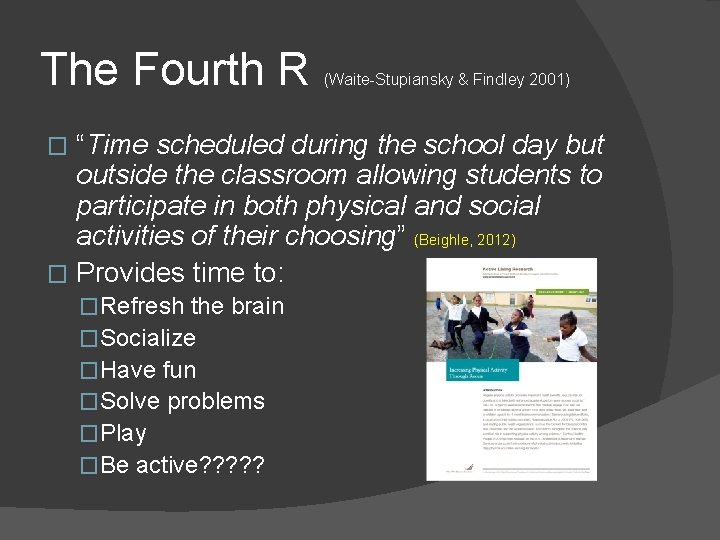
The Fourth R (Waite-Stupiansky & Findley 2001) “Time scheduled during the school day but outside the classroom allowing students to participate in both physical and social activities of their choosing” (Beighle, 2012) � Provides time to: � �Refresh the brain �Socialize �Have fun �Solve problems �Play �Be active? ? ?
What We Know about Recess � Girls are active 15%-52% of recess time; Boys are active 16%-68% of recess time � Recess can contribute as much as 40% of a child’s daily physical activity � Only 12% of states require recess � Only 20% of districts have wellness policies requiring recess � Recess offered throughout the day can improve student behavior and concentration
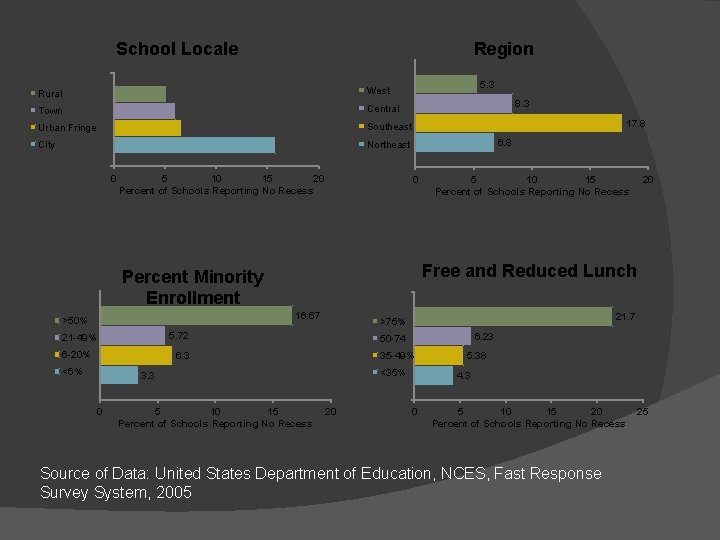
School Locale Region Rural West Town Central Urban Fringe Southeast City Northeast 0 5 10 15 20 Percent of Schools Reporting No Recess 5. 3 8. 3 17. 8 6. 8 0 16. 67 6 -20% 35 -49% <35% 3. 3 0 5 10 15 Percent of Schools Reporting No Recess 6. 23 50 -74 6. 3 <6% 21. 7 >75% 5. 72 21 -49% 20 Free and Reduced Lunch Percent Minority Enrollment >50% 5 10 15 Percent of Schools Reporting No Recess 20 5. 38 4. 3 0 5 10 15 20 Percent of Schools Reporting No Recess Source of Data: United States Department of Education, NCES, Fast Response Survey System, 2005 25
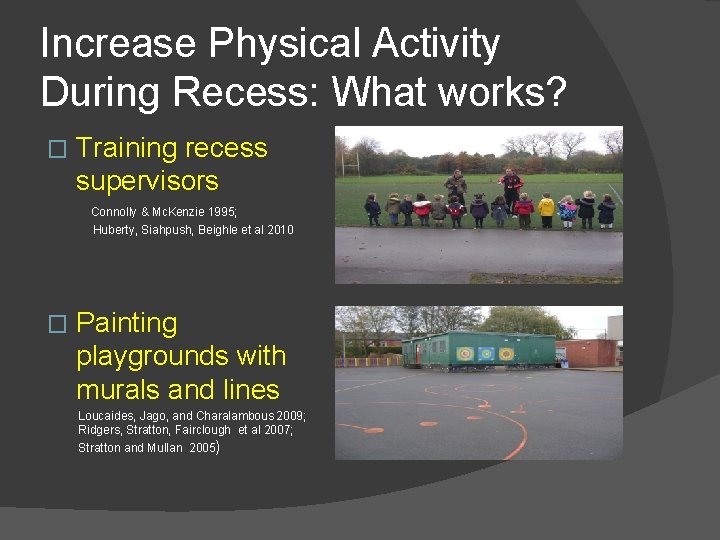
Increase Physical Activity During Recess: What works? � Training recess supervisors Connolly & Mc. Kenzie 1995; Huberty, Siahpush, Beighle et al 2010 � Painting playgrounds with murals and lines Loucaides, Jago, and Charalambous 2009; Ridgers, Stratton, Fairclough et al 2007; Stratton and Mullan 2005)
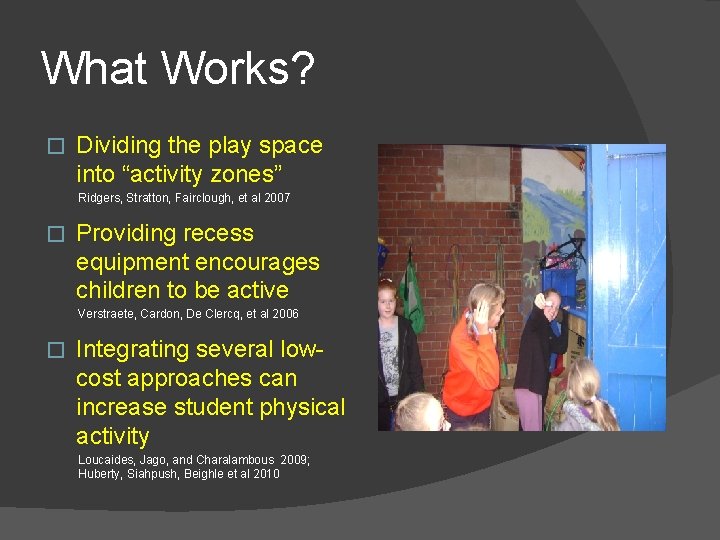
What Works? � Dividing the play space into “activity zones” Ridgers, Stratton, Fairclough, et al 2007 � Providing recess equipment encourages children to be active Verstraete, Cardon, De Clercq, et al 2006 � Integrating several lowcost approaches can increase student physical activity Loucaides, Jago, and Charalambous 2009; Huberty, Siahpush, Beighle et al 2010
Points to Ponder � More frequent, but shorter, recess periods � Unintended consequences of policies suggesting activity time during recess can not be taken away for punishment � Temperature policies � Recess before lunch � Extra recess as a reward or party “treat”
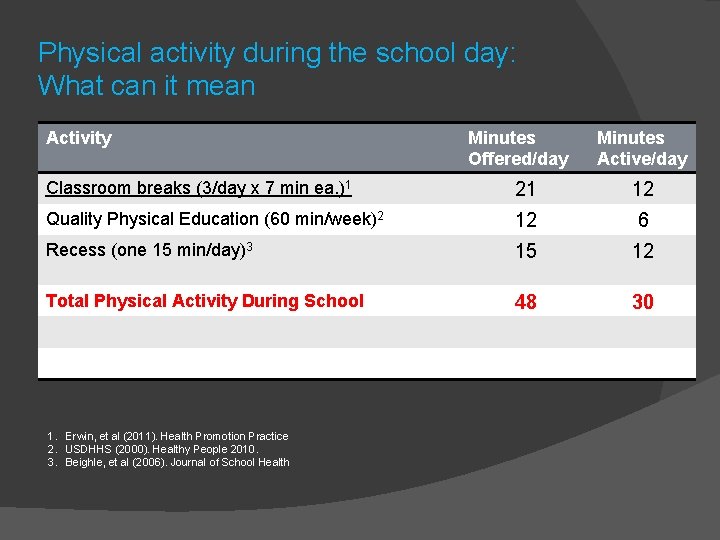
Physical activity during the school day: What can it mean Activity Minutes Offered/day Minutes Active/day Classroom breaks (3/day x 7 min ea. )1 21 12 Quality Physical Education (60 min/week)2 12 6 Recess (one 15 min/day)3 15 12 Total Physical Activity During School 48 30 1. Erwin, et al (2011). Health Promotion Practice 2. USDHHS (2000). Healthy People 2010. 3. Beighle, et al (2006). Journal of School Health
Physical activity and schools � Physical activity is warranted �Health and academic benefits � Schools offer an excellent opportunity but a champion is essential � Start small and with those who are interested � Be persistent � Remember, “It’s about kids”

Aaron Beighle beighle@uky. edu
- Slides: 48