PHYSE 0421 Solid State Physics Period V spring
- Slides: 27
PHYS-E 0421 Solid State Physics Period V, spring 2018 Prof. Martti Puska Dr. Hannu-Pekka. Komsa MSc. Maria Fedina MSc. Arsalan Hashemi Lecture 9, Friday 13. 4. 2018 Dielectric Properties of Solids Magnetism (Superconductivity)
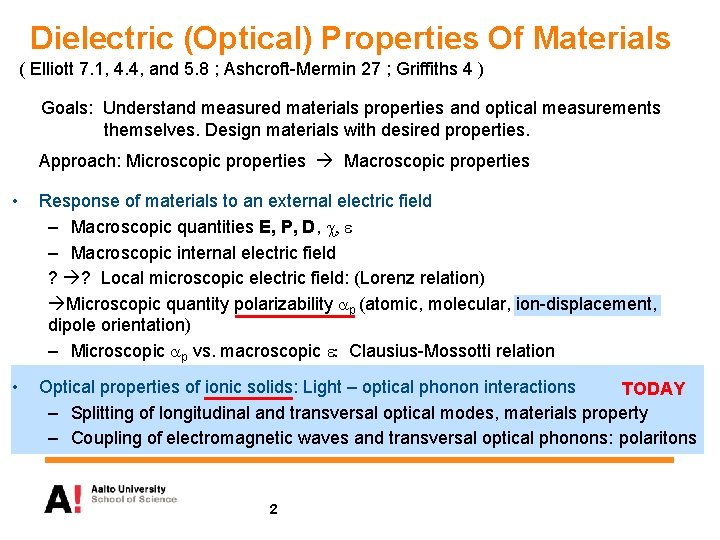
Dielectric (Optical) Properties Of Materials ( Elliott 7. 1, 4. 4, and 5. 8 ; Ashcroft-Mermin 27 ; Griffiths 4 ) Goals: Understand measured materials properties and optical measurements themselves. Design materials with desired properties. Approach: Microscopic properties Macroscopic properties • Response of materials to an external electric field – Macroscopic quantities E, P, D, c, e – Macroscopic internal electric field ? ? Local microscopic electric field: (Lorenz relation) Microscopic quantity polarizability ap (atomic, molecular, ion-displacement, dipole orientation) – Microscopic ap vs. macroscopic e: Clausius-Mossotti relation • Optical properties of ionic solids: Light – optical phonon interactions TODAY – Splitting of longitudinal and transversal optical modes, materials property – Coupling of electromagnetic waves and transversal optical phonons: polaritons 2
Dielectric (Optical) Properties Of Materials • Measuring light – phonon interaction • Optical properties of electrons in solids • Spontaneous polarization 3
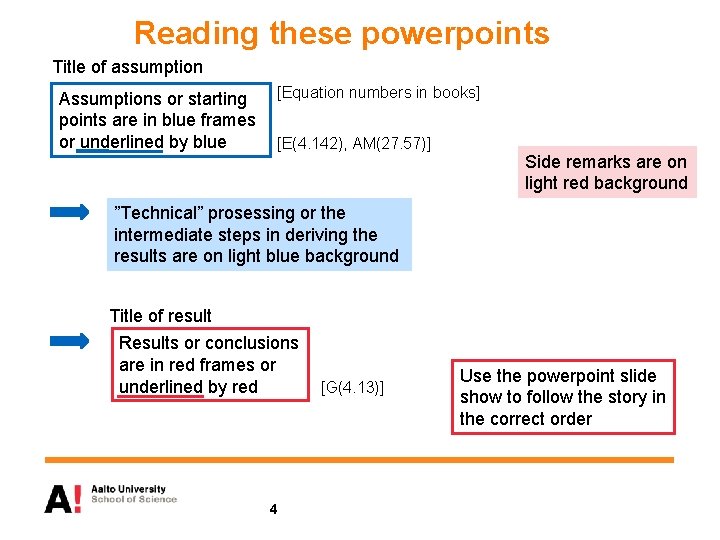
Reading these powerpoints Title of assumption Assumptions or starting points are in blue frames or underlined by blue [Equation numbers in books] [E(4. 142), AM(27. 57)] Side remarks are on light red background ”Technical” prosessing or the intermediate steps in deriving the results are on light blue background Title of result Results or conclusions are in red frames or underlined by red 4 [G(4. 13)] Use the powerpoint slide show to follow the story in the correct order
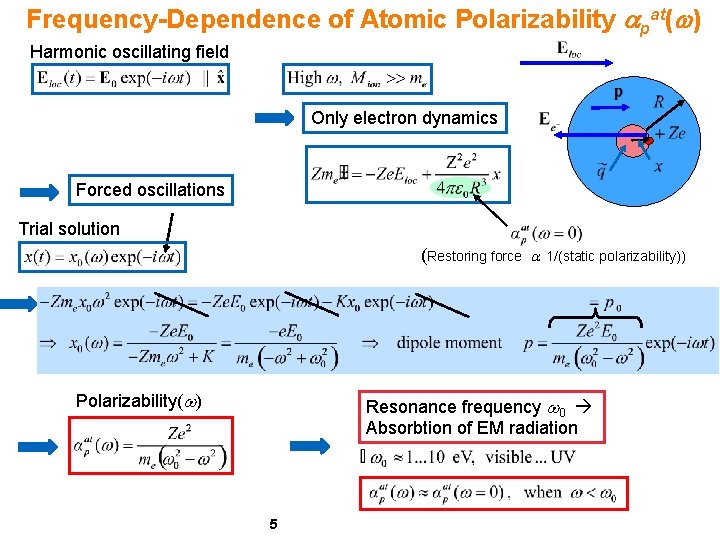
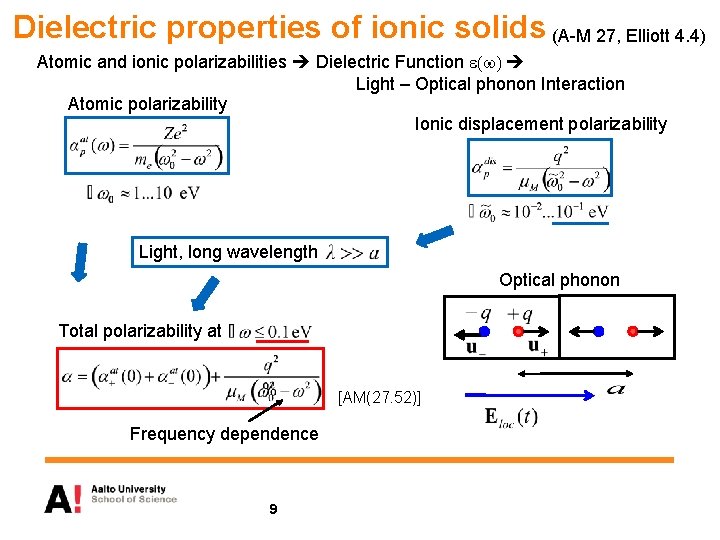
Frequency-Dependence of Atomic Polarizability apat(w) Harmonic oscillating field Only electron dynamics Forced oscillations Trial solution (Restoring force a Polarizability(w) 1/(static polarizability)) Resonance frequency w 0 Absorbtion of EM radiation S 5
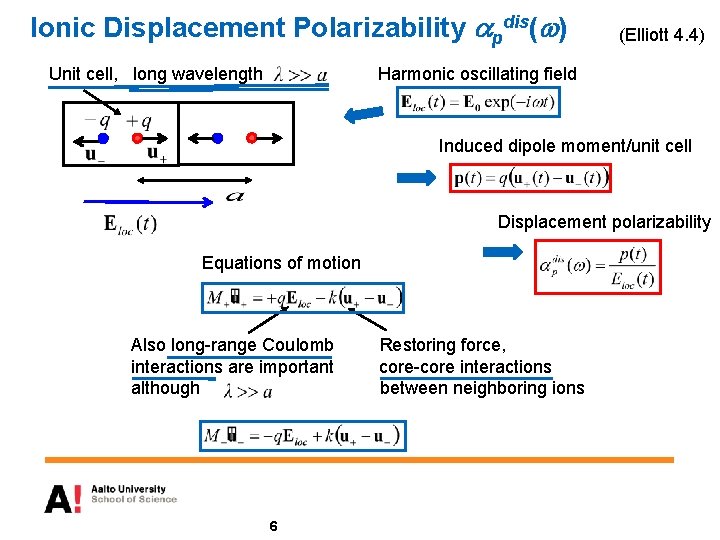
Ionic Displacement Polarizability apdis(w) Unit cell, long wavelength (Elliott 4. 4) Harmonic oscillating field Induced dipole moment/unit cell Displacement polarizability Equations of motion Also long-range Coulomb interactions are important although 6 Restoring force, core-core interactions between neighboring ions
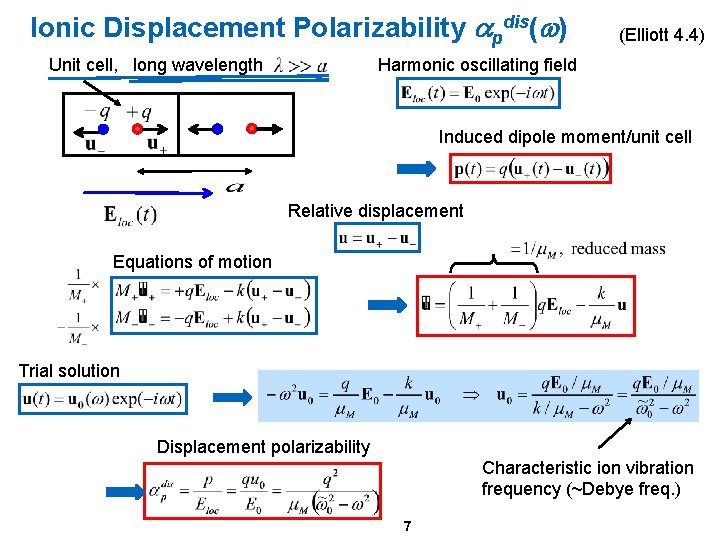
Ionic Displacement Polarizability apdis(w) Unit cell, long wavelength (Elliott 4. 4) Harmonic oscillating field Induced dipole moment/unit cell Relative displacement Equations of motion Trial solution Displacement polarizability Characteristic ion vibration frequency (~Debye freq. ) 7
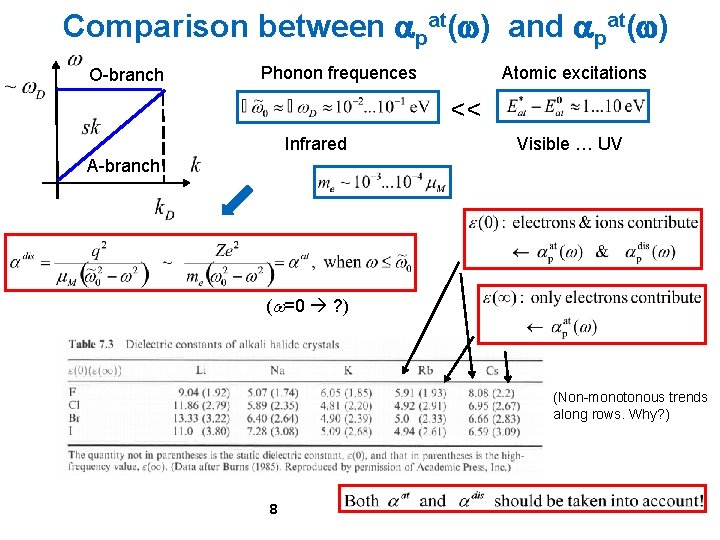
Comparison between apat(w) and apat(w) O-branch Phonon frequences Atomic excitations << Infrared Visible … UV A-branch (w=0 ? ) (Non-monotonous trends along rows. Why? ) 8
Dielectric properties of ionic solids (A-M 27, Elliott 4. 4) Atomic and ionic polarizabilities Dielectric Function e(w) Light – Optical phonon Interaction Atomic polarizability Ionic displacement polarizability Light, long wavelength Optical phonon Total polarizability at [AM(27. 52)] Frequency dependence 9
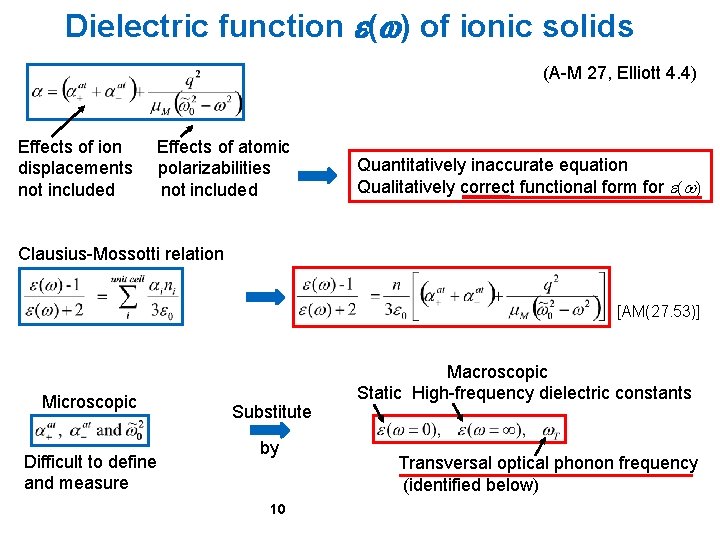
Dielectric function e(w) of ionic solids (A-M 27, Elliott 4. 4) Effects of ion displacements not included Effects of atomic polarizabilities not included Quantitatively inaccurate equation Qualitatively correct functional form for e(w) Clausius-Mossotti relation [AM(27. 53)] Microscopic Difficult to define and measure Substitute by 10 Macroscopic Static High-frequency dielectric constants Transversal optical phonon frequency (identified below)
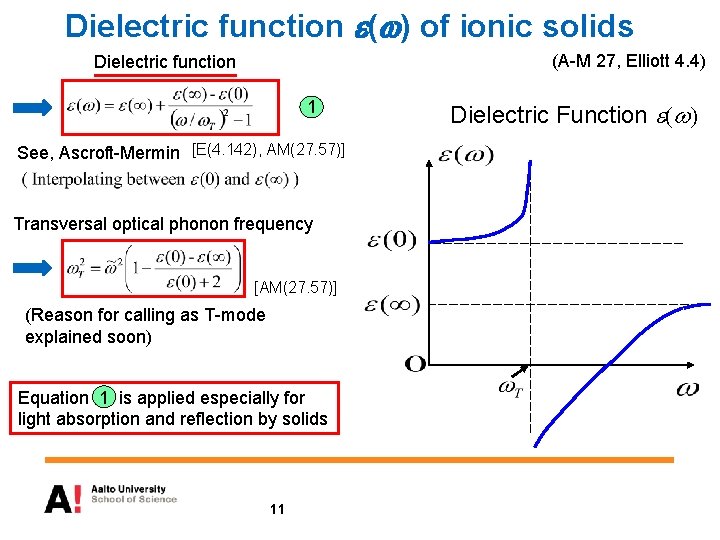
Dielectric function e(w) of ionic solids (A-M 27, Elliott 4. 4) Dielectric function 1 See, Ascroft-Mermin [E(4. 142), AM(27. 57)] Transversal optical phonon frequency [AM(27. 57)] (Reason for calling as T-mode explained soon) Equation 1 is applied especially for light absorption and reflection by solids 11 Dielectric Function e(w)
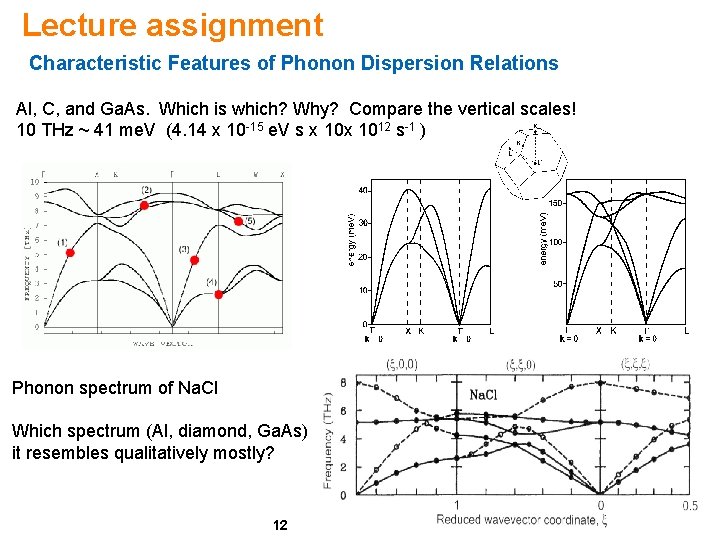
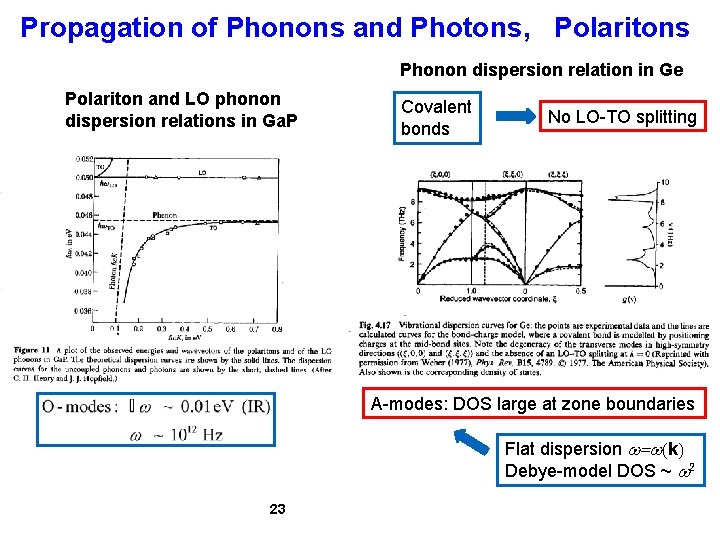
Lecture assignment Characteristic Features of Phonon Dispersion Relations Al, C, and Ga. As. Which is which? Why? Compare the vertical scales! 10 THz ~ 41 me. V (4. 14 x 10 -15 e. V s x 1012 s-1 ) D Phonon spectrum of Na. Cl Which spectrum (Al, diamond, Ga. As) it resembles qualitatively mostly? 12 D
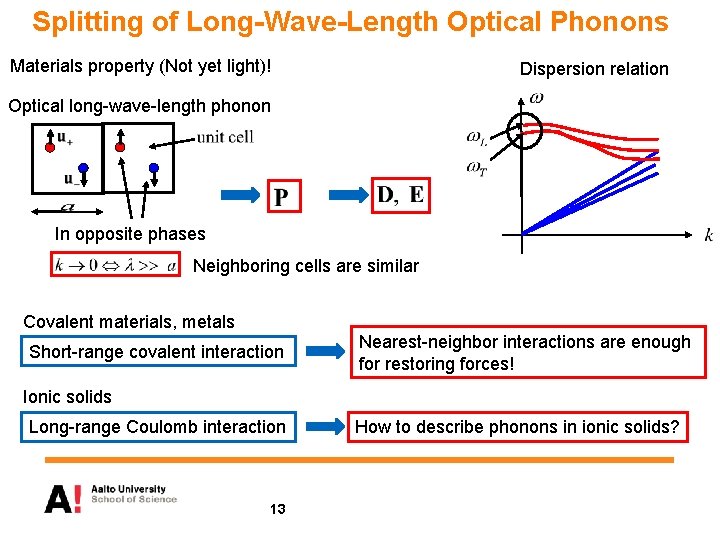
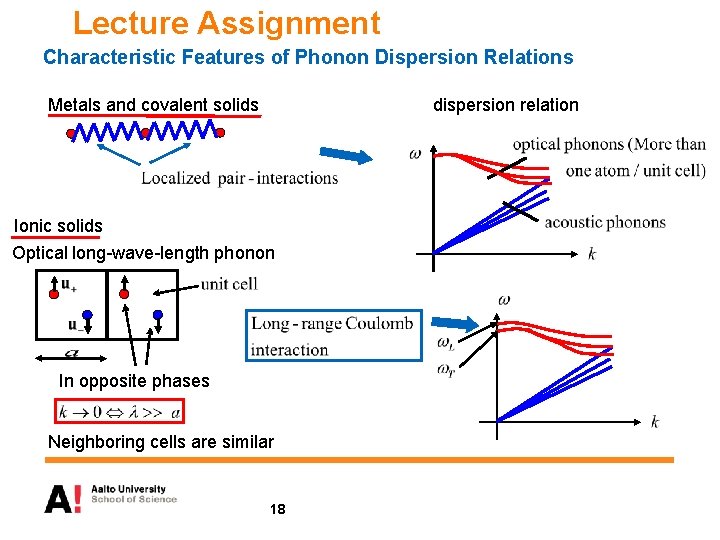
Splitting of Long-Wave-Length Optical Phonons Materials property (Not yet light)! Dispersion relation Optical long-wave-length phonon In opposite phases Neighboring cells are similar Covalent materials, metals Short-range covalent interaction Nearest-neighbor interactions are enough for restoring forces! Ionic solids Long-range Coulomb interaction 13 How to describe phonons in ionic solids?
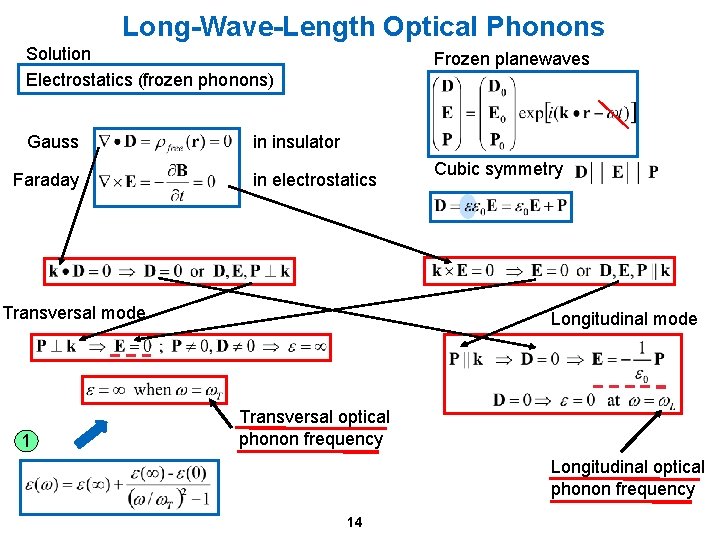
Long-Wave-Length Optical Phonons Solution Electrostatics (frozen phonons) Gauss Faraday Frozen planewaves in insulator in electrostatics Transversal mode 1 Cubic symmetry Longitudinal mode Transversal optical phonon frequency Longitudinal optical phonon frequency 14
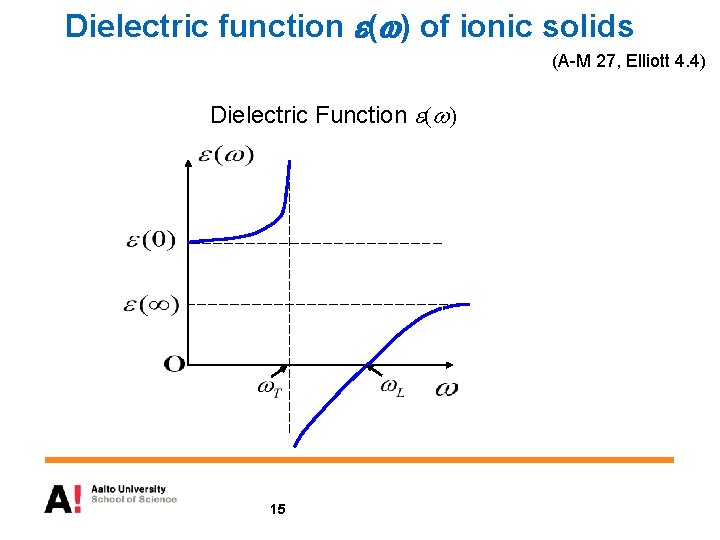
Dielectric function e(w) of ionic solids (A-M 27, Elliott 4. 4) Dielectric Function e(w) 15
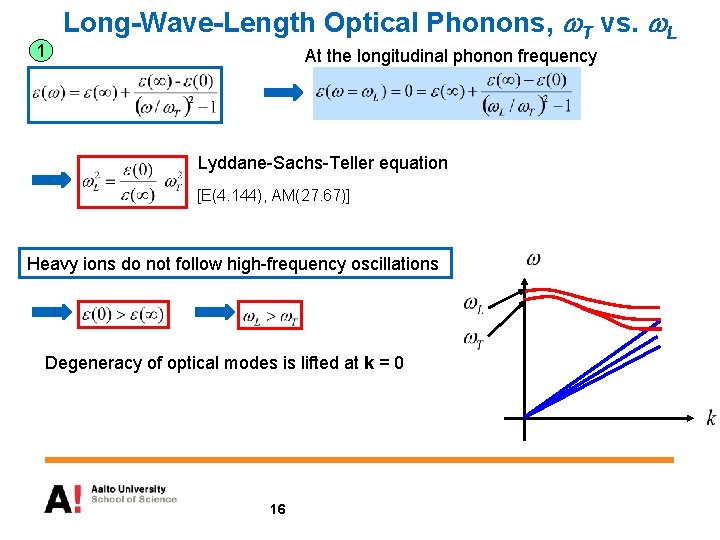
1 Long-Wave-Length Optical Phonons, w. T vs. w. L At the longitudinal phonon frequency Lyddane-Sachs-Teller equation [E(4. 144), AM(27. 67)] Heavy ions do not follow high-frequency oscillations Degeneracy of optical modes is lifted at k = 0 16
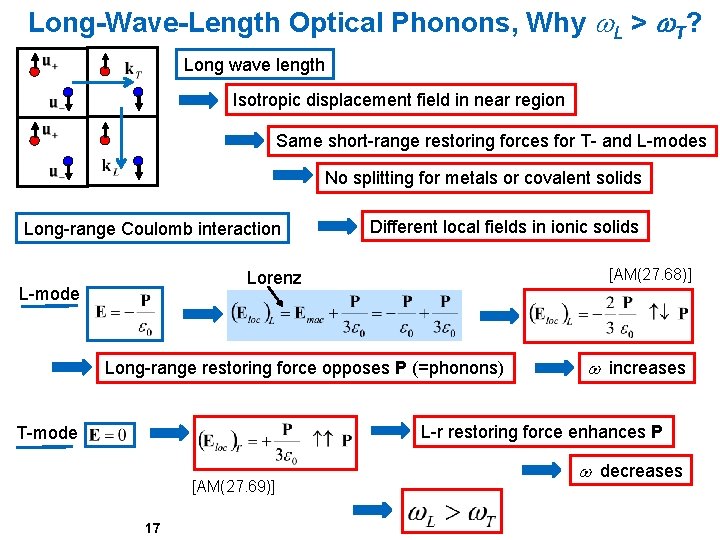
Long-Wave-Length Optical Phonons, Why w. L > w. T? Long wave length Isotropic displacement field in near region Same short-range restoring forces for T- and L-modes No splitting for metals or covalent solids Long-range Coulomb interaction Different local fields in ionic solids [AM(27. 68)] Lorenz L-mode Long-range restoring force opposes P (=phonons) w increases L-r restoring force enhances P T-mode [AM(27. 69)] 17 w decreases
Lecture Assignment Characteristic Features of Phonon Dispersion Relations Metals and covalent solids dispersion relation Ionic solids Optical long-wave-length phonon In opposite phases Neighboring cells are similar 18
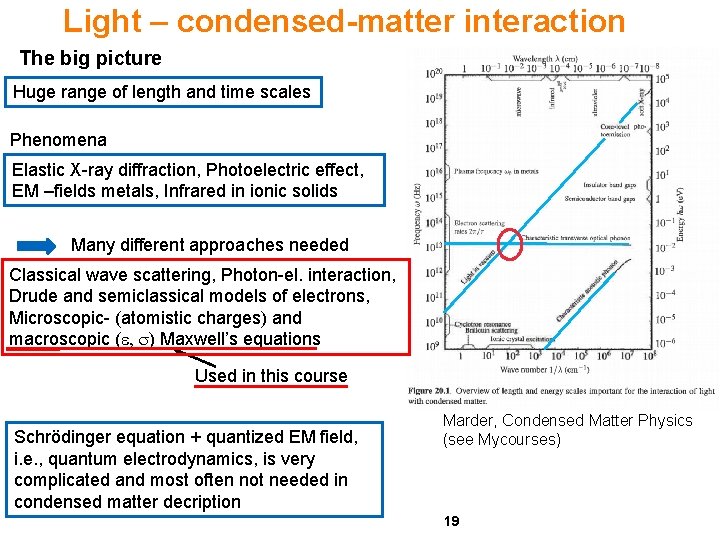
Light – condensed-matter interaction The big picture Huge range of length and time scales Phenomena Elastic X-ray diffraction, Photoelectric effect, EM –fields metals, Infrared in ionic solids Many different approaches needed Classical wave scattering, Photon-el. interaction, Drude and semiclassical models of electrons, Microscopic- (atomistic charges) and macroscopic (e, s) Maxwell’s equations Used in this course Schrödinger equation + quantized EM field, i. e. , quantum electrodynamics, is very complicated and most often not needed in condensed matter decription Marder, Condensed Matter Physics (see Mycourses) 19
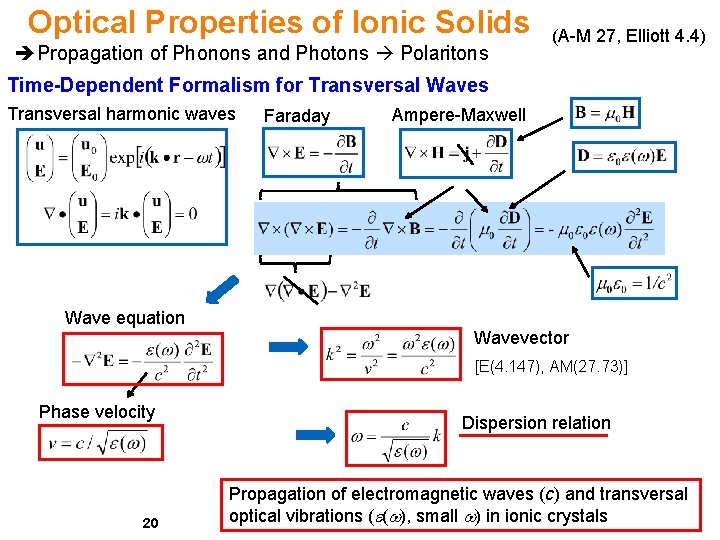
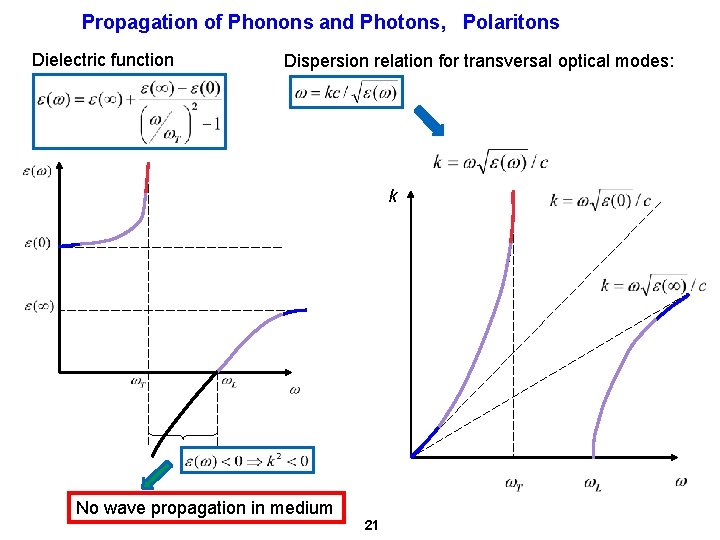
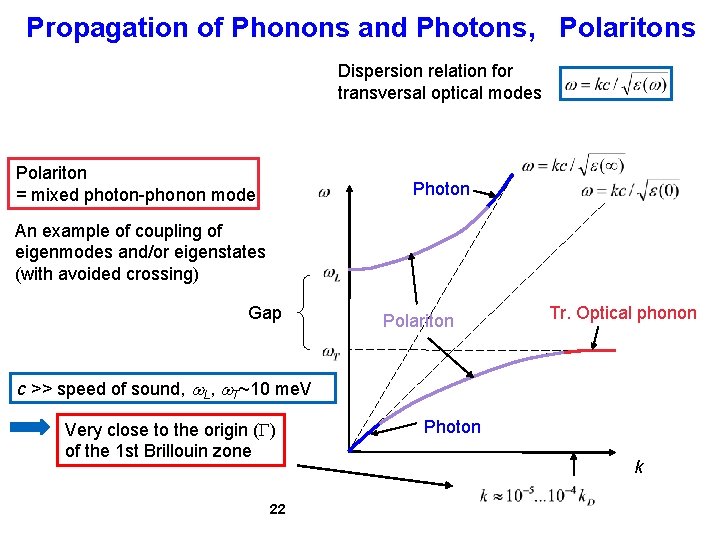
Optical Properties of Ionic Solids Propagation of Phonons and Photons Polaritons (A-M 27, Elliott 4. 4) Time-Dependent Formalism for Transversal Waves Transversal harmonic waves Faraday Ampere-Maxwell Wave equation Wavevector [E(4. 147), AM(27. 73)] Phase velocity 20 Dispersion relation Propagation of electromagnetic waves (c) and transversal optical vibrations (e(w), small w) in ionic crystals
Propagation of Phonons and Photons, Polaritons Dielectric function Dispersion relation for transversal optical modes: k No wave propagation in medium No 21
Propagation of Phonons and Photons, Polaritons Dispersion relation for transversal optical modes Polariton = mixed photon-phonon mode Photon An example of coupling of eigenmodes and/or eigenstates (with avoided crossing) Gap Polariton Tr. Optical phonon c >> speed of sound, w. L, w. T~10 me. V Very close to the origin (G) of the 1 st Brillouin zone 22 Photon k
Propagation of Phonons and Photons, Polaritons Phonon dispersion relation in Ge Polariton and LO phonon dispersion relations in Ga. P Covalent bonds No LO-TO splitting A-modes: DOS large at zone boundaries Flat dispersion w=w(k) Debye-model DOS ~ w 2 23
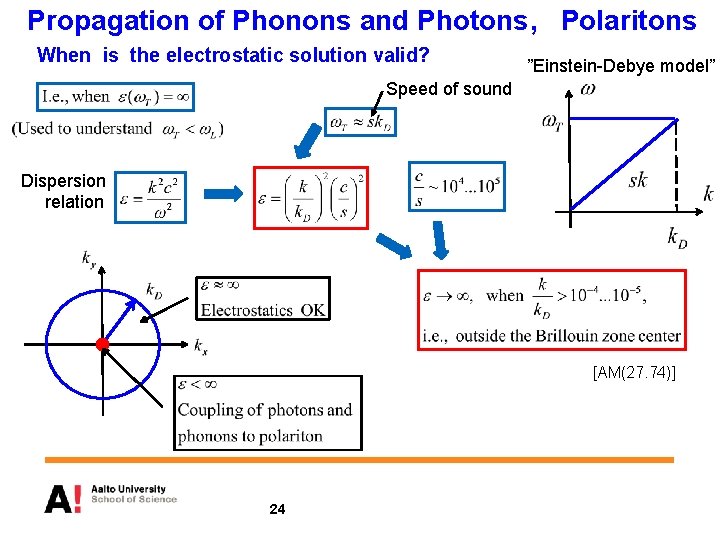
Propagation of Phonons and Photons, Polaritons When is the electrostatic solution valid? ”Einstein-Debye model” Speed of sound Dispersion relation [AM(27. 74)] 24
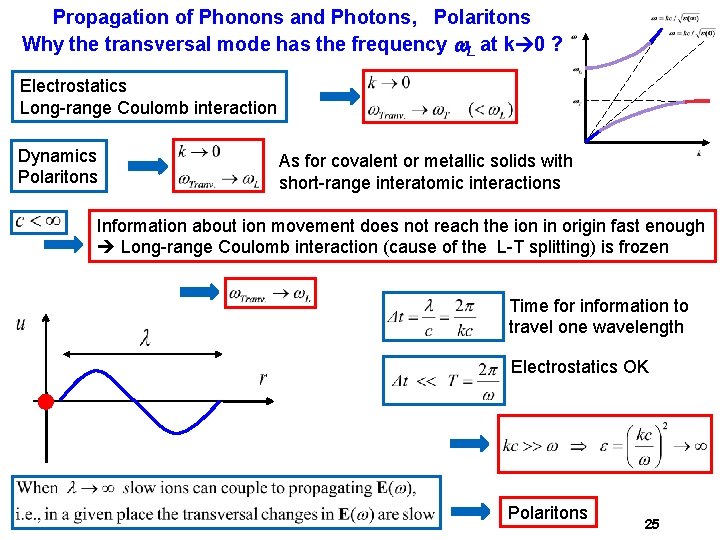
Propagation of Phonons and Photons, Polaritons Why the transversal mode has the frequency w. L at k 0 ? Electrostatics Long-range Coulomb interaction Dynamics Polaritons As for covalent or metallic solids with short-range interatomic interactions Information about ion movement does not reach the ion in origin fast enough Long-range Coulomb interaction (cause of the L-T splitting) is frozen Time for information to travel one wavelength Electrostatics OK How slow ions can couple with ”fast” light? Polaritons 25
Items of the second lecture on dielectric properties of solids • Dielectric properties of ionic solids – Behaviour of the dielectric function e(w) Application: Splitting of longitudinal and transversal optical modes • Optical properties of ionic solids: Light – optical phonon interactions – Coupling of electromagnetic waves and transversal optical phonons: polaritons 26
Items of the third lecture on dielectric properties of solids • Light – phonon interaction – Measuring phonon dispersion relations by infrared absorption and ineleastic photon scattering spectroscopies – Complex dielectric constant e+(w) = e 1(w) + i e 2(w), Kramers-Kronig relations • Optical properties of electrons in solids – Intraband excitations: creating electron-hole pairs and collective plasma oscillations of an electron gas (metals, heavily-doped semiconductors) – Interband excitations (direct and indirect band gap semiconductors) ; calculation of optical absorption coefficient from band structures ; bound electron-hole pairs: excitons • Spontaneous polarization – Piezoelectric, pyroelectric, ferroelectric materials nanoelectronics – Modern theory of polarization 27