
PHYS 389 Semiconductor Applications Lecture 15 Digital Gammaray
- Slides: 26
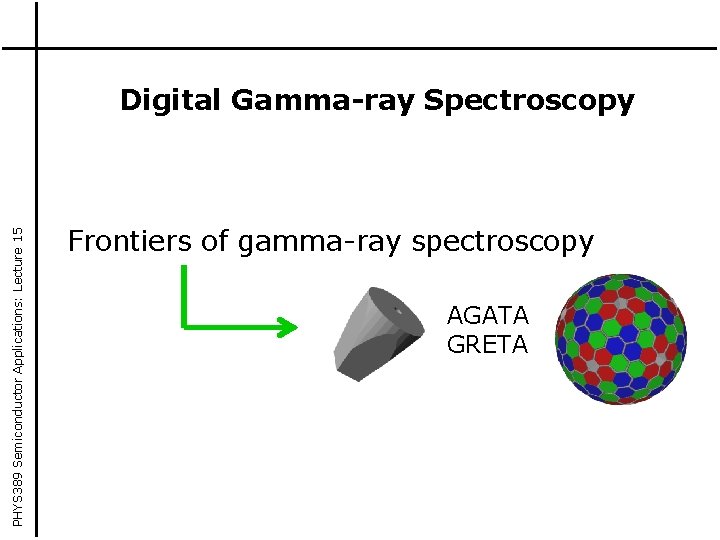
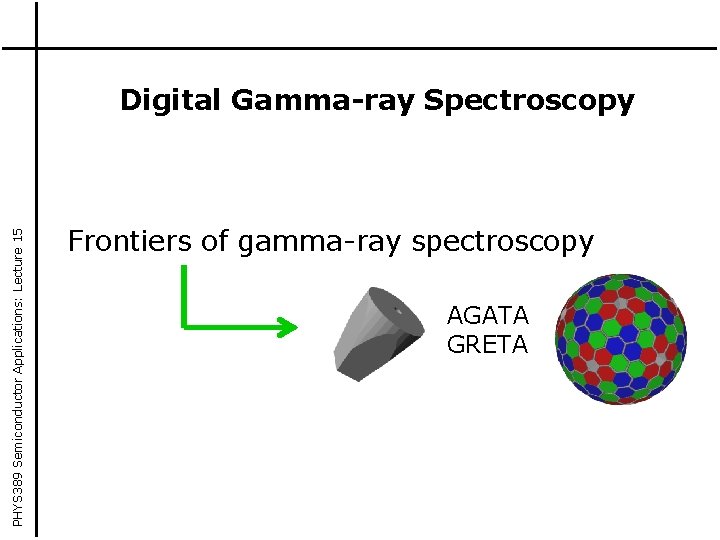
PHYS 389 Semiconductor Applications: Lecture 15 Digital Gamma-ray Spectroscopy Frontiers of gamma-ray spectroscopy AGATA GRETA
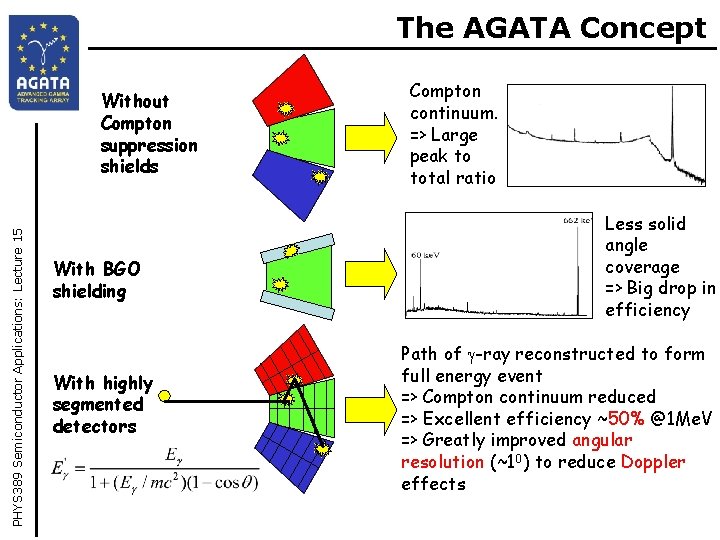
The AGATA Concept PHYS 389 Semiconductor Applications: Lecture 15 Without Compton suppression shields With BGO shielding With highly segmented detectors Compton continuum. => Large peak to total ratio Less solid angle coverage => Big drop in efficiency Path of -ray reconstructed to form full energy event => Compton continuum reduced => Excellent efficiency ~50% @1 Me. V => Greatly improved angular resolution (~10) to reduce Doppler effects
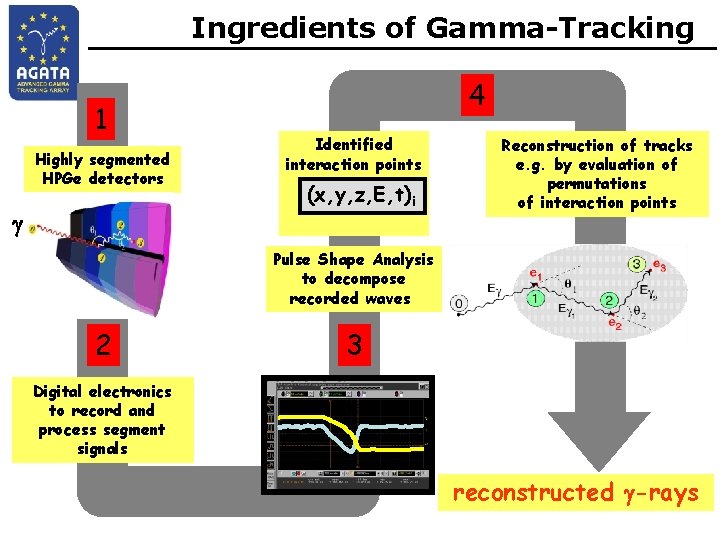
Ingredients of Gamma-Tracking 1 Highly segmented HPGe detectors · · PHYS 389 Semiconductor Applications: Lecture 15 · · g 2 4 Identified interaction points (x, y, z, E, t)i Reconstruction of tracks e. g. by evaluation of permutations of interaction points Pulse Shape Analysis to decompose recorded waves 3 Digital electronics to record and process segment signals reconstructed g-rays
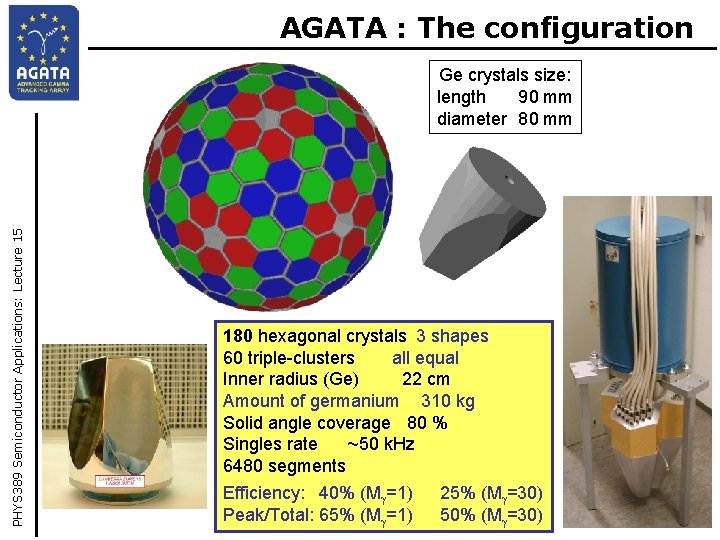
AGATA : The configuration PHYS 389 Semiconductor Applications: Lecture 15 Ge crystals size: length 90 mm diameter 80 mm 180 hexagonal crystals 3 shapes 60 triple-clusters all equal Inner radius (Ge) 22 cm Amount of germanium 310 kg Solid angle coverage 80 % Singles rate ~50 k. Hz 6480 segments Efficiency: 40% (M =1) 25% (M =30) Peak/Total: 65% (M =1) 50% (M =30)
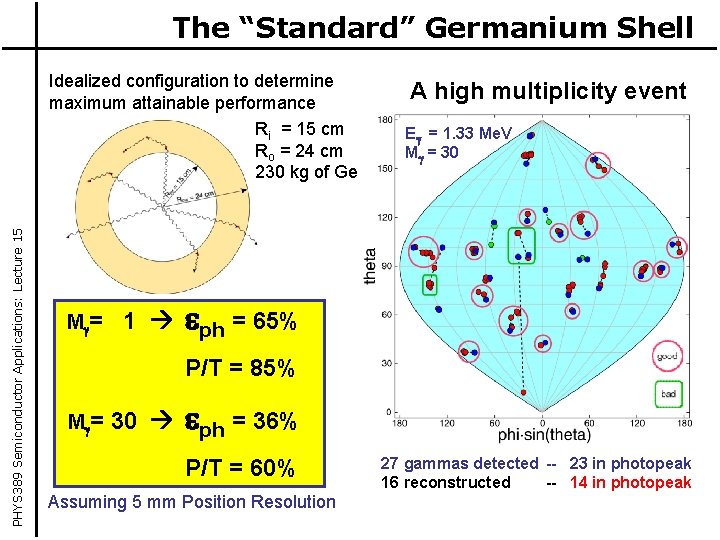
The “Standard” Germanium Shell PHYS 389 Semiconductor Applications: Lecture 15 Idealized configuration to determine maximum attainable performance Ri = 15 cm Ro = 24 cm 230 kg of Ge Mg= 1 A high multiplicity event Eg = 1. 33 Me. V Mg = 30 eph = 65% P/T = 85% Mg= 30 eph = 36% P/T = 60% Assuming 5 mm Position Resolution 27 gammas detected -- 23 in photopeak 16 reconstructed -- 14 in photopeak
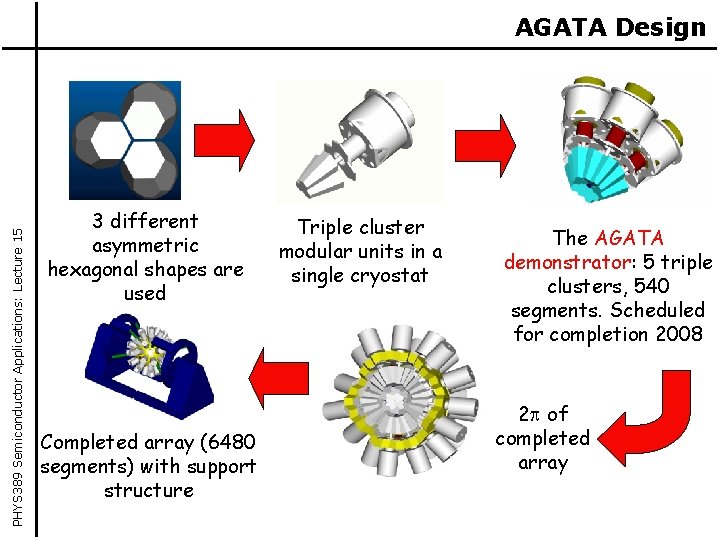
PHYS 389 Semiconductor Applications: Lecture 15 AGATA Design 3 different asymmetric hexagonal shapes are used Completed array (6480 segments) with support structure Triple cluster modular units in a single cryostat The AGATA demonstrator: 5 triple clusters, 540 segments. Scheduled for completion 2008 2 of completed array
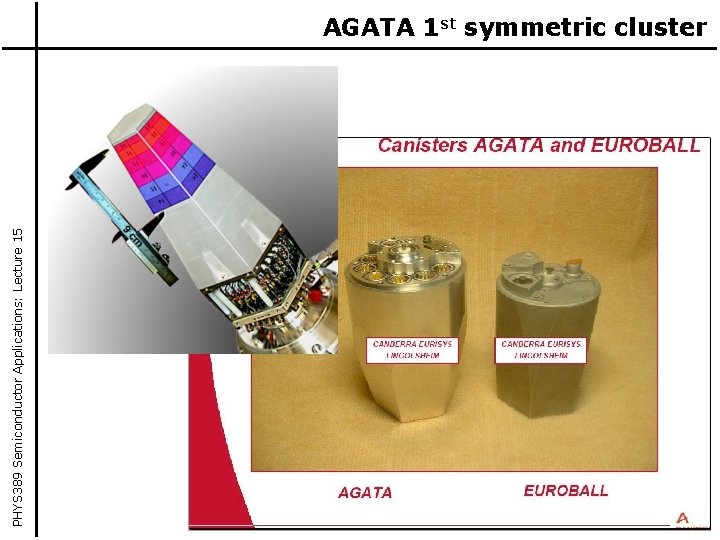
PHYS 389 Semiconductor Applications: Lecture 15 AGATA 1 st symmetric cluster
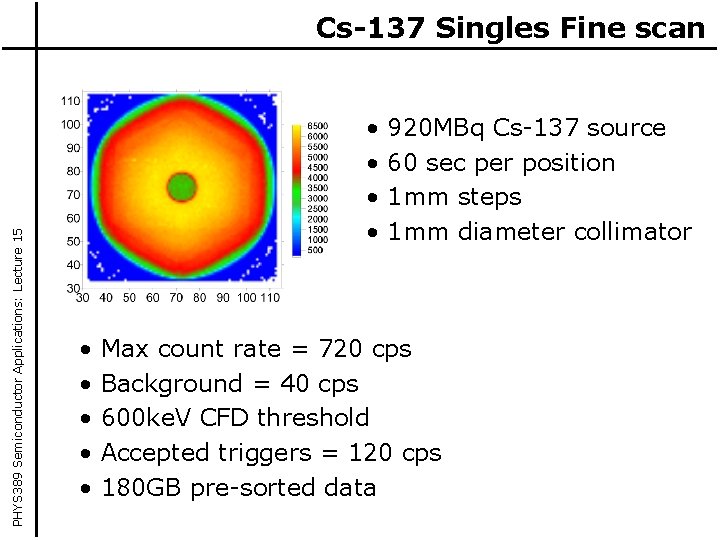
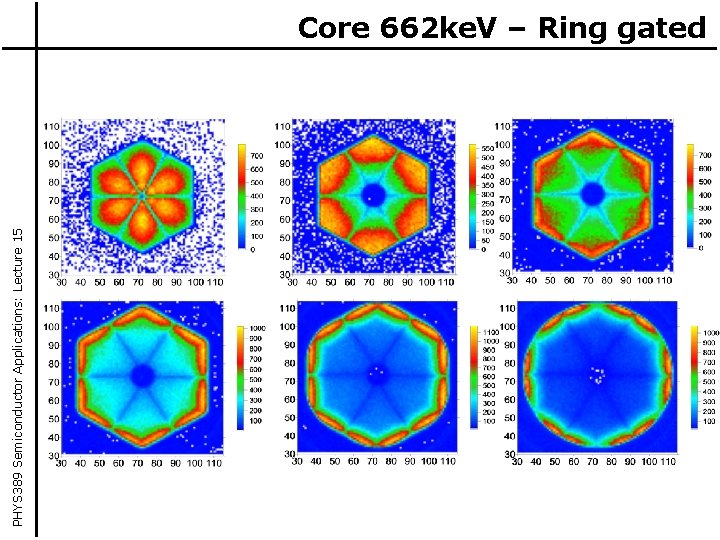
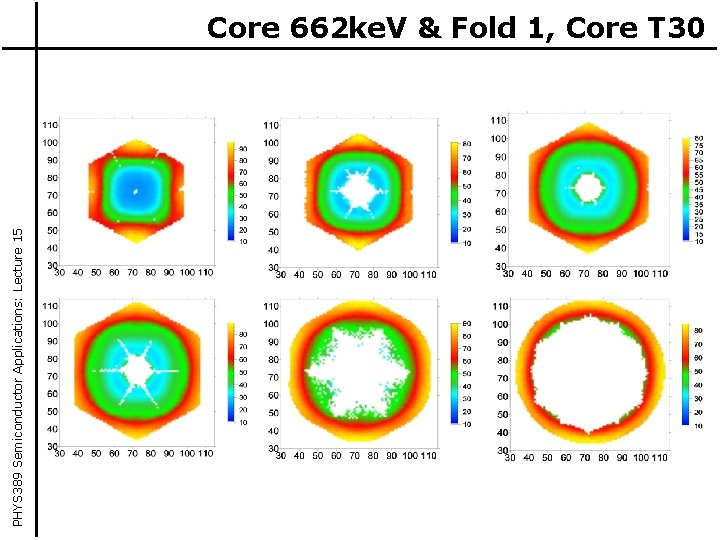
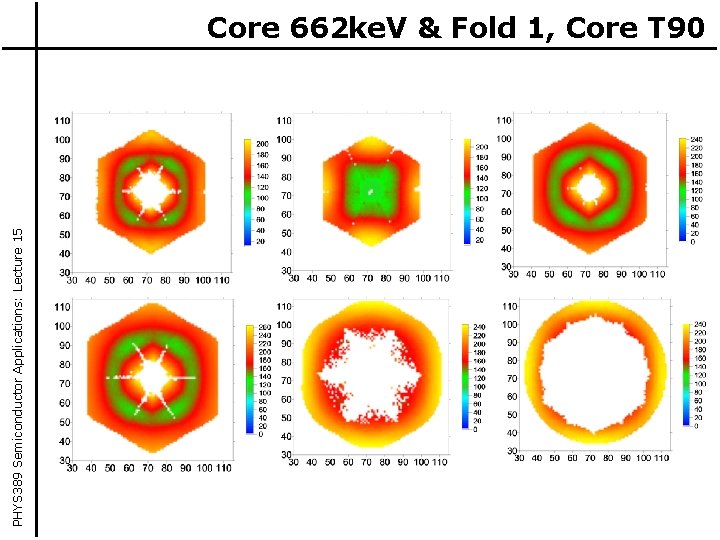
PHYS 389 Semiconductor Applications: Lecture 15 Cs-137 Singles Fine scan • • • 920 MBq Cs-137 source 60 sec per position 1 mm steps 1 mm diameter collimator Max count rate = 720 cps Background = 40 cps 600 ke. V CFD threshold Accepted triggers = 120 cps 180 GB pre-sorted data
PHYS 389 Semiconductor Applications: Lecture 15 Core 662 ke. V – Ring gated
PHYS 389 Semiconductor Applications: Lecture 15 Core 662 ke. V & Fold 1, Core T 30
PHYS 389 Semiconductor Applications: Lecture 15 Core 662 ke. V & Fold 1, Core T 90
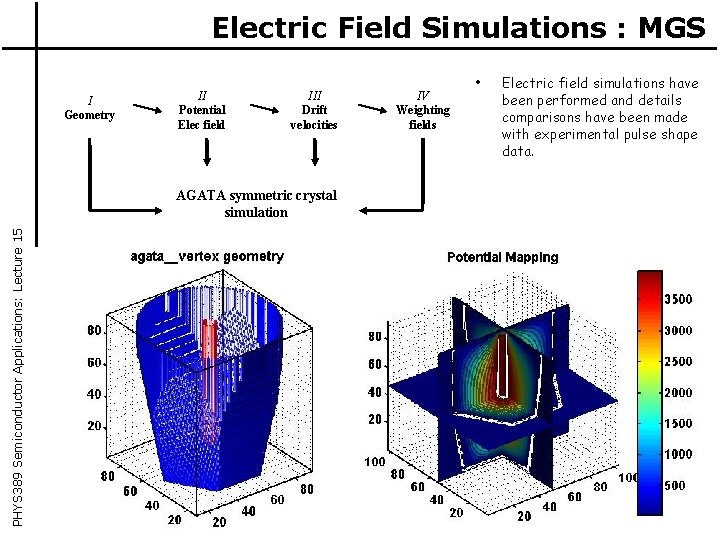
Electric Field Simulations : MGS I Geometry II Potential Elec field III Drift velocities PHYS 389 Semiconductor Applications: Lecture 15 AGATA symmetric crystal simulation IV Weighting fields • Electric field simulations have been performed and details comparisons have been made with experimental pulse shape data.
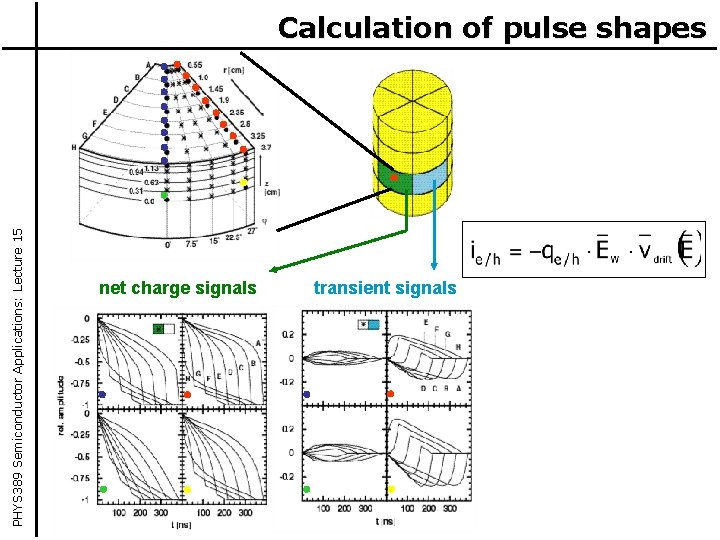
Calculation of pulse shapes PHYS 389 Semiconductor Applications: Lecture 15 ·· · · · * net charge signals transient signals · · · ·
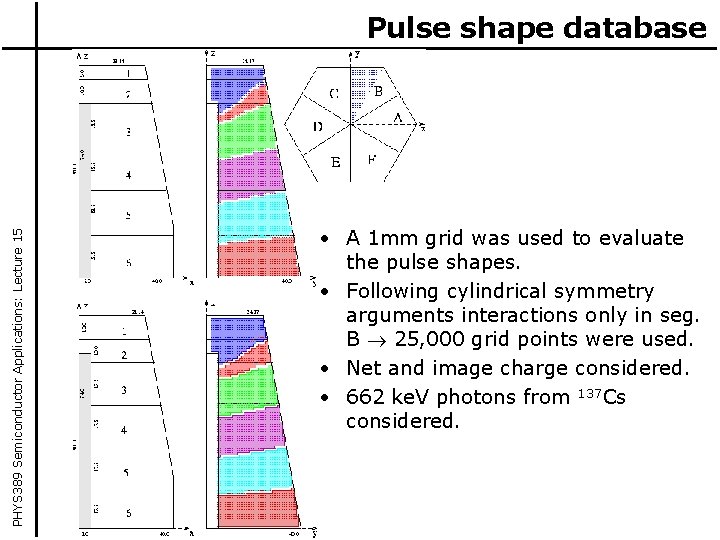
PHYS 389 Semiconductor Applications: Lecture 15 Pulse shape database • A 1 mm grid was used to evaluate the pulse shapes. • Following cylindrical symmetry arguments interactions only in seg. B 25, 000 grid points were used. • Net and image charge considered. • 662 ke. V photons from 137 Cs considered.
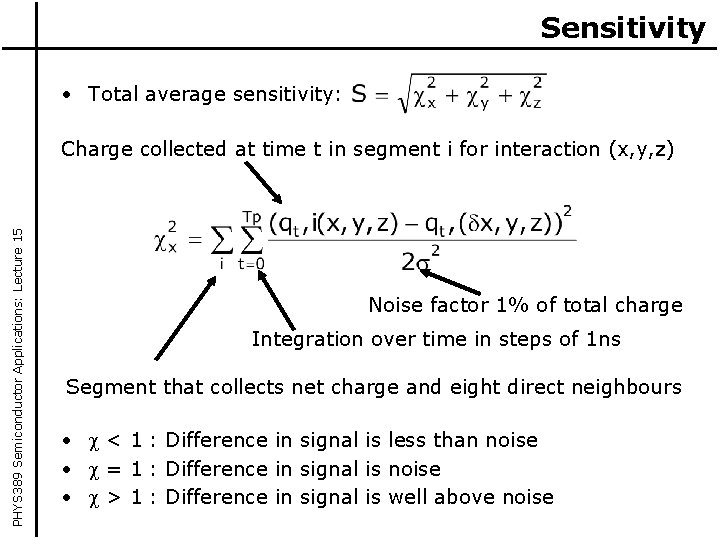
Sensitivity • Total average sensitivity: PHYS 389 Semiconductor Applications: Lecture 15 Charge collected at time t in segment i for interaction (x, y, z) Noise factor 1% of total charge Integration over time in steps of 1 ns Segment that collects net charge and eight direct neighbours • < 1 : Difference in signal is less than noise • = 1 : Difference in signal is noise • > 1 : Difference in signal is well above noise
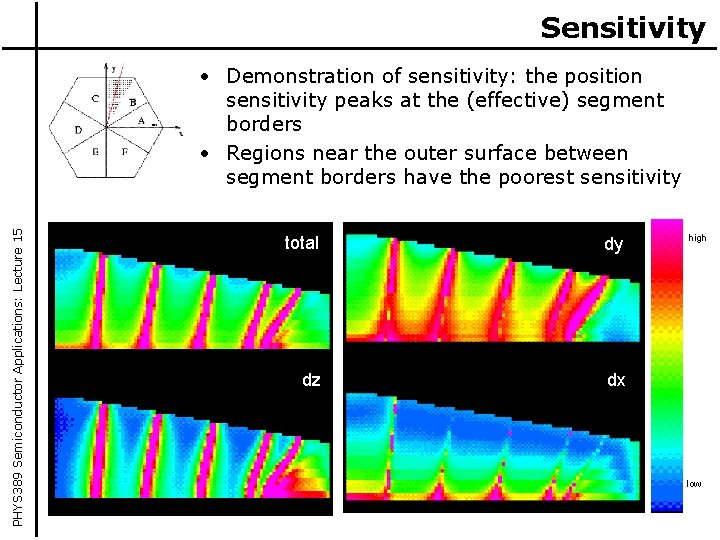
Sensitivity PHYS 389 Semiconductor Applications: Lecture 15 • Demonstration of sensitivity: the position sensitivity peaks at the (effective) segment borders • Regions near the outer surface between segment borders have the poorest sensitivity total dy dz dx high low
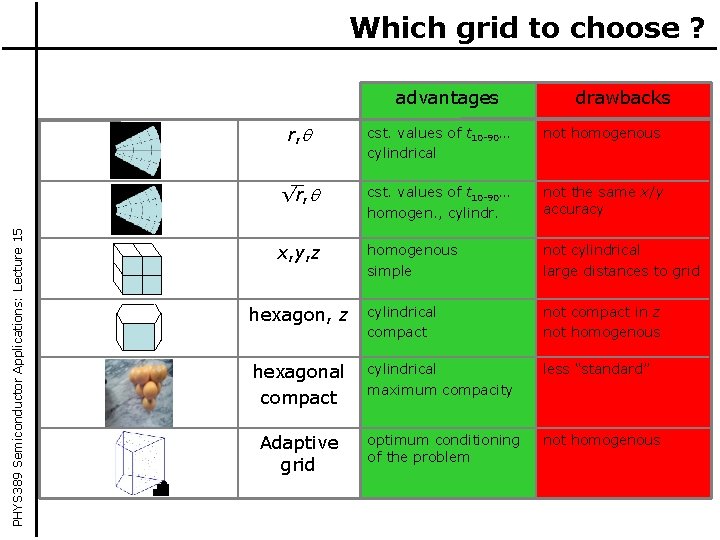
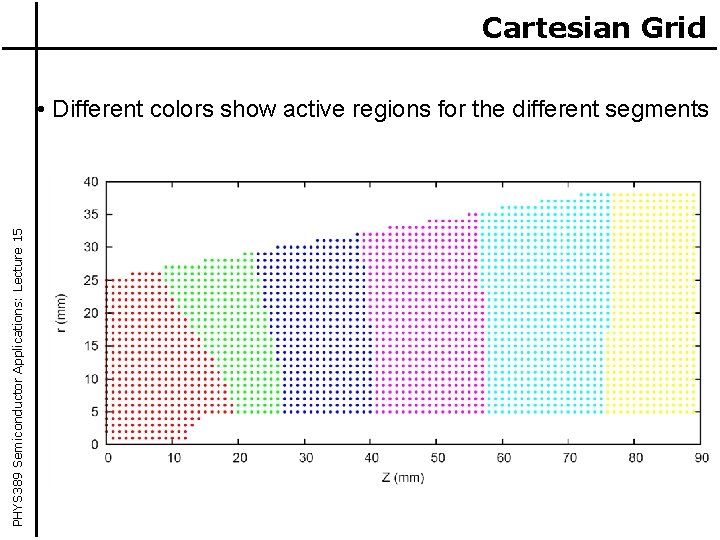
Which grid to choose ? PHYS 389 Semiconductor Applications: Lecture 15 advantages drawbacks r, q cst. values of t 10 -90… cylindrical not homogenous √r, q cst. values of t 10 -90… homogen. , cylindr. not the same x/y accuracy x, y, z homogenous simple not cylindrical large distances to grid hexagon, z cylindrical compact not compact in z not homogenous hexagonal compact cylindrical maximum compacity less “standard” Adaptive grid optimum conditioning of the problem not homogenous
Cartesian Grid PHYS 389 Semiconductor Applications: Lecture 15 • Different colors show active regions for the different segments
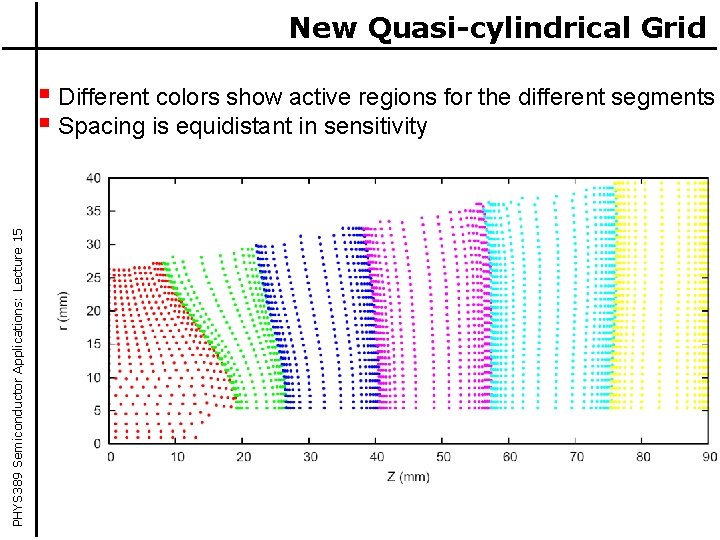
New Quasi-cylindrical Grid PHYS 389 Semiconductor Applications: Lecture 15 § Different colors show active regions for the different segments § Spacing is equidistant in sensitivity
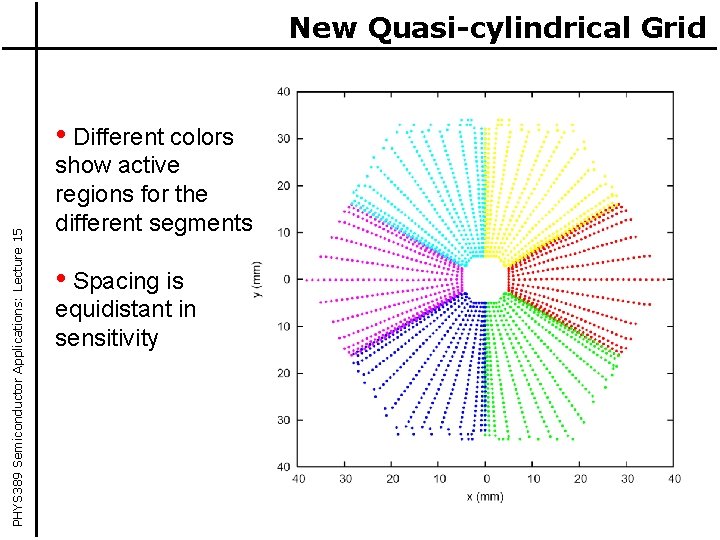
New Quasi-cylindrical Grid PHYS 389 Semiconductor Applications: Lecture 15 • Different colors show active regions for the different segments • Spacing is equidistant in sensitivity
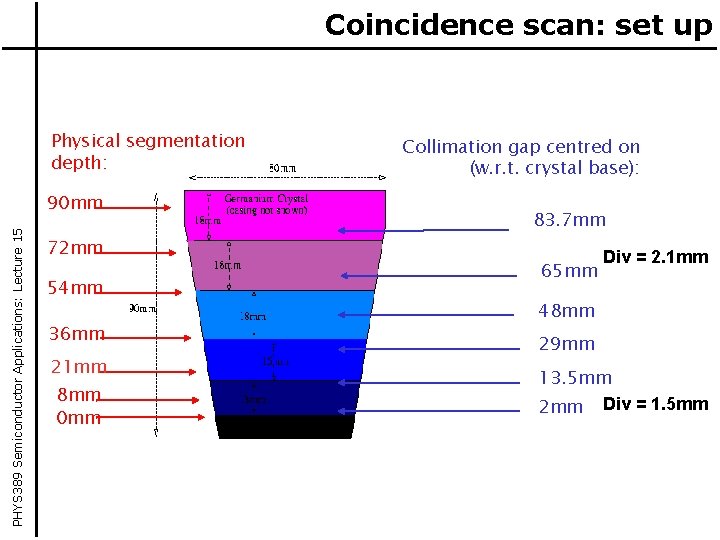
Coincidence scan: set up Physical segmentation depth: PHYS 389 Semiconductor Applications: Lecture 15 90 mm 72 mm 54 mm 36 mm 21 mm 8 mm 0 mm Collimation gap centred on (w. r. t. crystal base): 83. 7 mm 65 mm Div = 2. 1 mm 48 mm 29 mm 13. 5 mm 2 mm Div = 1. 5 mm
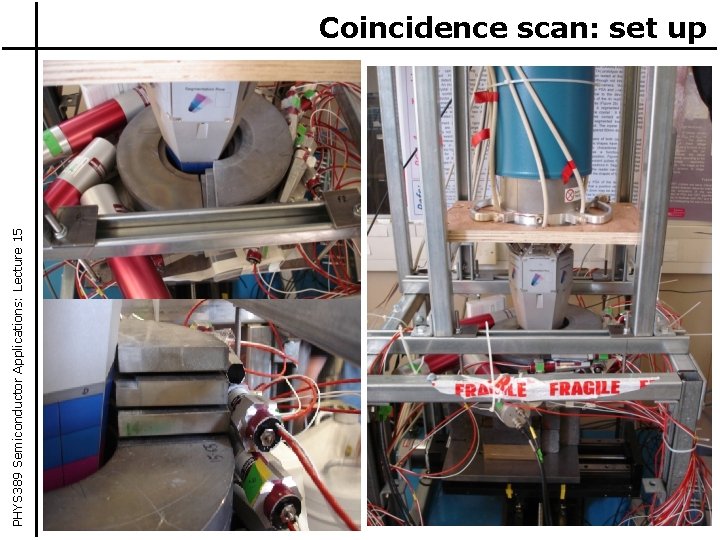
PHYS 389 Semiconductor Applications: Lecture 15 Coincidence scan: set up
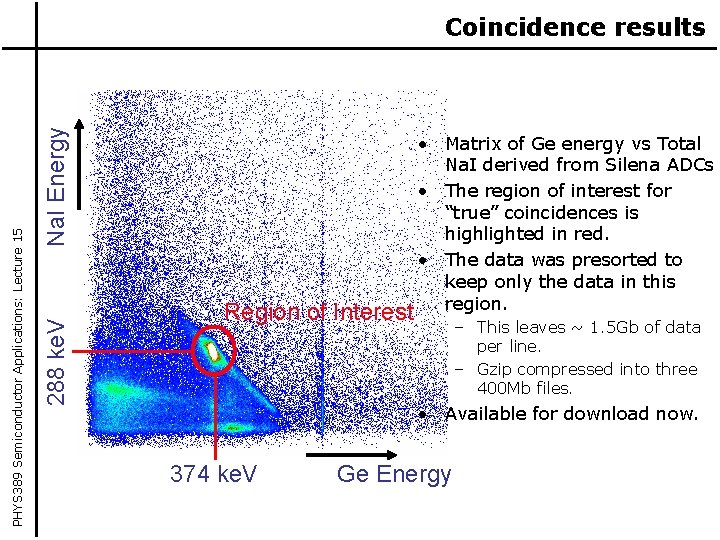
Na. I Energy 288 ke. V PHYS 389 Semiconductor Applications: Lecture 15 Coincidence results Region of Interest • Matrix of Ge energy vs Total Na. I derived from Silena ADCs • The region of interest for “true” coincidences is highlighted in red. • The data was presorted to keep only the data in this region. – This leaves ~ 1. 5 Gb of data per line. – Gzip compressed into three 400 Mb files. • Available for download now. 374 ke. V Ge Energy
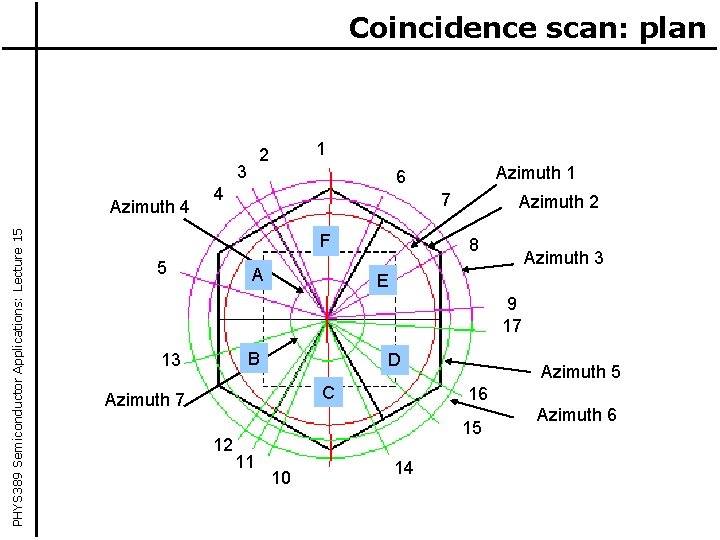
Coincidence scan: plan 3 PHYS 389 Semiconductor Applications: Lecture 15 Azimuth 4 1 2 4 7 F 5 Azimuth 1 6 A Azimuth 2 8 Azimuth 3 E 9 17 B 13 D C Azimuth 7 12 Azimuth 5 16 15 11 10 14 Azimuth 6
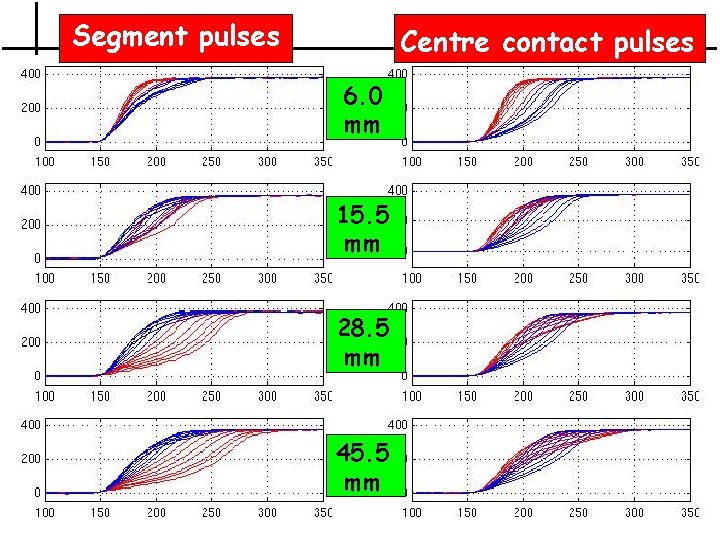
Segment pulses Centre contact pulses PHYS 389 Semiconductor Applications: Lecture 15 6. 0 mm 15. 5 mm 28. 5 mm 45. 5 mm
PHYS 389 Semiconductor Applications: Lecture 15 Digital Gamma-ray Spectroscopy Frontiers of gamma-ray spectroscopy AGATA GRETA