
PHYS 3313 Section 001 Lecture 22 Monday April


- Slides: 15
PHYS 3313 – Section 001 Lecture #22 Monday, April 15, 2019 Dr. Jaehoon Yu • Schrodinger Equations on Hydrogen Atom • Hydrogen Atom Wave Functions • Solution for Radial Equations • Solution for Angular and Azimuthal Equations • Angular Momentum Quantum Mon. April 15, 2019 PHYS 3313 -001, Spring 2019 Numbers Dr. Jaehoon Yu 1
Announcements • Bring out HW#5 • Reading assignments – CH 7. 2, CH 7. 6 and the entire CH 8 • Presentations next Monday and Wednesday • Research presentation deadline is 8 pm, Sunday, April 21 • Research paper deadline is Wednesday, 4/24 • You guys have done a marvelous job at the workshop last week! Everyone complimented how good you all were! Mon. April 15, 2019 this week’s PHYS 3313 -001, Spring 2019 2 Let’s hit workshop out of the Dr. Jaehoon Yu
Reminder: Special Project #7 • Show that the Schrodinger wave equation becomes Newton’s second law in the classical limit. (15 points) • Deadline this Wednesday, Apr. 17 • You MUST have your own answers! Mon. April 15, 2019 PHYS 3313 -001, Spring 2019 Dr. Jaehoon Yu 3
Application of the Schrödinger Equation to the Hydrogen Atom • The approximation of the potential energy of the electron-proton system is the Coulomb potential: • To solve this problem, we use threedimensional time-independent Schrödinger Wave Equation. • For Hydrogen-like atoms with one electron (He+ or Li++) • Replace e 2 with Ze 2 (Z is the atomic number) Mon. April 15, 2019 PHYS 3313 -001, Spring 2019 Dr. Jaehoon Yu • Use the appropriate reduced mass μ 4
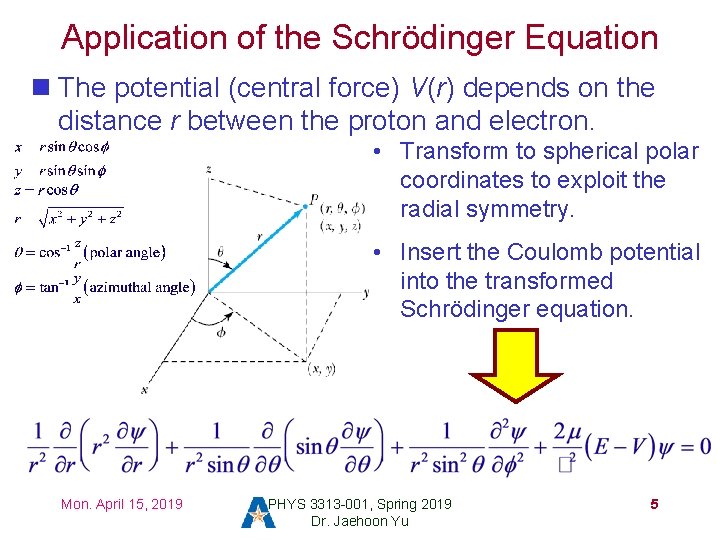
Application of the Schrödinger Equation n The potential (central force) V(r) depends on the distance r between the proton and electron. • Transform to spherical polar coordinates to exploit the radial symmetry. • Insert the Coulomb potential into the transformed Schrödinger equation. Mon. April 15, 2019 PHYS 3313 -001, Spring 2019 Dr. Jaehoon Yu 5
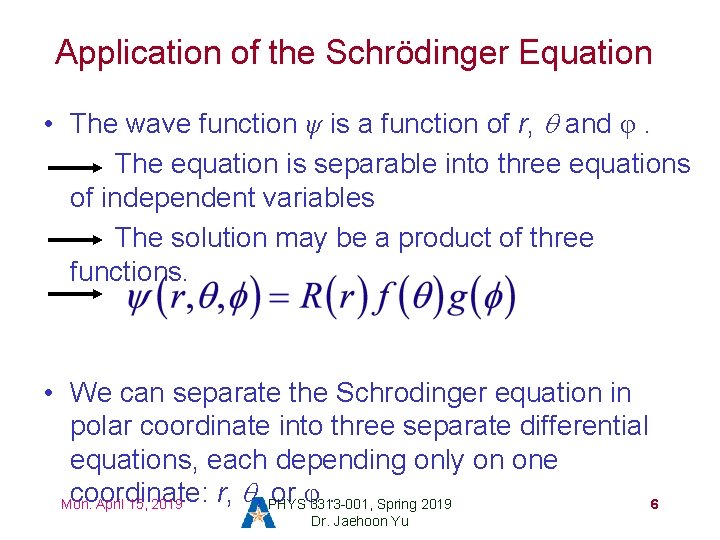
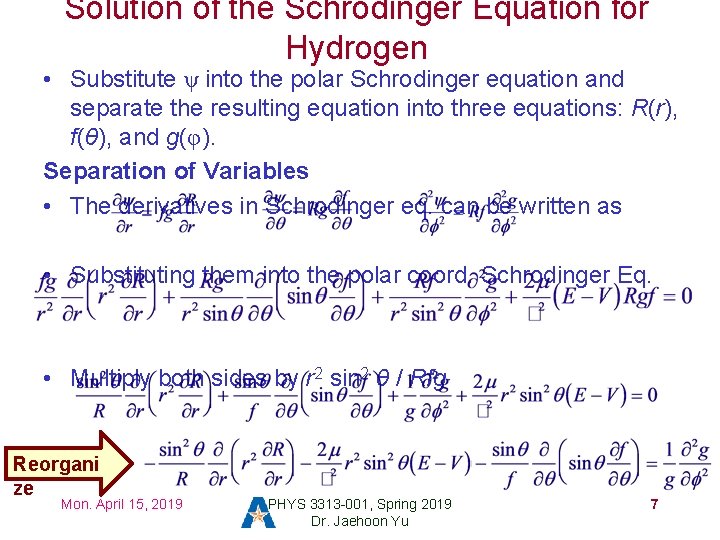
Application of the Schrödinger Equation • The wave function ψ is a function of r, q and φ. The equation is separable into three equations of independent variables The solution may be a product of three functions. • We can separate the Schrodinger equation in polar coordinate into three separate differential equations, each depending only on one coordinate: r, q, PHYS or φ3313 -001, . Spring 2019 Mon. April 15, 2019 6 Dr. Jaehoon Yu
Solution of the Schrödinger Equation for Hydrogen • Substitute ψ into the polar Schrodinger equation and separate the resulting equation into three equations: R(r), f(θ), and g(φ). Separation of Variables • The derivatives in Schrodinger eq. can be written as • Substituting them into the polar coord. Schrodinger Eq. • Multiply both sides by r 2 sin 2 θ / Rfg Reorgani ze Mon. April 15, 2019 PHYS 3313 -001, Spring 2019 Dr. Jaehoon Yu 7
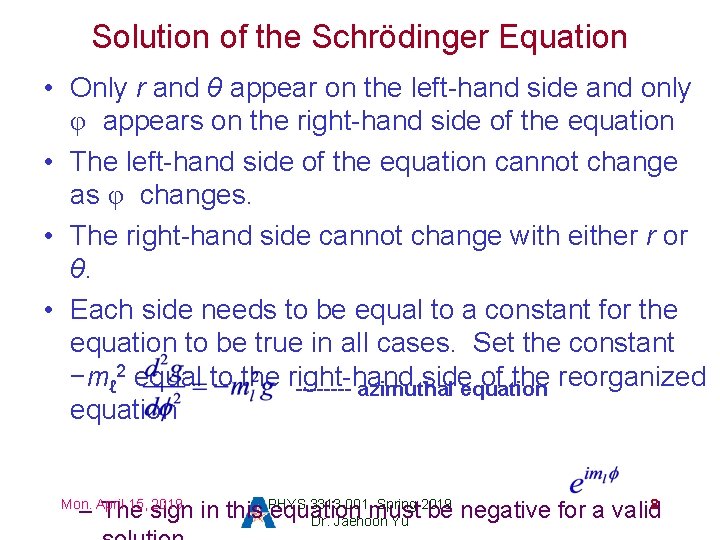
Solution of the Schrödinger Equation • Only r and θ appear on the left-hand side and only φ appears on the right-hand side of the equation • The left-hand side of the equation cannot change as φ changes. • The right-hand side cannot change with either r or θ. • Each side needs to be equal to a constant for the equation to be true in all cases. Set the constant −mℓ 2 equal to the right-hand sideequation of the reorganized ---- azimuthal equation 3313 -001, Spring 2019 8 – The sign in this PHYS equation must be negative for a valid Dr. Jaehoon Yu Mon. April 15, 2019
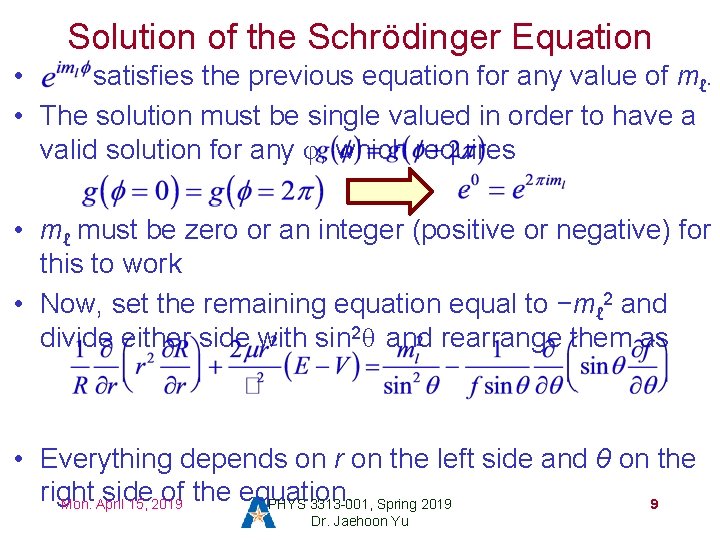
Solution of the Schrödinger Equation • satisfies the previous equation for any value of mℓ. • The solution must be single valued in order to have a valid solution for any φ, which requires • mℓ must be zero or an integer (positive or negative) for this to work • Now, set the remaining equation equal to −mℓ 2 and divide either side with sin 2θ and rearrange them as • Everything depends on r on the left side and θ on the right side of the equation. Mon. April 15, 2019 PHYS 3313 -001, Spring 2019 9 Dr. Jaehoon Yu
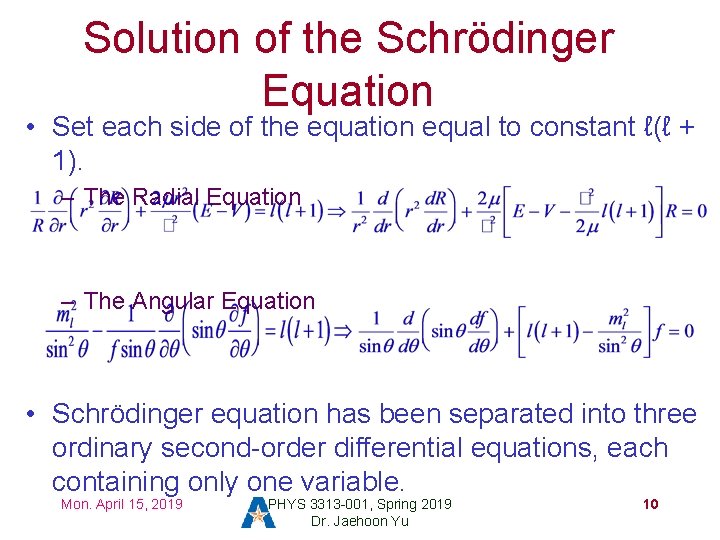
Solution of the Schrödinger Equation • Set each side of the equation equal to constant ℓ(ℓ + 1). – The Radial Equation – The Angular Equation • Schrödinger equation has been separated into three ordinary second-order differential equations, each containing only one variable. Mon. April 15, 2019 PHYS 3313 -001, Spring 2019 Dr. Jaehoon Yu 10
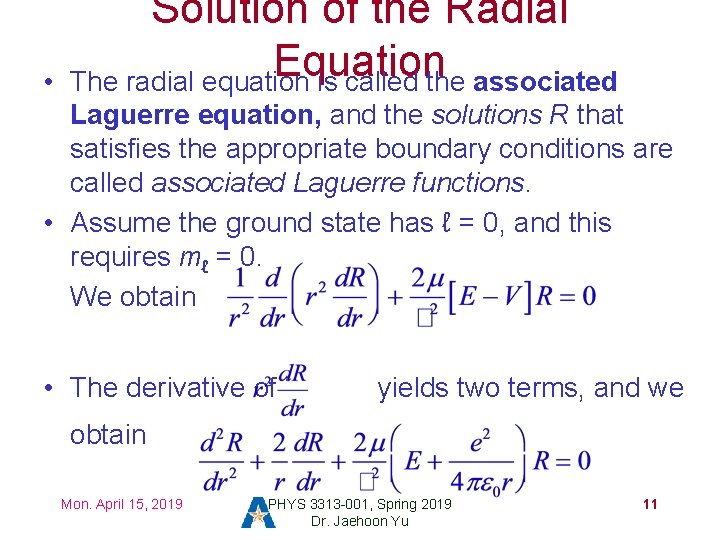
• Solution of the Radial Equation The radial equation is called the associated Laguerre equation, and the solutions R that satisfies the appropriate boundary conditions are called associated Laguerre functions. • Assume the ground state has ℓ = 0, and this requires mℓ = 0. We obtain • The derivative of yields two terms, and we obtain Mon. April 15, 2019 PHYS 3313 -001, Spring 2019 Dr. Jaehoon Yu 11
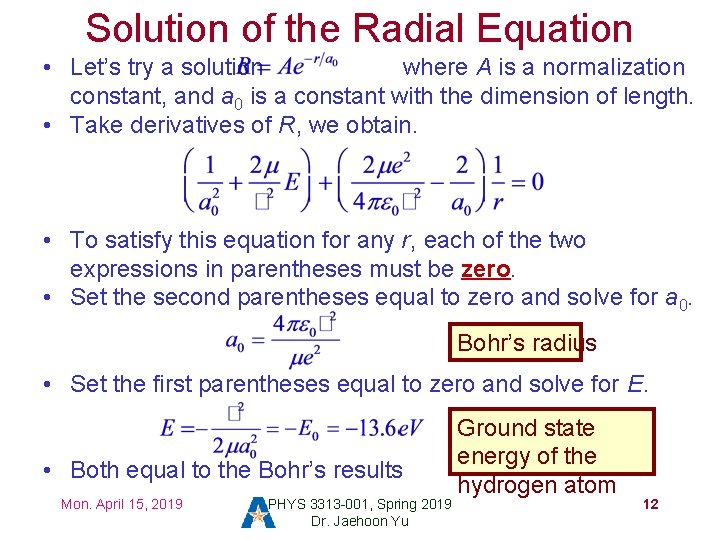
Solution of the Radial Equation • Let’s try a solution where A is a normalization constant, and a 0 is a constant with the dimension of length. • Take derivatives of R, we obtain. • To satisfy this equation for any r, each of the two expressions in parentheses must be zero. • Set the second parentheses equal to zero and solve for a 0. Bohr’s radius • Set the first parentheses equal to zero and solve for E. • Both equal to the Bohr’s results Mon. April 15, 2019 PHYS 3313 -001, Spring 2019 Dr. Jaehoon Yu Ground state energy of the hydrogen atom 12
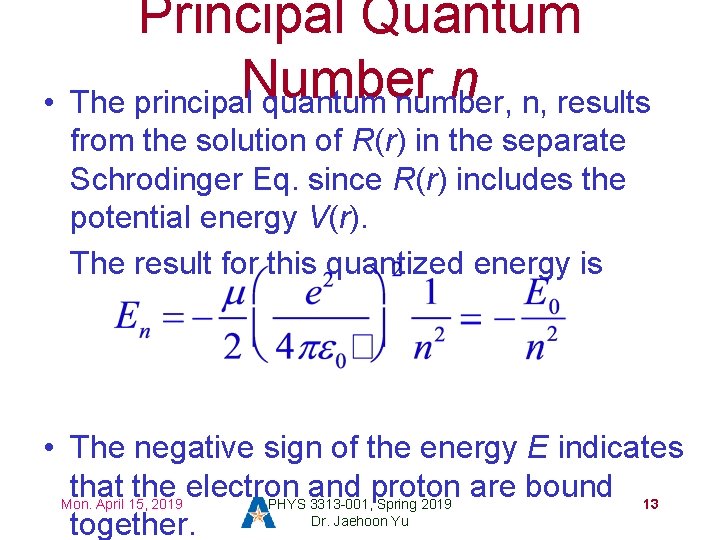
Principal Quantum Number n • The principal quantum number, n, results from the solution of R(r) in the separate Schrodinger Eq. since R(r) includes the potential energy V(r). The result for this quantized energy is • The negative sign of the energy E indicates that the electron and proton are bound 13 Mon. April 15, 2019 PHYS 3313 -001, Spring 2019 Dr. Jaehoon Yu together.
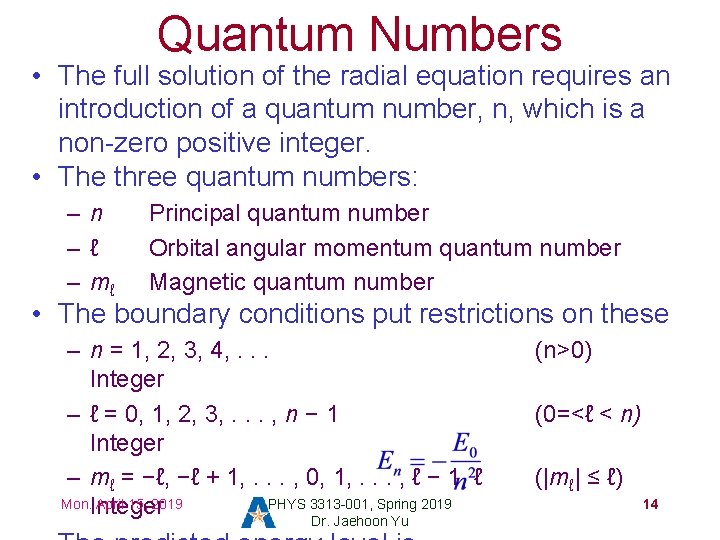
Quantum Numbers • The full solution of the radial equation requires an introduction of a quantum number, n, which is a non-zero positive integer. • The three quantum numbers: –n –ℓ – mℓ Principal quantum number Orbital angular momentum quantum number Magnetic quantum number • The boundary conditions put restrictions on these – n = 1, 2, 3, 4, . . . Integer – ℓ = 0, 1, 2, 3, . . . , n − 1 Integer – mℓ = −ℓ, −ℓ + 1, . . . , 0, 1, . . . , ℓ − 1, ℓ Mon. Integer April 15, 2019 PHYS 3313 -001, Spring 2019 Dr. Jaehoon Yu (n>0) (0=<ℓ < n) (|mℓ| ≤ ℓ) 14
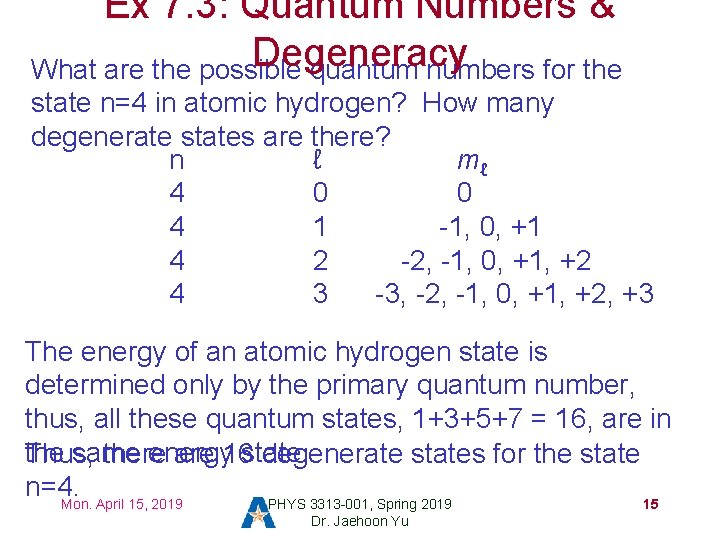
Ex 7. 3: Quantum Numbers & Degeneracy What are the possible quantum numbers for the state n=4 in atomic hydrogen? How many degenerate states are there? n ℓ mℓ 4 0 0 4 1 -1, 0, +1 4 2 -2, -1, 0, +1, +2 4 3 -3, -2, -1, 0, +1, +2, +3 The energy of an atomic hydrogen state is determined only by the primary quantum number, thus, all these quantum states, 1+3+5+7 = 16, are in the same energy Thus, there are 16 state. degenerate states for the state n=4. Mon. April 15, 2019 PHYS 3313 -001, Spring 2019 15 Dr. Jaehoon Yu