
PHYS 252 Special Relativity Topic 3 Lorentz Transformation
- Slides: 6
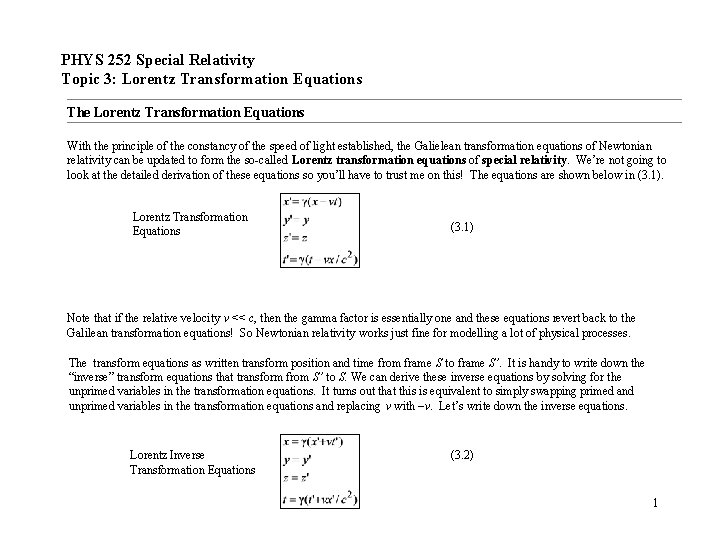
PHYS 252 Special Relativity Topic 3: Lorentz Transformation Equations The Lorentz Transformation Equations With the principle of the constancy of the speed of light established, the Galielean transformation equations of Newtonian relativity can be updated to form the so-called Lorentz transformation equations of special relativity. We’re not going to look at the detailed derivation of these equations so you’ll have to trust me on this! The equations are shown below in (3. 1). Lorentz Transformation Equations (3. 1) Note that if the relative velocity v << c, then the gamma factor is essentially one and these equations revert back to the Galilean transformation equations! So Newtonian relativity works just fine for modelling a lot of physical processes. The transform equations as written transform position and time from frame S to frame S’. It is handy to write down the “inverse” transform equations that transform from S’ to S. We can derive these inverse equations by solving for the unprimed variables in the transformation equations. It turns out that this is equivalent to simply swapping primed and unprimed variables in the transformation equations and replacing v with –v. Let’s write down the inverse equations. Lorentz Inverse Transformation Equations (3. 2) 1
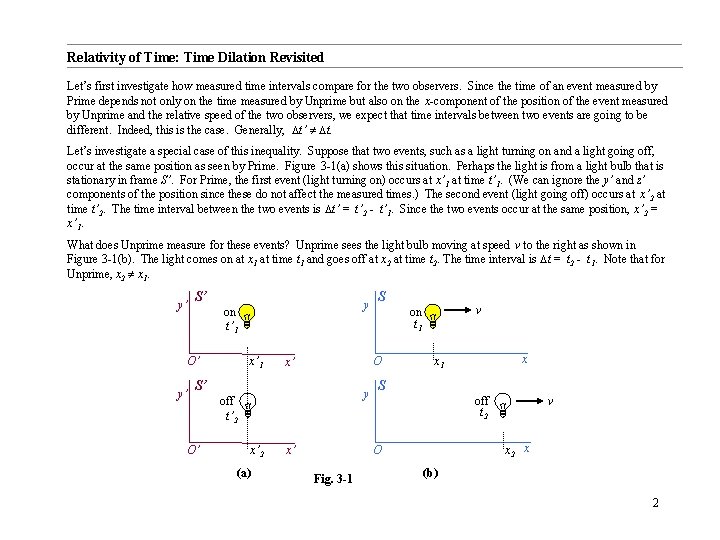
Relativity of Time: Time Dilation Revisited Let’s first investigate how measured time intervals compare for the two observers. Since the time of an event measured by Prime depends not only on the time measured by Unprime but also on the x-component of the position of the event measured by Unprime and the relative speed of the two observers, we expect that time intervals between two events are going to be different. Indeed, this is the case. Generally, t’ t. Let’s investigate a special case of this inequality. Suppose that two events, such as a light turning on and a light going off, occur at the same position as seen by Prime. Figure 3 -1(a) shows this situation. Perhaps the light is from a light bulb that is stationary in frame S’. For Prime, the first event (light turning on) occurs at x’ 1 at time t’ 1. (We can ignore the y’ and z’ components of the position since these do not affect the measured times. ) The second event (light going off) occurs at x’ 2 at time t’ 2. The time interval between the two events is t’ = t’ 2 - t’ 1. Since the two events occur at the same position, x’ 2 = x’ 1. What does Unprime measure for these events? Unprime sees the light bulb moving at speed v to the right as shown in Figure 3 -1(b). The light comes on at x 1 at time t 1 and goes off at x 2 at time t 2. The time interval is t = t 2 - t 1. Note that for Unprime, x 2 x 1. y’ S’ on t’ 1 O’ y’ y x’ 1 y off t’ 2 x’ 2 (a) x’ v on t 1 O x’ S’ O’ S S off t 2 v x 2 x O Fig. 3 -1 x x 1 (b) 2
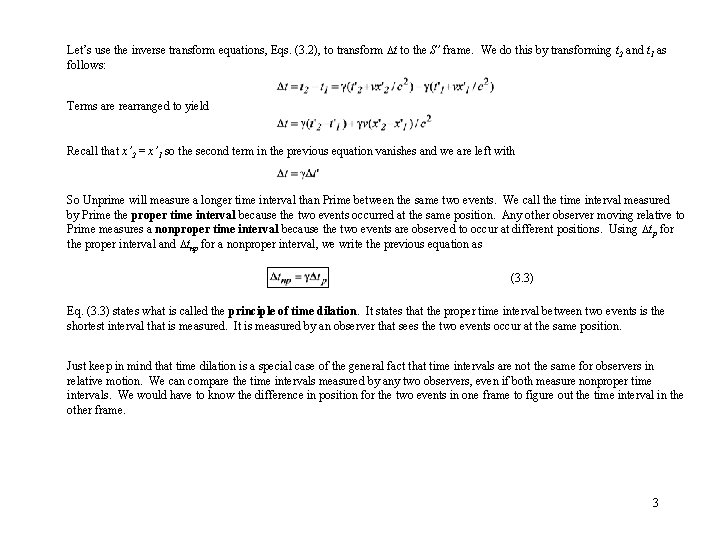
Let’s use the inverse transform equations, Eqs. (3. 2), to transform t to the S’ frame. We do this by transforming t 2 and t 1 as follows: Terms are rearranged to yield Recall that x’ 2 = x’ 1 so the second term in the previous equation vanishes and we are left with So Unprime will measure a longer time interval than Prime between the same two events. We call the time interval measured by Prime the proper time interval because the two events occurred at the same position. Any other observer moving relative to Prime measures a nonproper time interval because the two events are observed to occur at different positions. Using tp for the proper interval and tnp for a nonproper interval, we write the previous equation as (3. 3) Eq. (3. 3) states what is called the principle of time dilation. It states that the proper time interval between two events is the shortest interval that is measured. It is measured by an observer that sees the two events occur at the same position. Just keep in mind that time dilation is a special case of the general fact that time intervals are not the same for observers in relative motion. We can compare the time intervals measured by any two observers, even if both measure nonproper time intervals. We would have to know the difference in position for the two events in one frame to figure out the time interval in the other frame. 3
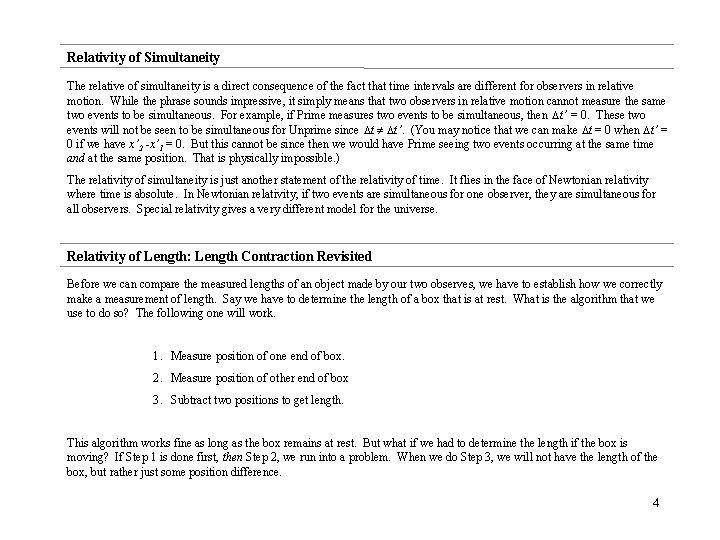
Relativity of Simultaneity The relative of simultaneity is a direct consequence of the fact that time intervals are different for observers in relative motion. While the phrase sounds impressive, it simply means that two observers in relative motion cannot measure the same two events to be simultaneous. For example, if Prime measures two events to be simultaneous, then t’ = 0. These two events will not be seen to be simultaneous for Unprime since t t’. (You may notice that we can make t = 0 when t’ = 0 if we have x’ 2 -x’ 1 = 0. But this cannot be since then we would have Prime seeing two events occurring at the same time and at the same position. That is physically impossible. ) The relativity of simultaneity is just another statement of the relativity of time. It flies in the face of Newtonian relativity where time is absolute. In Newtonian relativity, if two events are simultaneous for one observer, they are simultaneous for all observers. Special relativity gives a very different model for the universe. Relativity of Length: Length Contraction Revisited Before we can compare the measured lengths of an object made by our two observes, we have to establish how we correctly make a measurement of length. Say we have to determine the length of a box that is at rest. What is the algorithm that we use to do so? The following one will work. 1. Measure position of one end of box. 2. Measure position of other end of box 3. Subtract two positions to get length. This algorithm works fine as long as the box remains at rest. But what if we had to determine the length if the box is moving? If Step 1 is done first, then Step 2, we run into a problem. When we do Step 3, we will not have the length of the box, but rather just some position difference. 4
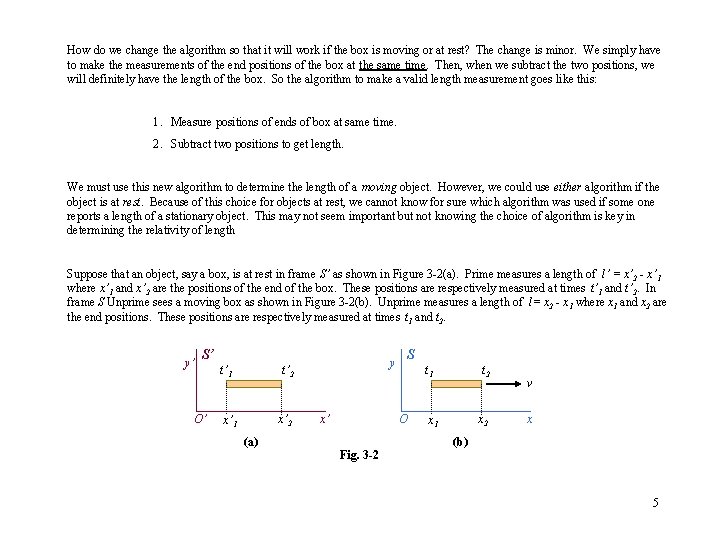
How do we change the algorithm so that it will work if the box is moving or at rest? The change is minor. We simply have to make the measurements of the end positions of the box at the same time. Then, when we subtract the two positions, we will definitely have the length of the box. So the algorithm to make a valid length measurement goes like this: 1. Measure positions of ends of box at same time. 2. Subtract two positions to get length. We must use this new algorithm to determine the length of a moving object. However, we could use either algorithm if the object is at rest. Because of this choice for objects at rest, we cannot know for sure which algorithm was used if some one reports a length of a stationary object. This may not seem important but not knowing the choice of algorithm is key in determining the relativity of length Suppose that an object, say a box, is at rest in frame S’ as shown in Figure 3 -2(a). Prime measures a length of l’ = x’ 2 - x’ 1 where x’ 1 and x’ 2 are the positions of the end of the box. These positions are respectively measured at times t’ 1 and t’ 2. In frame S Unprime sees a moving box as shown in Figure 3 -2(b). Unprime measures a length of l= x 2 - x 1 where x 1 and x 2 are the end positions. These positions are respectively measured at times t 1 and t 2. y’ S’ O’ t’ 1 y t’ 2 x’ 1 (a) x’ S t 1 O Fig. 3 -2 t 2 x 1 v x (b) 5
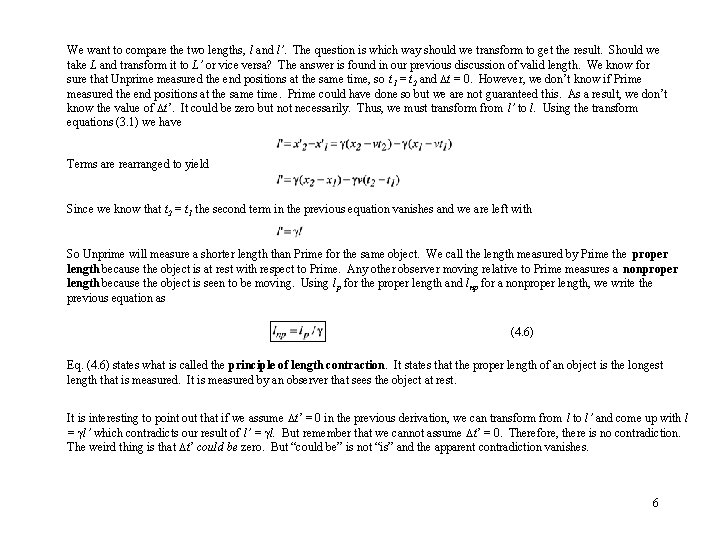
We want to compare the two lengths, l and l’. The question is which way should we transform to get the result. Should we take L and transform it to L’ or vice versa? The answer is found in our previous discussion of valid length. We know for sure that Unprime measured the end positions at the same time, so t 1 = t 2 and t = 0. However, we don’t know if Prime measured the end positions at the same time. Prime could have done so but we are not guaranteed this. As a result, we don’t know the value of t’. It could be zero but not necessarily. Thus, we must transform from l’ to l. Using the transform equations (3. 1) we have Terms are rearranged to yield Since we know that t 2 = t 1 the second term in the previous equation vanishes and we are left with So Unprime will measure a shorter length than Prime for the same object. We call the length measured by Prime the proper length because the object is at rest with respect to Prime. Any other observer moving relative to Prime measures a nonproper length because the object is seen to be moving. Using lp for the proper length and lnp for a nonproper length, we write the previous equation as (4. 6) Eq. (4. 6) states what is called the principle of length contraction. It states that the proper length of an object is the longest length that is measured. It is measured by an observer that sees the object at rest. It is interesting to point out that if we assume t’ = 0 in the previous derivation, we can transform from l to l’ and come up with l = l’ which contradicts our result of l’ = l. But remember that we cannot assume t’ = 0. Therefore, there is no contradiction. The weird thing is that t’ could be zero. But “could be” is not “is” and the apparent contradiction vanishes. 6