
PHYS 172 Modern Mechanics Summer 2010 Please pick

- Slides: 22
PHYS 172: Modern Mechanics Summer 2010 Please pick up the 6 handouts by the door: • Syllabus • Schedule • Problem Guidelines • CHIP Info • Web. Assign Info • Today’s lecture notes Lecture 1 – Matter and Interactions, Vectors Read 1. 1 – 1. 5
Welcome to PHYS 172 Course web page: go to www. physics. purdue. edu and select Phys 172 Textbook: “Matter & Interactions – Volume 1 – Modern Mechanics” by Ruth Chabay and Bruce Sherwood (Wiley). Lab Manual: “Physics 172 Lab Manual” Web. Assign: (homework) go to: www. webassign. net/login. html CHIP: scoring and grades: http: //chip. physics. purdue. edu/public/172/summer 2009/ i>Clicker: Go to the course web page, register on CHIP Help center – room 11
Things to Do Today: 1. Register for Web. Assign. You have a short HW assignment due tomorrow at 11: 59 PM. 2. Login to CHIP and register your i. Clicker. We use them tomorrow. 3. Read the syllabus. 4. Read 1. 1 -1. 9. Recitation Phys 238 – Switch to 12: 00 if you can Lab Bring a notebook!
Matter and Interactions Goal: use small set of fundamental principles explain broad range of phenomena Chapter 1: Interactions and Motion Fundamental Principles and Matter Detecting Interactions Displacement Vectors
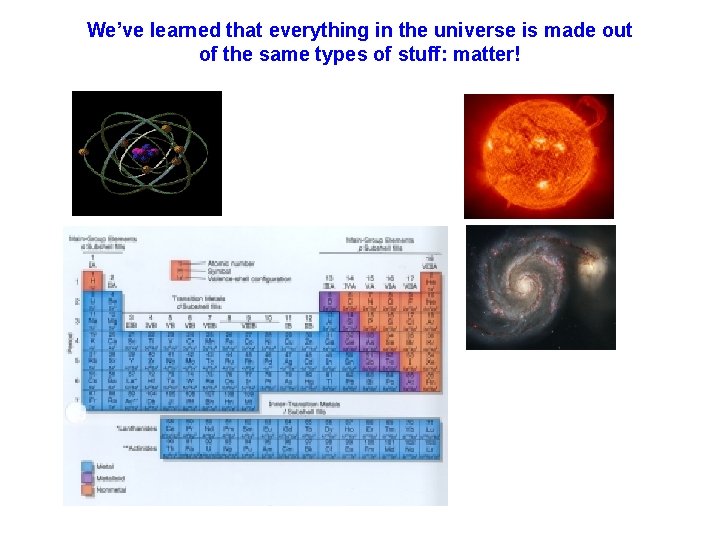
We’ve learned that everything in the universe is made out of the same types of stuff: matter!
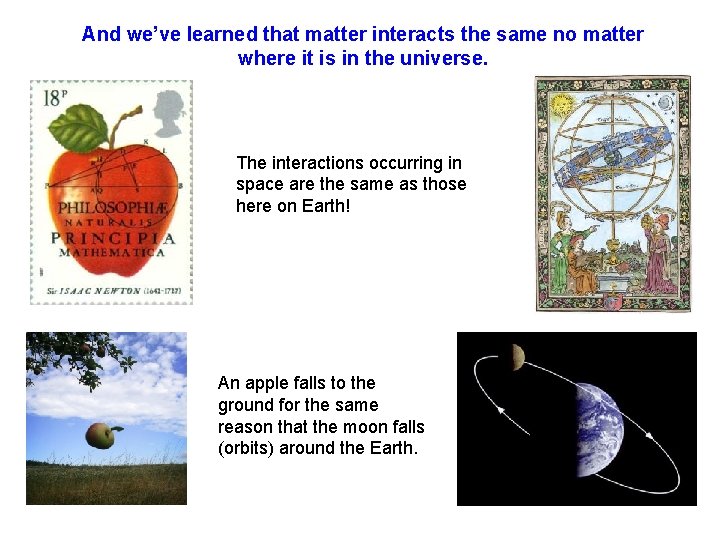
And we’ve learned that matter interacts the same no matter where it is in the universe. The interactions occurring in space are the same as those here on Earth! An apple falls to the ground for the same reason that the moon falls (orbits) around the Earth.
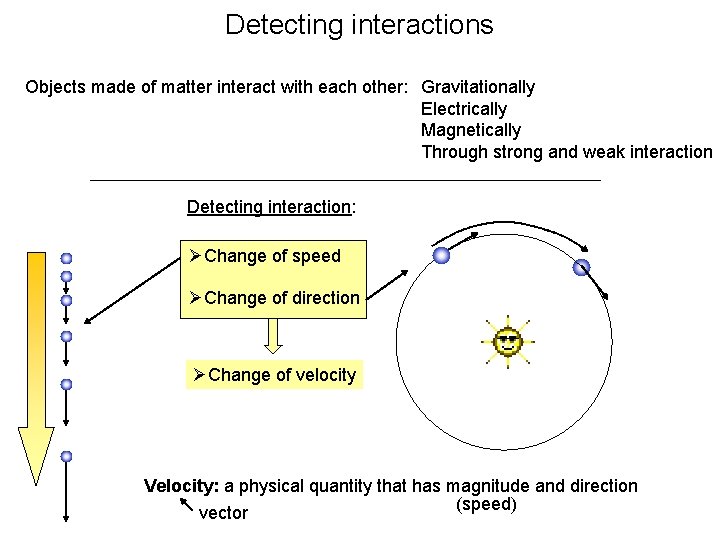
Detecting interactions Objects made of matter interact with each other: Gravitationally Electrically Magnetically Through strong and weak interaction Detecting interaction: ØChange of speed ØChange of direction ØChange of velocity Velocity: a physical quantity that has magnitude and direction (speed) vector
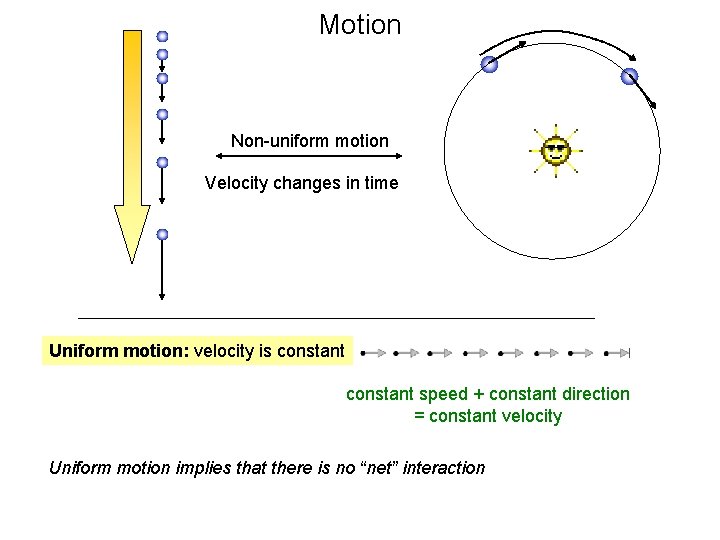
Motion Non-uniform motion Velocity changes in time Uniform motion: velocity is constant speed + constant direction = constant velocity Uniform motion implies that there is no “net” interaction
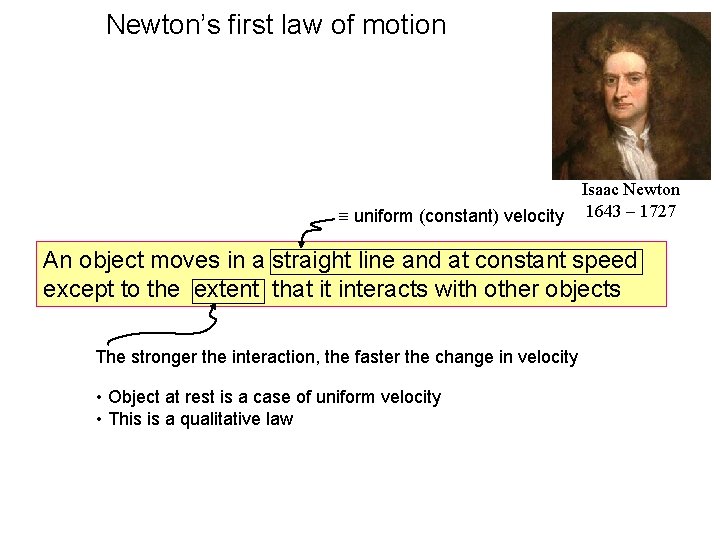
Newton’s first law of motion uniform (constant) velocity Isaac Newton 1643 – 1727 An object moves in a straight line and at constant speed except to the extent that it interacts with other objects The stronger the interaction, the faster the change in velocity • Object at rest is a case of uniform velocity • This is a qualitative law
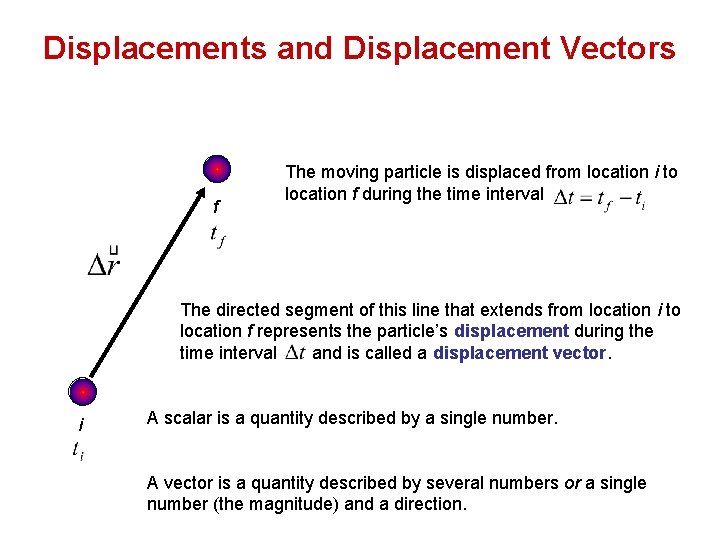
Displacements and Displacement Vectors f The moving particle is displaced from location i to location f during the time interval The directed segment of this line that extends from location i to location f represents the particle’s displacement during the time interval and is called a displacement vector. i A scalar is a quantity described by a single number. A vector is a quantity described by several numbers or a single number (the magnitude) and a direction.
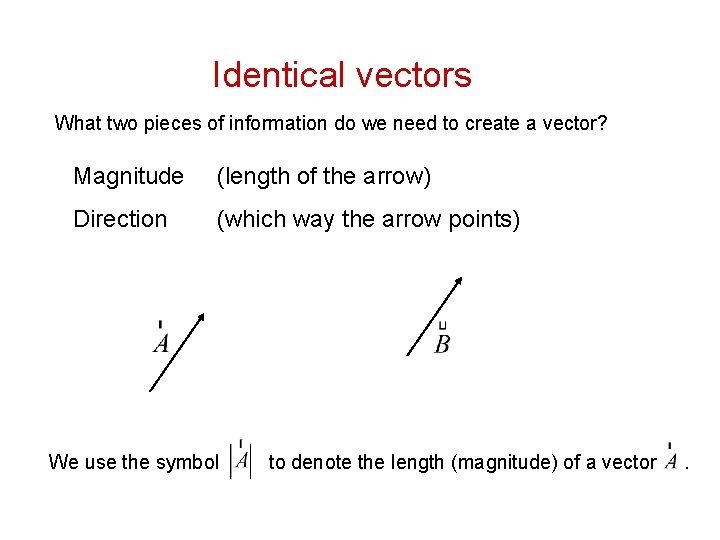
Identical vectors What two pieces of information do we need to create a vector? Magnitude (length of the arrow) Direction (which way the arrow points) We use the symbol to denote the length (magnitude) of a vector .
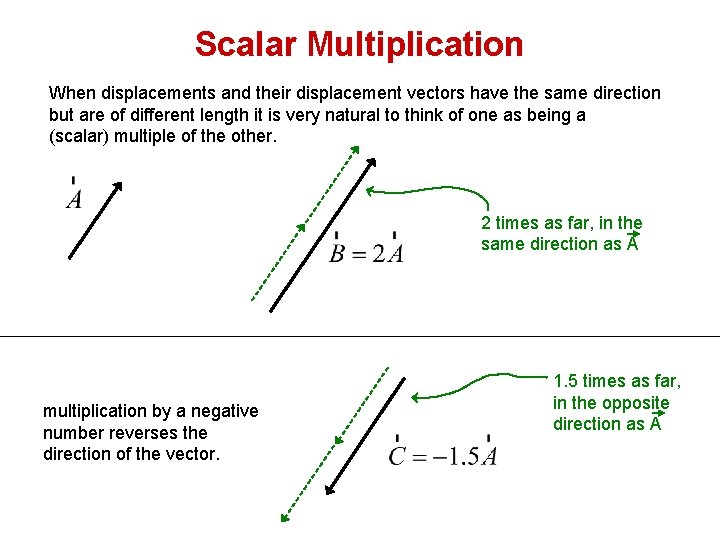
Scalar Multiplication When displacements and their displacement vectors have the same direction but are of different length it is very natural to think of one as being a (scalar) multiple of the other. 2 times as far, in the same direction as A multiplication by a negative number reverses the direction of the vector. 1. 5 times as far, in the opposite direction as A
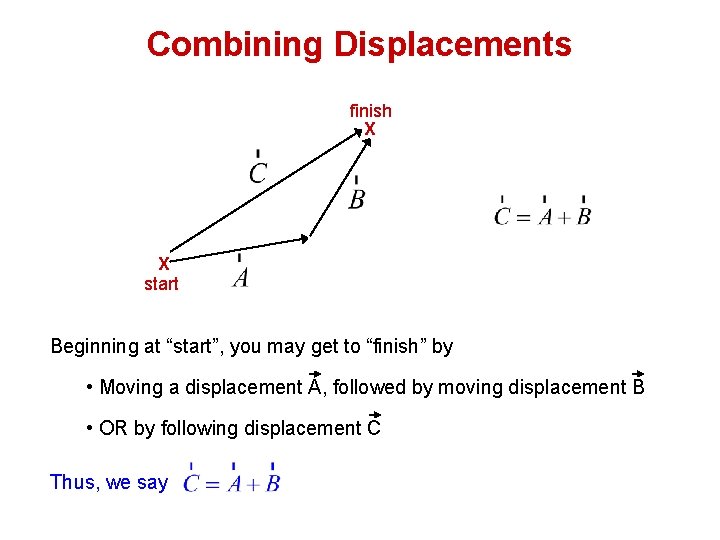
Combining Displacements finish X X start Beginning at “start”, you may get to “finish” by • Moving a displacement A, followed by moving displacement B • OR by following displacement C Thus, we say
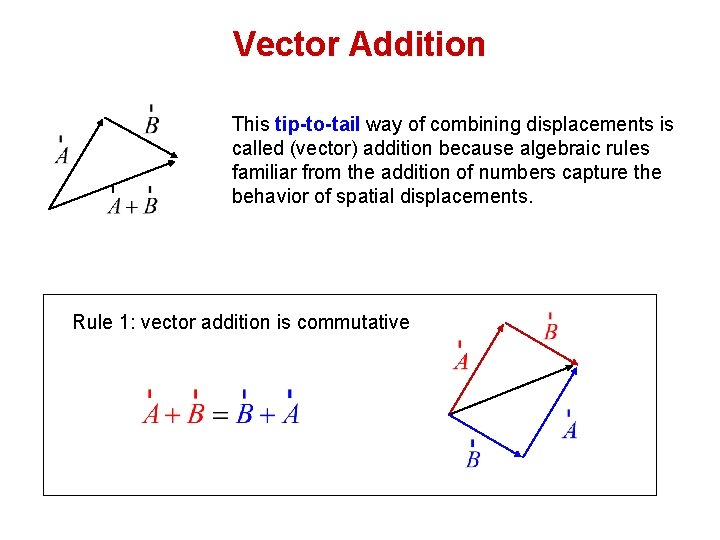
Vector Addition This tip-to-tail way of combining displacements is called (vector) addition because algebraic rules familiar from the addition of numbers capture the behavior of spatial displacements. Rule 1: vector addition is commutative
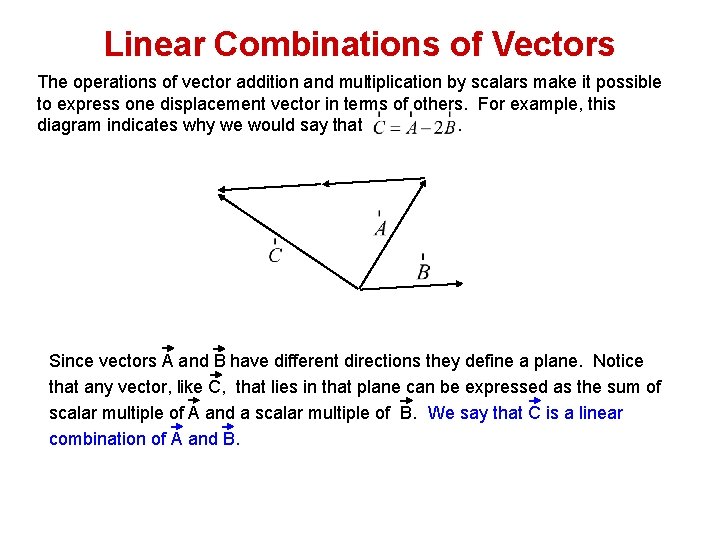
Linear Combinations of Vectors The operations of vector addition and multiplication by scalars make it possible to express one displacement vector in terms of others. For example, this diagram indicates why we would say that. Since vectors A and B have different directions they define a plane. Notice that any vector, like C, that lies in that plane can be expressed as the sum of scalar multiple of A and a scalar multiple of B. We say that C is a linear combination of A and B.
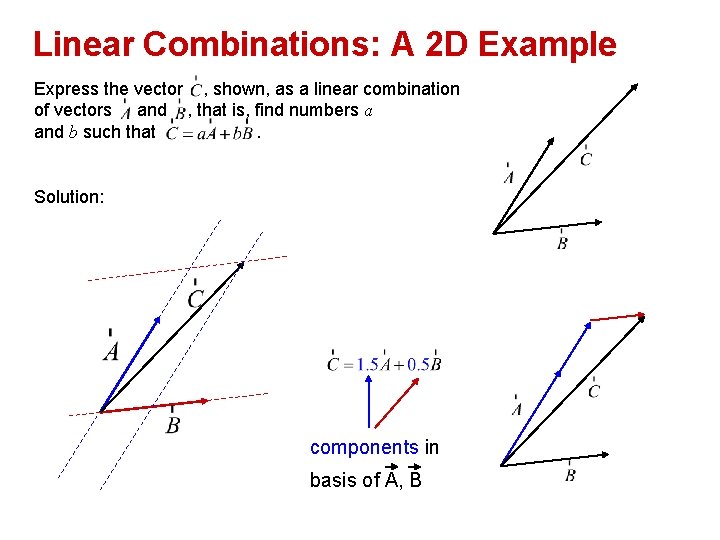
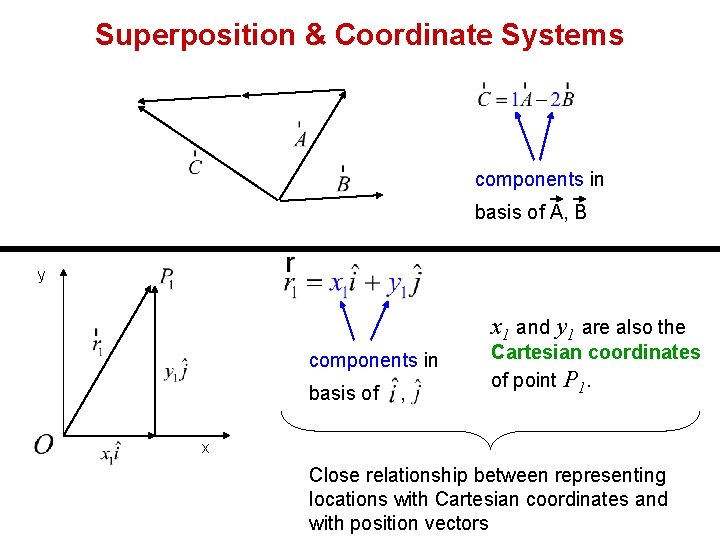
Linear Combinations: A 2 D Example Express the vector , shown, as a linear combination of vectors and , that is, find numbers a and b such that. Solution: components in basis of A, B
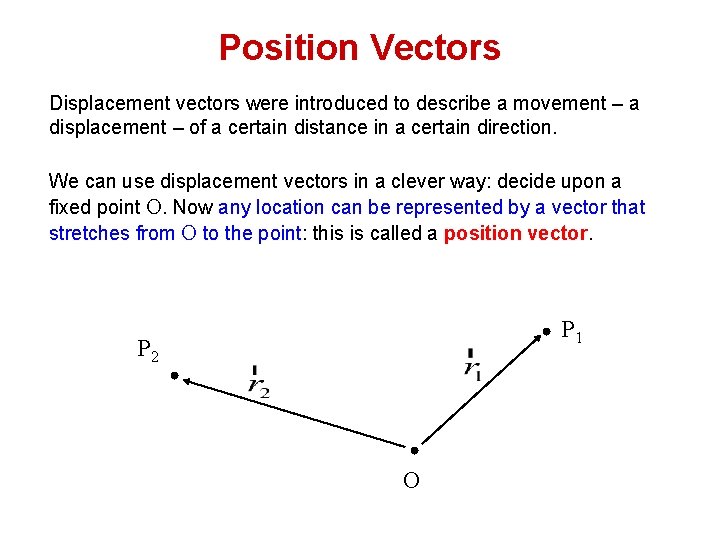
Position Vectors Displacement vectors were introduced to describe a movement – a displacement – of a certain distance in a certain direction. We can use displacement vectors in a clever way: decide upon a fixed point O. Now any location can be represented by a vector that stretches from O to the point: this is called a position vector. P 1 P 2 O
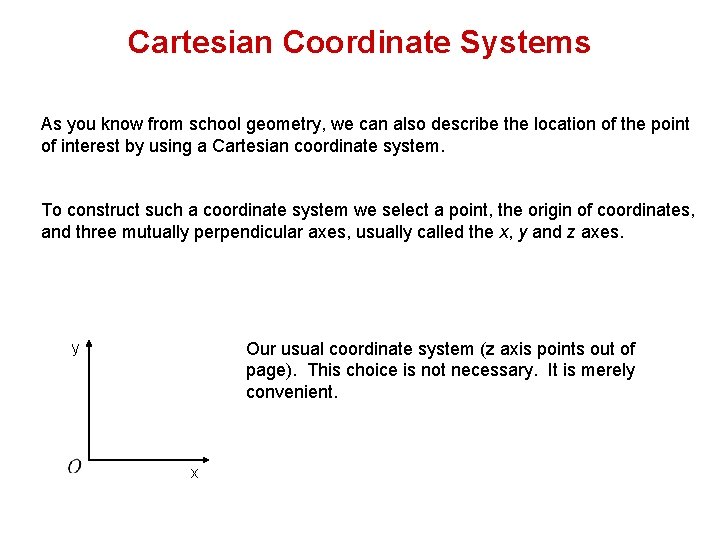
Cartesian Coordinate Systems As you know from school geometry, we can also describe the location of the point of interest by using a Cartesian coordinate system. To construct such a coordinate system we select a point, the origin of coordinates, and three mutually perpendicular axes, usually called the x, y and z axes. Our usual coordinate system (z axis points out of page). This choice is not necessary. It is merely convenient. y x
Superposition & Coordinate Systems components in basis of A, B y x 1 and y 1 are also the components in basis of , Cartesian coordinates of point P 1. x Close relationship between representing locations with Cartesian coordinates and with position vectors
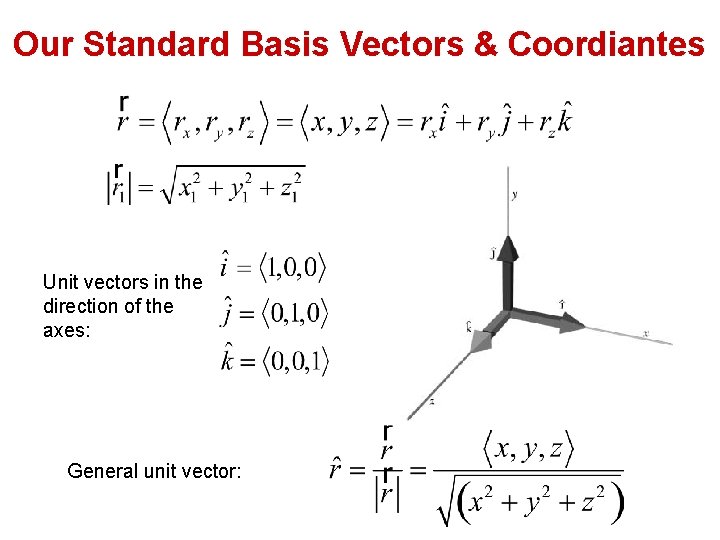
Our Standard Basis Vectors & Coordiantes Unit vectors in the direction of the axes: General unit vector:
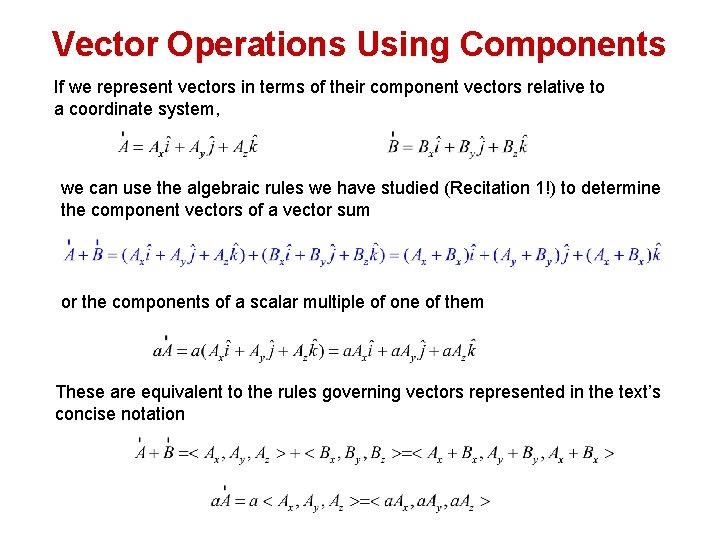
Vector Operations Using Components If we represent vectors in terms of their component vectors relative to a coordinate system, we can use the algebraic rules we have studied (Recitation 1!) to determine the component vectors of a vector sum or the components of a scalar multiple of one of them These are equivalent to the rules governing vectors represented in the text’s concise notation
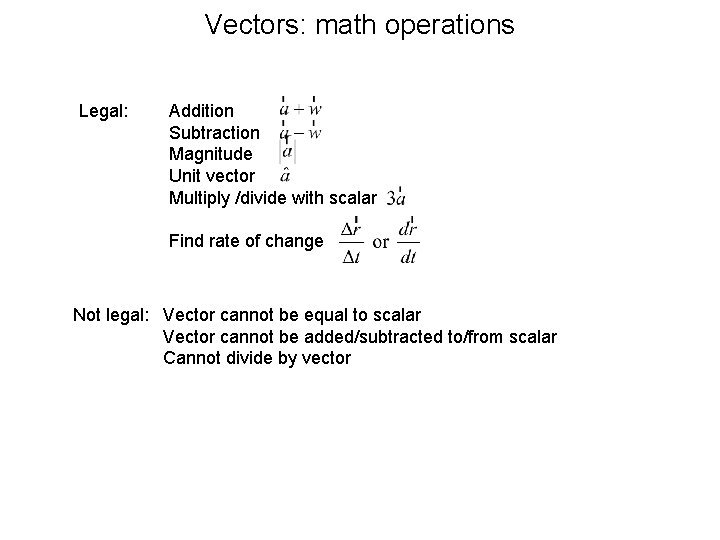
Vectors: math operations Legal: Addition Subtraction Magnitude Unit vector Multiply /divide with scalar Find rate of change Not legal: Vector cannot be equal to scalar Vector cannot be added/subtracted to/from scalar Cannot divide by vector