
PHYS 172 Modern Mechanics Lecture 21 Counting Statistics
- Slides: 19
PHYS 172: Modern Mechanics Lecture 21 – Counting Statistics Summer 2012 Read 12. 1– 12. 2
Today: Counting Statistics Need For Statistical Considerations Einstein Model and Counting Microstates Fundamental Assumption of Statistical Mechanics Entropy 2 nd Law of Thermodynamics Irreversibility
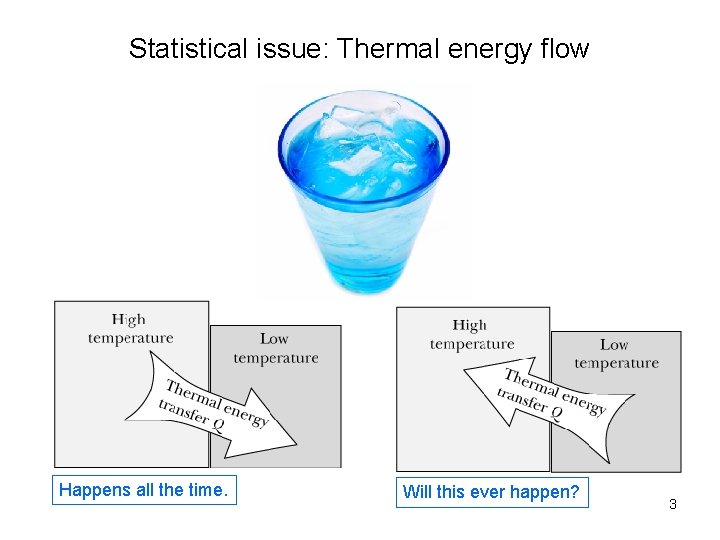
Statistical issue: Thermal energy flow Happens all the time. Will this ever happen? 3
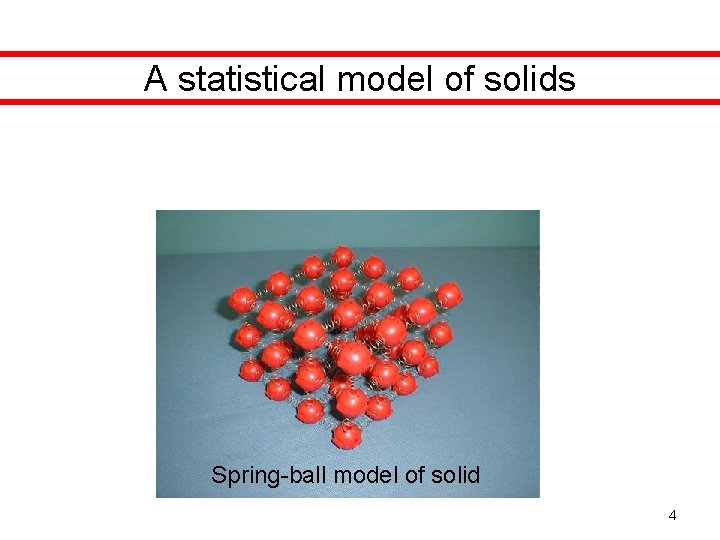
A statistical model of solids Spring-ball model of solid 4
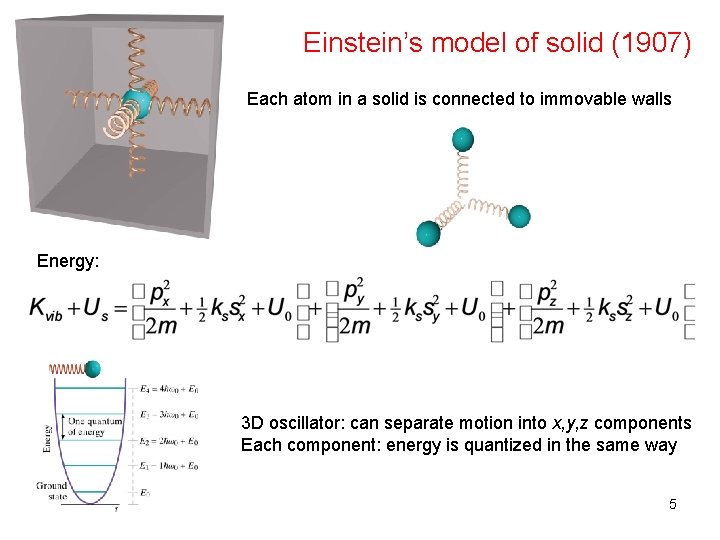
Einstein’s model of solid (1907) Each atom in a solid is connected to immovable walls Energy: 3 D oscillator: can separate motion into x, y, z components Each component: energy is quantized in the same way 5
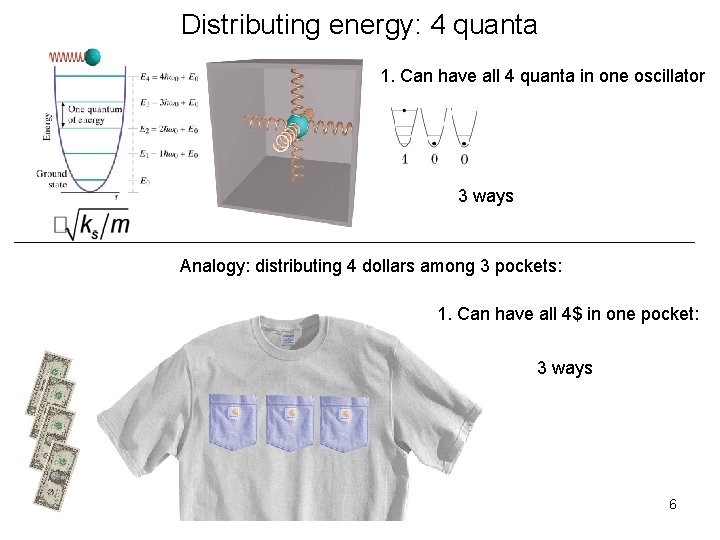
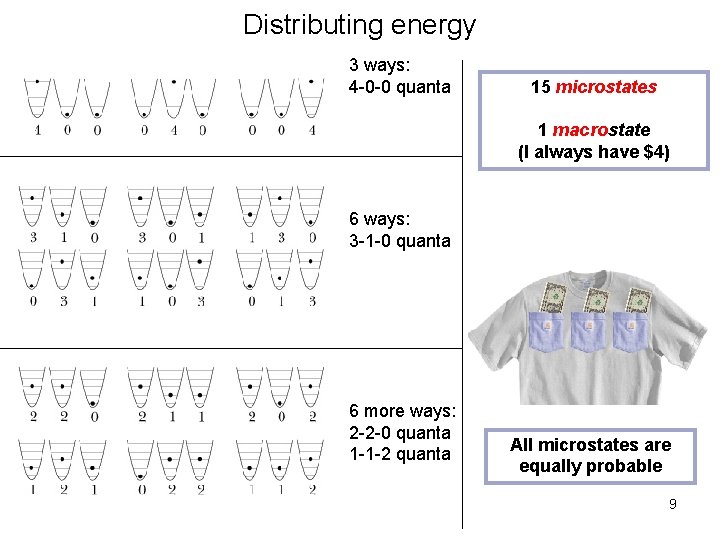
Distributing energy: 4 quanta 1. Can have all 4 quanta in one oscillator 3 ways Analogy: distributing 4 dollars among 3 pockets: 1. Can have all 4$ in one pocket: 3 ways 6
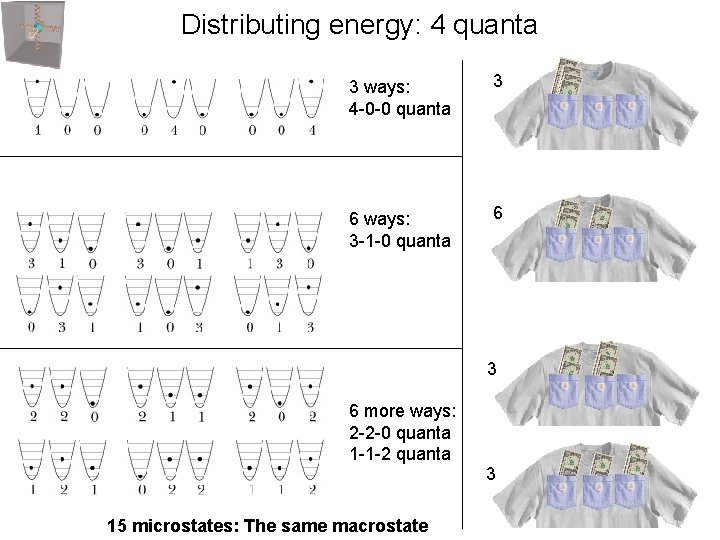
Distributing energy: 4 quanta 3 ways: 4 -0 -0 quanta 3 6 ways: 3 -1 -0 quanta 6 3 6 more ways: 2 -2 -0 quanta 1 -1 -2 quanta 15 microstates: The same macrostate 3
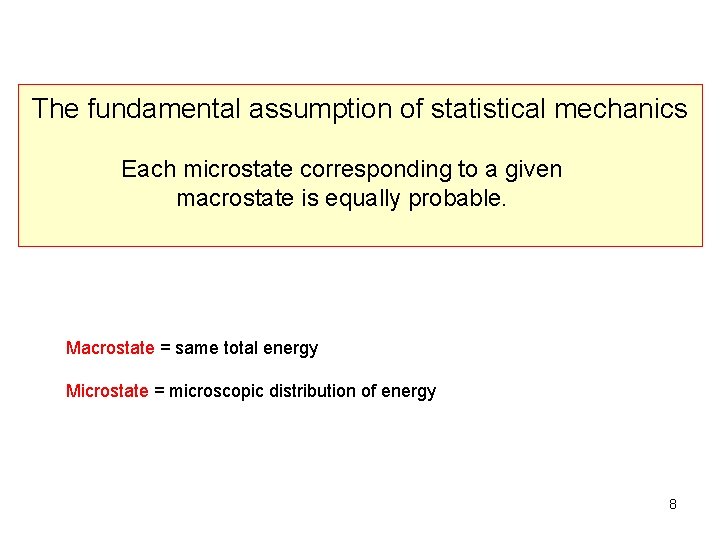
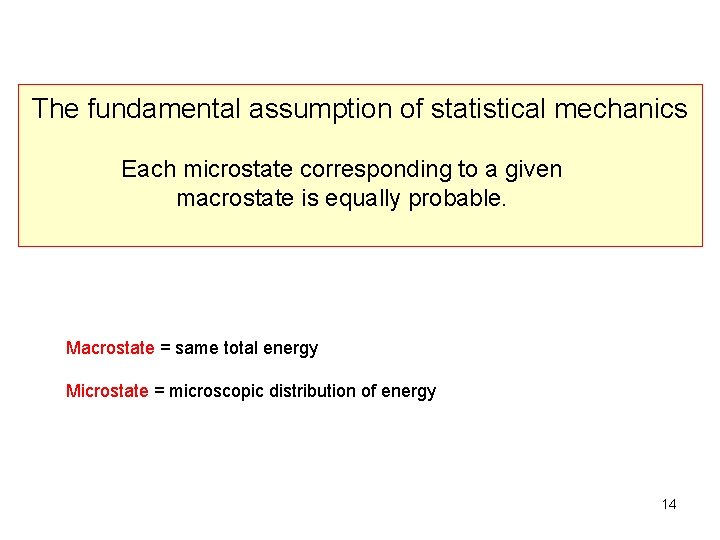
The fundamental assumption of statistical mechanics Each microstate corresponding to a given macrostate is equally probable. Macrostate = same total energy Microstate = microscopic distribution of energy 8
Distributing energy 3 ways: 4 -0 -0 quanta 15 microstates 1 macrostate (I always have $4) 6 ways: 3 -1 -0 quanta 6 more ways: 2 -2 -0 quanta 1 -1 -2 quanta All microstates are equally probable 9
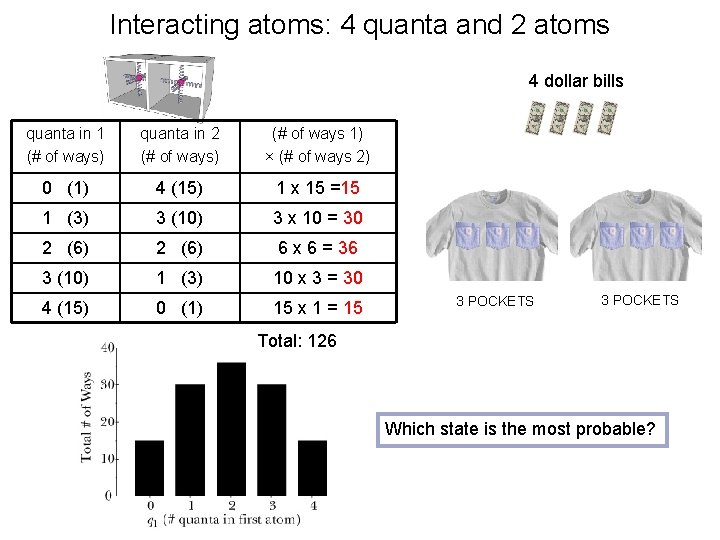
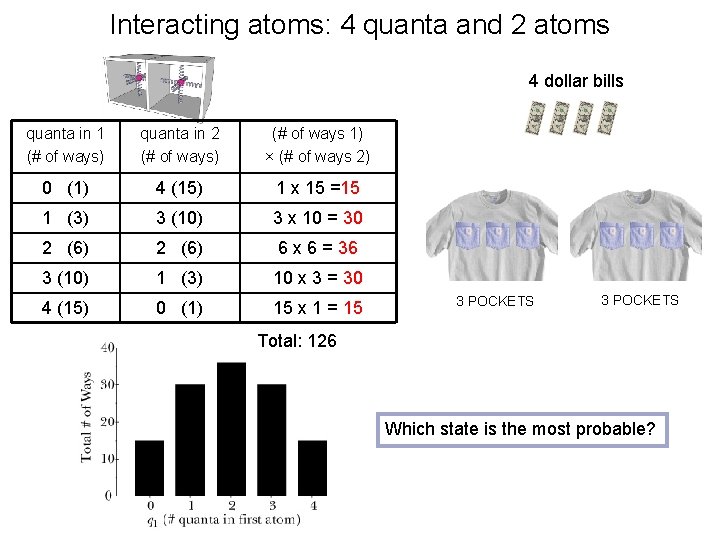
Interacting atoms: 4 quanta and 2 atoms 4 dollar bills quanta in 1 (# of ways) quanta in 2 (# of ways) (# of ways 1) × (# of ways 2) 0 (1) 4 (15) 1 x 15 =15 1 (3) 3 (10) 3 x 10 = 30 2 (6) 6 x 6 = 36 3 (10) 1 (3) 10 x 3 = 30 4 (15) 0 (1) 15 x 1 = 15 3 POCKETS Total: 126 Which state is the most probable?
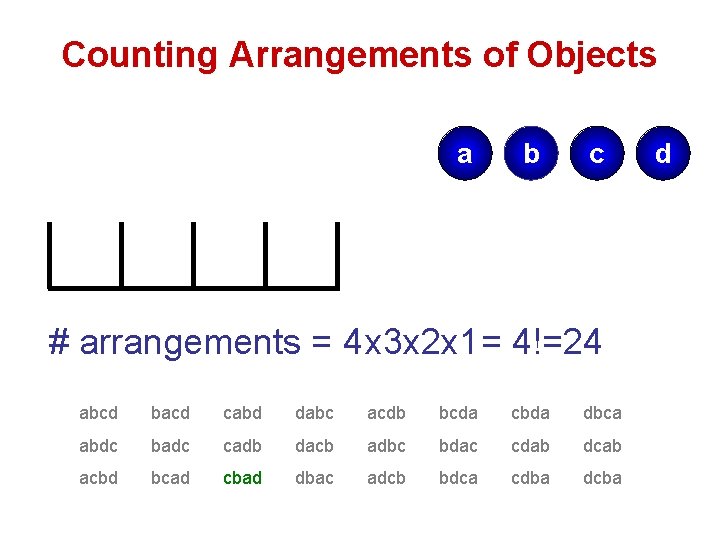
Counting Arrangements of Objects a b c # arrangements = 4 x 3 x 2 x 1 = 4!=24 abcd bacd cabd dabc acdb bcda cbda dbca abdc badc cadb dacb adbc bdac cdab dcab acbd bcad cbad dbac adcb bdca cdba dcba d
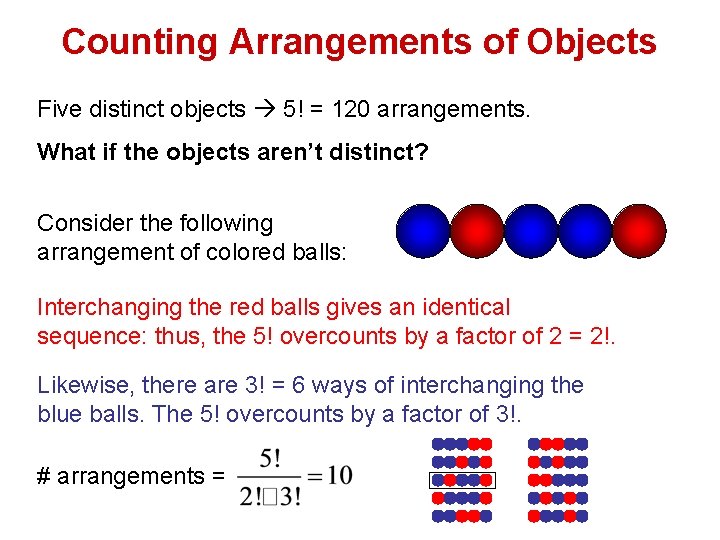
Counting Arrangements of Objects Five distinct objects 5! = 120 arrangements. What if the objects aren’t distinct? Consider the following arrangement of colored balls: Interchanging the red balls gives an identical sequence: thus, the 5! overcounts by a factor of 2 = 2!. Likewise, there are 3! = 6 ways of interchanging the blue balls. The 5! overcounts by a factor of 3!. # arrangements =
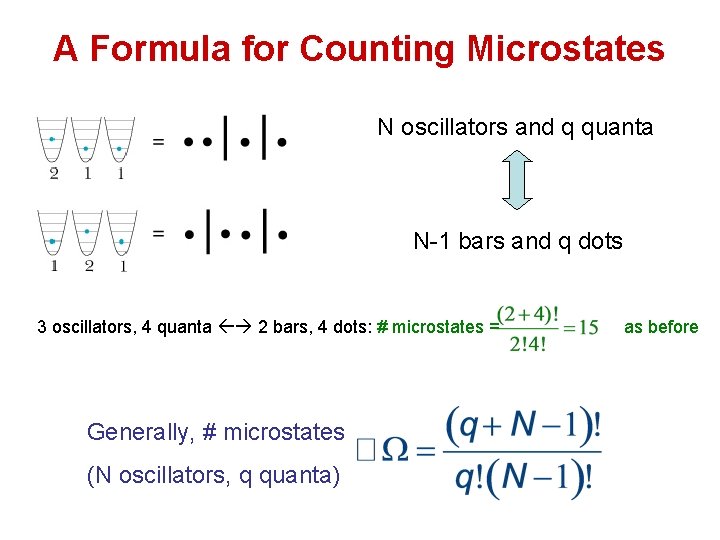
A Formula for Counting Microstates N oscillators and q quanta N-1 bars and q dots 3 oscillators, 4 quanta 2 bars, 4 dots: # microstates = Generally, # microstates (N oscillators, q quanta) as before
The fundamental assumption of statistical mechanics Each microstate corresponding to a given macrostate is equally probable. Macrostate = same total energy Microstate = microscopic distribution of energy 14
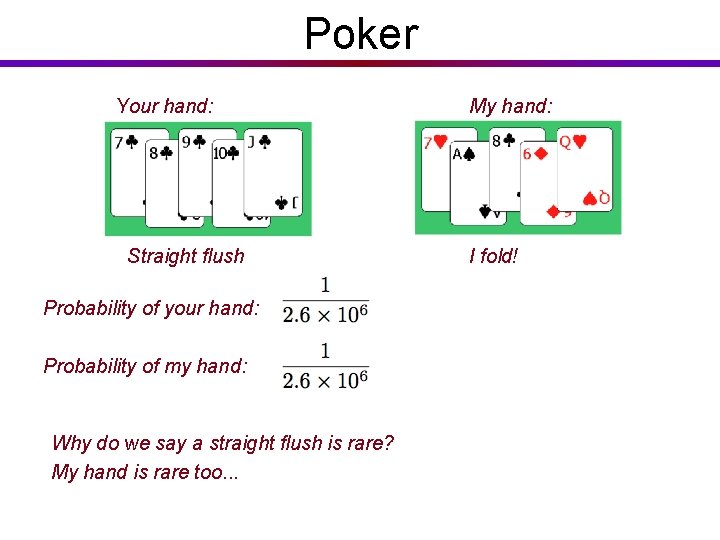
Poker Your hand: Straight flush Probability of your hand: Probability of my hand: Why do we say a straight flush is rare? My hand is rare too. . . My hand: I fold!
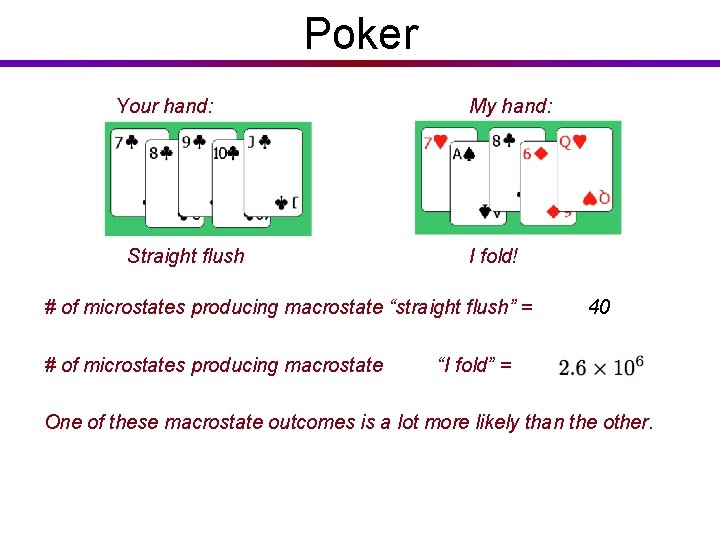
Poker Your hand: Straight flush My hand: I fold! # of microstates producing macrostate “straight flush” = # of microstates producing macrostate 40 “I fold” = One of these macrostate outcomes is a lot more likely than the other.
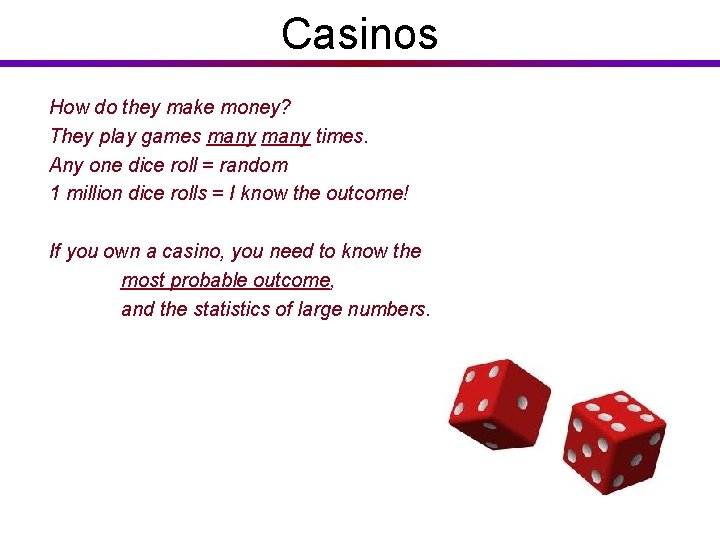
Casinos How do they make money? They play games many times. Any one dice roll = random 1 million dice rolls = I know the outcome! If you own a casino, you need to know the most probable outcome, and the statistics of large numbers.
Interacting atoms: 4 quanta and 2 atoms 4 dollar bills quanta in 1 (# of ways) quanta in 2 (# of ways) (# of ways 1) × (# of ways 2) 0 (1) 4 (15) 1 x 15 =15 1 (3) 3 (10) 3 x 10 = 30 2 (6) 6 x 6 = 36 3 (10) 1 (3) 10 x 3 = 30 4 (15) 0 (1) 15 x 1 = 15 3 POCKETS Total: 126 Which state is the most probable?
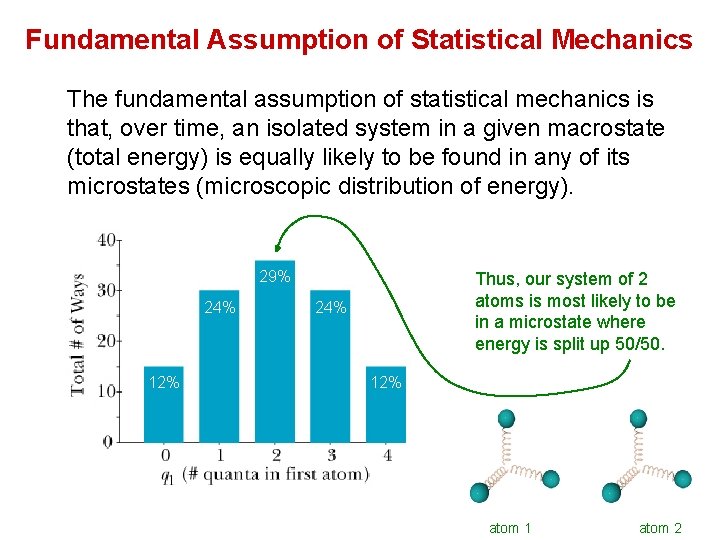
Fundamental Assumption of Statistical Mechanics The fundamental assumption of statistical mechanics is that, over time, an isolated system in a given macrostate (total energy) is equally likely to be found in any of its microstates (microscopic distribution of energy). 29% 24% 12% Thus, our system of 2 atoms is most likely to be in a microstate where energy is split up 50/50. 24% 12% atom 1 atom 2