
PHYS 172 Modern Mechanics Lecture 20 Angular Momentum
- Slides: 17
PHYS 172: Modern Mechanics Lecture 20 – Angular Momentum Quantization Summer 2012 Read 11. 8 – 11. 11
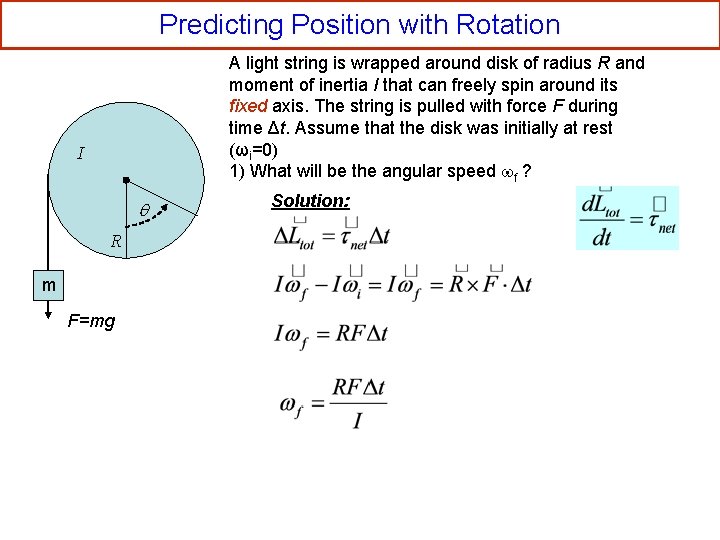
Predicting Position with Rotation A light string is wrapped around disk of radius R and moment of inertia I that can freely spin around its fixed axis. The string is pulled with force F during time Δt. Assume that the disk was initially at rest (ωi=0) 1) What will be the angular speed f ? I R m F=mg Solution:
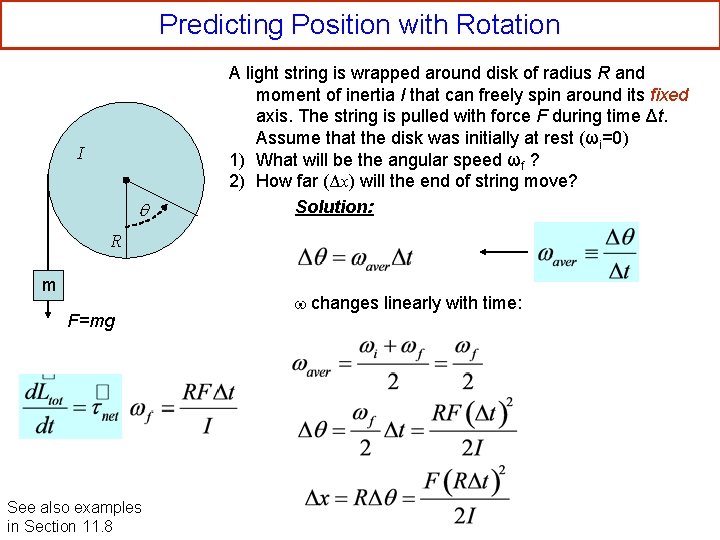
Predicting Position with Rotation I A light string is wrapped around disk of radius R and moment of inertia I that can freely spin around its fixed axis. The string is pulled with force F during time Δt. Assume that the disk was initially at rest (ωi=0) 1) What will be the angular speed ωf ? 2) How far (Δx) will the end of string move? Solution: R m F=mg See also examples in Section 11. 8 changes linearly with time:
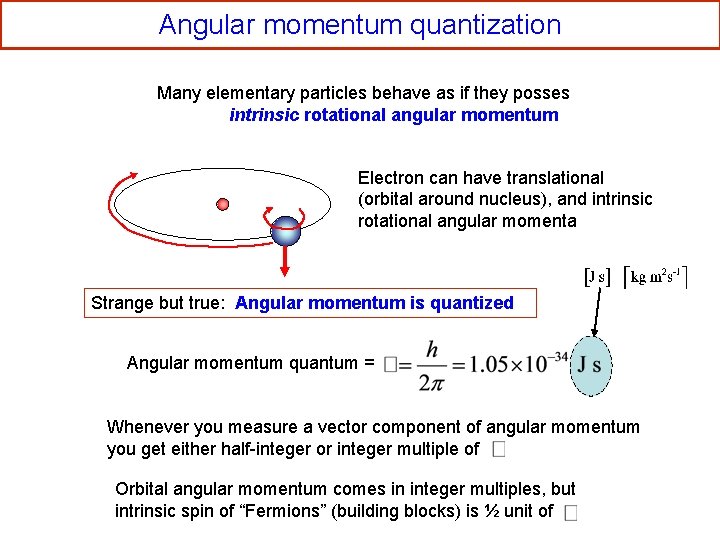
Angular momentum quantization Many elementary particles behave as if they posses intrinsic rotational angular momentum Electron can have translational (orbital around nucleus), and intrinsic rotational angular momenta Strange but true: Angular momentum is quantized Angular momentum quantum = Whenever you measure a vector component of angular momentum you get either half-integer or integer multiple of Orbital angular momentum comes in integer multiples, but intrinsic spin of “Fermions” (building blocks) is ½ unit of
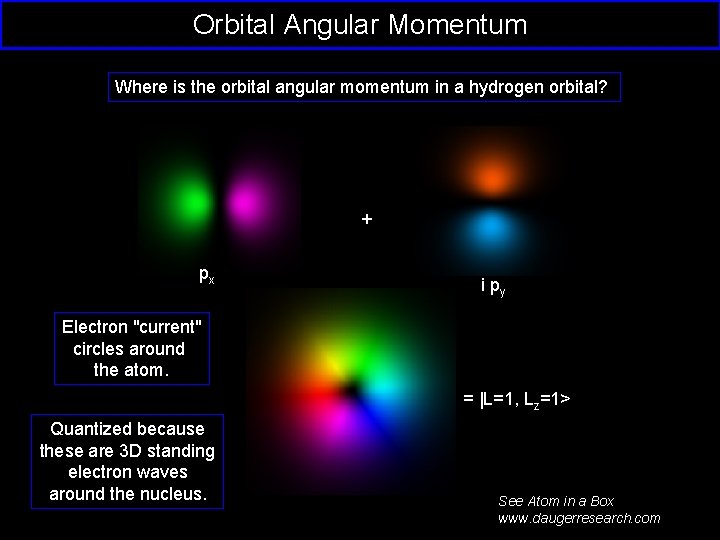
Orbital Angular Momentum Where is the orbital angular momentum in a hydrogen orbital? + px i py Electron "current" circles around the atom. = |L=1, Lz=1> Quantized because these are 3 D standing electron waves around the nucleus. See Atom in a Box www. daugerresearch. com
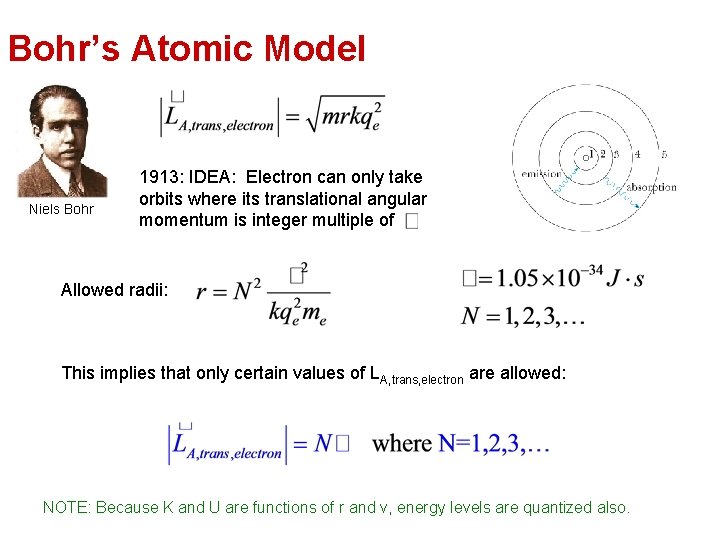
Bohr’s Atomic Model Niels Bohr 1913: IDEA: Electron can only take orbits where its translational angular momentum is integer multiple of Allowed radii: This implies that only certain values of LA, trans, electron are allowed: NOTE: Because K and U are functions of r and v, energy levels are quantized also.
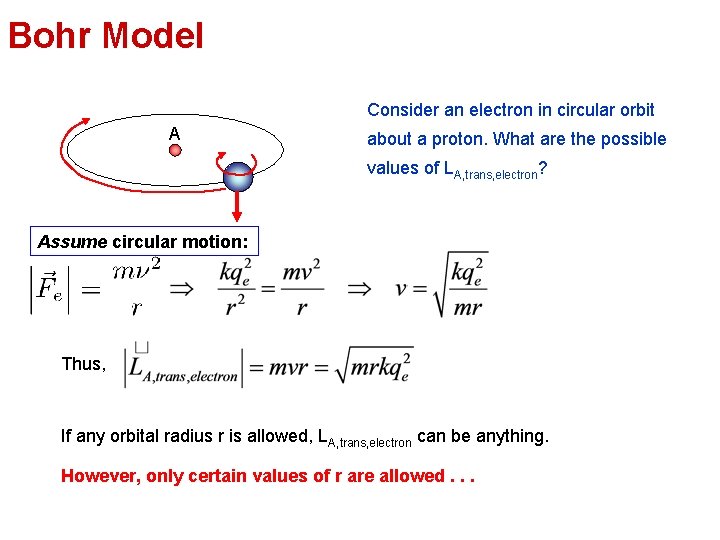
Bohr Model Consider an electron in circular orbit A about a proton. What are the possible values of LA, trans, electron? Assume circular motion: Thus, If any orbital radius r is allowed, LA, trans, electron can be anything. However, only certain values of r are allowed. . .
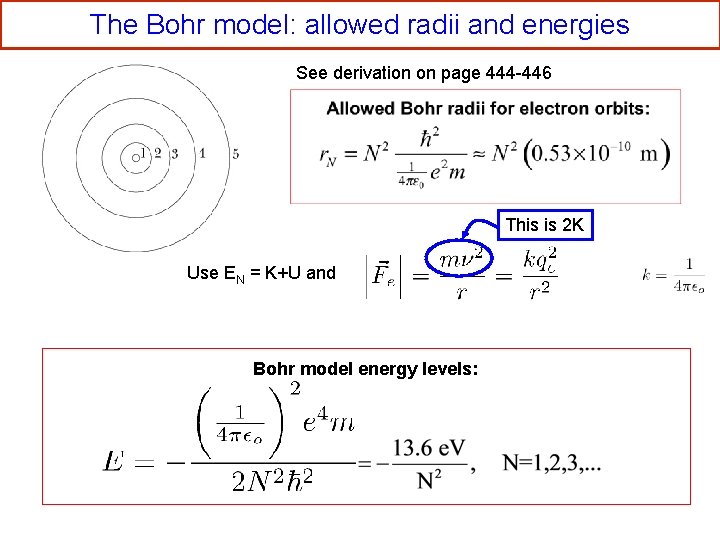
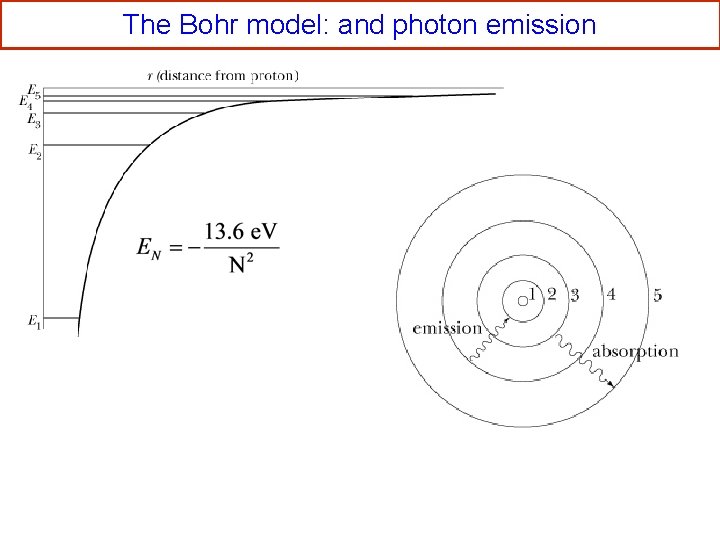
The Bohr model: allowed radii and energies See derivation on page 444 -446 This is 2 K Use EN = K+U and Bohr model energy levels:
The Bohr model: and photon emission
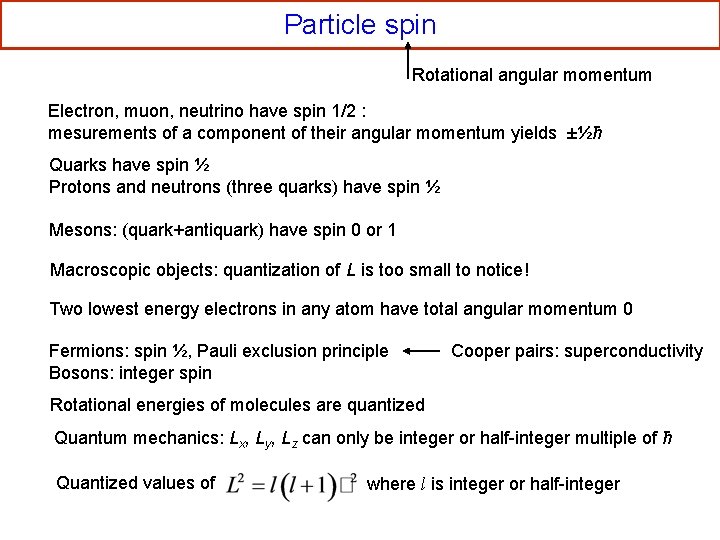
Particle spin Rotational angular momentum Electron, muon, neutrino have spin 1/2 : mesurements of a component of their angular momentum yields ±½ħ Quarks have spin ½ Protons and neutrons (three quarks) have spin ½ Mesons: (quark+antiquark) have spin 0 or 1 Macroscopic objects: quantization of L is too small to notice! Two lowest energy electrons in any atom have total angular momentum 0 Fermions: spin ½, Pauli exclusion principle Bosons: integer spin Cooper pairs: superconductivity Rotational energies of molecules are quantized Quantum mechanics: Lx, Ly, Lz can only be integer or half-integer multiple of ħ Quantized values of where l is integer or half-integer
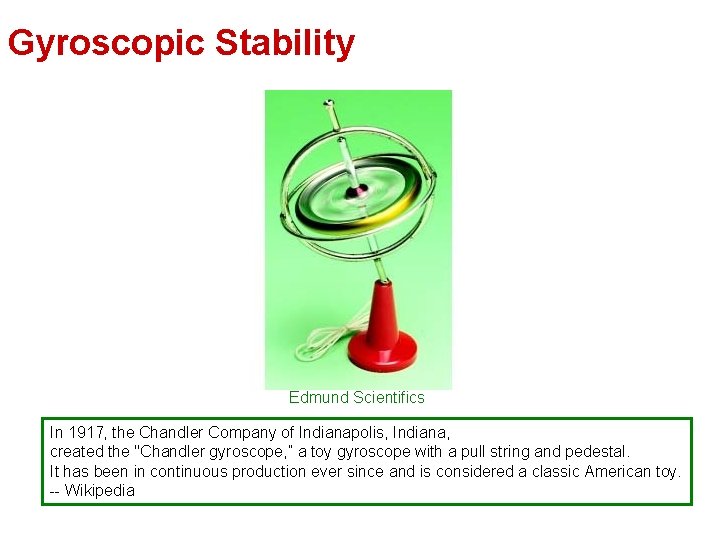
Gyroscopic Stability Edmund Scientifics In 1917, the Chandler Company of Indianapolis, Indiana, created the "Chandler gyroscope, ” a toy gyroscope with a pull string and pedestal. It has been in continuous production ever since and is considered a classic American toy. -- Wikipedia
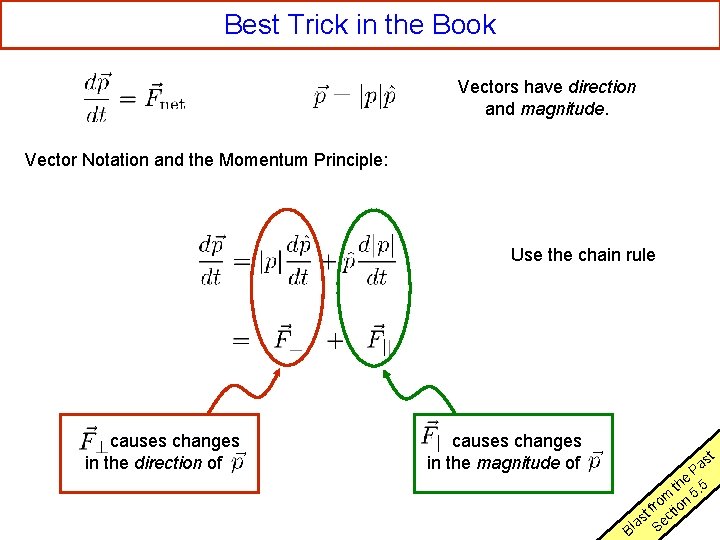
Best Trick in the Book Vectors have direction and magnitude. Vector Notation and the Momentum Principle: Use the chain rule causes changes in the direction of causes changes in the magnitude of t s Pa e th. 5 m 5 rf o tion t as Sec l B
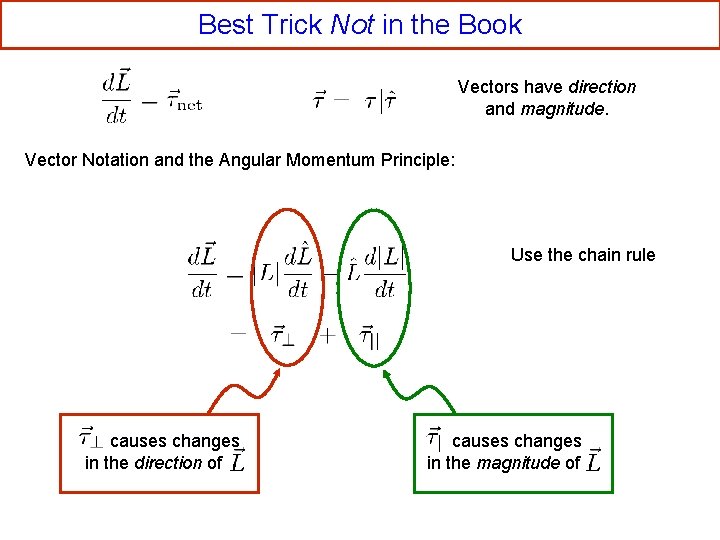
Best Trick Not in the Book Vectors have direction and magnitude. Vector Notation and the Angular Momentum Principle: Use the chain rule causes changes in the direction of causes changes in the magnitude of
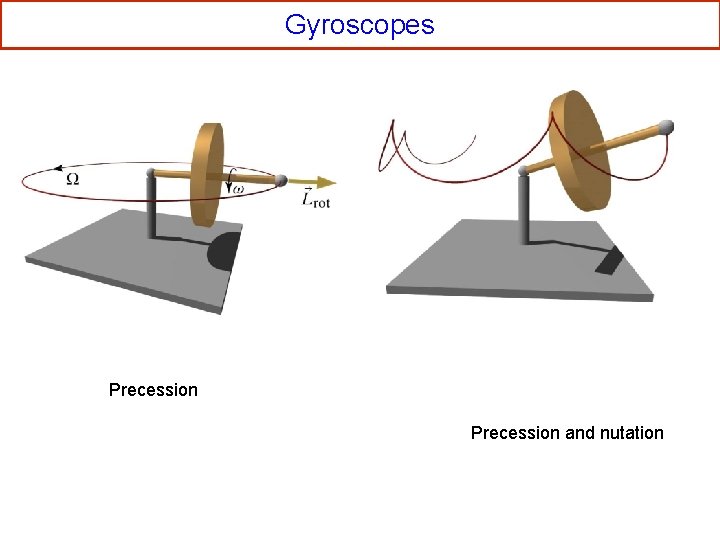
Gyroscopes Precession and nutation
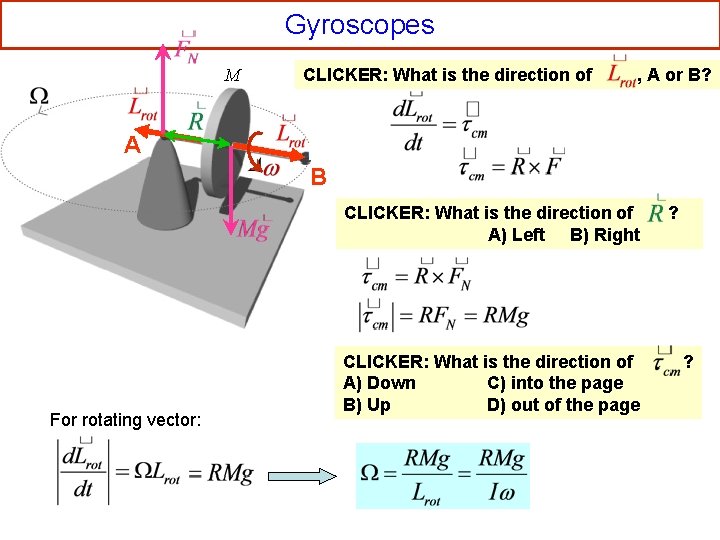
Gyroscopes M CLICKER: What is the direction of , A or B? A B CLICKER: What is the direction of A) Left B) Right For rotating vector: CLICKER: What is the direction of A) Down C) into the page B) Up D) out of the page ? ?
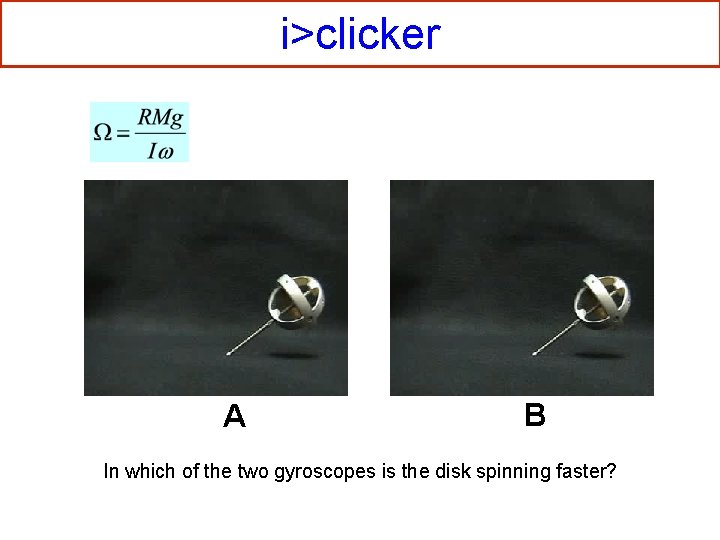
i>clicker A B In which of the two gyroscopes is the disk spinning faster?
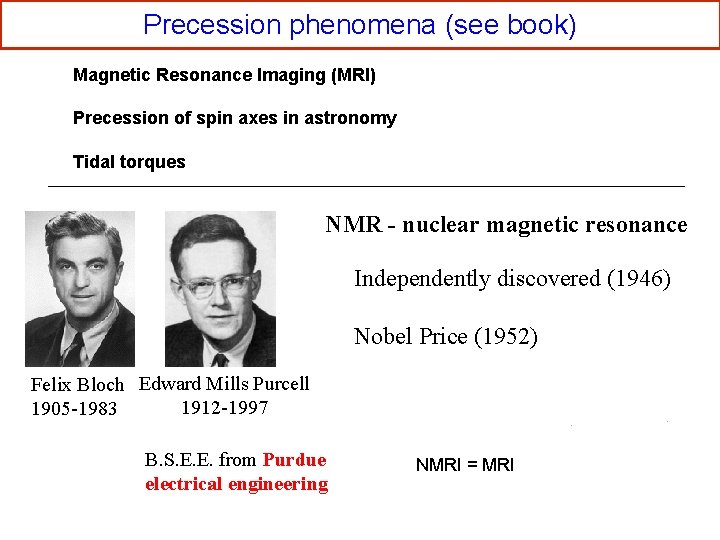
Precession phenomena (see book) Magnetic Resonance Imaging (MRI) Precession of spin axes in astronomy Tidal torques NMR - nuclear magnetic resonance Independently discovered (1946) Nobel Price (1952) Felix Bloch Edward Mills Purcell 1912 -1997 1905 -1983 B. S. E. E. from Purdue electrical engineering NMRI = MRI