
PHYS 16 Lecture 28 Ch 13 Gravitation This
- Slides: 16
PHYS 16 – Lecture 28 Ch. 13 Gravitation
This Week • • Newton’s law of Gravity Gravitational Potential Energy Satellites Kepler’s Laws of Planetary Motion – Orbital Shape – Orbital Areas – Orbital Period
Gravitational Force
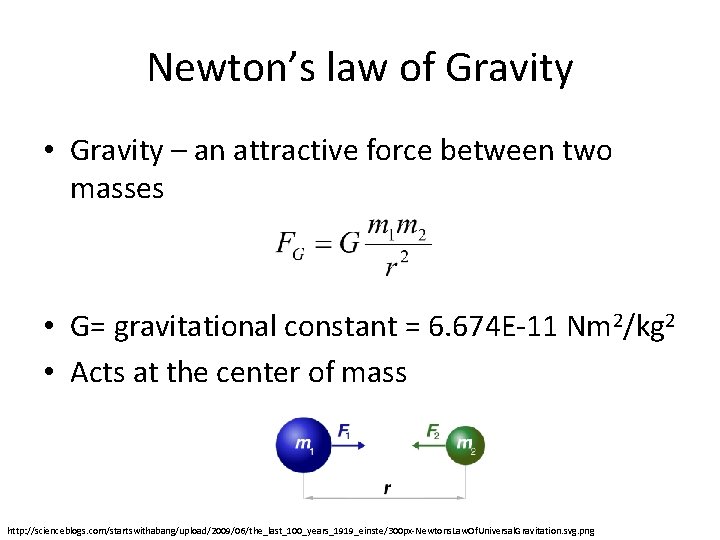
Newton’s law of Gravity • Gravity – an attractive force between two masses • G= gravitational constant = 6. 674 E-11 Nm 2/kg 2 • Acts at the center of mass http: //scienceblogs. com/startswithabang/upload/2009/06/the_last_100_years_1919_einste/300 px-Newtons. Law. Of. Universal. Gravitation. svg. png
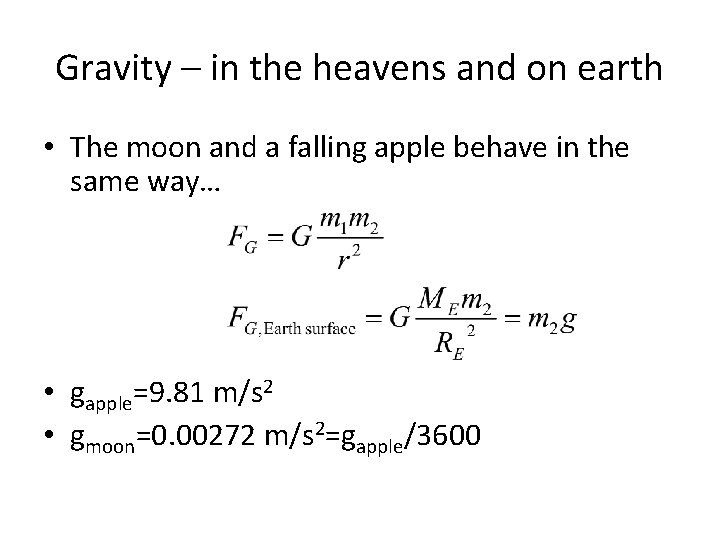
Gravity – in the heavens and on earth • The moon and a falling apple behave in the same way… • gapple=9. 81 m/s 2 • gmoon=0. 00272 m/s 2=gapple/3600
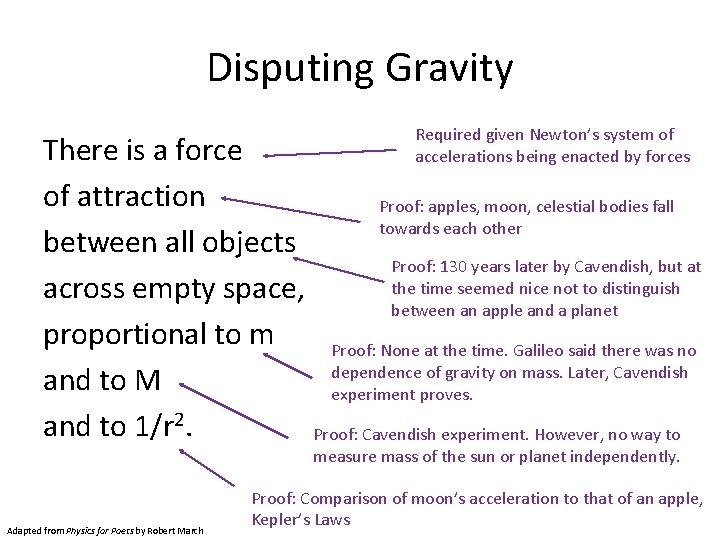
Disputing Gravity Required given Newton’s system of accelerations being enacted by forces There is a force of attraction Proof: apples, moon, celestial bodies fall towards each other between all objects Proof: 130 years later by Cavendish, but at the time seemed nice not to distinguish across empty space, between an apple and a planet proportional to m Proof: None at the time. Galileo said there was no dependence of gravity on mass. Later, Cavendish and to M experiment proves. and to 1/r 2. Proof: Cavendish experiment. However, no way to measure mass of the sun or planet independently. Adapted from Physics for Poets by Robert March Proof: Comparison of moon’s acceleration to that of an apple, Kepler’s Laws
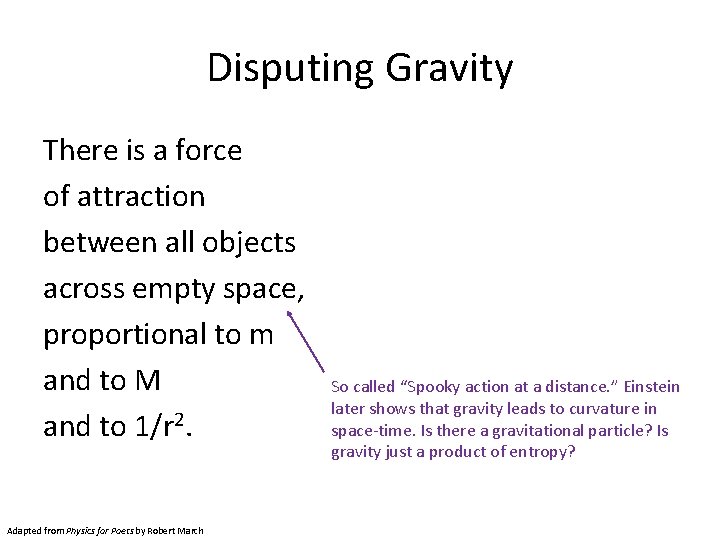
Disputing Gravity There is a force of attraction between all objects across empty space, proportional to m and to M and to 1/r 2. Adapted from Physics for Poets by Robert March So called “Spooky action at a distance. ” Einstein later shows that gravity leads to curvature in space-time. Is there a gravitational particle? Is gravity just a product of entropy?
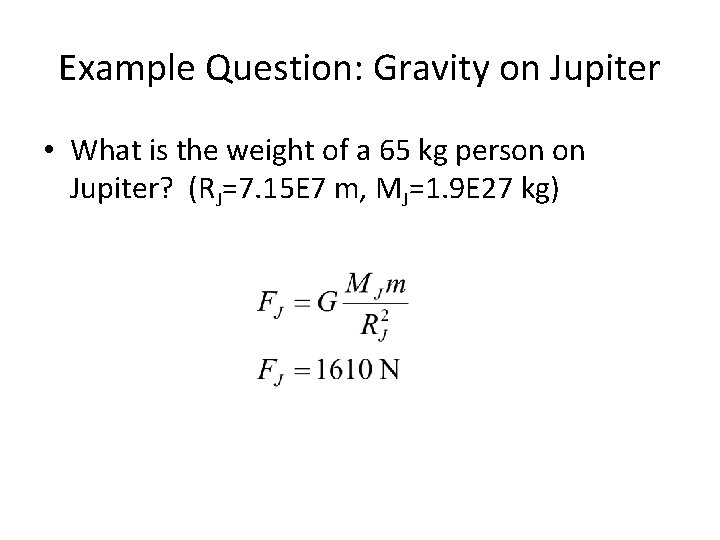
Example Question: Gravity on Jupiter • What is the weight of a 65 kg person on Jupiter? (RJ=7. 15 E 7 m, MJ=1. 9 E 27 kg)
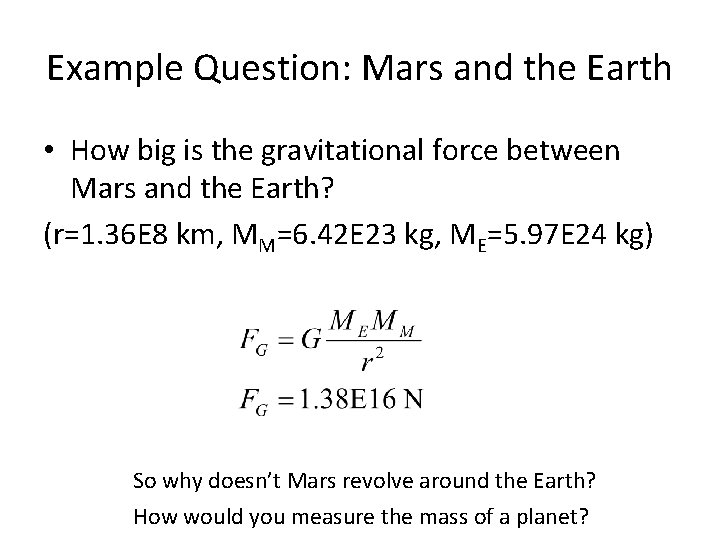
Example Question: Mars and the Earth • How big is the gravitational force between Mars and the Earth? (r=1. 36 E 8 km, MM=6. 42 E 23 kg, ME=5. 97 E 24 kg) So why doesn’t Mars revolve around the Earth? How would you measure the mass of a planet?
Gravitational Potential
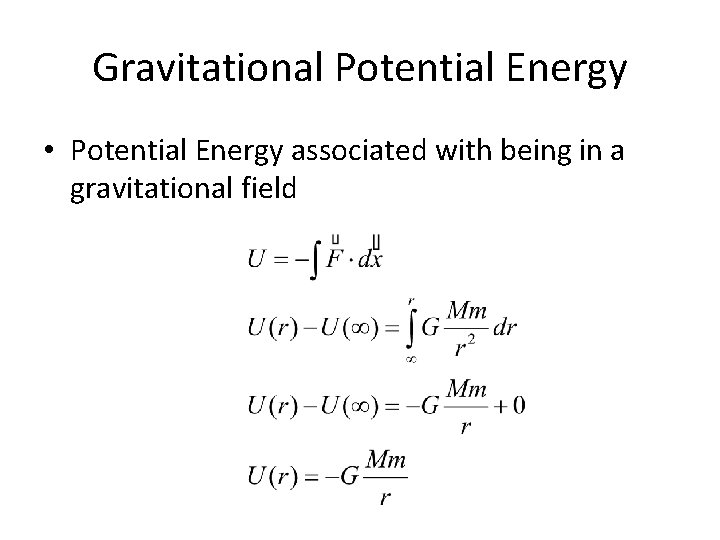
Gravitational Potential Energy • Potential Energy associated with being in a gravitational field
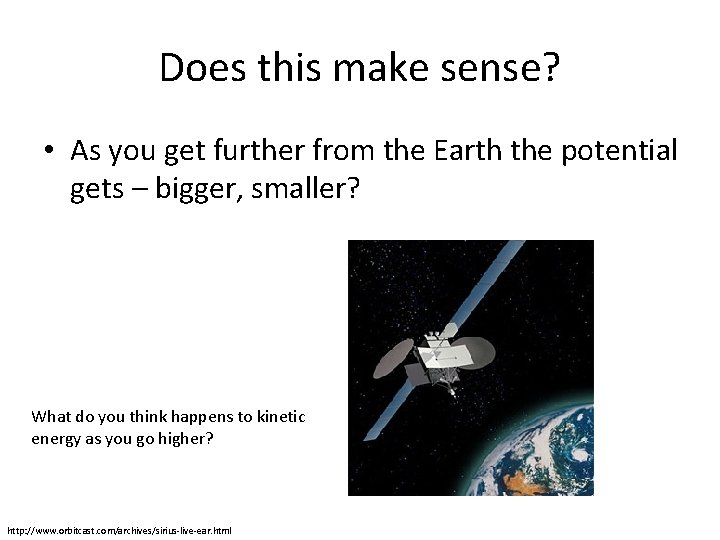
Does this make sense? • As you get further from the Earth the potential gets – bigger, smaller? What do you think happens to kinetic energy as you go higher? http: //www. orbitcast. com/archives/sirius-live-ear. html
Satellites
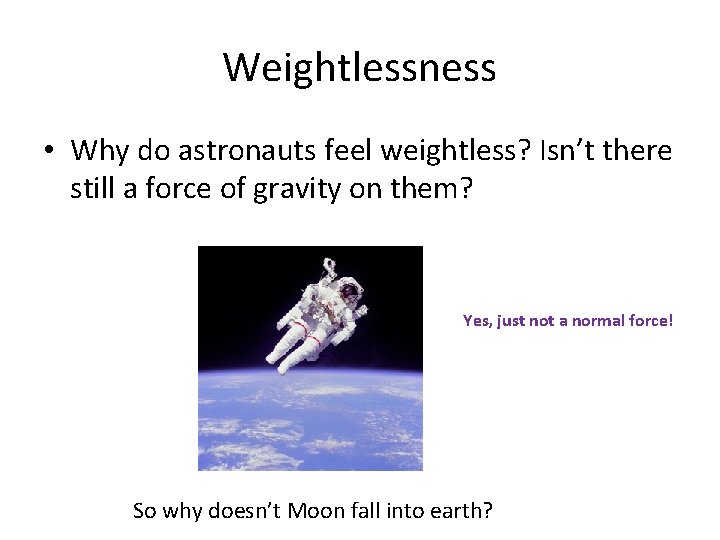
Weightlessness • Why do astronauts feel weightless? Isn’t there still a force of gravity on them? Yes, just not a normal force! So why doesn’t Moon fall into earth?
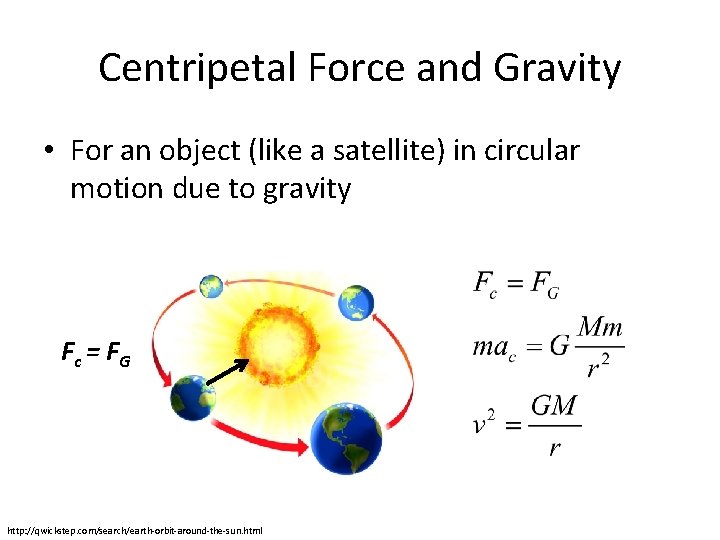
Centripetal Force and Gravity • For an object (like a satellite) in circular motion due to gravity Fc = FG http: //qwickstep. com/search/earth-orbit-around-the-sun. html
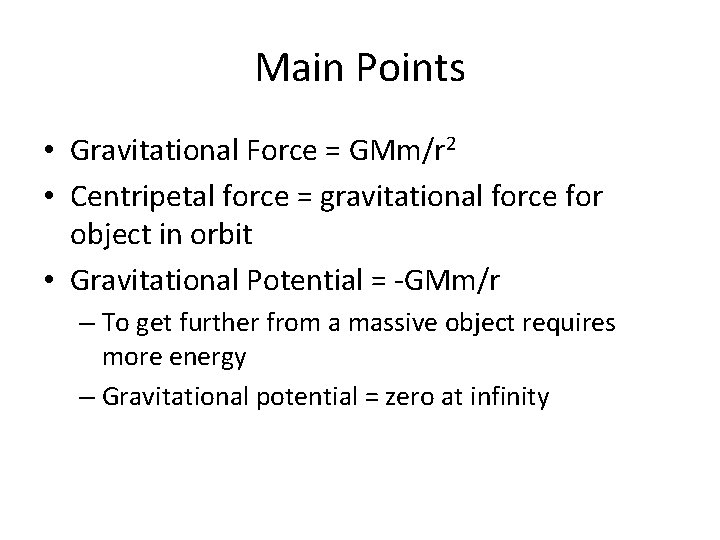
Main Points • Gravitational Force = GMm/r 2 • Centripetal force = gravitational force for object in orbit • Gravitational Potential = -GMm/r – To get further from a massive object requires more energy – Gravitational potential = zero at infinity