
PHYS 1211 Energy and Environmental Physics Lecture 3

- Slides: 48
PHYS 1211 - Energy and Environmental Physics Lecture 3 Energy in Chemistry and Biology Oleh Klochan & Michael Ashley
This Lecture • • • Chemical Energy Biological Energy Photosynthesis Respiration Energy in the Human Body
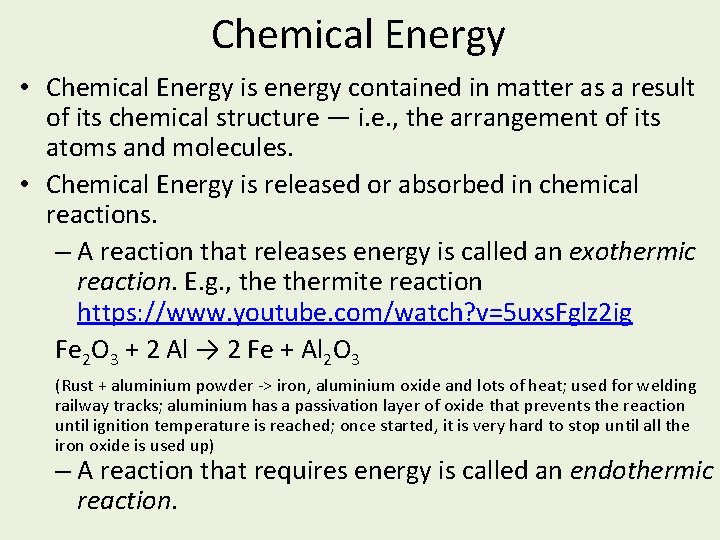
Chemical Energy • Chemical Energy is energy contained in matter as a result of its chemical structure — i. e. , the arrangement of its atoms and molecules. • Chemical Energy is released or absorbed in chemical reactions. – A reaction that releases energy is called an exothermic reaction. E. g. , thermite reaction https: //www. youtube. com/watch? v=5 uxs. Fglz 2 ig Fe 2 O 3 + 2 Al → 2 Fe + Al 2 O 3 (Rust + aluminium powder -> iron, aluminium oxide and lots of heat; used for welding railway tracks; aluminium has a passivation layer of oxide that prevents the reaction until ignition temperature is reached; once started, it is very hard to stop until all the iron oxide is used up) – A reaction that requires energy is called an endothermic reaction.
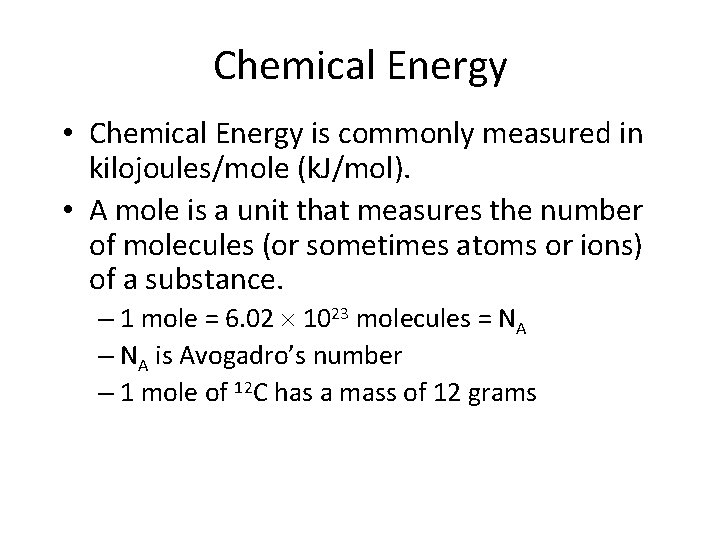
Chemical Energy • Chemical Energy is commonly measured in kilojoules/mole (k. J/mol). • A mole is a unit that measures the number of molecules (or sometimes atoms or ions) of a substance. – 1 mole = 6. 02 1023 molecules = NA – NA is Avogadro’s number – 1 mole of 12 C has a mass of 12 grams
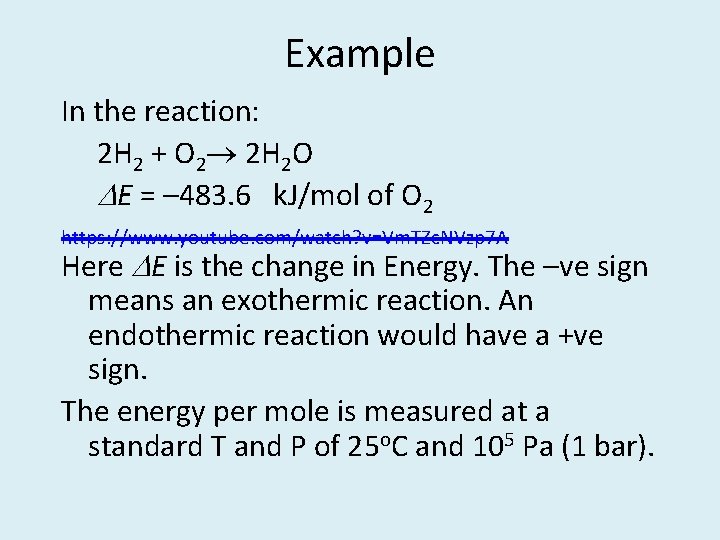
Example In the reaction: 2 H 2 + O 2 2 H 2 O DE = – 483. 6 k. J/mol of O 2 https: //www. youtube. com/watch? v=Vm. TZc. NVzp 7 A Here DE is the change in Energy. The –ve sign means an exothermic reaction. An endothermic reaction would have a +ve sign. The energy per mole is measured at a standard T and P of 25 o. C and 105 Pa (1 bar).
Bond Energies • Chemical Energy is contained in chemical bonds – It can be thought of as the potential energy associated with the electrical forces that bind atoms together into molecules.
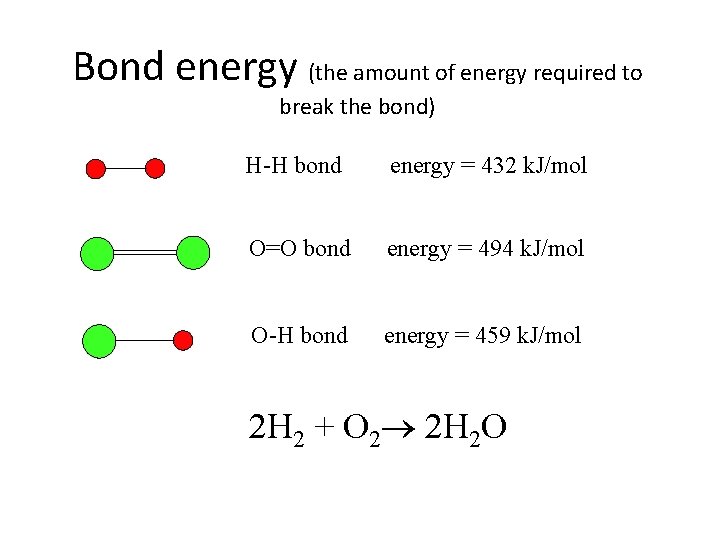
Bond energy (the amount of energy required to break the bond) H-H bond energy = 432 k. J/mol O=O bond energy = 494 k. J/mol O-H bond energy = 459 k. J/mol 2 H 2 + O 2 2 H 2 O
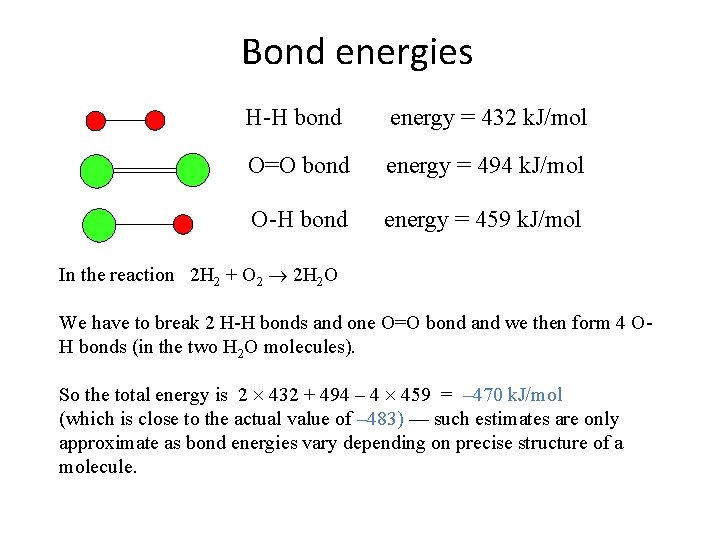
Bond energies H-H bond energy = 432 k. J/mol O=O bond energy = 494 k. J/mol O-H bond energy = 459 k. J/mol In the reaction 2 H 2 + O 2 2 H 2 O We have to break 2 H-H bonds and one O=O bond and we then form 4 OH bonds (in the two H 2 O molecules). So the total energy is 2 432 + 494 – 4 459 = – 470 k. J/mol (which is close to the actual value of – 483) — such estimates are only approximate as bond energies vary depending on precise structure of a molecule.
Energy and Oxidation • The concept of Chemical Energy applies to a particular chemical reaction. – We can’t in general talk about the chemical energy of a substance. • However, when we talk about the chemical energy contained in fuel or food we mean the energy released by combining with oxygen. – i. e. , burning in oxygen (or oxidation). • Because there is plentiful oxygen in the atmosphere (for the Earth), and oxygen is highly reactive, this is an efficient way to get energy.
Energy in Biology • All living organisms require energy. • As human beings we need energy to generate the heat to maintain our body temperature, and to provide mechanical energy in our muscles. • However, even a microbe needs energy just to allow its fundamental chemistry to operate. – Many chemical reactions involved in metabolism (the chemical processes that occur within a living organism to maintain life) are endothermic and require an energy source to make them go.
Autotrophs and Heteroptrophs • Organisms can be classified according to the way they obtain energy. • Autotrophs are organisms that can obtain energy from light or inorganic chemical reactions. – Plants, phytoplankton, and some microbes are autotrophs. • Heterotrophs are organisms that can only obtain energy from other organisms. – Animals, fungi and many bacteria are heterotrophs.
Autotrophs • Autotrophs can be further divided according to their source of energy. • Chemoautotrophs obtain their energy from inorganic chemical reactions. – Mostly microbes that live in extreme environments. • Photoautotrophs obtain their energy from sunlight. – By far the dominant primary source of energy. These obtain energy from sunlight through the process of photosynthesis. Includes plants, phytoplankton, and some bacteria.
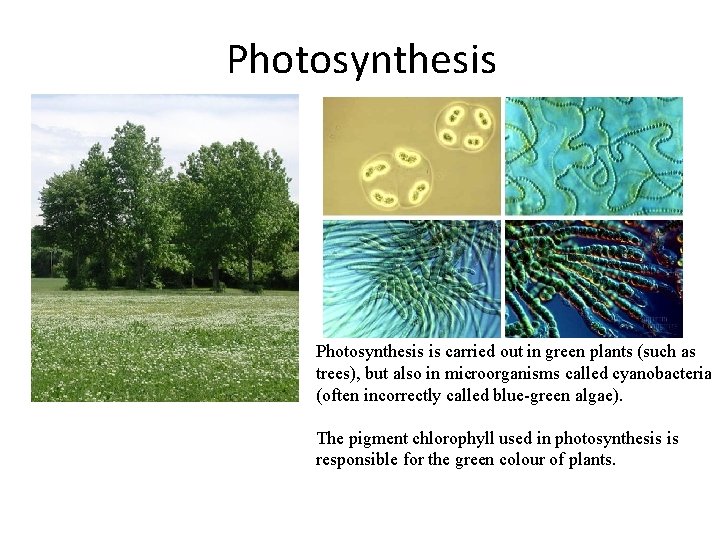
Photosynthesis is carried out in green plants (such as trees), but also in microorganisms called cyanobacteria (often incorrectly called blue-green algae). The pigment chlorophyll used in photosynthesis is responsible for the green colour of plants.
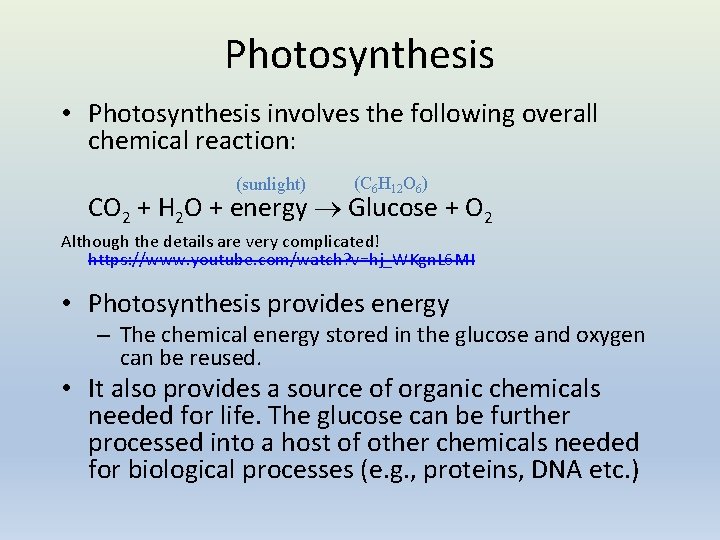
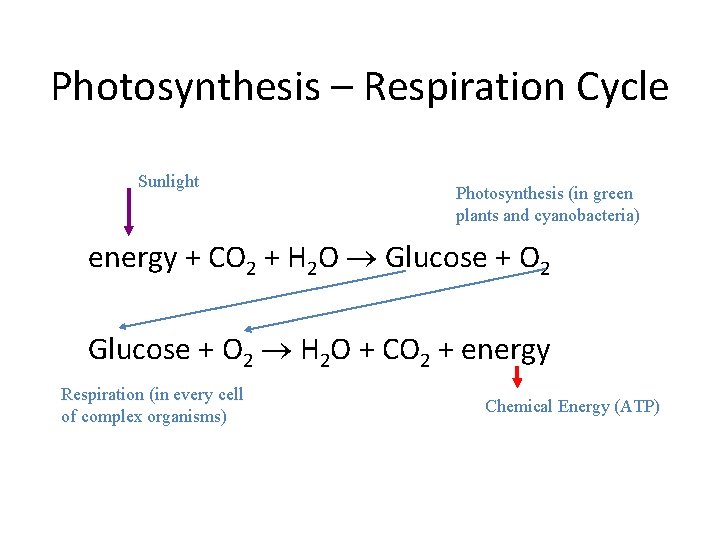
Photosynthesis • Photosynthesis involves the following overall chemical reaction: (sunlight) (C 6 H 12 O 6) CO 2 + H 2 O + energy Glucose + O 2 Although the details are very complicated! https: //www. youtube. com/watch? v=hj_WKgn. L 6 MI • Photosynthesis provides energy – The chemical energy stored in the glucose and oxygen can be reused. • It also provides a source of organic chemicals needed for life. The glucose can be further processed into a host of other chemicals needed for biological processes (e. g. , proteins, DNA etc. )
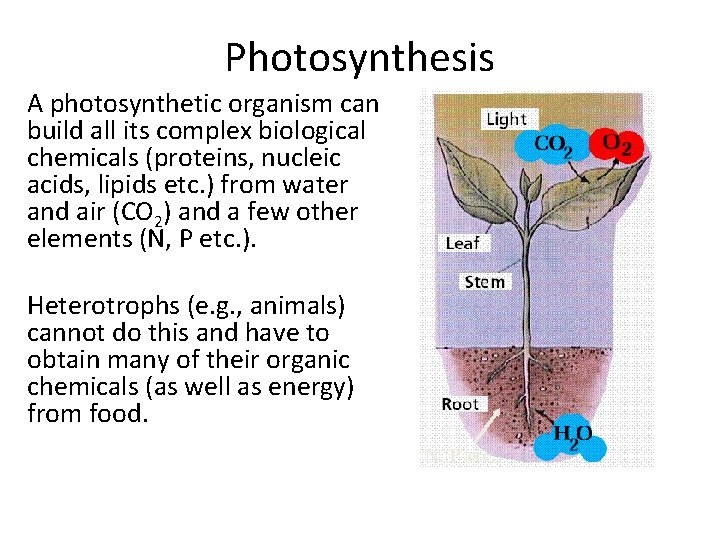
Photosynthesis A photosynthetic organism can build all its complex biological chemicals (proteins, nucleic acids, lipids etc. ) from water and air (CO 2) and a few other elements (N, P etc. ). Heterotrophs (e. g. , animals) cannot do this and have to obtain many of their organic chemicals (as well as energy) from food. N, P etc.
Photosynthesis and Oxygen • Photosynthesis was first evolved by cyanobacteria at least about 2. 4 billion years ago. • It is photosynthesis that created the oxygen in the Earth’s atmosphere. • We know from geological evidence that the oxygen in the Earth’s atmosphere began to build up over about 2. 4– 2. 2 billion years ago.
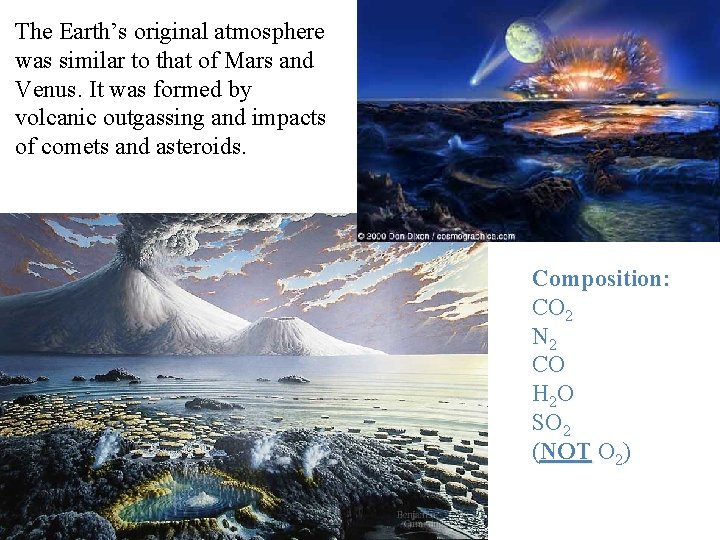
The Earth’s original atmosphere was similar to that of Mars and Venus. It was formed by volcanic outgassing and impacts of comets and asteroids. Composition: CO 2 N 2 CO H 2 O SO 2 (NOT O 2)
The Great Oxygenation Event (2. 3 Billion Years Ago) • The invention of photosynthesis changed the world forever. • The oxygen produced as a by product is an incredibly reactive chemical that easily reacts with most organic chemicals. It would have been toxic to most life at the time. • Probably caused the extinction of many species. • Some species survived by hiding in oxygen free environments. (obligate anaerobes). • But some organisms evolved mechanisms to survive and thrive in this “toxic waste”. – Antioxidants — to protect them from the oxidising environment. – Aerobic respiration — to use oxygen as an efficient source of energy.
Toxic Oxygen! • Oxygen can be dangerous at above normal atmospheric partial pressures – e. g. for scuba divers particularly if using oxygen rich mixtures. • Oxygen may be a significant factor in aging and degenerative diseases. • We have evolved protection to oxygen (using antioxidants) but only just enough to survive atmospheric oxygen levels.
Antioxidants • Antioxidants are chemicals that protect us from our toxic oxygen environment. – Without them many of the key biological chemicals such as DNA and proteins would be subject to oxidative damage. • Some antioxidants are made in the body — others must be obtained from food. – A well known example is Vitamin C (ascorbic acid). – Lack of Vitamin C causes the disease scurvy — a major problem for sailors on long voyages before its cause was understood.
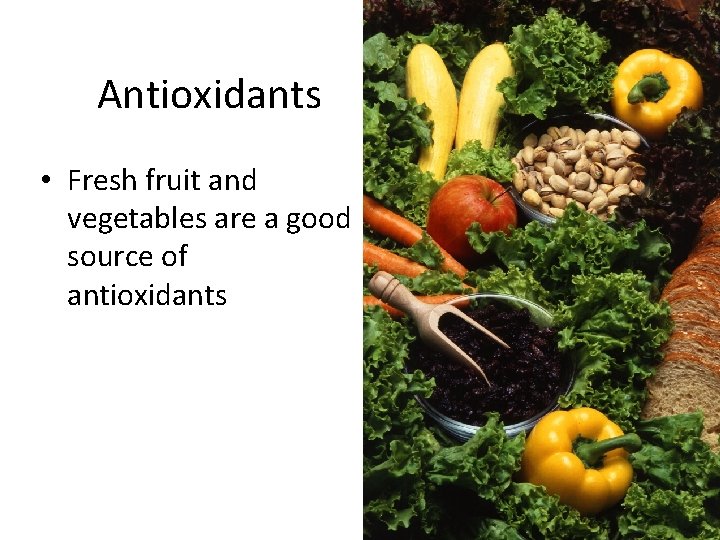
Antioxidants • Fresh fruit and vegetables are a good source of antioxidants
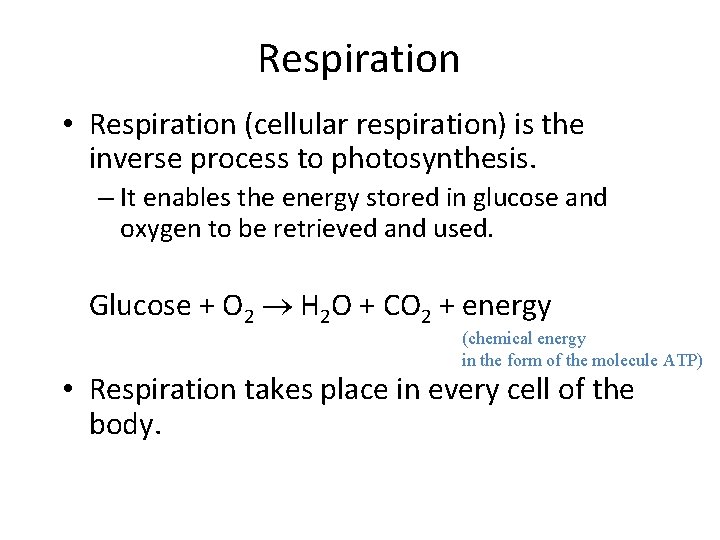
Respiration • Respiration (cellular respiration) is the inverse process to photosynthesis. – It enables the energy stored in glucose and oxygen to be retrieved and used. Glucose + O 2 H 2 O + CO 2 + energy (chemical energy in the form of the molecule ATP) • Respiration takes place in every cell of the body.
Photosynthesis – Respiration Cycle Sunlight Photosynthesis (in green plants and cyanobacteria) energy + CO 2 + H 2 O Glucose + O 2 H 2 O + CO 2 + energy Respiration (in every cell of complex organisms) Chemical Energy (ATP)
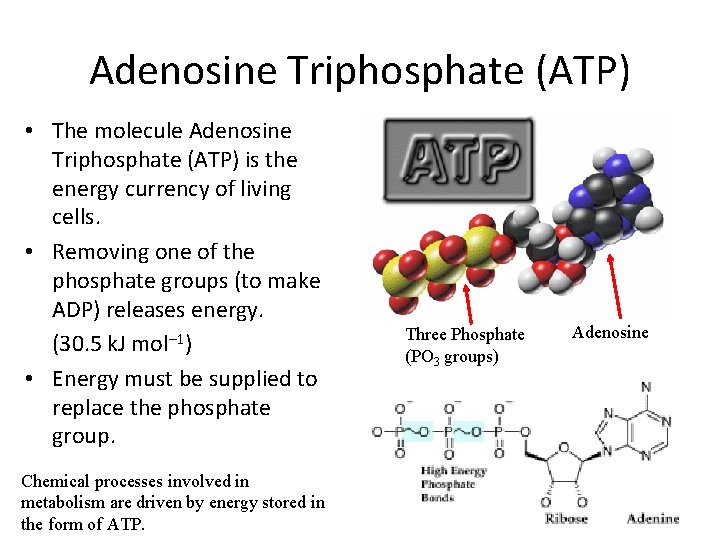
Adenosine Triphosphate (ATP) • The molecule Adenosine Triphosphate (ATP) is the energy currency of living cells. • Removing one of the phosphate groups (to make ADP) releases energy. (30. 5 k. J mol– 1) • Energy must be supplied to replace the phosphate group. Chemical processes involved in metabolism are driven by energy stored in the form of ATP. Three Phosphate (PO 3 groups) Adenosine
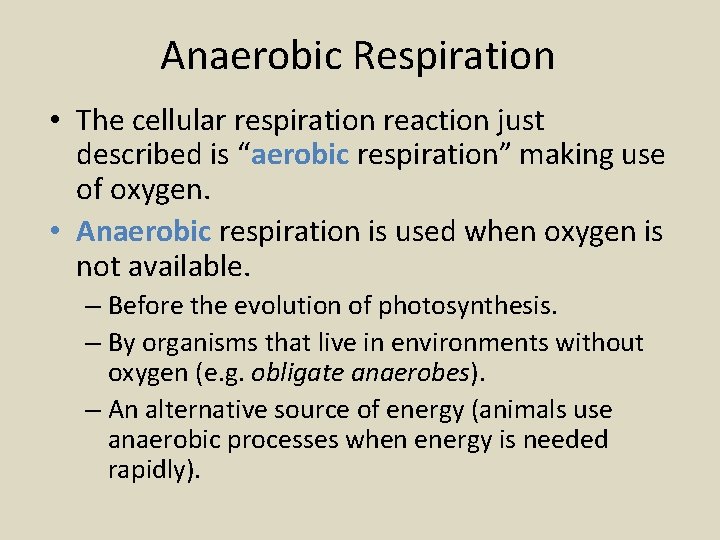
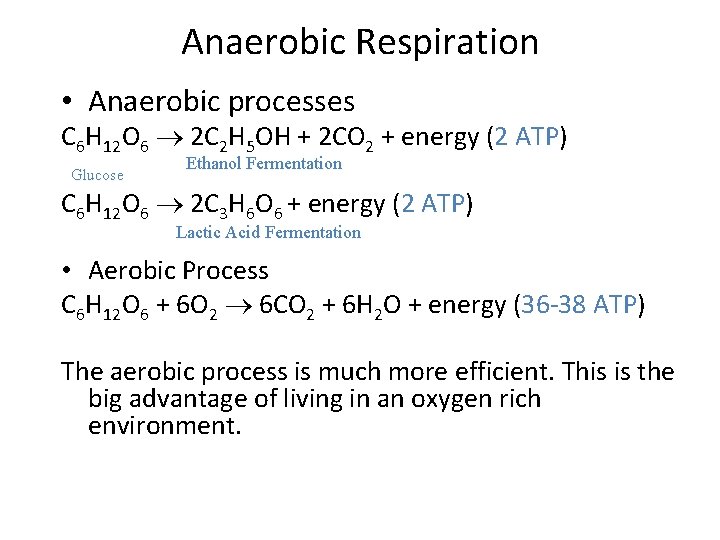
Anaerobic Respiration • The cellular respiration reaction just described is “aerobic respiration” making use of oxygen. • Anaerobic respiration is used when oxygen is not available. – Before the evolution of photosynthesis. – By organisms that live in environments without oxygen (e. g. obligate anaerobes). – An alternative source of energy (animals use anaerobic processes when energy is needed rapidly).
Anaerobic Respiration • Anaerobic processes C 6 H 12 O 6 2 C 2 H 5 OH + 2 CO 2 + energy (2 ATP) Glucose Ethanol Fermentation C 6 H 12 O 6 2 C 3 H 6 O 6 + energy (2 ATP) Lactic Acid Fermentation • Aerobic Process C 6 H 12 O 6 + 6 O 2 6 CO 2 + 6 H 2 O + energy (36 -38 ATP) The aerobic process is much more efficient. This is the big advantage of living in an oxygen rich environment.
Efficient energy production The availability of abundant oxygen and efficient energy production by aerobic respiration allowed the development of large complex organisms. Anaerobes are invariably microbes
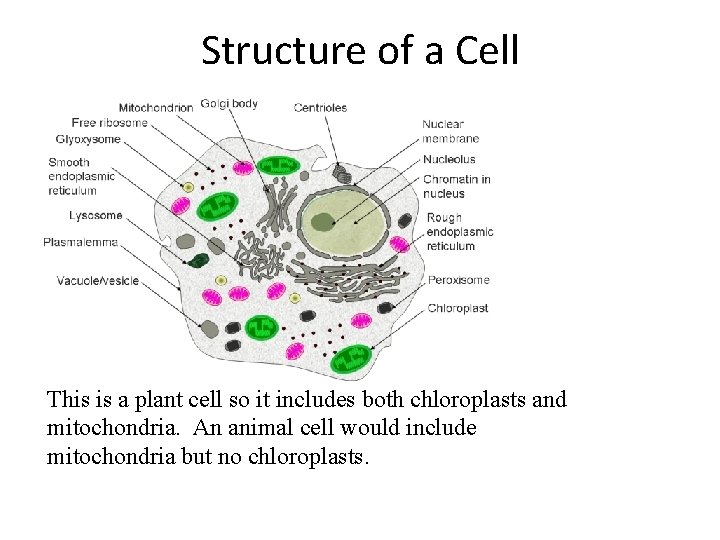
Structure of a Cell This is a plant cell so it includes both chloroplasts and mitochondria. An animal cell would include mitochondria but no chloroplasts.
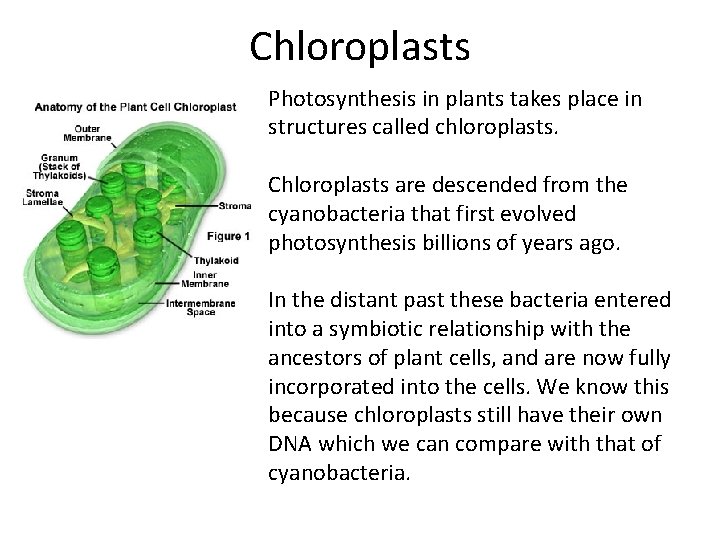
Chloroplasts Photosynthesis in plants takes place in structures called chloroplasts. Chloroplasts are descended from the cyanobacteria that first evolved photosynthesis billions of years ago. In the distant past these bacteria entered into a symbiotic relationship with the ancestors of plant cells, and are now fully incorporated into the cells. We know this because chloroplasts still have their own DNA which we can compare with that of cyanobacteria.
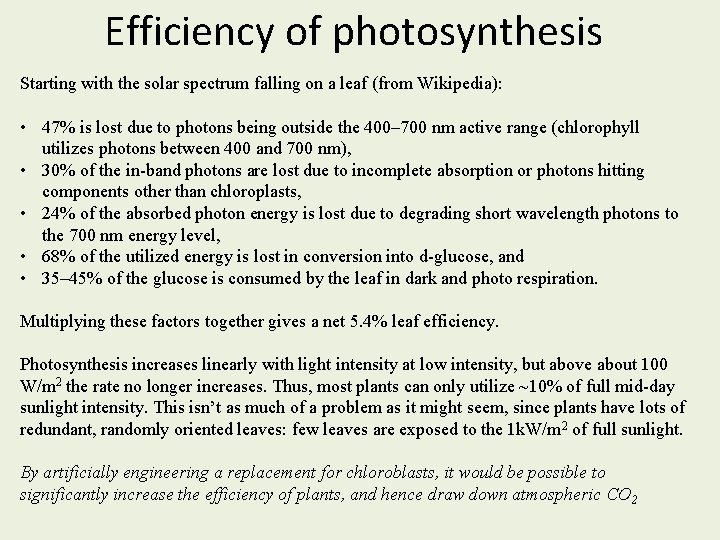
Efficiency of photosynthesis Starting with the solar spectrum falling on a leaf (from Wikipedia): • 47% is lost due to photons being outside the 400– 700 nm active range (chlorophyll utilizes photons between 400 and 700 nm), • 30% of the in-band photons are lost due to incomplete absorption or photons hitting components other than chloroplasts, • 24% of the absorbed photon energy is lost due to degrading short wavelength photons to the 700 nm energy level, • 68% of the utilized energy is lost in conversion into d-glucose, and • 35– 45% of the glucose is consumed by the leaf in dark and photo respiration. Multiplying these factors together gives a net 5. 4% leaf efficiency. Photosynthesis increases linearly with light intensity at low intensity, but above about 100 W/m 2 the rate no longer increases. Thus, most plants can only utilize ~10% of full mid-day sunlight intensity. This isn’t as much of a problem as it might seem, since plants have lots of redundant, randomly oriented leaves: few leaves are exposed to the 1 k. W/m 2 of full sunlight. By artificially engineering a replacement for chloroblasts, it would be possible to significantly increase the efficiency of plants, and hence draw down atmospheric CO 2
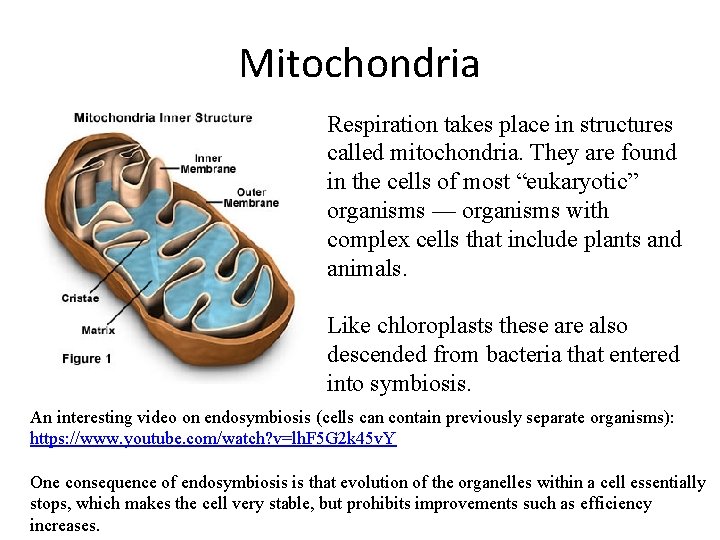
Mitochondria Respiration takes place in structures called mitochondria. They are found in the cells of most “eukaryotic” organisms — organisms with complex cells that include plants and animals. Like chloroplasts these are also descended from bacteria that entered into symbiosis. An interesting video on endosymbiosis (cells can contain previously separate organisms): https: //www. youtube. com/watch? v=lh. F 5 G 2 k 45 v. Y One consequence of endosymbiosis is that evolution of the organelles within a cell essentially stops, which makes the cell very stable, but prohibits improvements such as efficiency increases.
Energy in the Human Body Humans take in energy in the form of food and oxygen. • Digestive system for processing food • Cardiovascular System for processing oxygen
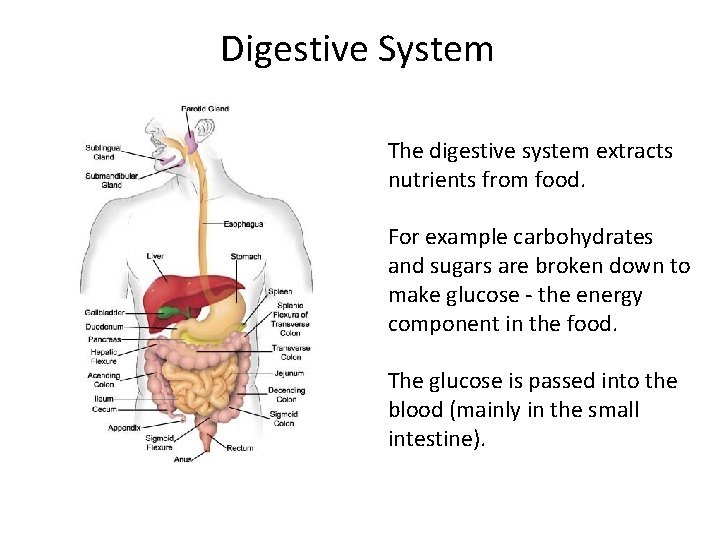
Digestive System The digestive system extracts nutrients from food. For example carbohydrates and sugars are broken down to make glucose - the energy component in the food. The glucose is passed into the blood (mainly in the small intestine).
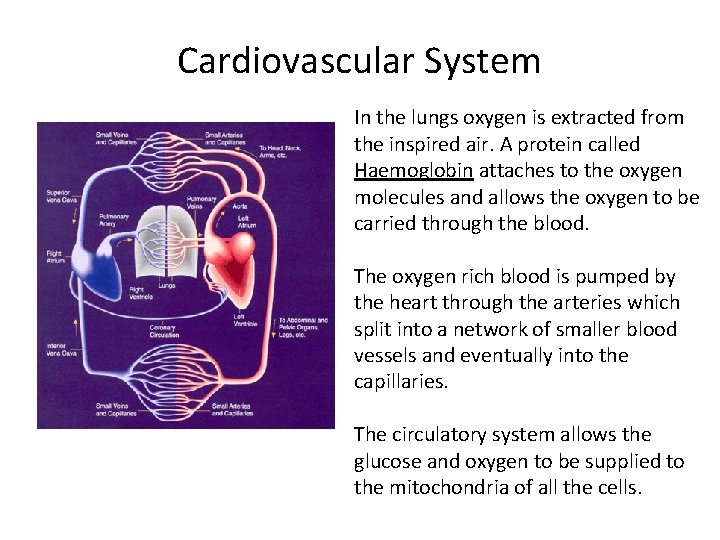
Cardiovascular System In the lungs oxygen is extracted from the inspired air. A protein called Haemoglobin attaches to the oxygen molecules and allows the oxygen to be carried through the blood. The oxygen rich blood is pumped by the heart through the arteries which split into a network of smaller blood vessels and eventually into the capillaries. The circulatory system allows the glucose and oxygen to be supplied to the mitochondria of all the cells.
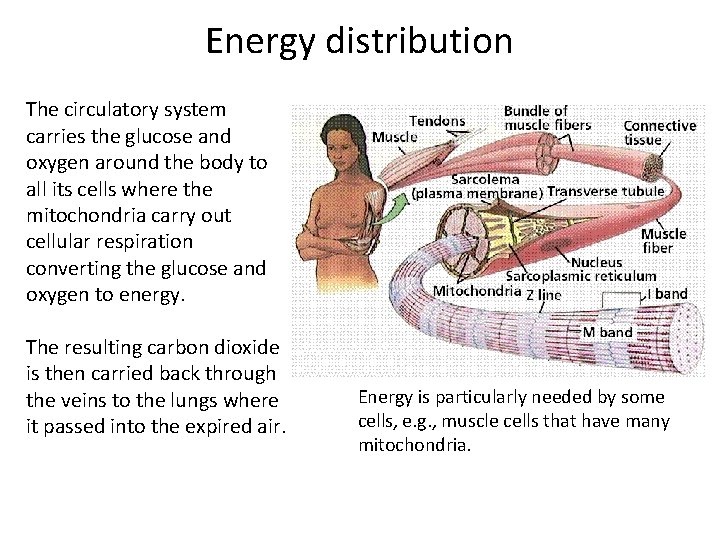
Energy distribution The circulatory system carries the glucose and oxygen around the body to all its cells where the mitochondria carry out cellular respiration converting the glucose and oxygen to energy. The resulting carbon dioxide is then carried back through the veins to the lungs where it passed into the expired air. Energy is particularly needed by some cells, e. g. , muscle cells that have many mitochondria.
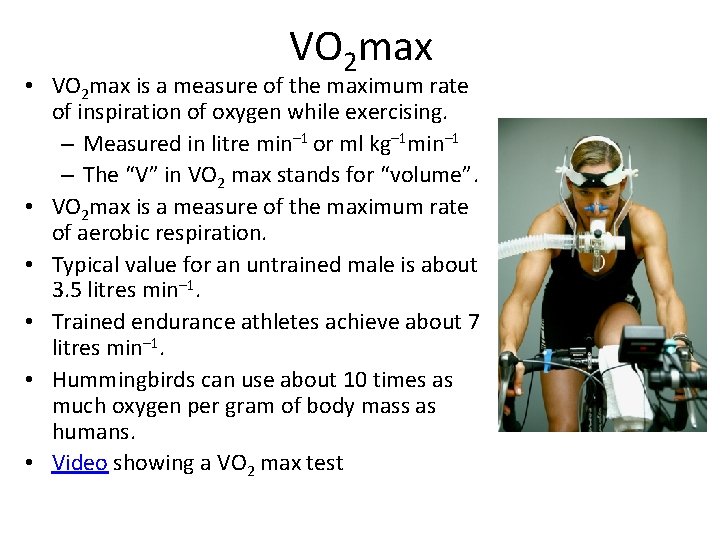
VO 2 max • VO 2 max is a measure of the maximum rate of inspiration of oxygen while exercising. – Measured in litre min– 1 or ml kg– 1 min– 1 – The “V” in VO 2 max stands for “volume”. • VO 2 max is a measure of the maximum rate of aerobic respiration. • Typical value for an untrained male is about 3. 5 litres min– 1. • Trained endurance athletes achieve about 7 litres min– 1. • Hummingbirds can use about 10 times as much oxygen per gram of body mass as humans. • Video showing a VO 2 max test
VO 2 max and Power C 6 H 12 O 6 + 6 O 2 6 CO 2 + 6 H 2 O + energy (2817 k. J mol– 1) Glucose A VO 2 max of 7 l min– 1 is 0. 3125 mol of O 2 min– 1 = 0. 052 mol of glucose per minute = 146. 7 k. J min– 1 = 2445 W Remember that earlier we calculated the power output of an endurance athlete as about 400 W. The difference between these two figures is due to the efficiency of muscles in converting energy into mechanical form (which is about 15%). The rest of the energy ends up as heat — which is of course why we get hot when exercising.
Anaerobic Respiration • Human muscles can extract energy using anaerobic respiration. This enables short periods of exertion at rates well above that limited by VO 2 max. • This is used by sprinters for example. The body goes into “oxygen debt” and has to take in oxygen to break down the anaerobic products such as lactic acid.
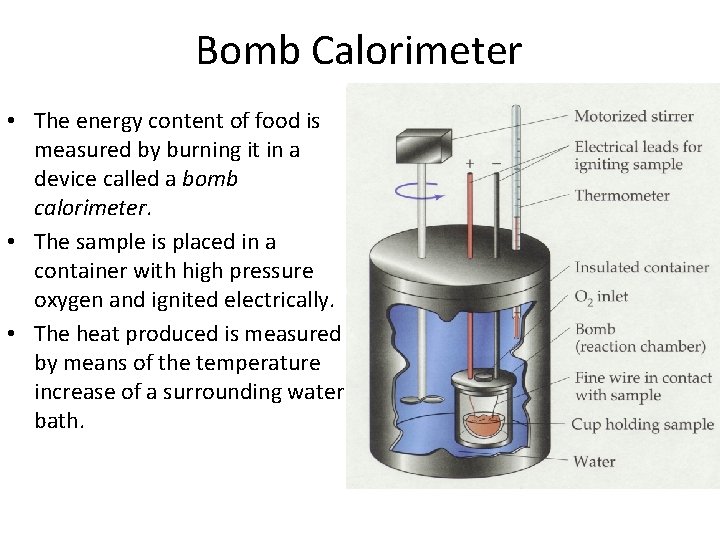
Bomb Calorimeter • The energy content of food is measured by burning it in a device called a bomb calorimeter. • The sample is placed in a container with high pressure oxygen and ignited electrically. • The heat produced is measured by means of the temperature increase of a surrounding water bath.
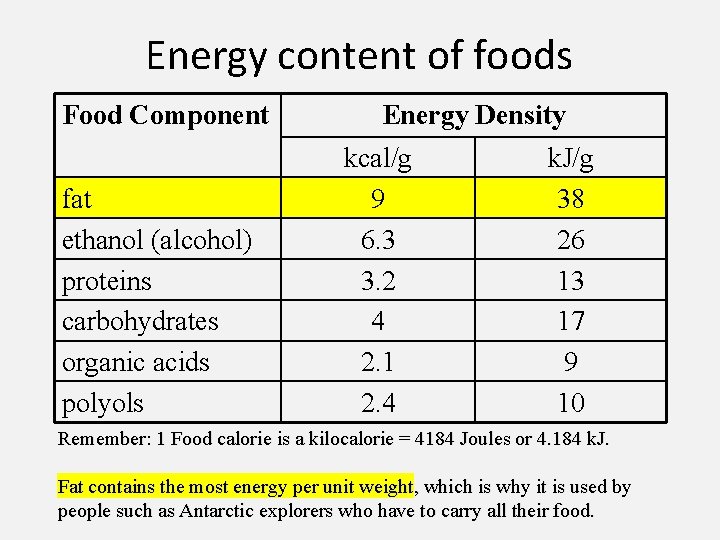
Energy content of foods Food Component fat ethanol (alcohol) proteins carbohydrates organic acids polyols Energy Density kcal/g 9 6. 3 3. 2 4 2. 1 2. 4 k. J/g 38 26 13 17 9 10 Remember: 1 Food calorie is a kilocalorie = 4184 Joules or 4. 184 k. J. Fat contains the most energy per unit weight, which is why it is used by people such as Antarctic explorers who have to carry all their food.
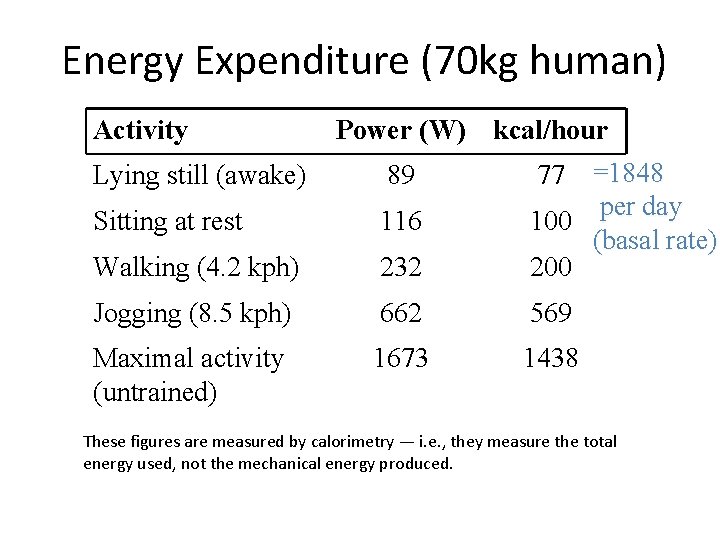
Energy Expenditure (70 kg human) Activity Power (W) kcal/hour Lying still (awake) 89 Sitting at rest 116 Walking (4. 2 kph) 232 77 =1848 per day 100 (basal rate) 200 Jogging (8. 5 kph) 662 569 Maximal activity (untrained) 1673 1438 These figures are measured by calorimetry — i. e. , they measure the total energy used, not the mechanical energy produced.
Energy Requirement • The actual energy requirement (in the form of food) will be the basal rate + the energy needed for activity during the day. • This varies depending on level of activity but might typically be 2400– 2900 calories for a 70 kg body weight. • Can be much higher for extreme levels of activity. – A tour de France cyclist “burns” 6000– 9000 calories per day.
Excess Energy • Many countries have average energy consumption above typical daily requirements. • Excess energy is stored as fat. • This energy storage is an important evolutionary adaptation enabling animals to survive with an unpredictable food supply. – When food is abundant we eat more than we need and store the excess energy as fat. – When food is scarce we can use the stored fat as an energy source.
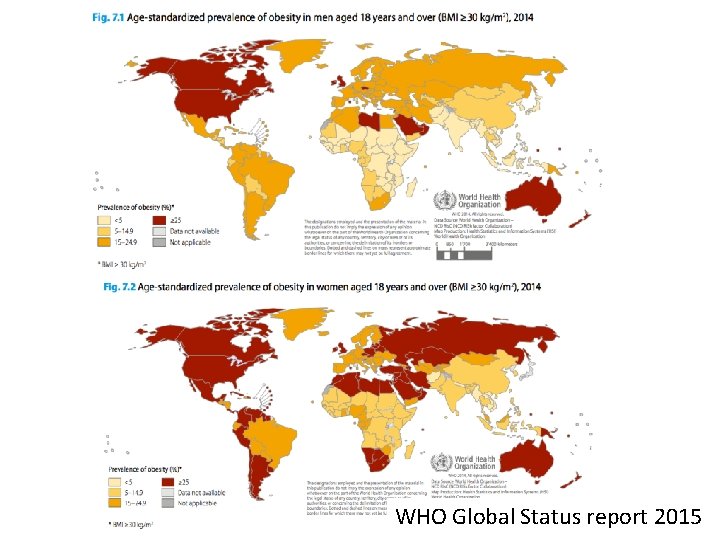
The Obesity Problem • In developed countries food is readily available. – There is a tendency to overeat — This is just what we are evolutionarily programmed to do in such circumstances. • Many of these countries have an epidemic of obesity. – Resultant health problems that include cancer, cardiovascular disease and many others. • Also supports a large diet and exercise industry.
WHO Global Status report 2015
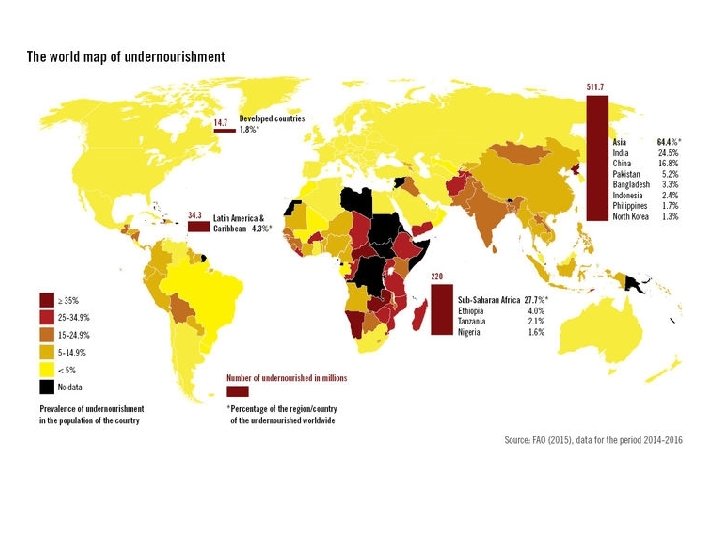
World Food Crisis • At the same time in many poor countries there are food shortages and high food prices. • Average energy consumptions in these poor countries are only just above the basal level. • Many people there are undernourished.
Next lecture • The next lecture will be the first of two looking at fossil fuels (coal, oil and natural gas).