
Phys 102 Lecture 25 The quantum mechanical model


- Slides: 18
Phys 102 – Lecture 25 The quantum mechanical model of light 1
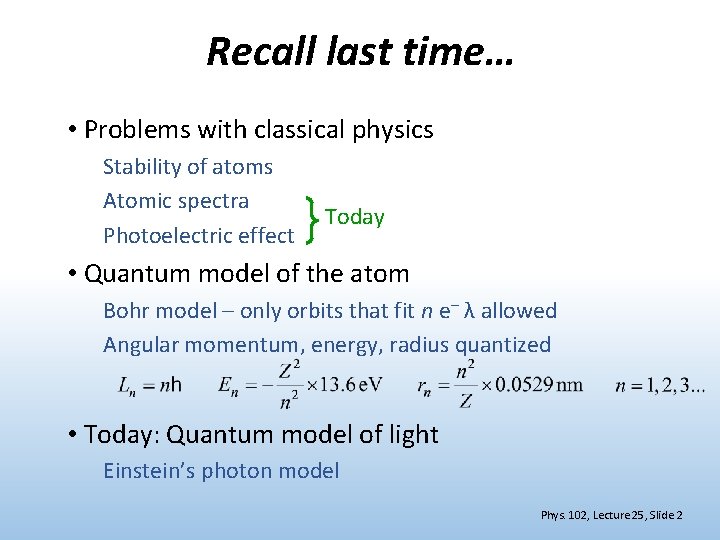
Recall last time… • Problems with classical physics Stability of atoms Atomic spectra Photoelectric effect Today • Quantum model of the atom Bohr model – only orbits that fit n e– λ allowed Angular momentum, energy, radius quantized • Today: Quantum model of light Einstein’s photon model Phys. 102, Lecture 25, Slide 2
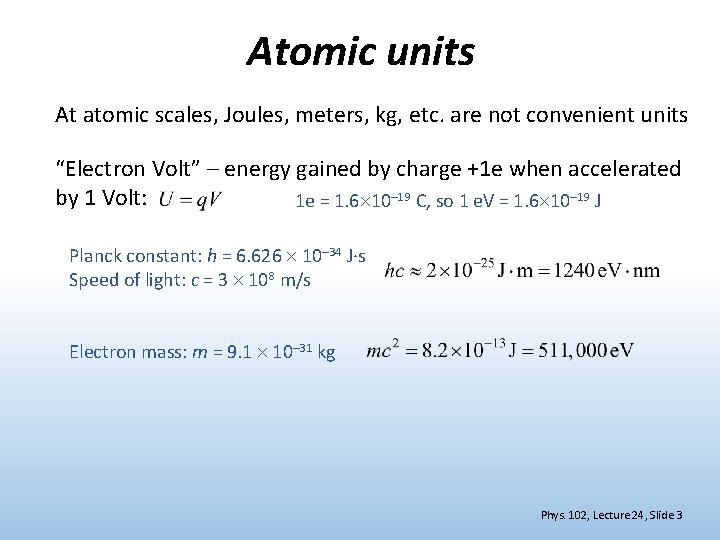
Atomic units At atomic scales, Joules, meters, kg, etc. are not convenient units “Electron Volt” – energy gained by charge +1 e when accelerated by 1 Volt: 1 e = 1. 6 10– 19 C, so 1 e. V = 1. 6 10– 19 J Planck constant: h = 6. 626 10– 34 J∙s Speed of light: c = 3 108 m/s Electron mass: m = 9. 1 10– 31 kg Phys. 102, Lecture 24, Slide 3
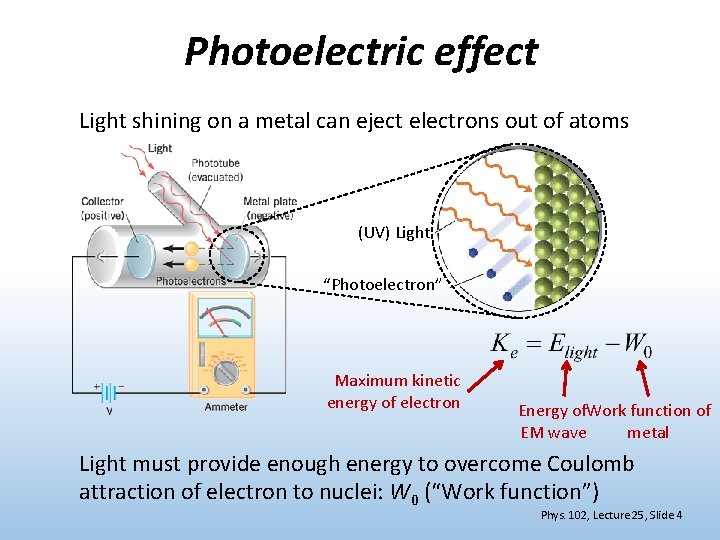
Photoelectric effect Light shining on a metal can eject electrons out of atoms (UV) Light “Photoelectron” Maximum kinetic energy of electron Energy of. Work function of EM wave metal Light must provide enough energy to overcome Coulomb attraction of electron to nuclei: W 0 (“Work function”) Phys. 102, Lecture 25, Slide 4
Classical model vs. experiment Classical prediction 1. Increasing intensity should increase Elight, Ke 2. Changing f (or λ) of light should change nothing – + – – Experimental result 1. Increasing intensity results in more e–, at same Ke 2. Decreasing f (or increasing λ) decreases Ke, and below critical value f 0, e– emission stops DEMO Phys. 102, Lecture 25, Slide 5
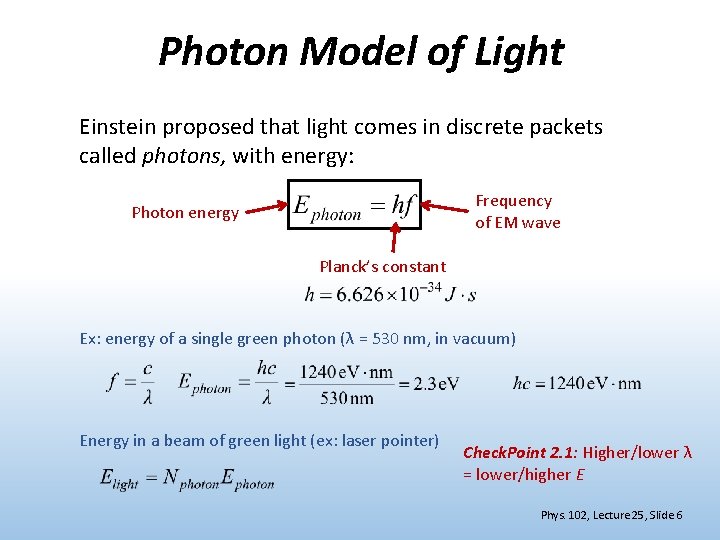
Photon Model of Light Einstein proposed that light comes in discrete packets called photons, with energy: Frequency of EM wave Photon energy Planck’s constant Ex: energy of a single green photon (λ = 530 nm, in vacuum) Energy in a beam of green light (ex: laser pointer) Check. Point 2. 1: Higher/lower λ = lower/higher E Phys. 102, Lecture 25, Slide 6
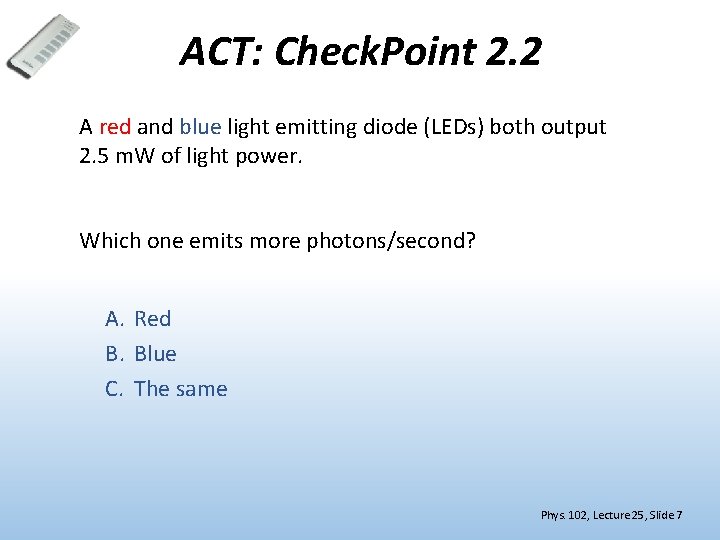
ACT: Check. Point 2. 2 A red and blue light emitting diode (LEDs) both output 2. 5 m. W of light power. Which one emits more photons/second? A. Red B. Blue C. The same Phys. 102, Lecture 25, Slide 7
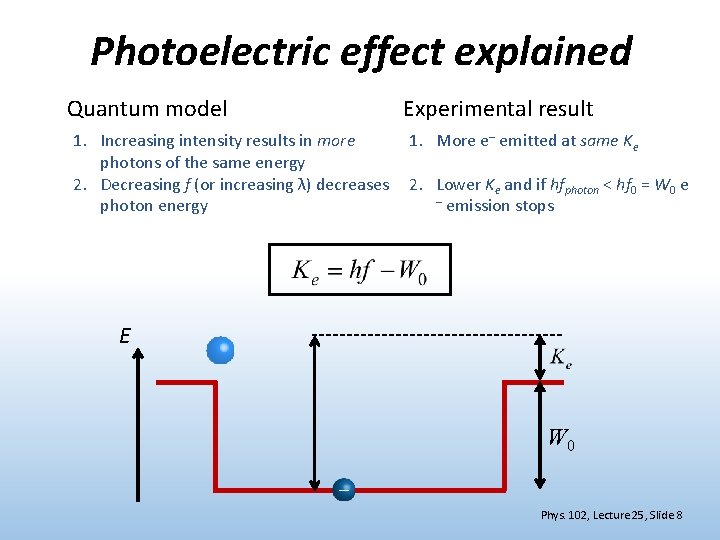
Photoelectric effect explained Quantum model Experimental result 1. Increasing intensity results in more photons of the same energy 2. Decreasing f (or increasing λ) decreases photon energy 1. More e– emitted at same Ke 2. Lower Ke and if hfphoton < hf 0 = W 0 e – emission stops E W 0 – Phys. 102, Lecture 25, Slide 8
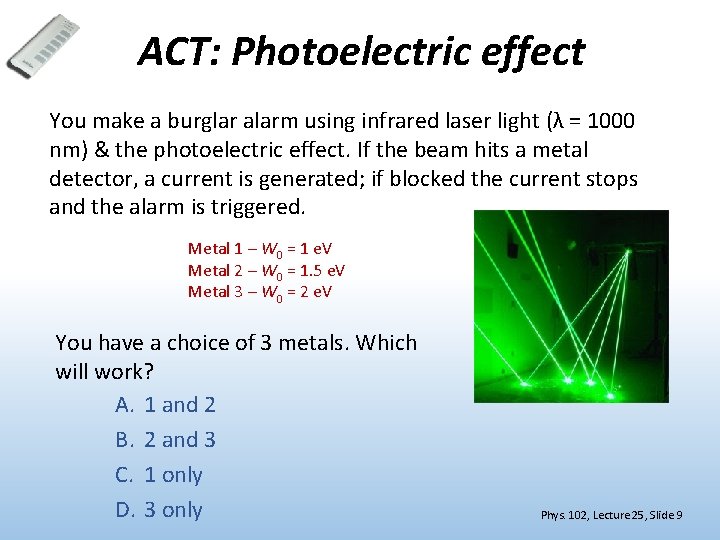
ACT: Photoelectric effect You make a burglar alarm using infrared laser light (λ = 1000 nm) & the photoelectric effect. If the beam hits a metal detector, a current is generated; if blocked the current stops and the alarm is triggered. Metal 1 – W 0 = 1 e. V Metal 2 – W 0 = 1. 5 e. V Metal 3 – W 0 = 2 e. V You have a choice of 3 metals. Which will work? A. 1 and 2 B. 2 and 3 C. 1 only D. 3 only Phys. 102, Lecture 25, Slide 9
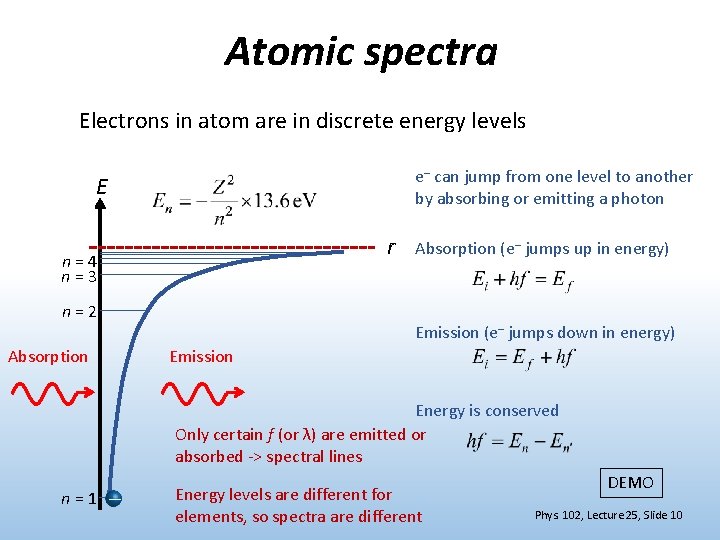
Atomic spectra Electrons in atom are in discrete energy levels e– can jump from one level to another by absorbing or emitting a photon E r n=4 n=3 n=2 Absorption (e– jumps up in energy) Emission (e– jumps down in energy) Absorption Emission Energy is conserved Only certain f (or λ) are emitted or absorbed -> spectral lines n=1 – Energy levels are different for elements, so spectra are different DEMO Phys. 102, Lecture 25, Slide 10
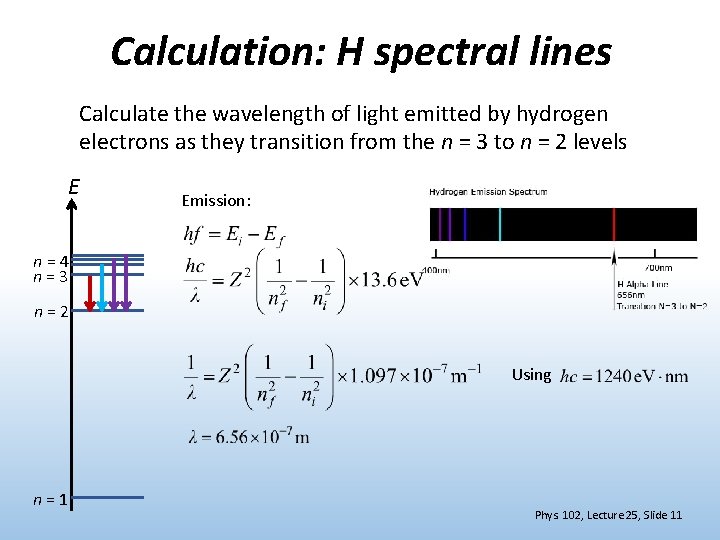
Calculation: H spectral lines Calculate the wavelength of light emitted by hydrogen electrons as they transition from the n = 3 to n = 2 levels E Emission: n=4 n=3 n=2 Using n=1 Phys. 102, Lecture 25, Slide 11
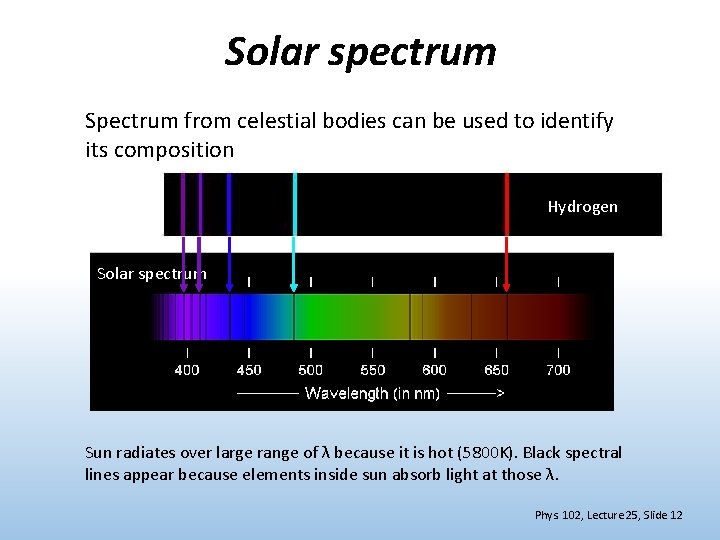
Solar spectrum Spectrum from celestial bodies can be used to identify its composition Hydrogen Solar spectrum Sun radiates over large range of λ because it is hot (5800 K). Black spectral lines appear because elements inside sun absorb light at those λ. Phys. 102, Lecture 25, Slide 12
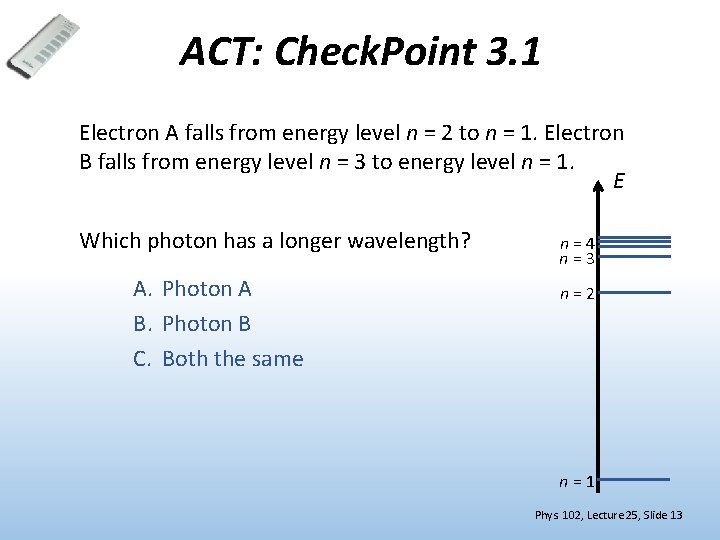
ACT: Check. Point 3. 1 Electron A falls from energy level n = 2 to n = 1. Electron B falls from energy level n = 3 to energy level n = 1. E Which photon has a longer wavelength? A. Photon A B. Photon B C. Both the same n=4 n=3 n=2 n=1 Phys. 102, Lecture 25, Slide 13
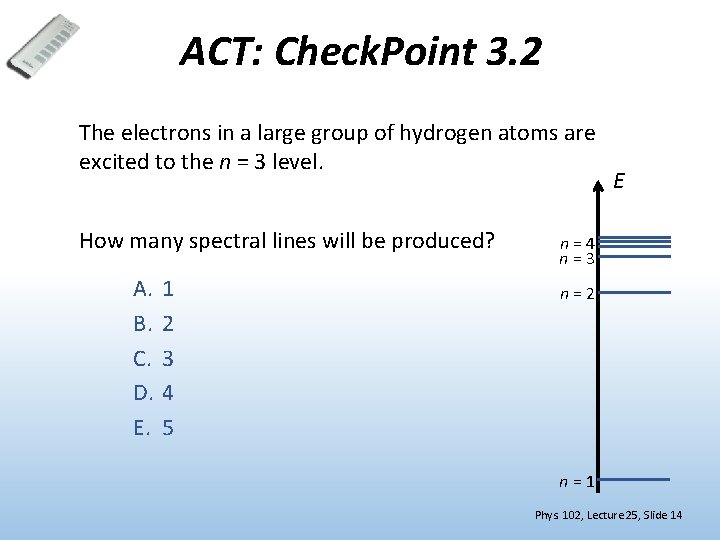
ACT: Check. Point 3. 2 The electrons in a large group of hydrogen atoms are excited to the n = 3 level. How many spectral lines will be produced? A. B. C. D. E. 1 2 3 4 5 E n=4 n=3 n=2 n=1 Phys. 102, Lecture 25, Slide 14
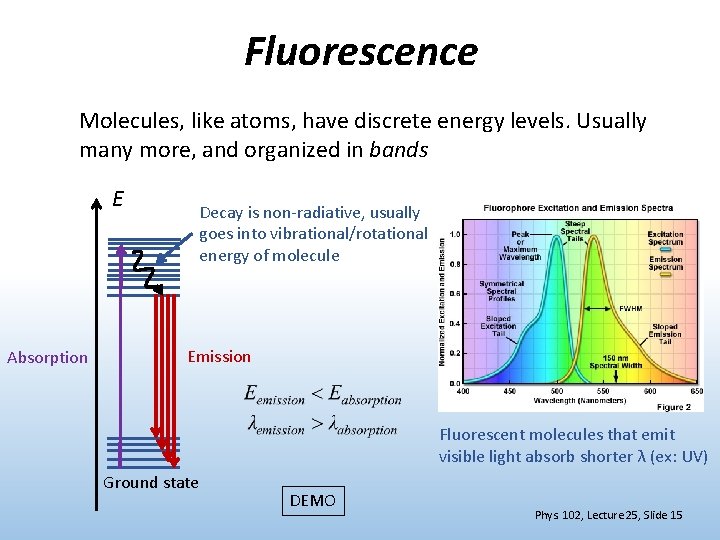
Fluorescence Molecules, like atoms, have discrete energy levels. Usually many more, and organized in bands E Absorption Decay is non-radiative, usually goes into vibrational/rotational energy of molecule Emission Fluorescent molecules that emit visible light absorb shorter λ (ex: UV) Ground state DEMO Phys. 102, Lecture 25, Slide 15
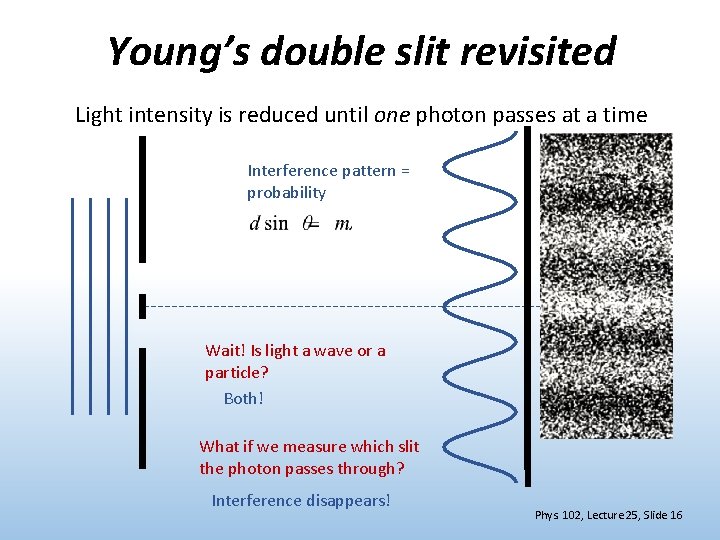
Young’s double slit revisited Light intensity is reduced until one photon passes at a time Interference pattern = probability Wait! Is light a wave or a particle? Both! What if we measure which slit the photon passes through? Interference disappears! Phys. 102, Lecture 25, Slide 16
ACT: Photons & electrons A free photon and an electron have the same energy of 1 e. V. Therefore they must have the same wavelength. A. True B. False Phys. 102, Lecture 25, Slide 17
Summary of today’s lecture • Quantum model of light Light comes in discrete packets of energy Light intensity is related to number of photons, not photon energy • Spectral lines Transitions between energy levels • Wave-particle duality Waves behave like particles (photons) Particles behave like waves (electrons) Phys. 102, Lecture 25, Slide 18