
PHYS 101 General Physics Vector Force and Newtons

- Slides: 36
PHYS 101 General Physics Vector Force and Newton’s laws of Motion Work, Energy and Power Fluids Direct Current (DC) Instructor: Zyad Ahmed 2018 Nerve Conduction Ionizing radiation
Force and Newtown's Laws of Motion
CHAPTER OUTLINE • Definition of force and motion. • Equilibrium state. • Newton’s laws of motion. • Fundamental forces: Weight and friction.
OBJECTIVE After completing this chapter , You should be able to do the following: : • To understand use Newton's 1 st, 2 nd, and 3 rd laws. • To understand the significance of Newton's law of inertia • To relate the net force of an object to the acceleration of the object. • To identify the proportional relationship between acceleration, net force, and mass. • To utilize Newton's second law equation to algebraically solve for an unknown quantity - acceleration, net force, or mass. • To identify action-reaction force pairs for any physical situation.
Isaac Newton first published his three laws of motion in 1687. I’m sure you will ask me : “Why are they teaching me this stuff? ” This is an important question Newton's law are very important because they tie into almost everything we see in everyday life. These laws tell us exactly how things move or sit still, like why you don't float out of bed or fall through the floor of your house. Newton's laws control how cars work, how water flows, how buildings don't fall down, and basically how everything around us moves. In this chapter , you'll definitely learn how to apply these laws to understand real-life problems. But to understand these laws you must first know the meaning of motion and force because this laws are based on understanding and the meaning of motion and force
After we have finished understanding and knowing the meaning of motion and force. Now we can explain the laws of Newton’s
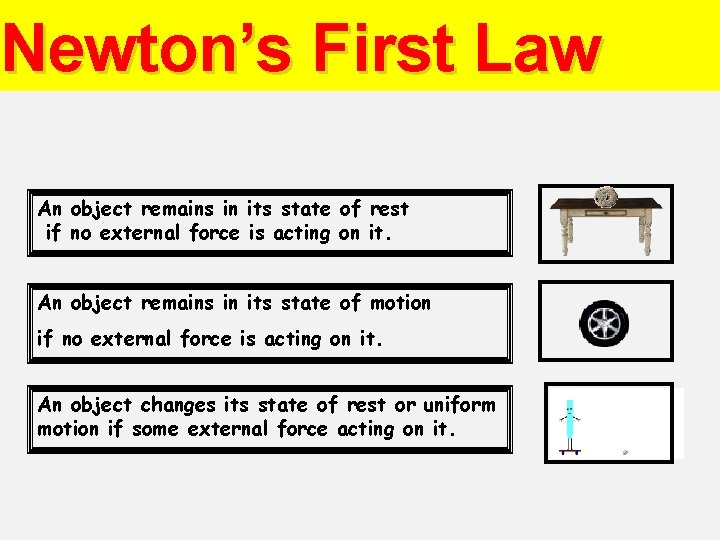
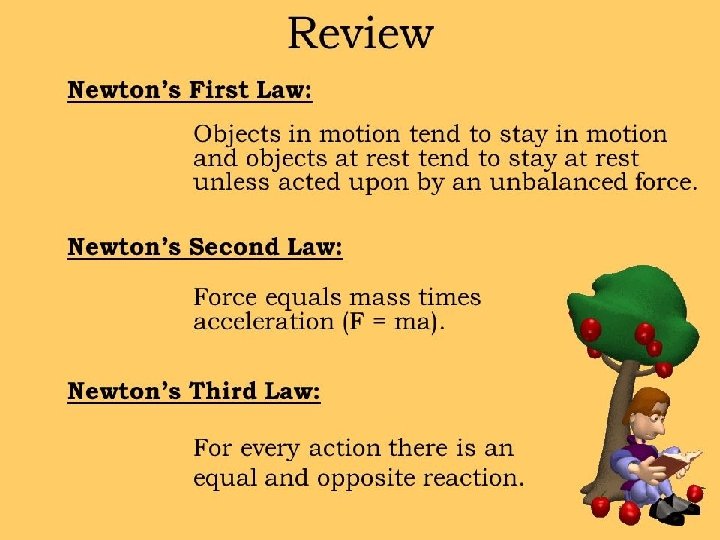
Newton’s First Law NEWTON’S FIRST LAW An object at rest tends to stay at rest and an object in motion tends to stay in motion unless acted upon by an unbalanced force.
Newton’s First Law WHAT DOES THIS MEAN? 9
Newton’s First Law An object remains in its state of rest if no external force is acting on it. An object remains in its state of motion if no external force is acting on it. An object changes its state of rest or uniform motion if some external force acting on it.
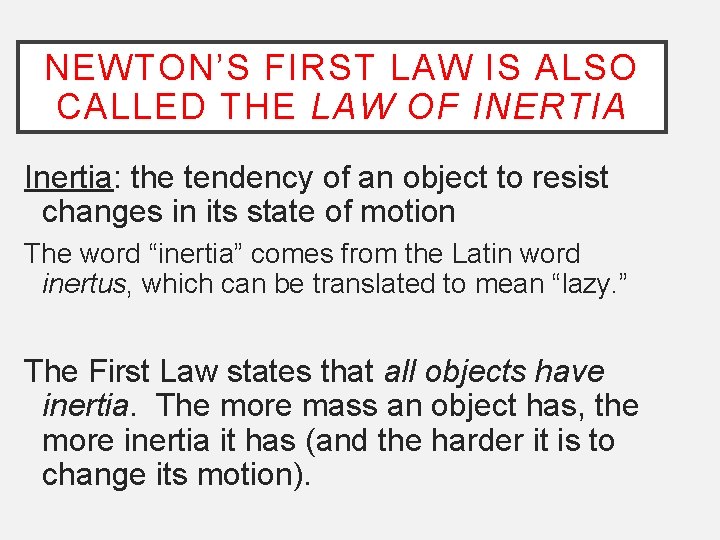
NEWTON’S FIRST LAW IS ALSO CALLED THE LAW OF INERTIA Inertia: the tendency of an object to resist changes in its state of motion The word “inertia” comes from the Latin word inertus, which can be translated to mean “lazy. ” The First Law states that all objects have inertia. The more mass an object has, the more inertia it has (and the harder it is to change its motion).
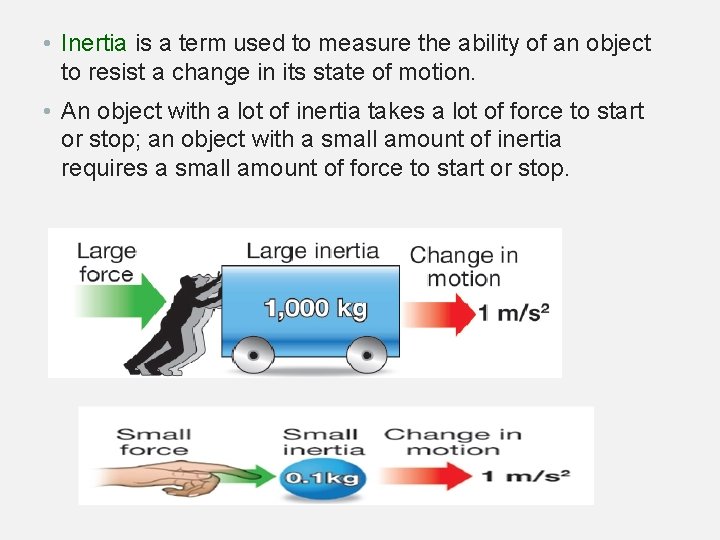
• Inertia is a term used to measure the ability of an object to resist a change in its state of motion. • An object with a lot of inertia takes a lot of force to start or stop; an object with a small amount of inertia requires a small amount of force to start or stop.
Some examples of Newton's First Law of Motion? 1 -We live each day doing the same things like waking up, going to work, returning home from work. These things becomes routine to us that unless we apply an external force, that is by doing something different to our lives we will remain in constant state of inertia. 2 - If you are driving in your car at a very high speed and hit something, like a brick wall or a tree, the car will come to an instant stop, but you will keep moving forward. This is why cars have airbags, to protect you from smashing into the windscreen. 3 - A large box is sitting on the floor and you want to move it from one side of the room to the other.
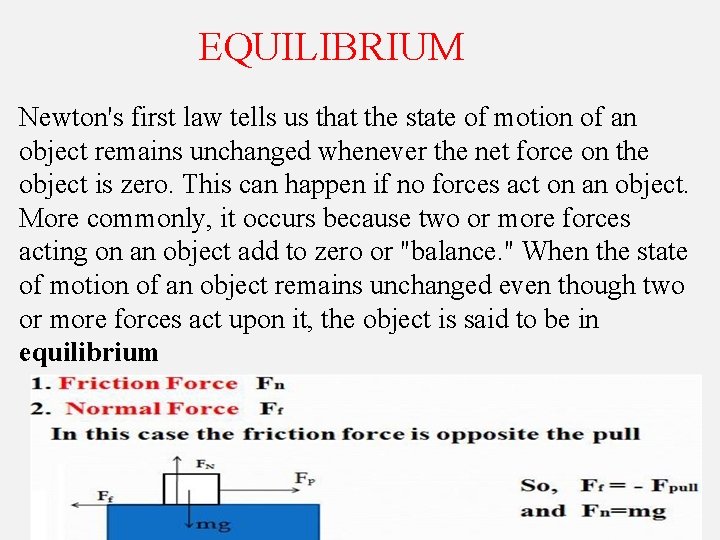
EQUILIBRIUM Newton's first law tells us that the state of motion of an object remains unchanged whenever the net force on the object is zero. This can happen if no forces act on an object. More commonly, it occurs because two or more forces acting on an object add to zero or "balance. " When the state of motion of an object remains unchanged even though two or more forces act upon it, the object is said to be in equilibrium
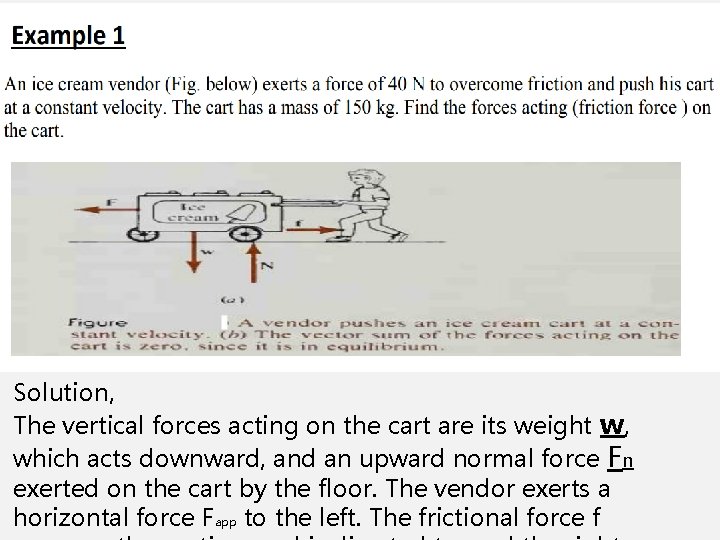
Solution, The vertical forces acting on the cart are its weight w, which acts downward, and an upward normal force Fn exerted on the cart by the floor. The vendor exerts a horizontal force Fapp to the left. The frictional force f
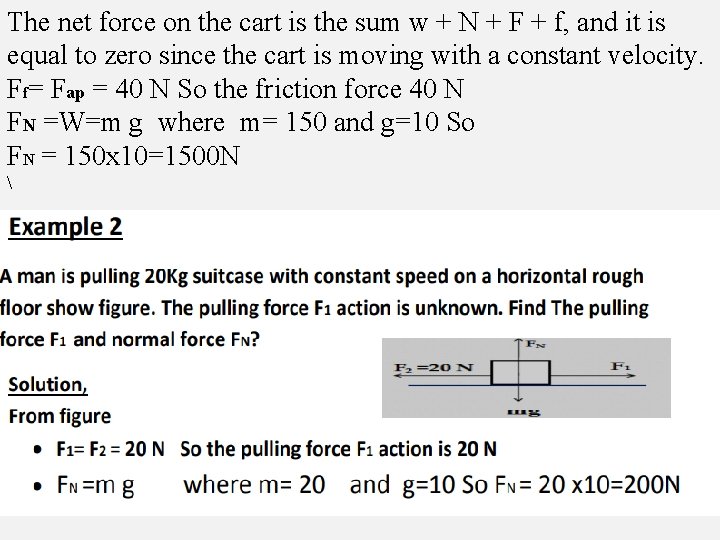
The net force on the cart is the sum w + N + F + f, and it is equal to zero since the cart is moving with a constant velocity. Ff= Fap = 40 N So the friction force 40 N FN =W=m g where m= 150 and g=10 So FN = 150 x 10=1500 N
Newton’s Second Law
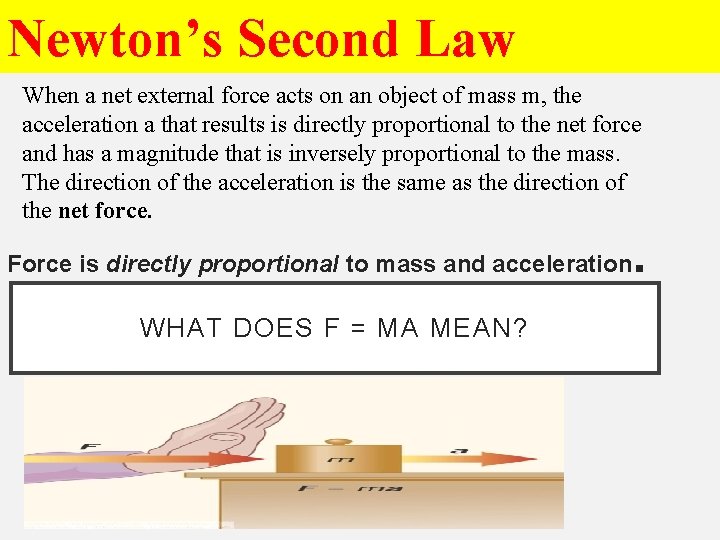
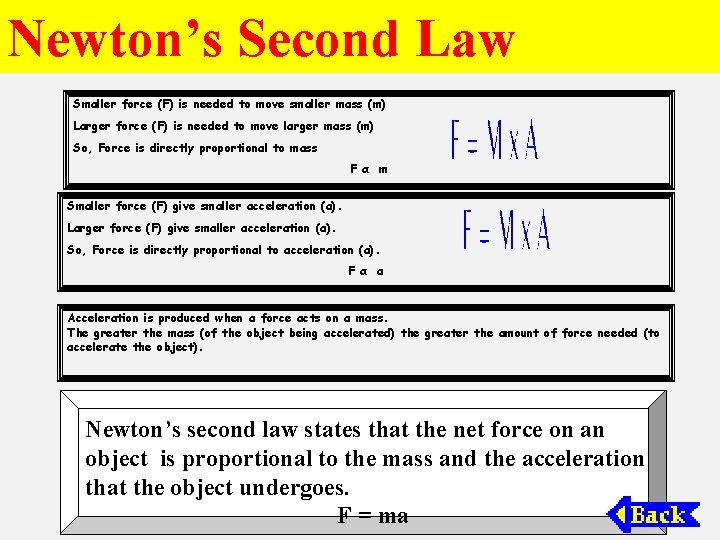
Newton’s Second Law When a net external force acts on an object of mass m, the acceleration a that results is directly proportional to the net force and has a magnitude that is inversely proportional to the mass. The direction of the acceleration is the same as the direction of the net force. Force is directly proportional to mass and acceleration WHAT DOES F = MA MEAN? .
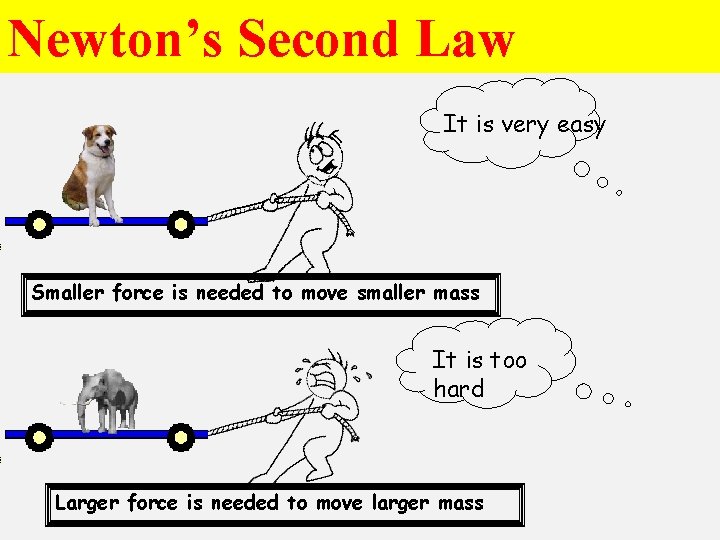
Newton’s Second Law It is very easy Smaller force is needed to move smaller mass It is too hard Larger force is needed to move larger mass
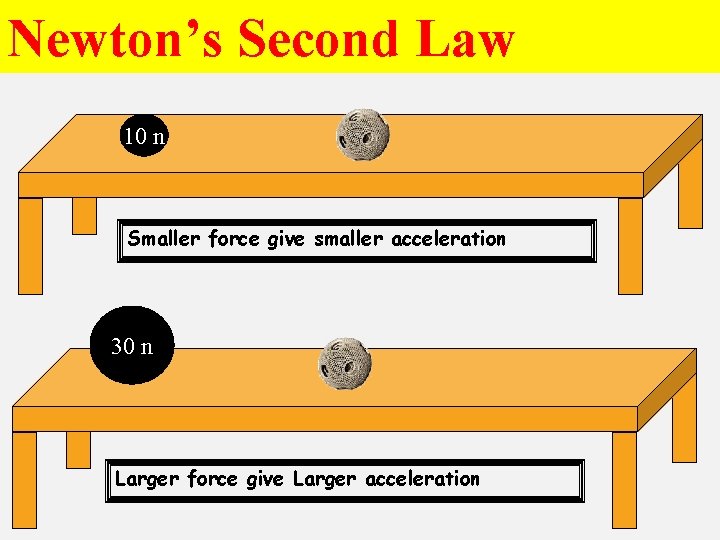
Newton’s Second Law 10 n Smaller force give smaller acceleration 30 n Larger force give Larger acceleration
Newton’s Second Law Smaller force (F) is needed to move smaller mass (m) Larger force (F) is needed to move larger mass (m) So, Force is directly proportional to mass F α m Smaller force (F) give smaller acceleration (a). Larger force (F) give smaller acceleration (a). So, Force is directly proportional to acceleration (a). F α a Acceleration is produced when a force acts on a mass. The greater the mass (of the object being accelerated) the greater the amount of force needed (to accelerate the object). Newton’s second law states that the net force on an object is proportional to the mass and the acceleration that the object undergoes. F = ma
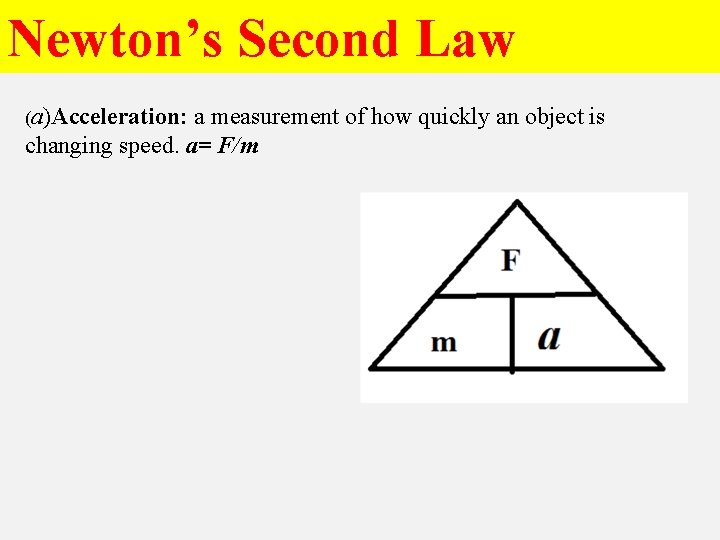
Newton’s Second Law (a)Acceleration: a measurement of how quickly an object is changing speed. a= F/m
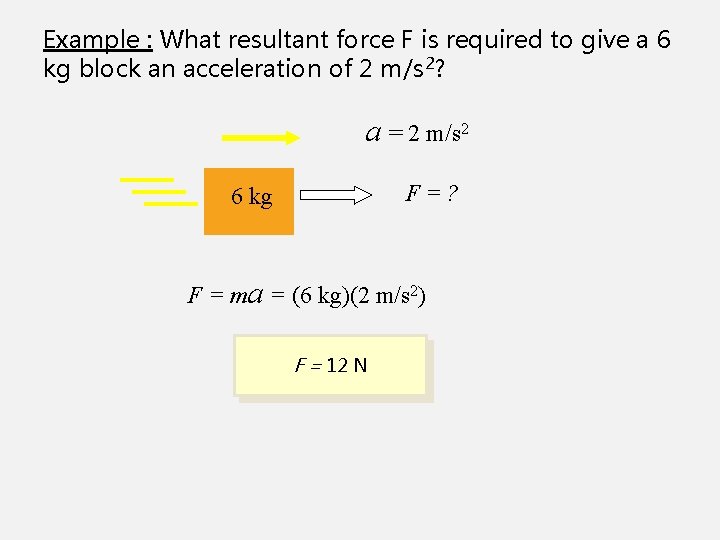
Example : What resultant force F is required to give a 6 kg block an acceleration of 2 m/s 2? a = 2 m/s 2 F=? 6 kg F = ma = (6 kg)(2 m/s 2) F = 12 N
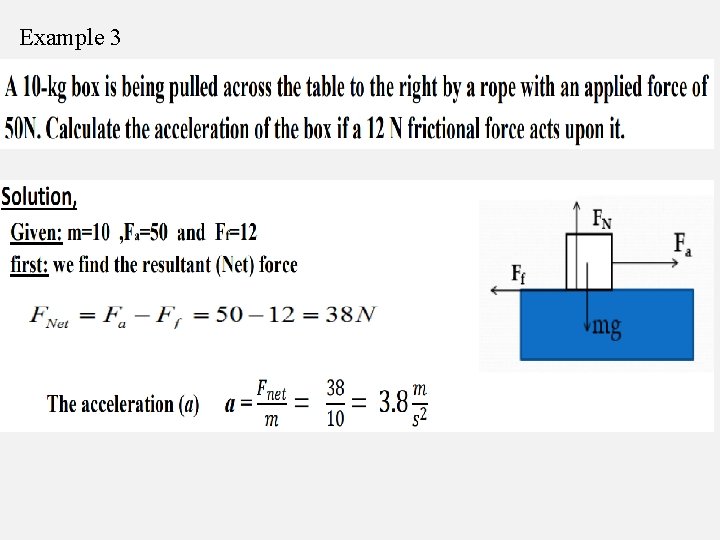
Example 3
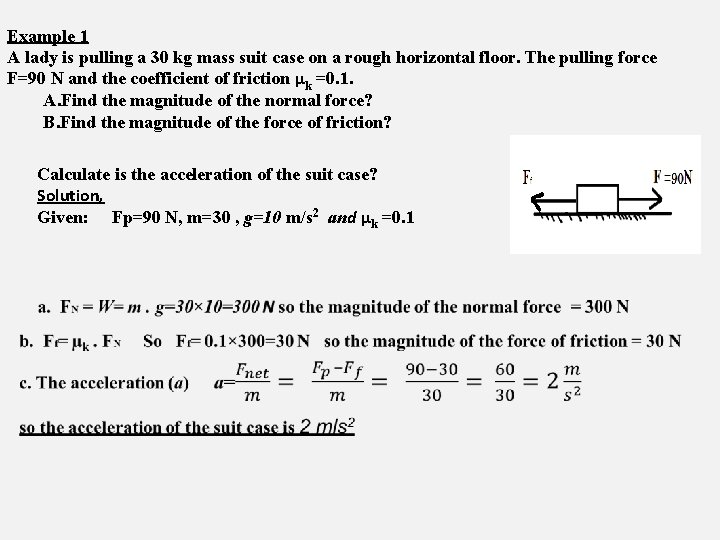
Example 1 A lady is pulling a 30 kg mass suit case on a rough horizontal floor. The pulling force F=90 N and the coefficient of friction µk =0. 1. A. Find the magnitude of the normal force? B. Find the magnitude of the force of friction? Calculate is the acceleration of the suit case? Solution, Given: Fp=90 N, m=30 , g=10 m/s 2 and µk =0. 1
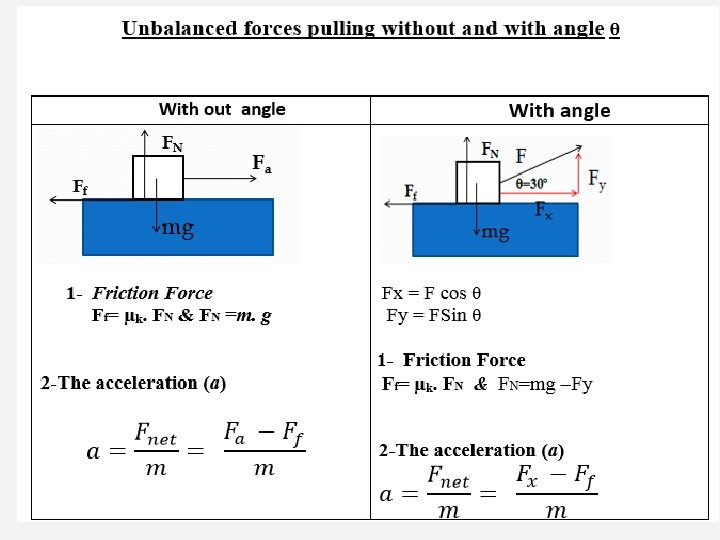
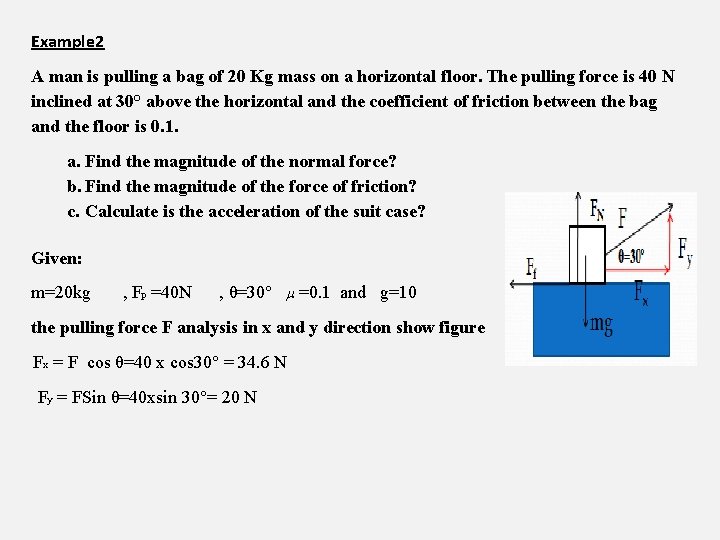
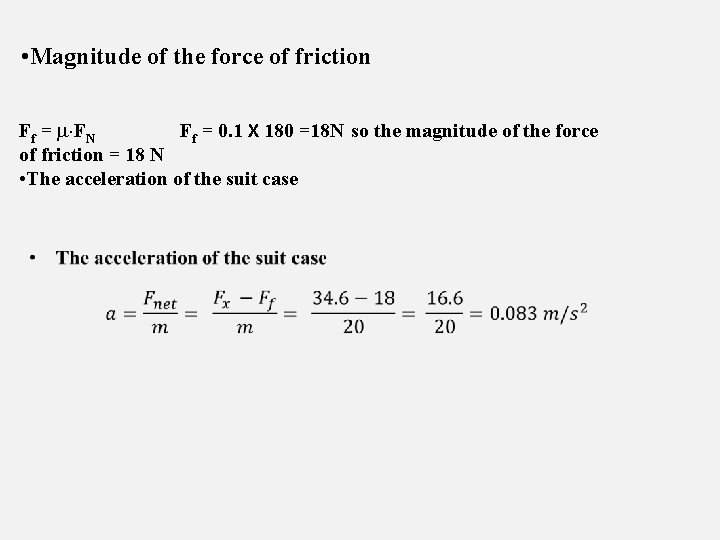
Example 2 A man is pulling a bag of 20 Kg mass on a horizontal floor. The pulling force is 40 N inclined at 30° above the horizontal and the coefficient of friction between the bag and the floor is 0. 1. a. Find the magnitude of the normal force? b. Find the magnitude of the force of friction? c. Calculate is the acceleration of the suit case? Given: m=20 kg , Fp =40 N , θ=30° =0. 1 and g=10 the pulling force F analysis in x and y direction show figure Fx = F cos θ=40 x cos 30° = 34. 6 N Fy = FSin θ=40 xsin 30°= 20 N
• Magnitude of the force of friction Ff = FN Ff = 0. 1 X 180 =18 N so the magnitude of the force of friction = 18 N • The acceleration of the suit case
Newton’s Third Law NEWTON’S THIRD LAW
Newton’s Third Law Whenever one object exerts a force on a second object, the second object exerts an equal and opposite force on the first OR “For every action there is always an opposed equal reaction”
Newton’s Third Law WHAT DOES THIS MEAN? 33
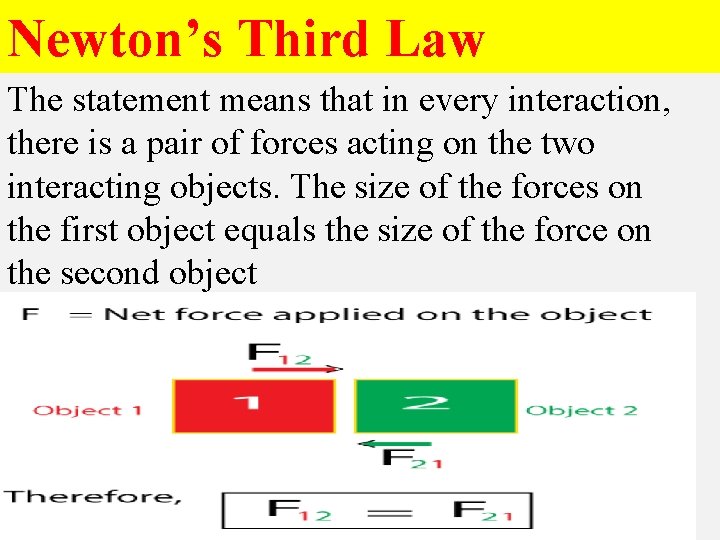
Newton’s Third Law The statement means that in every interaction, there is a pair of forces acting on the two interacting objects. The size of the forces on the first object equals the size of the force on the second object
Newton’s Third Law • For example, suppose you are at rest in a swimming pool. If you push a wall with your legs, the wall exerts a force that propels you further into the pool. The reaction force the wall exerts on you is opposite in direction to the force you exert on the wall. Another example When you use a boat paddle to push water backwards, the water exerts an opposite force pushing the boat forward.