
Phylum Protozoa Order Foraminifera e g Globigerina Its
Phylum : Protozoa

Order : Foraminifera e. g. : Globigerina It’s marine sarcodines that secrete a test of many chambers. Long , delicate , feeding pseudopodia extent through pores in the test.

Order : Heliozoa e. g. : Actinosphaerium It is spherical organism. The ectoplasm contain one or more rows of large contractile vacuoles , endoplasm contain many nuclei and small vacuoles. The pseudopodia (Axopodia) are semipermanent and radiate in all directions.

Order : Radiolarians are marine sarcodines that secret about themselves a transparent test of silica and then thrust out slender pseudopodia through pore in the test. These organisms are different in it’s test shaps.

Class : Ciliata è Cilia or ciliary organelles present in at least one stage of life cycle. è Usually two type of nuclei , a large macronucleus that regulates the metabolism of the organism (controlling cellular function such as feeding and digestion , and micronucleus that is reproductive and contains the animal’s genome. è Nutrition is holozoic.

Class : Ciliata è It can reproduce asexually by binary fission. Sexual reproduction by conjugation. è Predominantly free living. è Most species solitary and motile but there are some colonial and some sessile forms.

Order : Holotricha e. g. : Didinum , Tetrahymena , Paramecium Didinum
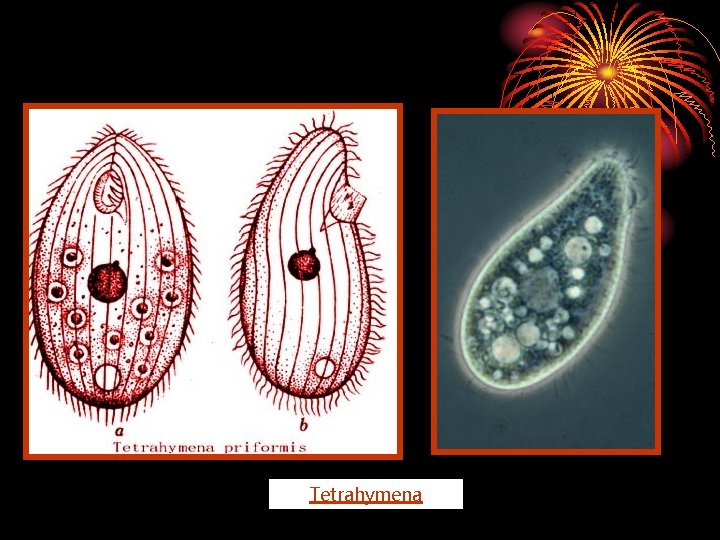
Tetrahymena
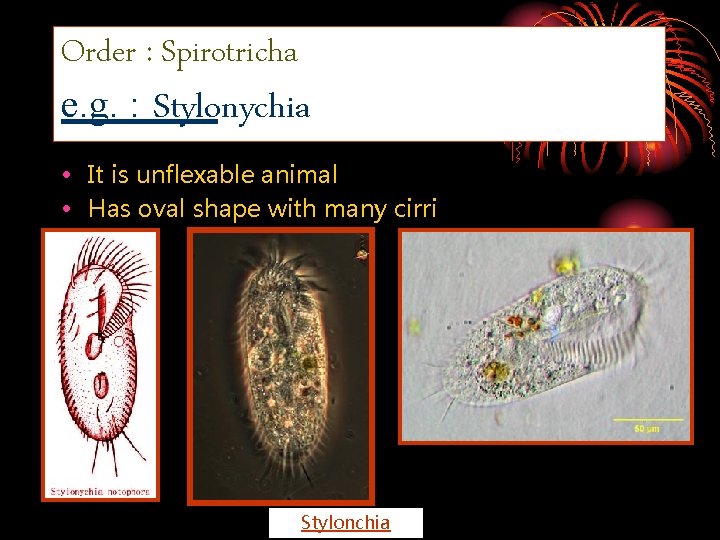
Order : Spirotricha e. g. : Stylonychia • It is unflexable animal • Has oval shape with many cirri Stylonchia
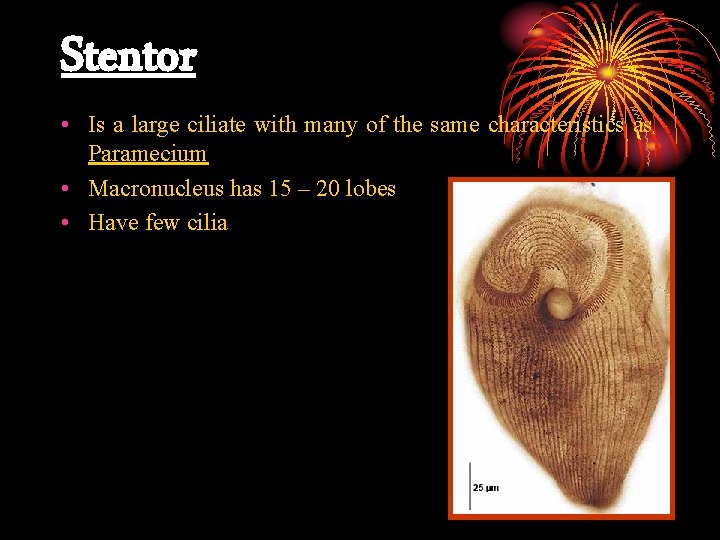
Stentor • Is a large ciliate with many of the same characteristics as Paramecium • Macronucleus has 15 – 20 lobes • Have few cilia
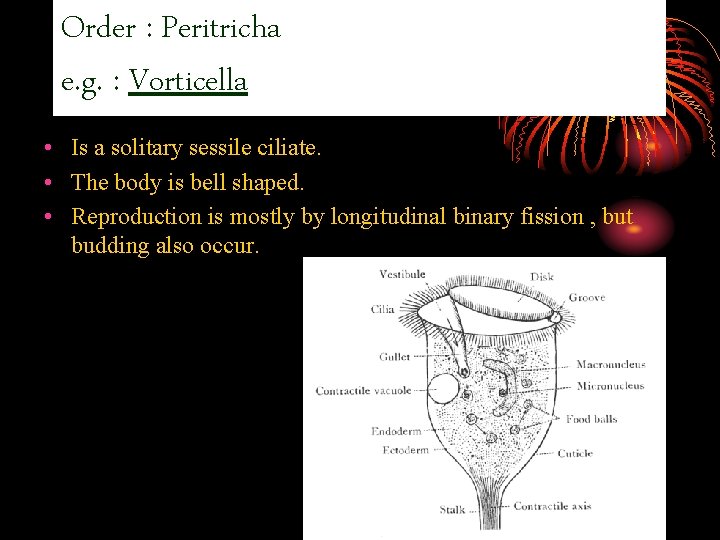
Order : Peritricha e. g. : Vorticella • Is a solitary sessile ciliate. • The body is bell shaped. • Reproduction is mostly by longitudinal binary fission , but budding also occur.

Order : Suctoria e. g. : Ephelota • The cilia present only in the early stages of age , in the adult stage the cilia disappear and tentacle growing up. • There are two types of tentacles , the first is suctorial and the second is piercing. • This animal is sessile. • Reproduction by external budding
- Slides: 12