
Phylum Porifera Microscope Look at spicules Assymetrical Do
- Slides: 19
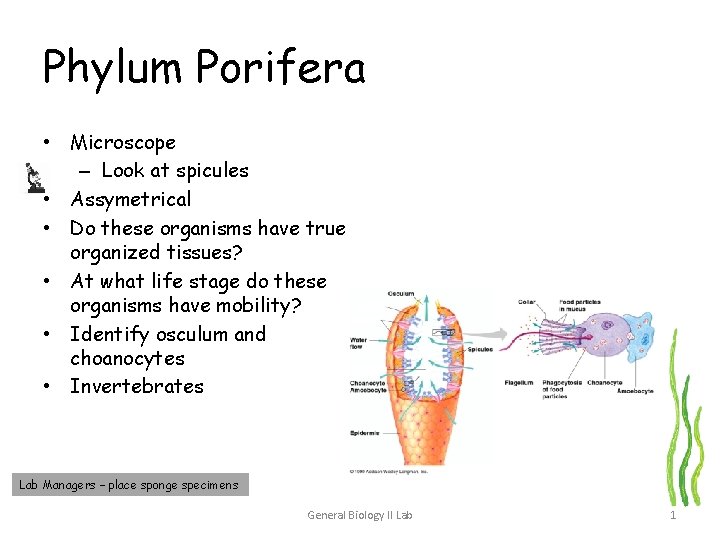
Phylum Porifera • Microscope – Look at spicules • Assymetrical • Do these organisms have true organized tissues? • At what life stage do these organisms have mobility? • Identify osculum and choanocytes • Invertebrates Lab Managers – place sponge specimens General Biology II Lab 1
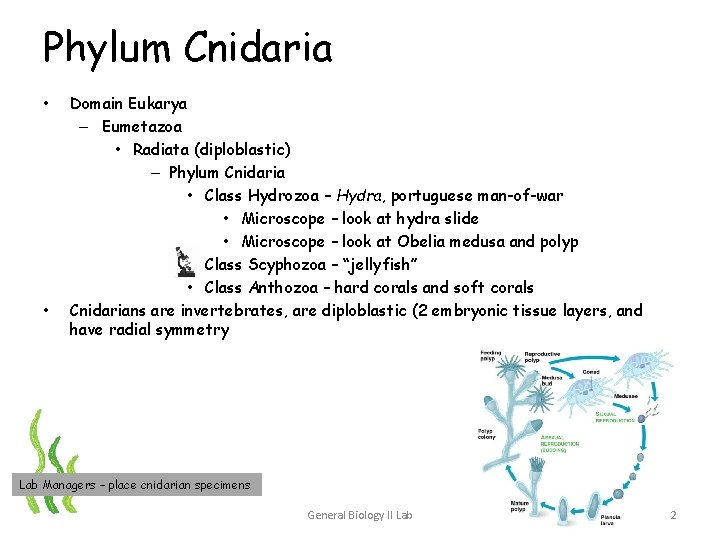
Phylum Cnidaria • • Domain Eukarya – Eumetazoa • Radiata (diploblastic) – Phylum Cnidaria • Class Hydrozoa – Hydra, portuguese man-of-war • Microscope – look at hydra slide • Microscope – look at Obelia medusa and polyp • Class Scyphozoa – “jellyfish” • Class Anthozoa – hard corals and soft corals Cnidarians are invertebrates, are diploblastic (2 embryonic tissue layers, and have radial symmetry Lab Managers – place cnidarian specimens General Biology II Lab 2
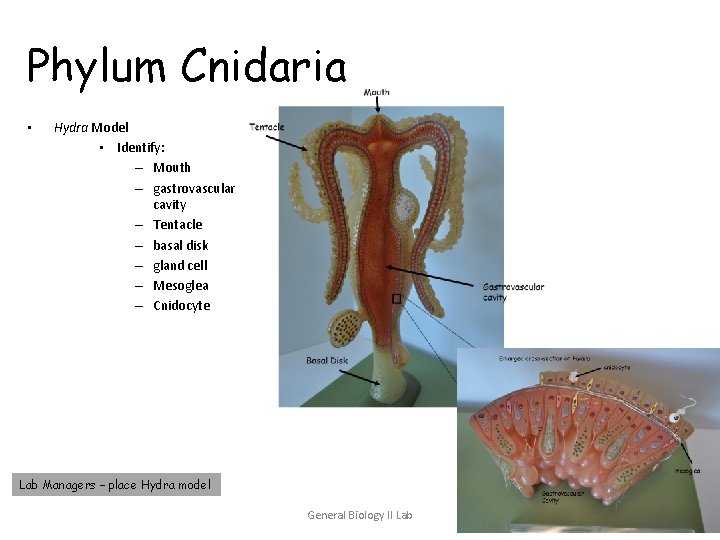
Phylum Cnidaria • Hydra Model • Identify: – Mouth – gastrovascular cavity – Tentacle – basal disk – gland cell – Mesoglea – Cnidocyte Lab Managers – place Hydra model General Biology II Lab 3
Phylum Platyhelminthes • Domain Eukarya – Kingdom Animalia • Eumetazoa – Bilateria (what is bilateral symmetry? , what does triploblastic mean? ) » Phylum Platyhelminthes (flat worms) • Class Turbellaria – free-living flatworms • Class Trematoda – flukes • Class Cestoda – tapeworms • Flatworms are invertebrates, acoelomates (no true coelom), have bilateral symmetry, some are parasites Lab Managers – place a couple flatworms specimens General Biology II Lab 4
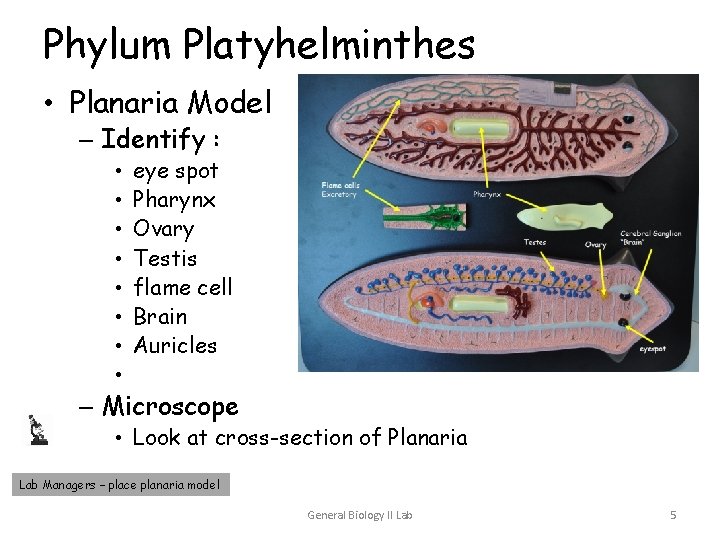
Phylum Platyhelminthes • Planaria Model – Identify : • • eye spot Pharynx Ovary Testis flame cell Brain Auricles – Microscope • Look at cross-section of Planaria Lab Managers – place planaria model General Biology II Lab 5
Phylum Nematoda • Domain Eukarya – Kingdom Animalia • Eumetazoa – Bilateria • Phylum Nematoda – round worms • Nematodes: – – – – Are protostomes Are pseudocoelomates Have a complete digestive system Are invertebrates Many are parasitic Have cuticle (for molting) Note differences between sexes of Ascaris Lab Managers – place few round worm specimens, Ascaris biomount General Biology II Lab 6
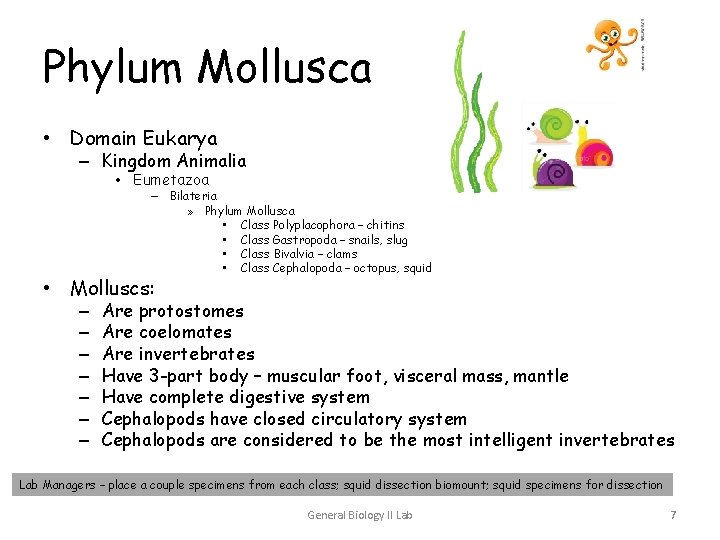
Phylum Mollusca • Domain Eukarya – Kingdom Animalia • Eumetazoa – Bilateria » Phylum Mollusca • Class Polyplacophora – chitins • Class Gastropoda – snails, slug • Class Bivalvia – clams • Class Cephalopoda – octopus, squid • Molluscs: – – – – Are protostomes Are coelomates Are invertebrates Have 3 -part body – muscular foot, visceral mass, mantle Have complete digestive system Cephalopods have closed circulatory system Cephalopods are considered to be the most intelligent invertebrates Lab Managers – place a couple specimens from each class; squid dissection biomount; squid specimens for dissection General Biology II Lab 7
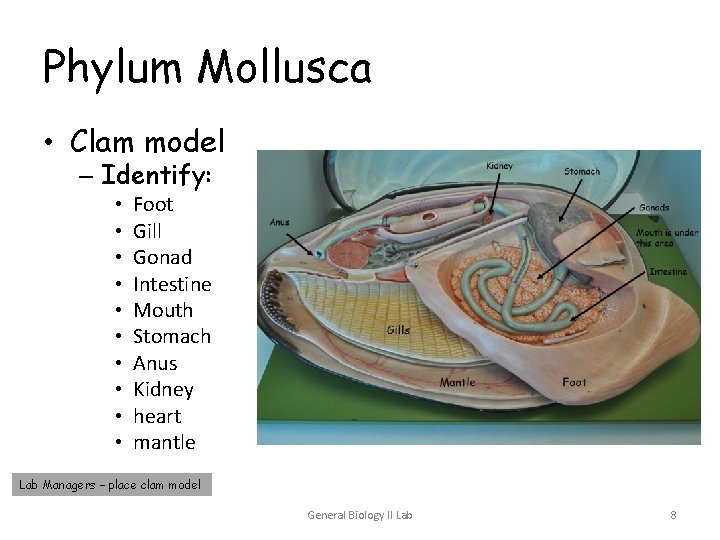
Phylum Mollusca • Clam model – Identify: • • • Foot Gill Gonad Intestine Mouth Stomach Anus Kidney heart mantle Lab Managers – place clam model General Biology II Lab 8
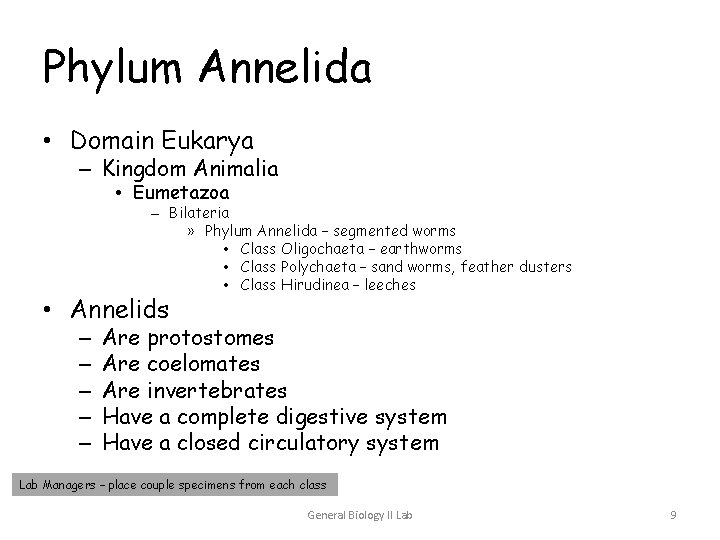
Phylum Annelida • Domain Eukarya – Kingdom Animalia • Eumetazoa – Bilateria » Phylum Annelida – segmented worms • Class Oligochaeta – earthworms • Class Polychaeta – sand worms, feather dusters • Class Hirudinea – leeches • Annelids – – – Are protostomes Are coelomates Are invertebrates Have a complete digestive system Have a closed circulatory system Lab Managers – place couple specimens from each class General Biology II Lab 9
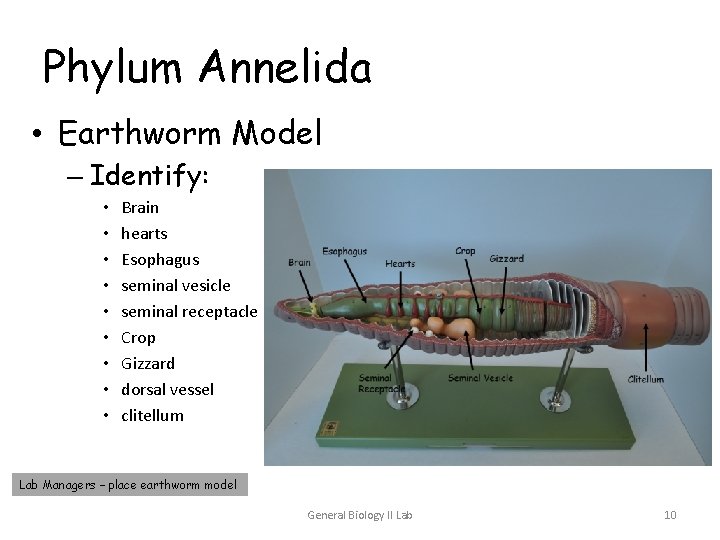
Phylum Annelida • Earthworm Model – Identify: • • • Brain hearts Esophagus seminal vesicle seminal receptacle Crop Gizzard dorsal vessel clitellum Lab Managers – place earthworm model General Biology II Lab 10
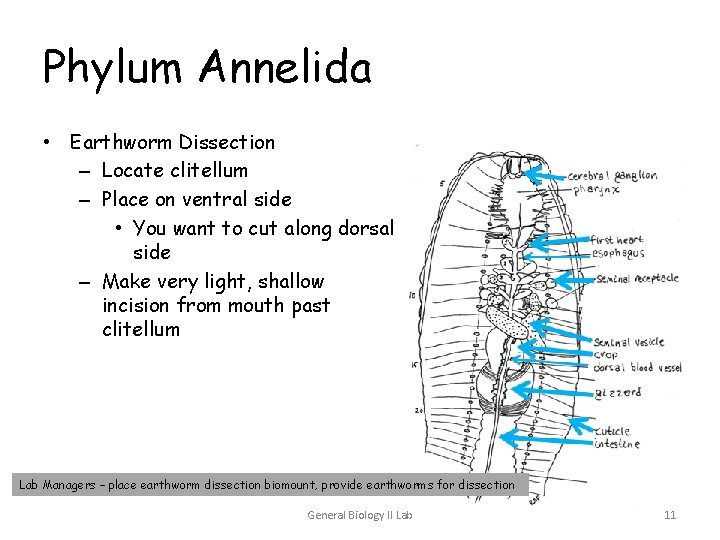
Phylum Annelida • Earthworm Dissection – Locate clitellum – Place on ventral side • You want to cut along dorsal side – Make very light, shallow incision from mouth past clitellum Lab Managers – place earthworm dissection biomount, provide earthworms for dissection General Biology II Lab 11
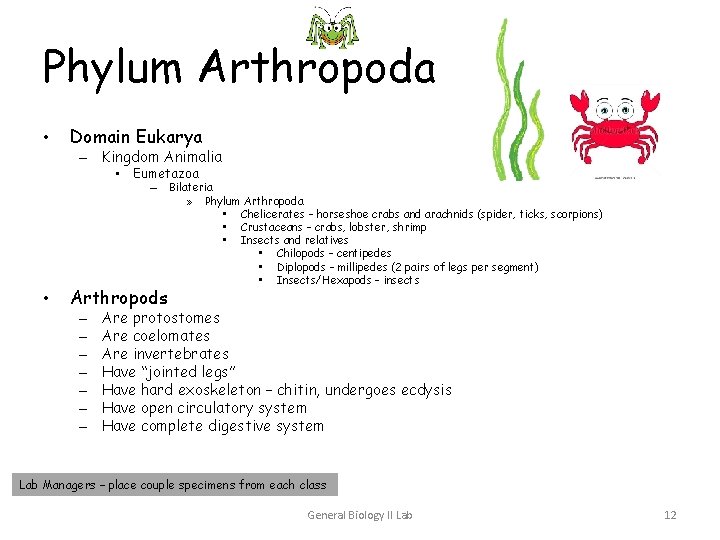
Phylum Arthropoda • Domain Eukarya – Kingdom Animalia • Eumetazoa – • Arthropods – – – – Bilateria » Phylum Arthropoda • Chelicerates – horseshoe crabs and arachnids (spider, ticks, scorpions) • Crustaceans – crabs, lobster, shrimp • Insects and relatives • Chilopods – centipedes • Diplopods – millipedes (2 pairs of legs per segment) • Insects/Hexapods – insects Are protostomes Are coelomates Are invertebrates Have “jointed legs” Have hard exoskeleton – chitin, undergoes ecdysis Have open circulatory system Have complete digestive system Lab Managers – place couple specimens from each class General Biology II Lab 12
Phylum Arthropoda • Grasshopper Model – Identify: • • • Brain Heart nerve ganglion crop, malpighian tubules – Insects • Head, thorax, abdomen • 3 pairs jointed appendages and 2 antennae • Respiration – tracheae Lab Managers – place grasshopper model General Biology II Lab 13
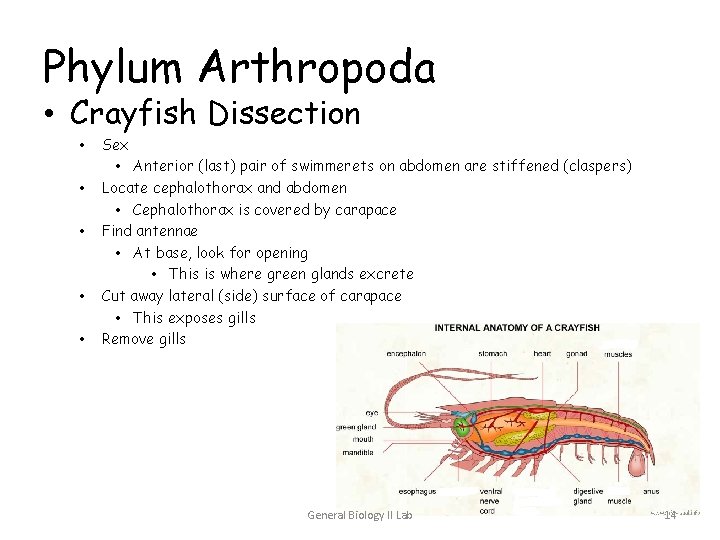
Phylum Arthropoda • Crayfish Dissection • • • Sex • Anterior (last) pair of swimmerets on abdomen are stiffened (claspers) Locate cephalothorax and abdomen • Cephalothorax is covered by carapace Find antennae • At base, look for opening • This is where green glands excrete Cut away lateral (side) surface of carapace • This exposes gills Remove gills General Biology II Lab 14
Insect Metamorphosis • Complete Metamorphosis • Incomplete metamorphosis – Drastic change – Larvae does not resemble adult – Example is butterfly – Gradual change – Larvae (nymphs) resemble adult – Example is grasshopper Lab Managers – place metamorphosis biomount General Biology II Lab 15
Phylum Echinodermata • Domain Eukarya – Kingdom Animalia • Eumetazoa – Bilateria » Phylum Echinodermata • Class Astroidea – sea stars • Class Ophiuroidea – brittle stars • Class Echinodea – Sea urchins • Class Holothuroidea – sea cucumber • Class Crinodea – sea lillies • Echinoderms: – Are deuterostomes – up until this point we have been seeing protostomes – Are invertebrates – Have an endoskeleton – Adult can be radially symmetrical (pentrahedral) but larvae are bilateral – Most unique feature is water vascular system Lab Managers – place couple specimens from each class General Biology II Lab 16
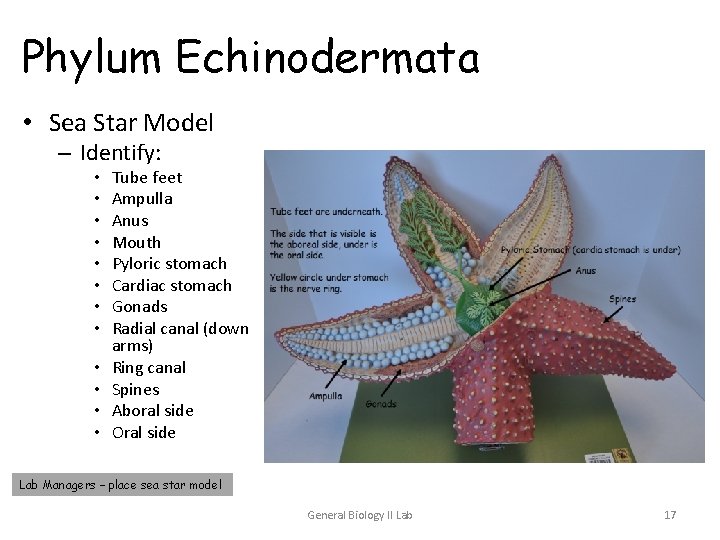
Phylum Echinodermata • Sea Star Model – Identify: • • • Tube feet Ampulla Anus Mouth Pyloric stomach Cardiac stomach Gonads Radial canal (down arms) Ring canal Spines Aboral side Oral side Lab Managers – place sea star model General Biology II Lab 17
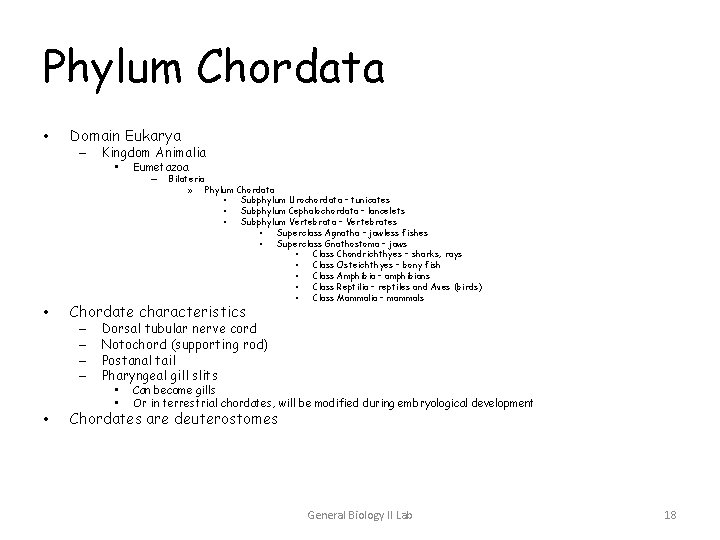
Phylum Chordata • Domain Eukarya – Kingdom Animalia • Eumetazoa – Bilateria » • Chordate characteristics – – Dorsal tubular nerve cord Notochord (supporting rod) Postanal tail Pharyngeal gill slits • • • Phylum Chordata • Subphylum Urochordata – tunicates • Subphylum Cephalochordata – lancelets • Subphylum Vertebrata – Vertebrates • Superclass Agnatha – jawless fishes • Superclass Gnathostoma – jaws • Class Chondrichthyes – sharks, rays • Class Osteichthyes – bony fish • Class Amphibia – amphibians • Class Reptilia – reptiles and Aves (birds) • Class Mammalia – mammals Can become gills Or in terrestrial chordates, will be modified during embryological development Chordates are deuterostomes General Biology II Lab 18
Subphylum Vertebrata • Segmented bodies and jointed appendages like arthropods – But arthropods have exoskeleton and vertebrates have endoskeleton • Both aquatic and terrestrial vertebrates • Vertebrate brain is complex – High degree of cephalization General Biology II Lab 19