
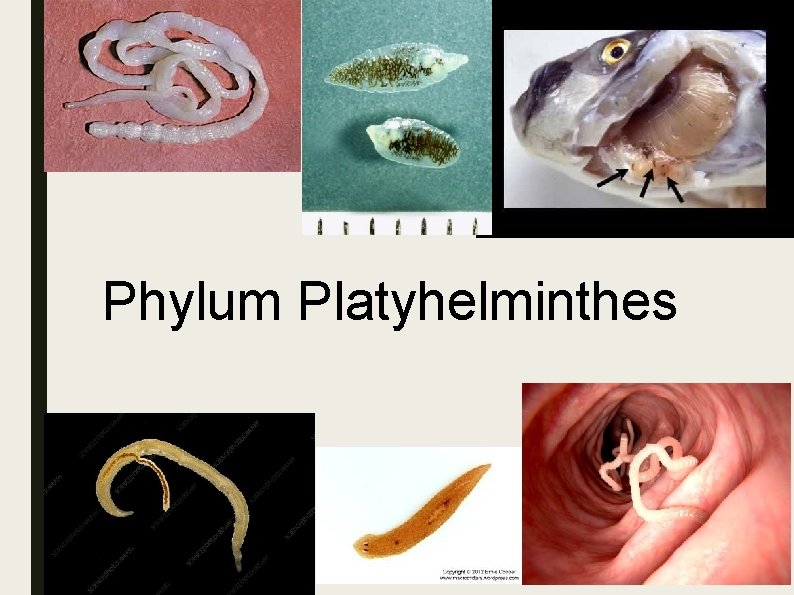
Phylum Platyhelminthes Characteristics of Phylum Platyhelminthes means flat

- Slides: 42
Phylum Platyhelminthes
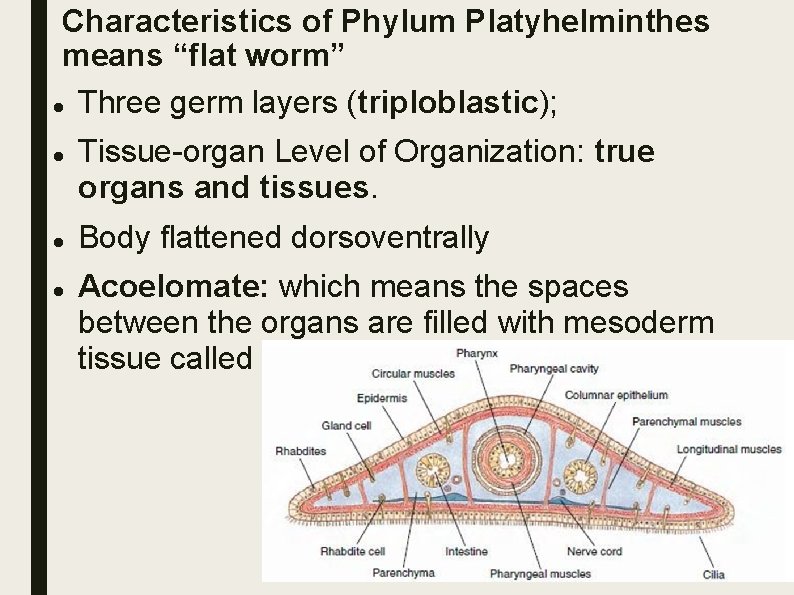
Characteristics of Phylum Platyhelminthes means “flat worm” Three germ layers (triploblastic); Tissue-organ Level of Organization: true organs and tissues. Body flattened dorsoventrally Acoelomate: which means the spaces between the organs are filled with mesoderm tissue called parenchyma.
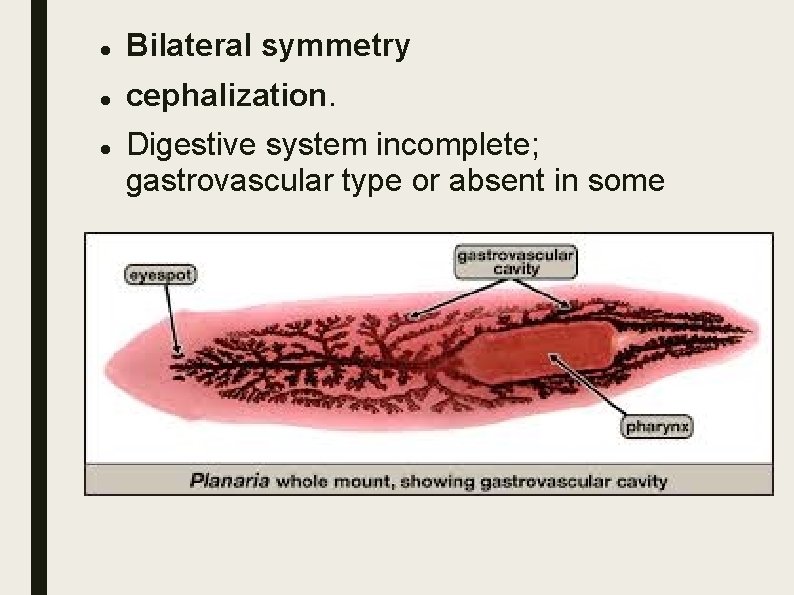
Bilateral symmetry cephalization. Digestive system incomplete; gastrovascular type or absent in some
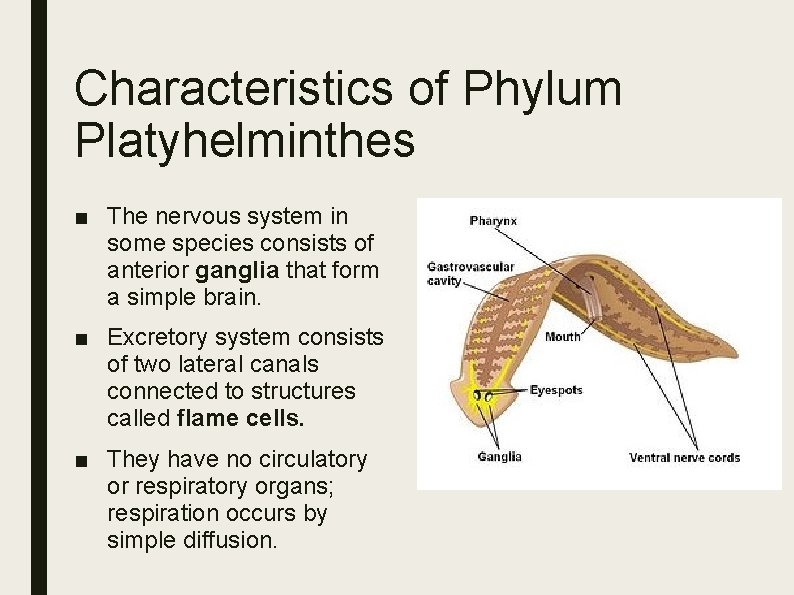
Characteristics of Phylum Platyhelminthes ■ The nervous system in some species consists of anterior ganglia that form a simple brain. ■ Excretory system consists of two lateral canals connected to structures called flame cells. ■ They have no circulatory or respiratory organs; respiration occurs by simple diffusion.
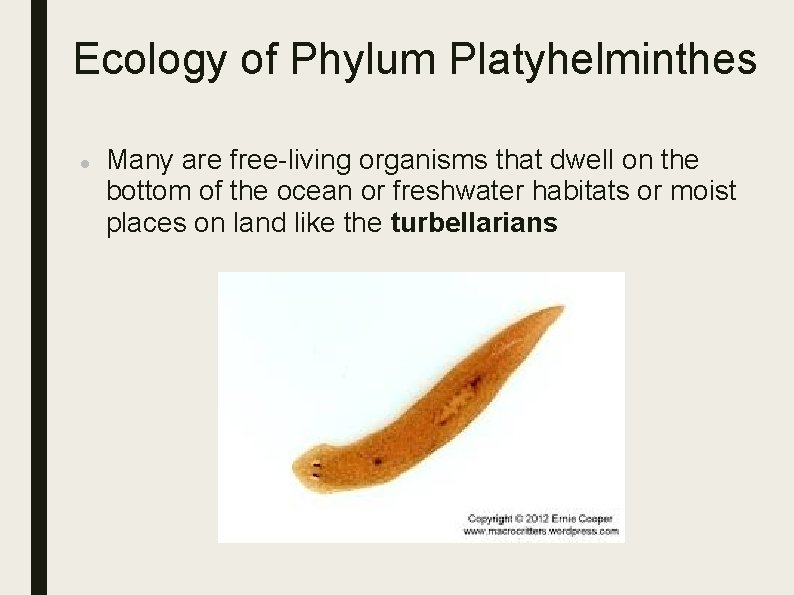
Ecology of Phylum Platyhelminthes Many are free-living organisms that dwell on the bottom of the ocean or freshwater habitats or moist places on land like the turbellarians
Ecology of Phylum Platyhelminthes All of the flatworms that belong to class Trematoda, Monogenea, and Cestoda are parasitic. Some are ectoparasites and others are endoparasites. Many have complex lifestyles that involve more than one host. The first host is usually an invertebrate and the second host is usually a vertebrate.
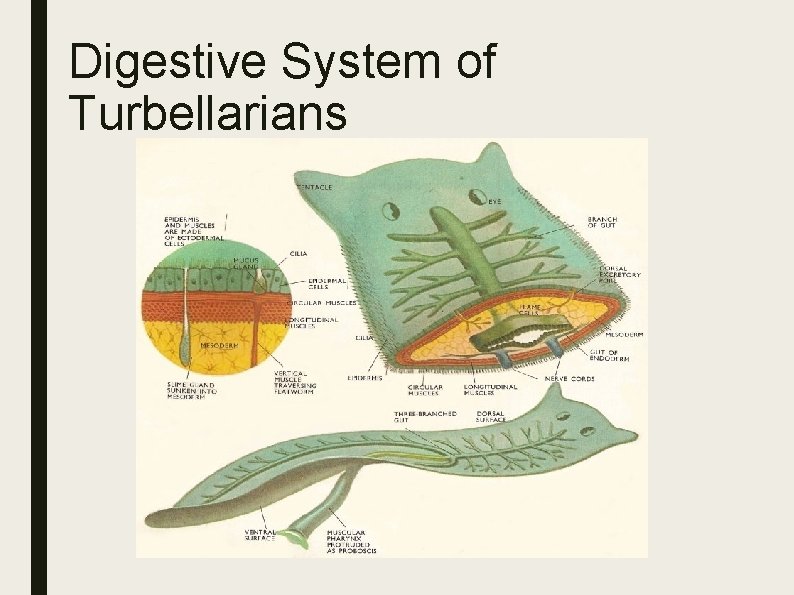
Digestive System of Phylum Platyhelminthes incomplete digestive system, one opening mouth/anus. Turbellarians (such as planaria)have a muscular mouth and pharynx that protrudes from the ventral surface. The pharynx is inserted into prey or decayed organic matter, digestive enzymes are secreted, and then the pharynx brings food into the gastrovascular cavity.
Digestive System of Turbellarians
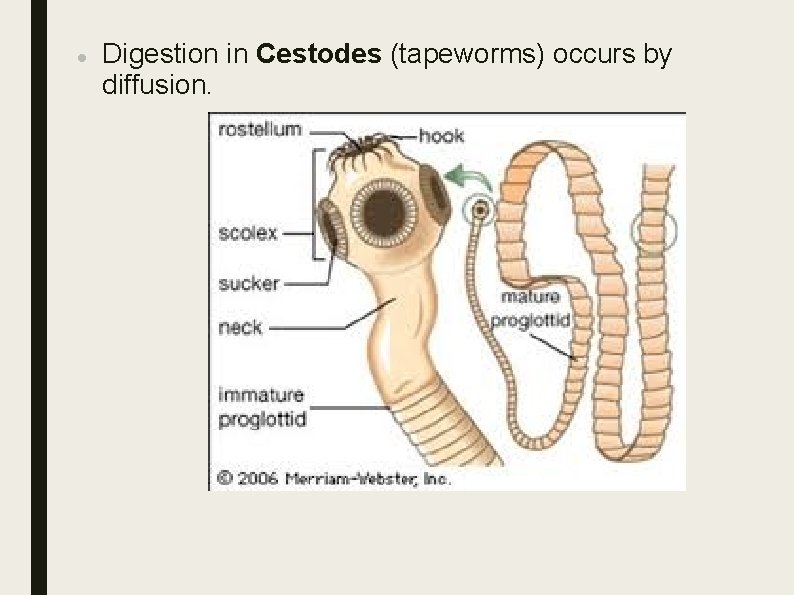
Digestion in Cestodes (tapeworms) occurs by diffusion.
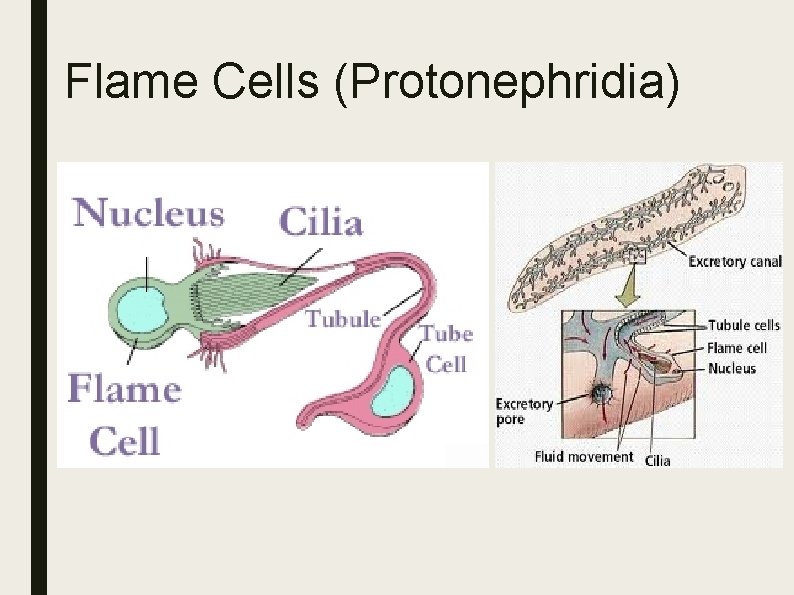
Excretory System in Phylum Platyhelminthes The excretory system of flatworms consists of a complex network of cells called flame cells connected to canals and tubes. Flame cells or protonephridia are similar to kidneys in larger more complex animals such as the vertebrates. The flame cells consist of a hollow cup filled with cilia that beat and pump water and nitrogenous wastes out the body. When the cilia of the flame cells beat they resemble flames.
Flame Cells (Protonephridia)
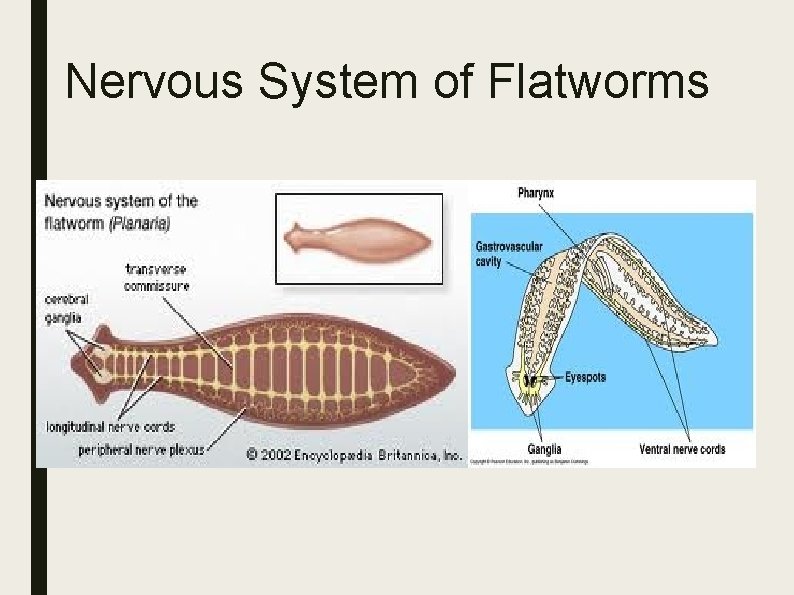
Nervous System of Flatworms are the first animal we have discussed in this class that exhibits cephalization. Cephalization means they have a head (anterior) and tail (posterior) region and a brain. Cephalization allows animals to move (crawl, swim, fly etc. ) in a certain direction to search for resources.
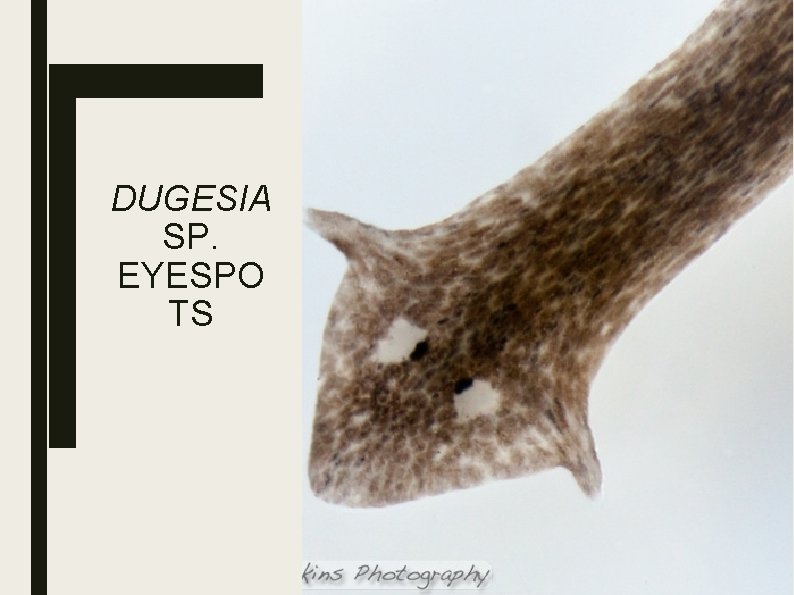
Nervous System of Flatworms The central nervous system in flatworms is a region of nerve tissue at the anterior end called a ganglion. The ganglion attaches to a pair of ventral nerve cords that run the full length of the body. The nerve cords are sensitive to touch, chemical detection, balance and equilibrium, water current direction and they can control muscular movement. The ganglion are also attached to eye spots that are sensitive to light (but they can not form images).
Nervous System of Flatworms
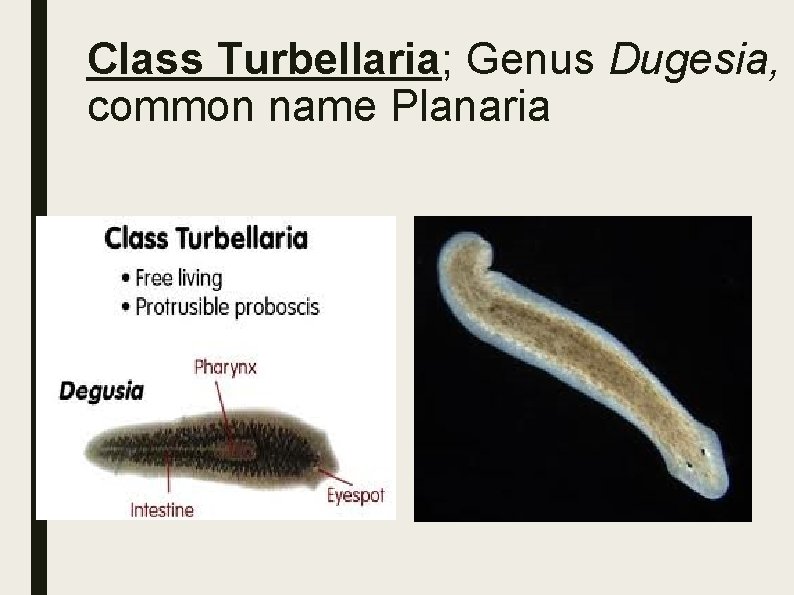
DUGESIA SP. EYESPO TS
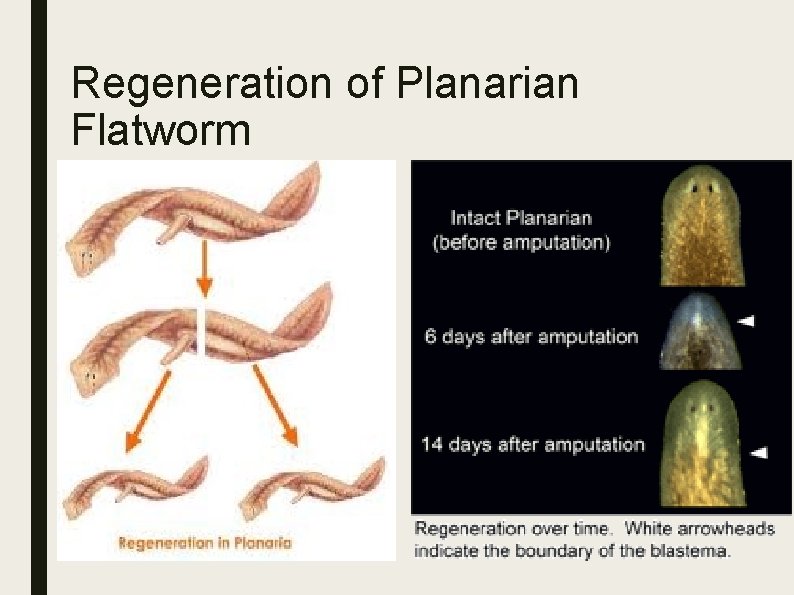
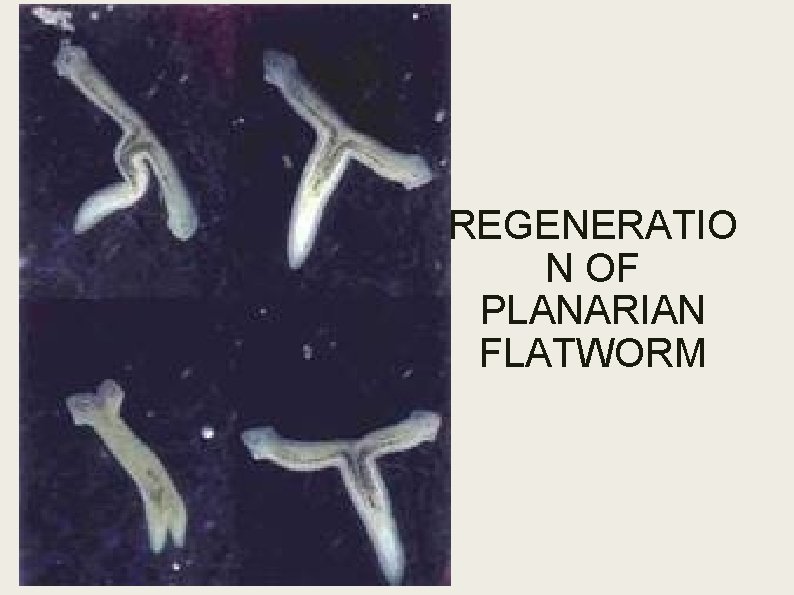
Reproduction of Flatworms reproduce both sexually and asexually. Sexual reproduction usually occurs by cross fertilization (trading sperm) with other hermaphrodites. Most flatworms are monoecious. Only a few flatworms are dioecious (separate sexes). Asexual reproduction occurs by fission. The organism separates into two halves that regenerate into two adults.
Regeneration of Planarian Flatworm
REGENERATIO N OF PLANARIAN FLATWORM
Class Turbellaria Free-living, soft, flat bodies Bodies are covered in cilia Mouth located on ventral surface near the center of the body Mostly hermaphroditic Some can reproduce asexually by fission Examples: Dugesia (planaria), Microstomum, Planocera
Class Turbellaria; Genus Dugesia, common name Planaria
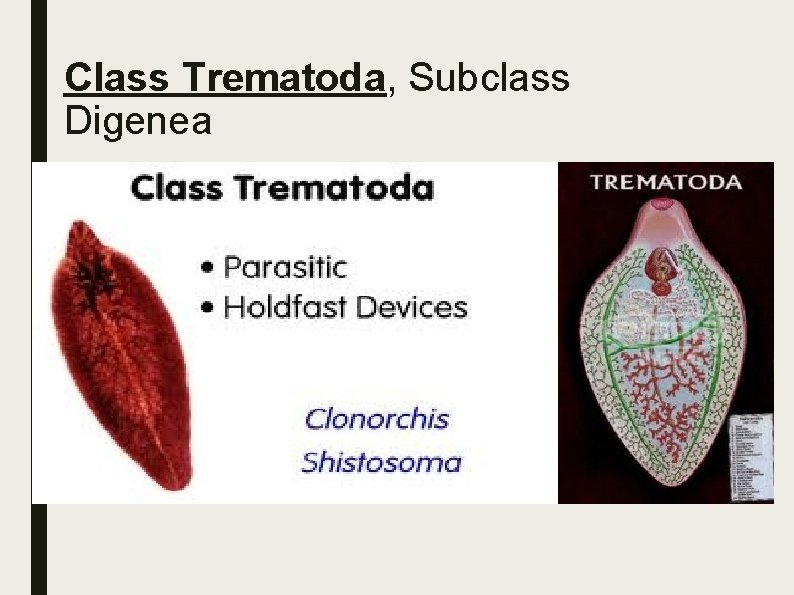
Class Trematoda; Subclass Digenea Digenetic Flukes (two with hosts) Parasitic lifestyle (endoparasites) two hosts. First intermediate host is a mollusk. Second definitive host is a vertebrate. Sexual reproduction occurs in the definitive host. Occasionally a third host (intermediate) plays a role in the life cycle. Parasitism can occur in almost every system of the body including the digestive, respiratory, circulatory, excretory, and reproductive systems. Examples: Fasciola, Clonorchis, Schistosoma
Class Trematoda, Subclass Digenea
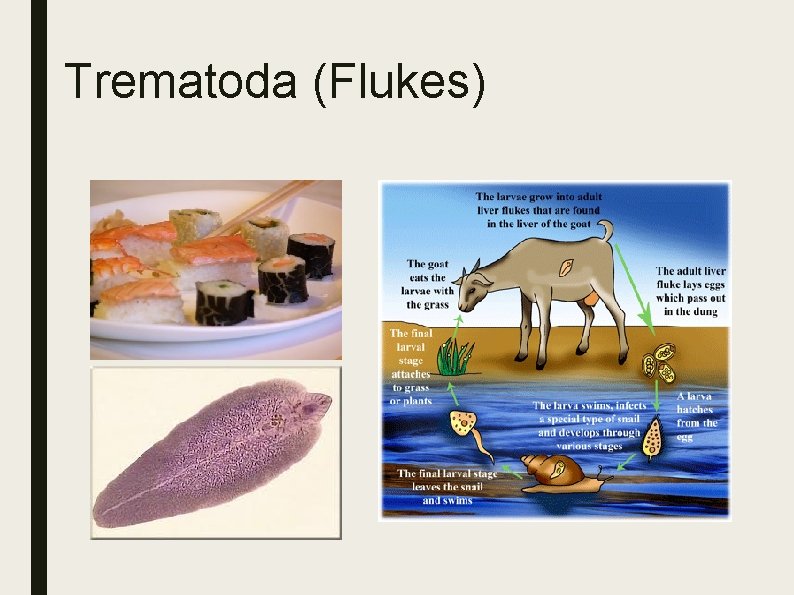
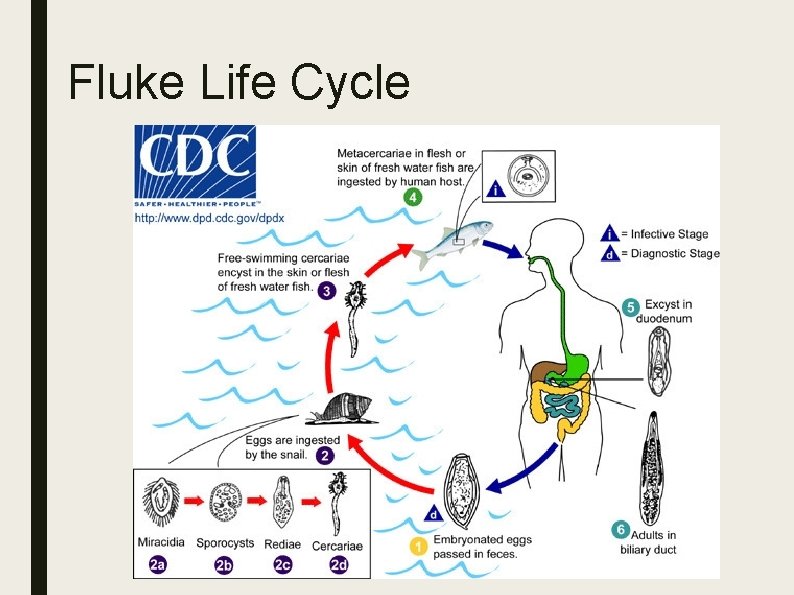
Class Trematoda; Subclass Digenea Digenetic Flukes A typical life cycle would include the following life cycle stages; adult, egg, miracidium, sporocyst, redia, cercaria, and metacercaria. Egg is released from the host's excrement and must reach a source of water to be released. In the water the egg releases a free-swimming, ciliated larva called the miracidium The miracidium penetrates and enters the tissues of a mollusk, and transforms into a sporocyst.
Class Trematoda; Subclass Digenea Digenetic Flukes Sporocysts then reproduce asexually to produce redia. Redia reproduce asexually to produce cercaria. Cercaria emerge from the mollusk and penetrate a second intermediate host or they can develop as a metacercaria on vegetation or in an animal host. Metacercaria are eventually ingested by a definitive host and develop into adult flukes.
Trematoda (Flukes)
Fluke Life Cycle
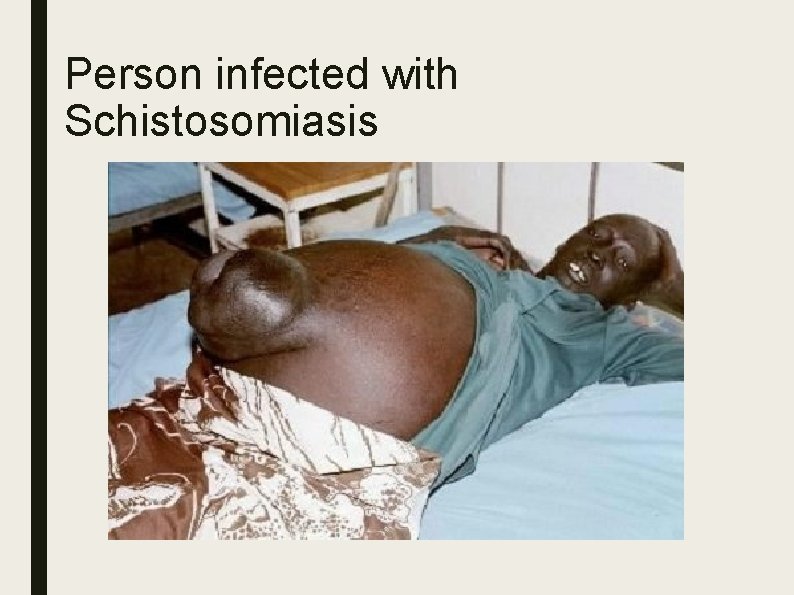
Parasitic Flukes in Humans Some of the most serious parasites in humans are flukes. Clonorchis is a liver fluke that is common in China, south Asia, and Japan and can cause cirrhosis of the liver and death. Schistosoma is a blood fluke that causes a serious infection called schistosomiasis. Schistosomiasis is one of the most deadliest diseases in the world. There is estimated to be about 200 million people infected with schistosomiasis in Africa, South America, and the Middle East. Symptoms of schistosomiasis include dysentery, anemia, enlarged liver, inflammation of the bladder, and brain damage.
Person infected with Schistosomiasis
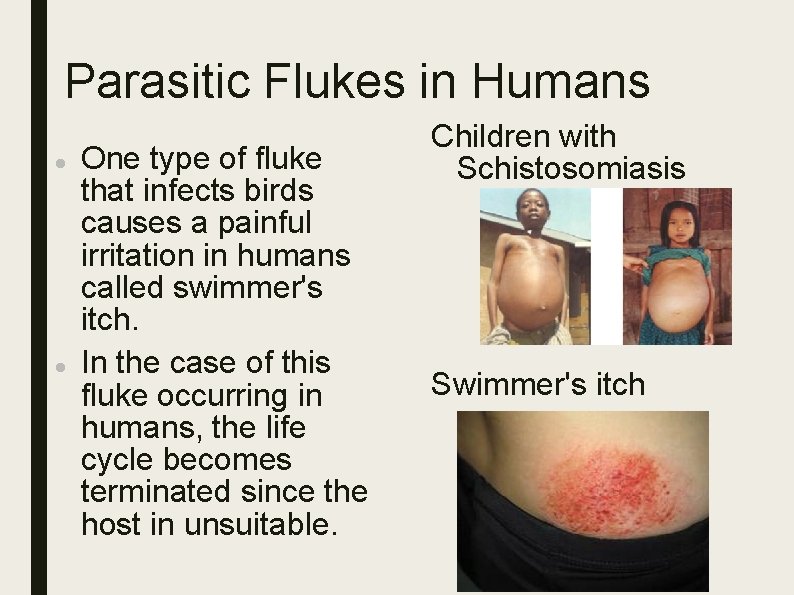
Parasitic Flukes in Humans One type of fluke that infects birds causes a painful irritation in humans called swimmer's itch. In the case of this fluke occurring in humans, the life cycle becomes terminated since the host in unsuitable. Children with Schistosomiasis Swimmer's itch
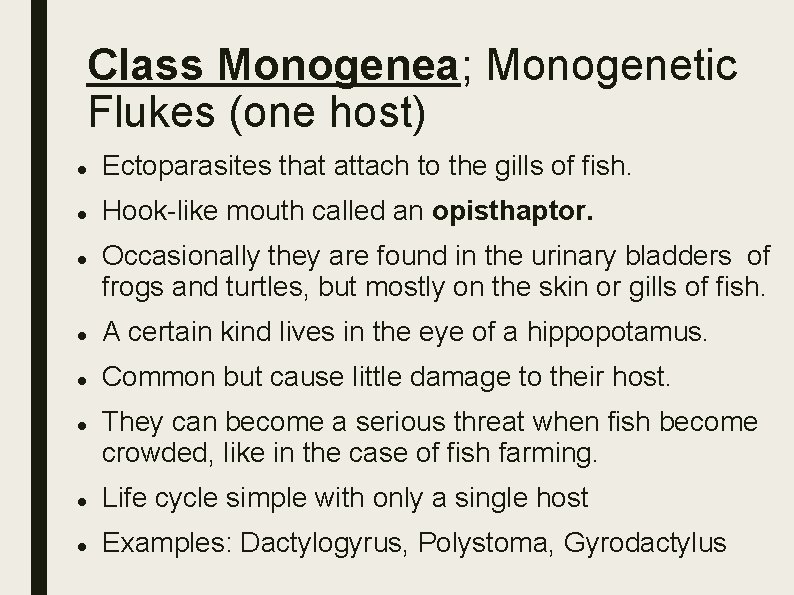
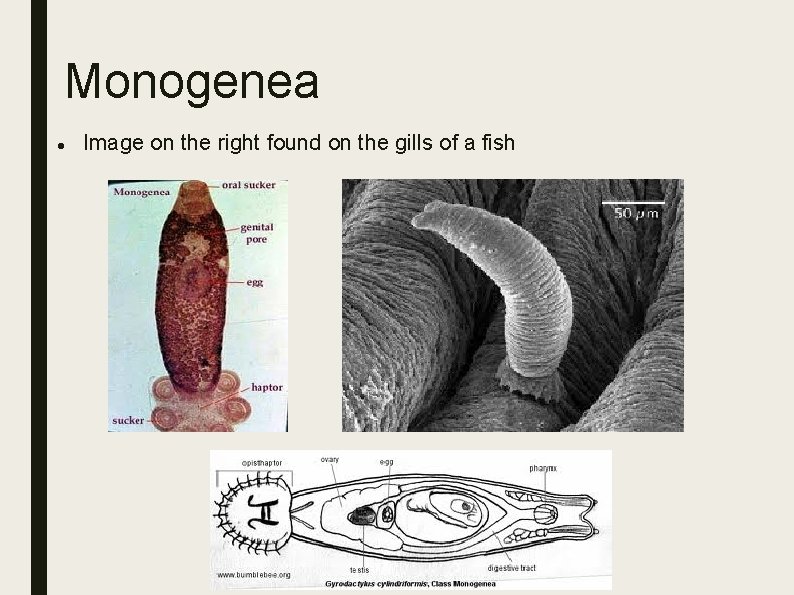
Class Monogenea; Monogenetic Flukes (one host) Ectoparasites that attach to the gills of fish. Hook-like mouth called an opisthaptor. Occasionally they are found in the urinary bladders of frogs and turtles, but mostly on the skin or gills of fish. A certain kind lives in the eye of a hippopotamus. Common but cause little damage to their host. They can become a serious threat when fish become crowded, like in the case of fish farming. Life cycle simple with only a single host Examples: Dactylogyrus, Polystoma, Gyrodactylus
Monogenea Image on the right found on the gills of a fish
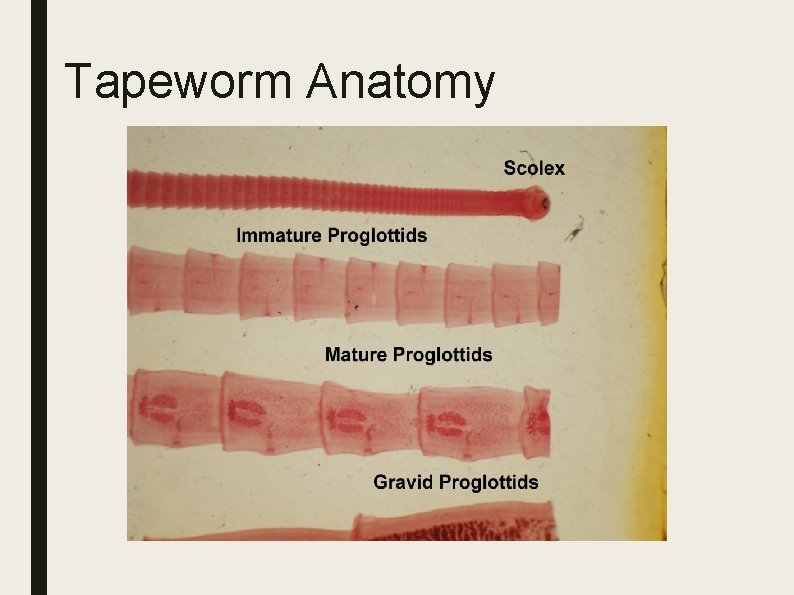
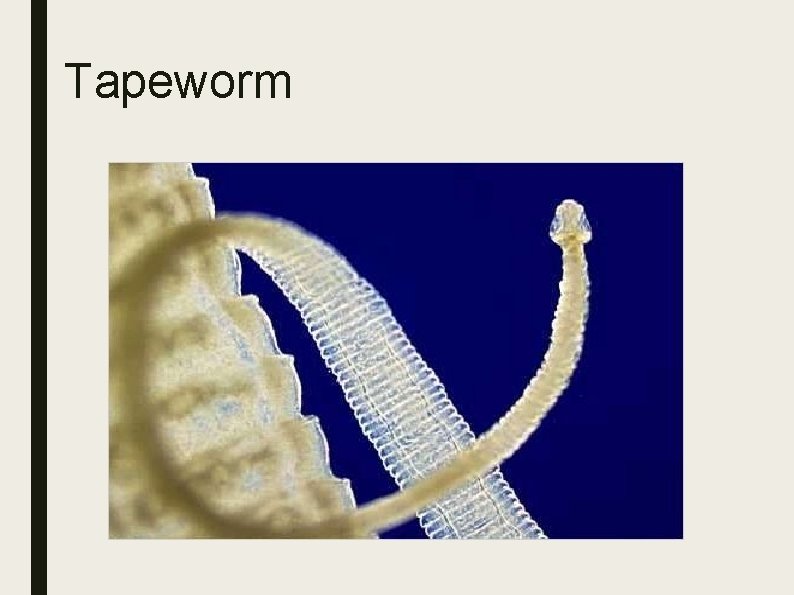
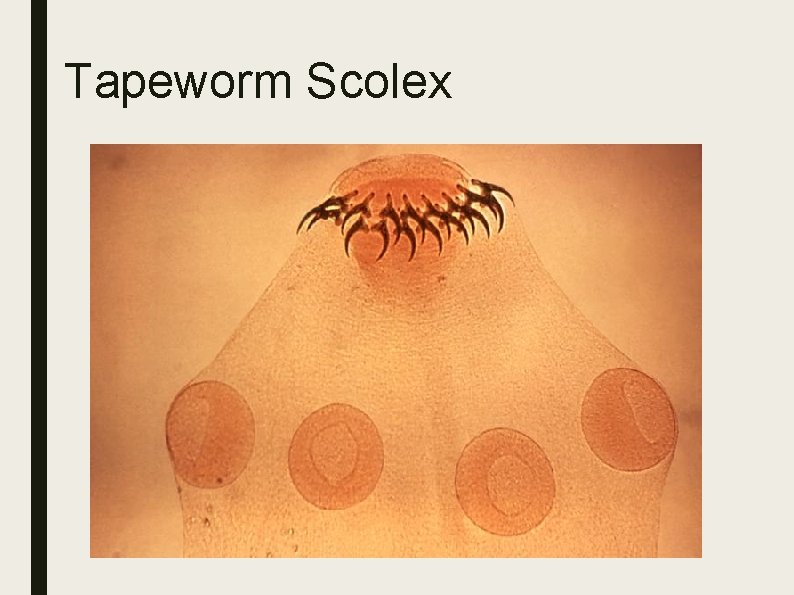
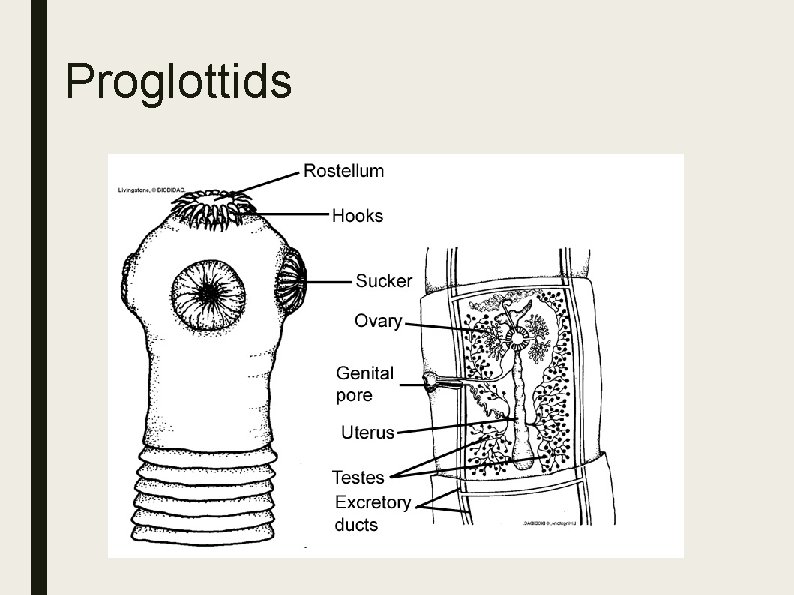
Class Cestoda (Tapeworms) Long flat bodies with a hook-like mouth called a scolex. The scolex is used for attaching to the intestinal wall of it’s host. The rest of the body is followed by regular repeating units of reproducing sections called proglottids. The main body of a tapeworm is a chain of proglottids called a strobila. No digestive tract. Nutrients are absorbed across the skin by diffusion.
Tapeworm Anatomy
Class Cestoda (Tapeworms) All tapeworms require at least two hosts. Adults are parasitic in the digestive tract of vertebrates. Almost ALL vertebrate species can become infected, but adult tapeworms do very little harm to their hosts. Humans often get infected by consuming raw or rare beef, pork, or fish (larva form cysts in the muscle tissue). Children often become infected by putting their fingers in their mouth after touching infected animals.
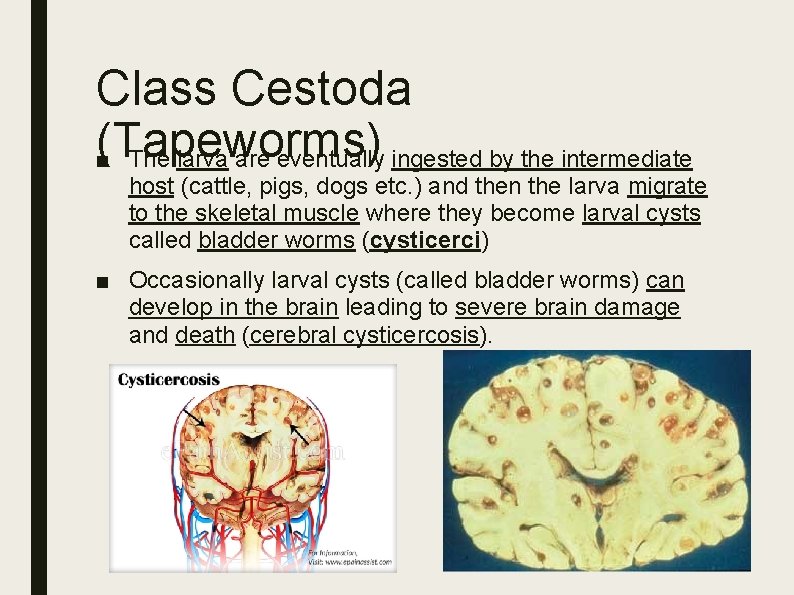
Class Cestoda (Tapeworms) ■ The larva are eventually ingested by the intermediate host (cattle, pigs, dogs etc. ) and then the larva migrate to the skeletal muscle where they become larval cysts called bladder worms (cysticerci) ■ Occasionally larval cysts (called bladder worms) can develop in the brain leading to severe brain damage and death (cerebral cysticercosis).
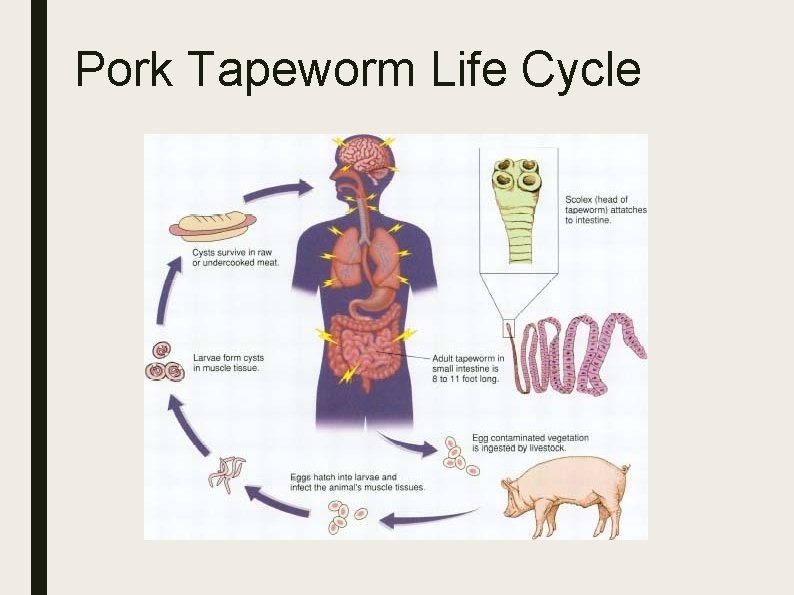
Pork Tapeworm Life Cycle
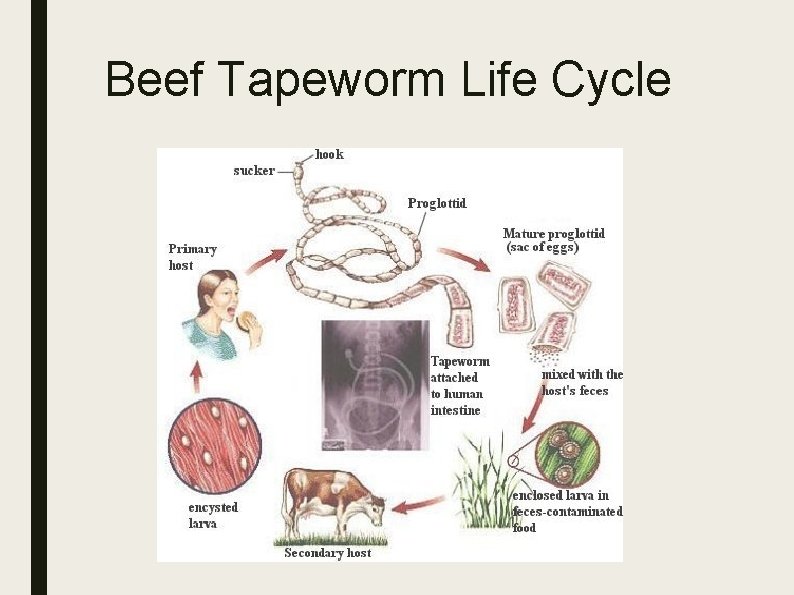
Beef Tapeworm Life Cycle
Tapeworm
Tapeworm Scolex
Proglottids
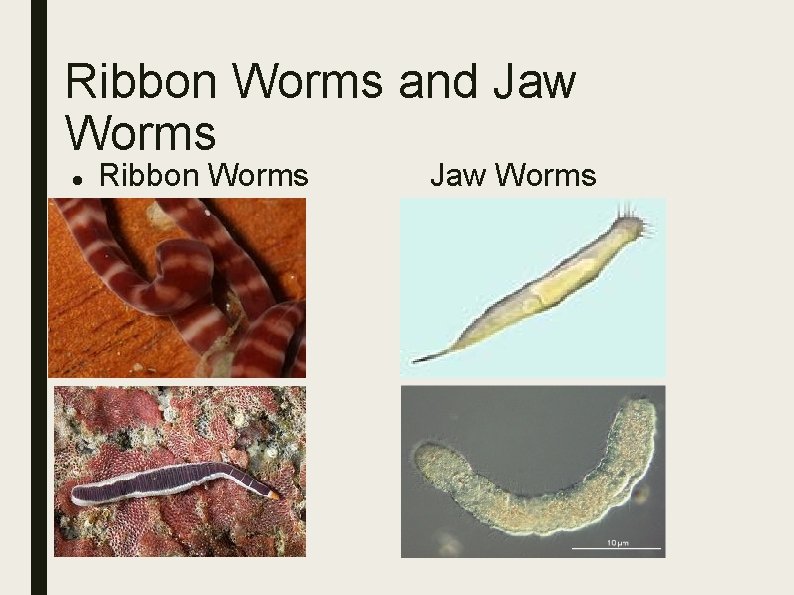
Phylum Nemertea (Ribbon Worms) and Phylum Gnathostomulida (Jaw Worms) Ribbon Worms and Jaw Worms are similar to animals in the Phylum Platyhelminthes in several ways, but have some important differences, placing them in their own phyla. Both are acoelomate and bilaterally symmetrical. Ribbon worms have flame cells and ganglia. Some ribbon worms can regenerate like planarians. However, unlike flatworms, ribbon worms have a complete digestive tract with both a mouth and an anus. Ribbon worms also have a circulatory system. Jaw worms are a newly discovered species and have yet to be properly classified. They do somewhat resemble rotifers.
Ribbon Worms and Jaw Worms Ribbon Worms Jaw Worms