
Phylum Mollusca Distinguishing features and Classification By Dr
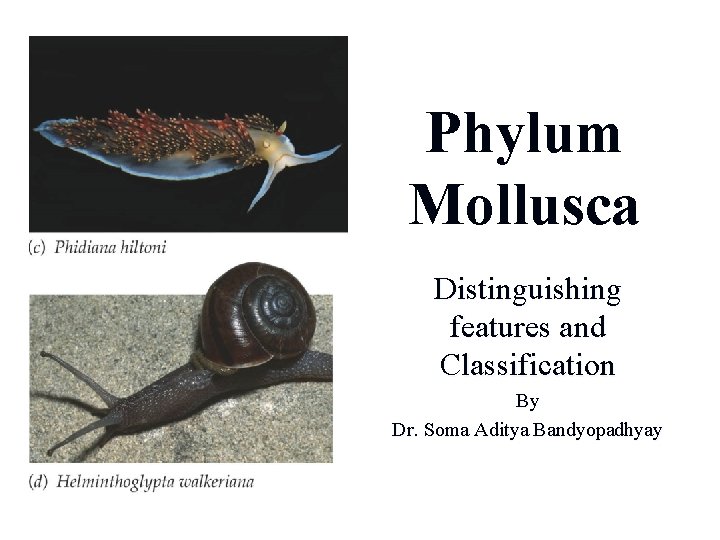
Phylum Mollusca Distinguishing features and Classification By Dr. Soma Aditya Bandyopadhyay
Phylum Mollusca n n n n Protostomes Eucoelomates (latin mollis- soft) Soft Bodied, Unsegmented animals Habitat – mostly aquatic, few terrestrial Shelled / Some without shell Cephalization well marked n Sensory organs n Mouths Body Divisions n Visceral Mass n Head-Foot
Phylum Mollusca Complete digestive tract n Digestive glands n Specialized feeding structures - radula n Circulatory system n Heart (2 chambers) n Open system in most groups n Closed in cephalopods n n Coelom restricted to pericardium in most cases
Phylum Mollusca n Advanced nervous system Brain n Sensory organs n n Eyes n Sensory n Excretory system n n papillae Kidney-like nephridia (Organ of Bojanus) Reproduction Monoecious and dioecious n External development n
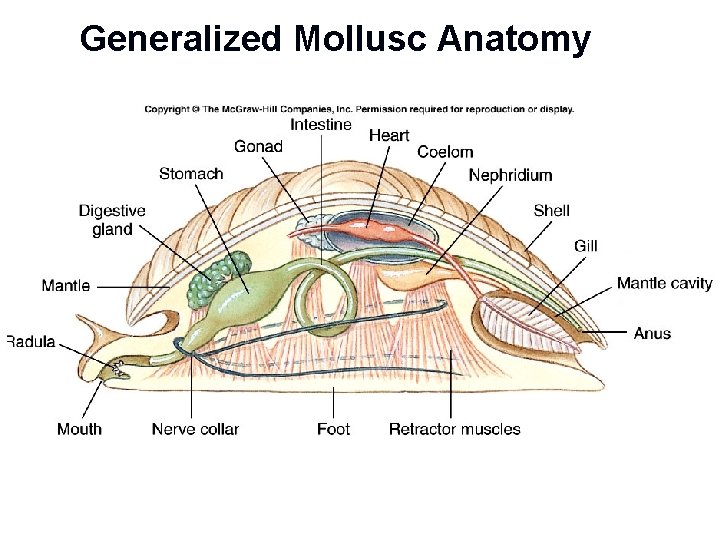
Generalized Mollusc Anatomy
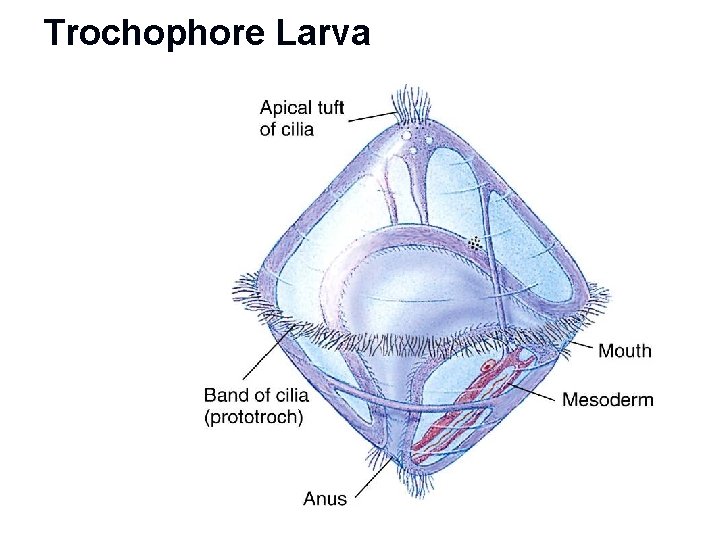
Trochophore Larva
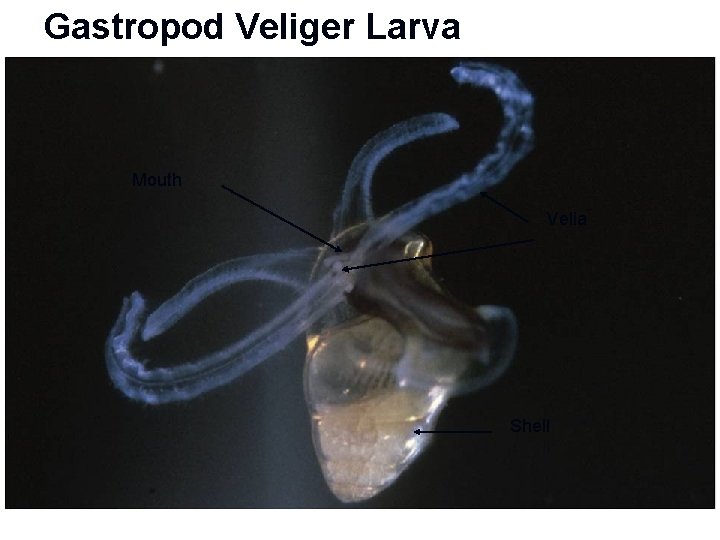
Gastropod Veliger Larva Mouth Velia Shell
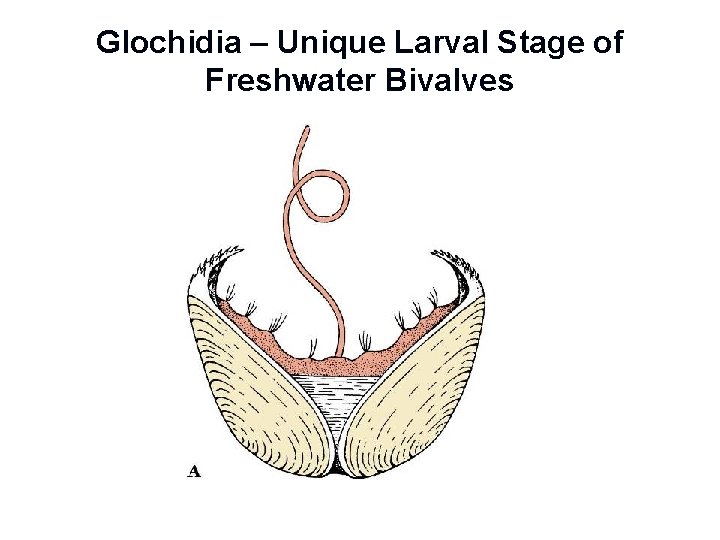
Glochidia – Unique Larval Stage of Freshwater Bivalves
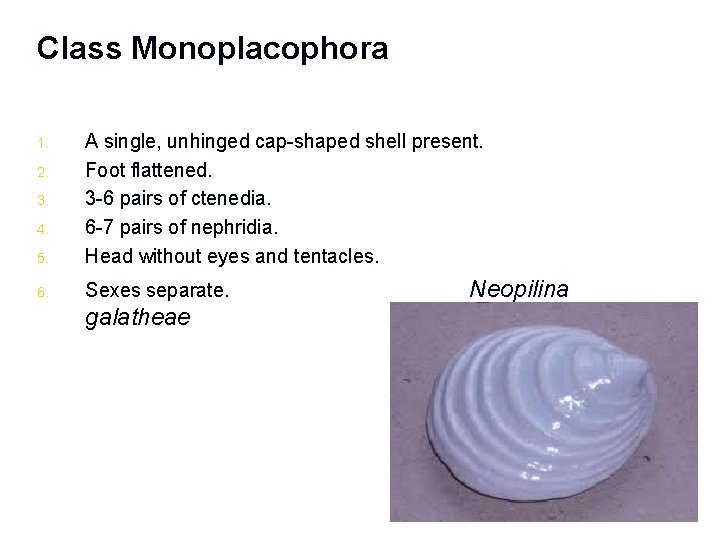
Class Monoplacophora 5. A single, unhinged cap-shaped shell present. Foot flattened. 3 -6 pairs of ctenedia. 6 -7 pairs of nephridia. Head without eyes and tentacles. 6. Sexes separate. 1. 2. 3. 4. galatheae Neopilina
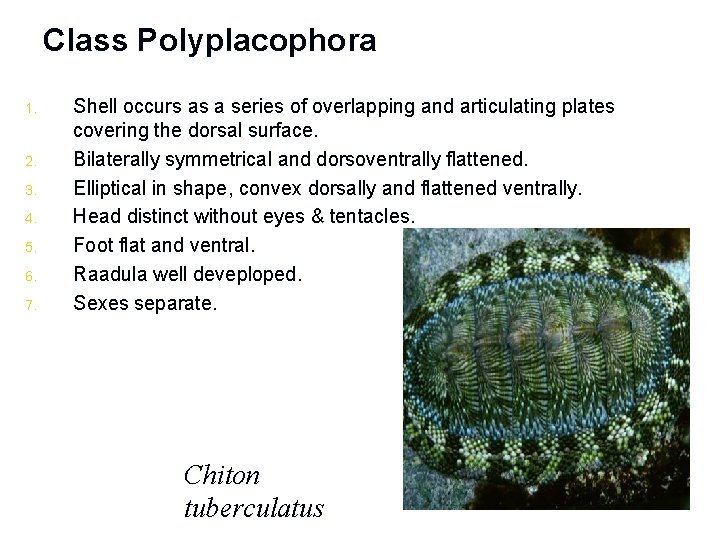
Class Polyplacophora 1. 2. 3. 4. 5. 6. 7. Shell occurs as a series of overlapping and articulating plates covering the dorsal surface. Bilaterally symmetrical and dorsoventrally flattened. Elliptical in shape, convex dorsally and flattened ventrally. Head distinct without eyes & tentacles. Foot flat and ventral. Raadula well deveploped. Sexes separate. Chiton tuberculatus
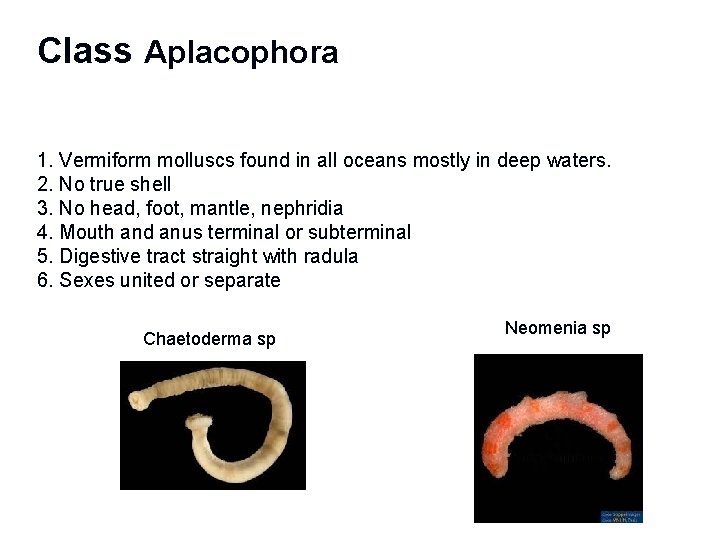
Class Aplacophora 1. Vermiform molluscs found in all oceans mostly in deep waters. 2. No true shell 3. No head, foot, mantle, nephridia 4. Mouth and anus terminal or subterminal 5. Digestive tract straight with radula 6. Sexes united or separate Chaetoderma sp Neomenia sp
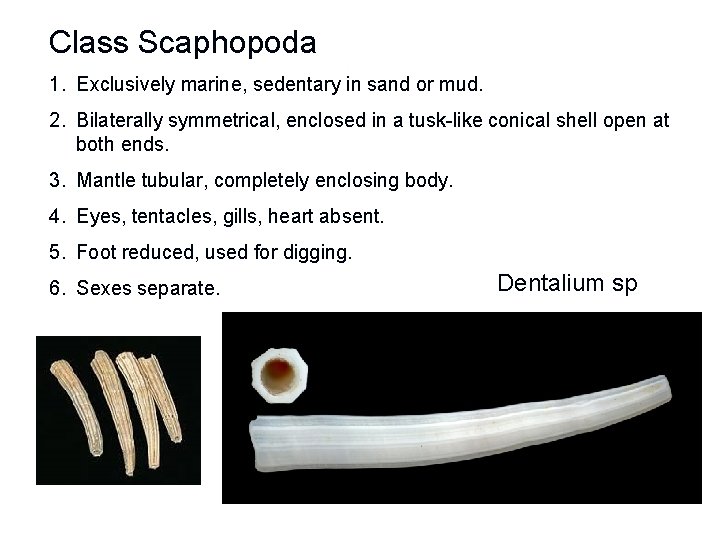
Class Scaphopoda 1. Exclusively marine, sedentary in sand or mud. 2. Bilaterally symmetrical, enclosed in a tusk-like conical shell open at both ends. 3. Mantle tubular, completely enclosing body. 4. Eyes, tentacles, gills, heart absent. 5. Foot reduced, used for digging. 6. Sexes separate. Dentalium sp Dentalium octangulatum
Class Bivalvia (Pelecypoda) n n n n n Primarily marine, 10% freshwater, none terrestrial. Sedentary life style. Body bilaterally symmetrical, flattened laterally. 2 valved shell, hinged mid-dorsally. Absence of head and associated sensory structures. A spacious mantle cavity Foot ventral, muscular. Ctenedia paired. Alimentary canal coiled Development includes a trochophore larva.
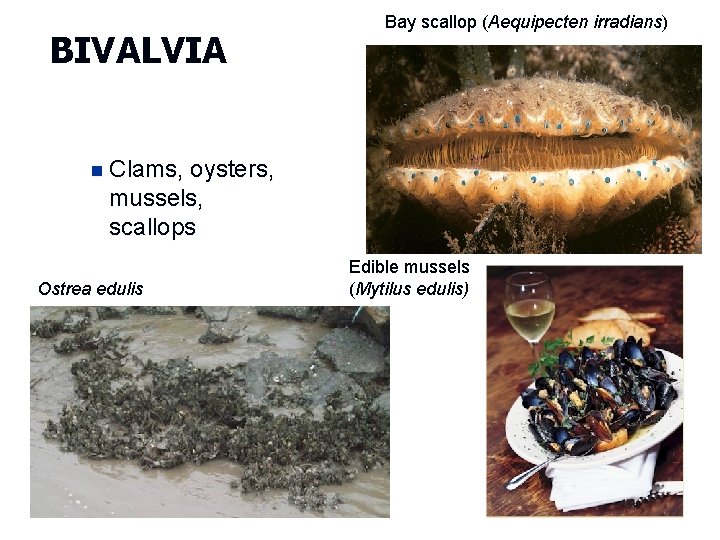
BIVALVIA Bay scallop (Aequipecten irradians) n Clams, oysters, mussels, scallops Ostrea edulis Edible mussels (Mytilus edulis)
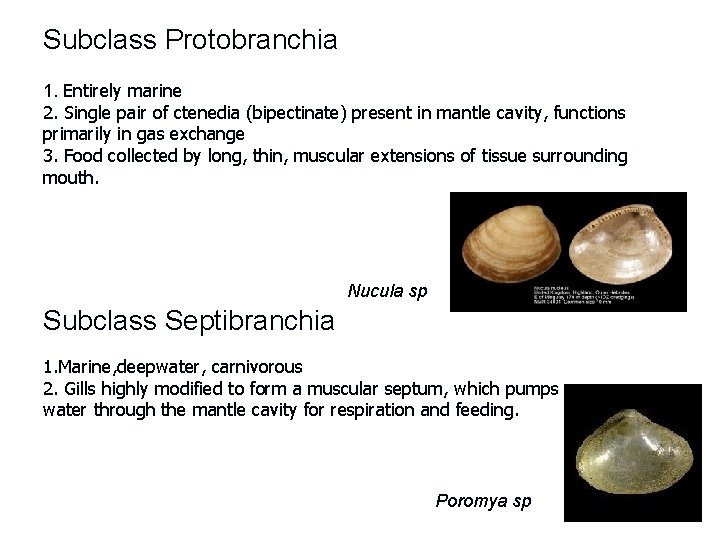
Subclass Protobranchia 1. Entirely marine 2. Single pair of ctenedia (bipectinate) present in mantle cavity, functions primarily in gas exchange 3. Food collected by long, thin, muscular extensions of tissue surrounding mouth. Nucula sp Subclass Septibranchia 1. Marine, deepwater, carnivorous 2. Gills highly modified to form a muscular septum, which pumps water through the mantle cavity for respiration and feeding. Poromya sp
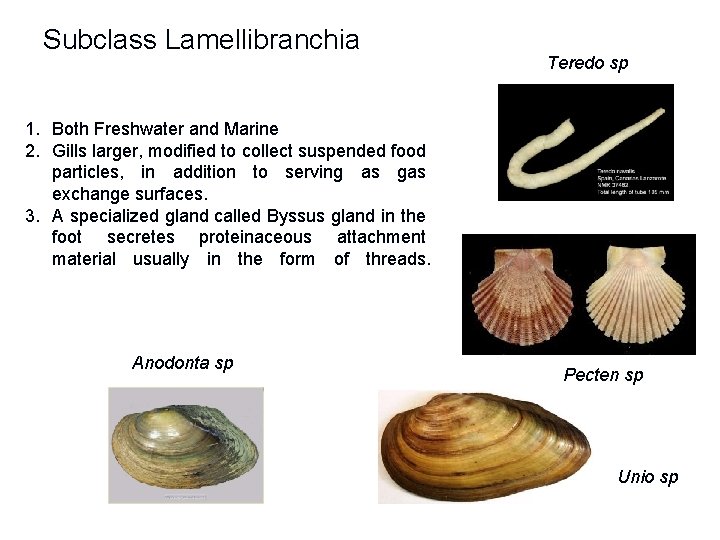
Subclass Lamellibranchia Teredo sp 1. Both Freshwater and Marine 2. Gills larger, modified to collect suspended food particles, in addition to serving as gas exchange surfaces. 3. A specialized gland called Byssus gland in the foot secretes proteinaceous attachment material usually in the form of threads. Anodonta sp Pecten sp Unio sp
Class Gastropoda 1. Largest molluscan class 2. Marine, freshwater and terrestrial environments 3. Diversity of lifestyles – suspension-feeding, deposit feeding, carnivorous, herbivorous and ectoparasitic species 4. Body consists of visceral mass, muscular foot and a spirally coiled univalved shell exhibiting torsion 5. Respiration by gills 6. Open circulatory system 7. Trochophore and veliger larvae
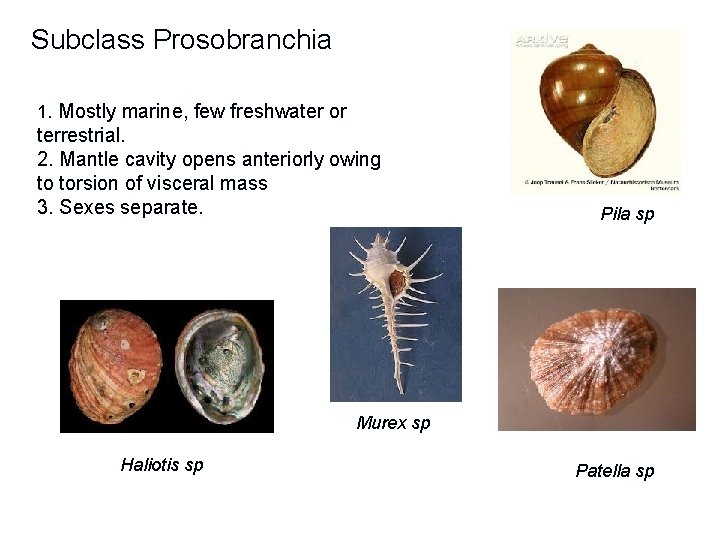
Subclass Prosobranchia 1. Mostly marine, few freshwater or terrestrial. 2. Mantle cavity opens anteriorly owing to torsion of visceral mass 3. Sexes separate. Pila sp Murex sp Haliotis sp Patella sp
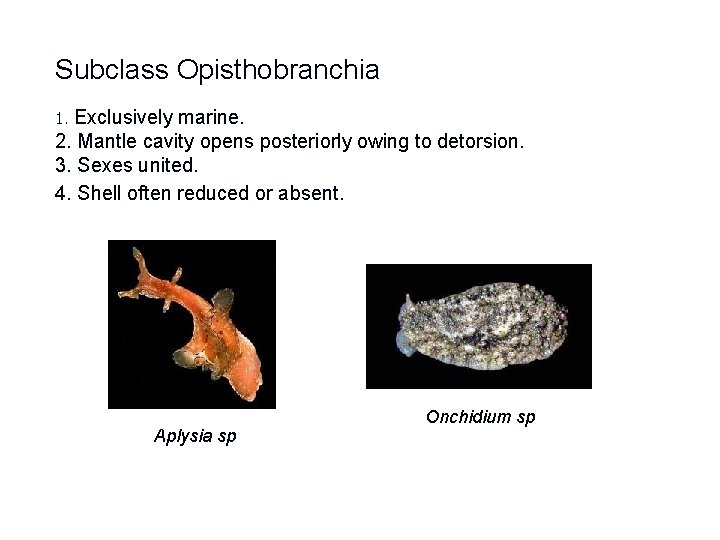
Subclass Opisthobranchia Exclusively marine. 2. Mantle cavity opens posteriorly owing to detorsion. 3. Sexes united. 4. Shell often reduced or absent. 1. Aplysia sp Onchidium sp
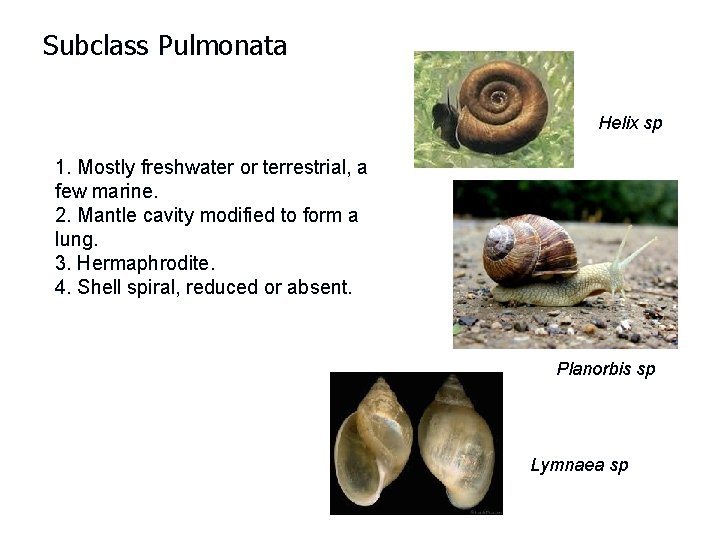
Subclass Pulmonata Helix sp 1. Mostly freshwater or terrestrial, a few marine. 2. Mantle cavity modified to form a lung. 3. Hermaphrodite. 4. Shell spiral, reduced or absent. Planorbis sp Lymnaea sp
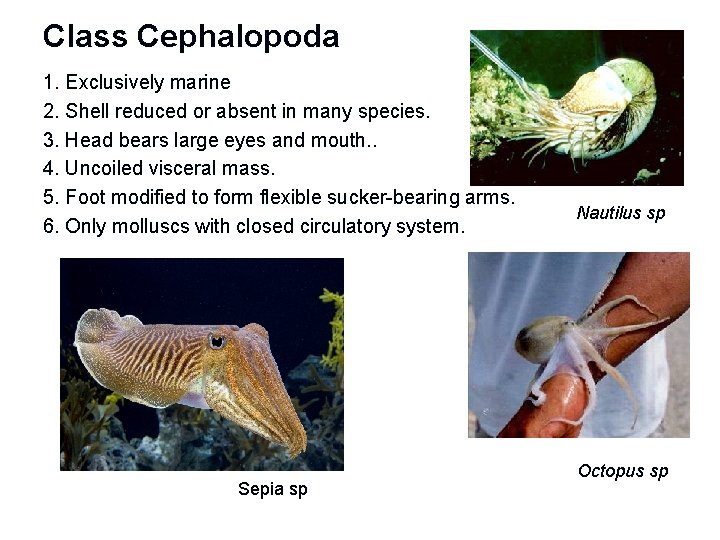
Class Cephalopoda 1. Exclusively marine 2. Shell reduced or absent in many species. 3. Head bears large eyes and mouth. . 4. Uncoiled visceral mass. 5. Foot modified to form flexible sucker-bearing arms. 6. Only molluscs with closed circulatory system. Sepia sp Nautilus sp Octopus sp
- Slides: 21