
Phylum Ascomycota Class Ascomycetes Sac fungi The name
- Slides: 28
Phylum: Ascomycota Class: Ascomycetes (Sac fungi) The name is derived from the Greek words askos (a bag or bladder) and mykes (a fungus), so ascomycetes are sac fungi.
• Characteristics of Ascomycetes: • They are the largest phylum of Fungi, with over 64, 000 species. • There is a very wide range of lifestyles. Some ascomycetes are saprotrophs, others parasites of plants and animals, including humans. • The hyphae are septate. proteinaceous organelles termed woronin bodies may be closely grouped near the central pore. • Cell walls consist of chitin and glucan. • Asexual reproduction in the ascomycetes may be carried on by fission, budding, fragmentation, arthrospores, chlamydospores, or conidia according to the species and environmental conditions.
• The characteristic feature of the group is that the sexually produced spores, the ascospores are contained within a sac, the ascus. In most ascomycetes the ascus contains eight ascospores. • Most have life cycle with short dikaryophase only in the ascogenous hyphal system that develops after fertilization in the developing fruit body.
• Sexual reproduction: Sexual reproduction in ascomycetes either homothallic or heterothallic: and sexual reproduction is isogamous (yeasts) or heterogamous as in the higher ascomycetes, the male gamete is called (antheridium) and the female gamete (ascogonium). • Gametangial copulation: In some lower ascomycetes (yeasts). In which two similar gametangia isogamous (morphologivcally indistinguishable) fuse and forming the ascus. • Gametangial contact: By producing morphologically differentiated gametangia, antheridia and ascogonia precedes sexual reproduction.
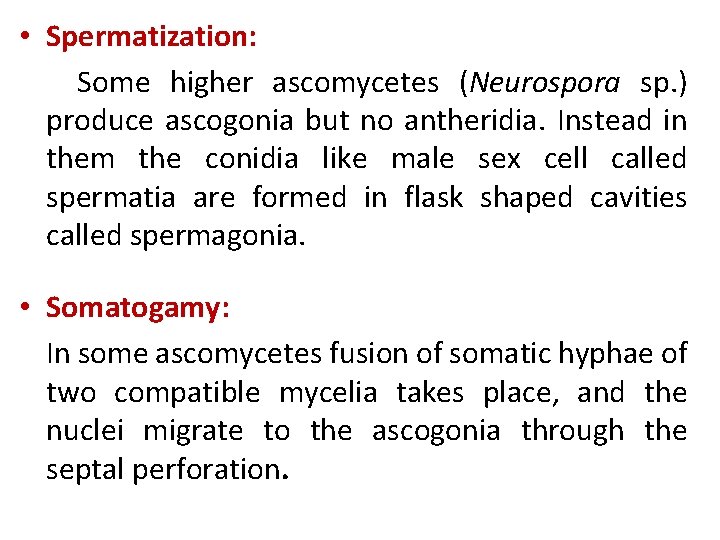
• Spermatization: Some higher ascomycetes (Neurospora sp. ) produce ascogonia but no antheridia. Instead in them the conidia like male sex cell called spermatia are formed in flask shaped cavities called spermagonia. • Somatogamy: In some ascomycetes fusion of somatic hyphae of two compatible mycelia takes place, and the nuclei migrate to the ascogonia through the septal perforation.
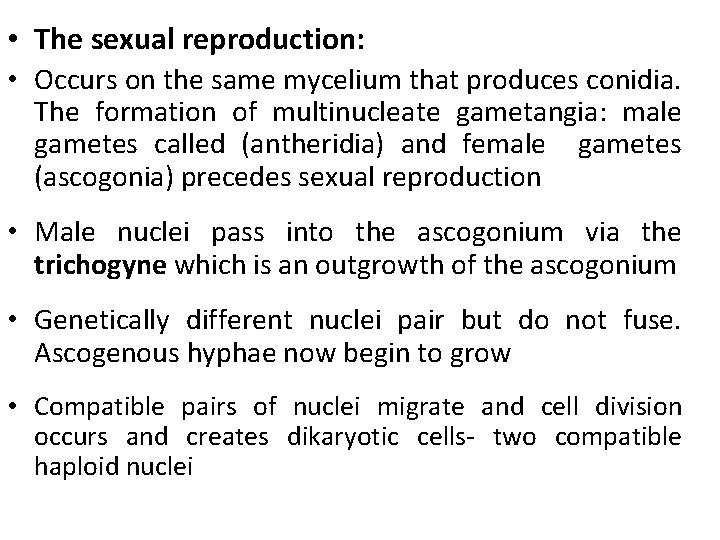
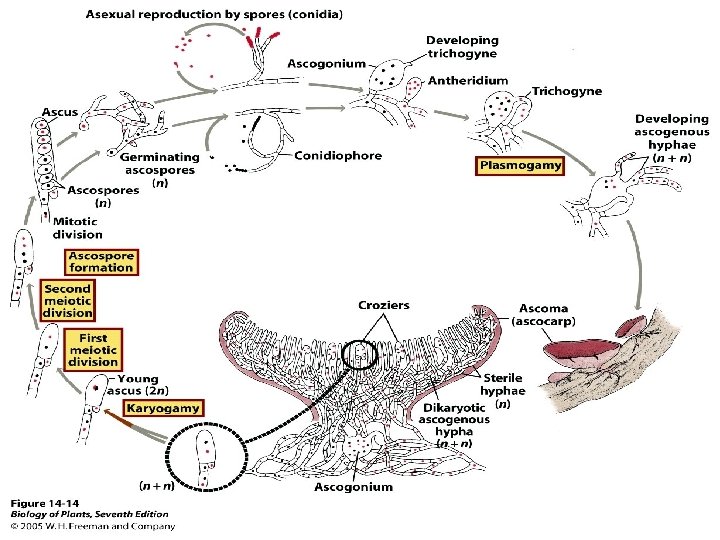
• The sexual reproduction: • Occurs on the same mycelium that produces conidia. The formation of multinucleate gametangia: male gametes called (antheridia) and female gametes (ascogonia) precedes sexual reproduction • Male nuclei pass into the ascogonium via the trichogyne which is an outgrowth of the ascogonium • Genetically different nuclei pair but do not fuse. Ascogenous hyphae now begin to grow • Compatible pairs of nuclei migrate and cell division occurs and creates dikaryotic cells- two compatible haploid nuclei
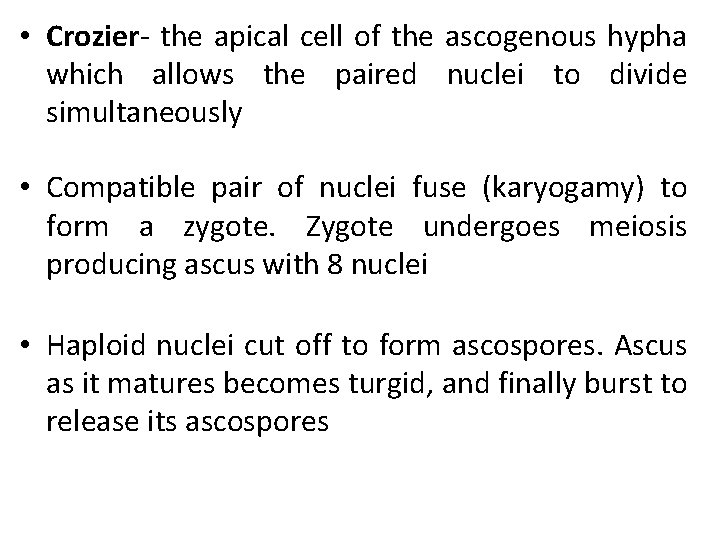
• Crozier- the apical cell of the ascogenous hypha which allows the paired nuclei to divide simultaneously • Compatible pair of nuclei fuse (karyogamy) to form a zygote. Zygote undergoes meiosis producing ascus with 8 nuclei • Haploid nuclei cut off to form ascospores. Ascus as it matures becomes turgid, and finally burst to release its ascospores
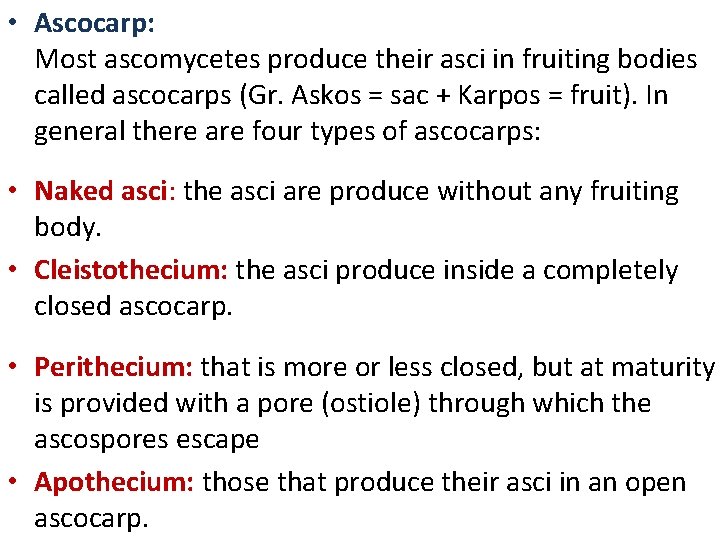
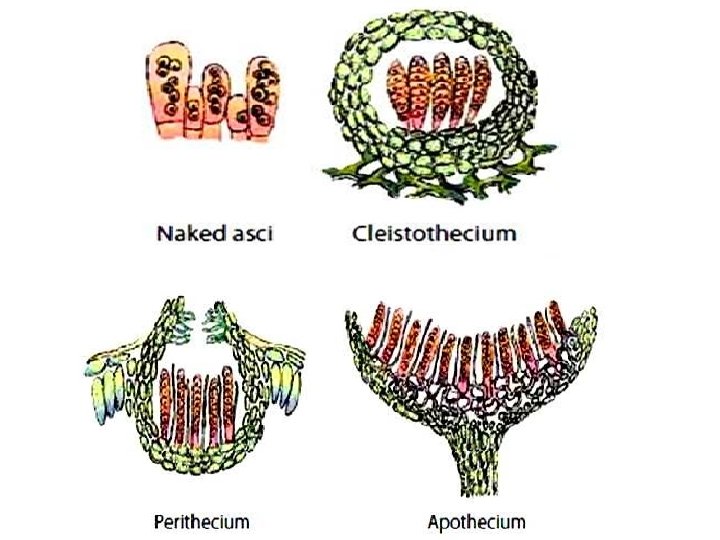
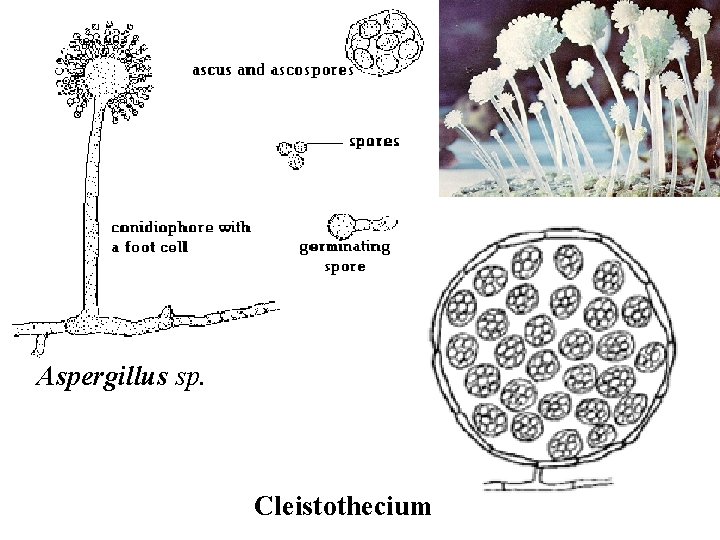
• Ascocarp: Most ascomycetes produce their asci in fruiting bodies called ascocarps (Gr. Askos = sac + Karpos = fruit). In general there are four types of ascocarps: • Naked asci: the asci are produce without any fruiting body. • Cleistothecium: the asci produce inside a completely closed ascocarp. • Perithecium: that is more or less closed, but at maturity is provided with a pore (ostiole) through which the ascospores escape • Apothecium: those that produce their asci in an open ascocarp.
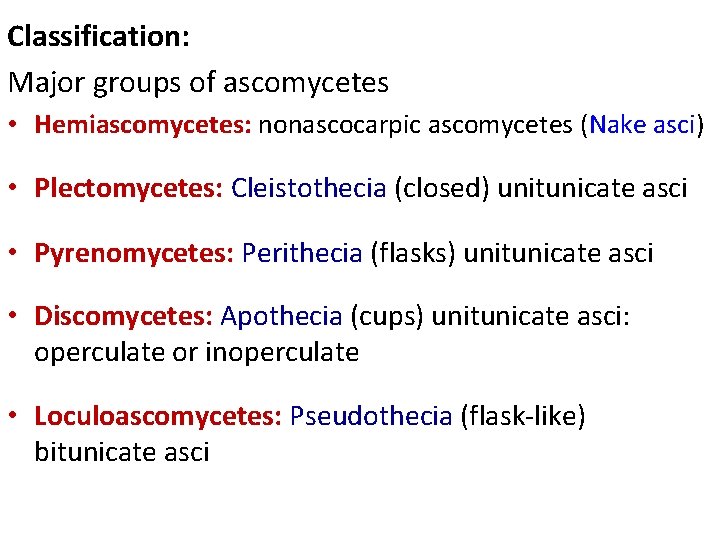
Classification: Major groups of ascomycetes • Hemiascomycetes: nonascocarpic ascomycetes (Nake asci) • Plectomycetes: Cleistothecia (closed) unitunicate asci • Pyrenomycetes: Perithecia (flasks) unitunicate asci • Discomycetes: Apothecia (cups) unitunicate asci: operculate or inoperculate • Loculoascomycetes: Pseudothecia (flask-like) bitunicate asci
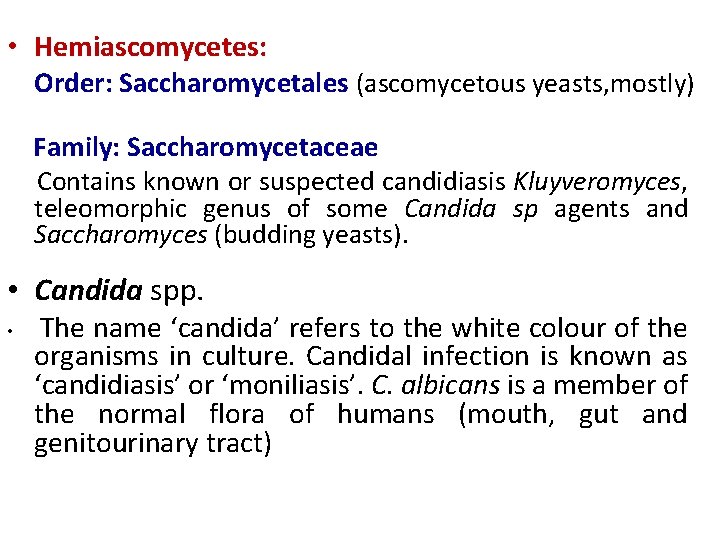
• Hemiascomycetes: Order: Saccharomycetales (ascomycetous yeasts, mostly) Family: Saccharomycetaceae Contains known or suspected candidiasis Kluyveromyces, teleomorphic genus of some Candida sp agents and Saccharomyces (budding yeasts). • Candida spp. • . The name ‘candida’ refers to the white colour of the organisms in culture. Candidal infection is known as ‘candidiasis’ or ‘moniliasis’. C. albicans is a member of the normal flora of humans (mouth, gut and genitourinary tract)
Order: Eurotiales Family: Trichocomaceae • The class Plectomycetes produce their asci within a cleistothecium. • The most important family is the Trichocomaceae, which includes the teleomorphs of Aspergillus and Penicillium. • There are other important opportunistic pathogens of Eurotialean affinity known only in their anamorphic forms. • Eurotium teleomorphic genera of some Aspergillus • Talaromyces, teleomorphic genus of some Penicillium
Aspergillus sp. Cleistothecium
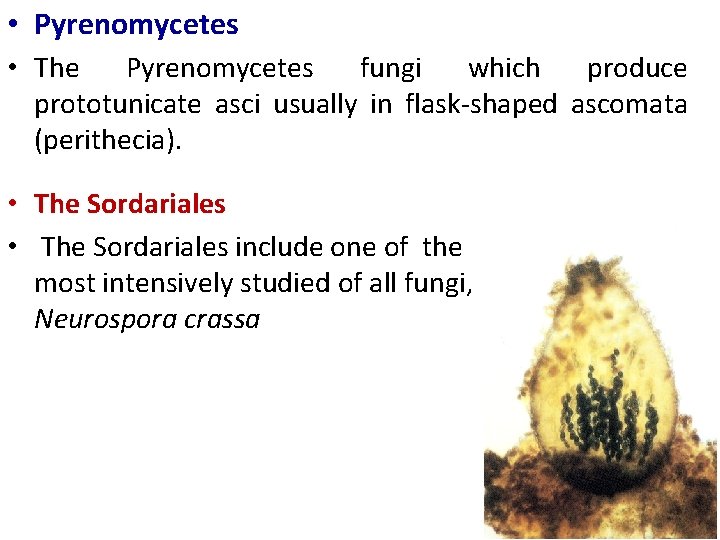
• Pyrenomycetes • The Pyrenomycetes fungi which produce prototunicate asci usually in flask-shaped ascomata (perithecia). • The Sordariales include one of the most intensively studied of all fungi, Neurospora crassa
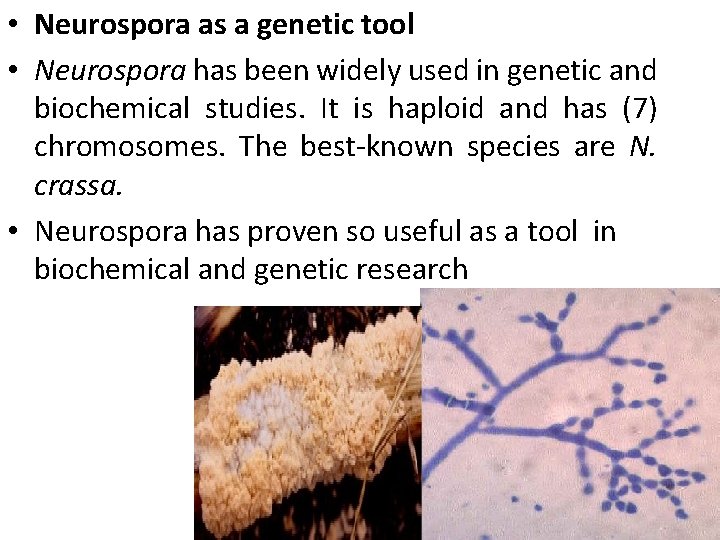
• Neurospora as a genetic tool • Neurospora has been widely used in genetic and biochemical studies. It is haploid and has (7) chromosomes. The best-known species are N. crassa. • Neurospora has proven so useful as a tool in biochemical and genetic research
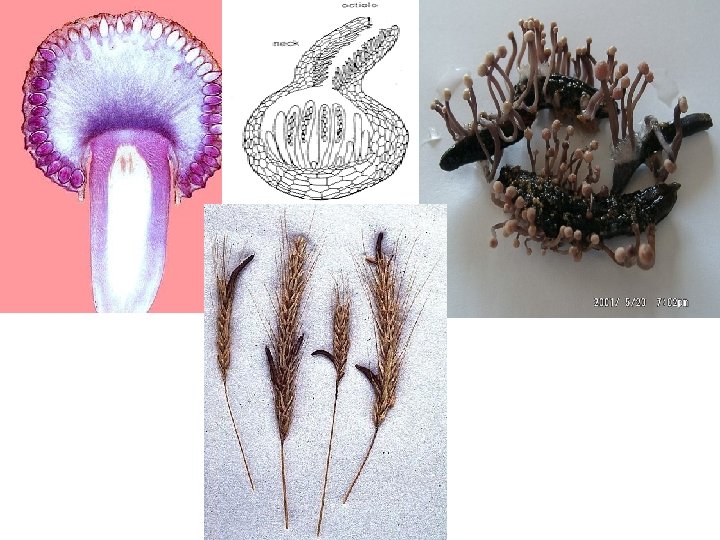
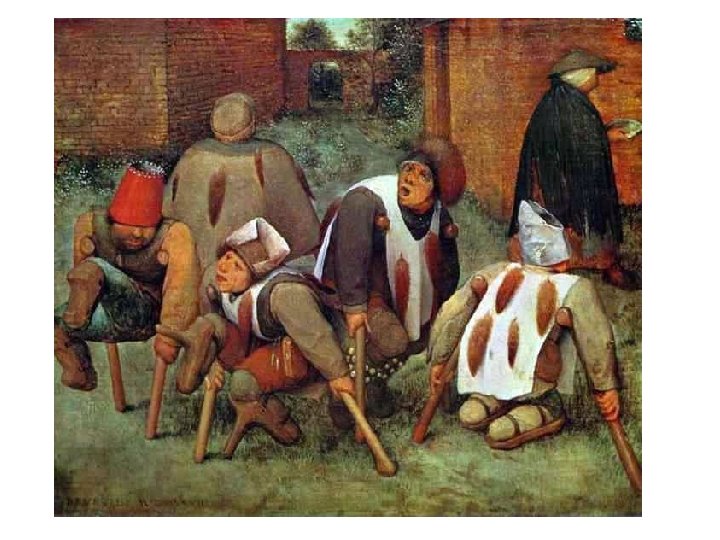
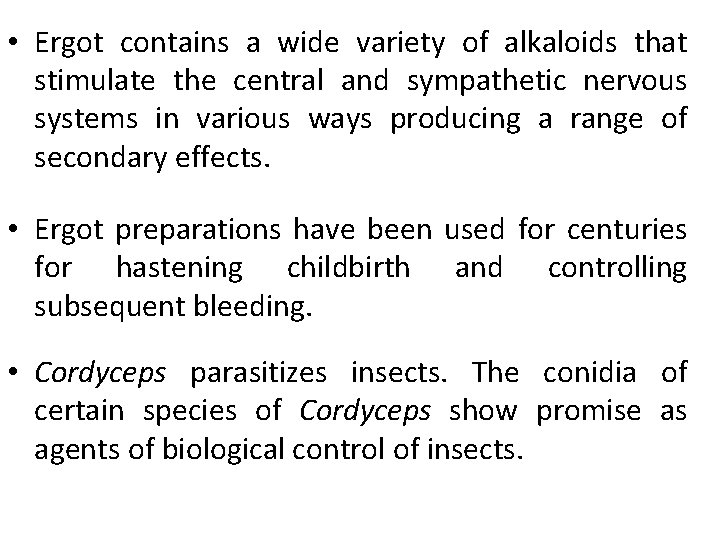
• Ergot contains a wide variety of alkaloids that stimulate the central and sympathetic nervous systems in various ways producing a range of secondary effects. • Ergot preparations have been used for centuries for hastening childbirth and controlling subsequent bleeding. • Cordyceps parasitizes insects. The conidia of certain species of Cordyceps show promise as agents of biological control of insects.
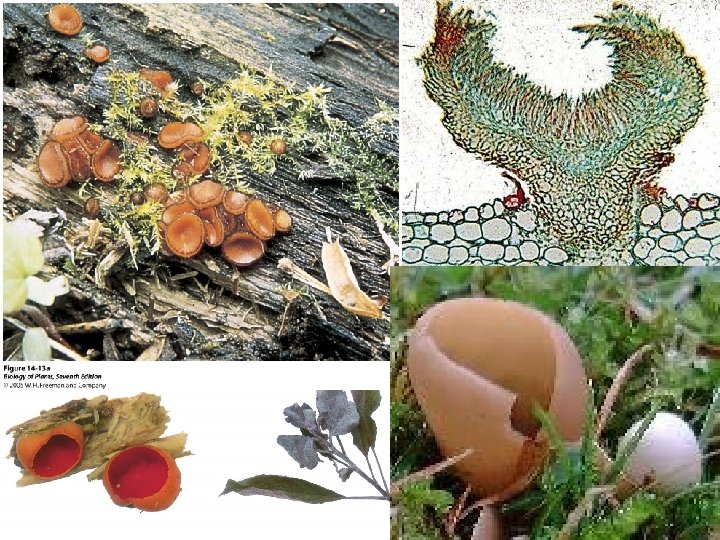
• Discomycetes: • Order Pezizales (operculate discomycetes) • Cup-shaped fruiting bodies (apothecia) • Pezizales • grow on the surface of forest soil, dead wood or dung. The ascocarp is generally an apothecium. It is often cup-shaped or disc-like, fleshy, sometimes stalked, and frequently brightly coloured.
• Pezizaceae • Peziza sp. • Peziza is a large genus containing around 100 species. They are commonly encountered in a very wide range of habitats including soil, manure heaps, dung, rotting wood or straw, burnt ground and sand dunes.
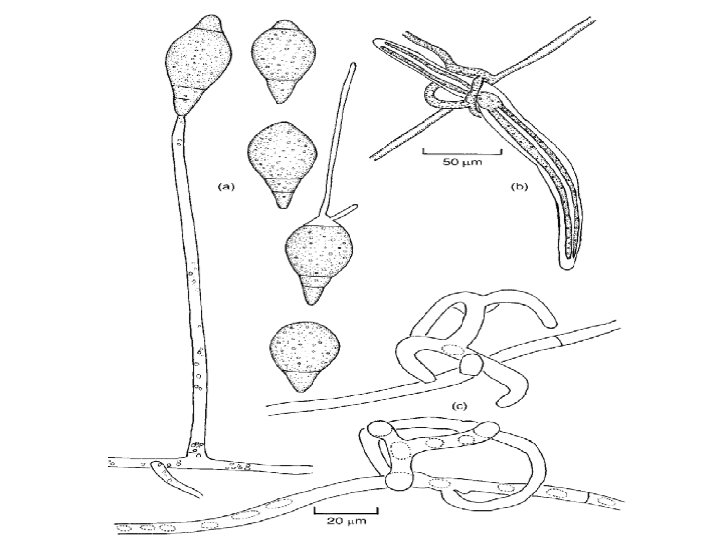
• Family: Orbiliaceae • Predatory fungi belonging to Ascomycota • All known trap-forming ascomycetes are belong to the family Orbiliaceae, that produce an apothecium. • Arthrobotrys: • The predatory fungi (nematophagous fungi) are present in the soil; they develop structures for trapping nematodes, • adhesive knobs • lateral branches.
• Adhesive knobs are Single-celled globose knobs, covered by a sticky secretion. These knobs are borne directly on the hypha or on short lateral branches in such a way that a nematode may become attached to several knobs.
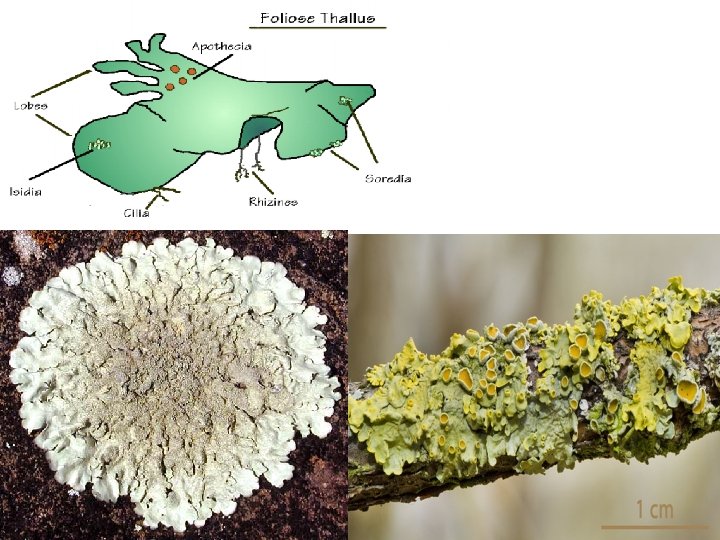
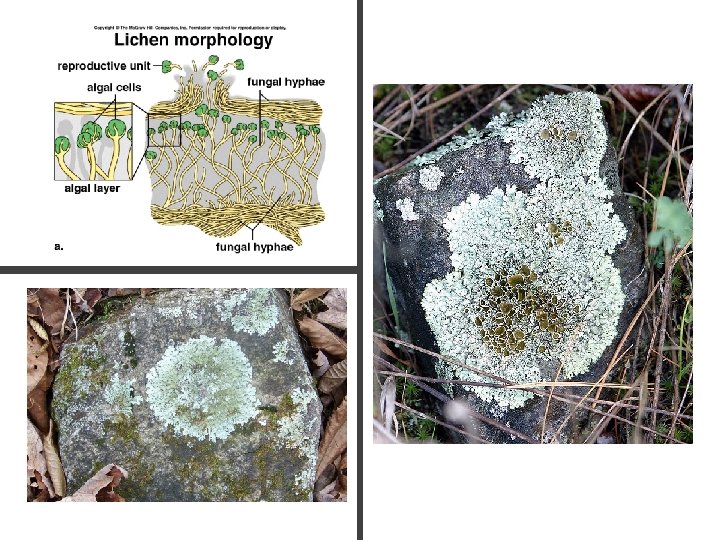
• Order: Lecanorales • Lichens : are usually Discomycetes in the order Lecanorales • Lichens are symbiotic relationships between a fungus and algae or a cyanobacterium housed by the fungus in a thallus. • They can grow in the most extreme environments: in the arctic, the deserts, on trees. • They are now used as indicators of pollution or biomarkers