
PHYLUM ARTHROPODA ZLY 103 Animal Diversity Delivered by
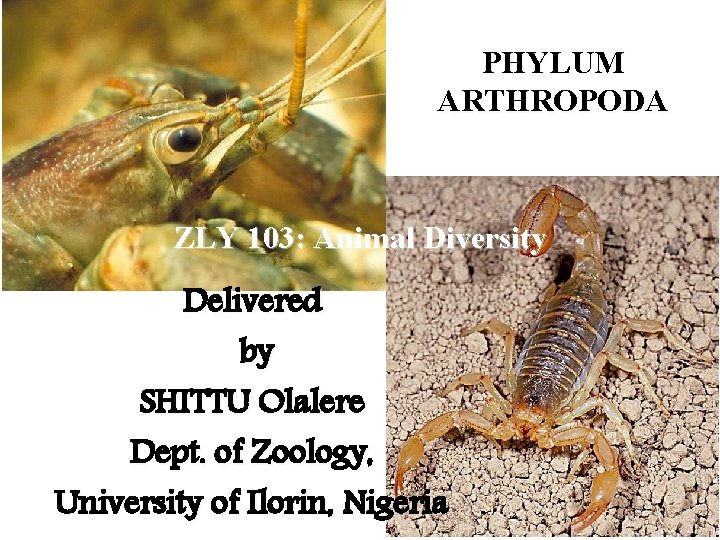
PHYLUM ARTHROPODA ZLY 103: Animal Diversity Delivered by SHITTU Olalere Dept. of Zoology, University of Ilorin, Nigeria
Introduction • Gk. “arthros”– joint + “podos”– foot is the most extensive, successful, ubiquitous and diverse phylum in the animal kingdom. • Common throughout marine, freshwater, terrestrial, and even aerial environments. • They dominate life in terms of their relative large size, numbers and species diversity • They are the first set of organisms to Colonize the land. • Feeding mode is highly varied, almost all organic substances are edible to arthropods
Introduction • They have innate ability to defend and protect self from danger in any given habitation. • They share numerous ecological niche, e. g. trophic niche with man. • They possess a very efficient food acquisition and utilization mechanism • Arthropods share common features to annelids and are believed to have evolved from annelid-like ancestors. • The Onychoporans share so many characters with annelids, like; segmentation, metamerism, discrete muscular arrangements, ganglia on ventral nerve cord, etc.
General Characteristics • They are triploblastic, bilateral symmetrical, metamerically segmented coelomates. • Entire body is covered with a chitinous exoskeleton called cuticle. • The cuticle is completely non-living, non cellular, multilayered, stout and rigid. It is secreted by the epidermis. • Body usually segmented and jointed externally (divided into 3 major parts (Tagmata): head, thorax, abdomen
General Characteristics • They possess jointed appendages that are equipped for feeding, sensory reception, defense and locomotion; with hardened exoskeleton containing chitin with Ecdysis (molt) at intervals. • Their muscles run in discrete bundles and operates on a lever system for movement. • They possess a central nervous system (CNS) made up of a dorsal brain connected to a double, ventral and solid ganglionated nerve cord. • The coelom is reduced to cavities of the gonads, pericardium and haemocoel.
General Characteristics • Presence of a open vascular system with no septa consisting of a dorsal contractile tubular heart with blood flowing in haemocoelic sinuses. • Complete digestive tract: Mandible-chewing or proboscis- sucking ending in an anus. • Improved respiration through gills, trachea, book lungs or body surface to support the active and energetic life style due to loss of gaseous exchange between body wall. • Sensory organs include antennae and hairs, simple and compound eye
General Characteristics • Arthropods have improved excretory system which is mediated by glands like antennary, coxal/maxillary glands that functions as coelomoducts. • Terrestrial forms use a more efficient and water conserving malphighian tubules. • Reproduces (mostly sexually), one to several larval stage or direct development in some species.
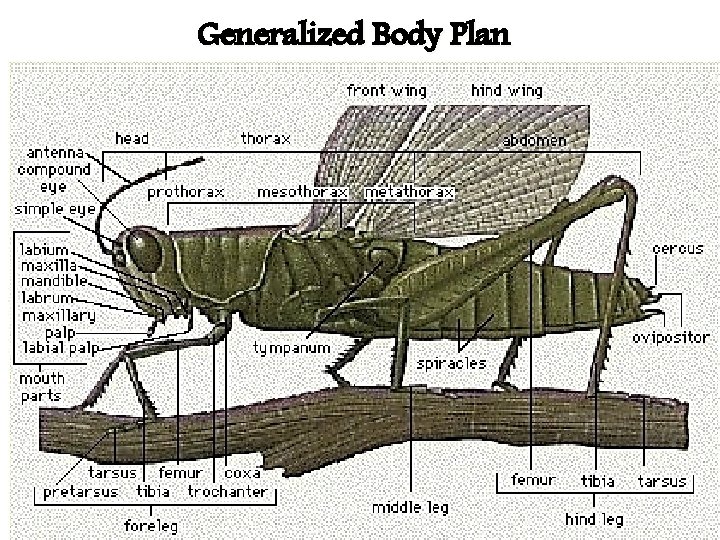
Generalized Body Plan
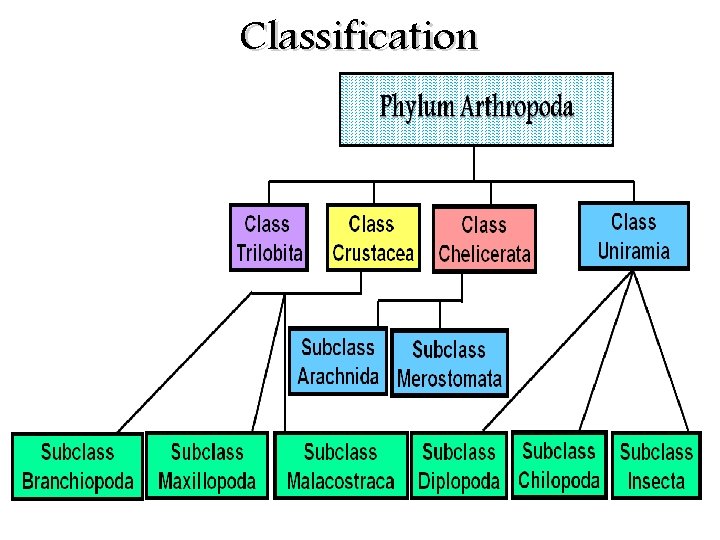
Classification
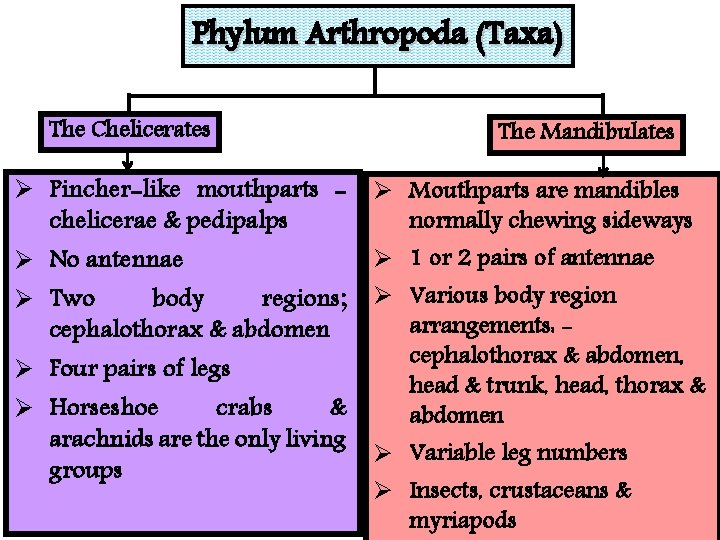
Phylum Arthropoda (Taxa) The Chelicerates Ø Pincher-like mouthparts chelicerae & pedipalps Ø No antennae Ø Two body regions; cephalothorax & abdomen Ø Four pairs of legs Ø Horseshoe crabs & arachnids are the only living groups The Mandibulates Ø Mouthparts are mandibles normally chewing sideways Ø 1 or 2 pairs of antennae Ø Various body region arrangements: cephalothorax & abdomen, head & trunk, head, thorax & abdomen Ø Variable leg numbers Ø Insects, crustaceans & myriapods
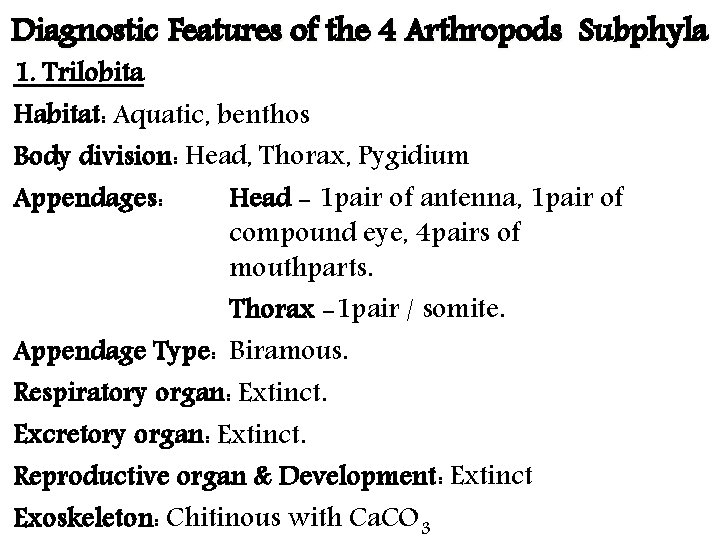
Diagnostic Features of the 4 Arthropods Subphyla 1. Trilobita Habitat: Aquatic, benthos Body division: Head, Thorax, Pygidium Appendages: Head - 1 pair of antenna, 1 pair of compound eye, 4 pairs of mouthparts. Thorax -1 pair / somite. Appendage Type: Biramous. Respiratory organ: Extinct. Excretory organ: Extinct. Reproductive organ & Development: Extinct Exoskeleton: Chitinous with Ca. CO 3
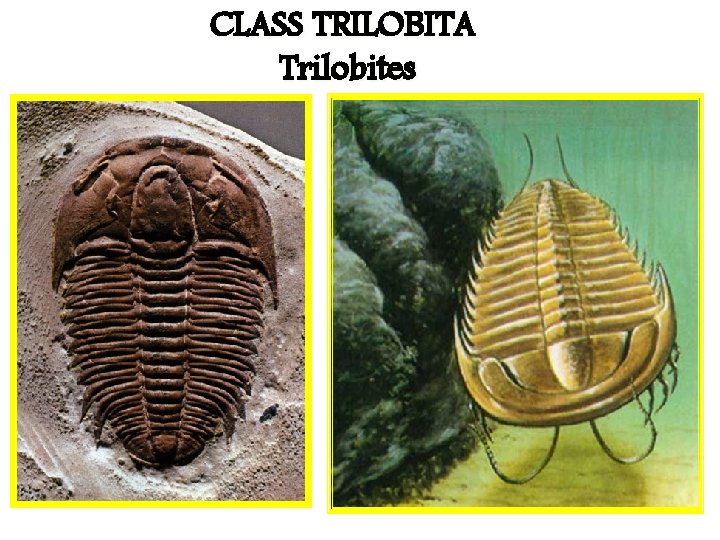
CLASS TRILOBITA Trilobites
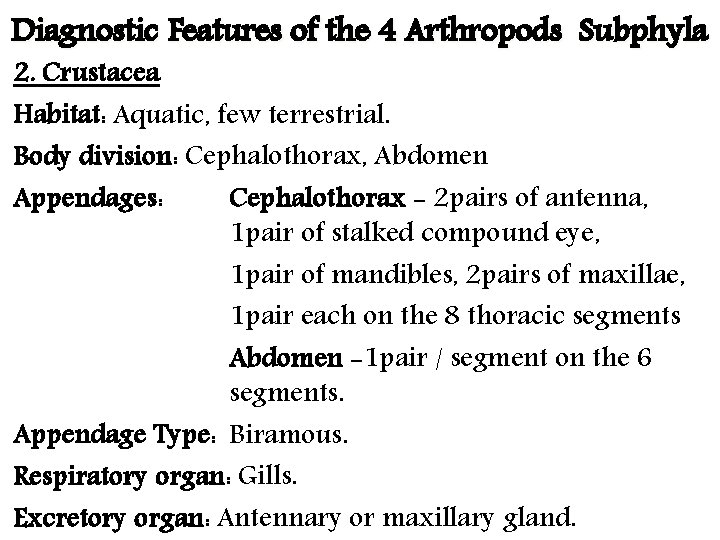
Diagnostic Features of the 4 Arthropods Subphyla 2. Crustacea Habitat: Aquatic, few terrestrial. Body division: Cephalothorax, Abdomen Appendages: Cephalothorax - 2 pairs of antenna, 1 pair of stalked compound eye, 1 pair of mandibles, 2 pairs of maxillae, 1 pair each on the 8 thoracic segments Abdomen -1 pair / segment on the 6 segments. Appendage Type: Biramous. Respiratory organ: Gills. Excretory organ: Antennary or maxillary gland.
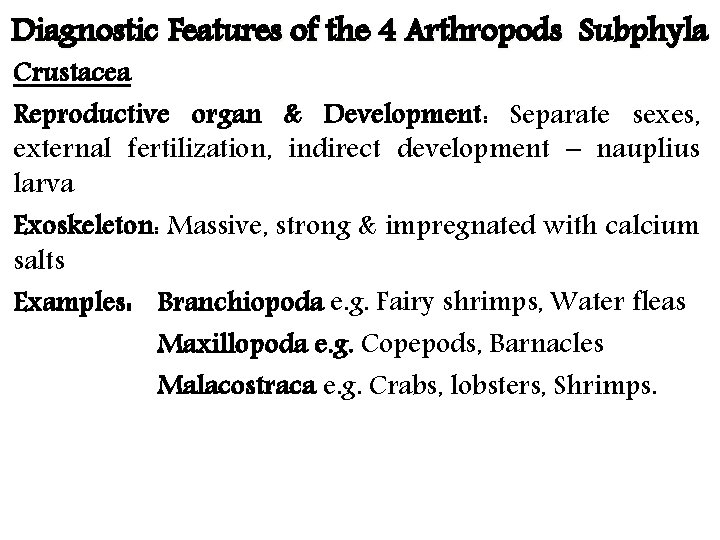
Diagnostic Features of the 4 Arthropods Subphyla Crustacea Reproductive organ & Development: Separate sexes, external fertilization, indirect development – nauplius larva Exoskeleton: Massive, strong & impregnated with calcium salts Examples: Branchiopoda e. g. Fairy shrimps, Water fleas Maxillopoda e. g. Copepods, Barnacles Malacostraca e. g. Crabs, lobsters, Shrimps.
Diagnostic Features of the 4 Arthropods Subphyla Crustacea Isopoda – sow bugs or pill bugs Amphipoda - sand fleas, amphipods Cirripedia - barnacles Decapoda - crabs, lobster, shrimp several other minor orders
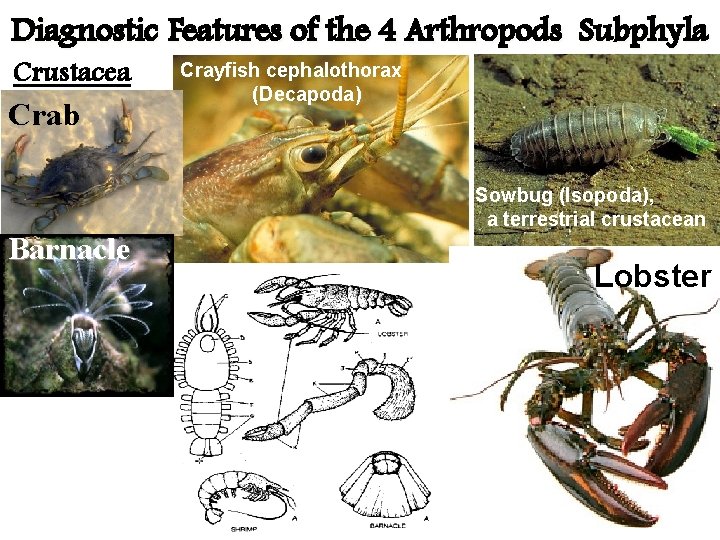
Diagnostic Features of the 4 Arthropods Subphyla Crustacea Crab Barnacle Crayfish cephalothorax (Decapoda) Sowbug (Isopoda), a terrestrial crustacean Lobster
Diagnostic Features of the 4 Arthropods Subphyla 3. Chelicerata Habitat: Terrestrial with some aquatic forms. Body division: Prosoma, Opisthosoma Appendages: Prosoma - 1 pair of chelicera, 1 pair of pedipalp, numerous simple eyes, 4 pairs of walking legs, Opisthosoma – No appendages except on last segment. Appendage Type: Uniramous. Respiratory organ: Lung books or tracheal system. Excretory organ: Coxal gland or malpighian tubule.
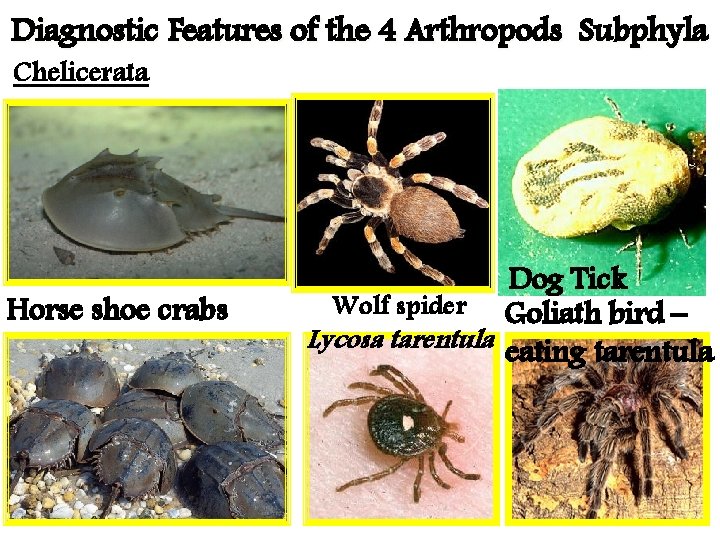
Diagnostic Features of the 4 Arthropods Subphyla Chelicerata Horse shoe crabs Dog Tick Wolf spider Goliath bird – Lycosa tarentula eating tarentula
Diagnostic Features of the 4 Arthropods Subphyla Chelicerata Reproductive organ & Development: Separate sexes, internal fertilization, direct development Exoskeleton: Epicuticle impregnated with wax. Examples: Merostomata e. g. Horse shoe crab, Limulus Arachnida e. g. Spiders, Scorpions, Mites & Ticks Pycnogonida e. g. Sea spiders
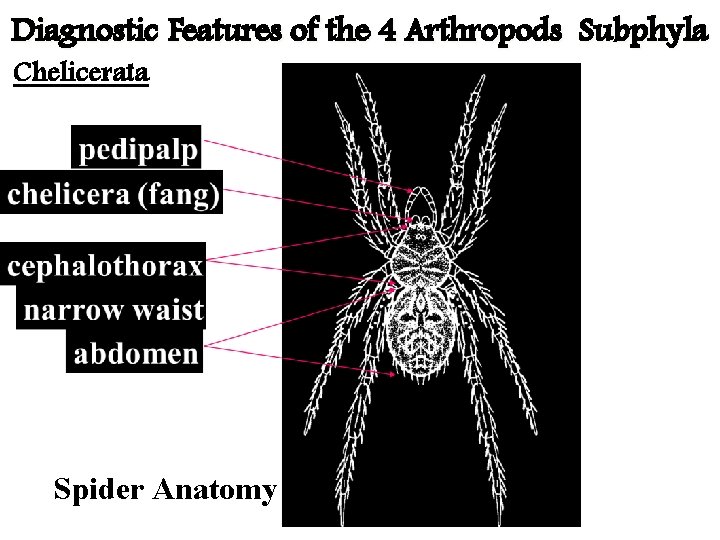
Diagnostic Features of the 4 Arthropods Subphyla Chelicerata Spider Anatomy
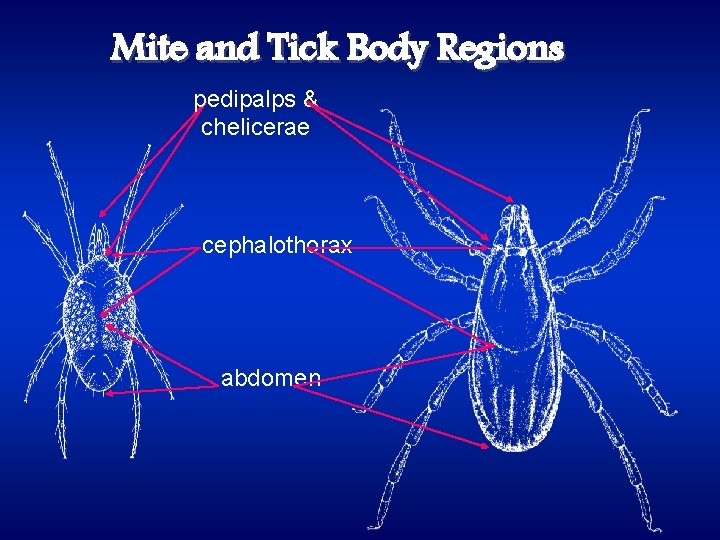
Mite and Tick Body Regions pedipalps & chelicerae cephalothorax abdomen
Diagnostic Features of the 4 Arthropods Subphyla 4. Uniramia Habitat: Terrestrial with some aquatic forms. Body division: Head and Trunk or as in Trilobita Appendages: Head - 1 pair of antenna, 1 pair of simple or compound eye, 1 pair of mandibles, 2 pairs of maxillae, Trunk/Thorax – 1 or 2 pairs of walking legs on each side of the segment except the abdomen Appendage Type: Uniramous. Respiratory organ: Tracheal system. Excretory organ: Malpighian tubule
Diagnostic Features of the 4 Arthropods Subphyla Uniramia Reproductive organ & Development: Separate sexes, internal fertilization, Metamorphosis Exoskeleton: Cuticle hardened with proteins, epicuticle waxed in insects. Examples: Dipolopoda e. g. Millipedes Chilopoda e. g. Centipede Insecta e. g. Mosquitoes, Housefly, Grasshopper, Termites, Ants, Bugs etc.
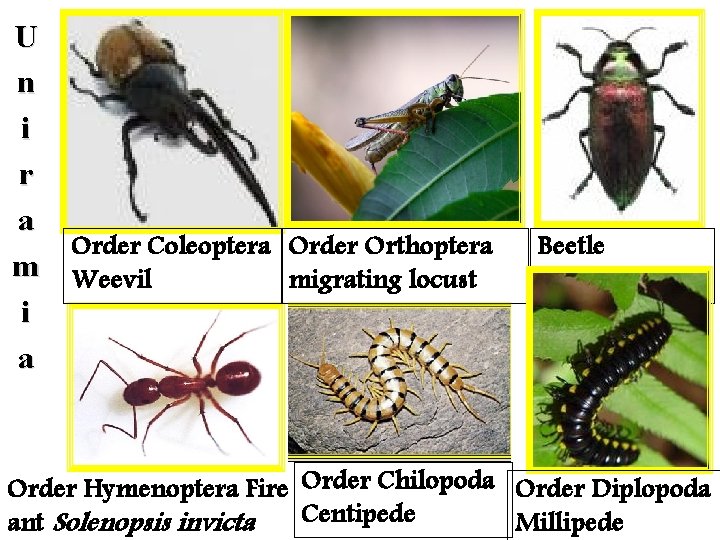
U n i r a Order Coleoptera Order Orthoptera m Weevil migrating locust i a Beetle Order Hymenoptera Fire Order Chilopoda Order Diplopoda Centipede ant Solenopsis invicta Millipede
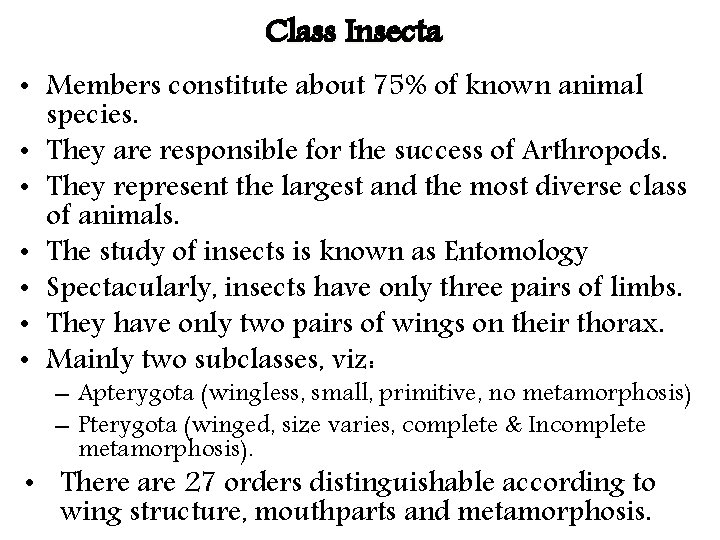
Class Insecta • Members constitute about 75% of known animal species. • They are responsible for the success of Arthropods. • They represent the largest and the most diverse class of animals. • The study of insects is known as Entomology • Spectacularly, insects have only three pairs of limbs. • They have only two pairs of wings on their thorax. • Mainly two subclasses, viz: – Apterygota (wingless, small, primitive, no metamorphosis) – Pterygota (winged, size varies, complete & Incomplete metamorphosis). • There are 27 orders distinguishable according to wing structure, mouthparts and metamorphosis.
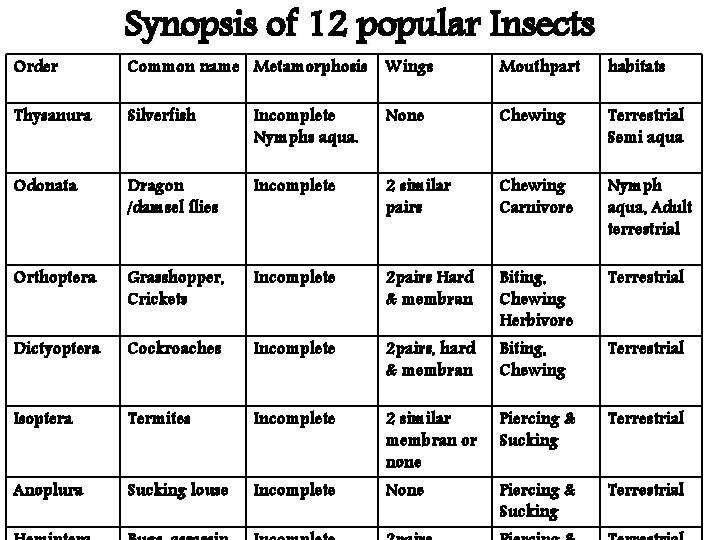
Order Synopsis of 12 popular Insects Common name Metamorphosis Wings Mouthpart habitats Thysanura Silverfish Incomplete Nymphs aqua. None Chewing Terrestrial Semi aqua Odonata Dragon /damsel flies Incomplete 2 similar pairs Chewing Carnivore Nymph aqua, Adult terrestrial Orthoptera Grasshopper, Crickets Incomplete 2 pairs Hard & membran Biting, Chewing Herbivore Terrestrial Dictyoptera Cockroaches Incomplete 2 pairs, hard & membran Biting, Chewing Terrestrial Isoptera Termites Incomplete 2 similar membran or none Piercing & Sucking Terrestrial Anoplura Sucking louse Incomplete None Piercing & Sucking Terrestrial
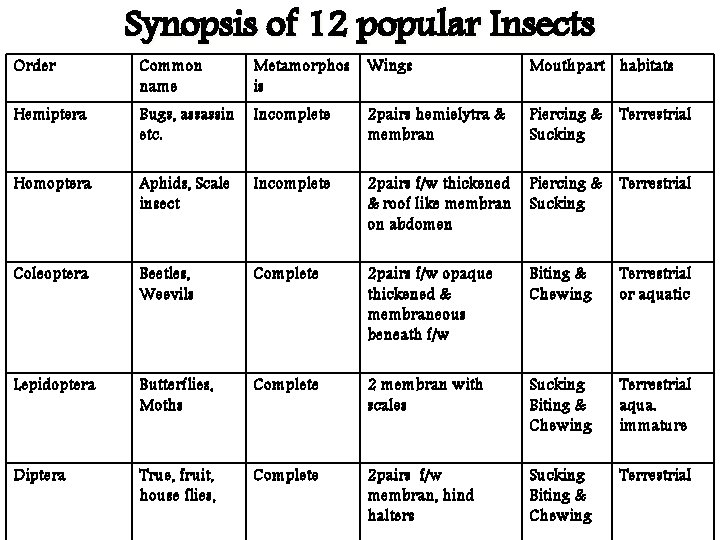
Order Synopsis of 12 popular Insects Common name Metamorphos is Wings Mouthpart habitats Hemiptera Bugs, assassin etc. Incomplete 2 pairs hemielytra & membran Piercing & Sucking Terrestrial Homoptera Aphids, Scale insect Incomplete 2 pairs f/w thickened & roof like membran on abdomen Piercing & Sucking Terrestrial Coleoptera Beetles, Weevils Complete 2 pairs f/w opaque thickened & membraneous beneath f/w Biting & Chewing Terrestrial or aquatic Lepidoptera Butterflies, Moths Complete 2 membran with scales Sucking Biting & Chewing Terrestrial aqua. immature Diptera True, fruit, house flies, Complete 2 pairs f/w membran, hind halters Sucking Biting & Chewing Terrestrial
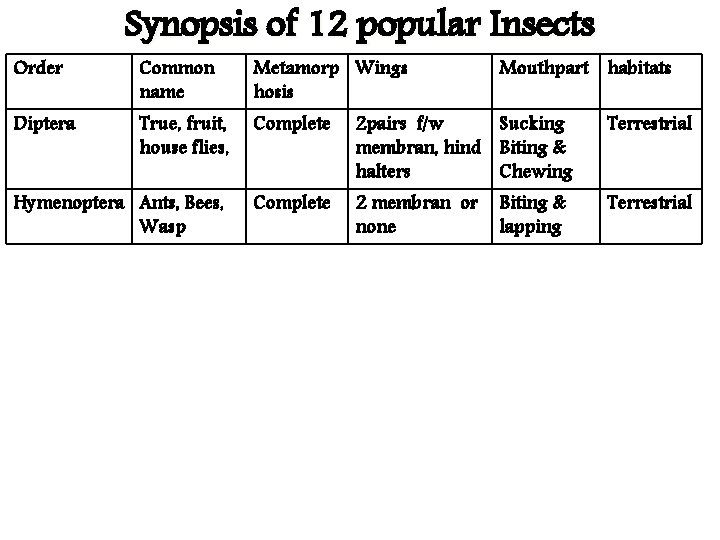
Order Synopsis of 12 popular Insects Common name Metamorp Wings hosis True, fruit, house flies, Complete 2 pairs f/w Sucking membran, hind Biting & halters Chewing Terrestrial Hymenoptera Ants, Bees, Wasp Complete 2 membran or none Terrestrial Diptera Mouthpart habitats Biting & lapping
Diversity • Insects that have piercing and sucking mouthparts are called BUGS while BEETLES are insects distinguished as those having forewings modified into hard wing cases that cover and protect the hind wings and abdomen!
LIFE CYCLES OF SOME INSECTS
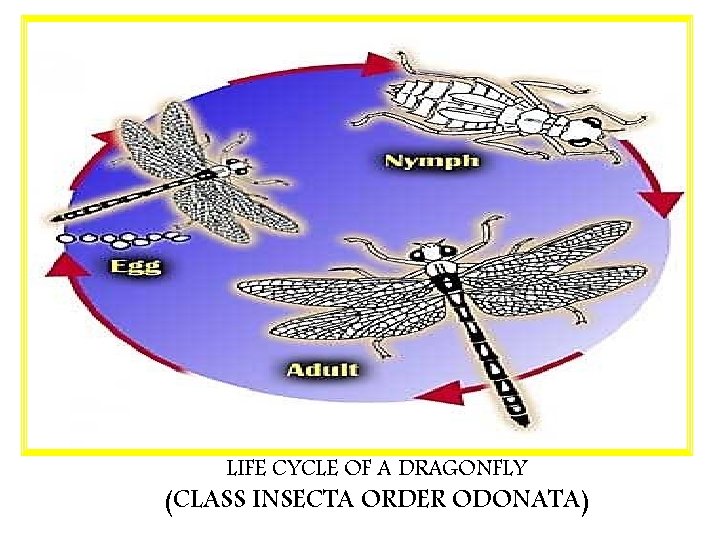
LIFE CYCLE OF A DRAGONFLY (CLASS INSECTA ORDER ODONATA)
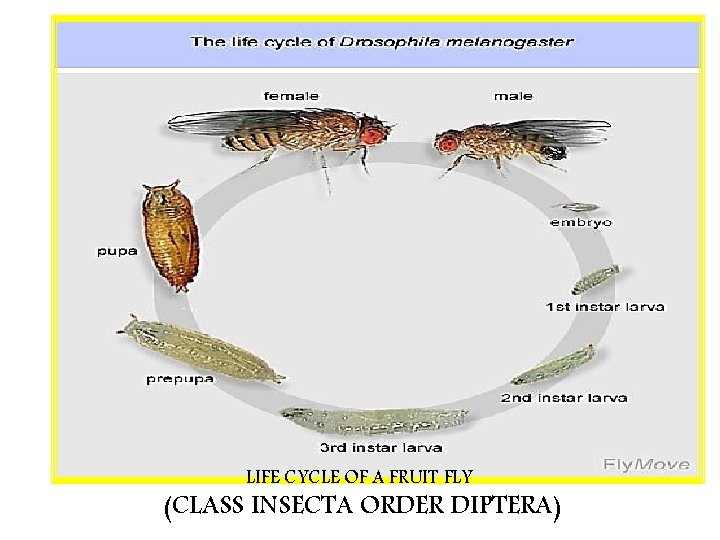
LIFE CYCLE OF A FRUIT FLY (CLASS INSECTA ORDER DIPTERA)
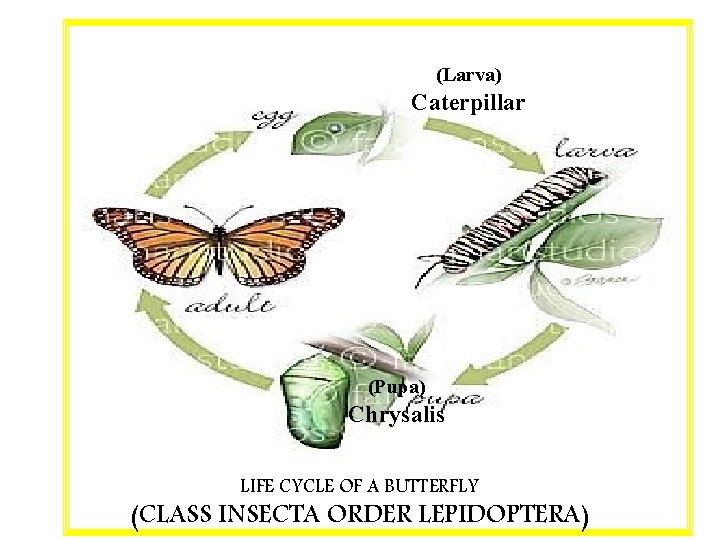
(Larva) Caterpillar (Pupa) Chrysalis LIFE CYCLE OF A BUTTERFLY (CLASS INSECTA ORDER LEPIDOPTERA)
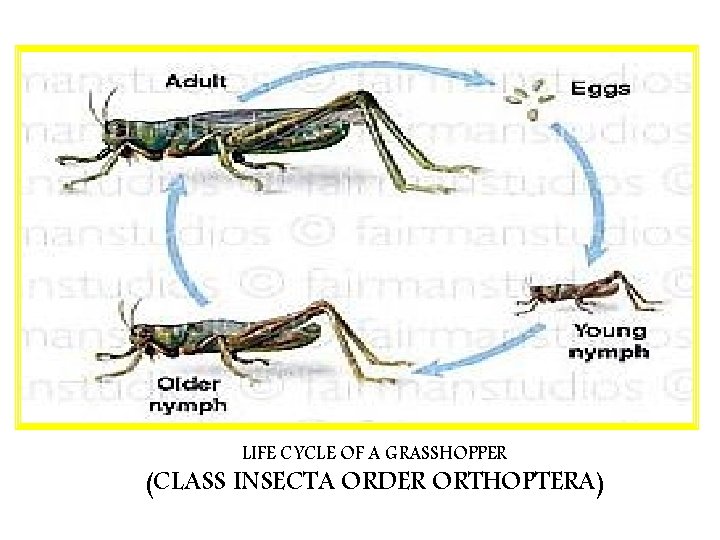
LIFE CYCLE OF A GRASSHOPPER (CLASS INSECTA ORDER ORTHOPTERA)
Economic importance • Serve as food source for both animals and humans • Aid in the propagation of plant species by means of cross-pollination • Control the population of some harmful organisms • Some act as scavengers or saprotrophs

End of Presentation Thanks for Listening
- Slides: 36