
Phylum Apicomplexa Characteristics of Apicomplexa Shape of cell
- Slides: 87
Phylum Apicomplexa
Characteristics of Apicomplexa • Shape of cell maintained by pellicle.
Characteristics of Apicomplexa • Shape of cell maintained by pellicle. • Locomotion characterized as gliding. Cilia absent, but some species produce flagellated or ameboid gamest.
Characteristics of Apicomplexa • Shape of cell maintained by pellicle. • Locomotion characterized as gliding. Cilia absent, but some species produce flagellated or ameboid gamest. • Asexual and sexual reproduction.
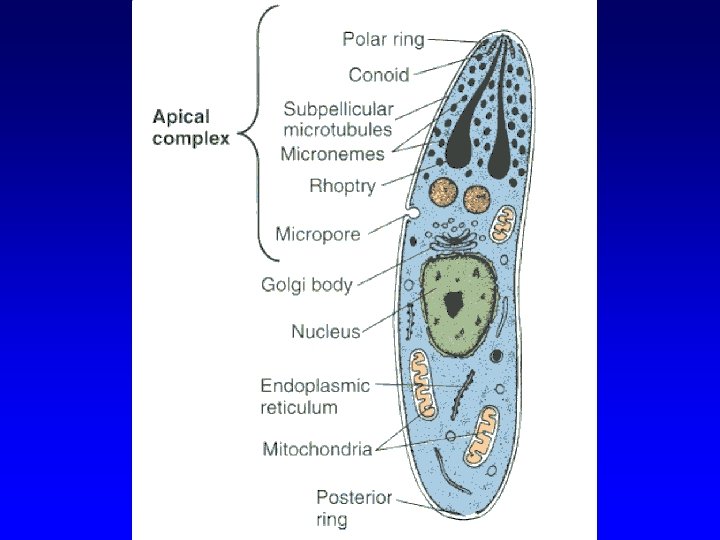
Characteristics of Apicomplexa • Shape of cell maintained by pellicle. • Locomotion characterized as gliding. Cilia absent, but some species produce flagellated or ameboid gamest. • Asexual and sexual reproduction. • Unique system of organelles, the apical complex in anterior region of cell.
Characteristics of Apicomplexa • Shape of cell maintained by pellicle. • Locomotion characterized as gliding. Cilia absent, but some species produce flagellated or ameboid gamest. • Asexual and sexual reproduction. • Unique system of organelles, the apical complex in anterior region of cell. • All intracellular parasites at some stage in the life cycle.
Classification • Perkinsasidea- parasites of oysters. • Conoidasida- gregarines and coccidians. • Aconoidasida- malaria parasites and piroplasms, usually blood parasites of vertebrates, with an arthropod host.
Protozoan Reproduction • Amoeba reproduce by binary fission essentially mitosis. • Other types of fission:
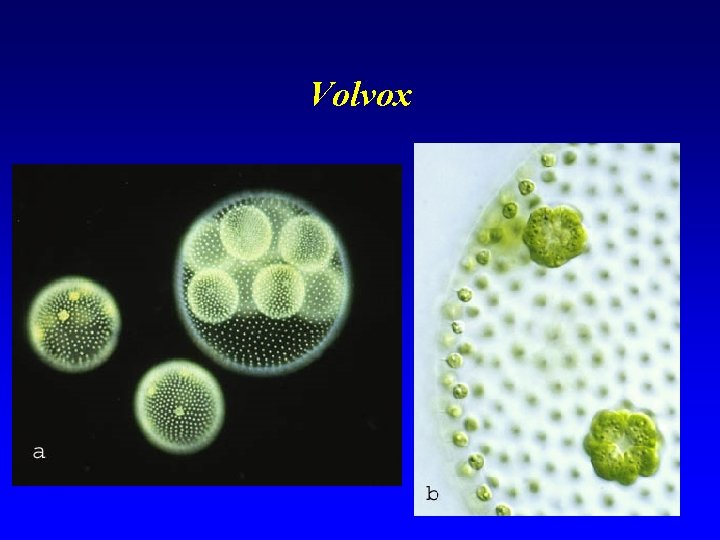
Protozoan Reproduction • Repeated fission: Process by which colonies are made; like binary fission except daughter cells don’t separate!
Volvox
Protozoan Reproduction • Multiple fission: nucleus divides (multinucleated) before cytoplasm; the cytoplasm divides secondly. – Schizogony: asexual process done by an organism that is itself asexual. – Sporogony: formed by a sexual process.
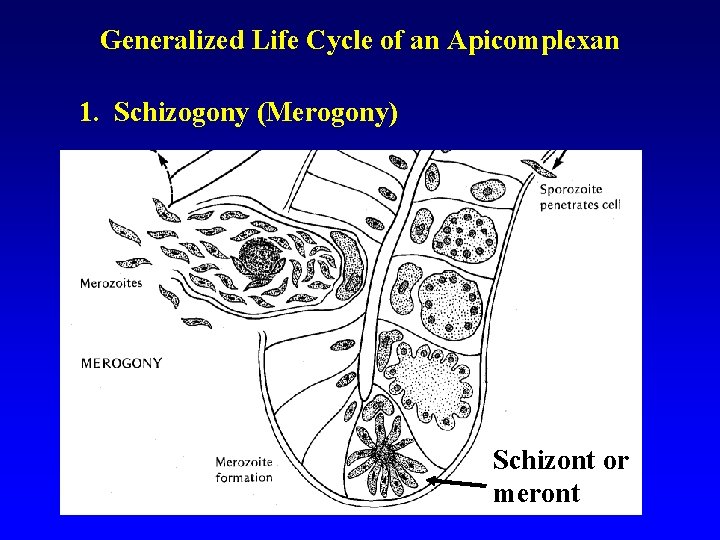
Generalized Life Cycle of an Apicomplexan 1. Schizogony (Merogony) Schizont or meront
Sexual Reproduction • Gamete: formed by sexual process (meiosis); sperm and egg. • Microgamete (sperm) and macrogamete (egg). • Gametes are made by a process called gametogenesis.
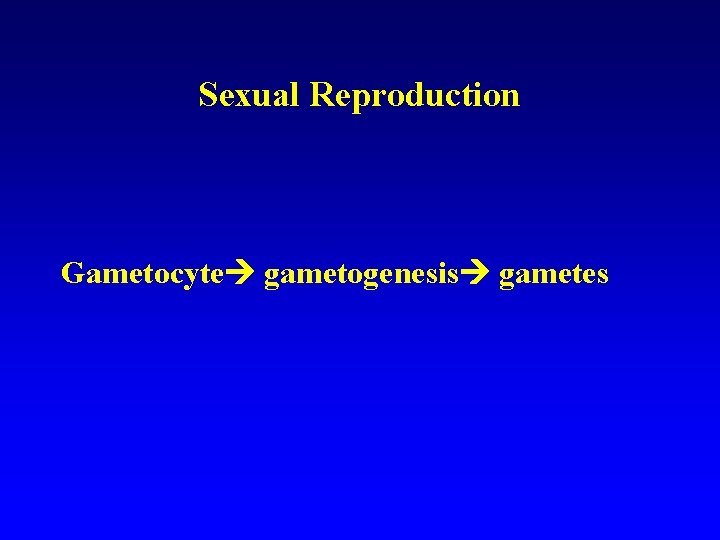
Sexual Reproduction Gametocyte gametogenesis gametes
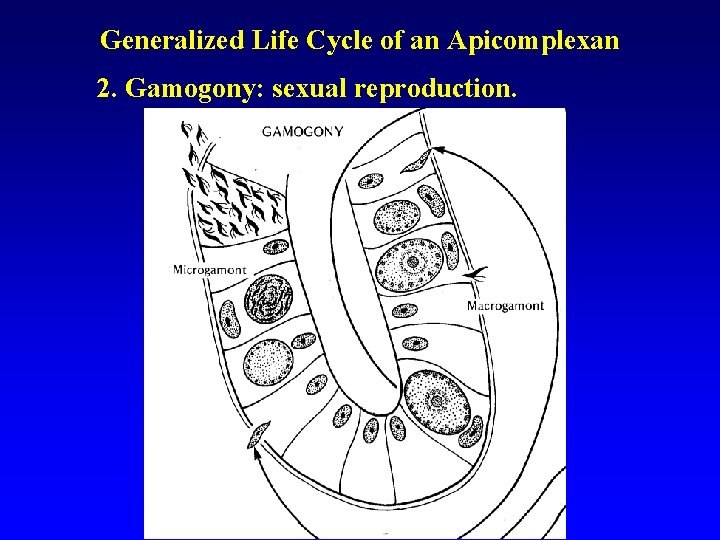
Generalized Life Cycle of an Apicomplexan 2. Gamogony: sexual reproduction.
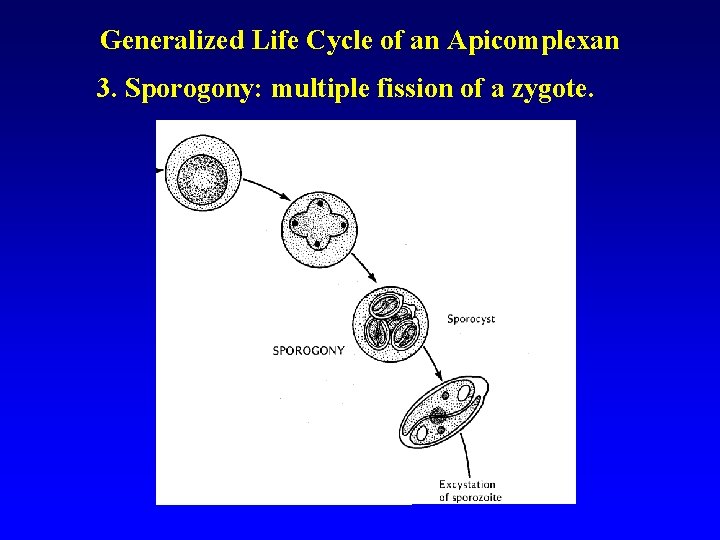
Generalized Life Cycle of an Apicomplexan 3. Sporogony: multiple fission of a zygote.
Malaria Disease has been known since antiquity - one of first reports described fevers in 1550 BC.
Malaria Disease has been known since antiquity - one of first reports described fevers in 1550 BC. Malaria was commonly found in swampy areas and was thought to be contracted by breathing in "bad air" (= mal aria) in the swamps.
Malaria Disease has been known since antiquity - one of first reports described fevers in 1550 BC. Malaria was commonly found in swampy areas and was thought to be contracted by breathing in "bad air" (= mal aria) in the swamps. • Much effort was directed towards finding a causative agent in the water or air of these swamps. • We now know that the mosquitoes that vectors the disease lived in these swamps.
Malaria (Plasmodium) Life Cycle • Has a two host life cycle. • Mosquitoes in the genus Anopheles are the vector hosts.
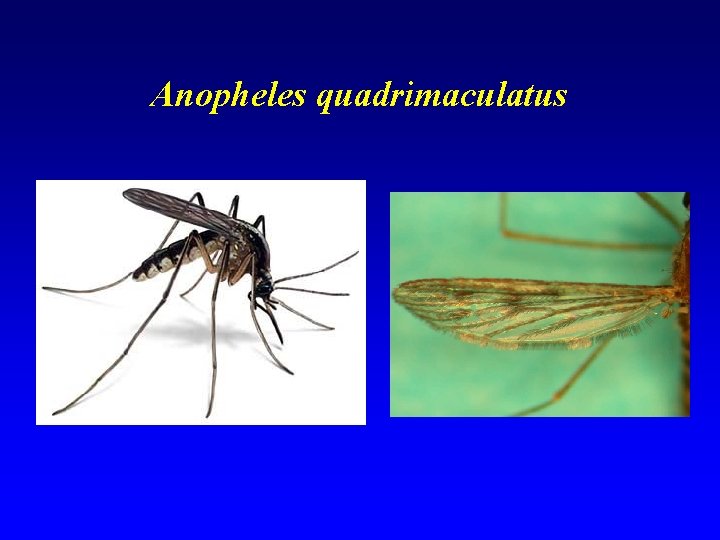
Anopheles quadrimaculatus
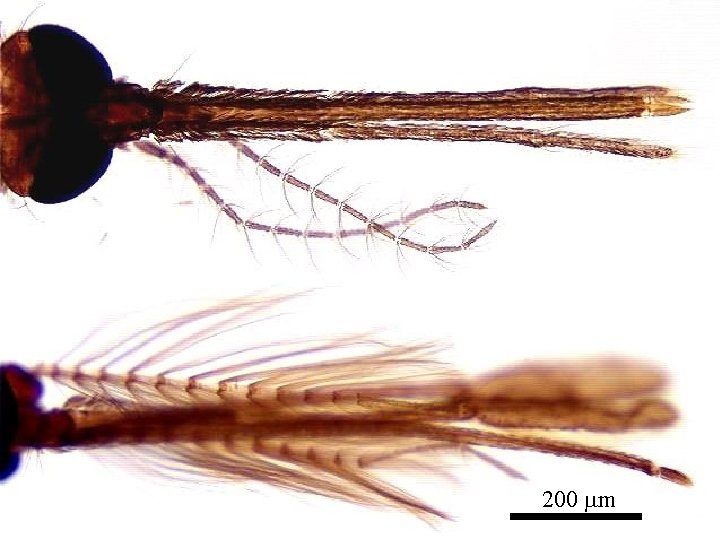
200 mm
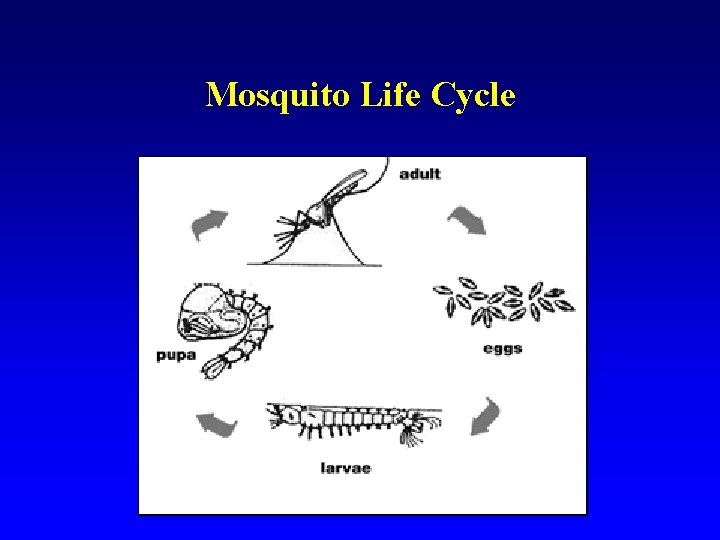
Mosquito Life Cycle
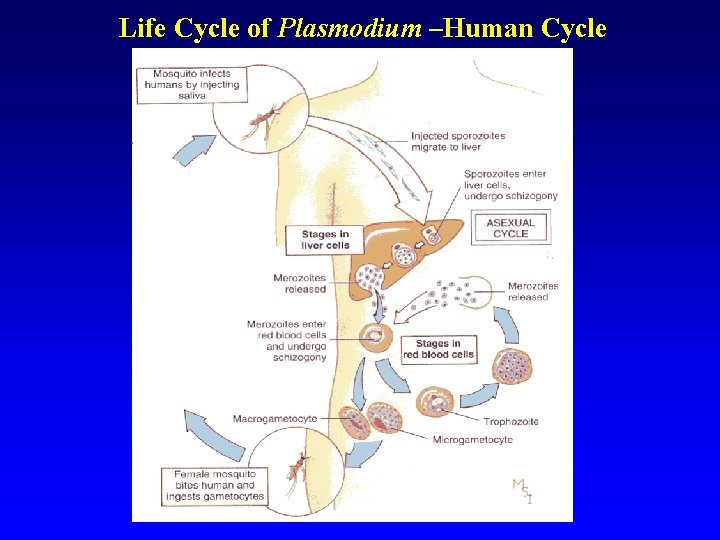
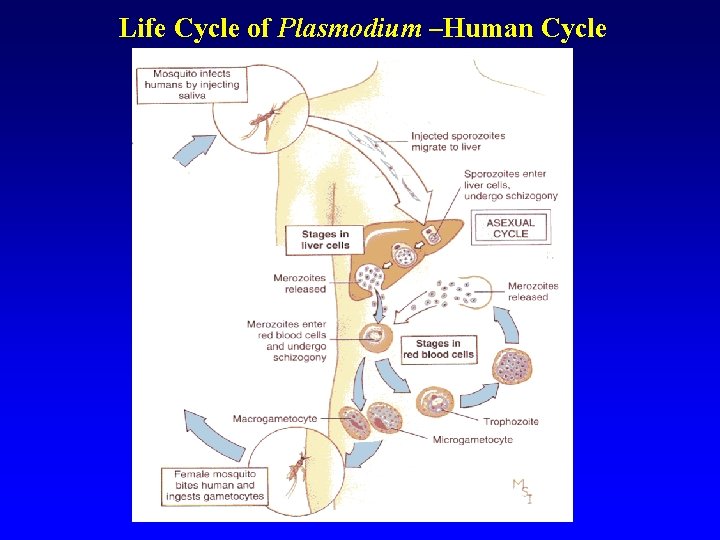
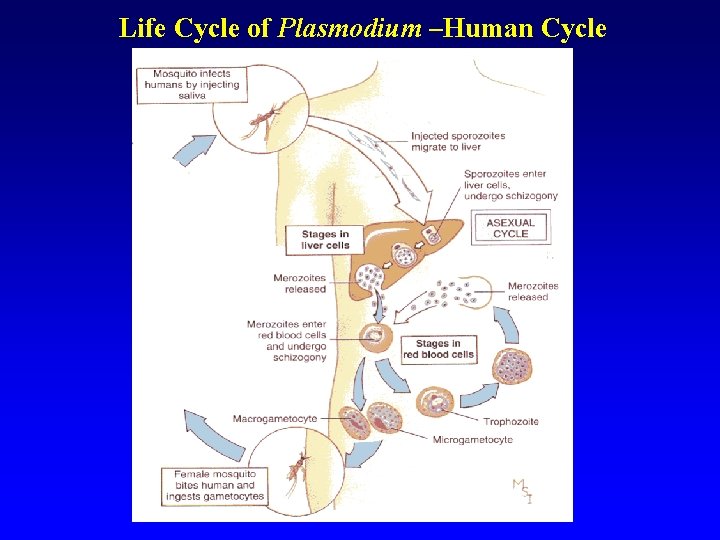
Life Cycle of Plasmodium –Human Cycle
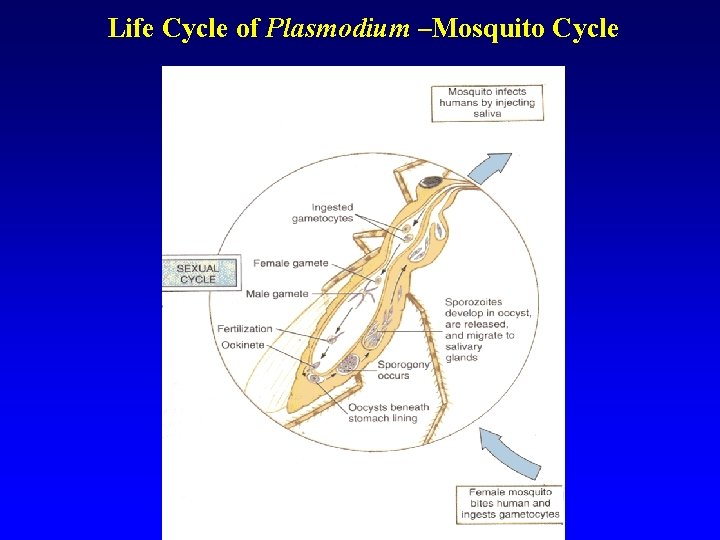
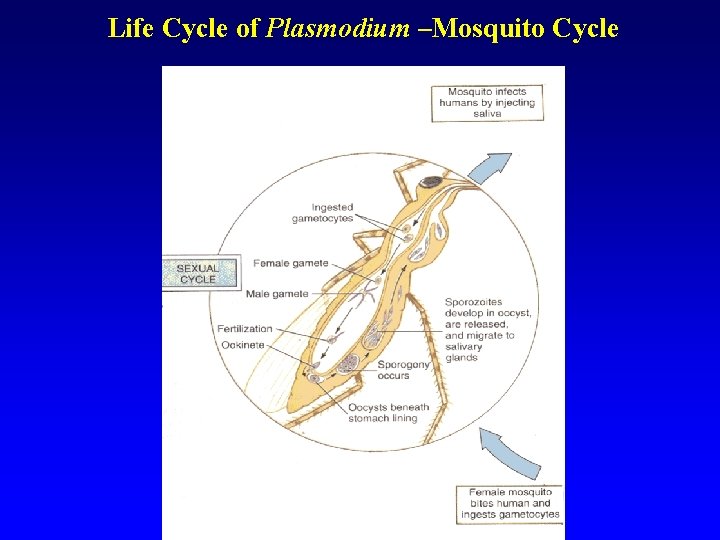
Life Cycle of Plasmodium –Mosquito Cycle
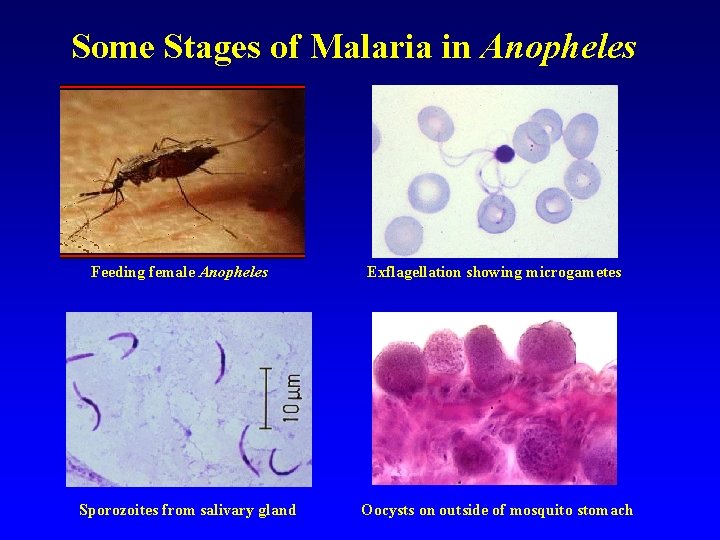
Some Stages of Malaria in Anopheles Feeding female Anopheles Sporozoites from salivary gland Exflagellation showing microgametes Oocysts on outside of mosquito stomach
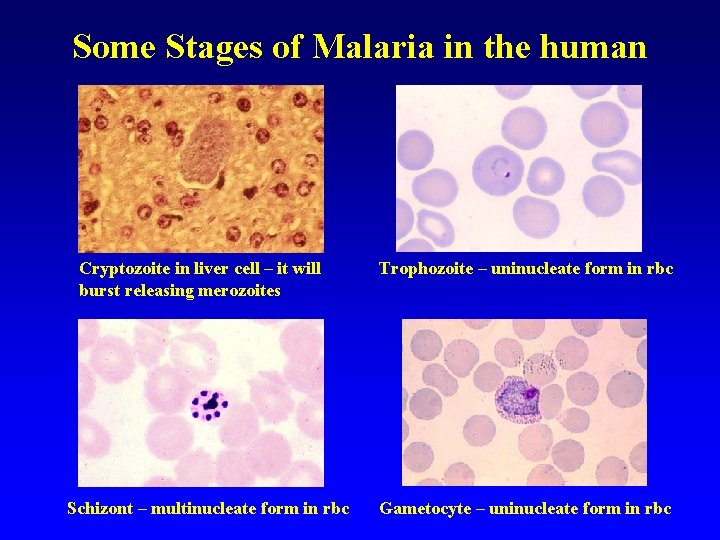
Some Stages of Malaria in the human Cryptozoite in liver cell – it will burst releasing merozoites Schizont – multinucleate form in rbc Trophozoite – uninucleate form in rbc Gametocyte – uninucleate form in rbc
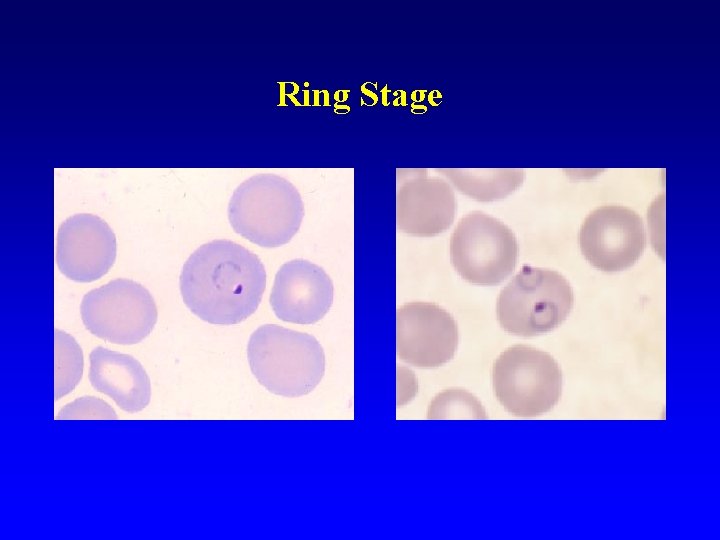
Ring Stage
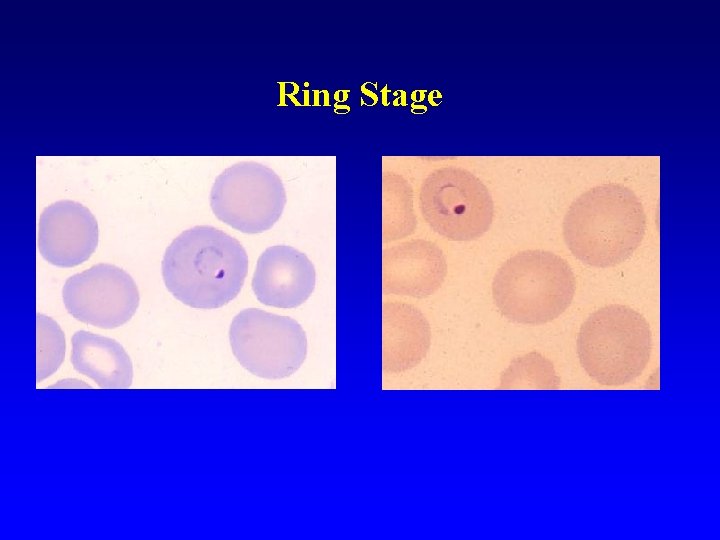
Ring Stage
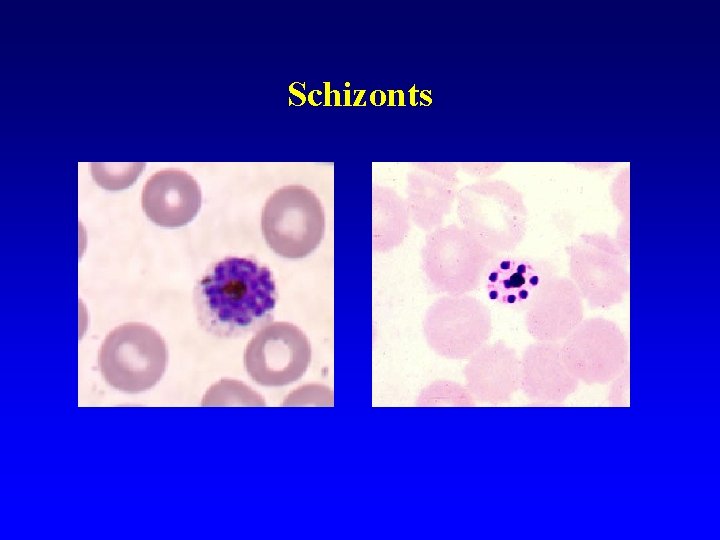
Schizonts
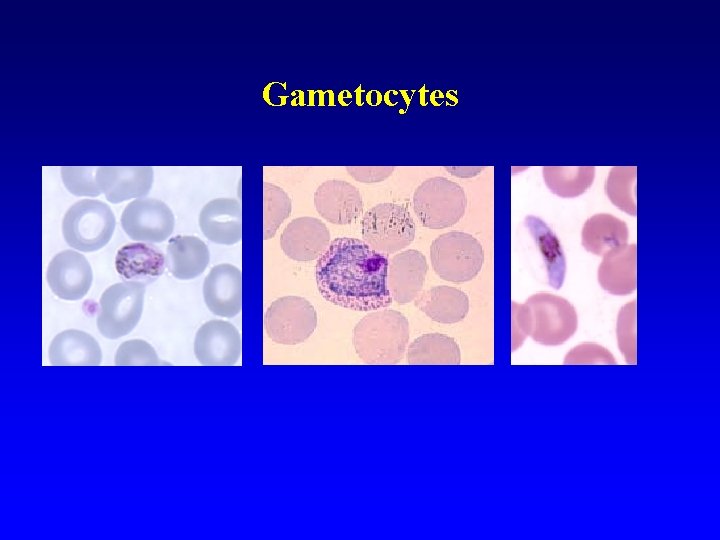
Gametocytes
Blood Apicomplexans • Plasmodium-cause malaria in people; occur in birds, lizards, mammals. • Have exoerythrocytic and erythrocytic schizogony.
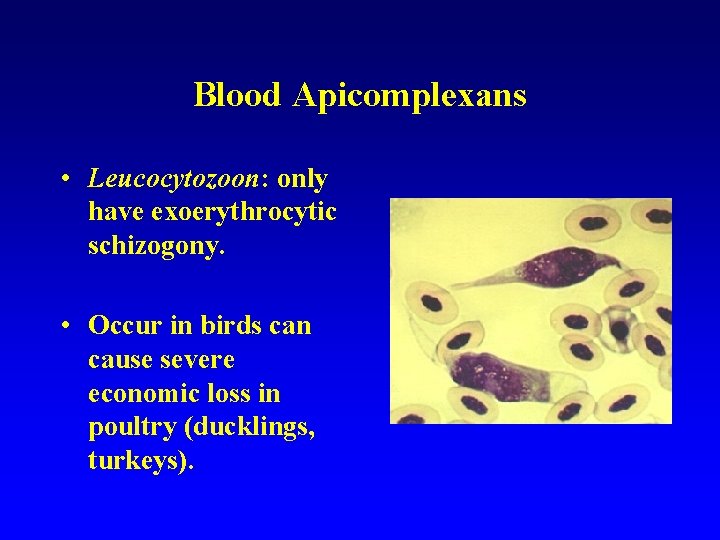
Blood Apicomplexans • Leucocytozoon: only have exoerythrocytic schizogony. • Occur in birds can cause severe economic loss in poultry (ducklings, turkeys).
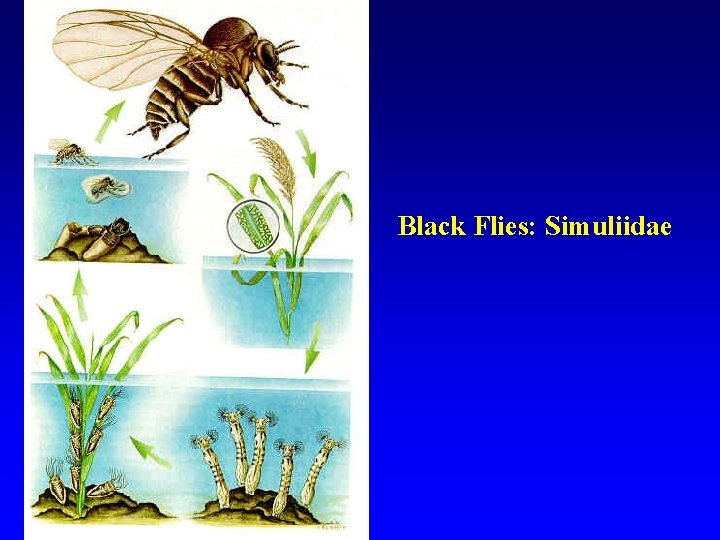
Black Flies: Simuliidae
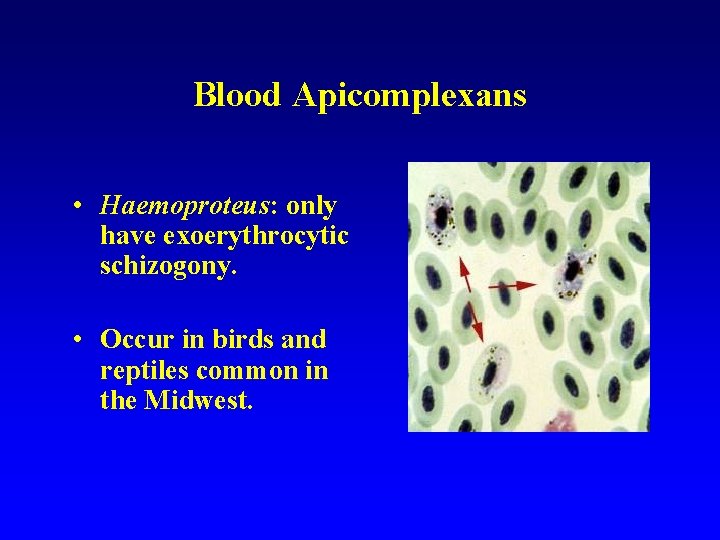
Blood Apicomplexans • Haemoproteus: only have exoerythrocytic schizogony. • Occur in birds and reptiles common in the Midwest.
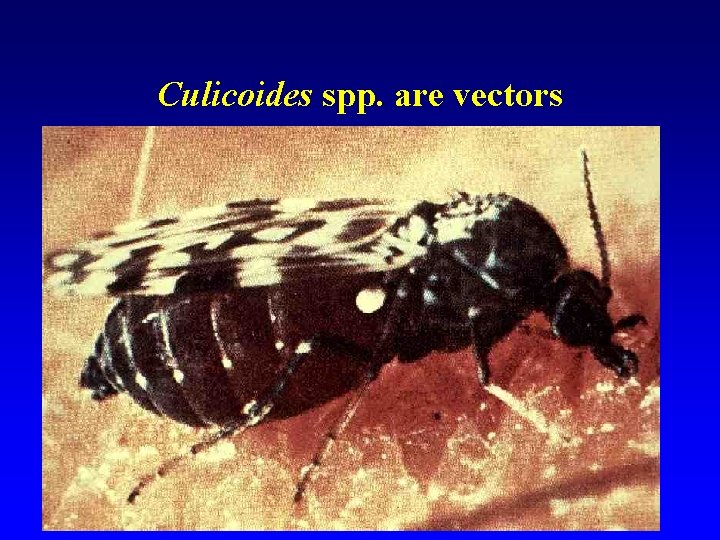
Culicoides spp. are vectors
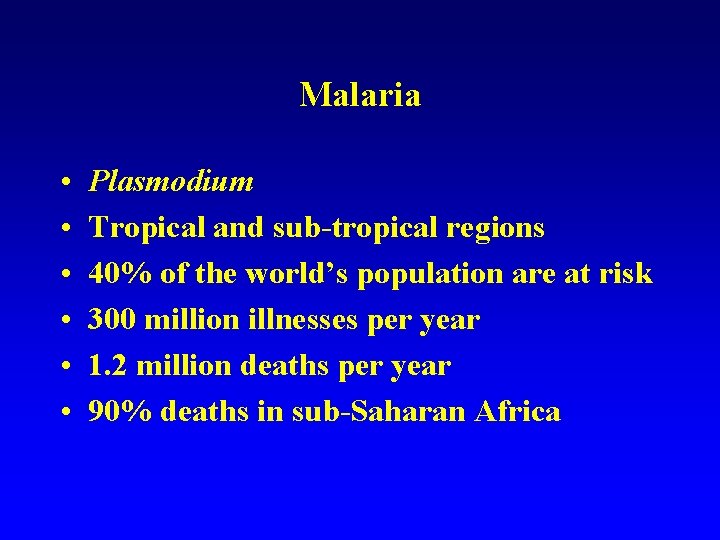
Malaria • • • Plasmodium Tropical and sub-tropical regions 40% of the world’s population are at risk 300 million illnesses per year 1. 2 million deaths per year 90% deaths in sub-Saharan Africa
Life Cycle of Plasmodium –Human Cycle
Life Cycle of Plasmodium –Mosquito Cycle
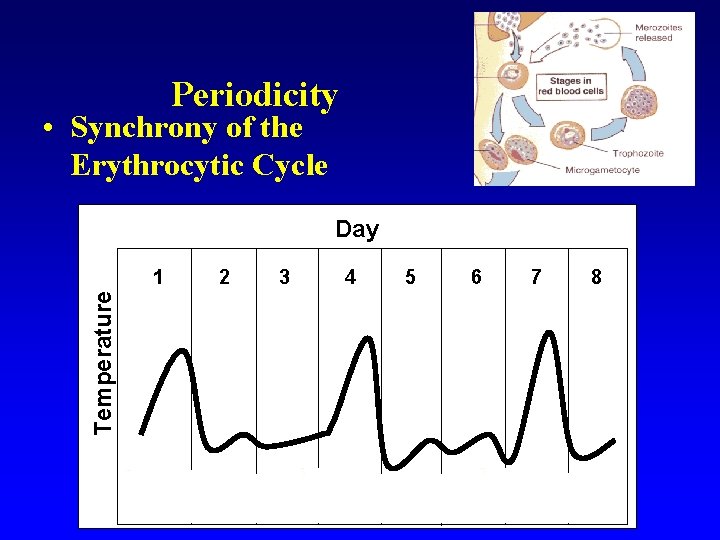
Period of Schizogony • Breaking of erythrocytes Paroxysm.
Period of Schizogony • Breaking of erythrocytes Paroxysm. • Tertian – 48 hr erythrocytes break; attacks every other day, P. vivax and P. ovale.
Period of Schizogony • Breaking of erythrocytes Paroxysm. • Tertian – 48 hr erythrocytes break; attacks every other day, P. vivax and P. ovale. • Quartan – 72 hr erythrocytes break; attacks three days, P. malariae.
Period of Schizogony • Breaking of erythrocytes Paroxysm. • Tertian – 48 hr erythrocytes break; attacks every other day, P. vivax and P. ovale. • Quartan – 72 hr erythrocytes break; attacks three days, P. malariae. • P. falciparum- attacks not as predictable 36 -48 hr.
Malaria • We usually think of malaria as a tropical disease, but it can occur in temperate zones. • There have been cases of malaria above the arctic circle.
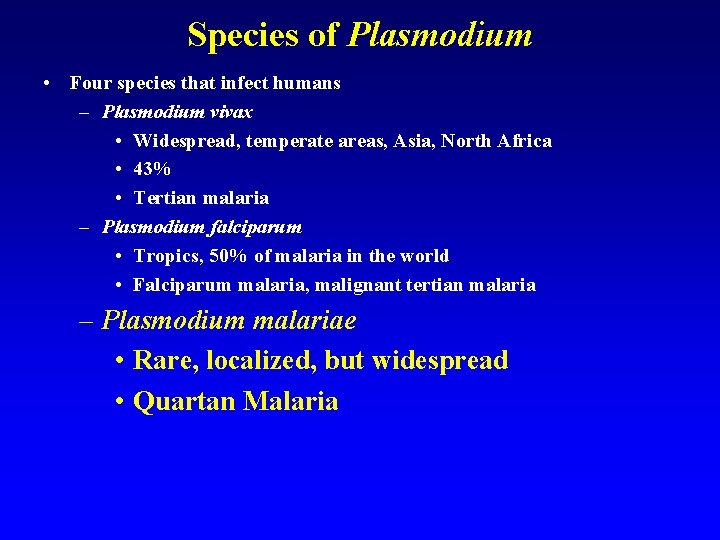
Species of Plasmodium • Four species that infect humans
Species of Plasmodium • Four species that infect humans – Plasmodium vivax • Widespread, temperate areas, Asia, North Africa • 43% • Tertian malaria
Species of Plasmodium • Four species that infect humans – Plasmodium vivax • Widespread, temperate areas, Asia, North Africa • 43% • Tertian malaria – Plasmodium falciparum • Tropics, 50% of malaria in the world • Falciparum malaria, malignant tertian malaria
Species of Plasmodium • Four species that infect humans – Plasmodium vivax • Widespread, temperate areas, Asia, North Africa • 43% • Tertian malaria – Plasmodium falciparum • Tropics, 50% of malaria in the world • Falciparum malaria, malignant tertian malaria – Plasmodium malariae • Rare, localized, but widespread • Quartan Malaria
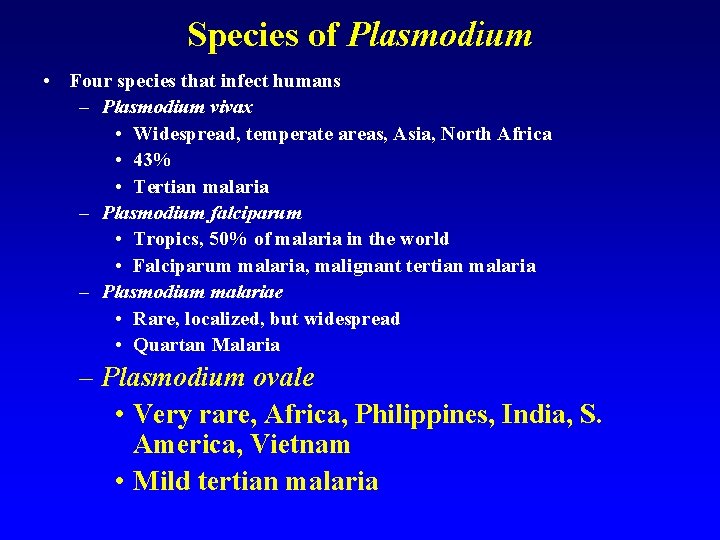
Species of Plasmodium • Four species that infect humans – Plasmodium vivax • Widespread, temperate areas, Asia, North Africa • 43% • Tertian malaria – Plasmodium falciparum • Tropics, 50% of malaria in the world • Falciparum malaria, malignant tertian malaria – Plasmodium malariae • Rare, localized, but widespread • Quartan Malaria – Plasmodium ovale • Very rare, Africa, Philippines, India, S. America, Vietnam • Mild tertian malaria
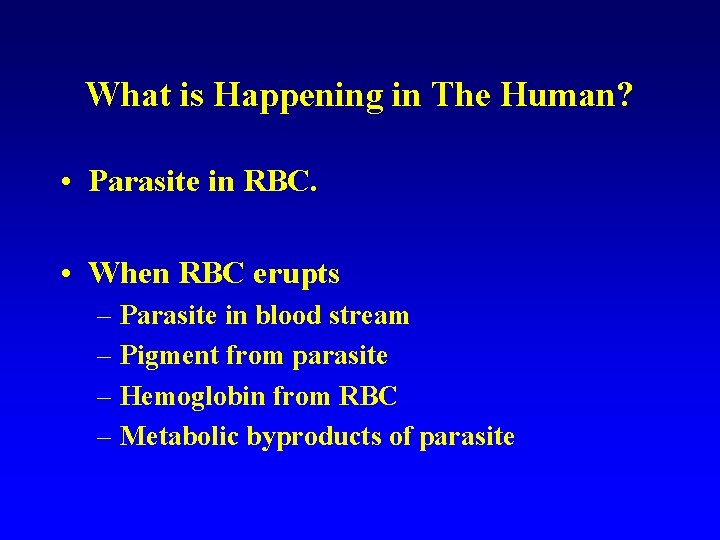
What is Happening in The Human? • Parasite in RBC. • When RBC erupts – Parasite in blood stream – Pigment from parasite – Hemoglobin from RBC – Metabolic byproducts of parasite
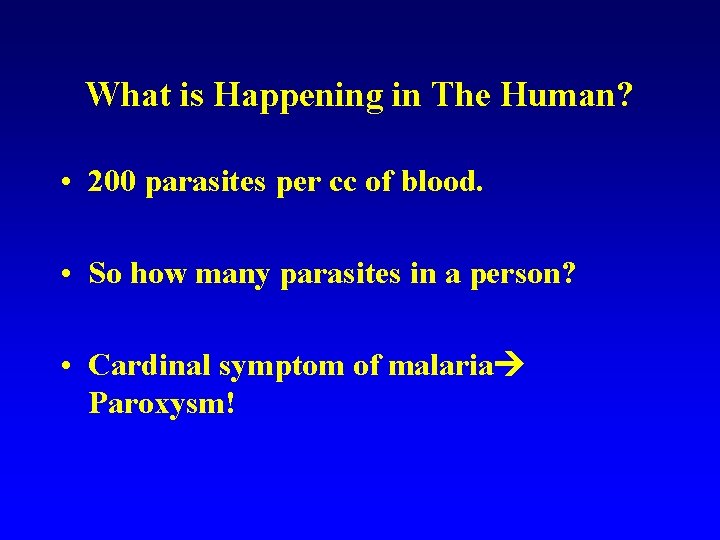
What is Happening in The Human? • 200 parasites per cc of blood. • So how many parasites in a person? • Cardinal symptom of malaria Paroxysm!
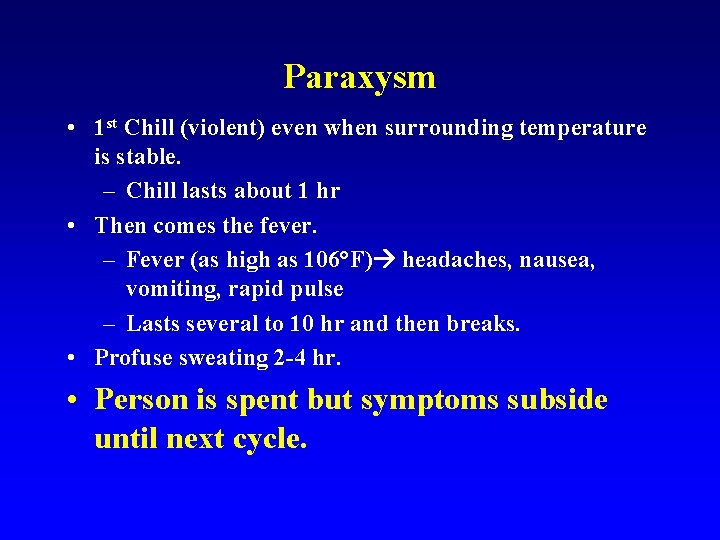
Paraxysm • 1 st Chill (violent) even when surrounding temperature is stable. – Chill lasts about 1 hr
Paraxysm • 1 st Chill (violent) even when surrounding temperature is stable. – Chill lasts about 1 hr • Then comes the fever. – Fever (as high as 106°F) headaches, nausea, vomiting, rapid pulse – Lasts several to 10 hr and then breaks.
Paraxysm • 1 st Chill (violent) even when surrounding temperature is stable. – Chill lasts about 1 hr • Then comes the fever. – Fever (as high as 106°F) headaches, nausea, vomiting, rapid pulse – Lasts several to 10 hr and then breaks. • Profuse sweating 2 -4 hr.
Paraxysm • 1 st Chill (violent) even when surrounding temperature is stable. – Chill lasts about 1 hr • Then comes the fever. – Fever (as high as 106°F) headaches, nausea, vomiting, rapid pulse – Lasts several to 10 hr and then breaks. • Profuse sweating 2 -4 hr. • Person is spent but symptoms subside until next cycle.
Periodicity • Synchrony of the Erythrocytic Cycle Day Temperature 1 2 3 4 5 6 7 8
Symptoms • After three weeks primary attacks stop! • Why?
Life Cycle of Plasmodium –Human Cycle
Malaria Relapse • Relapse occurs after primary attack.
Malaria Relapse • Relapse occurs after primary attack. • True relapse persistent exoerythrocytic schizogony produces merozoites that infect RBC’s that then produce more merozoites.
Malaria Relapse • Relapse occurs after primary attack. • True relapse persistent exoerythrocytic schizogony produces merozoites that infect RBC’s that then produce more merozoites. • Only occurs in P. vivax and P. ovale. Why is this important?
Mechanisms for Malaria Relapse • When sporozoites are inoculated, not all genetically identical.
Mechanisms for Malaria Relapse • When sporozoites are inoculated, not all genetically identical. • When they infect liver cells some turn into schizonts but others turn into dormant stages known as hypnozoites.
Mechanisms for Malaria Relapse • When sporozoites are inoculated, not all genetically identical. • When they infect liver cells some turn into schizonts but others turn into dormant stages known as hypnozoites. • Can be dormant for up to 3 years!
Reoccurrence of P. malariae • After primary attack there a small number of organisms that remain in the blood stream but don’t turn into gametocytes! • Reoccurrence (Recrudescence) has been known to happen 50 yrs after the primary attack!
P. falciparum • No relapse! • Survival of primary attack reconstitutes a cure! • There have been a few cases of reoccurrences; same mechanism as P. malariae but will not last for 50 yrs.
Pathology
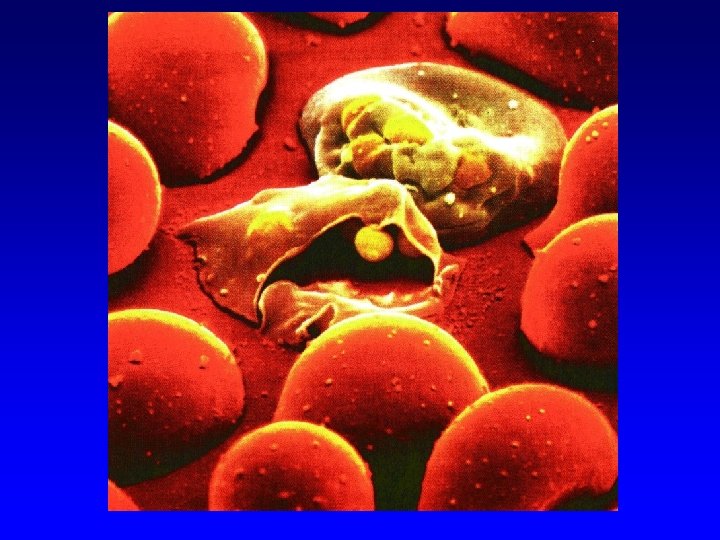
Pathology • Destruction of RBC’s.
Pathology • Destruction of RBC’s. – Loss of Oxygen to tissues and cells
Pathology • Destruction of RBC’s. – Loss of Oxygen to tissues and cells • Accumulation of iron pigment in liver, spleen, or brain.
Pathology • Destruction of RBC’s. – Loss of Oxygen to tissues and cells • Accumulation of iron pigment in liver, spleen, or brain. – When RBC’s burst they release cell debris, hemoglobin and metabolites of parasite
Pathology • Destruction of RBC’s. – Loss of Oxygen to tissues and cells • Accumulation of iron pigment in liver, spleen, or brain. – When RBC’s burst they release cell debris, hemoglobin and metabolites of parasite – Iron pigment can disrupt functions of cells and tissues
Pathology • Destruction of RBC’s. – Loss of Oxygen to tissues and cells • Accumulation of iron pigment in liver, spleen, or brain. – When RBC’s burst they release cell debris, hemoglobin and metabolites of parasite – Iron pigment can disrupt functions of cells and tissues – Sometimes iron pigment will collect under skin cause jaundice
Pathology • Destruction of RBC’s. – Loss of Oxygen to tissues and cells • Accumulation of iron pigment in liver, spleen, or brain. – When RBC’s burst they release cell debris, hemoglobin and metabolites of parasite – Iron pigment can disrupt functions of cells and tissues – Sometimes iron pigment will collect under skin cause jaundice – Pigment can collect in kidneys, causing them to shut down
Pathogenesis • 2 Major aspects during the erythrocytic cycle. – Host Inflammatory response – Anemia
Most Severe P. falciparum • More cells infected (about 60%). • Infected cells clump more. • Cause clogging of capillaries and hemorrhaging.
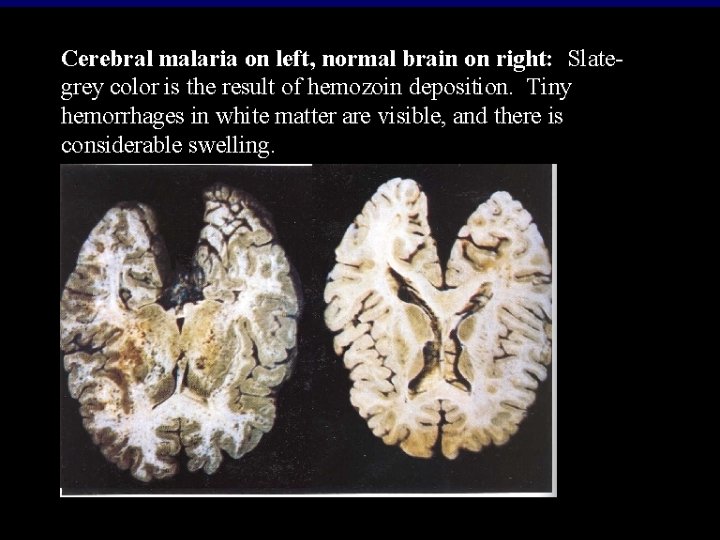
Clinical Conditions associated with Plasmodium falciparum • Complications – Cerebral Malaria • Headache, Coma • High temp (>108 F) • Psychotic symptoms • Hypoxia
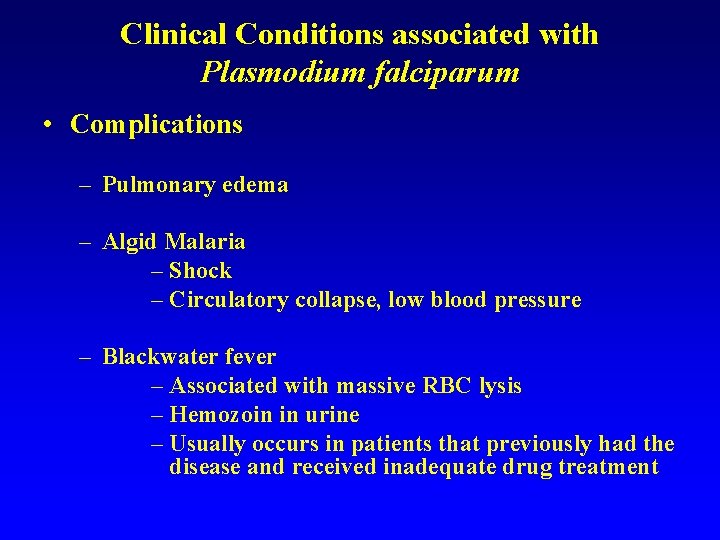
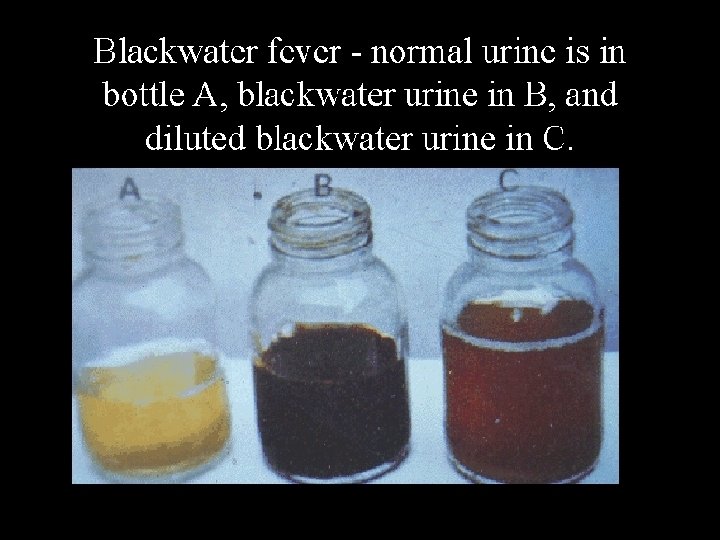
Clinical Conditions associated with Plasmodium falciparum • Complications – Pulmonary edema – Algid Malaria – Shock – Circulatory collapse, low blood pressure – Blackwater fever – Associated with massive RBC lysis – Hemozoin in urine – Usually occurs in patients that previously had the disease and received inadequate drug treatment
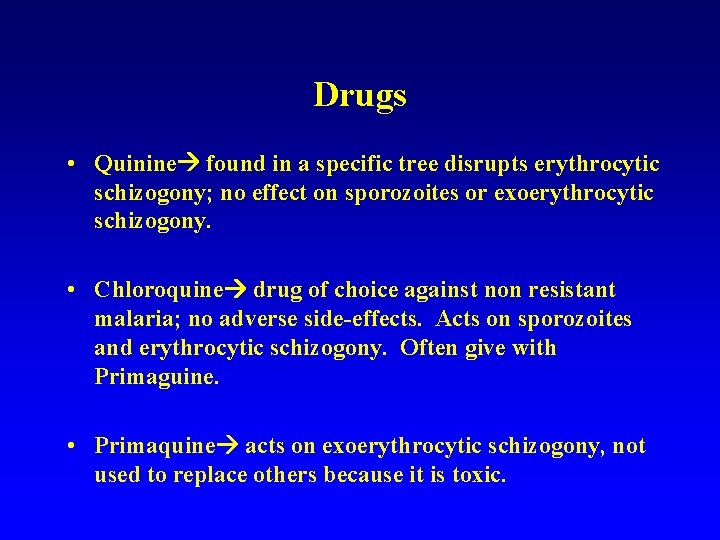
Drugs • Quinine found in a specific tree disrupts erythrocytic schizogony; no effect on sporozoites or exoerythrocytic schizogony. • Chloroquine drug of choice against non resistant malaria; no adverse side-effects. Acts on sporozoites and erythrocytic schizogony. Often give with Primaguine. • Primaquine acts on exoerythrocytic schizogony, not used to replace others because it is toxic.
Drugs • Mefloquine (Larium) widely used; used for chloroquine resistant strains of P. falciparum; acts on sporozoites; schizonts; exo-erythrocytic schizonts and gametocytes, but people don’t react to it very well lots of side effects!
Immunity to Plasmodium • If you recover, somewhat protected against reinfections. • Subsequent infections won’t produce as many symptoms. • Antibodies and their response (acquired immunity).
Side Effects of Malaria • • • Malnutrition Shutting down of organs Stunts growth of children Affects growth of children Ancient disease Endemic that can turn to epidemics