
Phylogenetic Tree Generation Brandon Andrews CS 6030 Topics
Phylogenetic Tree Generation Brandon Andrews CS 6030
Topics �What is a phylogenetic tree? �Goals in a phylogenetic tree generator �Distance based method �Fitch-Margoliash Method • Example �Verification �Demo
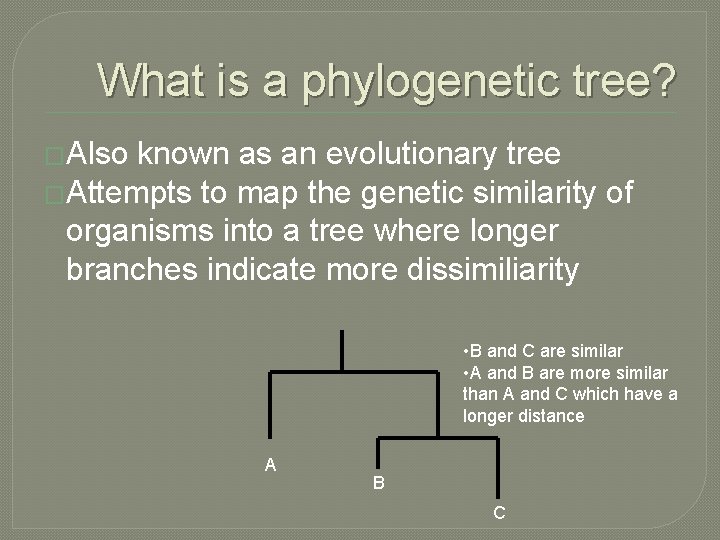
What is a phylogenetic tree? �Also known as an evolutionary tree �Attempts to map the genetic similarity of organisms into a tree where longer branches indicate more dissimiliarity • B and C are similar • A and B are more similar than A and C which have a longer distance A B C
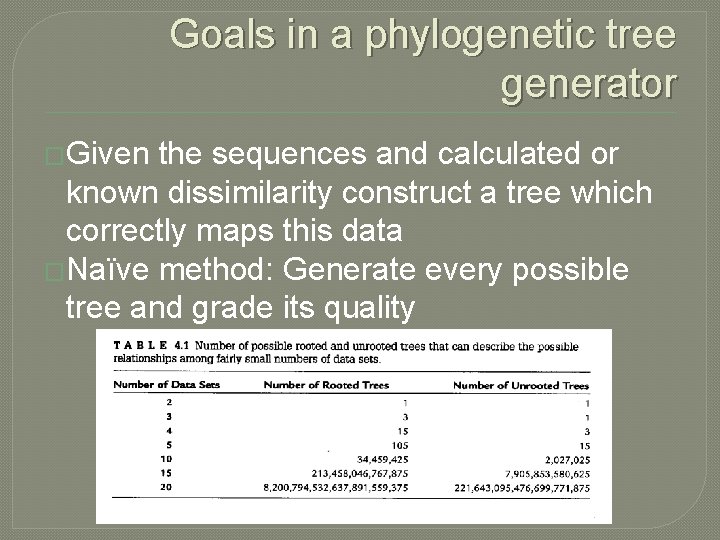
Goals in a phylogenetic tree generator �Given the sequences and calculated or known dissimilarity construct a tree which correctly maps this data �Naïve method: Generate every possible tree and grade its quality

Distance based method �Take a distance matrix that stores the distance from every sequence to every other sequence �Construct a tree which preserves these distances • Most don’t 100% preserve the distances
Fitch-Margoliash Method �Clustering algorithm that works bottom up to create an unrooted tree �Weights are used to help lower the error rate for long paths
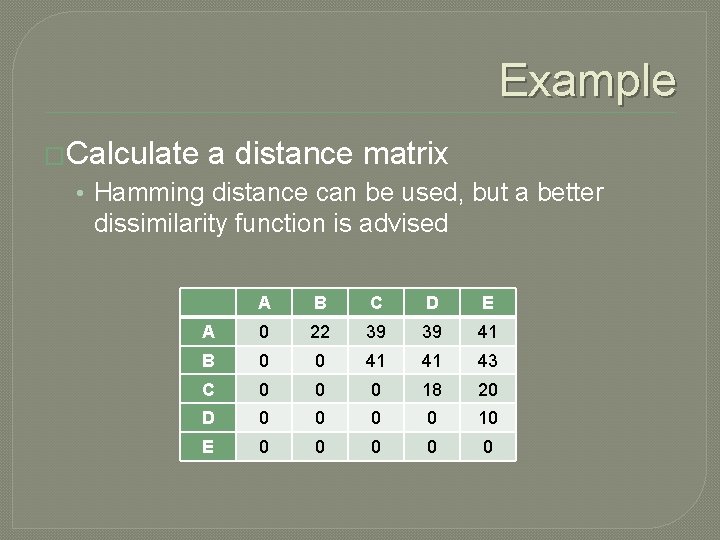
Example �Calculate a distance matrix • Hamming distance can be used, but a better dissimilarity function is advised A B C D E A 0 22 39 39 41 B 0 0 41 41 43 C 0 0 0 18 20 D 0 0 10 E 0 0 0
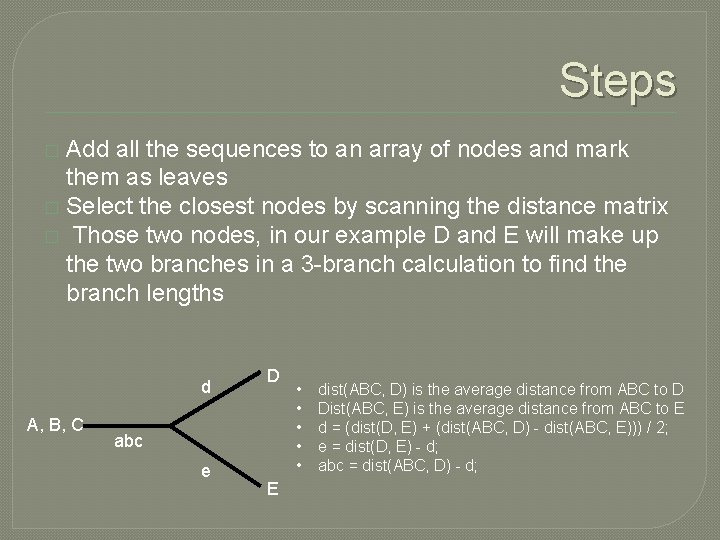
Steps Add all the sequences to an array of nodes and mark them as leaves � Select the closest nodes by scanning the distance matrix � Those two nodes, in our example D and E will make up the two branches in a 3 -branch calculation to find the branch lengths � d A, B, C D abc e E • • • dist(ABC, D) is the average distance from ABC to D Dist(ABC, E) is the average distance from ABC to E d = (dist(D, E) + (dist(ABC, D) - dist(ABC, E))) / 2; e = dist(D, E) - d; abc = dist(ABC, D) - d;
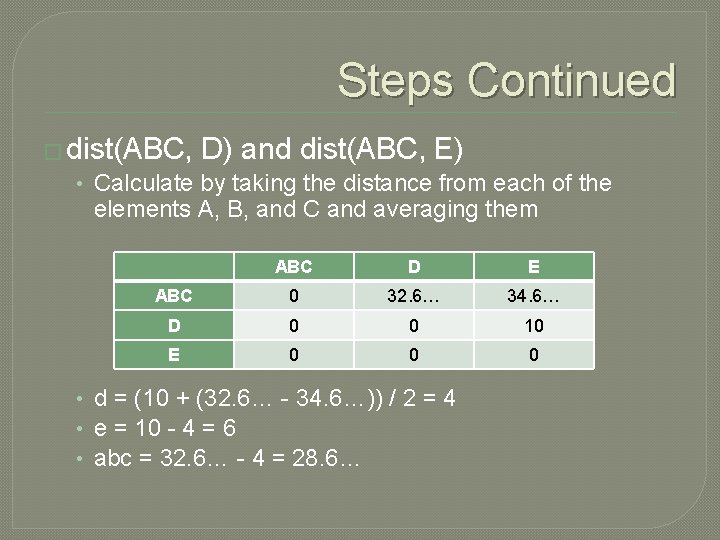
Steps Continued � dist(ABC, D) and dist(ABC, E) • Calculate by taking the distance from each of the elements A, B, and C and averaging them ABC D E ABC 0 32. 6… 34. 6… D 0 0 10 E 0 0 0 • d = (10 + (32. 6… - 34. 6…)) / 2 = 4 • e = 10 - 4 = 6 • abc = 32. 6… - 4 = 28. 6…
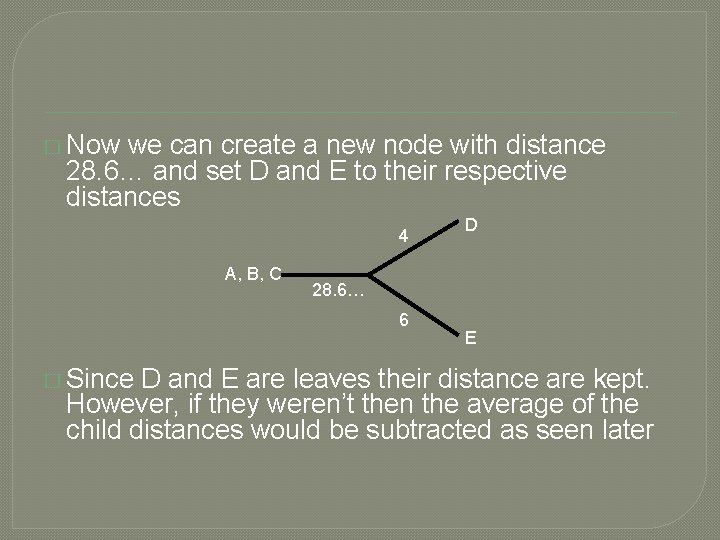
� Now we can create a new node with distance 28. 6… and set D and E to their respective distances 4 A, B, C 28. 6… 6 � Since D E D and E are leaves their distance are kept. However, if they weren’t then the average of the child distances would be subtracted as seen later
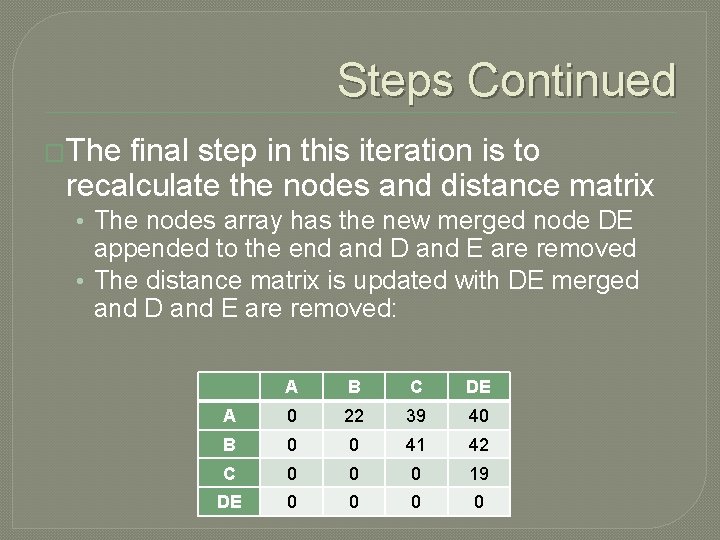
Steps Continued �The final step in this iteration is to recalculate the nodes and distance matrix • The nodes array has the new merged node DE appended to the end and D and E are removed • The distance matrix is updated with DE merged and D and E are removed: A B C DE A 0 22 39 40 B 0 0 41 42 C 0 0 0 19 DE 0 0
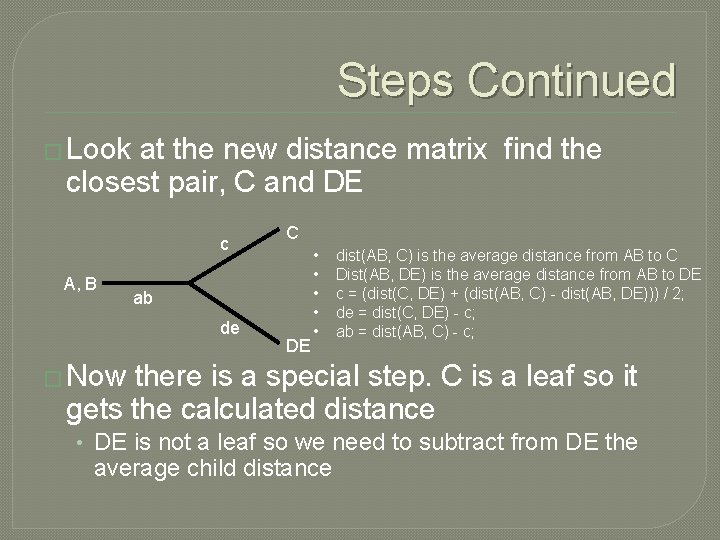
Steps Continued � Look at the new distance matrix find the closest pair, C and DE c A, B C ab de DE • • • dist(AB, C) is the average distance from AB to C Dist(AB, DE) is the average distance from AB to DE c = (dist(C, DE) + (dist(AB, C) - dist(AB, DE))) / 2; de = dist(C, DE) - c; ab = dist(AB, C) - c; � Now there is a special step. C is a leaf so it gets the calculated distance • DE is not a leaf so we need to subtract from DE the average child distance
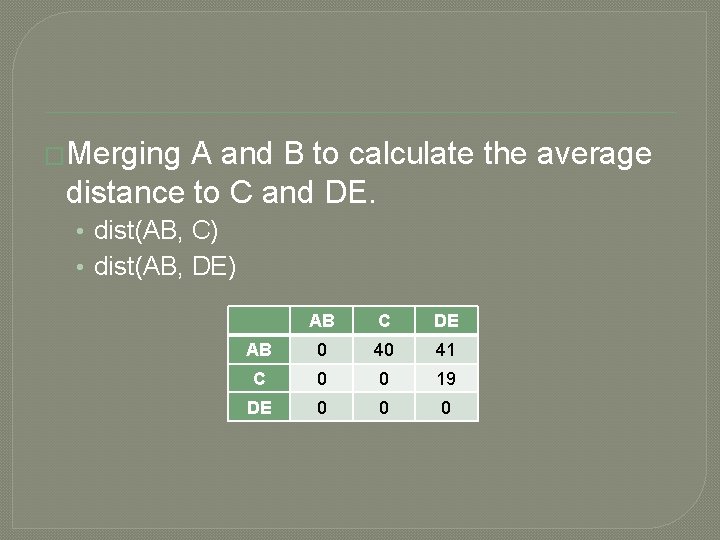
�Merging A and B to calculate the average distance to C and DE. • dist(AB, C) • dist(AB, DE) AB C DE AB 0 40 41 C 0 0 19 DE 0 0 0
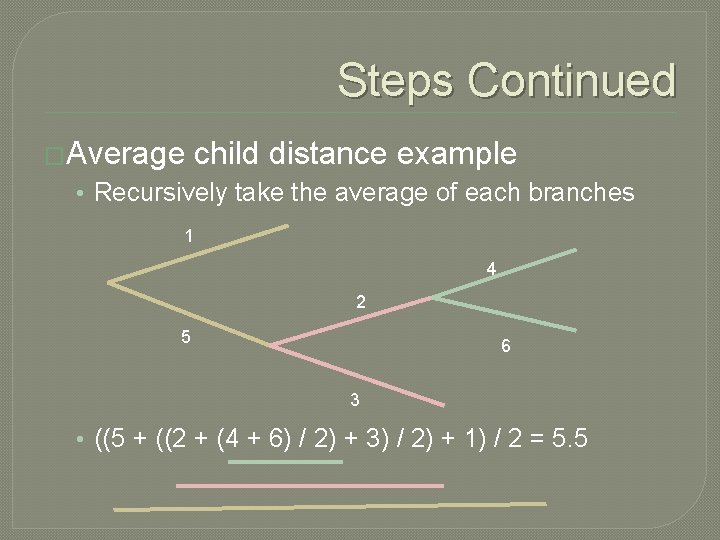
Steps Continued �Average child distance example • Recursively take the average of each branches 1 4 2 5 6 3 • ((5 + ((2 + (4 + 6) / 2) + 3) / 2) + 1) / 2 = 5. 5
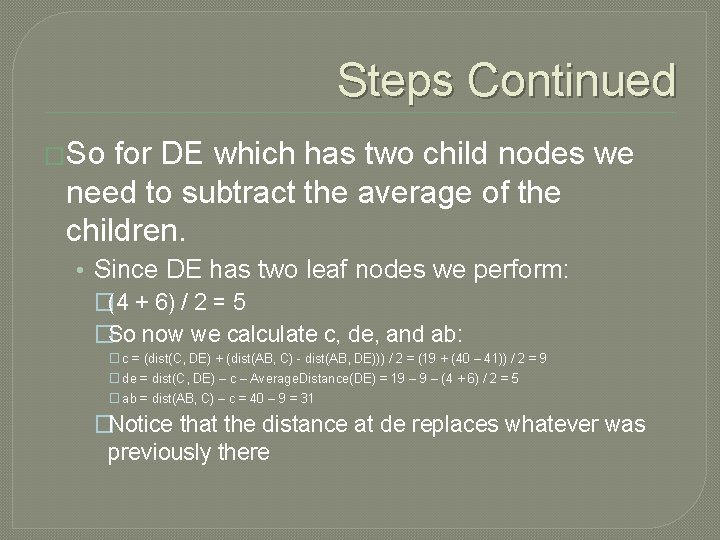
Steps Continued �So for DE which has two child nodes we need to subtract the average of the children. • Since DE has two leaf nodes we perform: �(4 + 6) / 2 = 5 �So now we calculate c, de, and ab: � c = (dist(C, DE) + (dist(AB, C) - dist(AB, DE))) / 2 = (19 + (40 – 41)) / 2 = 9 � de = dist(C, DE) – c – Average. Distance(DE) = 19 – (4 + 6) / 2 = 5 � ab = dist(AB, C) – c = 40 – 9 = 31 �Notice that the distance at de replaces whatever was previously there
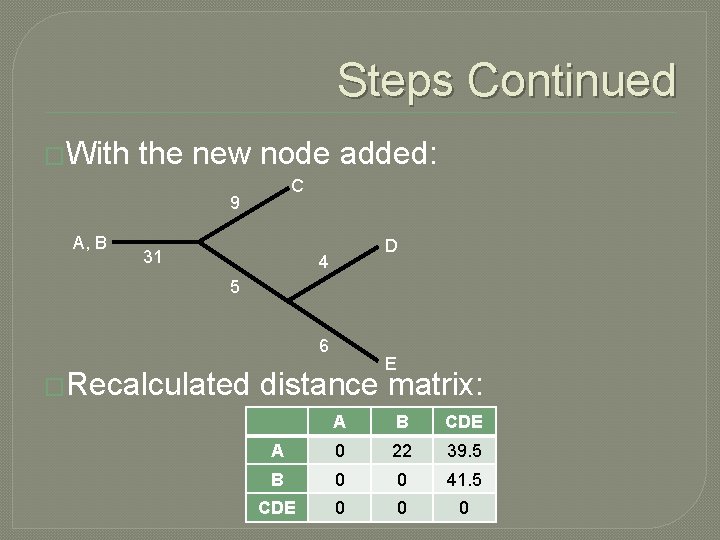
Steps Continued �With the new node added: C 9 A, B 31 D 4 5 6 �Recalculated E distance matrix: A B CDE A 0 22 39. 5 B 0 0 41. 5 CDE 0 0 0
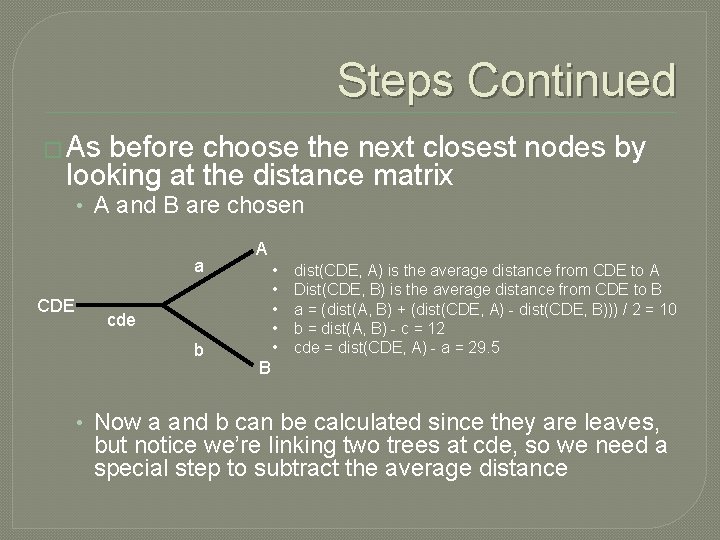
Steps Continued � As before choose the next closest nodes by looking at the distance matrix • A and B are chosen a CDE A • • • cde b dist(CDE, A) is the average distance from CDE to A Dist(CDE, B) is the average distance from CDE to B a = (dist(A, B) + (dist(CDE, A) - dist(CDE, B))) / 2 = 10 b = dist(A, B) - c = 12 cde = dist(CDE, A) - a = 29. 5 B • Now a and b can be calculated since they are leaves, but notice we’re linking two trees at cde, so we need a special step to subtract the average distance
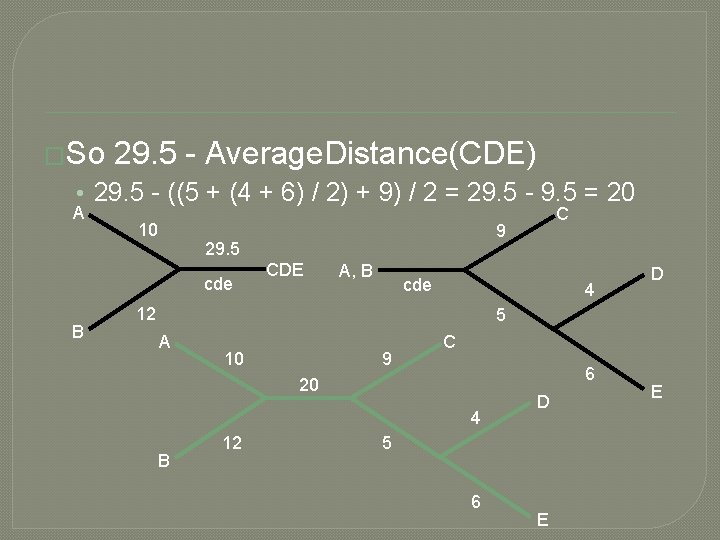
�So 29. 5 - Average. Distance(CDE) • 29. 5 - ((5 + (4 + 6) / 2) + 9) / 2 = 29. 5 - 9. 5 = 20 A 10 B 9 29. 5 cde C CDE A, B cde 4 12 D 5 A 10 9 C 6 20 4 B 12 D 5 6 E E
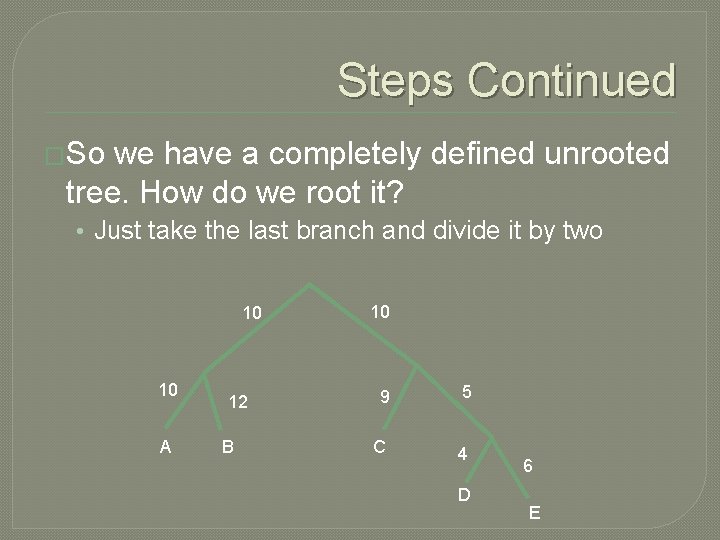
Steps Continued �So we have a completely defined unrooted tree. How do we root it? • Just take the last branch and divide it by two 10 10 A 12 B 10 9 5 C 4 D 6 E
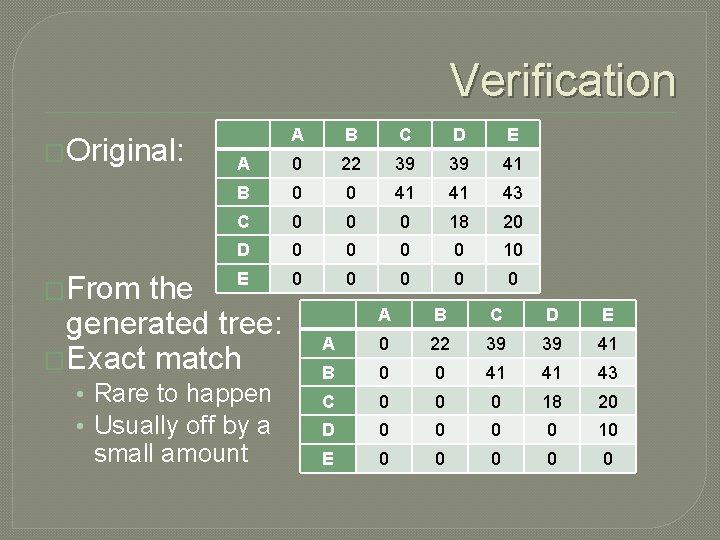
Verification A B C D E A 0 22 39 39 41 B 0 0 41 41 43 C 0 0 0 18 20 D 0 0 10 the E 0 generated tree: �Exact match 0 0 �Original: �From • Rare to happen • Usually off by a small amount A B C D E A 0 22 39 39 41 B 0 0 41 41 43 C 0 0 0 18 20 D 0 0 10 E 0 0 0

Demo � http: //sirisian. com/javascript/CS 6030 Project. html
Conclusion �Distance based methods such as the Fitch -Margoliash method produce very accurate trees given an accurate distance matrix in a very timely manner
References Bacardit, J. , Krasnogor, N. Phylogenetic Trees [PPT document]. Retrieved from http: //www. cs. nott. ac. uk/~jqb/G 53 BIO/Slides/Phylogenetic%20 Trees. ppt Louhisuo K. (2004, May 4). Constructing phylogenetic trees with UPGMA and Fitch. Margoliash. Retrieved from http: //www. niksula. cs. hut. fi/~klouhisu/Bioinfo/phyltree. pdf
- Slides: 23