
PHY 711 Classical Mechanics and Mathematical Methods 10


- Slides: 33
PHY 711 Classical Mechanics and Mathematical Methods 10 -10: 50 AM MWF Olin 103 Plan for Lecture 20: Review Chapters 1 -4, 6, 7 1. Scattering theory & Rotation reference frames 2. Calculus of variation 3. Lagrangian and Hamiltonian formalisms 4. Normal modes of vibration 5. The wave equation 6. Sturm-Liouville equation 10/9/2019 PHY 711 Fall 2019 -- Lecture 20 1
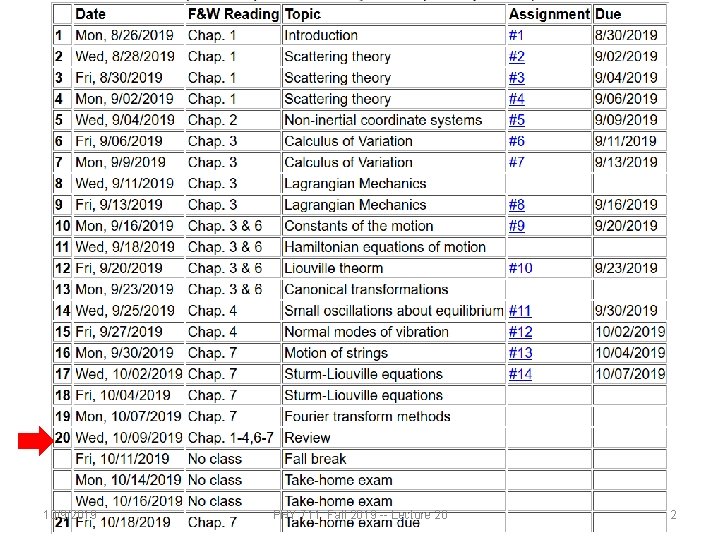
10/9/2019 PHY 711 Fall 2019 -- Lecture 20 2
10/9/2019 PHY 711 Fall 2019 -- Lecture 20 3
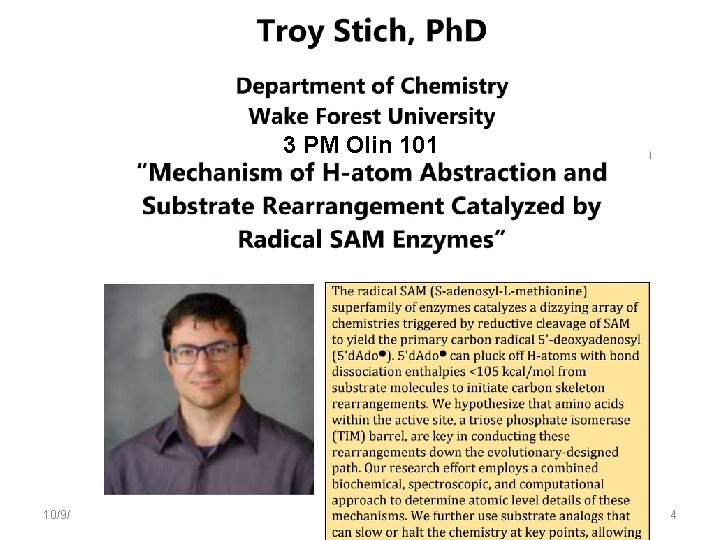
3 PM Olin 101 10/9/2019 PHY 711 Fall 2019 -- Lecture 20 4
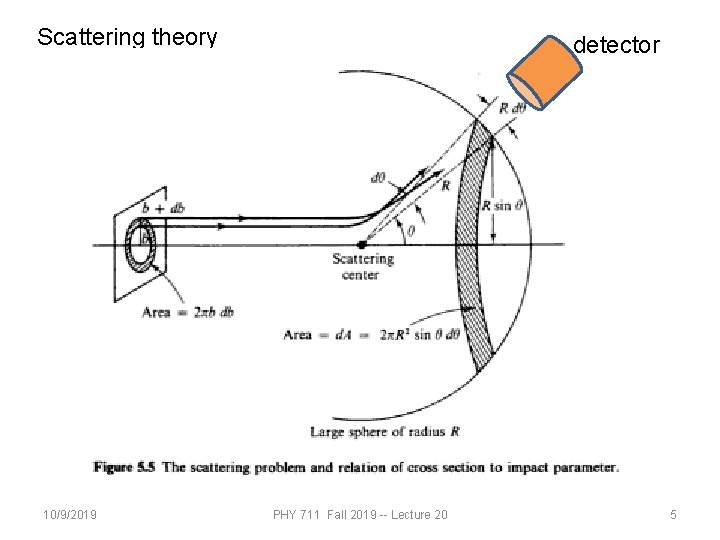
Scattering theory 10/9/2019 detector PHY 711 Fall 2019 -- Lecture 20 5
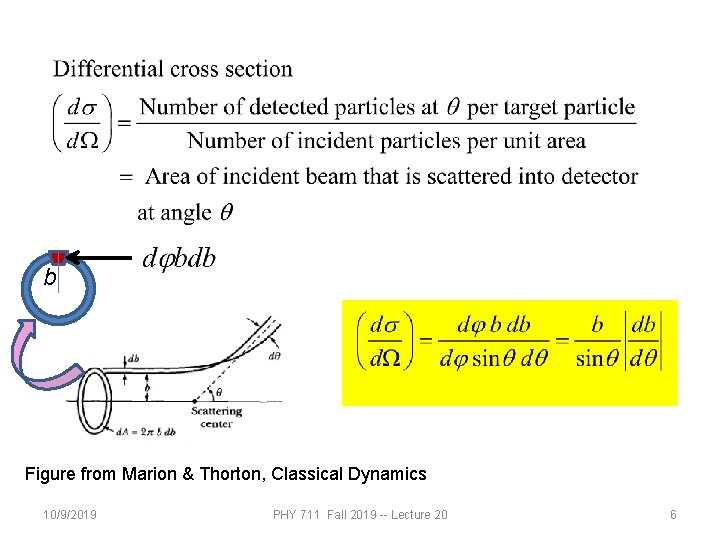
b Figure from Marion & Thorton, Classical Dynamics 10/9/2019 PHY 711 Fall 2019 -- Lecture 20 6
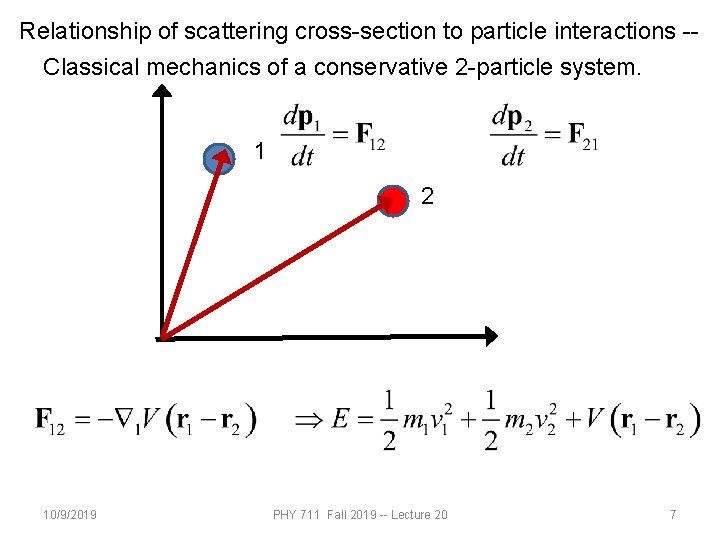
Relationship of scattering cross-section to particle interactions -Classical mechanics of a conservative 2 -particle system. 1 2 10/9/2019 PHY 711 Fall 2019 -- Lecture 20 7
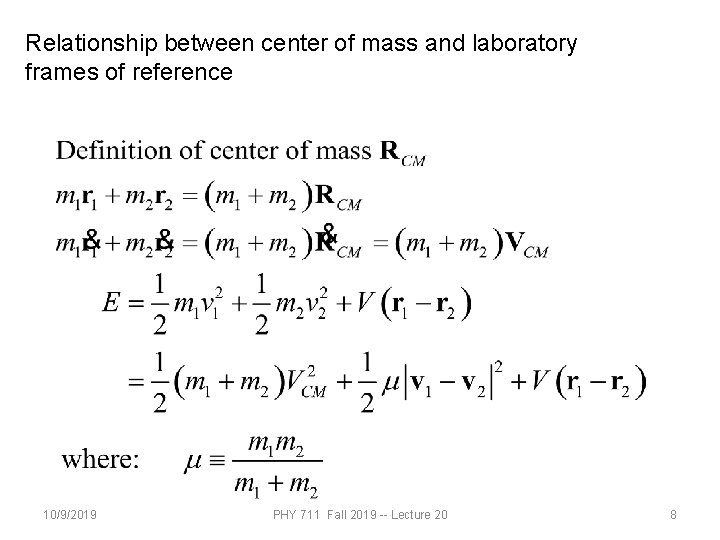
Relationship between center of mass and laboratory frames of reference 10/9/2019 PHY 711 Fall 2019 -- Lecture 20 8
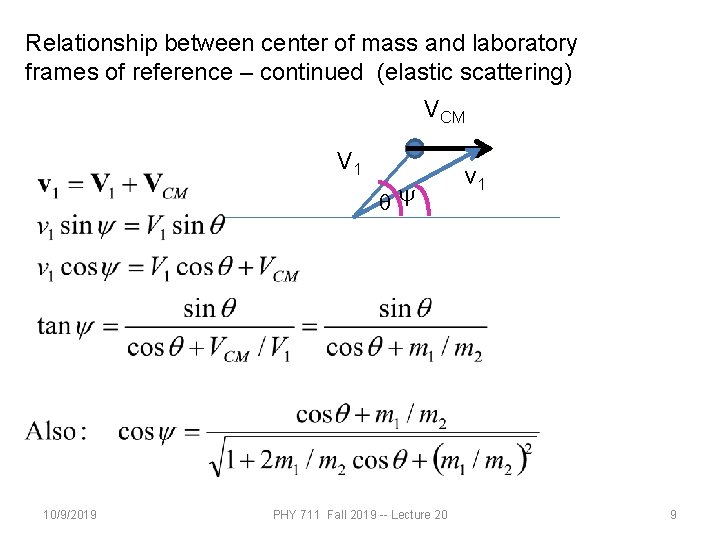
Relationship between center of mass and laboratory frames of reference – continued (elastic scattering) VCM V 1 10/9/2019 qy PHY 711 Fall 2019 -- Lecture 20 v 1 9
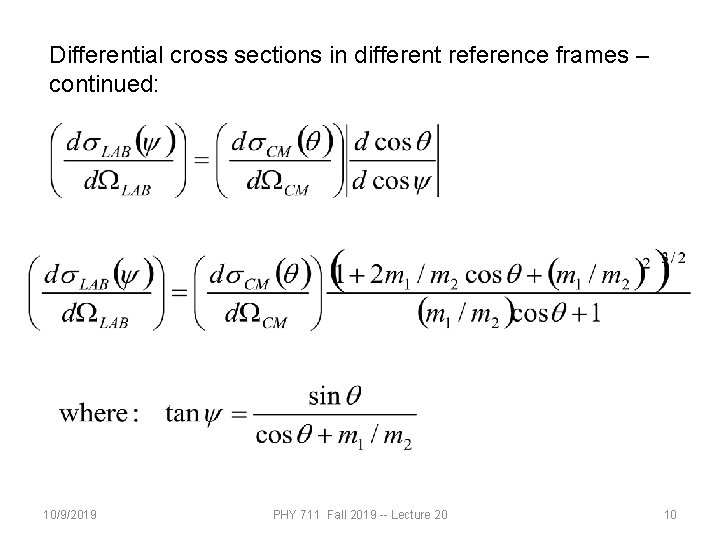
Differential cross sections in different reference frames – continued: 10/9/2019 PHY 711 Fall 2019 -- Lecture 20 10
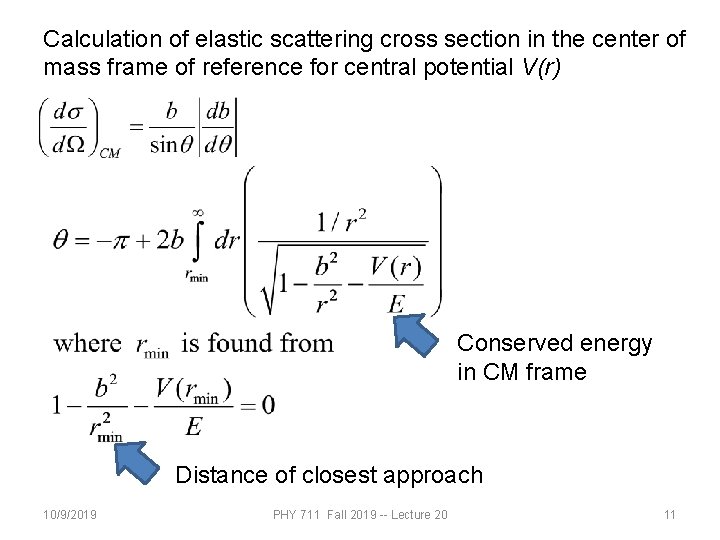
Calculation of elastic scattering cross section in the center of mass frame of reference for central potential V(r) Conserved energy in CM frame Distance of closest approach 10/9/2019 PHY 711 Fall 2019 -- Lecture 20 11
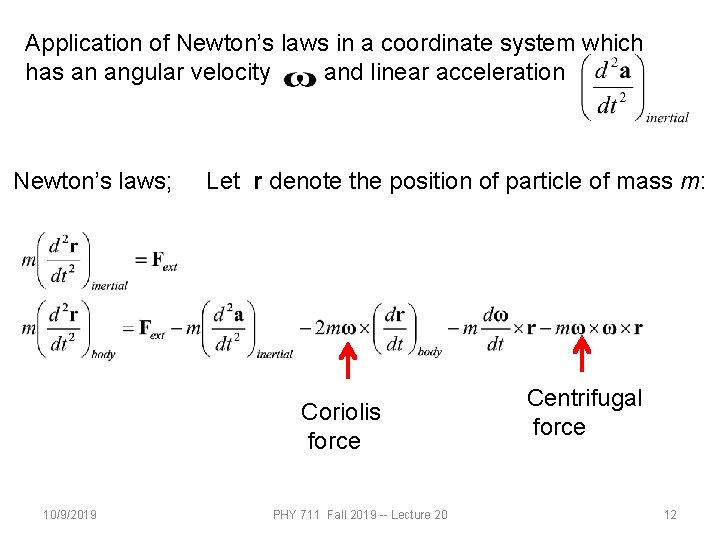
Application of Newton’s laws in a coordinate system which has an angular velocity and linear acceleration Newton’s laws; Let r denote the position of particle of mass m: Coriolis force 10/9/2019 PHY 711 Fall 2019 -- Lecture 20 Centrifugal force 12
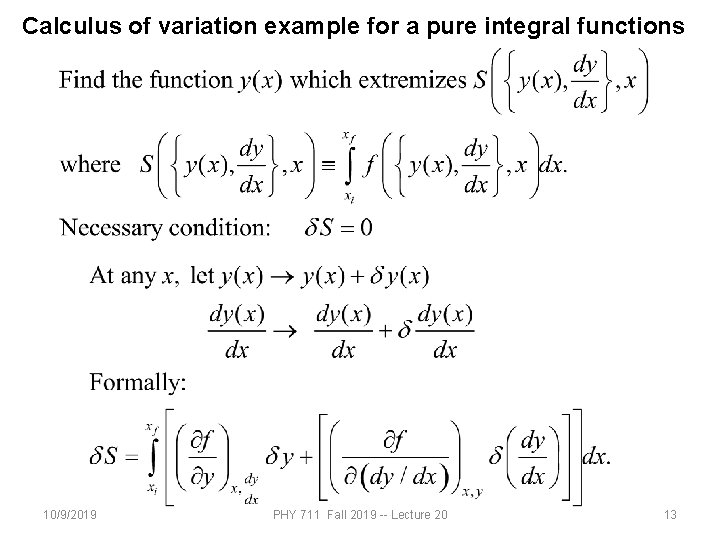
Calculus of variation example for a pure integral functions 10/9/2019 PHY 711 Fall 2019 -- Lecture 20 13
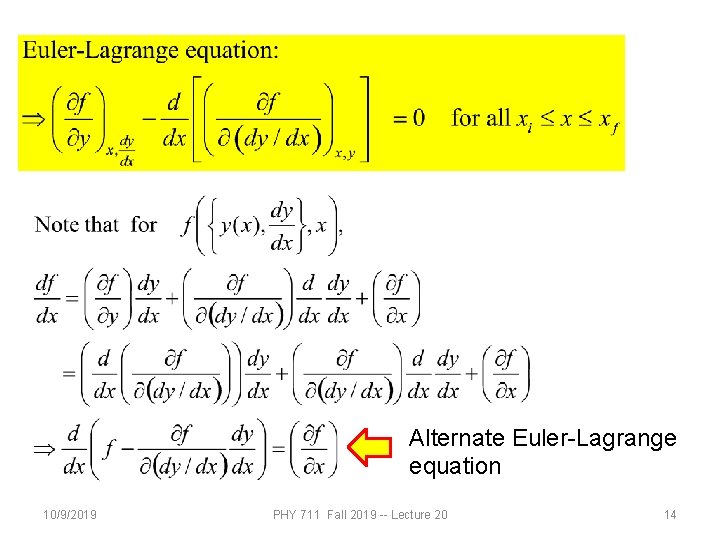
Alternate Euler-Lagrange equation 10/9/2019 PHY 711 Fall 2019 -- Lecture 20 14
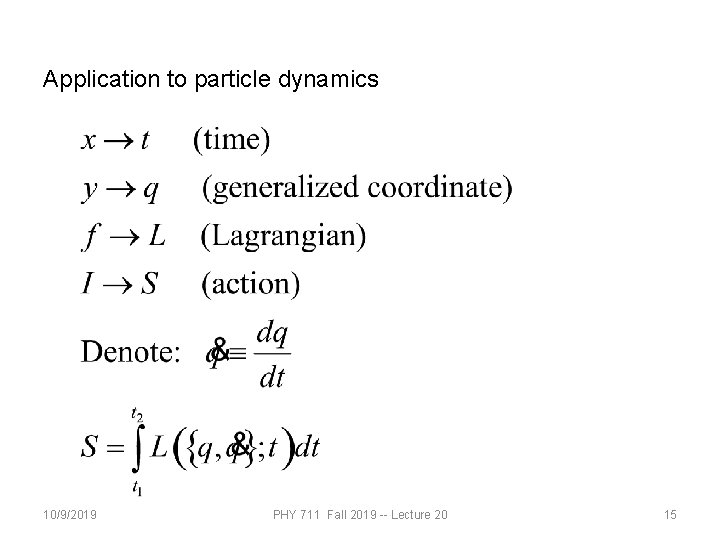
Application to particle dynamics 10/9/2019 PHY 711 Fall 2019 -- Lecture 20 15
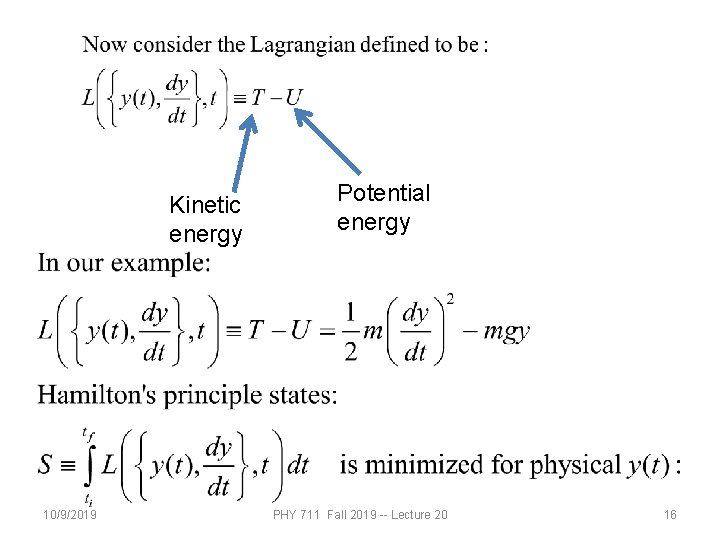
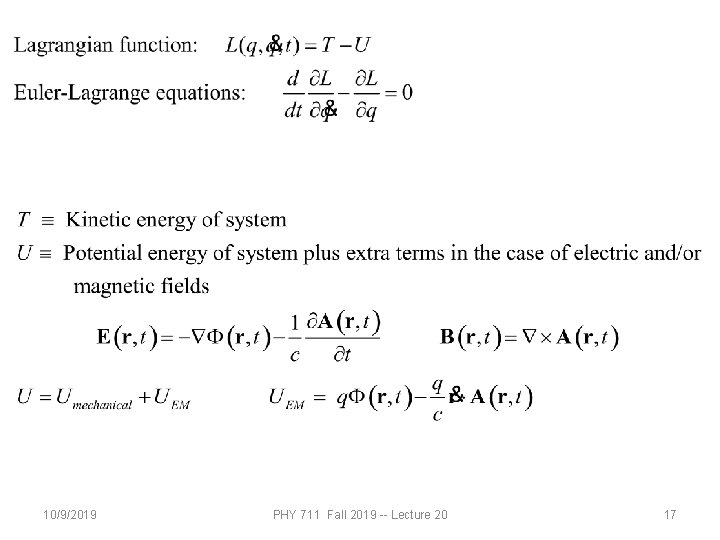
Kinetic energy 10/9/2019 Potential energy PHY 711 Fall 2019 -- Lecture 20 16
10/9/2019 PHY 711 Fall 2019 -- Lecture 20 17
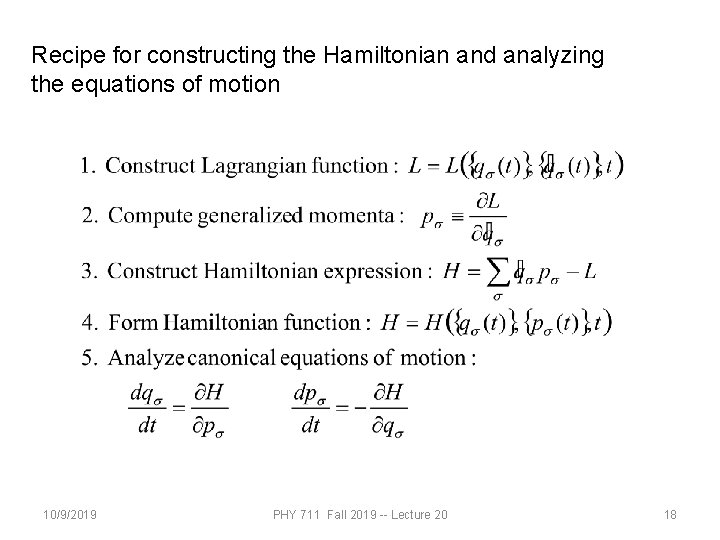
Recipe for constructing the Hamiltonian and analyzing the equations of motion 10/9/2019 PHY 711 Fall 2019 -- Lecture 20 18
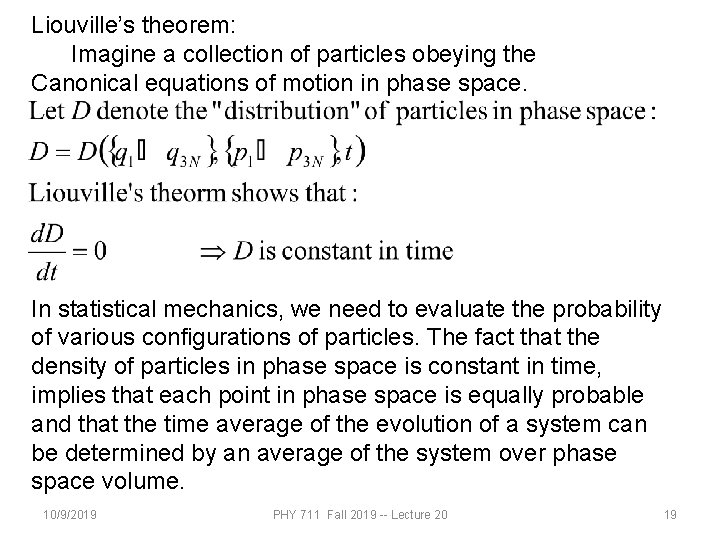
Liouville’s theorem: Imagine a collection of particles obeying the Canonical equations of motion in phase space. In statistical mechanics, we need to evaluate the probability of various configurations of particles. The fact that the density of particles in phase space is constant in time, implies that each point in phase space is equally probable and that the time average of the evolution of a system can be determined by an average of the system over phase space volume. 10/9/2019 PHY 711 Fall 2019 -- Lecture 20 19
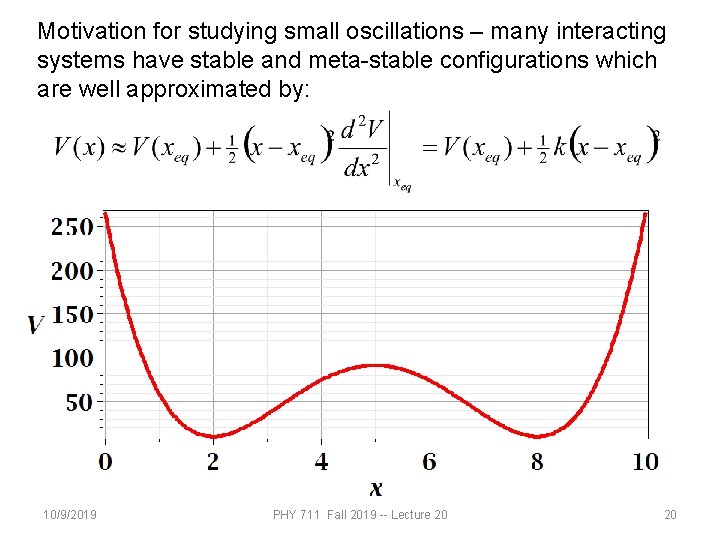
Motivation for studying small oscillations – many interacting systems have stable and meta-stable configurations which are well approximated by: 10/9/2019 PHY 711 Fall 2019 -- Lecture 20 20
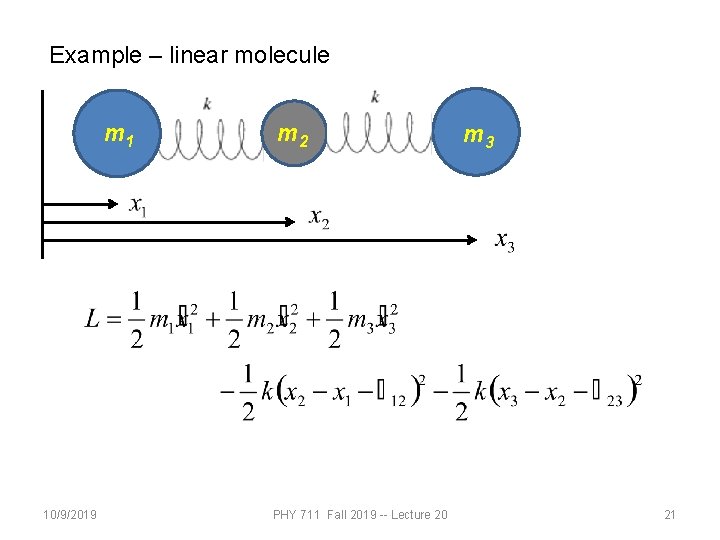
Example – linear molecule m 1 10/9/2019 m 2 PHY 711 Fall 2019 -- Lecture 20 m 3 21
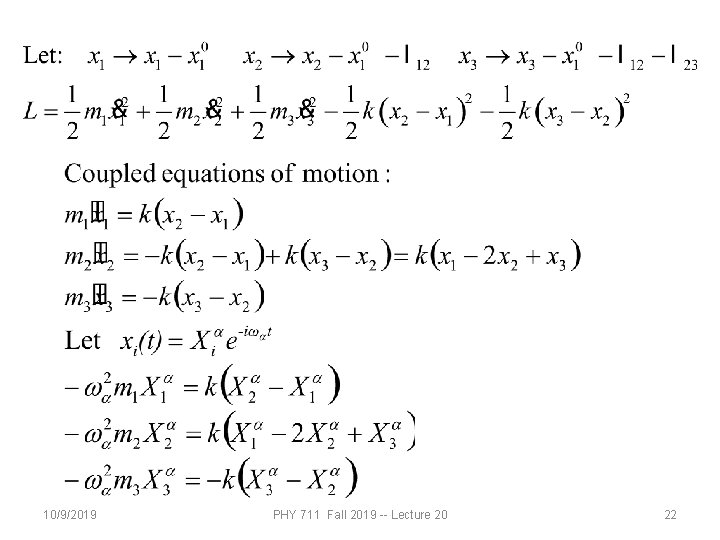
10/9/2019 PHY 711 Fall 2019 -- Lecture 20 22
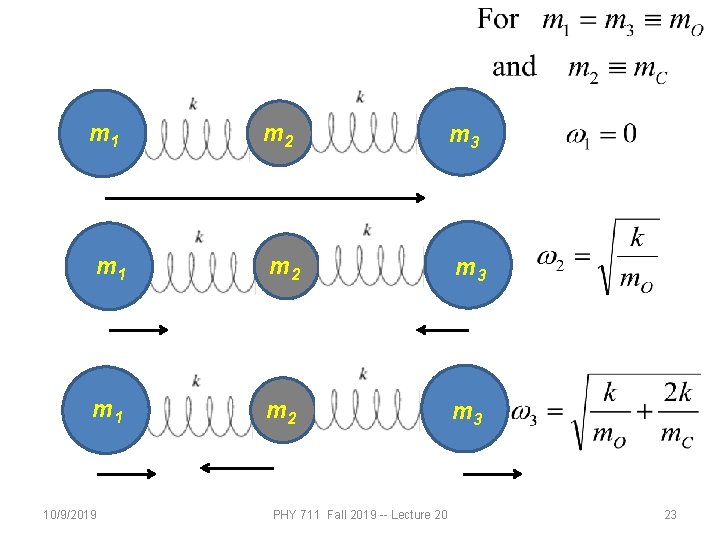
m 1 m 2 m 3 10/9/2019 PHY 711 Fall 2019 -- Lecture 20 23
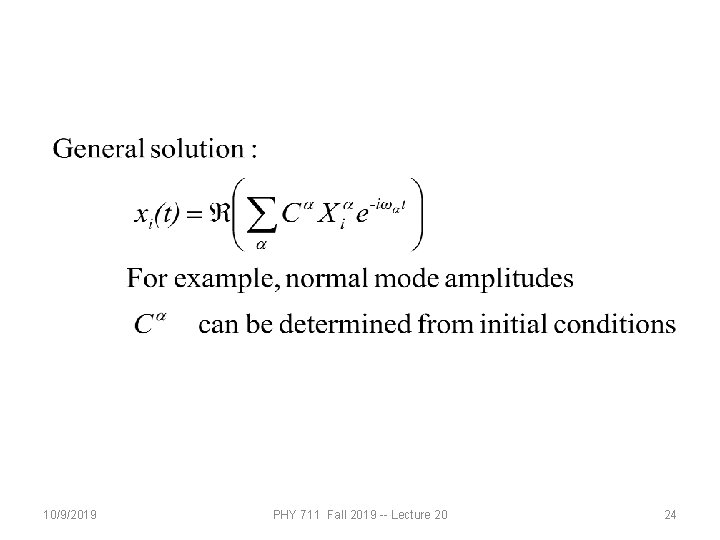
10/9/2019 PHY 711 Fall 2019 -- Lecture 20 24
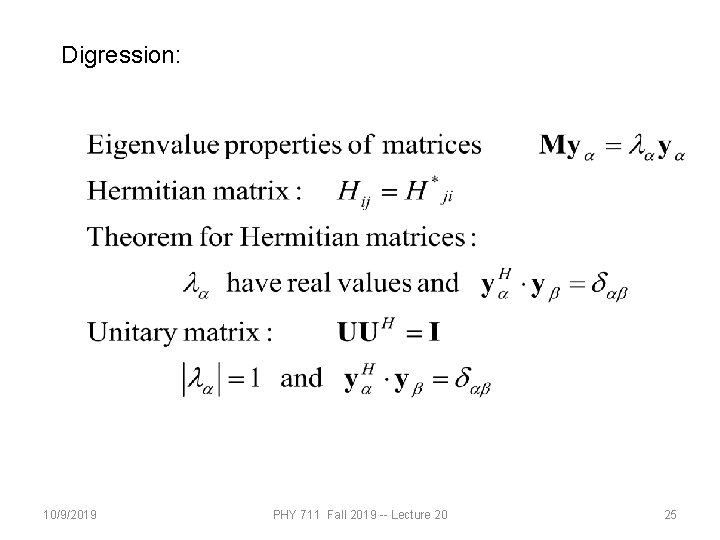
Digression: 10/9/2019 PHY 711 Fall 2019 -- Lecture 20 25
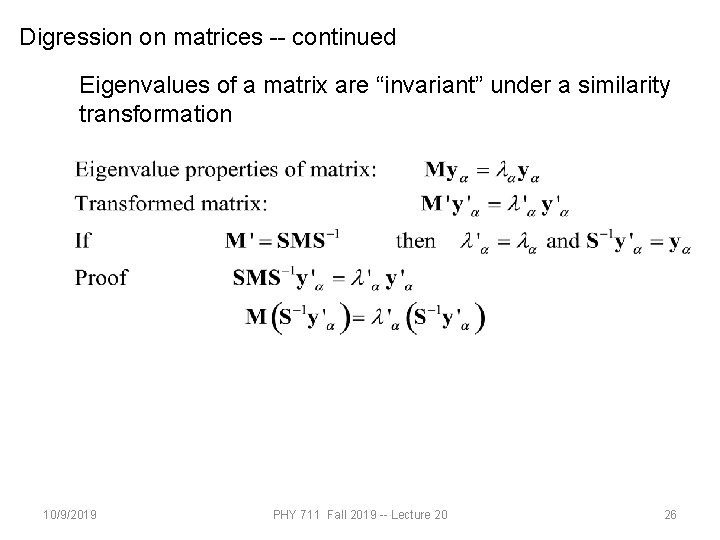
Digression on matrices -- continued Eigenvalues of a matrix are “invariant” under a similarity transformation 10/9/2019 PHY 711 Fall 2019 -- Lecture 20 26
Additional digression on matrix properties Singular value decomposition 10/9/2019 PHY 711 Fall 2019 -- Lecture 20 27
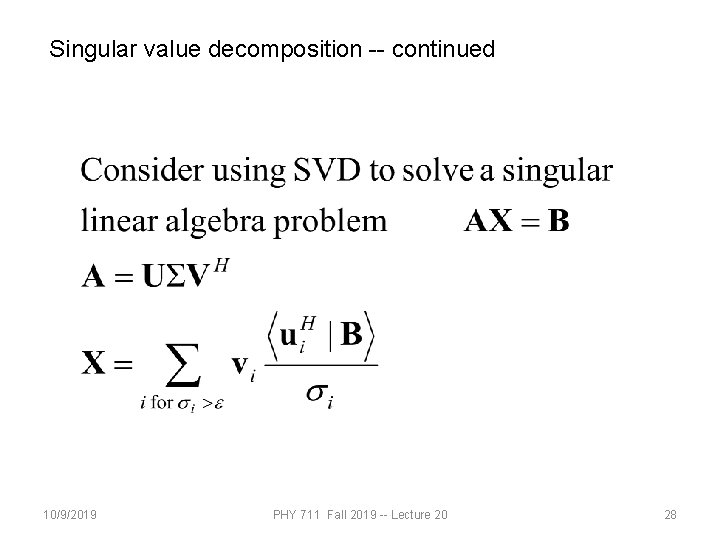
Singular value decomposition -- continued 10/9/2019 PHY 711 Fall 2019 -- Lecture 20 28
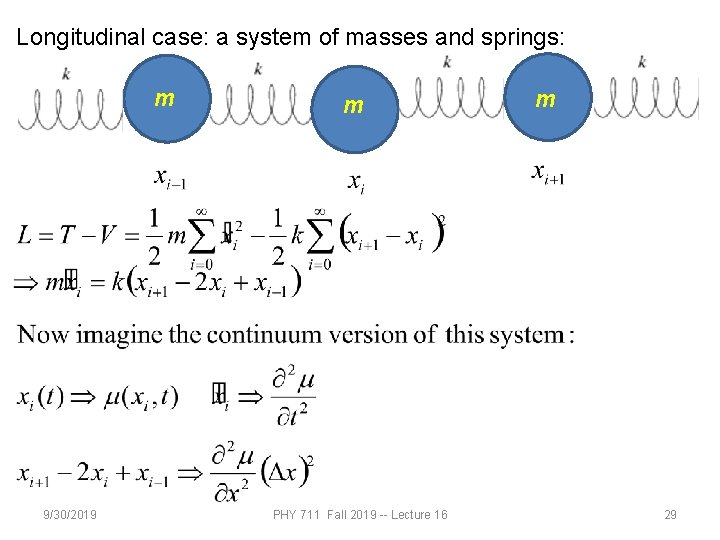
Longitudinal case: a system of masses and springs: m 9/30/2019 m PHY 711 Fall 2019 -- Lecture 16 m 29
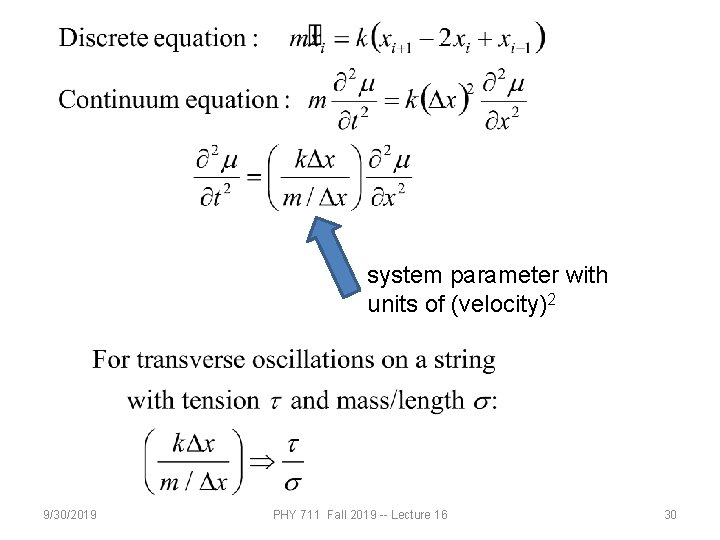
system parameter with units of (velocity)2 9/30/2019 PHY 711 Fall 2019 -- Lecture 16 30
9/30/2019 PHY 711 Fall 2019 -- Lecture 16 31
9/30/2019 PHY 711 Fall 2019 -- Lecture 16 32
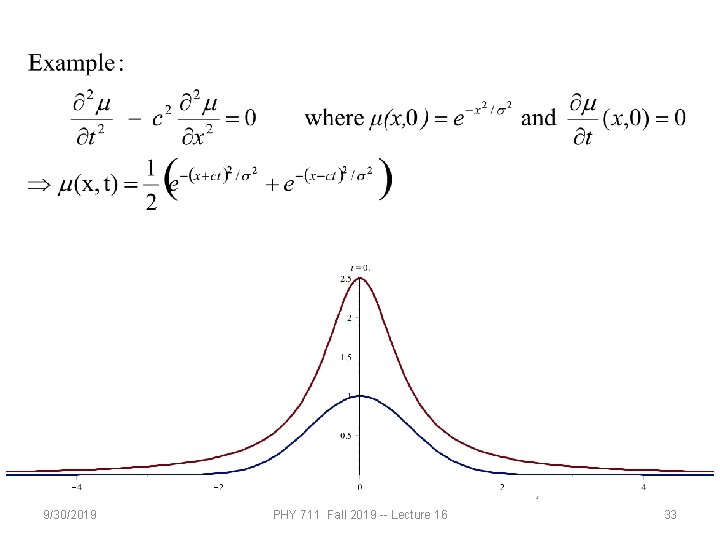
9/30/2019 PHY 711 Fall 2019 -- Lecture 16 33