
PHY 711 Classical Mechanics and Mathematical Methods 10






- Slides: 34
PHY 711 Classical Mechanics and Mathematical Methods 10 -10: 50 AM MWF Online or (occasionally) in Olin 103 Discussion of Lecture 16 – Chap. 4 (F & W) Analysis of motion near equilibrium 1. Normal modes of vibration for simple systems 2. Some concepts of linear algebra 3. Normal modes of vibration for more complicated systems 9/30/2020 PHY 711 Fall 2020 -- Lecture 16 1
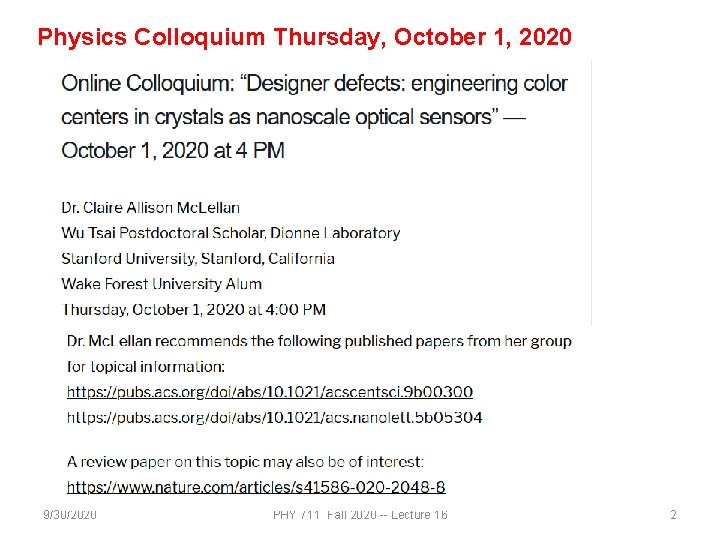
Physics Colloquium Thursday, October 1, 2020 9/30/2020 PHY 711 Fall 2020 -- Lecture 16 2
Schedule for weekly one-on-one meetings Nick – 11 AM Monday (ED/ST) Tim – 9 AM Tuesday Bamidele – 7 PM Tuesday Zhi– 9 PM Tuesday Jeanette – 11 AM Friday Derek – 12 PM Friday 9/30/2020 PHY 711 Fall 2020 -- Lecture 16 3
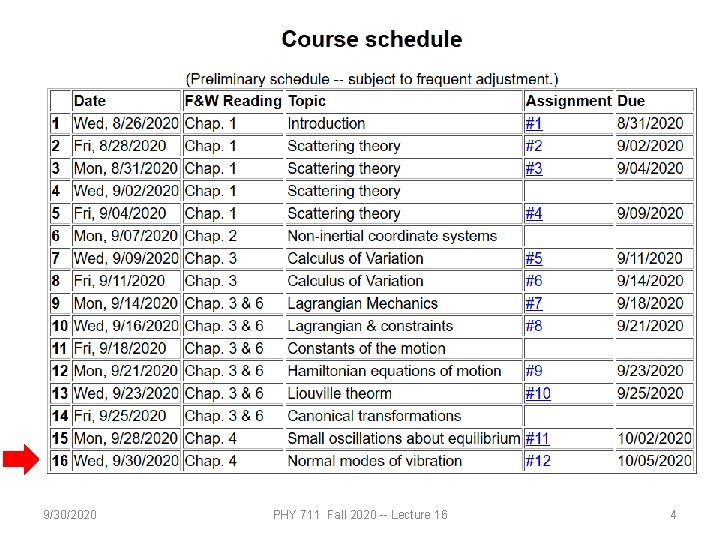
9/30/2020 PHY 711 Fall 2020 -- Lecture 16 4
9/30/2020 PHY 711 Fall 2020 -- Lecture 16 5
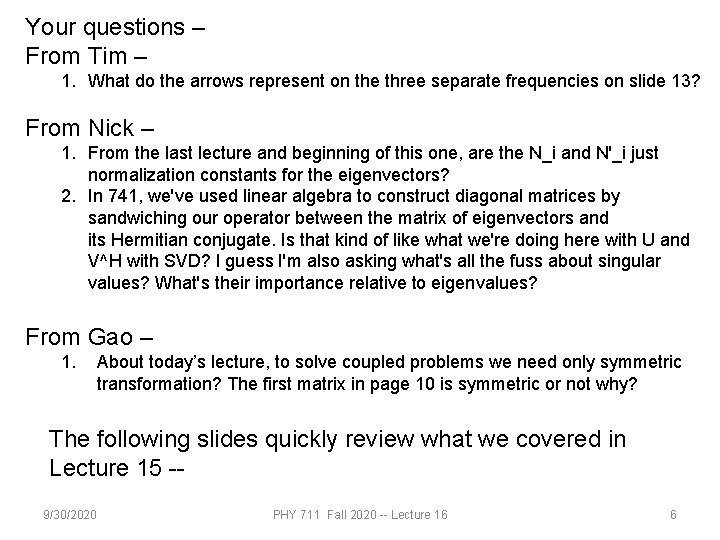
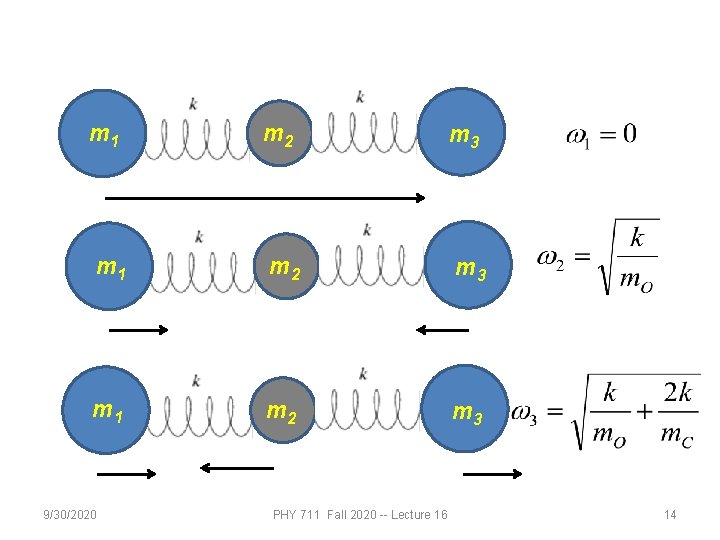
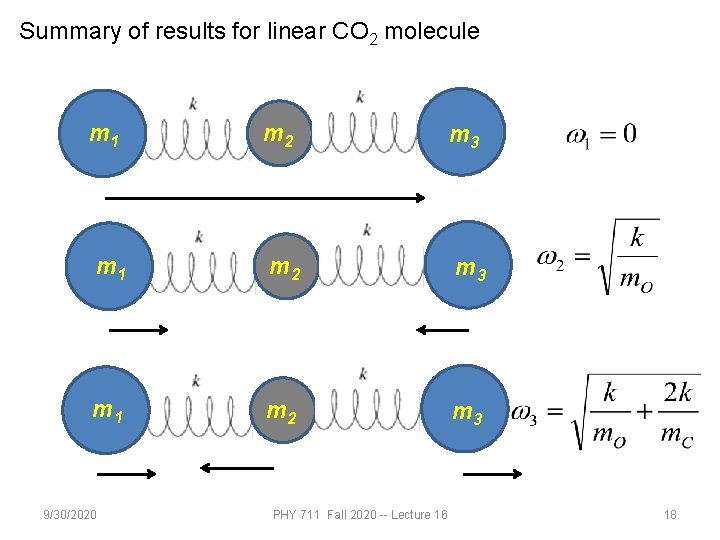
Your questions – From Tim – 1. What do the arrows represent on the three separate frequencies on slide 13? From Nick – 1. From the last lecture and beginning of this one, are the N_i and N'_i just normalization constants for the eigenvectors? 2. In 741, we've used linear algebra to construct diagonal matrices by sandwiching our operator between the matrix of eigenvectors and its Hermitian conjugate. Is that kind of like what we're doing here with U and V^H with SVD? I guess I'm also asking what's all the fuss about singular values? What's their importance relative to eigenvalues? From Gao – 1. About today’s lecture, to solve coupled problems we need only symmetric transformation? The first matrix in page 10 is symmetric or not why? The following slides quickly review what we covered in Lecture 15 -9/30/2020 PHY 711 Fall 2020 -- Lecture 16 6
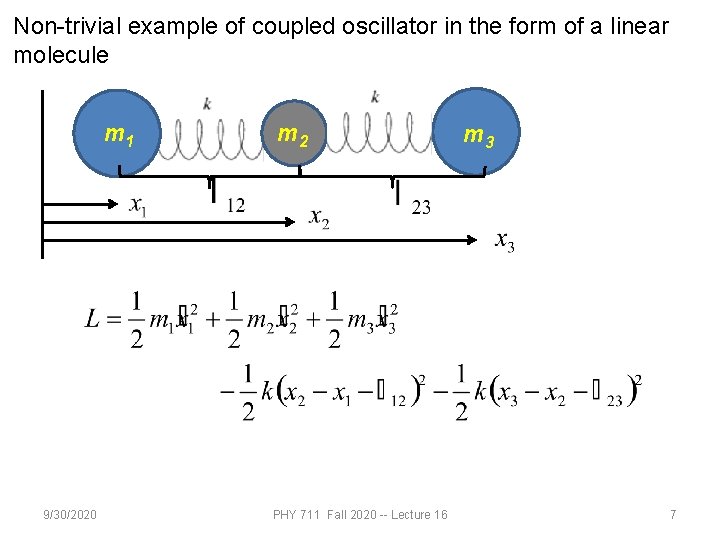
Non-trivial example of coupled oscillator in the form of a linear molecule m 1 9/30/2020 m 2 PHY 711 Fall 2020 -- Lecture 16 m 3 7
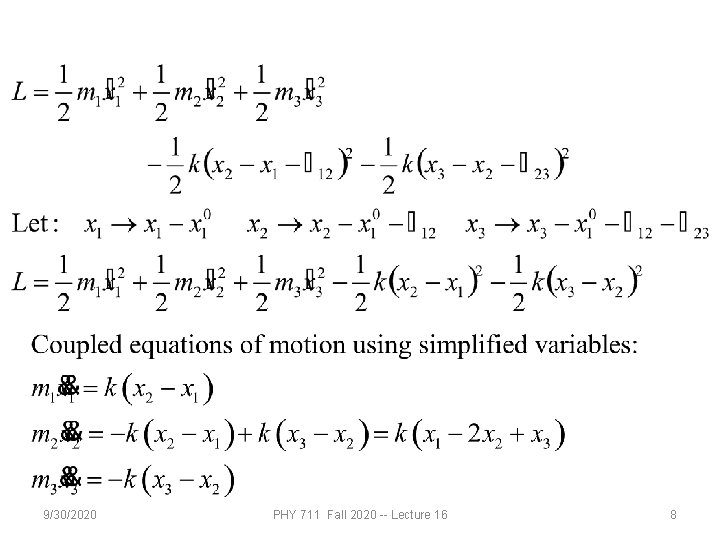
9/30/2020 PHY 711 Fall 2020 -- Lecture 16 8
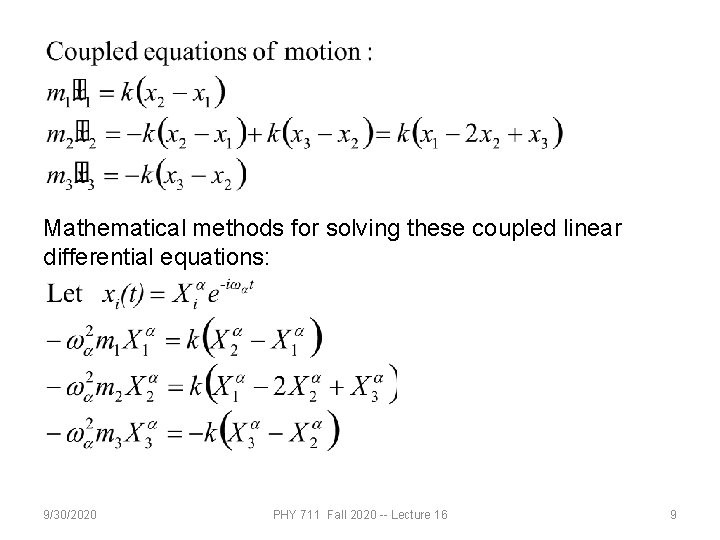
Mathematical methods for solving these coupled linear differential equations: 9/30/2020 PHY 711 Fall 2020 -- Lecture 16 9
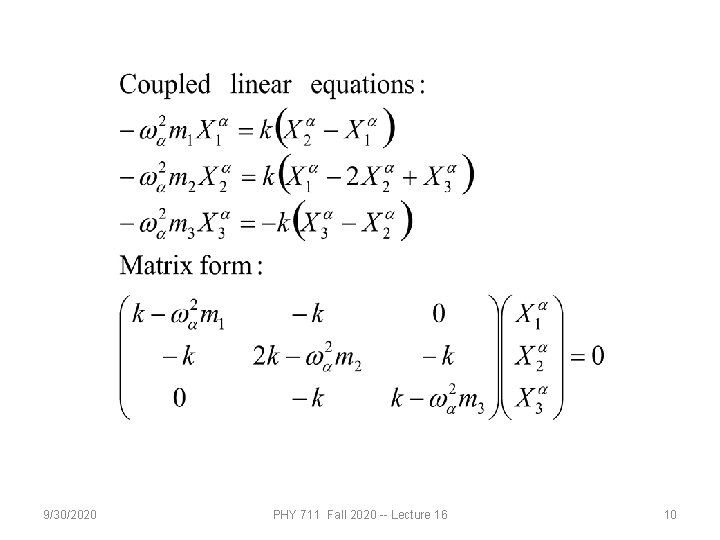
9/30/2020 PHY 711 Fall 2020 -- Lecture 16 10
9/30/2020 PHY 711 Fall 2020 -- Lecture 16 11
9/30/2020 PHY 711 Fall 2020 -- Lecture 16 12
(with help from Maple) N, N’ are normalization constants. 9/30/2020 PHY 711 Fall 2020 -- Lecture 16 13
m 1 m 2 m 3 9/30/2020 PHY 711 Fall 2020 -- Lecture 16 14
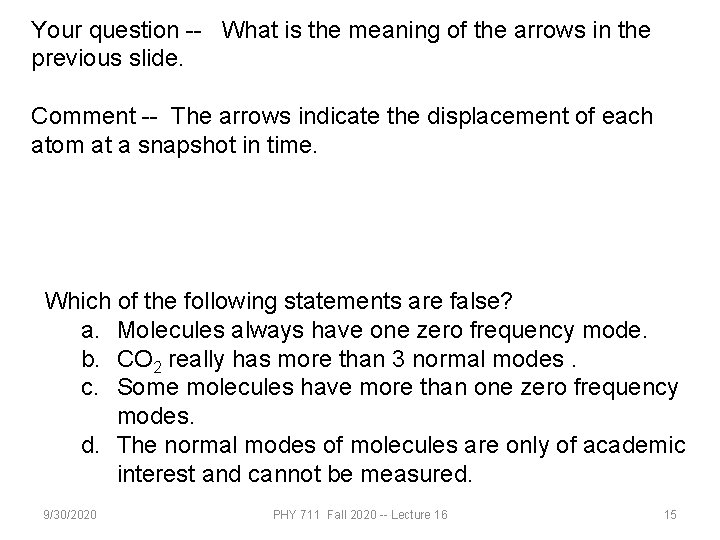
Your question -- What is the meaning of the arrows in the previous slide. Comment -- The arrows indicate the displacement of each atom at a snapshot in time. Which of the following statements are false? a. Molecules always have one zero frequency mode. b. CO 2 really has more than 3 normal modes. c. Some molecules have more than one zero frequency modes. d. The normal modes of molecules are only of academic interest and cannot be measured. 9/30/2020 PHY 711 Fall 2020 -- Lecture 16 15
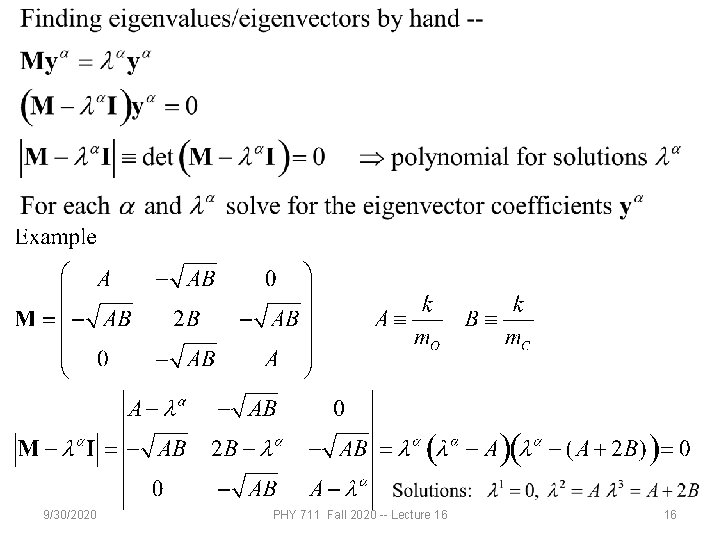
9/30/2020 PHY 711 Fall 2020 -- Lecture 16 16
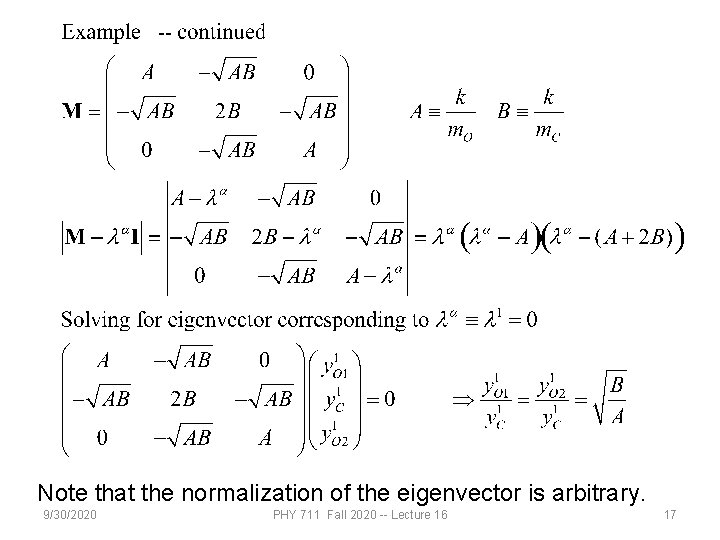
Note that the normalization of the eigenvector is arbitrary. 9/30/2020 PHY 711 Fall 2020 -- Lecture 16 17
Summary of results for linear CO 2 molecule m 1 m 2 m 3 9/30/2020 PHY 711 Fall 2020 -- Lecture 16 18
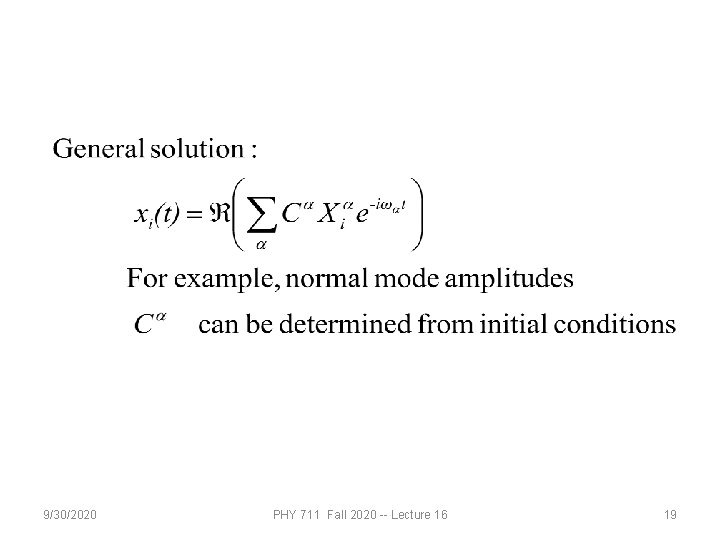
9/30/2020 PHY 711 Fall 2020 -- Lecture 16 19
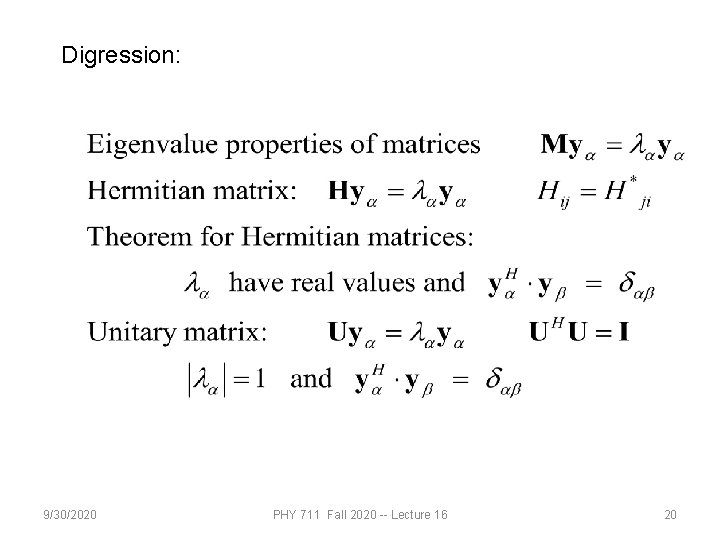
Digression: 9/30/2020 PHY 711 Fall 2020 -- Lecture 16 20
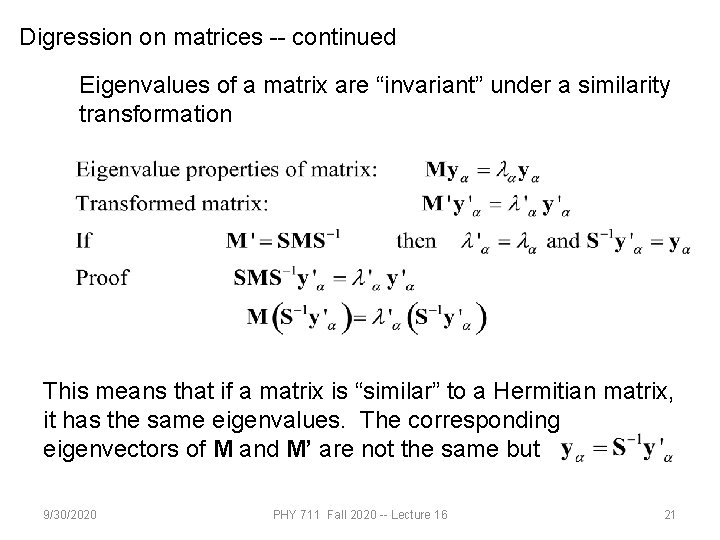
Digression on matrices -- continued Eigenvalues of a matrix are “invariant” under a similarity transformation This means that if a matrix is “similar” to a Hermitian matrix, it has the same eigenvalues. The corresponding eigenvectors of M and M’ are not the same but 9/30/2020 PHY 711 Fall 2020 -- Lecture 16 21
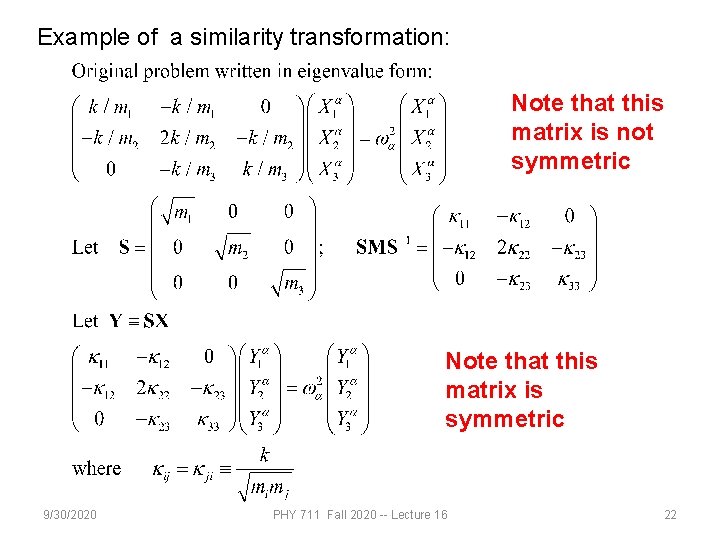
Example of a similarity transformation: Note that this matrix is not symmetric Note that this matrix is symmetric 9/30/2020 PHY 711 Fall 2020 -- Lecture 16 22
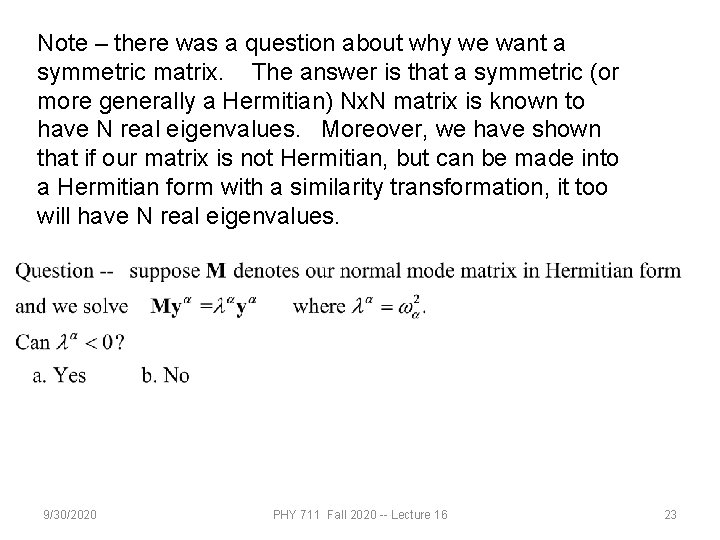
Note – there was a question about why we want a symmetric matrix. The answer is that a symmetric (or more generally a Hermitian) Nx. N matrix is known to have N real eigenvalues. Moreover, we have shown that if our matrix is not Hermitian, but can be made into a Hermitian form with a similarity transformation, it too will have N real eigenvalues. 9/30/2020 PHY 711 Fall 2020 -- Lecture 16 23
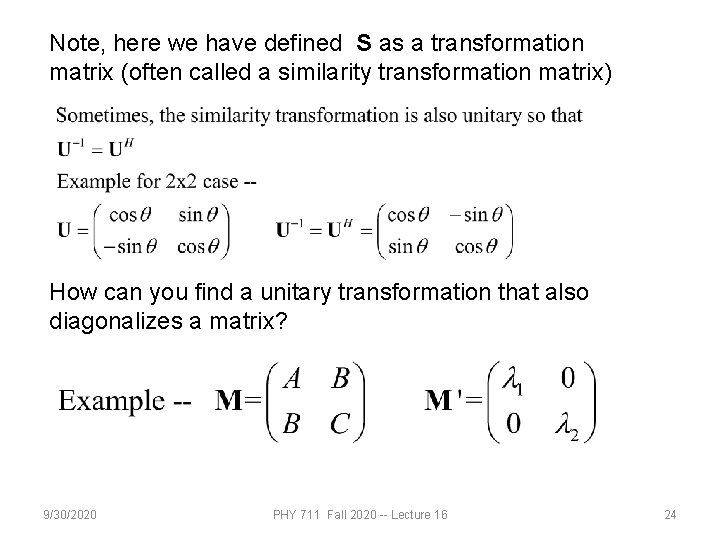
Note, here we have defined S as a transformation matrix (often called a similarity transformation matrix) How can you find a unitary transformation that also diagonalizes a matrix? 9/30/2020 PHY 711 Fall 2020 -- Lecture 16 24
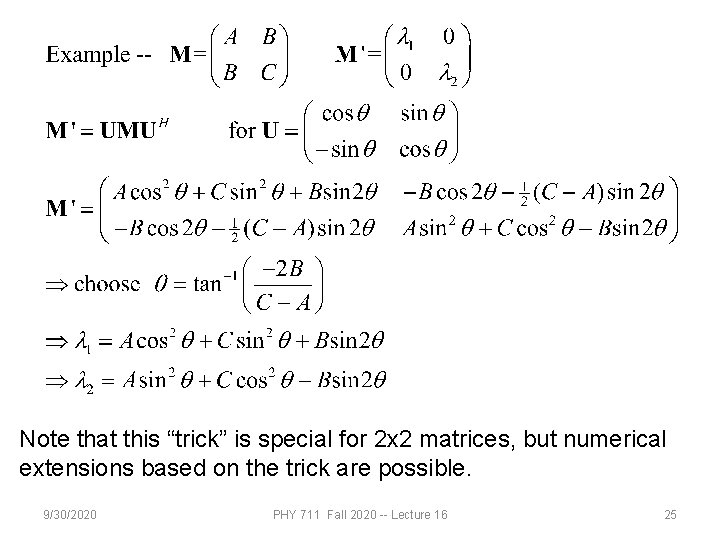
Note that this “trick” is special for 2 x 2 matrices, but numerical extensions based on the trick are possible. 9/30/2020 PHY 711 Fall 2020 -- Lecture 16 25
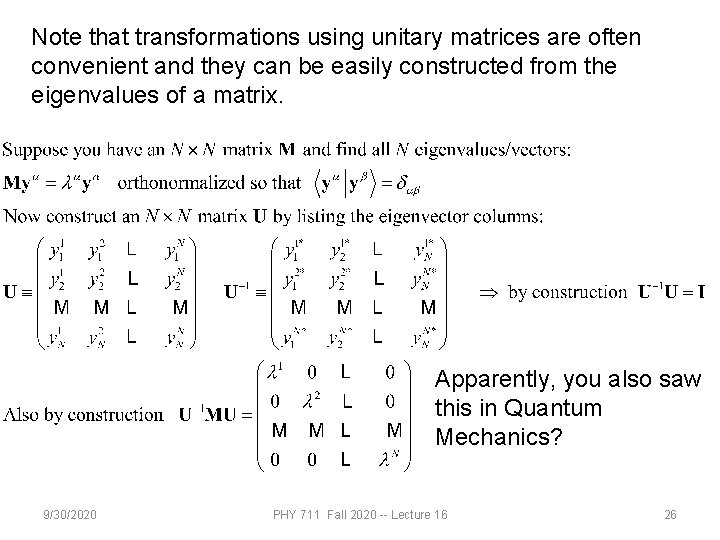
Note that transformations using unitary matrices are often convenient and they can be easily constructed from the eigenvalues of a matrix. Apparently, you also saw this in Quantum Mechanics? 9/30/2020 PHY 711 Fall 2020 -- Lecture 16 26
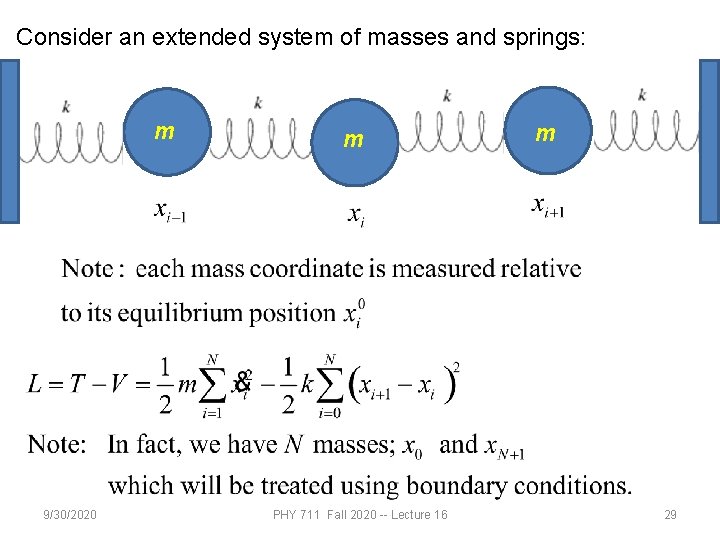
Consider an extended system of masses and springs: m 9/30/2020 m PHY 711 Fall 2020 -- Lecture 16 m 29
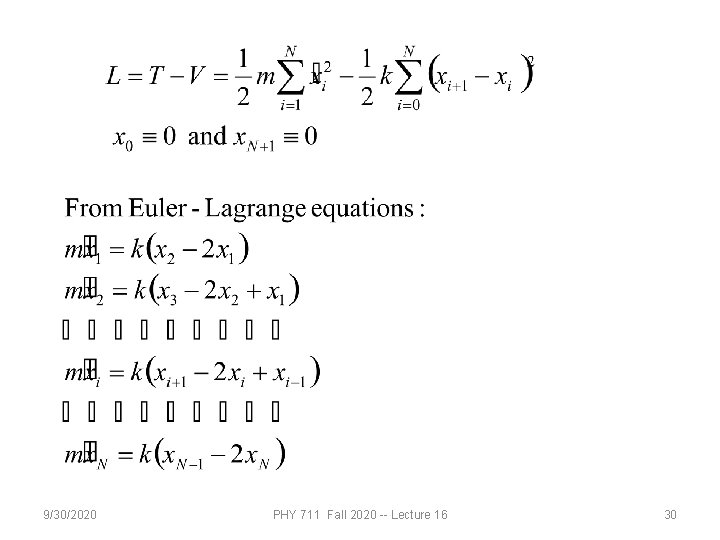
9/30/2020 PHY 711 Fall 2020 -- Lecture 16 30
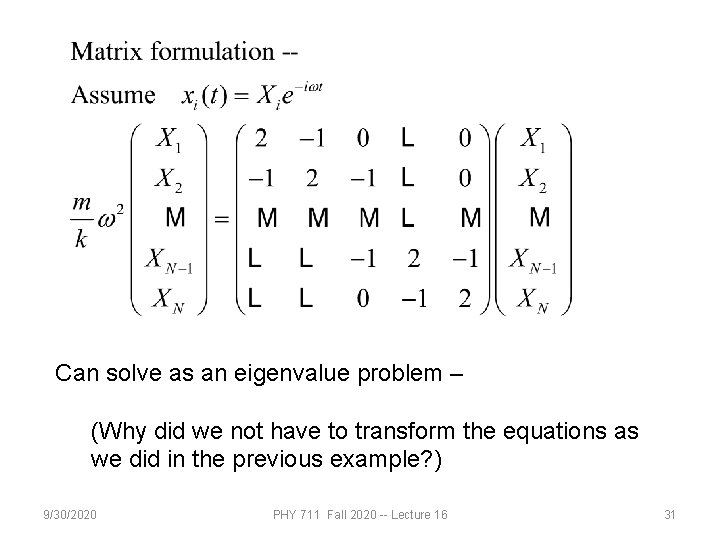
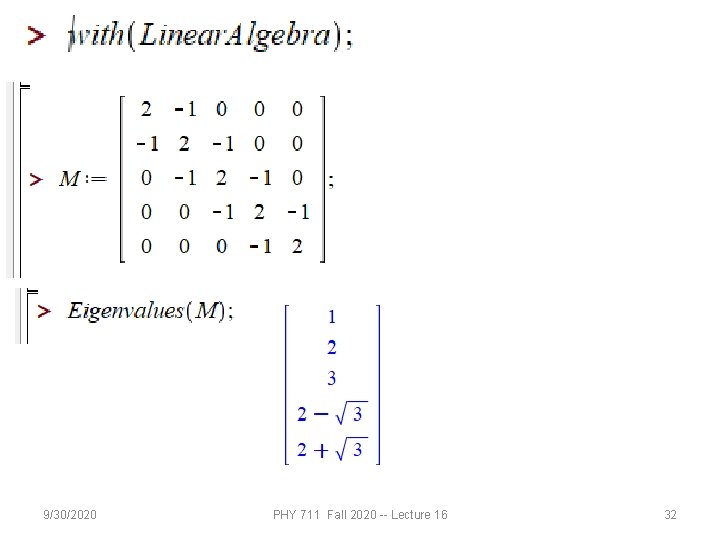
Can solve as an eigenvalue problem – (Why did we not have to transform the equations as we did in the previous example? ) 9/30/2020 PHY 711 Fall 2020 -- Lecture 16 31
9/30/2020 PHY 711 Fall 2020 -- Lecture 16 32
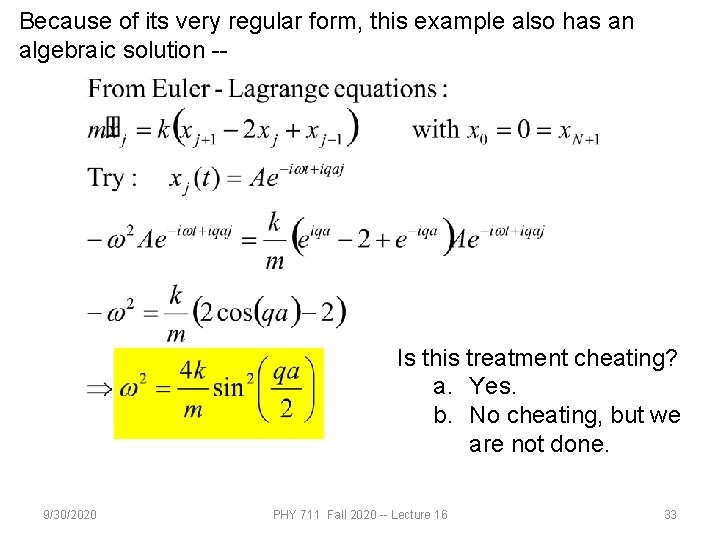
Because of its very regular form, this example also has an algebraic solution -- Is this treatment cheating? a. Yes. b. No cheating, but we are not done. 9/30/2020 PHY 711 Fall 2020 -- Lecture 16 33
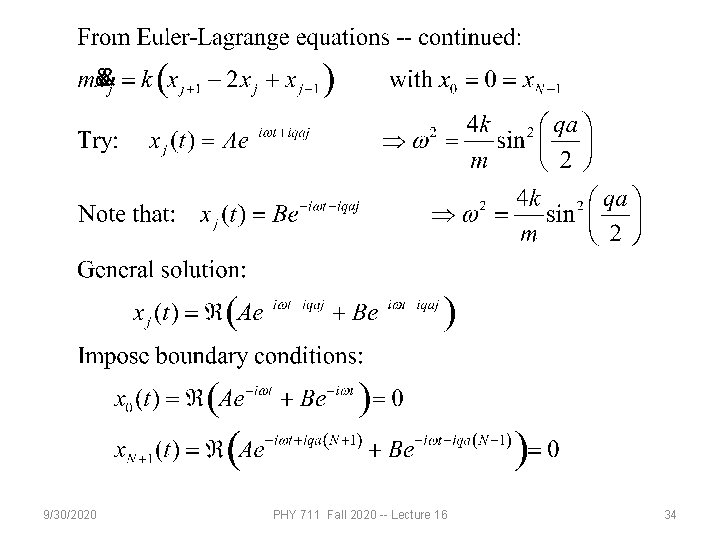
9/30/2020 PHY 711 Fall 2020 -- Lecture 16 34
9/30/2020 PHY 711 Fall 2020 -- Lecture 16 35
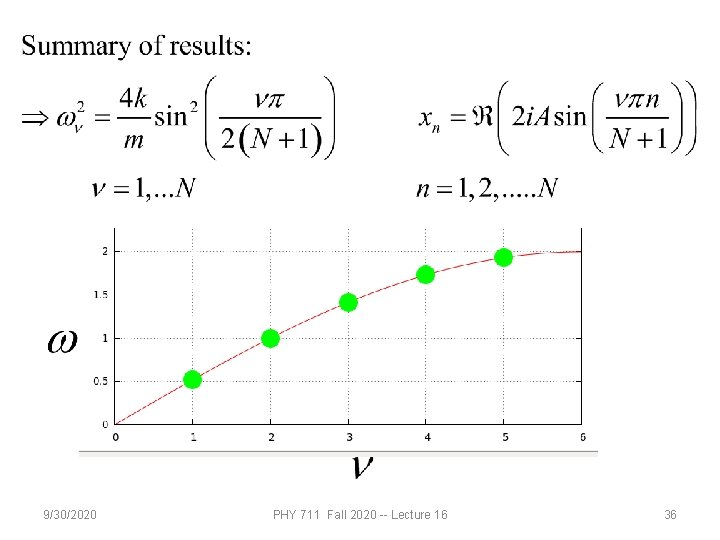
9/30/2020 PHY 711 Fall 2020 -- Lecture 16 36