
PHY 341641 Thermodynamics and Statistical Physics Lecture 36


- Slides: 36
PHY 341/641 Thermodynamics and Statistical Physics Lecture 36 Review and examples • Review of general principles • Review of specific examples 9/13/2021 PHY 341/641 Spring 2012 -- Lecture 36 1
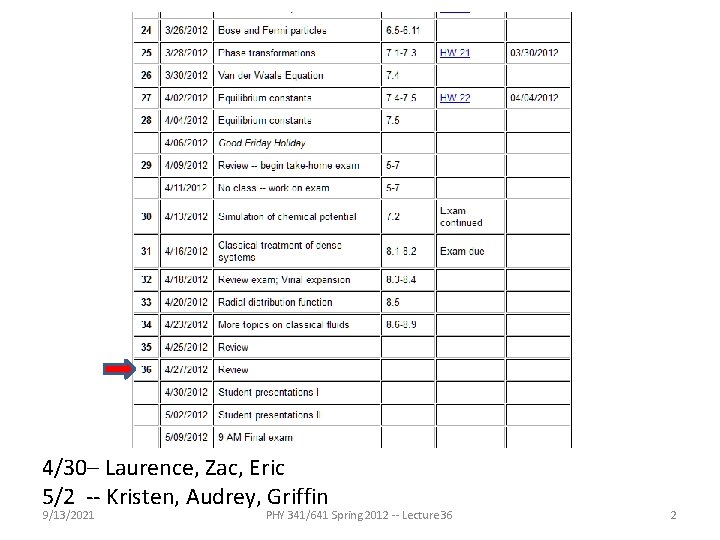
4/30– Laurence, Zac, Eric 5/2 -- Kristen, Audrey, Griffin 9/13/2021 PHY 341/641 Spring 2012 -- Lecture 36 2
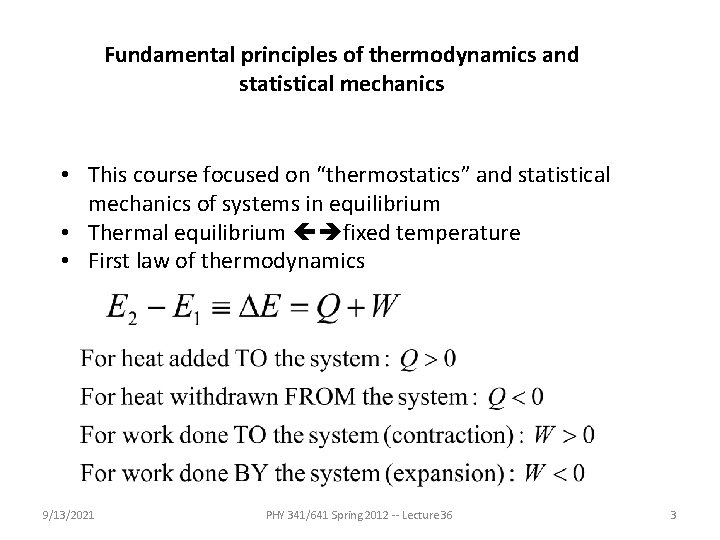
Fundamental principles of thermodynamics and statistical mechanics • This course focused on “thermostatics” and statistical mechanics of systems in equilibrium • Thermal equilibrium fixed temperature • First law of thermodynamics 9/13/2021 PHY 341/641 Spring 2012 -- Lecture 36 3
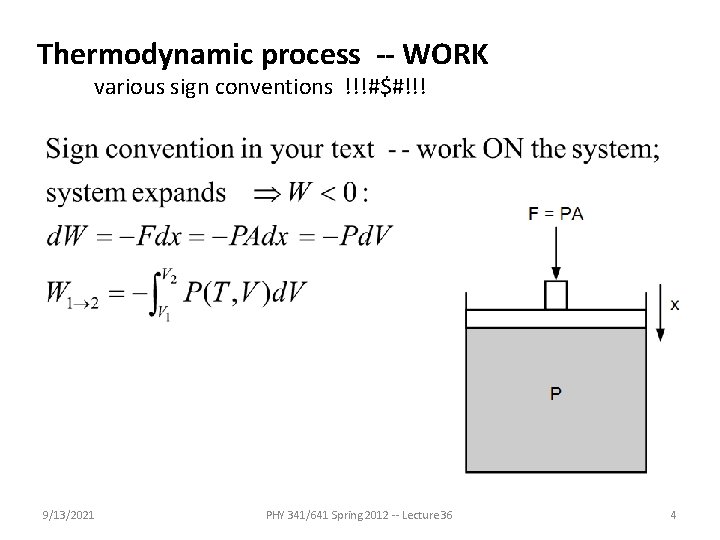
Thermodynamic process -- WORK various sign conventions !!!#$#!!! 9/13/2021 PHY 341/641 Spring 2012 -- Lecture 36 4
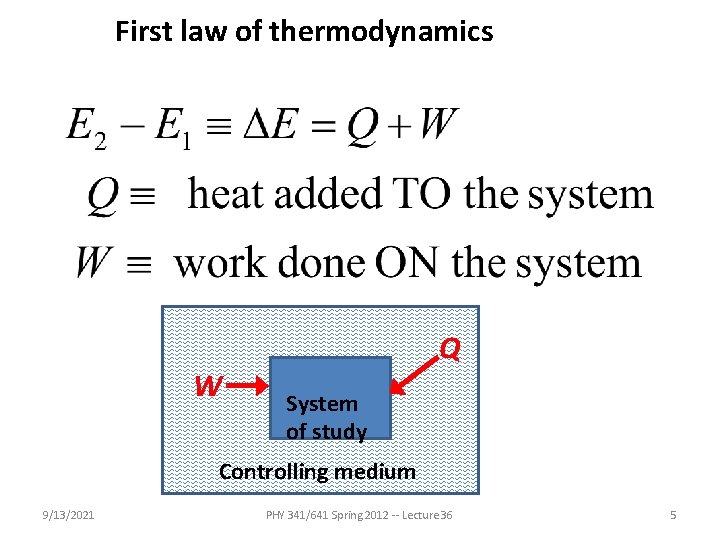
First law of thermodynamics W Q System of study Controlling medium 9/13/2021 PHY 341/641 Spring 2012 -- Lecture 36 5
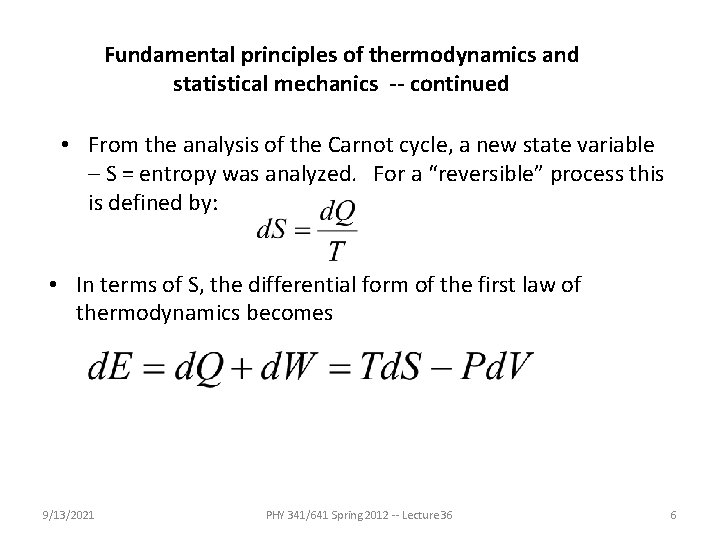
Fundamental principles of thermodynamics and statistical mechanics -- continued • From the analysis of the Carnot cycle, a new state variable – S = entropy was analyzed. For a “reversible” process this is defined by: • In terms of S, the differential form of the first law of thermodynamics becomes 9/13/2021 PHY 341/641 Spring 2012 -- Lecture 36 6
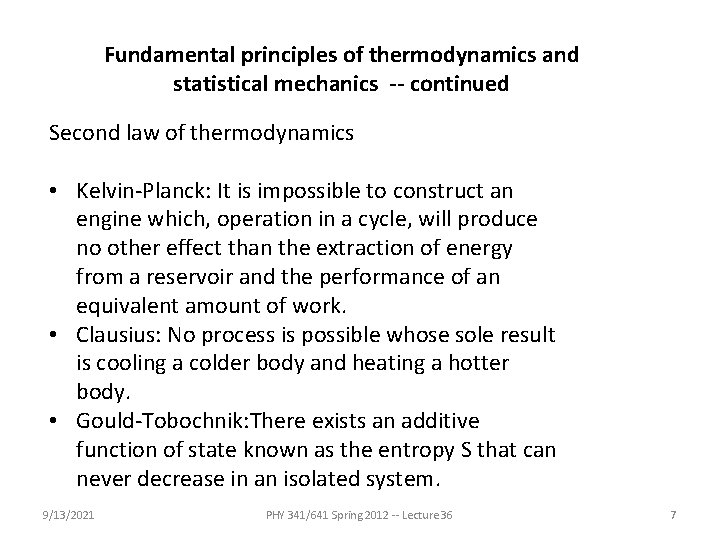
Fundamental principles of thermodynamics and statistical mechanics -- continued Second law of thermodynamics • Kelvin-Planck: It is impossible to construct an engine which, operation in a cycle, will produce no other effect than the extraction of energy from a reservoir and the performance of an equivalent amount of work. • Clausius: No process is possible whose sole result is cooling a colder body and heating a hotter body. • Gould-Tobochnik: There exists an additive function of state known as the entropy S that can never decrease in an isolated system. 9/13/2021 PHY 341/641 Spring 2012 -- Lecture 36 7
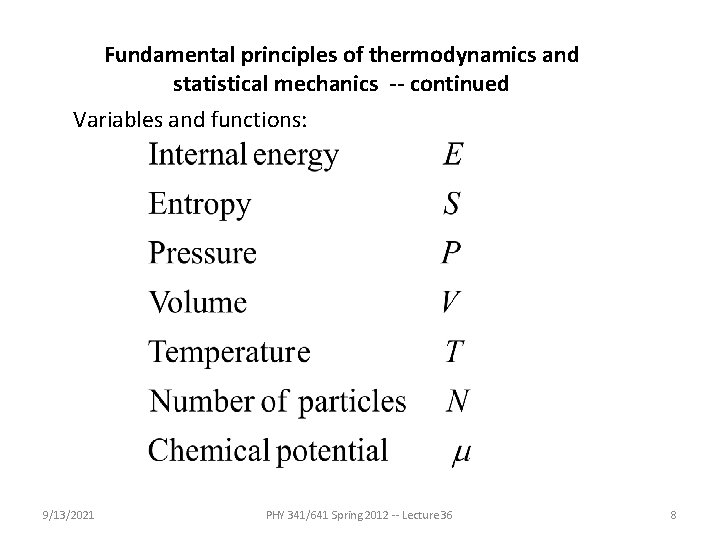
Fundamental principles of thermodynamics and statistical mechanics -- continued Variables and functions: 9/13/2021 PHY 341/641 Spring 2012 -- Lecture 36 8
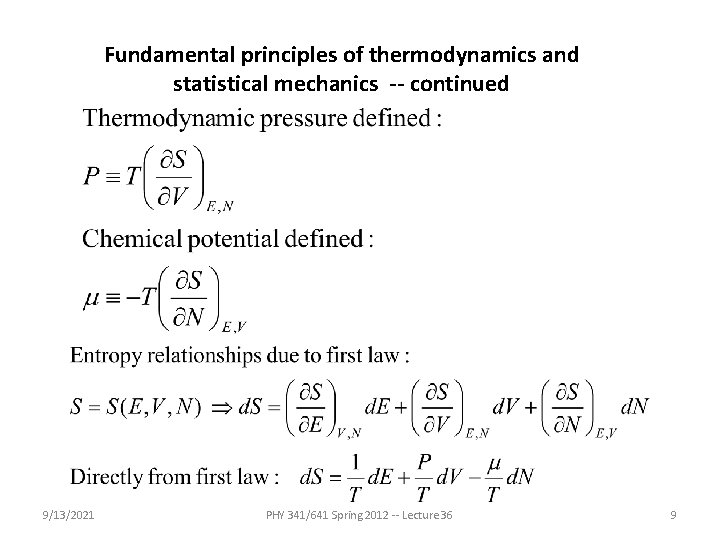
Fundamental principles of thermodynamics and statistical mechanics -- continued 9/13/2021 PHY 341/641 Spring 2012 -- Lecture 36 9
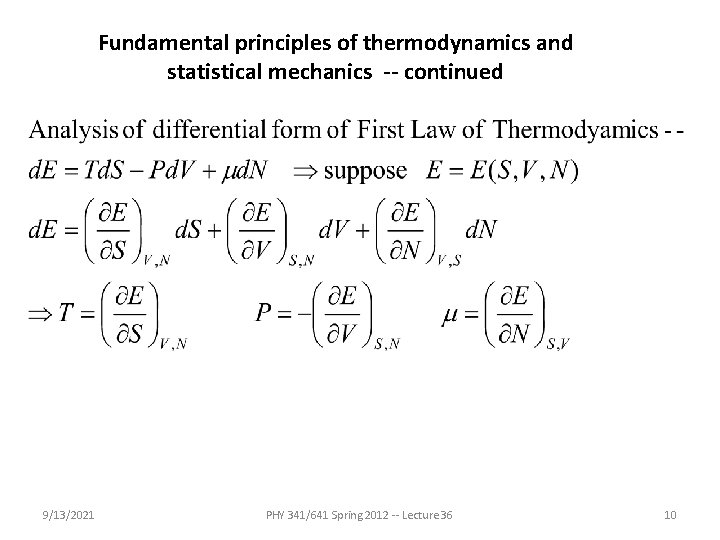
Fundamental principles of thermodynamics and statistical mechanics -- continued 9/13/2021 PHY 341/641 Spring 2012 -- Lecture 36 10
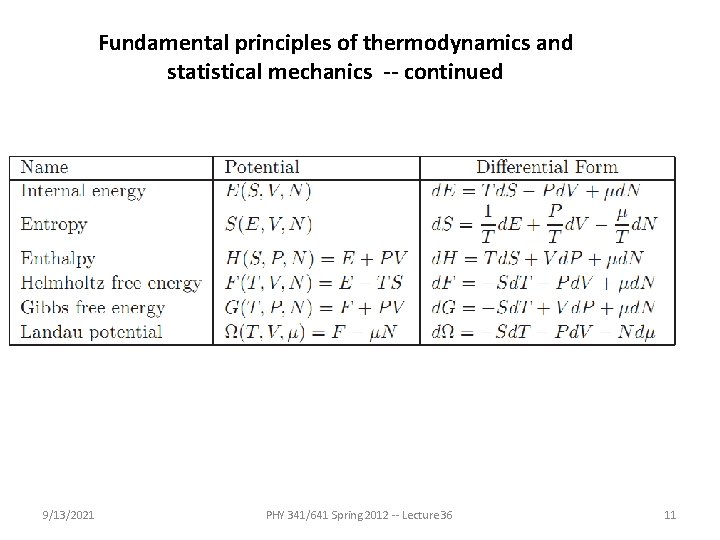
Fundamental principles of thermodynamics and statistical mechanics -- continued 9/13/2021 PHY 341/641 Spring 2012 -- Lecture 36 11
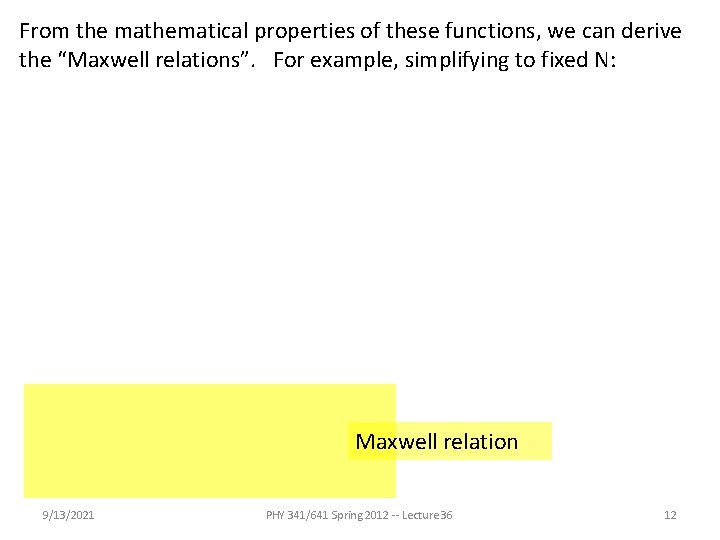
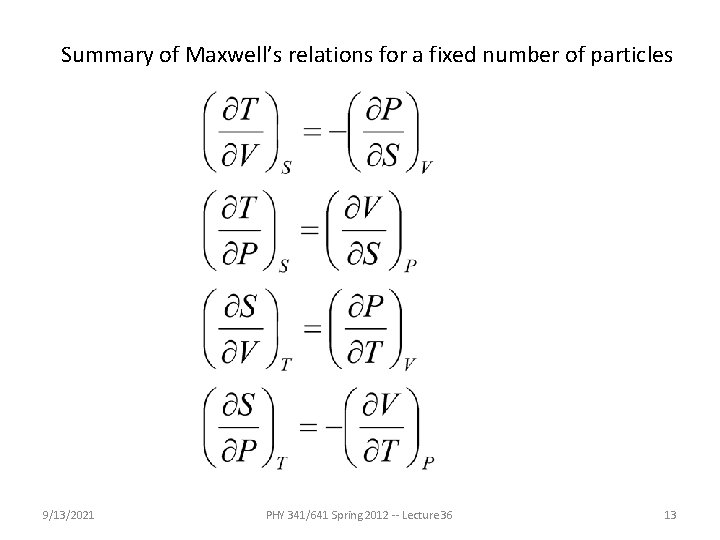
From the mathematical properties of these functions, we can derive the “Maxwell relations”. For example, simplifying to fixed N: Maxwell relation 9/13/2021 PHY 341/641 Spring 2012 -- Lecture 36 12
Summary of Maxwell’s relations for a fixed number of particles 9/13/2021 PHY 341/641 Spring 2012 -- Lecture 36 13
Properties of extended Maxwell’s relations 9/13/2021 PHY 341/641 Spring 2012 -- Lecture 36 14
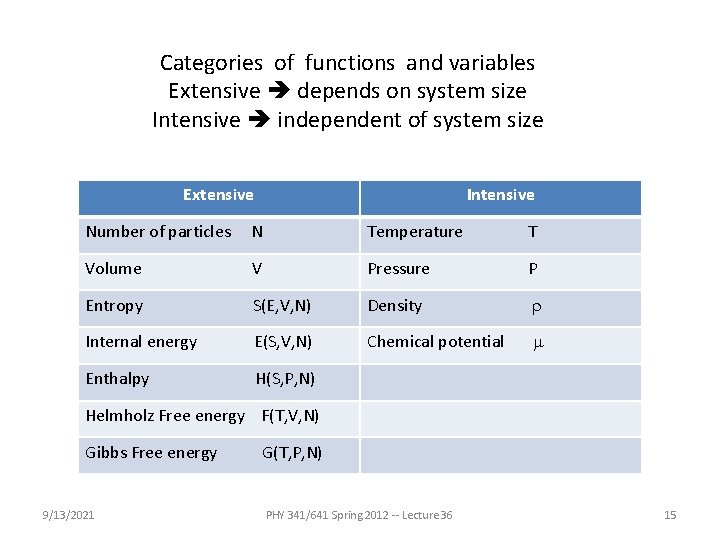
Categories of functions and variables Extensive depends on system size Intensive independent of system size Extensive Intensive Number of particles N Temperature T Volume V Pressure P Entropy S(E, V, N) Density r Internal energy E(S, V, N) Chemical potential m Enthalpy H(S, P, N) Helmholz Free energy F(T, V, N) Gibbs Free energy 9/13/2021 G(T, P, N) PHY 341/641 Spring 2012 -- Lecture 36 15
9/13/2021 PHY 341/641 Spring 2012 -- Lecture 36 16
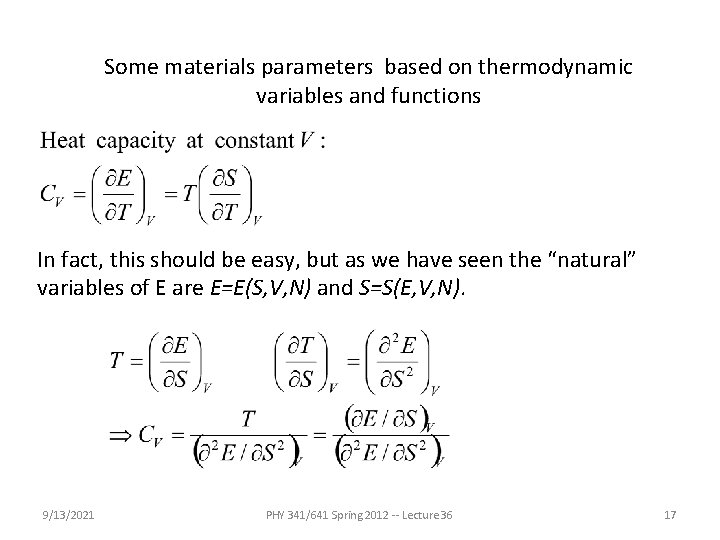
Some materials parameters based on thermodynamic variables and functions In fact, this should be easy, but as we have seen the “natural” variables of E are E=E(S, V, N) and S=S(E, V, N). 9/13/2021 PHY 341/641 Spring 2012 -- Lecture 36 17
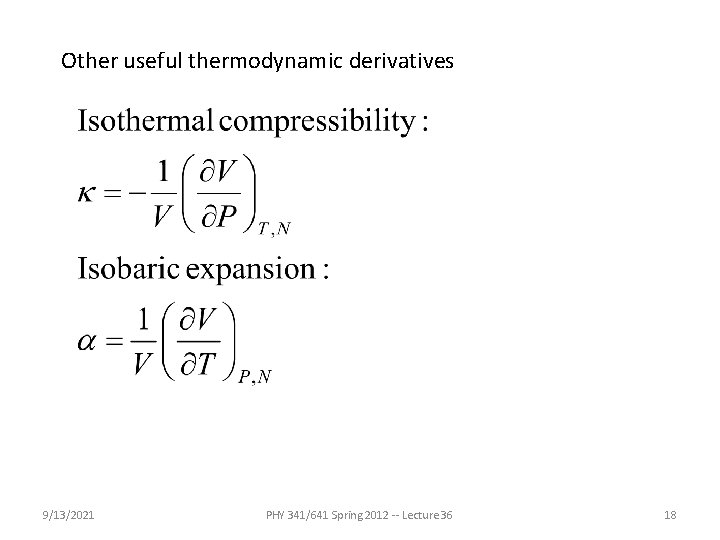
Other useful thermodynamic derivatives 9/13/2021 PHY 341/641 Spring 2012 -- Lecture 36 18
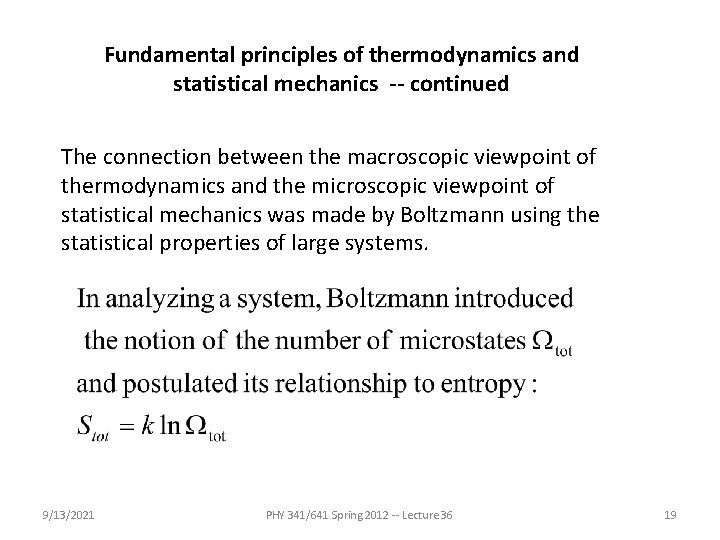
Fundamental principles of thermodynamics and statistical mechanics -- continued The connection between the macroscopic viewpoint of thermodynamics and the microscopic viewpoint of statistical mechanics was made by Boltzmann using the statistical properties of large systems. 9/13/2021 PHY 341/641 Spring 2012 -- Lecture 36 19
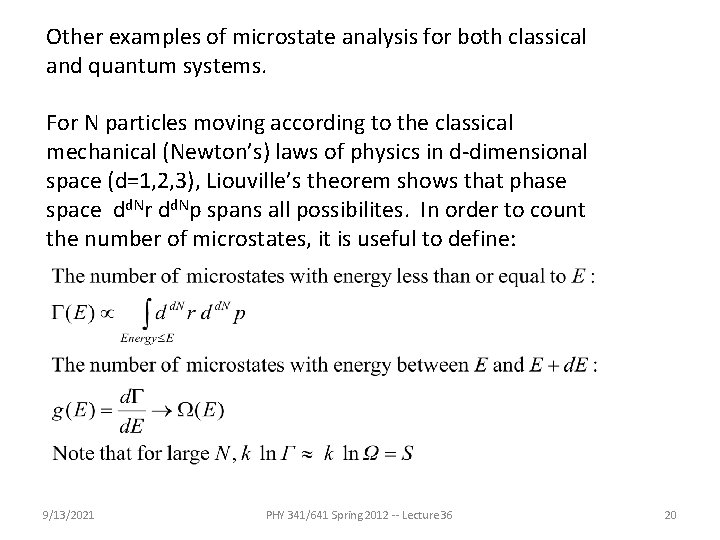
Other examples of microstate analysis for both classical and quantum systems. For N particles moving according to the classical mechanical (Newton’s) laws of physics in d-dimensional space (d=1, 2, 3), Liouville’s theorem shows that phase space dd. Nr dd. Np spans all possibilites. In order to count the number of microstates, it is useful to define: 9/13/2021 PHY 341/641 Spring 2012 -- Lecture 36 20
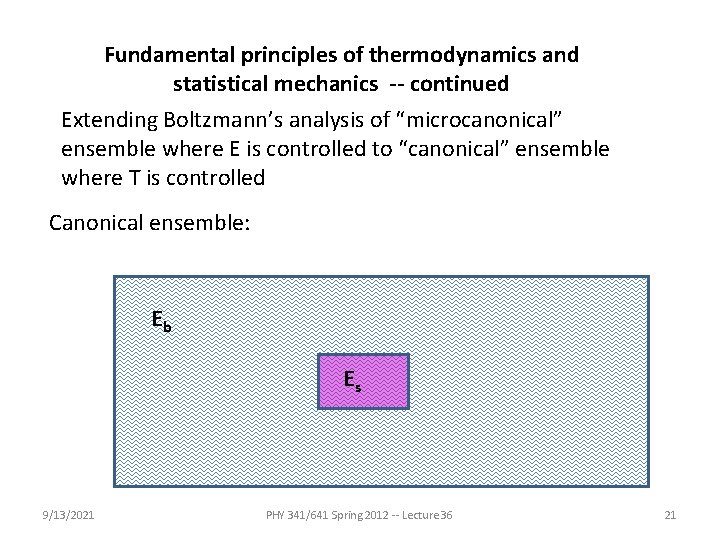
Fundamental principles of thermodynamics and statistical mechanics -- continued Extending Boltzmann’s analysis of “microcanonical” ensemble where E is controlled to “canonical” ensemble where T is controlled Canonical ensemble: Eb Es 9/13/2021 PHY 341/641 Spring 2012 -- Lecture 36 21
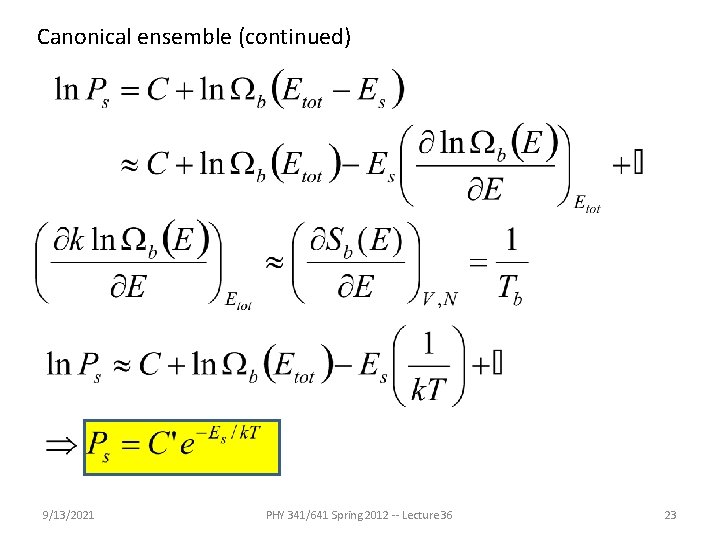
Canonical ensemble (continued) 9/13/2021 PHY 341/641 Spring 2012 -- Lecture 36 22
Canonical ensemble (continued) 9/13/2021 PHY 341/641 Spring 2012 -- Lecture 36 23
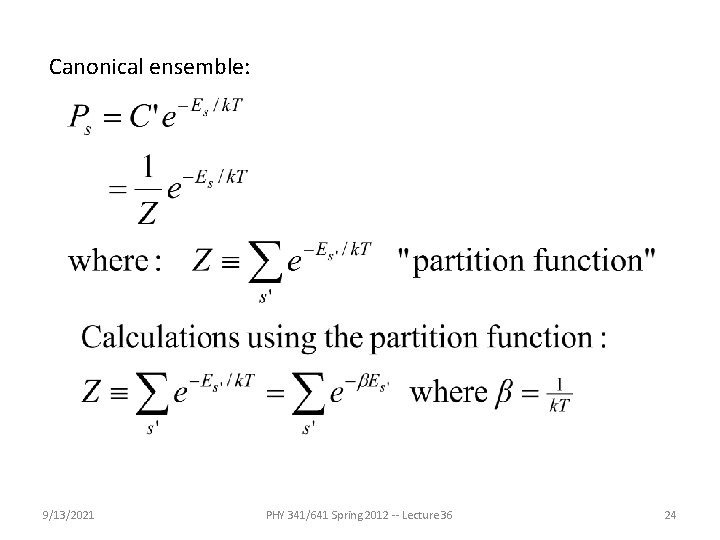
Canonical ensemble: 9/13/2021 PHY 341/641 Spring 2012 -- Lecture 36 24
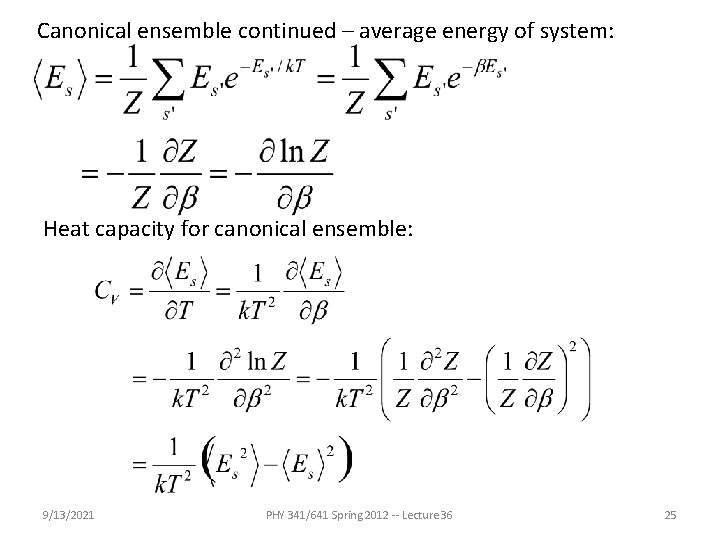
Canonical ensemble continued – average energy of system: Heat capacity for canonical ensemble: 9/13/2021 PHY 341/641 Spring 2012 -- Lecture 36 25
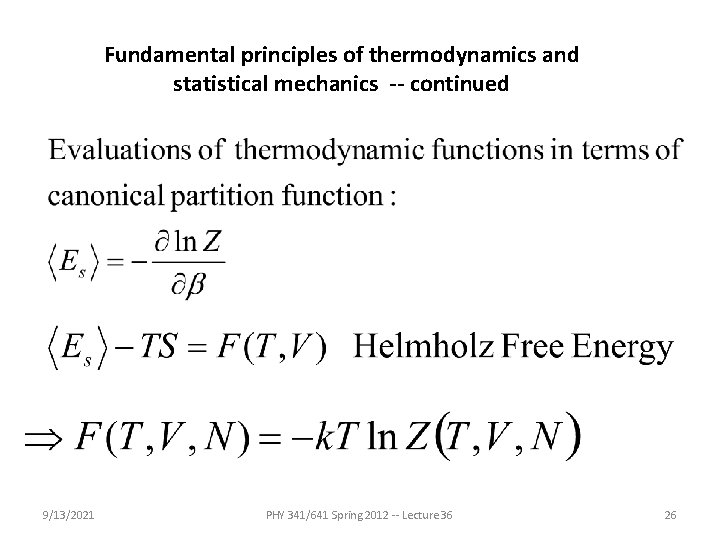
Fundamental principles of thermodynamics and statistical mechanics -- continued 9/13/2021 PHY 341/641 Spring 2012 -- Lecture 36 26
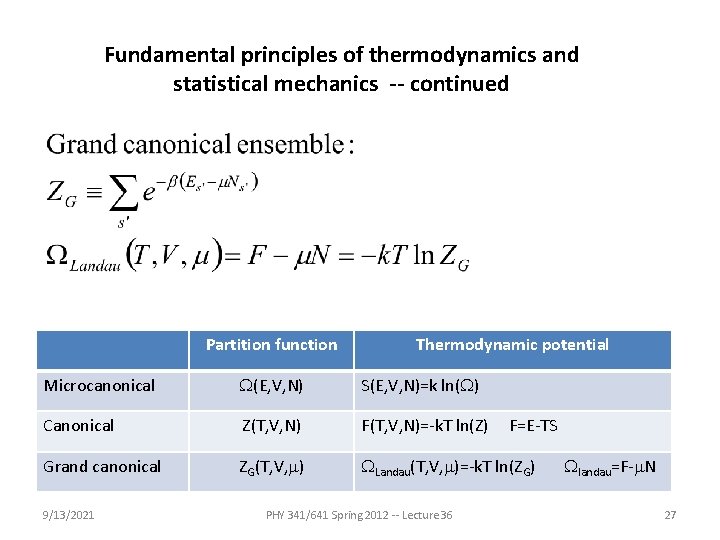
Fundamental principles of thermodynamics and statistical mechanics -- continued Partition function Thermodynamic potential Microcanonical W(E, V, N) S(E, V, N)=k ln(W) Canonical Z(T, V, N) F(T, V, N)=-k. T ln(Z) Grand canonical ZG(T, V, m) WLandau(T, V, m)=-k. T ln(ZG) 9/13/2021 PHY 341/641 Spring 2012 -- Lecture 36 F=E-TS Wlandau=F-m. N 27
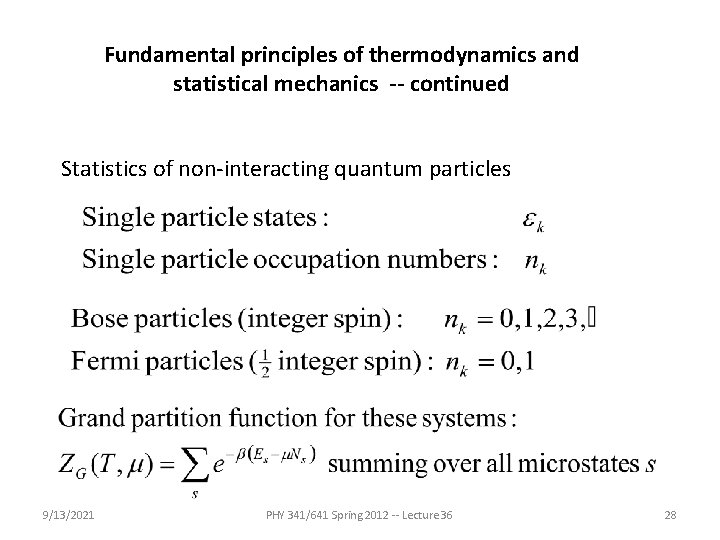
Fundamental principles of thermodynamics and statistical mechanics -- continued Statistics of non-interacting quantum particles 9/13/2021 PHY 341/641 Spring 2012 -- Lecture 36 28
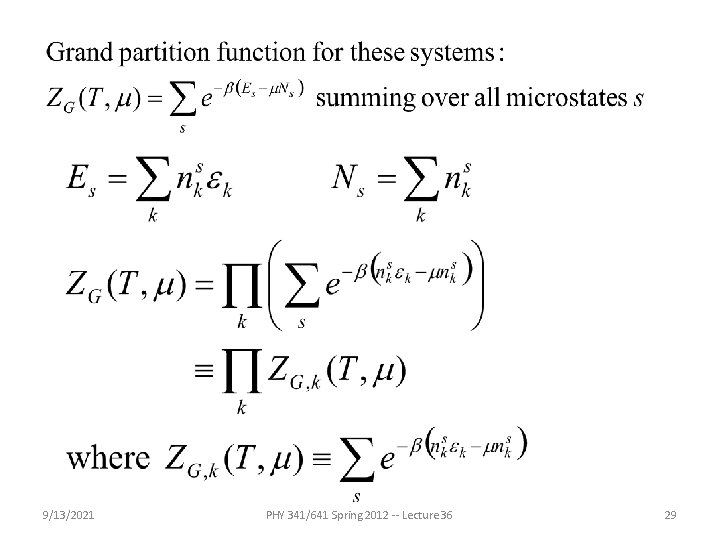
9/13/2021 PHY 341/641 Spring 2012 -- Lecture 36 29
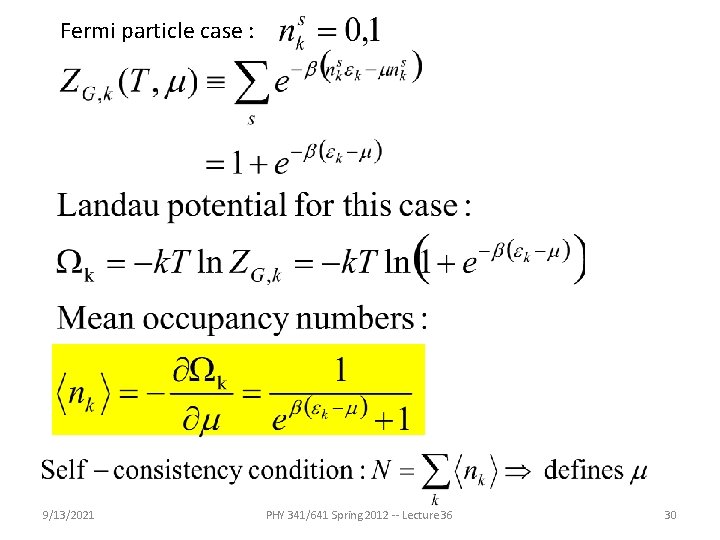
Fermi particle case : 9/13/2021 PHY 341/641 Spring 2012 -- Lecture 36 30
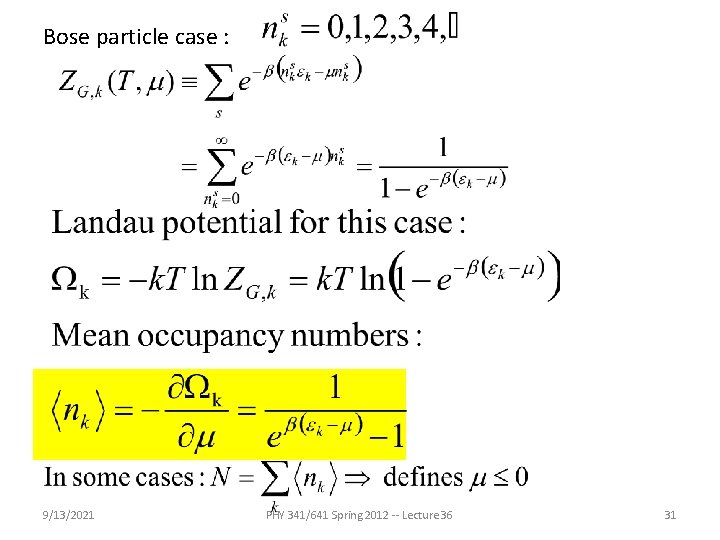
Bose particle case : 9/13/2021 PHY 341/641 Spring 2012 -- Lecture 36 31
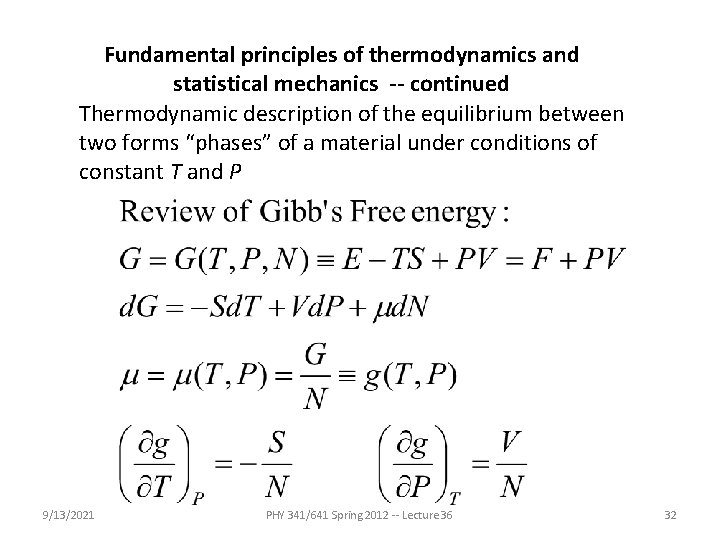
Fundamental principles of thermodynamics and statistical mechanics -- continued Thermodynamic description of the equilibrium between two forms “phases” of a material under conditions of constant T and P 9/13/2021 PHY 341/641 Spring 2012 -- Lecture 36 32
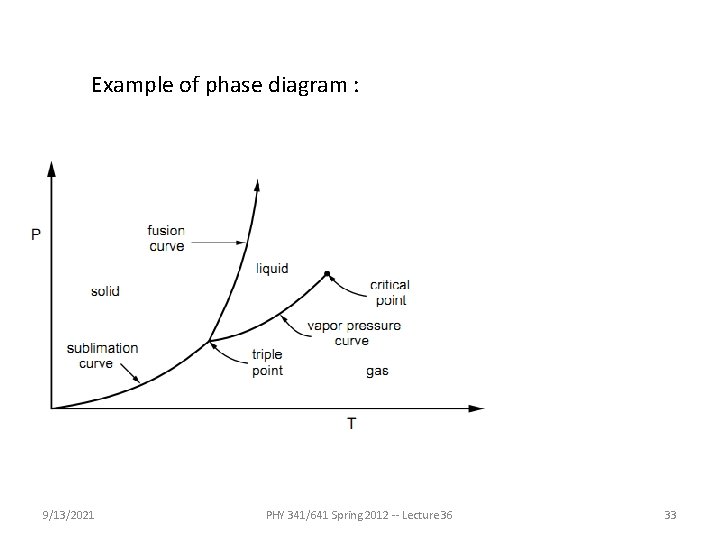
Example of phase diagram : 9/13/2021 PHY 341/641 Spring 2012 -- Lecture 36 33
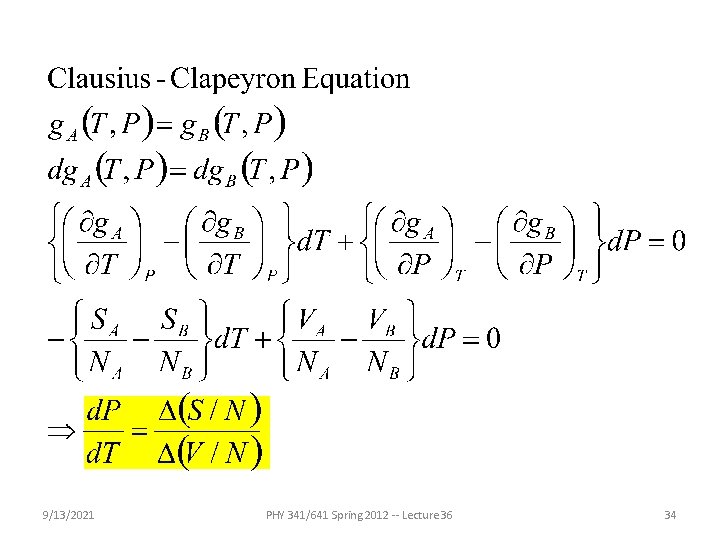
9/13/2021 PHY 341/641 Spring 2012 -- Lecture 36 34
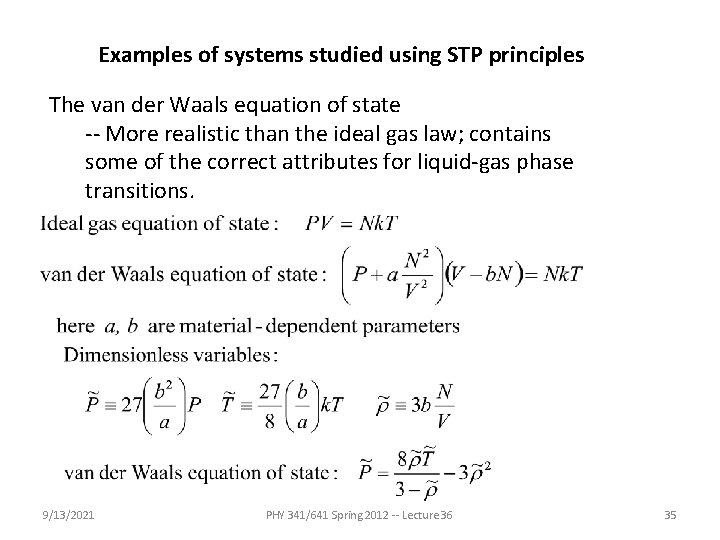
Examples of systems studied using STP principles The van der Waals equation of state -- More realistic than the ideal gas law; contains some of the correct attributes for liquid-gas phase transitions. 9/13/2021 PHY 341/641 Spring 2012 -- Lecture 36 35
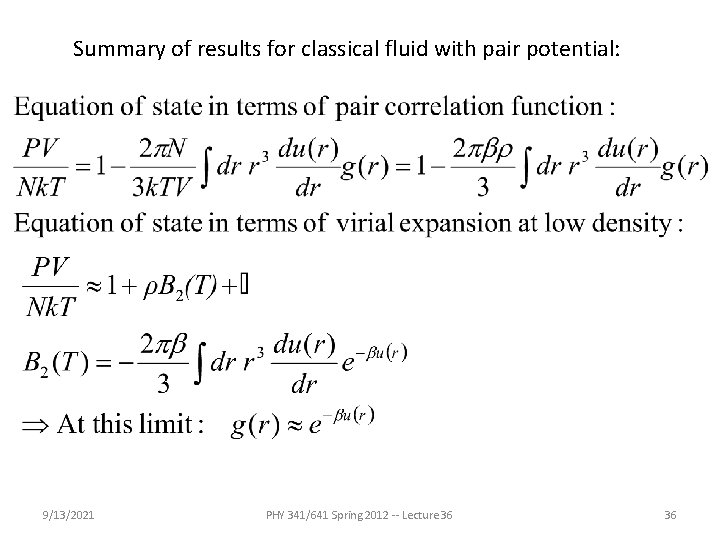
Summary of results for classical fluid with pair potential: 9/13/2021 PHY 341/641 Spring 2012 -- Lecture 36 36