
PHY 184 Spring 2007 Lecture 12 Title Capacitor
- Slides: 21
PHY 184 Spring 2007 Lecture 12 Title: Capacitor calculations 1/29/07 184 Lecture 12 1
Announcements § Homework Set 3 is due tomorrow morning at 8: 00 am. § Midterm 1 will take place in class next week on Thursday, February 8. § Practice exam will be posted in a few days. § Second half of this Thursday’s lecture: review. 1/29/07 184 Lecture 12 2
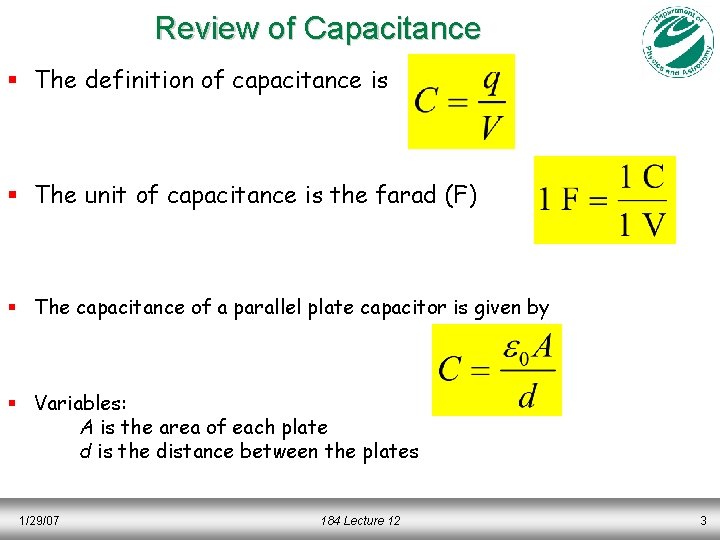
Review of Capacitance § The definition of capacitance is § The unit of capacitance is the farad (F) § The capacitance of a parallel plate capacitor is given by § Variables: A is the area of each plate d is the distance between the plates 1/29/07 184 Lecture 12 3
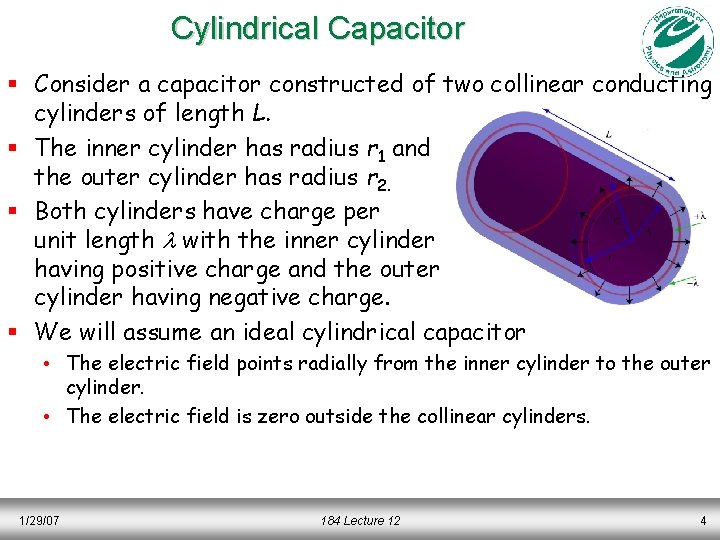
Cylindrical Capacitor § Consider a capacitor constructed of two collinear conducting cylinders of length L. § The inner cylinder has radius r 1 and the outer cylinder has radius r 2. § Both cylinders have charge per unit length with the inner cylinder having positive charge and the outer cylinder having negative charge. § We will assume an ideal cylindrical capacitor • The electric field points radially from the inner cylinder to the outer cylinder. • The electric field is zero outside the collinear cylinders. 1/29/07 184 Lecture 12 4
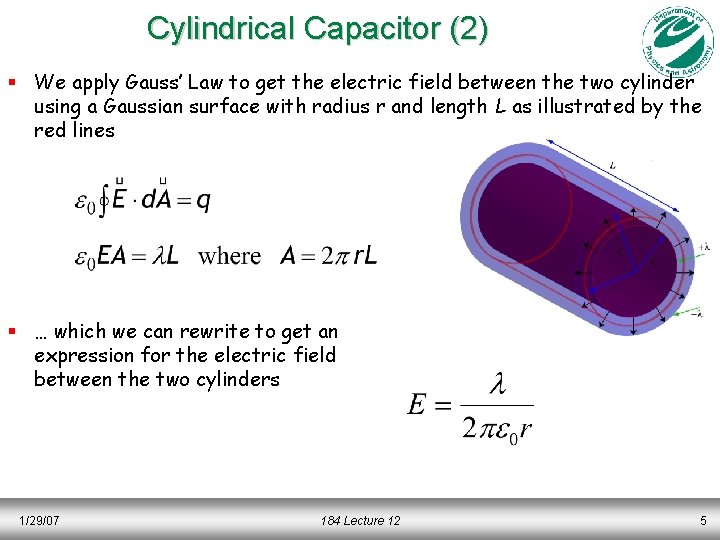
Cylindrical Capacitor (2) § We apply Gauss’ Law to get the electric field between the two cylinder using a Gaussian surface with radius r and length L as illustrated by the red lines § … which we can rewrite to get an expression for the electric field between the two cylinders 1/29/07 184 Lecture 12 5
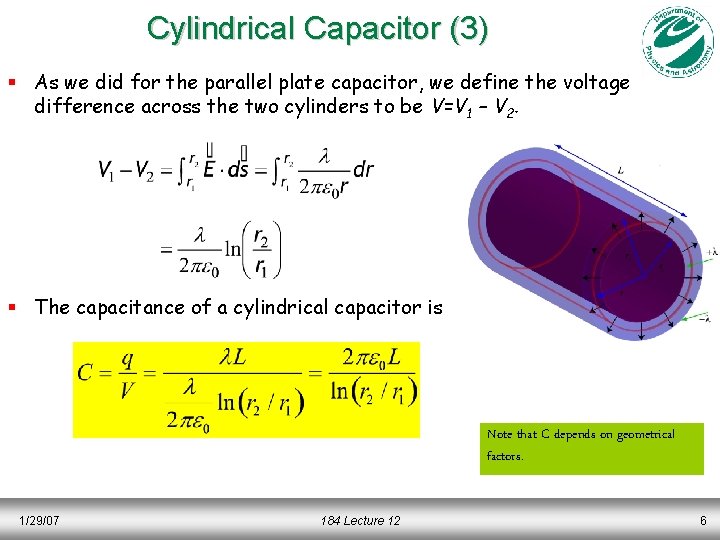
Cylindrical Capacitor (3) § As we did for the parallel plate capacitor, we define the voltage difference across the two cylinders to be V=V 1 – V 2. § The capacitance of a cylindrical capacitor is Note that C depends on geometrical factors. 1/29/07 184 Lecture 12 6
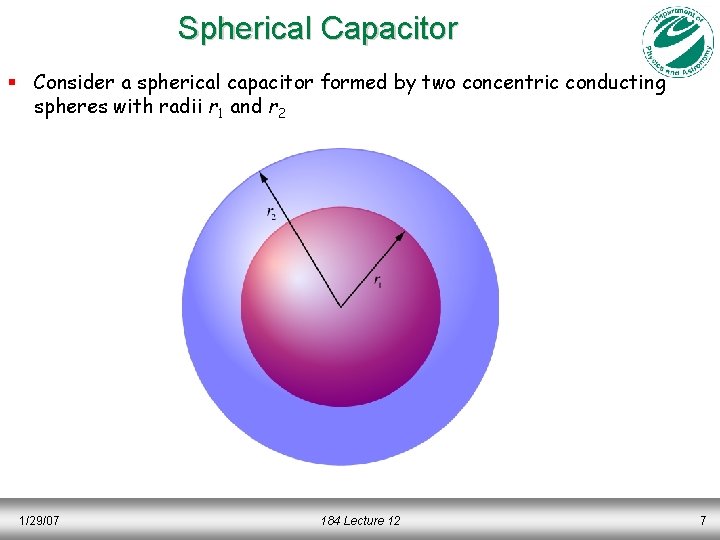
Spherical Capacitor § Consider a spherical capacitor formed by two concentric conducting spheres with radii r 1 and r 2 1/29/07 184 Lecture 12 7
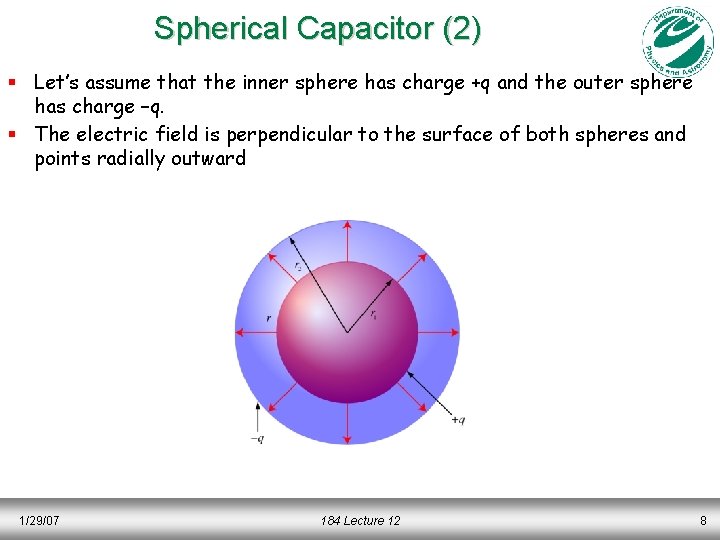
Spherical Capacitor (2) § Let’s assume that the inner sphere has charge +q and the outer sphere has charge –q. § The electric field is perpendicular to the surface of both spheres and points radially outward 1/29/07 184 Lecture 12 8
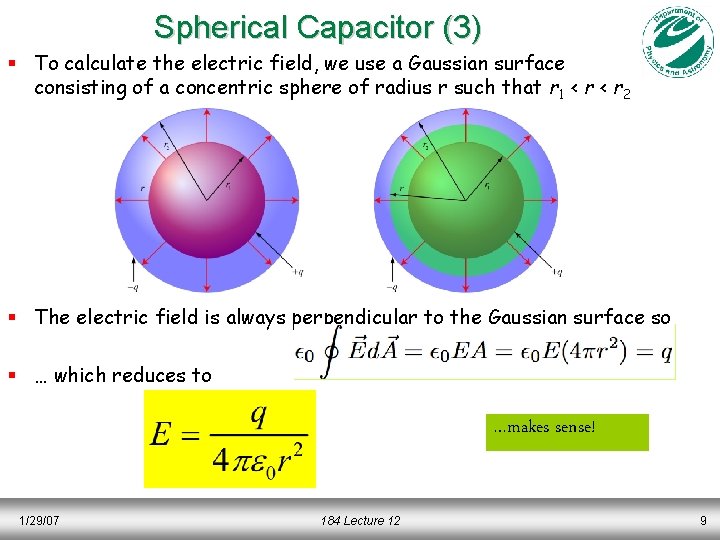
Spherical Capacitor (3) § To calculate the electric field, we use a Gaussian surface consisting of a concentric sphere of radius r such that r 1 < r 2 § The electric field is always perpendicular to the Gaussian surface so § … which reduces to …makes sense! 1/29/07 184 Lecture 12 9
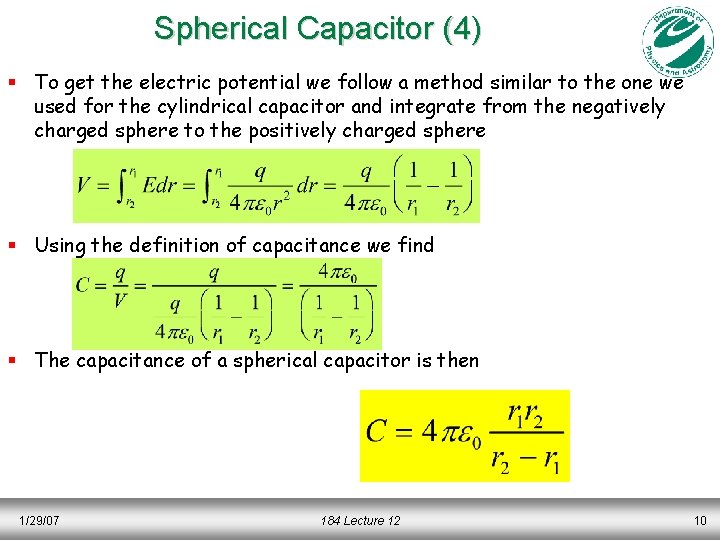
Spherical Capacitor (4) § To get the electric potential we follow a method similar to the one we used for the cylindrical capacitor and integrate from the negatively charged sphere to the positively charged sphere § Using the definition of capacitance we find § The capacitance of a spherical capacitor is then 1/29/07 184 Lecture 12 10
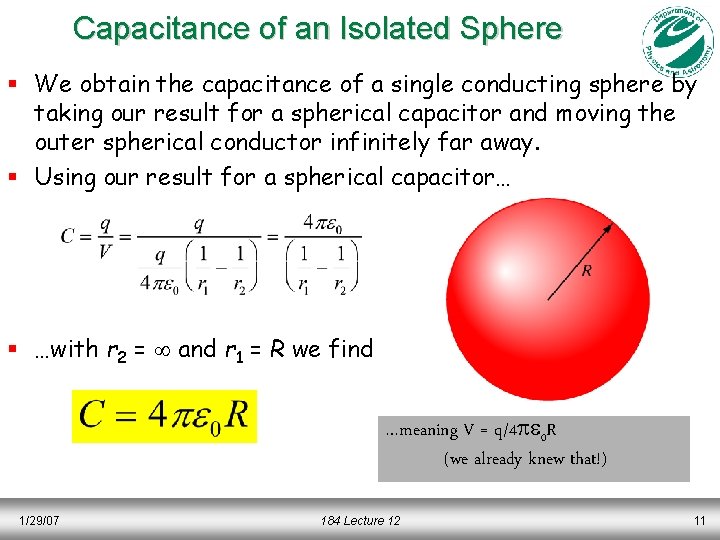
Capacitance of an Isolated Sphere § We obtain the capacitance of a single conducting sphere by taking our result for a spherical capacitor and moving the outer spherical conductor infinitely far away. § Using our result for a spherical capacitor… § …with r 2 = and r 1 = R we find …meaning V = q/4 pe 0 R (we already knew that!) 1/29/07 184 Lecture 12 11
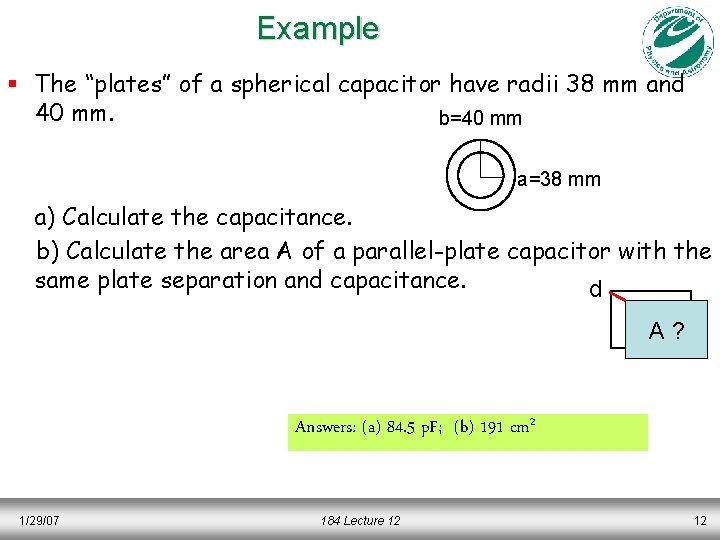
Example § The “plates” of a spherical capacitor have radii 38 mm and 40 mm. b=40 mm a=38 mm a) Calculate the capacitance. b) Calculate the area A of a parallel-plate capacitor with the same plate separation and capacitance. d A? Answers: (a) 84. 5 p. F; (b) 191 cm 2 1/29/07 184 Lecture 12 12
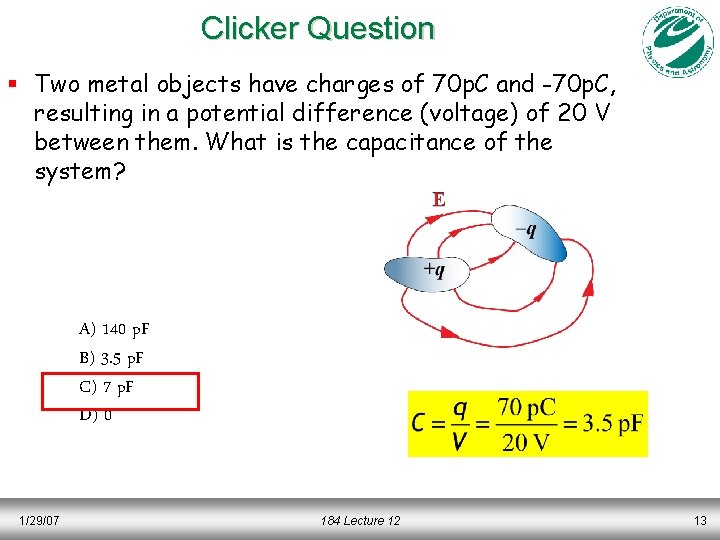
Clicker Question § Two metal objects have charges of 70 p. C and -70 p. C, resulting in a potential difference (voltage) of 20 V between them. What is the capacitance of the system? A) 140 p. F B) 3. 5 p. F C) 7 p. F D) 0 1/29/07 184 Lecture 12 13
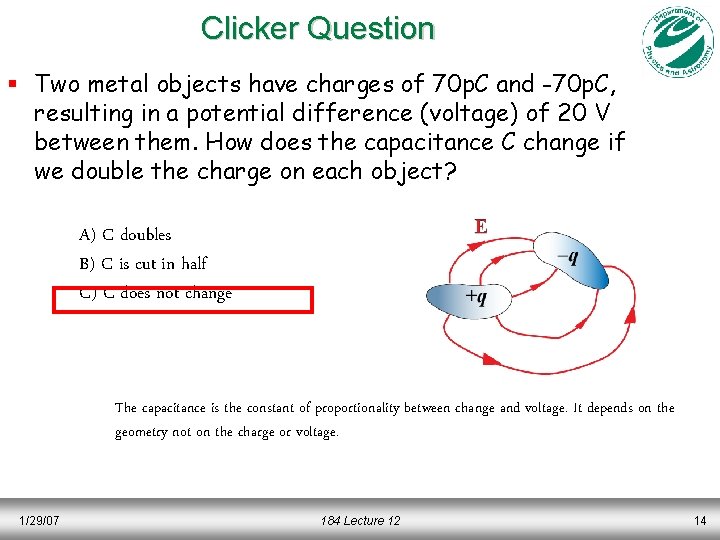
Clicker Question § Two metal objects have charges of 70 p. C and -70 p. C, resulting in a potential difference (voltage) of 20 V between them. How does the capacitance C change if we double the charge on each object? A) C doubles B) C is cut in half C) C does not change The capacitance is the constant of proportionality between change and voltage. It depends on the geometry not on the charge or voltage. 1/29/07 184 Lecture 12 14
Capacitors in Circuits § A circuit is a set of electrical devices connected with conducting wires. § Capacitors can be wired together in circuits in parallel or series • Capacitors in circuits connected by wires such that the positively charged plates are connected together and the negatively charged plates are connected together, are connected in parallel. • Capacitors wired together such that the positively charged plate of one capacitor is connected to the negatively charged plate of the next capacitor are connected in series. 1/29/07 184 Lecture 12 15
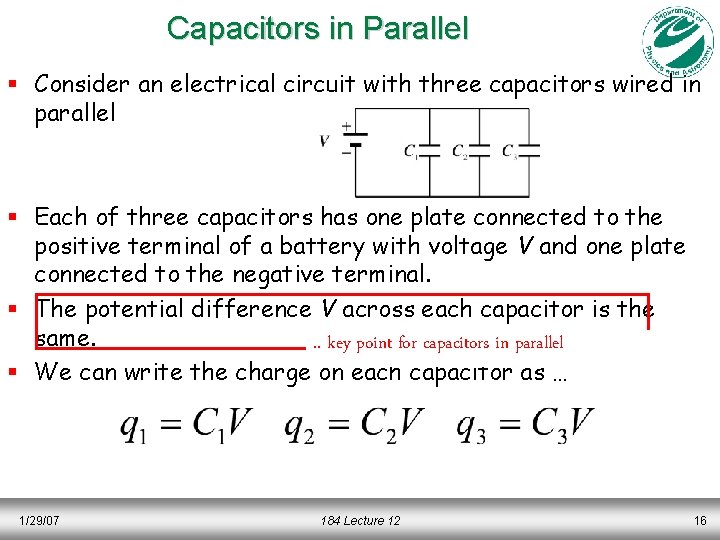
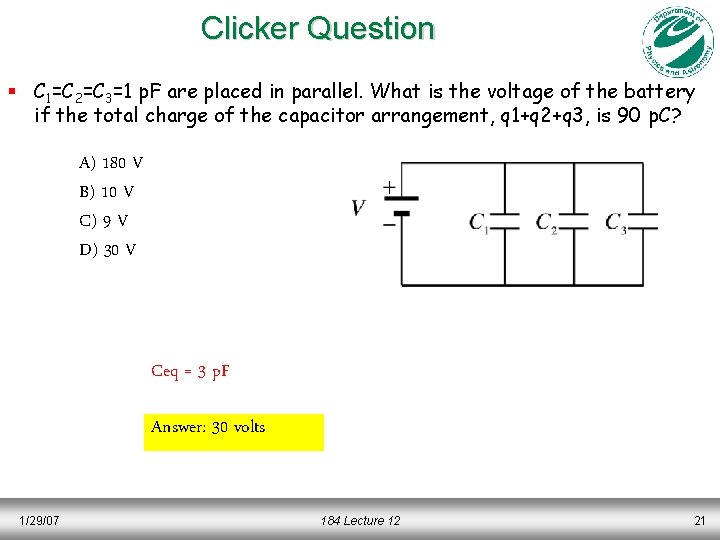
Capacitors in Parallel § Consider an electrical circuit with three capacitors wired in parallel § Each of three capacitors has one plate connected to the positive terminal of a battery with voltage V and one plate connected to the negative terminal. § The potential difference V across each capacitor is the same. . . key point for capacitors in parallel § We can write the charge on each capacitor as … 1/29/07 184 Lecture 12 16
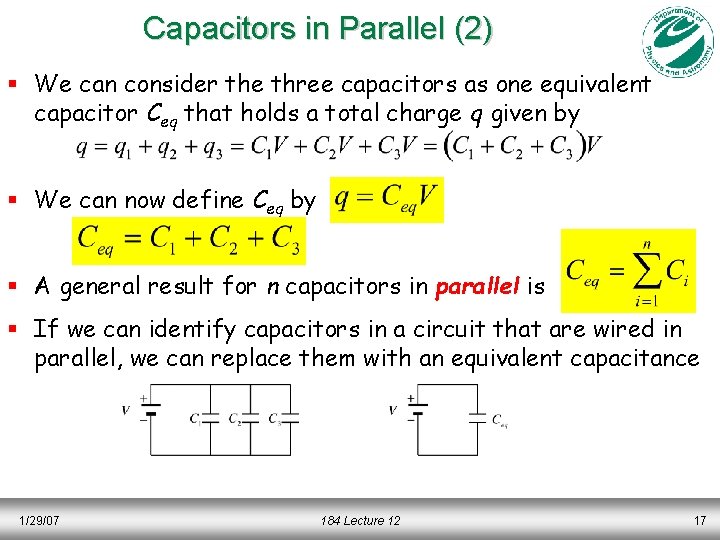
Capacitors in Parallel (2) § We can consider the three capacitors as one equivalent capacitor Ceq that holds a total charge q given by § We can now define Ceq by § A general result for n capacitors in parallel is § If we can identify capacitors in a circuit that are wired in parallel, we can replace them with an equivalent capacitance 1/29/07 184 Lecture 12 17
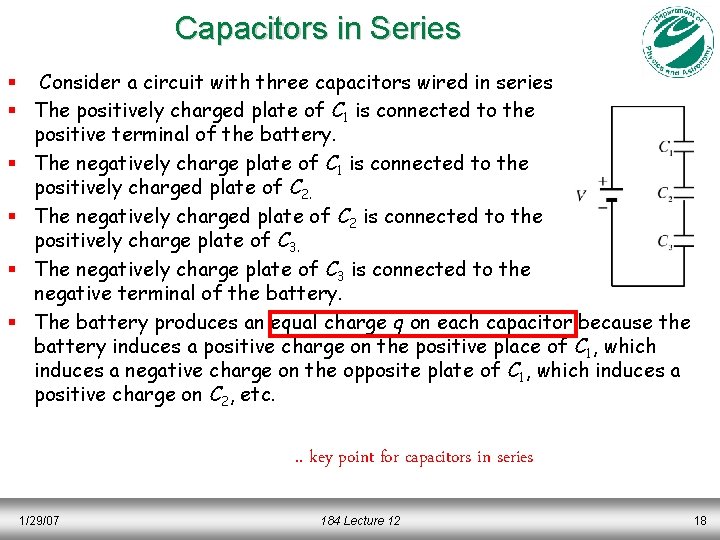
Capacitors in Series § Consider a circuit with three capacitors wired in series § The positively charged plate of C 1 is connected to the positive terminal of the battery. § The negatively charge plate of C 1 is connected to the positively charged plate of C 2. § The negatively charged plate of C 2 is connected to the positively charge plate of C 3. § The negatively charge plate of C 3 is connected to the negative terminal of the battery. § The battery produces an equal charge q on each capacitor because the battery induces a positive charge on the positive place of C 1, which induces a negative charge on the opposite plate of C 1, which induces a positive charge on C 2, etc. . . key point for capacitors in series 1/29/07 184 Lecture 12 18
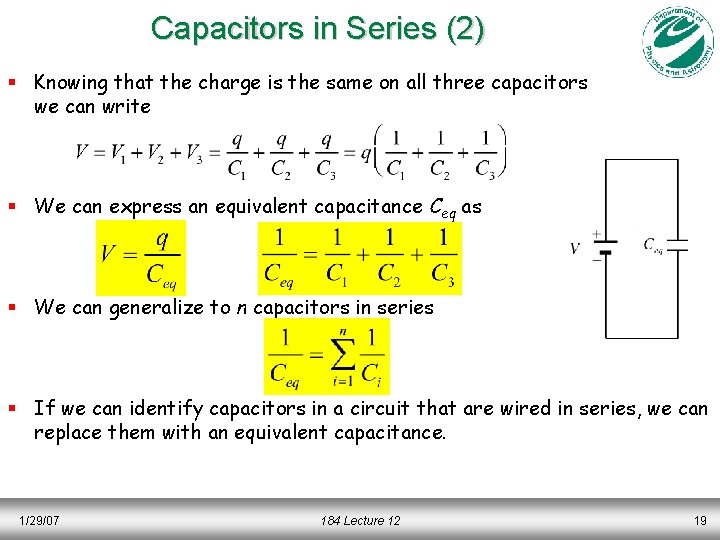
Capacitors in Series (2) § Knowing that the charge is the same on all three capacitors we can write § We can express an equivalent capacitance Ceq as § We can generalize to n capacitors in series § If we can identify capacitors in a circuit that are wired in series, we can replace them with an equivalent capacitance. 1/29/07 184 Lecture 12 19
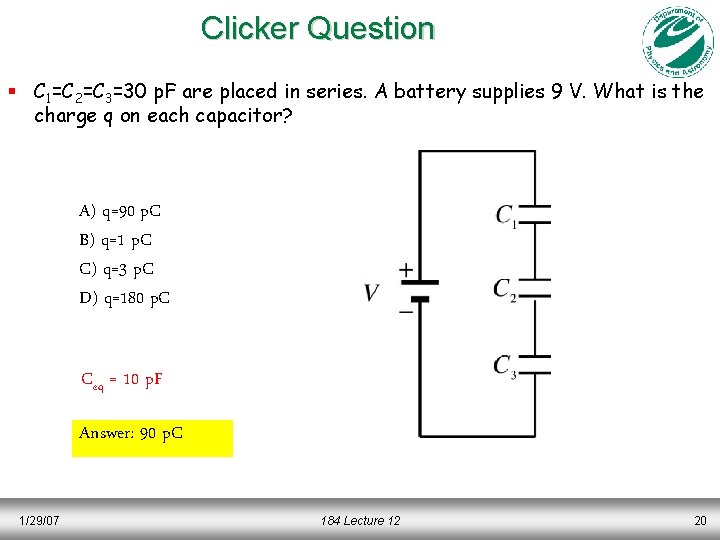
Clicker Question § C 1=C 2=C 3=30 p. F are placed in series. A battery supplies 9 V. What is the charge q on each capacitor? A) q=90 p. C B) q=1 p. C C) q=3 p. C D) q=180 p. C Ceq = 10 p. F Answer: 90 p. C 1/29/07 184 Lecture 12 20
Clicker Question § C 1=C 2=C 3=1 p. F are placed in parallel. What is the voltage of the battery if the total charge of the capacitor arrangement, q 1+q 2+q 3, is 90 p. C? A) 180 V B) 10 V C) 9 V D) 30 V Ceq = 3 p. F Answer: 30 volts 1/29/07 184 Lecture 12 21