
PHY 151 Lecture 20 B 20 4 Work
PHY 151: Lecture 20 B • 20. 4 Work and Heat in Thermodynamic Processes • 20. 5 First Law of Thermodynamics • 20. 6 Some Applications of the First Law of Thermodynamics • 20. 7 Energy Transfer Mechanisms in Thermal Processes
PHY 151: Lecture 20 B First Law of Thermodynamics 20. 4 Work and Heat in Thermodynamics Processes

State Variables • State variables describe the state of a system • Variables may include: – Pressure, temperature, volume, internal energy • The state of an isolated system can be specified only if the system is in thermal equilibrium internally – For a gas in a container, this means every part of the gas must be at the same pressure and temperature

Transfer Variables • Transfer variables are zero unless a process occurs in which energy is transferred across the boundary of a system • Transfer variables are not associated with any given state of the system, only with changes in the state – Heat and work are transfer variables • Transfer variable can be positive or negative, depending on whether energy is entering or leaving the system
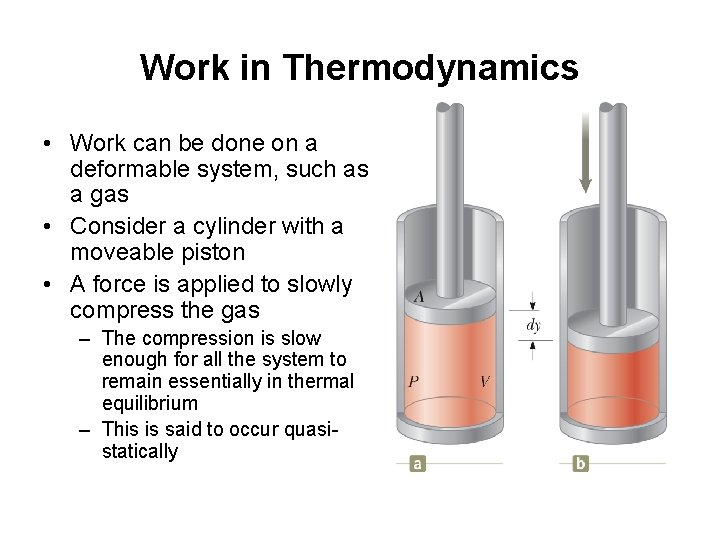
Work in Thermodynamics • Work can be done on a deformable system, such as a gas • Consider a cylinder with a moveable piston • A force is applied to slowly compress the gas – The compression is slow enough for all the system to remain essentially in thermal equilibrium – This is said to occur quasistatically
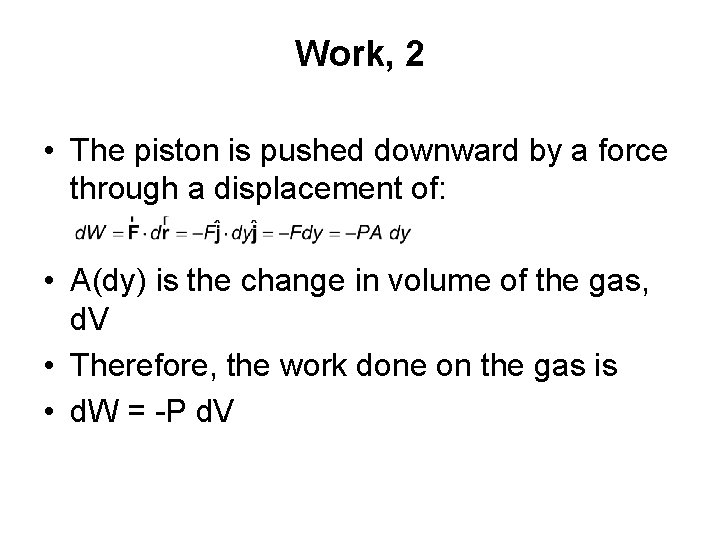
Work, 2 • The piston is pushed downward by a force through a displacement of: • A(dy) is the change in volume of the gas, d. V • Therefore, the work done on the gas is • d. W = -P d. V

Work, 3 • Interpreting d. W = - P d. V – If the gas is compressed, d. V is negative and the work done on the gas is positive – If the gas expands, d. V is positive and the work done on the gas is negative – If the volume remains constant, the work done is zero • The total work done is:
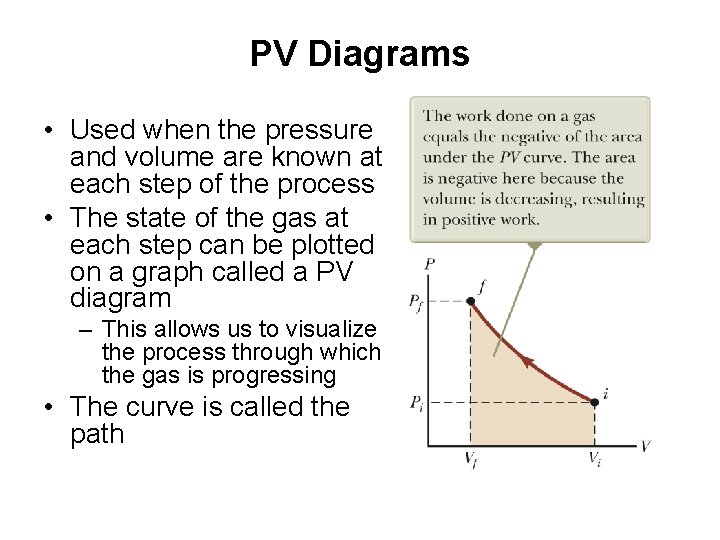
PV Diagrams • Used when the pressure and volume are known at each step of the process • The state of the gas at each step can be plotted on a graph called a PV diagram – This allows us to visualize the process through which the gas is progressing • The curve is called the path
PV Diagrams, cont • The work done on a gas in a quasi-static process that takes the gas from an initial state to a final state is the negative of the area under the curve on the PV diagram, evaluated between the initial and final states – This is true whether or not the pressure stays constant – The work done does depend on the path taken
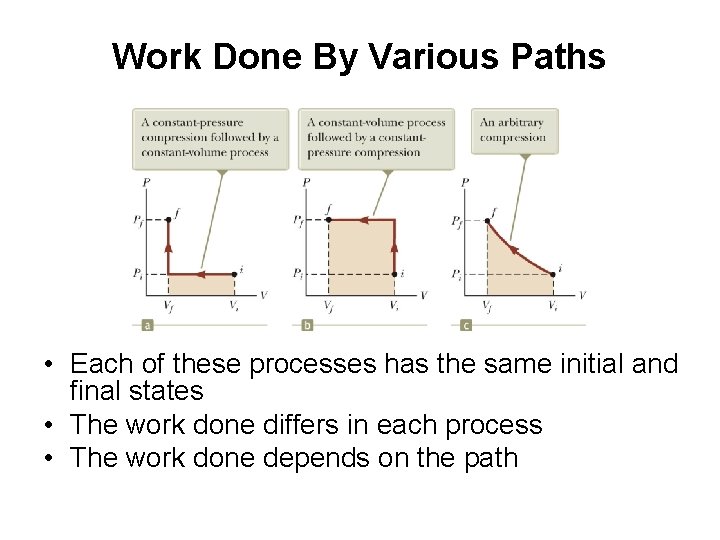
Work Done By Various Paths • Each of these processes has the same initial and final states • The work done differs in each process • The work done depends on the path
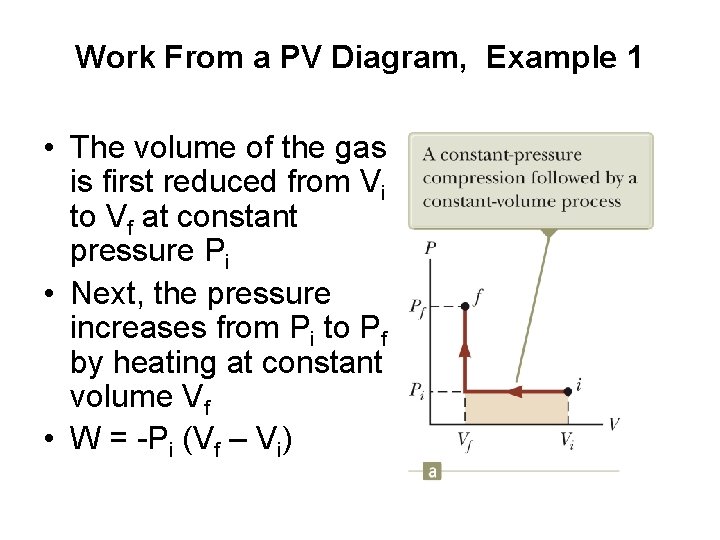
Work From a PV Diagram, Example 1 • The volume of the gas is first reduced from Vi to Vf at constant pressure Pi • Next, the pressure increases from Pi to Pf by heating at constant volume Vf • W = -Pi (Vf – Vi)
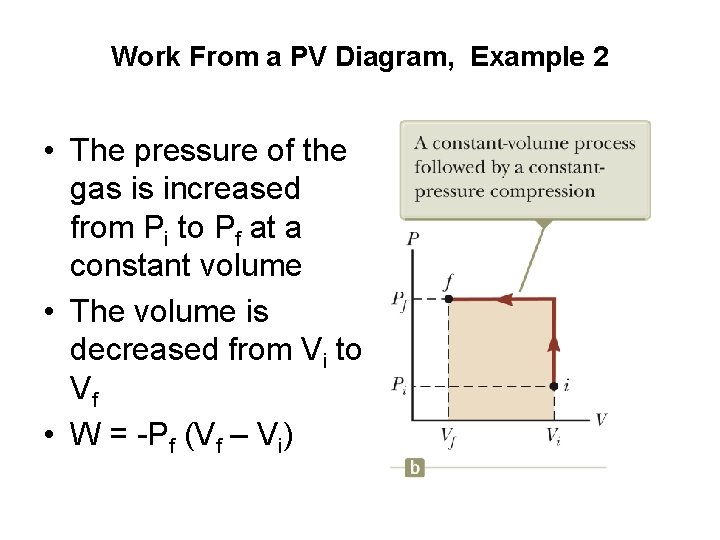
Work From a PV Diagram, Example 2 • The pressure of the gas is increased from Pi to Pf at a constant volume • The volume is decreased from Vi to Vf • W = -Pf (Vf – Vi)
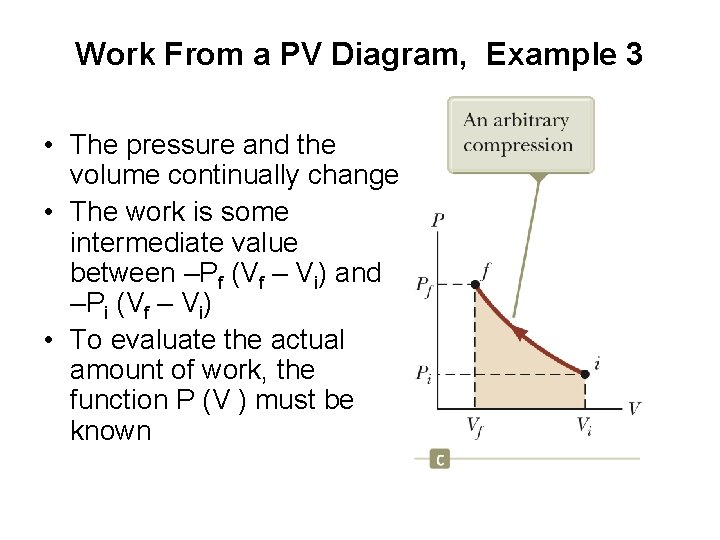
Work From a PV Diagram, Example 3 • The pressure and the volume continually change • The work is some intermediate value between –Pf (Vf – Vi) and –Pi (Vf – Vi) • To evaluate the actual amount of work, the function P (V ) must be known
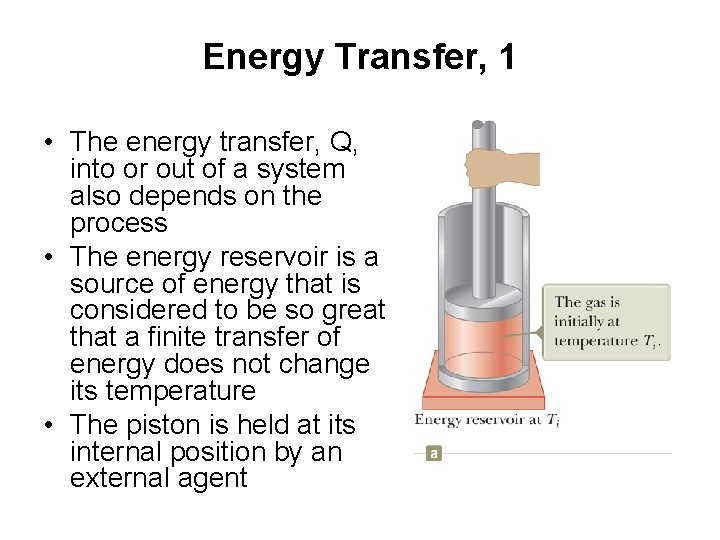
Energy Transfer, 1 • The energy transfer, Q, into or out of a system also depends on the process • The energy reservoir is a source of energy that is considered to be so great that a finite transfer of energy does not change its temperature • The piston is held at its internal position by an external agent
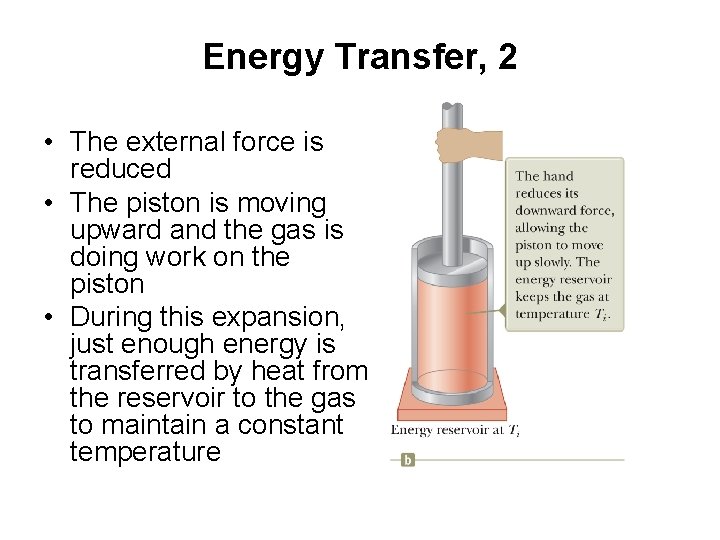
Energy Transfer, 2 • The external force is reduced • The piston is moving upward and the gas is doing work on the piston • During this expansion, just enough energy is transferred by heat from the reservoir to the gas to maintain a constant temperature
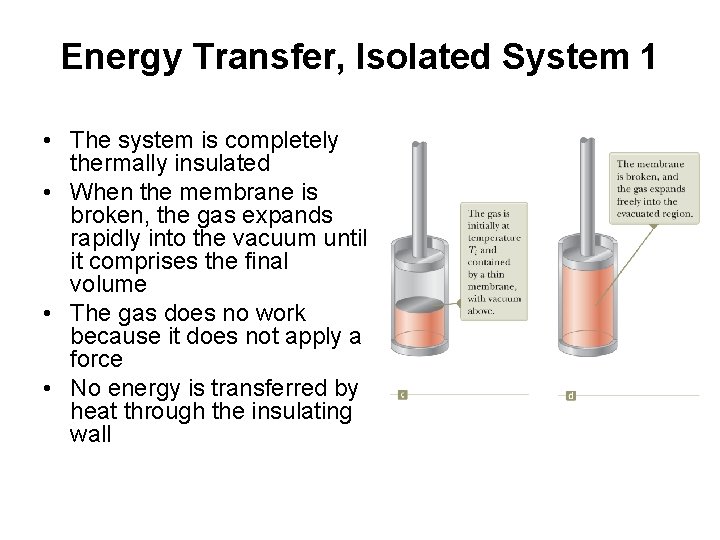
Energy Transfer, Isolated System 1 • The system is completely thermally insulated • When the membrane is broken, the gas expands rapidly into the vacuum until it comprises the final volume • The gas does no work because it does not apply a force • No energy is transferred by heat through the insulating wall
Energy Transfer, Summary • Energy transfers by heat, like the work done, depend on the initial, final, and intermediate states of the system • Both work and heat depend on the path taken • Neither can be determined solely by the end points of a thermodynamic process
PHY 151: Lecture 20 B First Law of Thermodynamics 20. 5 The First Law of Thermodynamics
The First Law of Thermodynamics • The First Law of Thermodynamics is a special case of the Law of Conservation of Energy – It is a special cases when only the internal energy changes and the only energy transfers are by heat and work • The First Law of Thermodynamics states that • DEint = Q + W – All quantities must have the same units of measure of energy • One consequence of the first law is that there must exist some quantity known as internal energy which is determined by the state of the system – The internal energy is therefore a state variable
PHY 151: Lecture 20 B First Law of Thermodynamics 20. 6 Some Applications of the First Law of Thermodynamics
Isolated Systems • An isolated system is one that does not interact with its surroundings – No energy transfer by heat takes place – The work done on the system is zero ØQ = W = 0, so DEint = 0 • The internal energy of an isolated system remains constant
Cyclic Processes • A cyclic process is one that starts and ends in the same state – This process would not be isolated – On a PV diagram, a cyclic process appears as a closed curve • The internal energy must be zero since it is a state variable • If DEint = 0, Q = -W • In a cyclic process, the net work done on the system per cycle equals the area enclosed by the path representing the process on a PV diagram
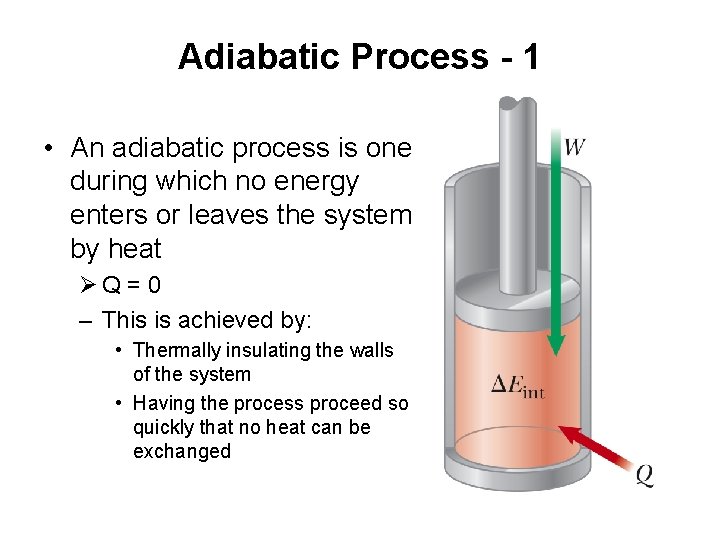
Adiabatic Process - 1 • An adiabatic process is one during which no energy enters or leaves the system by heat ØQ = 0 – This is achieved by: • Thermally insulating the walls of the system • Having the process proceed so quickly that no heat can be exchanged
Adiabatic Process - 2 • Since Q = 0, DEint = W • If the gas is compressed adiabatically, W is positive so DEint is positive and the temperature of the gas increases • If the gas expands adiabatically, the temperature of the gas decreases • Some important examples of adiabatic processes related to engineering are: – The expansion of hot gases in an internal combustion engine – The liquefaction of gases in a cooling system – The compression stroke in a diesel engine
Adiabatic Free Expansion • The process is adiabatic because it takes place in an insulated container • Because the gas expands into a vacuum, it does not apply a force on a piston and W=0 • Since Q = 0 and W = 0, DEint = 0 and the initial and final states are the same – No change in temperature is expected
Isobaric Processes • An isobaric process is one that occurs at a constant pressure – May be accomplished by allowing the piston to move freely so that it is always in equilibrium between the net force from the gas pushing upward and the weight of the piston plus the force due to atmospheric pressure pushing downward • The values of the heat and the work are generally both nonzero • The work done is W = -P (Vf – Vi) where P is the constant pressure
Isovolumetric Processes • An isovolumetric process is one in which there is no change in the volume – This may be accomplished by clamping the piston at a fixed position • Since the volume does not change, W = 0 • From the first law, DEint = Q • If energy is added by heat to a system kept at constant volume, all of the transferred energy remains in the system as an increase in its internal energy
Isothermal Process - 1 • An isothermal process is one that occurs at a constant temperature – This can be accomplished by putting the cylinder in contact with some constant-temperature reservoir • Since there is no change in temperature, DEint = 0 • Therefore, Q = - W • Any energy that enters the system by heat must leave the system by work
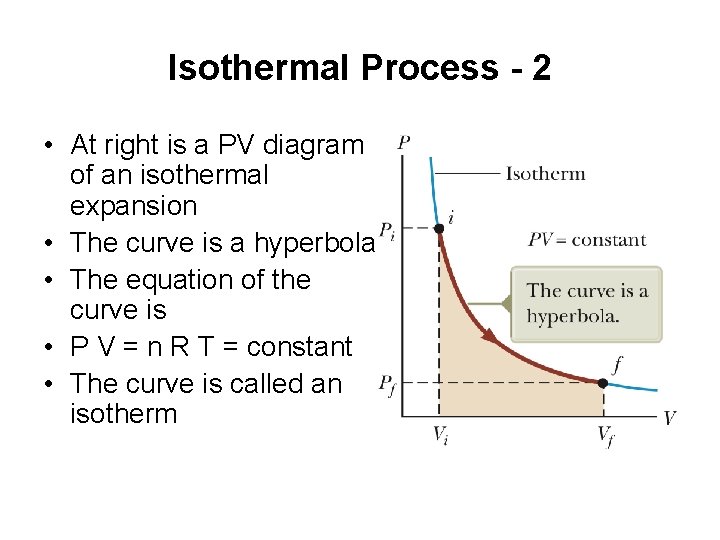
Isothermal Process - 2 • At right is a PV diagram of an isothermal expansion • The curve is a hyperbola • The equation of the curve is • P V = n R T = constant • The curve is called an isotherm
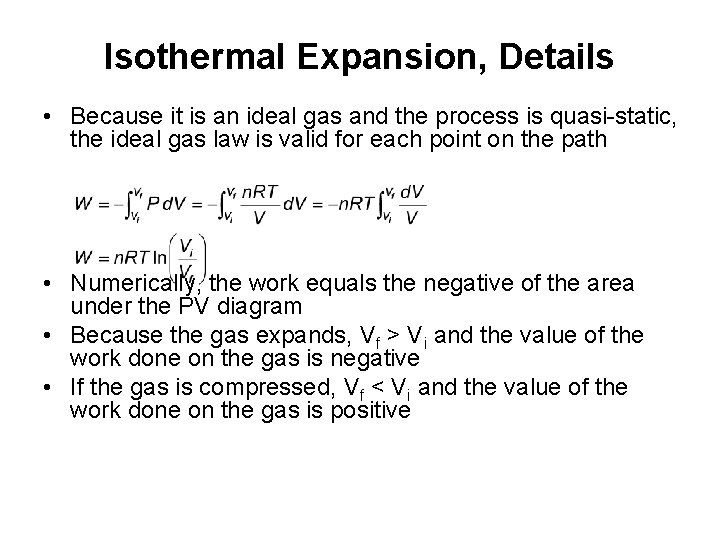
Isothermal Expansion, Details • Because it is an ideal gas and the process is quasi-static, the ideal gas law is valid for each point on the path • Numerically, the work equals the negative of the area under the PV diagram • Because the gas expands, Vf > Vi and the value of the work done on the gas is negative • If the gas is compressed, Vf < Vi and the value of the work done on the gas is positive
Isothermal Expansion Example – 1 a • A 1. 0 mol example of an ideal gas is kept at 0. 0 0 C during an expansion from 3. 0 L to 10. 0 L • (a) How much work is done on the gas during the expansion • W = n. RTln(vi/vf) = (1. 0)(8. 31)(273)ln(3. 0/10. 0) • W = -2. 07 x 103 J • (b) How much energy transfer by heat occurs between the gas and its surroundings in this process

Isothermal Expansion Example – 1 b • (b) How much energy transfer by heat occurs between the gas and its surroundings in this process • DEint = Q + W • 0=Q+W • Q = - W = 2. 7 x 10³ J • (c) If the gas is returned to the original volume by means of an isobaric process, how much work is done on the gas? • W = -P(Vf – Vi) = -(n. RTi/Vi)(Vf – Vi) • W = -(1. 0)(8. 31)(273)/10. 0 x 10 -3)(3 x 10 -3– 10 x 10 -3) • W = 1. 6 x 10³ J
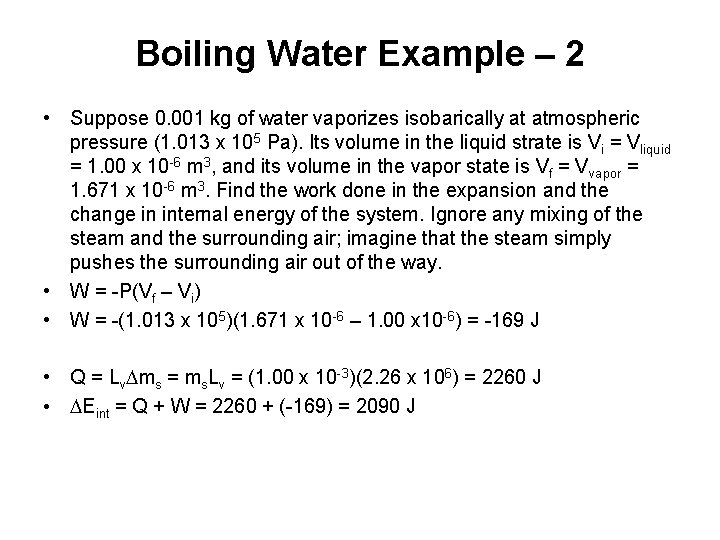
Boiling Water Example – 2 • Suppose 0. 001 kg of water vaporizes isobarically at atmospheric pressure (1. 013 x 105 Pa). Its volume in the liquid strate is Vi = Vliquid = 1. 00 x 10 -6 m 3, and its volume in the vapor state is Vf = Vvapor = 1. 671 x 10 -6 m 3. Find the work done in the expansion and the change in internal energy of the system. Ignore any mixing of the steam and the surrounding air; imagine that the steam simply pushes the surrounding air out of the way. • W = -P(Vf – Vi) • W = -(1. 013 x 105)(1. 671 x 10 -6 – 1. 00 x 10 -6) = -169 J • Q = Lv. Dms = ms. Lv = (1. 00 x 10 -3)(2. 26 x 106) = 2260 J • DEint = Q + W = 2260 + (-169) = 2090 J
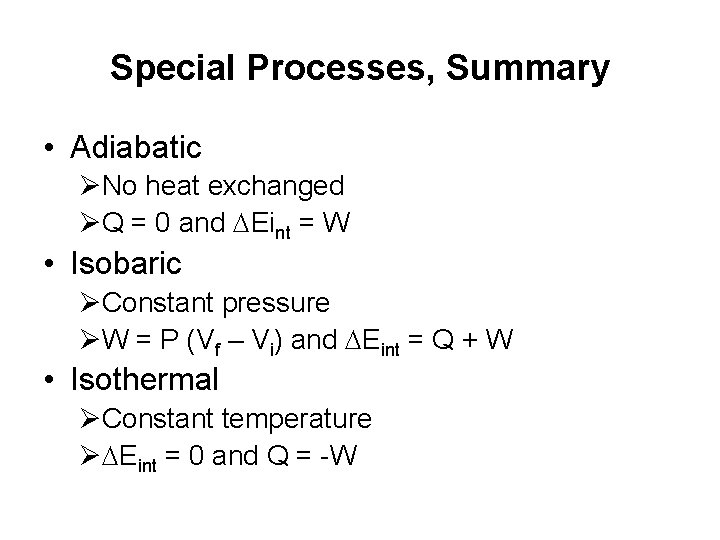
Special Processes, Summary • Adiabatic ØNo heat exchanged ØQ = 0 and DEint = W • Isobaric ØConstant pressure ØW = P (Vf – Vi) and DEint = Q + W • Isothermal ØConstant temperature ØDEint = 0 and Q = -W
PHY 151: Lecture 20 First Law of Thermodynamics 20. 7 Energy Transfer Mechanisms in Thermal Processes
Mechanisms of Energy Transfer In Thermal Processes • We want to know the rate at which energy is transferred • There are various mechanisms responsible for the transfer: – Conduction – Convection – Radiation
Conduction • The transfer can be viewed on an atomic scale – It is an exchange of kinetic energy between microscopic particles by collisions • The microscopic particles can be atoms, molecules or free electrons • Less energetic particles gain energy during collisions with more energetic particles • Rate of conduction depends upon the characteristics of the substance
Conduction, cont. • In general, metals are good thermal conductors – They contain large numbers of electrons that are relatively free to move through the metal – They can transport energy from one region to another • Poor conductors include asbestos, paper, and gases • Conduction can occur only if there is a difference in temperature between two parts of the conducting medium
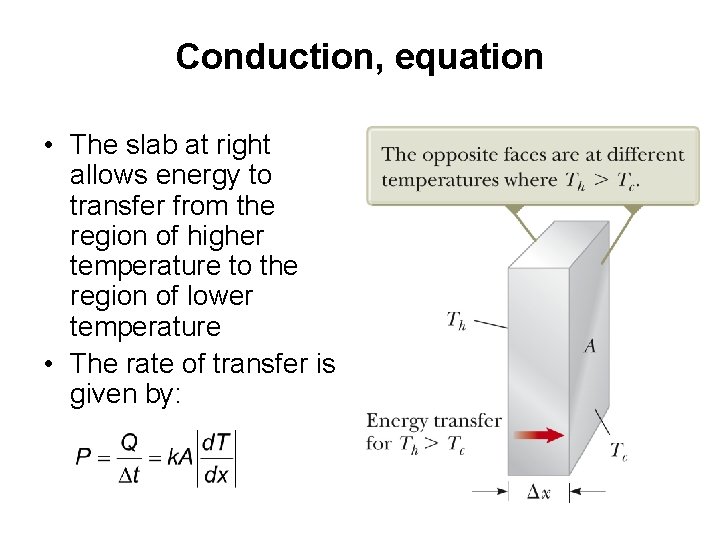
Conduction, equation • The slab at right allows energy to transfer from the region of higher temperature to the region of lower temperature • The rate of transfer is given by:
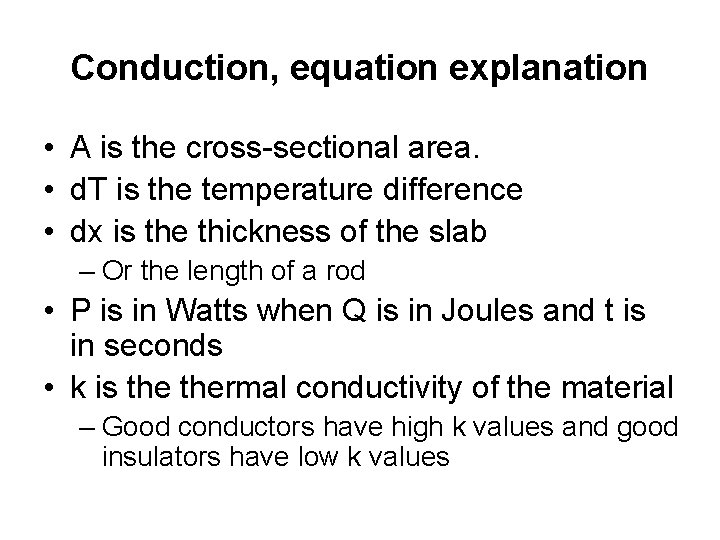
Conduction, equation explanation • A is the cross-sectional area. • d. T is the temperature difference • dx is the thickness of the slab – Or the length of a rod • P is in Watts when Q is in Joules and t is in seconds • k is thermal conductivity of the material – Good conductors have high k values and good insulators have low k values
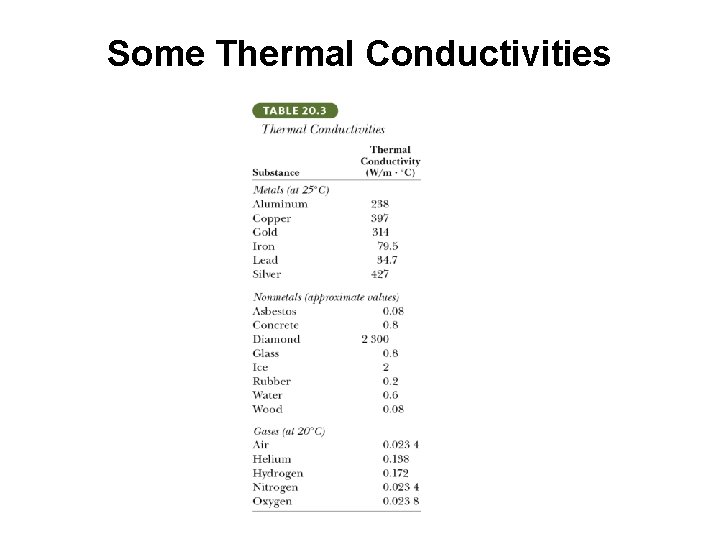
Some Thermal Conductivities
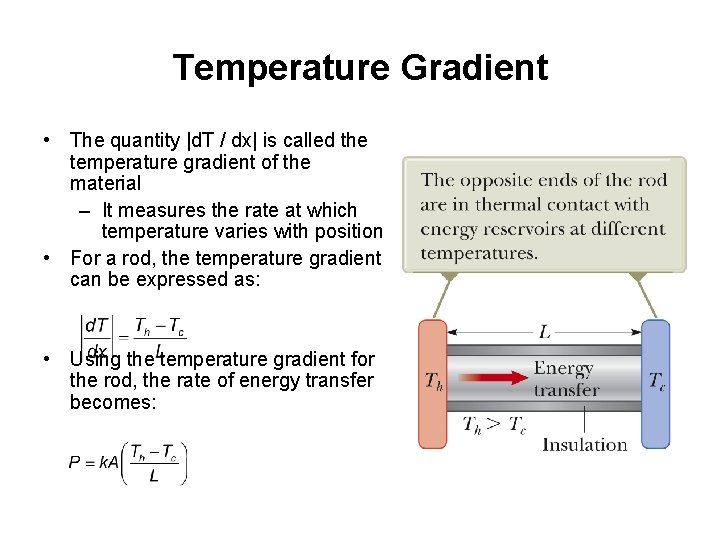
Temperature Gradient • The quantity |d. T / dx| is called the temperature gradient of the material – It measures the rate at which temperature varies with position • For a rod, the temperature gradient can be expressed as: • Using the temperature gradient for the rod, the rate of energy transfer becomes:
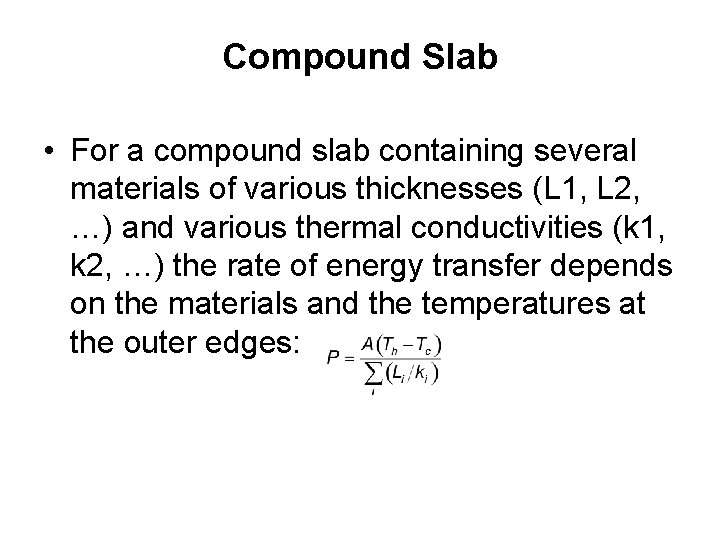
Compound Slab • For a compound slab containing several materials of various thicknesses (L 1, L 2, …) and various thermal conductivities (k 1, k 2, …) the rate of energy transfer depends on the materials and the temperatures at the outer edges:
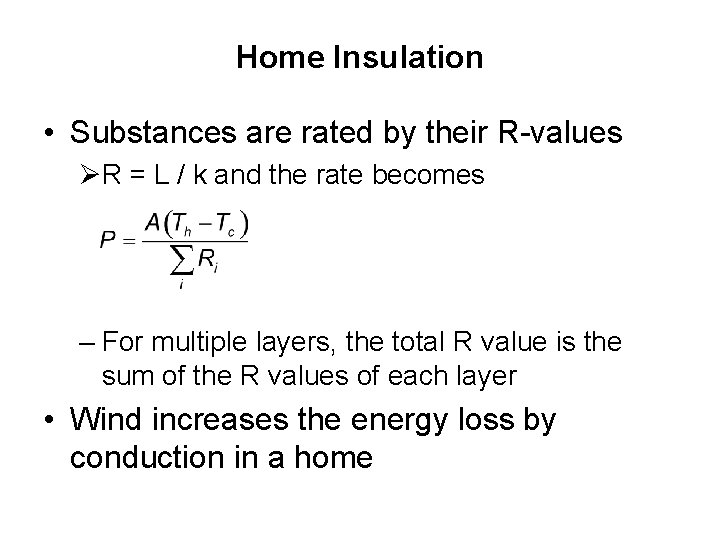
Home Insulation • Substances are rated by their R-values ØR = L / k and the rate becomes – For multiple layers, the total R value is the sum of the R values of each layer • Wind increases the energy loss by conduction in a home
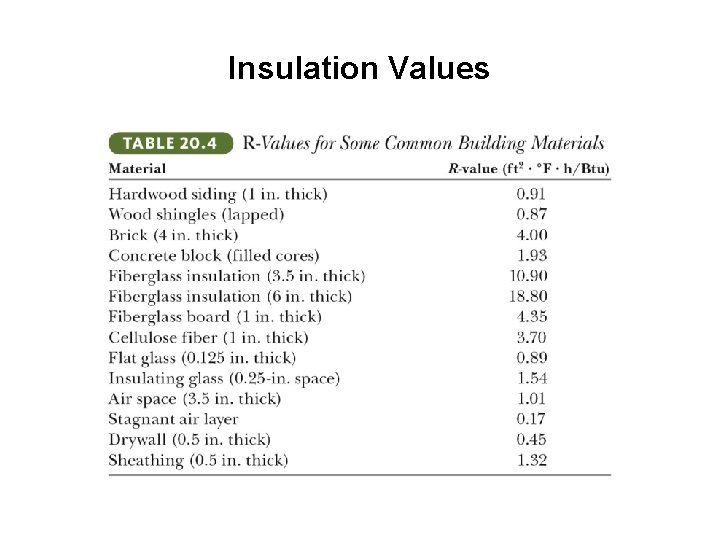
Insulation Values
Convection • Energy transferred by the movement of a substance • It is a form of matter transfer: – When the movement results from differences in density, it is called natural convection – When the movement is forced by a fan or a pump, it is called forced convection
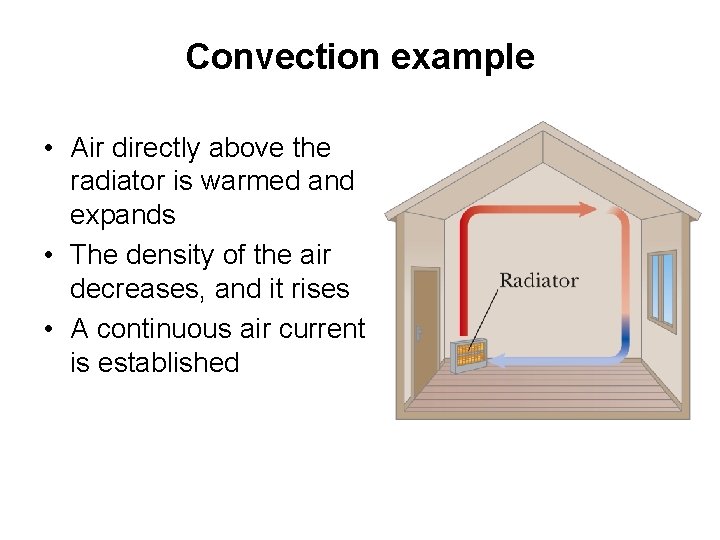
Convection example • Air directly above the radiator is warmed and expands • The density of the air decreases, and it rises • A continuous air current is established
Radiation • Radiation does not require physical contact • All objects radiate energy continuously in the form of electromagnetic waves due to thermal vibrations of their molecules • Rate of radiation is given by Stefan’s law
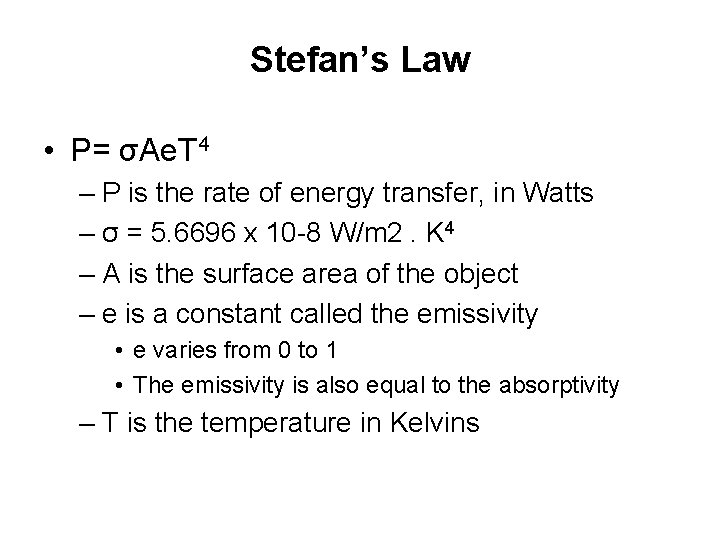
Stefan’s Law • P= σAe. T 4 – P is the rate of energy transfer, in Watts – σ = 5. 6696 x 10 -8 W/m 2. K 4 – A is the surface area of the object – e is a constant called the emissivity • e varies from 0 to 1 • The emissivity is also equal to the absorptivity – T is the temperature in Kelvins
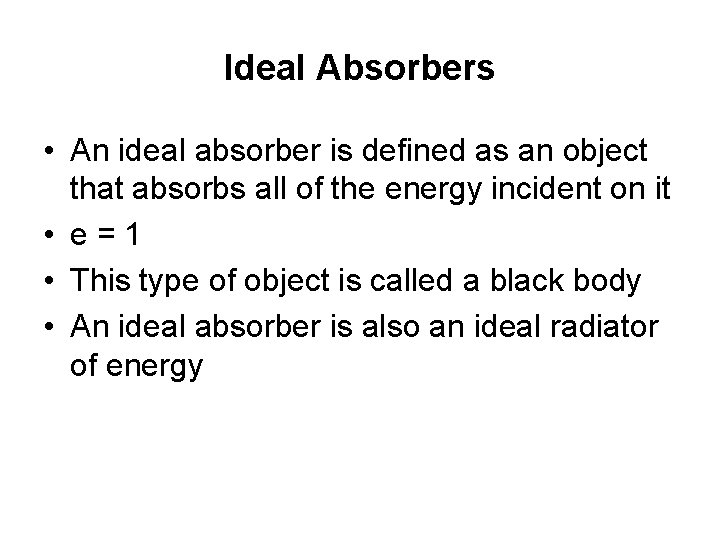
Ideal Absorbers • An ideal absorber is defined as an object that absorbs all of the energy incident on it • e=1 • This type of object is called a black body • An ideal absorber is also an ideal radiator of energy
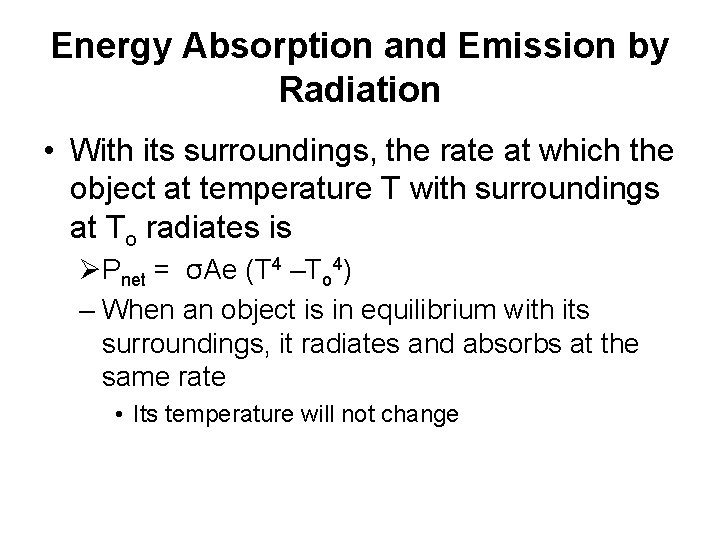
Energy Absorption and Emission by Radiation • With its surroundings, the rate at which the object at temperature T with surroundings at To radiates is ØPnet = σAe (T 4 –To 4) – When an object is in equilibrium with its surroundings, it radiates and absorbs at the same rate • Its temperature will not change
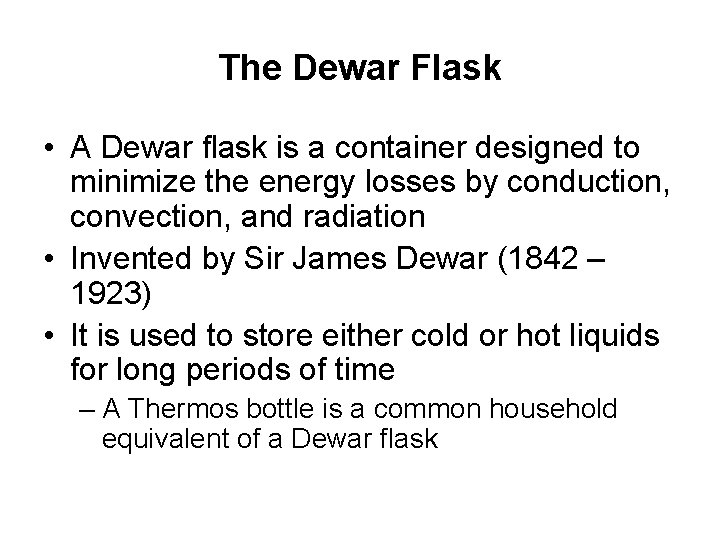
The Dewar Flask • A Dewar flask is a container designed to minimize the energy losses by conduction, convection, and radiation • Invented by Sir James Dewar (1842 – 1923) • It is used to store either cold or hot liquids for long periods of time – A Thermos bottle is a common household equivalent of a Dewar flask
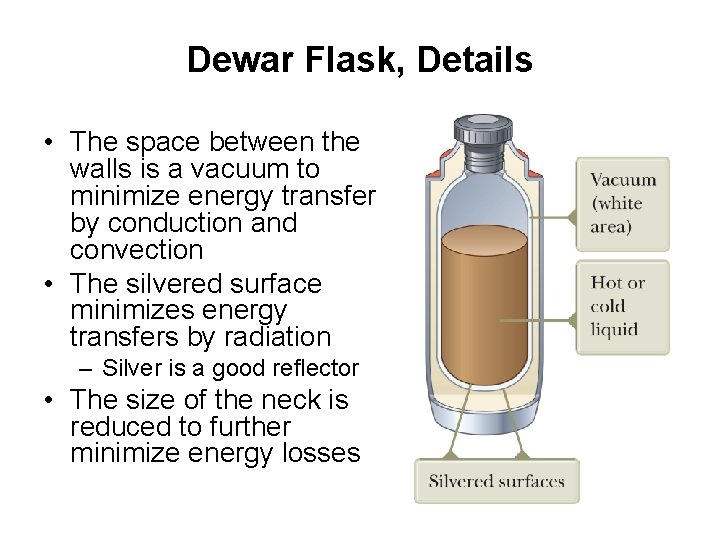
Dewar Flask, Details • The space between the walls is a vacuum to minimize energy transfer by conduction and convection • The silvered surface minimizes energy transfers by radiation – Silver is a good reflector • The size of the neck is reduced to further minimize energy losses
- Slides: 53