
PHY 106 PHYSICS FOR BIOLOGICAL SCIENCES ATOMIC STRUCTURE
PHY 106: PHYSICS FOR BIOLOGICAL SCIENCES ATOMIC STRUCTURE & NUCLEAR ENERGY BY J. B. OLOMO, FNIP
Atomic Structure
THE ATOM Definition: The smallest particle that has the properties of an element.
ATOMIC STRUCTURE 3 major parts of an atom Proton Neutron Electron
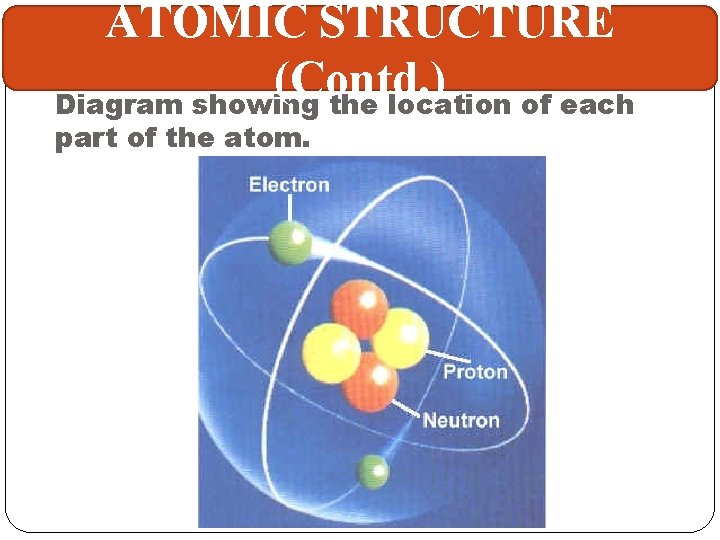
ATOMIC STRUCTURE (Contd. ) Diagram showing the location of each part of the atom.
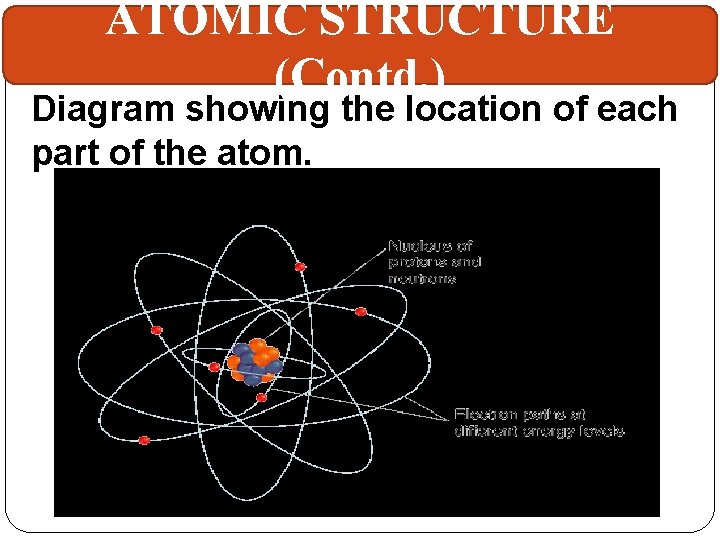
ATOMIC STRUCTURE (Contd. ) Diagram showing the location of each part of the atom.
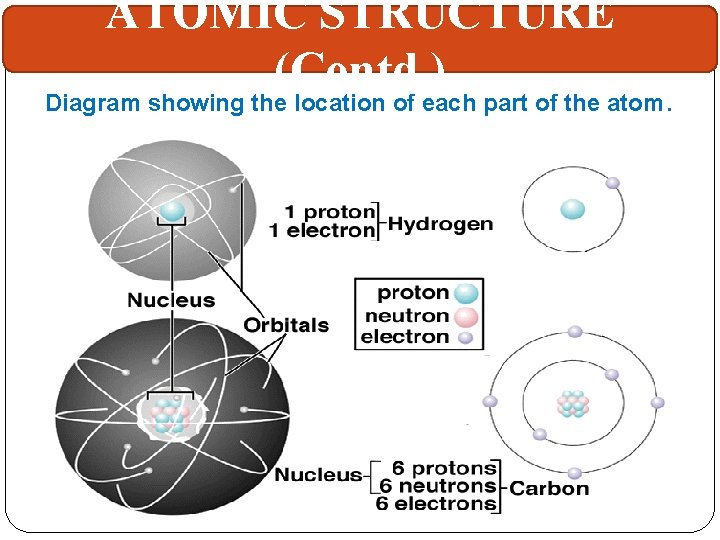
ATOMIC STRUCTURE (Contd. ) Diagram showing the location of each part of the atom.
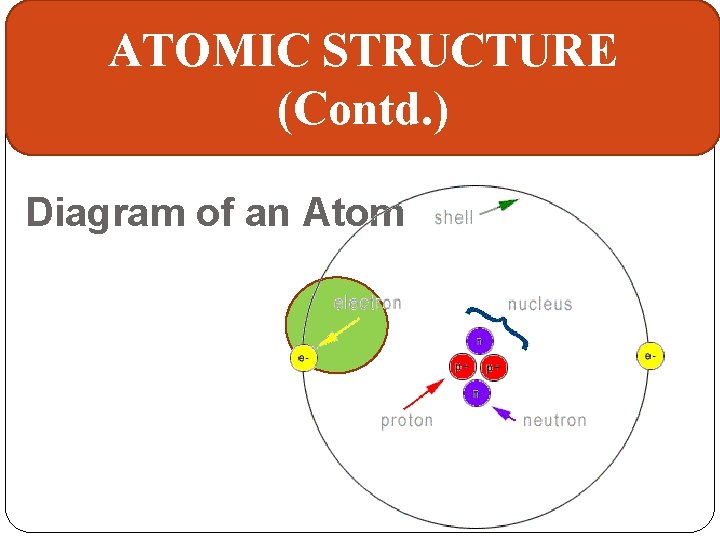
ATOMIC STRUCTURE (Contd. ) Diagram of an Atom
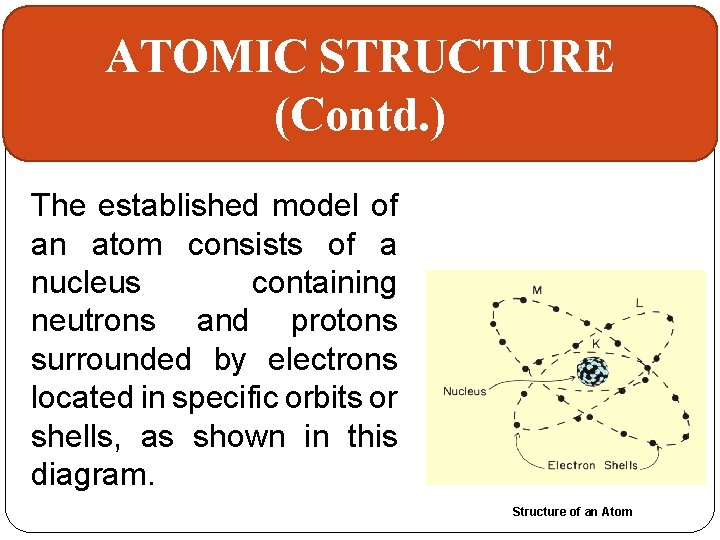
ATOMIC STRUCTURE (Contd. ) The established model of an atom consists of a nucleus containing neutrons and protons surrounded by electrons located in specific orbits or shells, as shown in this diagram. Structure of an Atom
ATOMIC STRUCTURE (Contd. ) Composition of the nucleus Recall that the atomic nucleus is comprised of two basic particles: neutrons and protons. o The sum of neutrons and protons are called nucleons. o Neutrons and protons are almost the same size but defer in their electrical charge o
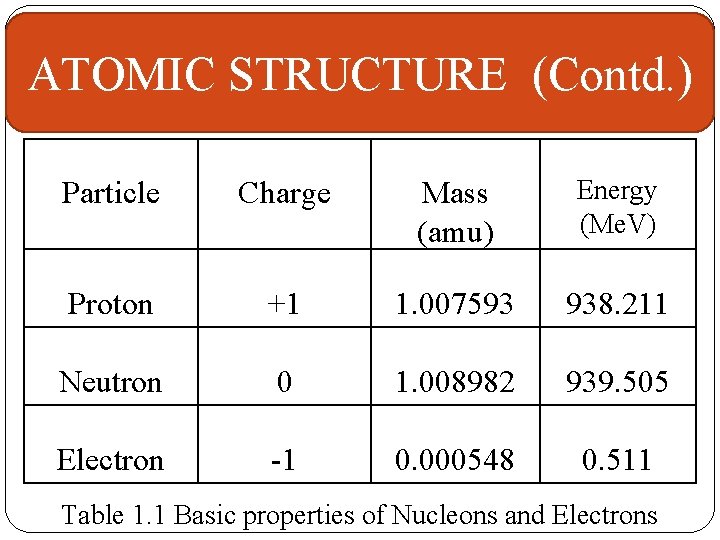
ATOMIC STRUCTURE (Contd. ) Particle Charge Mass (amu) Energy (Me. V) Proton +1 1. 007593 938. 211 Neutron 0 1. 008982 939. 505 Electron -1 0. 000548 0. 511 Table 1. 1 Basic properties of Nucleons and Electrons
ATOMIC STRUCTURE (Contd. ) • The total number of nucleons is the mass number, A. • The number of protons in a nucleus is the atomic number (Z) and establishes the chemical identity of the atom. • The difference, A–Z is the neutron number, N.
CHARACTERISTICS & STRUCTURE OF MATTER OVERVIEW • Radiation is created and then latter absorbed within some material substance or matter. • Atom is the smallest unit of matter and radiation interactions occur within individual atoms. • Atom consists of two major regions: v The nucleus which consists of protons (p+) and neutrons (n) v The orbital shells which house the electrons
CHARACTERISTICS & STRUCTURE OF MATTER (Contd) q Each region has a unique role in radiation interactions: q The nucleus is the source of energy for the processes q These radiations are ionizing in nature Note: The nucleus is not the source of X–ray energy but it is involved in the production of X-ray photons.
CHARACTERISTICS & STRUCTURE OF MATTER (Contd. ) Nuclide Ø A nuclide is characterized by: § An exact nuclear composition, including the mass number A, atomic number Z. § Arrangement of nucleons within the nucleus. Ø The species must have a “measurably long existence known as lifetime greater than 10 -12 Sec.
CHARACTERISTICS & STRUCTURE OF MATTER (Contd. ) There are 106 different atomic numbers or elements. Ø The structural relationship of various nuclides is often shown on a grid generally referred to as a nuclide chart, as shown in Fig 1. 2. Ø The scale in one direction represents the number of protons, Z (atomic number), and the scale in the other direction represents the number of neutrons, N. Ø Each square in the grid represents a specific nuclear composition or nuclide.
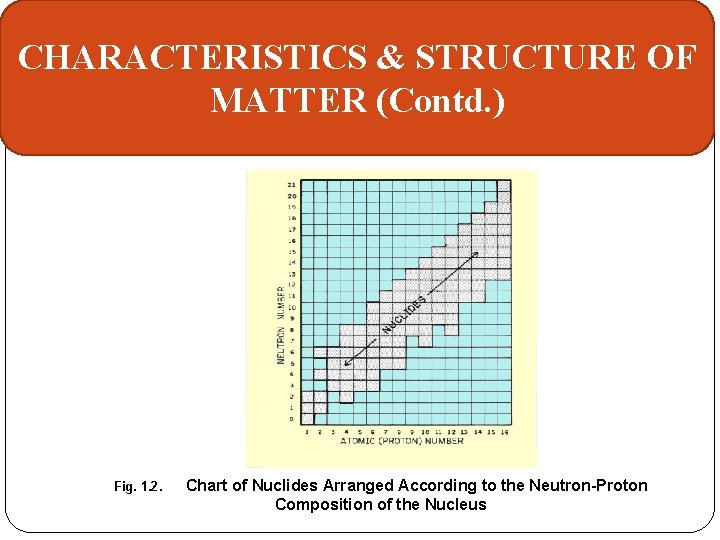
CHARACTERISTICS & STRUCTURE OF MATTER (Contd. ) Fig. 1. 2. Chart of Nuclides Arranged According to the Neutron-Proton Composition of the Nucleus
NUCLEAR STABILITY Nuclear Stability The nucleus consists of a closely packed collection of protons and neutrons. The very large repulsive electrostatic forces exists between protons should cause the nucleus disintegrate. However, nuclei are stable because of the presence of another, short -range (about 2 fm) force: the nuclear force, an attractive force that acts between all nuclear particles. The protons attract each other via the nuclear force, and at the same time they repel each other through the Coulomb force. The attractive nuclear force also acts between pairs of neutrons and between neutrons and protons.
FORCES IN THE NUCLEUS Coulomb force The force of repulsion due to proton-proton interaction. The protons are positively charged thus they repel one another Nuclear strong force The nuclear strong force is attractive Ø It is effective at short ranges. Ø stronger than the Coulomb repulsive force within the nucleus (at short ranges). If this were not the case, stable nuclei would not exist. Ø it is independent of charge, In other words, the nuclear forces associated with proton–proton, Ø proton–neutron, and neutron–neutron interactions are approximately the same, Ø It is responsible for the tight binding of nucleons, it is the
NUCLEAR STABILITY(Contd. ) Nuclear Weak force is short-range nuclear force that tends to produce instability in certain nuclei. Ø It is responsible for beta decay, and its strength is only about 10 -6 times that of the strong force.
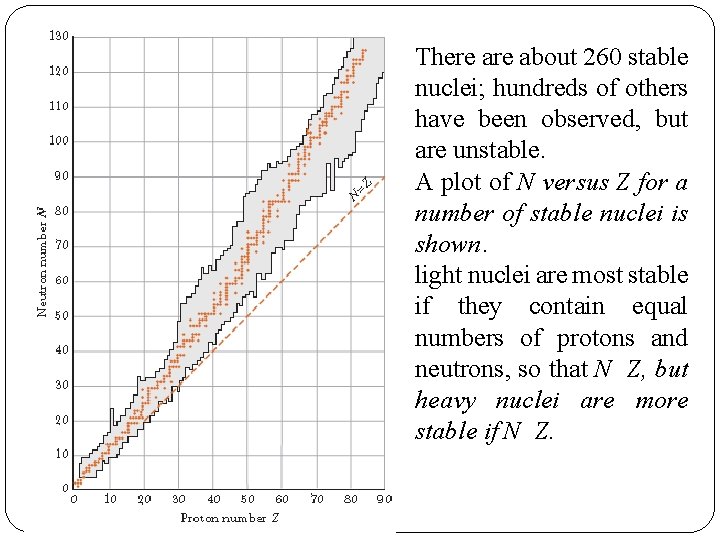
There about 260 stable nuclei; hundreds of others have been observed, but are unstable. A plot of N versus Z for a number of stable nuclei is shown. light nuclei are most stable if they contain equal numbers of protons and neutrons, so that N Z, but heavy nuclei are more stable if N Z.
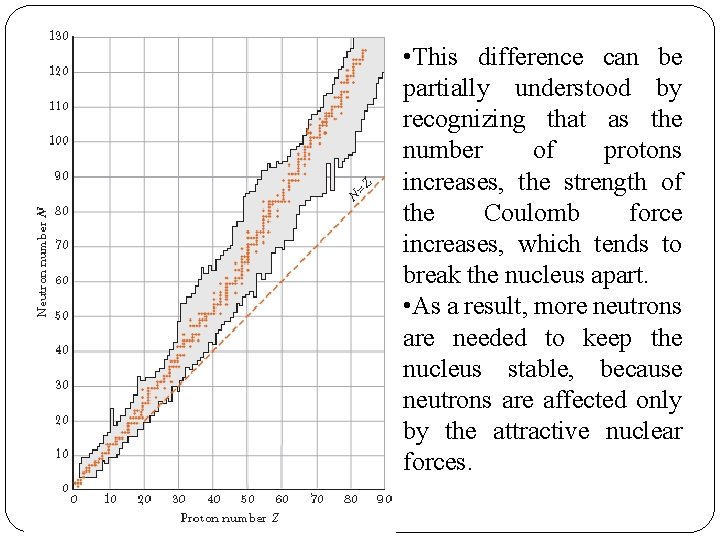
• This difference can be partially understood by recognizing that as the number of protons increases, the strength of the Coulomb force increases, which tends to break the nucleus apart. • As a result, more neutrons are needed to keep the nucleus stable, because neutrons are affected only by the attractive nuclear forces.
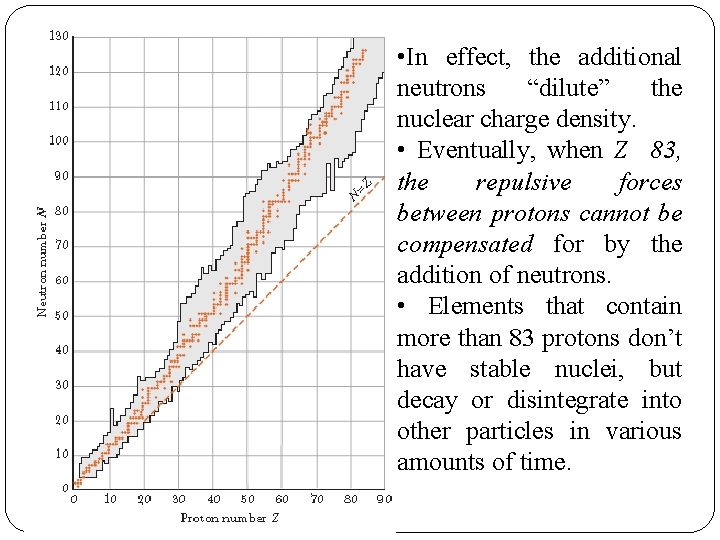
• In effect, the additional neutrons “dilute” the nuclear charge density. • Eventually, when Z 83, the repulsive forces between protons cannot be compensated for by the addition of neutrons. • Elements that contain more than 83 protons don’t have stable nuclei, but decay or disintegrate into other particles in various amounts of time.
CHARACTERISTICS & STRUCTURE OF MATTER (Contd. ) Isotopes Ø Nuclides that belong to the same chemical element (and have the same atomic number) but have different numbers of neutrons are known as isotopes. Ø Isotope describes a relationship between or among nuclides rather than a specific characteristics of a given nuclide. Ø The isotopes of each element are located in the same vertical column of the nuclide chart as shown in Fig 1. 3
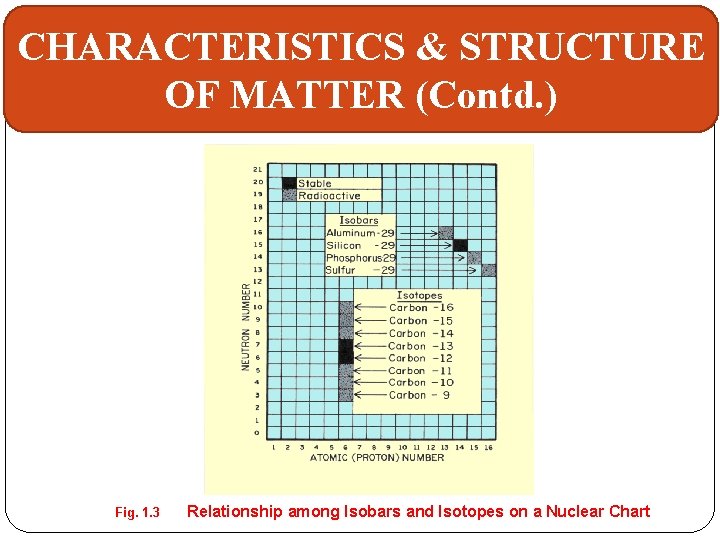
CHARACTERISTICS & STRUCTURE OF MATTER (Contd. ) Fig. 1. 3 Relationship among Isobars and Isotopes on a Nuclear Chart
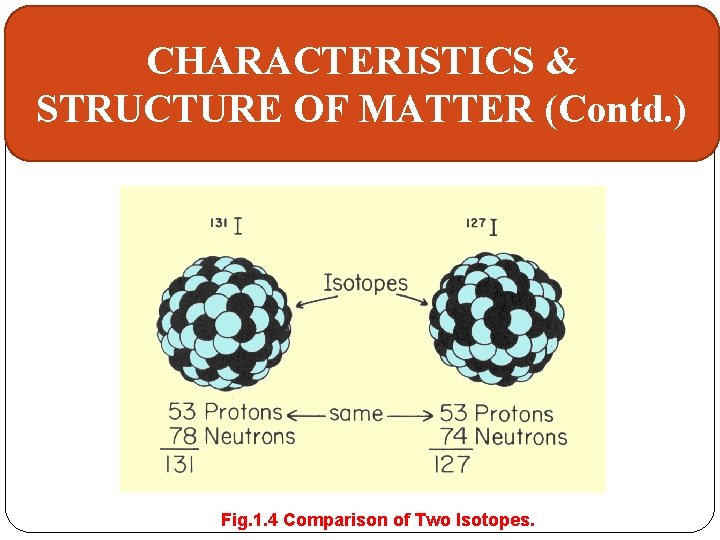
CHARACTERISTICS & STRUCTURE OF MATTER (Contd. ) Fig. 1. 4 Comparison of Two Isotopes.
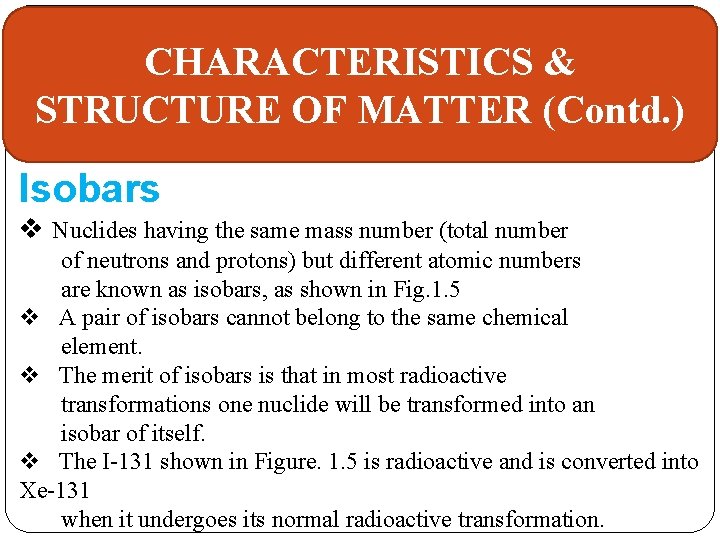
CHARACTERISTICS & STRUCTURE OF MATTER (Contd. ) Isobars v Nuclides having the same mass number (total number of neutrons and protons) but different atomic numbers are known as isobars, as shown in Fig. 1. 5 v A pair of isobars cannot belong to the same chemical element. v The merit of isobars is that in most radioactive transformations one nuclide will be transformed into an isobar of itself. v The I-131 shown in Figure. 1. 5 is radioactive and is converted into Xe-131 when it undergoes its normal radioactive transformation.
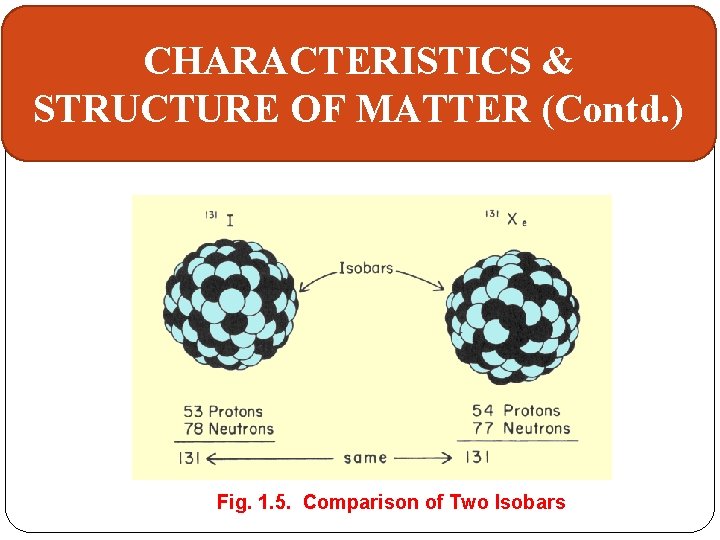
CHARACTERISTICS & STRUCTURE OF MATTER (Contd. ) Fig. 1. 5. Comparison of Two Isobars
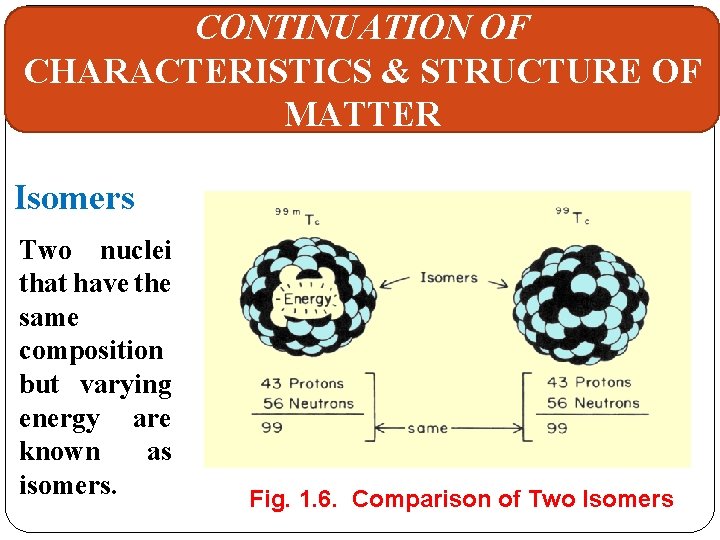
CONTINUATION OF CHARACTERISTICS & STRUCTURE OF MATTER Isomers Two nuclei that have the same composition but varying energy are known as isomers. Fig. 1. 6. Comparison of Two Isomers
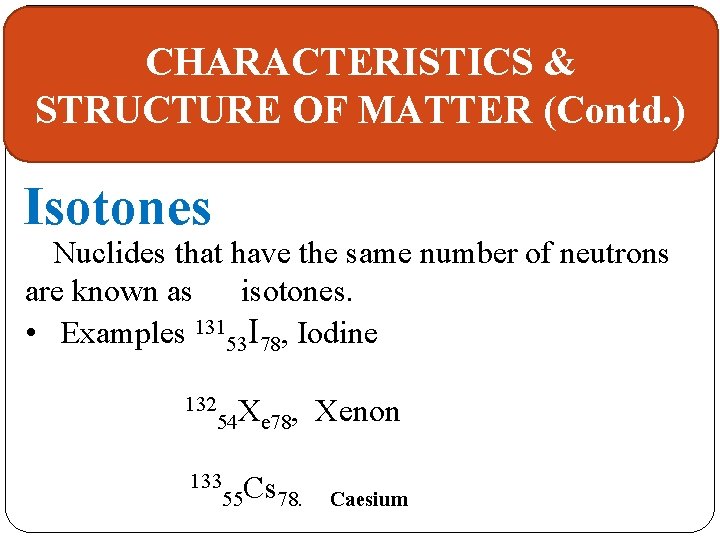
CHARACTERISTICS & STRUCTURE OF MATTER (Contd. ) Isotones Nuclides that have the same number of neutrons are known as isotones. • Examples 13153 I 78, Iodine 132 X , 54 e 78 133 Cs 55 78. Xenon Caesium
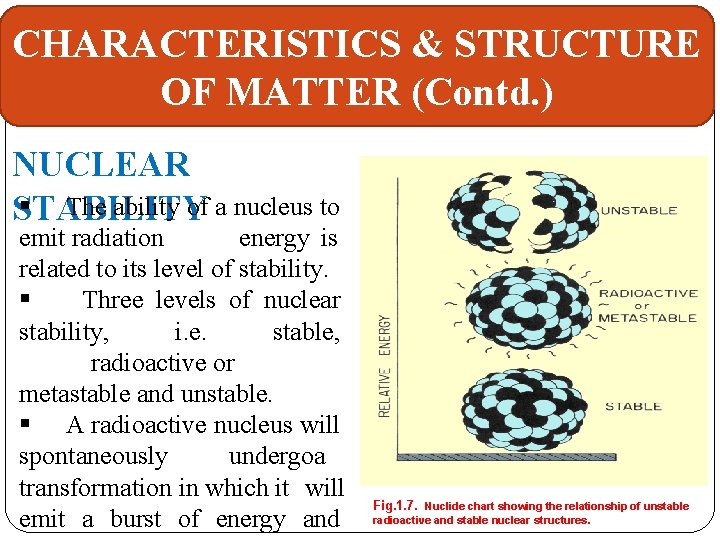
CHARACTERISTICS & STRUCTURE OF MATTER (Contd. ) NUCLEAR § The ability of a nucleus to STABILITY emit radiation energy is related to its level of stability. § Three levels of nuclear stability, i. e. stable, radioactive or metastable and unstable. § A radioactive nucleus will spontaneously undergoa transformation in which it will emit a burst of energy and Fig. 1. 7. Nuclide chart showing the relationship of unstable radioactive and stable nuclear structures.
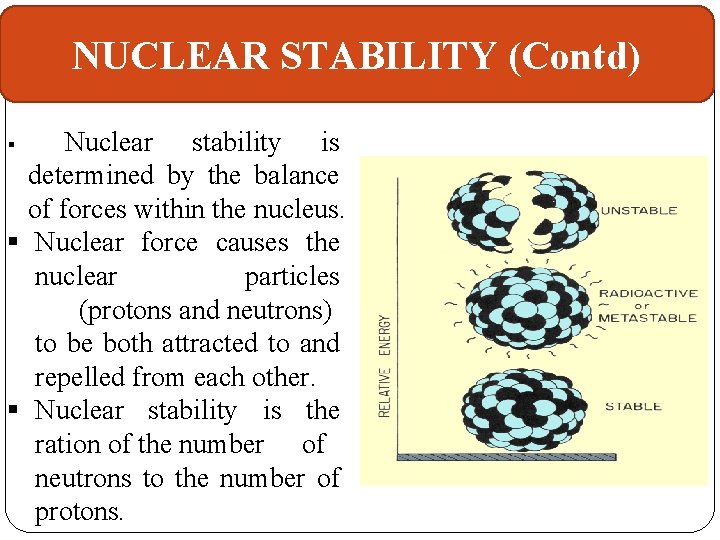
NUCLEAR STABILITY (Contd) Nuclear stability is determined by the balance of forces within the nucleus. § Nuclear force causes the nuclear particles (protons and neutrons) to be both attracted to and repelled from each other. § Nuclear stability is the ration of the number of neutrons to the number of protons. §
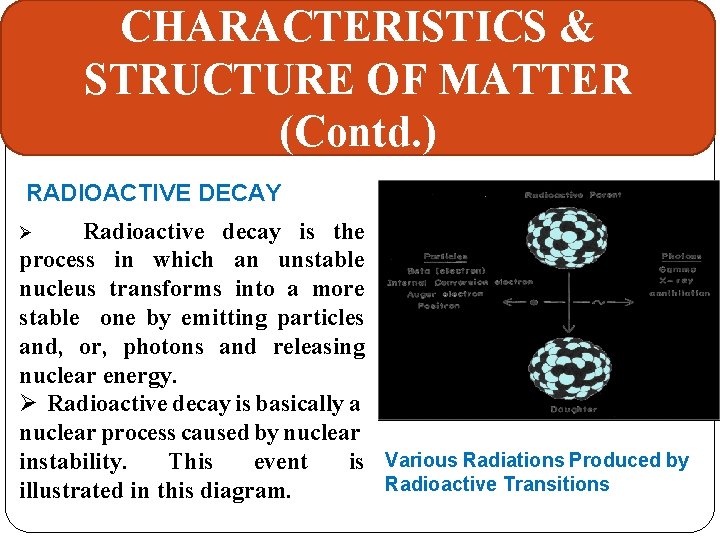
CHARACTERISTICS & STRUCTURE OF MATTER (Contd. ) RADIOACTIVE DECAY Radioactive decay is the process in which an unstable nucleus transforms into a more stable one by emitting particles and, or, photons and releasing nuclear energy. Ø Radioactive decay is basically a nuclear process caused by nuclear instability. This event is Various Radiations Produced by Radioactive Transitions illustrated in this diagram. Ø
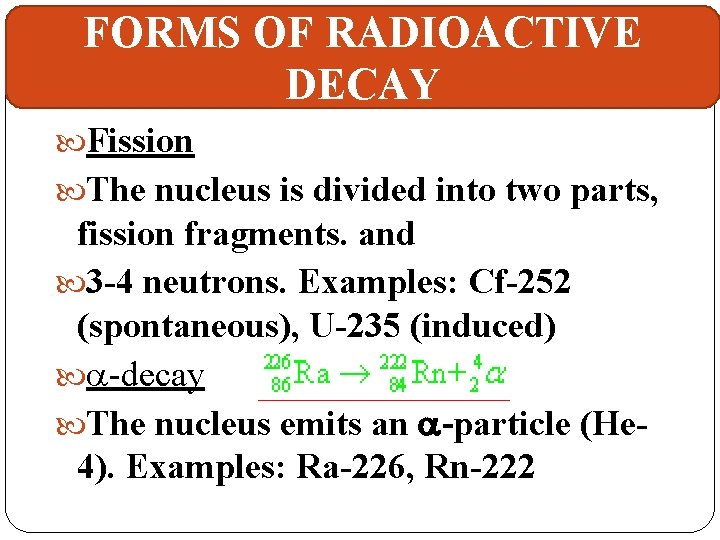
FORMS OF RADIOACTIVE DECAY Fission The nucleus is divided into two parts, fission fragments. and 3 -4 neutrons. Examples: Cf-252 (spontaneous), U-235 (induced) a-decay The nucleus emits an a-particle (He 4). Examples: Ra-226, Rn-222
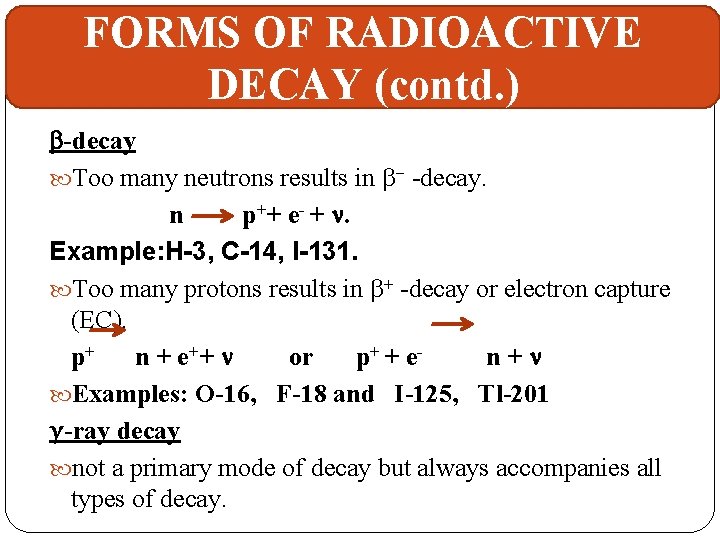
FORMS OF RADIOACTIVE DECAY (contd. ) b-decay Too many neutrons results in b- -decay. n p++ e- + n. Example: H-3, C-14, I-131. Too many protons results in b+ -decay or electron capture (EC). p+ n + e ++ n or p+ + e n+n Examples: O-16, F-18 and I-125, Tl-201 γ-ray decay not a primary mode of decay but always accompanies all types of decay.
Pure beta emitters In the case of a pure beta emitters such as 32 P in its decay to 32 S an isobar, there is the liberation of a beta particle and an antineutrino from the nucleus – no gamma rays Pure beta emitters are very useful for therapeutic applications because the beta particle's range in tissue is about 0. 5 cm and causes thousands of ionizations in its path. Radionuclide therapy with pure beta-ray emitters, even high-energy beta-ray emitters emitted in bone, does not require medical confinement of patients for radiation protection. If the nucleon is not a pure beta emitter, it may also partition some of the released nuclear energy to a gamma photon that it also releases from its nucleus.
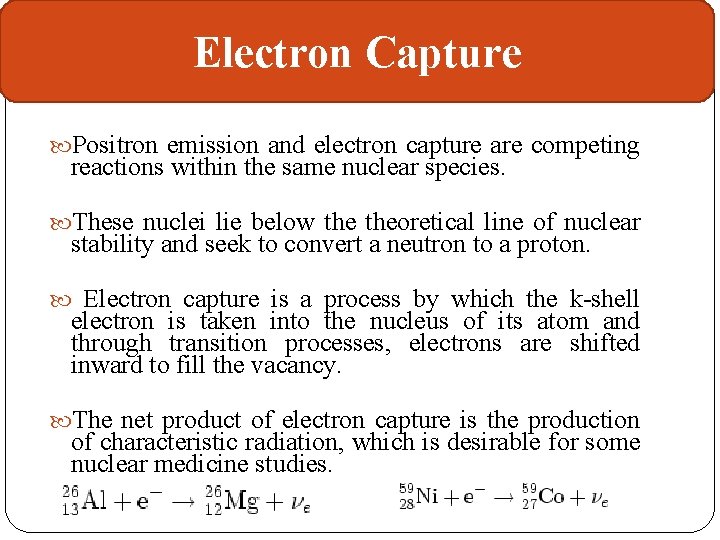
Electron Capture Positron emission and electron capture are competing reactions within the same nuclear species. These nuclei lie below theoretical line of nuclear stability and seek to convert a neutron to a proton. Electron capture is a process by which the k-shell electron is taken into the nucleus of its atom and through transition processes, electrons are shifted inward to fill the vacancy. The net product of electron capture is the production of characteristic radiation, which is desirable for some nuclear medicine studies.
Internal Conversion Internal conversion is another electromagnetic process which can occur in the nucleus and which competes with gamma emission. Sometimes the multipole electric fields of the nucleus interact with orbital electrons with enough energy to eject them from the atom.
Internal Conversion (Contd) This process is not the same as emitting a gamma ray which knocks an electron out of the atom. It is also not the same as beta decay, since the emitted electron was previously one of the orbital electrons, whereas the electron in beta decay is produced by the decay of a neutron.
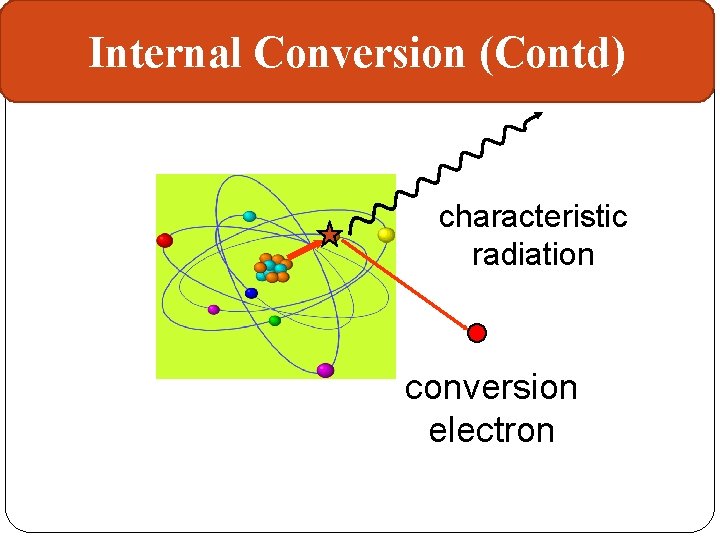
Internal Conversion (Contd) characteristic radiation conversion electron
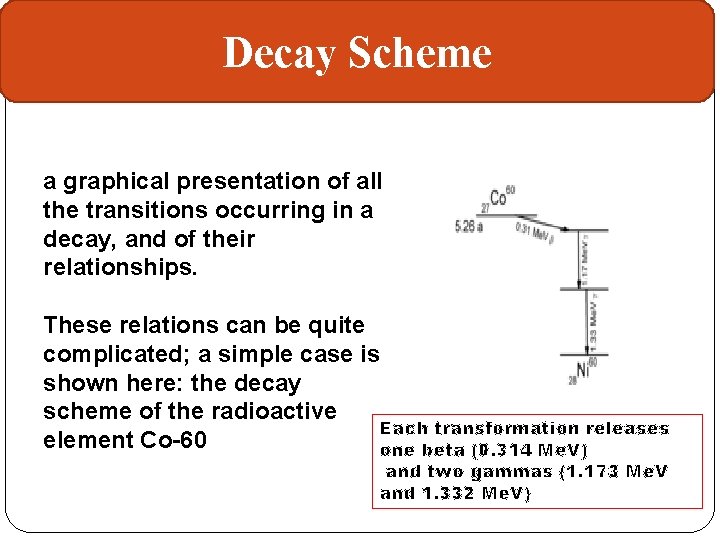
Decay Scheme a graphical presentation of all the transitions occurring in a decay, and of their relationships. These relations can be quite complicated; a simple case is shown here: the decay scheme of the radioactive Each transformation releases element Co-60 one beta (0. 314 Me. V) and two gammas (1. 173 Me. V and 1. 332 Me. V)
Decay Scheme(Contd) When a radioactive decay does not bring about stability of the daughter nucleus, radioactivity continues until a stable end product is formed. The decay chain produced until the product is formed is termed decay chain. It may consist of as many as 15 radionuclides or more There are four known radioactive decay series which occur naturally, the members of a given series having mass numbers that differ by jumps of 4.
Decay Scheme(Contd) The series beginning with uranium-238 and ending with lead-206 is known as the 4 n+2 series because all the mass numbers in the series are 2 greater than an integral multiple of 4 (e. g. , 238=4× 59+2, 206=4× 51+2). Thorium series is 4 n while Actinium series is 4 n +3. The 4 n+1 series, which begins with neptunium- 237, is not found in nature because the half-life of the parent nucleus (about 2 million years) is many times less than the age of the earth, and all naturally occurring samples have already
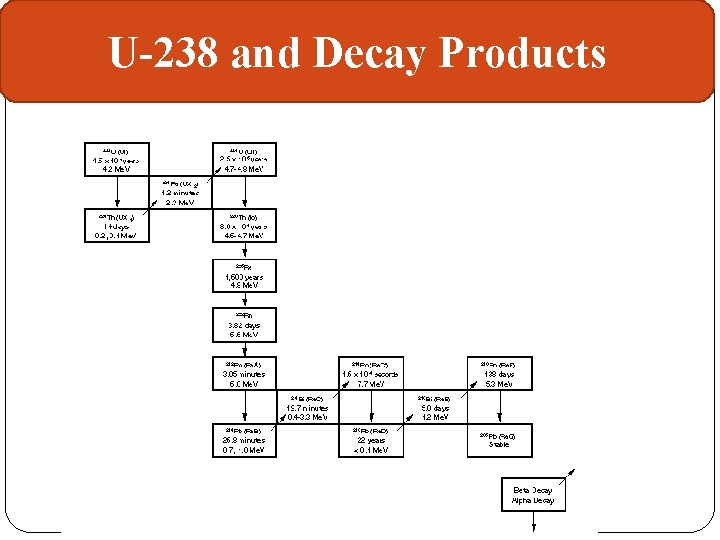
U-238 and Decay Products
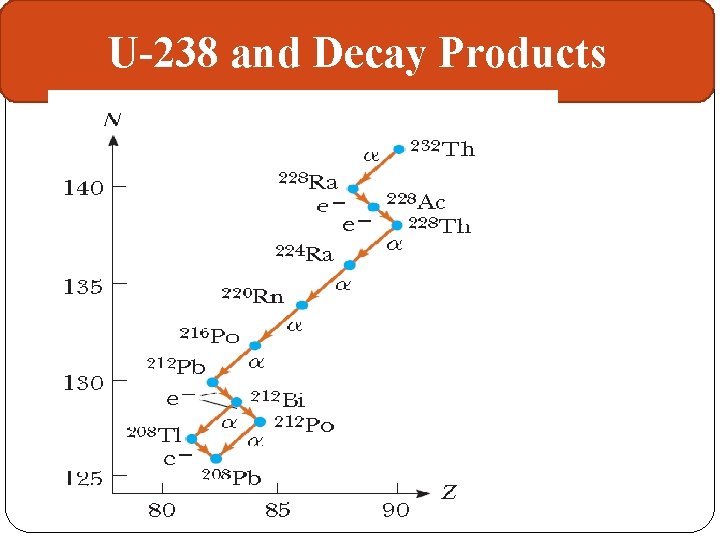
U-238 and Decay Products
Parent/Daughter Activity When the half-life of the parent radionuclide A is much longer than that of the daughter product B (i. e λB>>λA), the daughter product grows quickly while the activity of the parent can be considered equal to a constant K. The growth of B can be represented as: When solved for NB we have If NB = 0 at t = 0, then After a sufficiently long time, e-λBt ≈ 0 so that λB NB = K
Secular Equilibrium Within about 7 half lives (~ 24 days for Ra/Rn) of the decay product, their activities are equal Beyond this point, the decay product decays at the same rate it is produced-a state called "secular equilibrium. " Often, it is easier to determine the activity of the daughter radionuclide. This will be the activity of the parent if we allow secular equilibrium to be established.
Natural Radioactivity The earth is made of the different elements, about 100 in all. Among these are the primordial elements 238 U, 232 Th and 40 K which are radioactive with halflives comparable with the age of the earth.
Natural Radioactivity (Contd. ) They therefore still exist in small amounts in the earth, soil and rocks. Both 238 U and 232 Th have long decay series with members (226 Ra, 222 Rn, 214 Bi etc. ), all of which are radioactive. Natural potassium, an ubiquitous element in the soil, contains 0. 0119% radioactive 40 K. Radiations emitted by these three elements and members of the decay chains present within 15 - 30 cm topsoil reach the earth surface
Man Made Radioactivity When a combination of neutrons and protons, which does not already exist in nature, is produced artificially, the atom will become unstable and is called a radioactive isotope or radioisotope.

Any Useful Question
End of Lecture THANK YOU
- Slides: 52