
PHY 1039 Properties of Matter Thermodynamic Mechanical Work
- Slides: 20
PHY 1039 Properties of Matter Thermodynamic Mechanical Work: 1, 2 and 3 Dimensions (See Finn’s Thermal Physics, Ch. 2) 27 February and March 1 Lectures 7 and 8
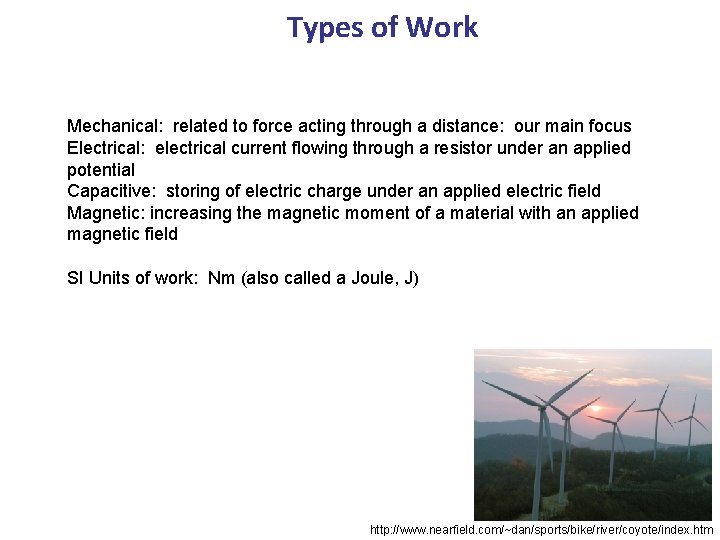
Types of Work Mechanical: related to force acting through a distance: our main focus Electrical: electrical current flowing through a resistor under an applied potential Capacitive: storing of electric charge under an applied electric field Magnetic: increasing the magnetic moment of a material with an applied magnetic field SI Units of work: Nm (also called a Joule, J) http: //www. nearfield. com/~dan/sports/bike/river/coyote/index. htm
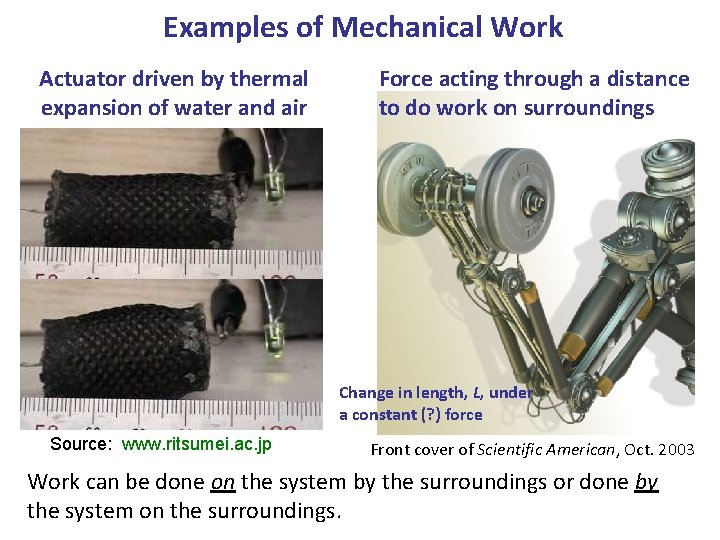
Examples of Mechanical Work Actuator driven by thermal expansion of water and air Force acting through a distance to do work on surroundings Change in length, L, under a constant (? ) force Source: www. ritsumei. ac. jp Front cover of Scientific American, Oct. 2003 Work can be done on the system by the surroundings or done by the system on the surroundings.
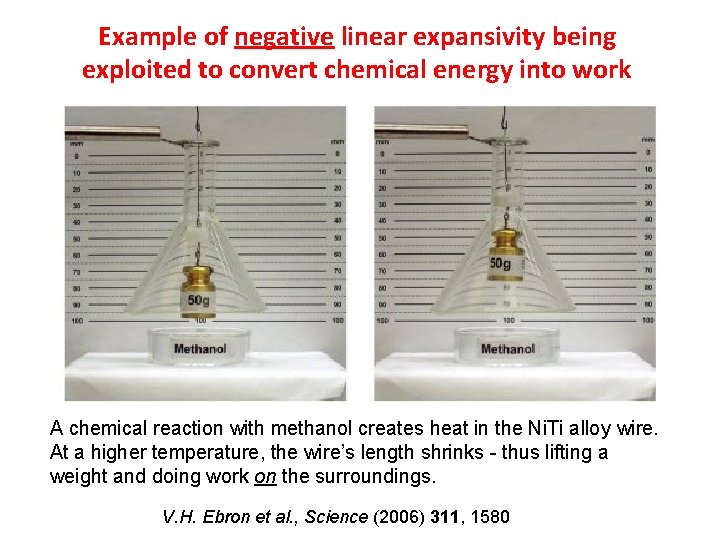
Example of negative linear expansivity being exploited to convert chemical energy into work A chemical reaction with methanol creates heat in the Ni. Ti alloy wire. At a higher temperature, the wire’s length shrinks - thus lifting a weight and doing work on the surroundings. V. H. Ebron et al. , Science (2006) 311, 1580
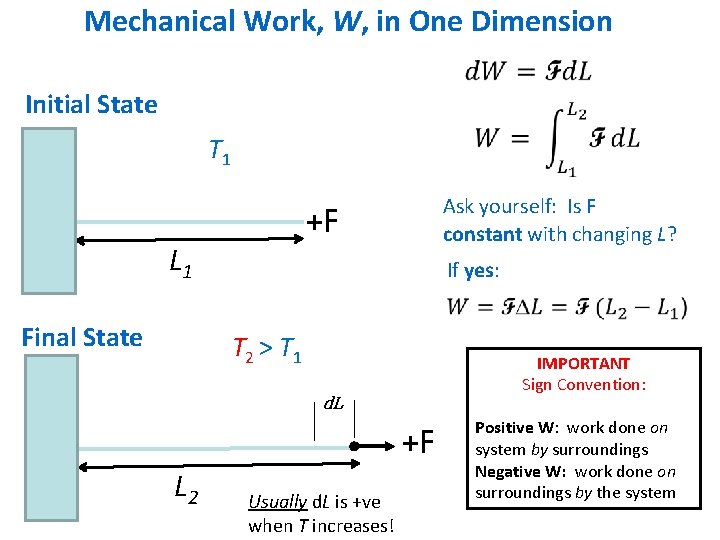
Mechanical Work, W, in One Dimension Initial State T 1 +F L 1 Final State Ask yourself: Is F constant with changing L? If yes: T 2 > T 1 IMPORTANT Sign Convention: d. L +F L 2 Usually d. L is +ve when T increases! Positive W: work done on system by surroundings Negative W: work done on surroundings by the system
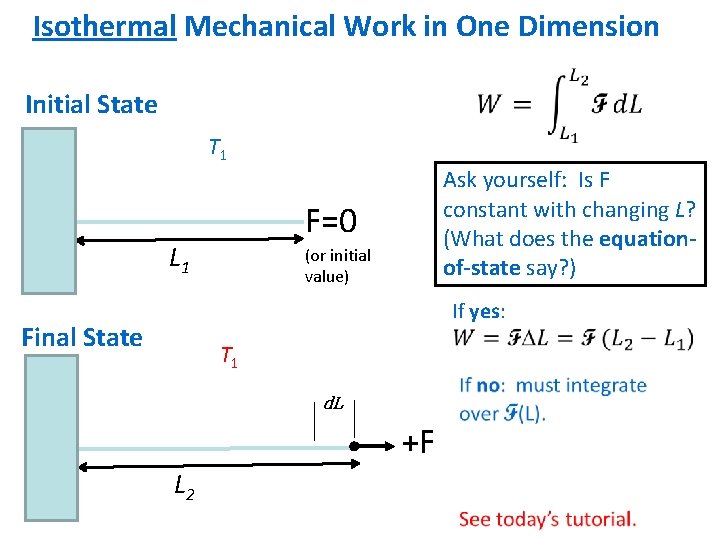
Isothermal Mechanical Work in One Dimension Initial State T 1 Ask yourself: Is F constant with changing L? (What does the equationof-state say? ) F=0 L 1 (or initial value) If yes: Final State T 1 d. L +F L 2
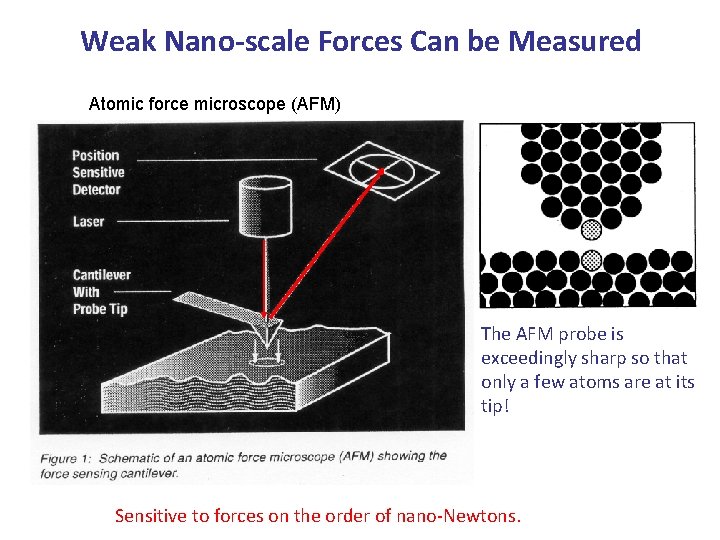
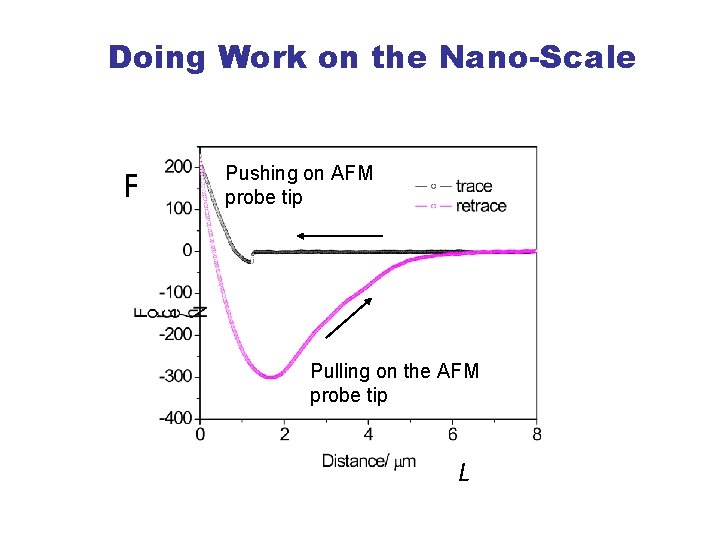
Weak Nano-scale Forces Can be Measured Atomic force microscope (AFM) The AFM probe is exceedingly sharp so that only a few atoms are at its tip! Sensitive to forces on the order of nano-Newtons.
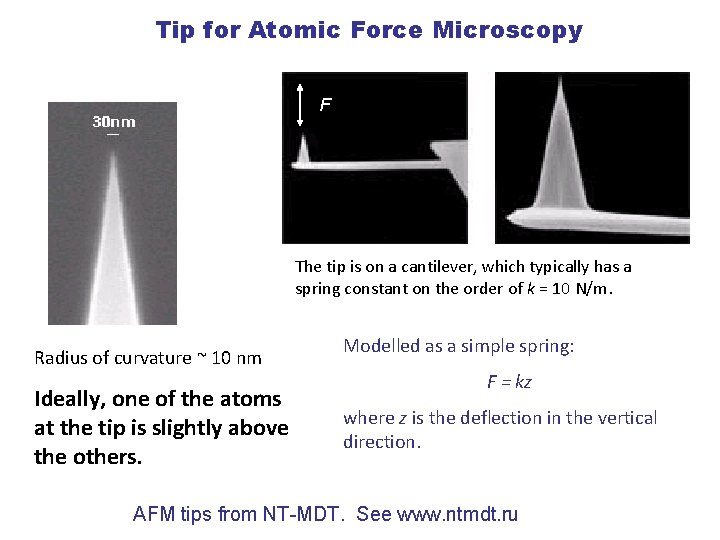
Tip for Atomic Force Microscopy F The tip is on a cantilever, which typically has a spring constant on the order of k = 10 N/m. Radius of curvature ~ 10 nm Ideally, one of the atoms at the tip is slightly above the others. Modelled as a simple spring: F = kz where z is the deflection in the vertical direction. AFM tips from NT-MDT. See www. ntmdt. ru
Doing Work on the Nano-Scale F Pushing on AFM probe tip Pulling on the AFM probe tip L
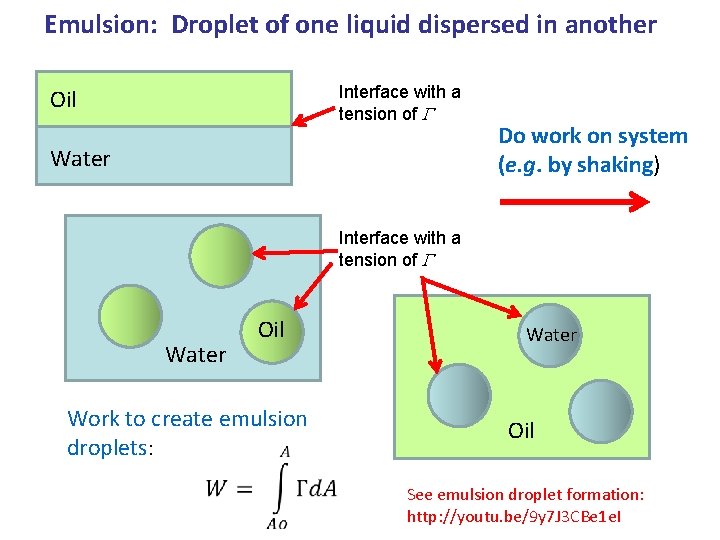
Emulsion: Droplet of one liquid dispersed in another Interface with a tension of G Oil Water Do work on system (e. g. by shaking) Interface with a tension of G Water Oil Work to create emulsion droplets: Water Oil See emulsion droplet formation: http: //youtu. be/9 y 7 J 3 CBe 1 e. I
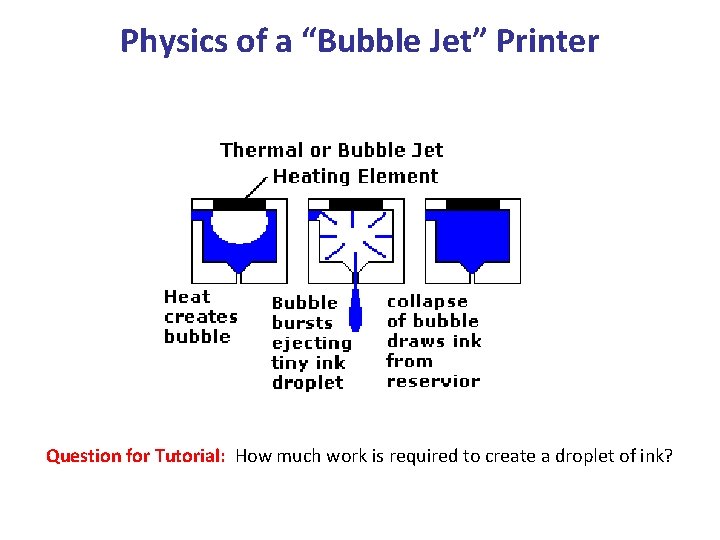
Physics of a “Bubble Jet” Printer Question for Tutorial: How much work is required to create a droplet of ink?
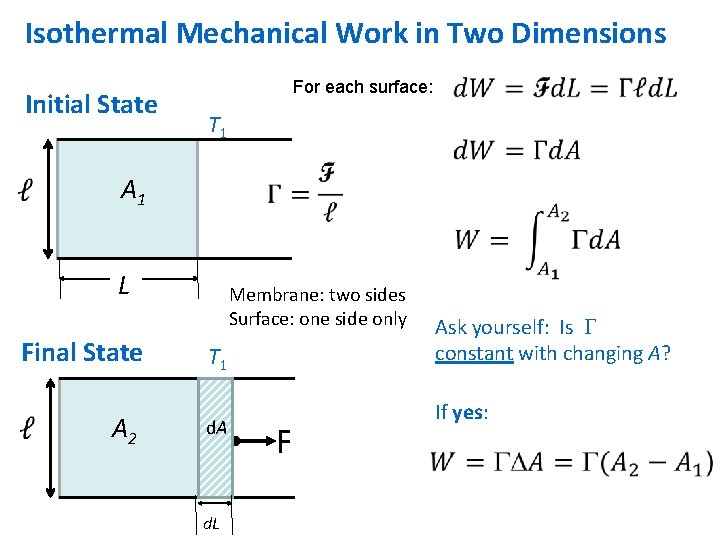
Isothermal Mechanical Work in Two Dimensions Initial State For each surface: T 1 A 1 L Final State A 2 Membrane: two sides Surface: one side only T 1 d. A d. L F Ask yourself: Is G constant with changing A? If yes:
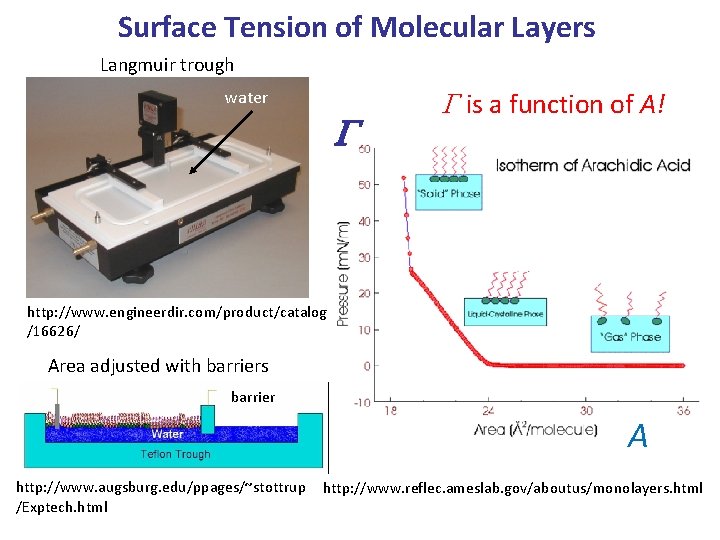
Surface Tension of Molecular Layers Langmuir trough water G G is a function of A! http: //www. engineerdir. com/product/catalog /16626/ Area adjusted with barriers barrier A http: //www. augsburg. edu/ppages/~stottrup /Exptech. html http: //www. reflec. ameslab. gov/aboutus/monolayers. html
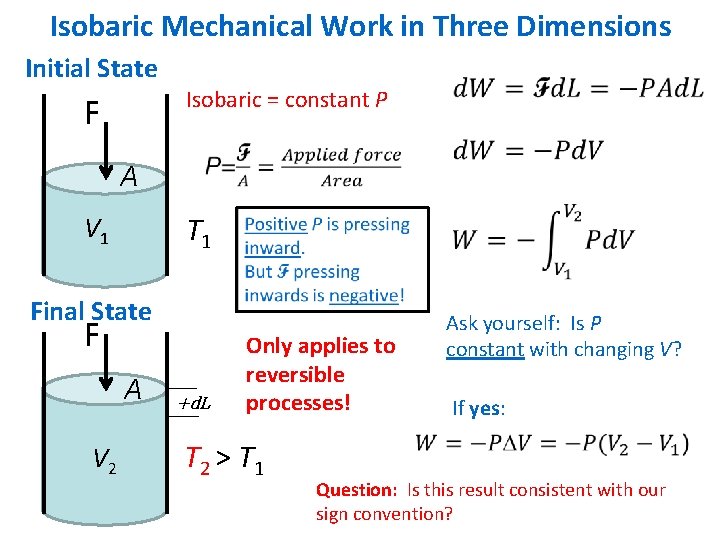
Isobaric Mechanical Work in Three Dimensions Initial State F Isobaric = constant P A A T 1 V 1 Final State F A A V 2 +d. L Only applies to reversible processes! T 2 > T 1 Ask yourself: Is P constant with changing V? If yes: Question: Is this result consistent with our sign convention?
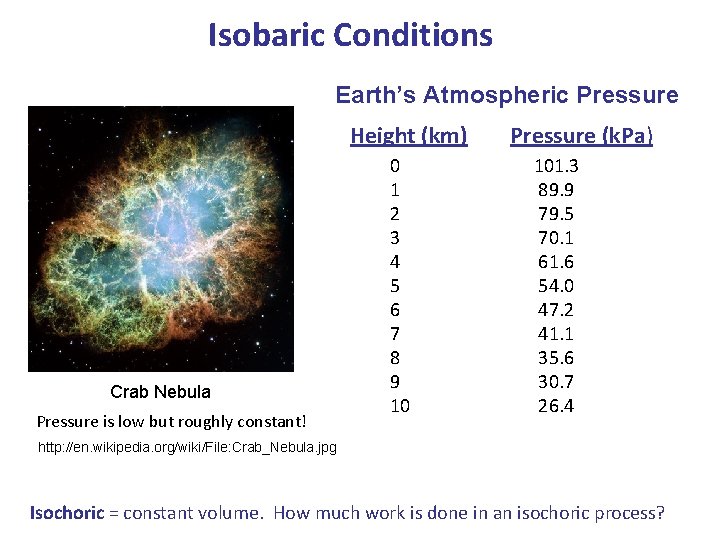
Isobaric Conditions Earth’s Atmospheric Pressure Height (km) Crab Nebula Pressure is low but roughly constant! 0 1 2 3 4 5 6 7 8 9 10 Pressure (k. Pa) 101. 3 89. 9 79. 5 70. 1 61. 6 54. 0 47. 2 41. 1 35. 6 30. 7 26. 4 http: //en. wikipedia. org/wiki/File: Crab_Nebula. jpg Isochoric = constant volume. How much work is done in an isochoric process?
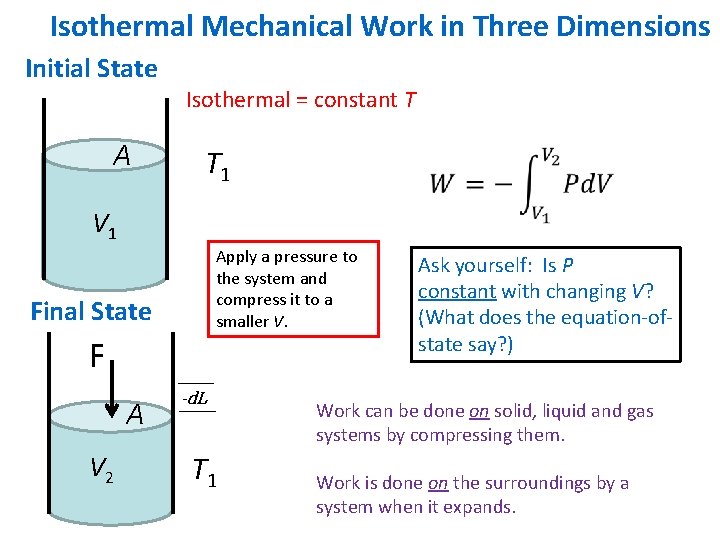
Isothermal Mechanical Work in Three Dimensions Initial State A A Isothermal = constant T T 1 V 1 Apply a pressure to the system and compress it to a smaller V. Final State F V 2 A A -d. L T 1 Ask yourself: Is P constant with changing V? (What does the equation-ofstate say? ) Work can be done on solid, liquid and gas systems by compressing them. Work is done on the surroundings by a system when it expands.
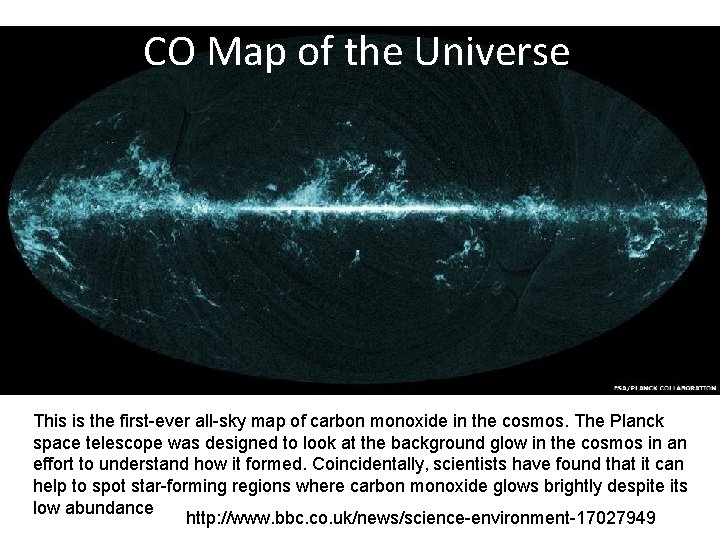
CO Map of the Universe This is the first-ever all-sky map of carbon monoxide in the cosmos. The Planck space telescope was designed to look at the background glow in the cosmos in an effort to understand how it formed. Coincidentally, scientists have found that it can help to spot star-forming regions where carbon monoxide glows brightly despite its low abundance http: //www. bbc. co. uk/news/science-environment-17027949
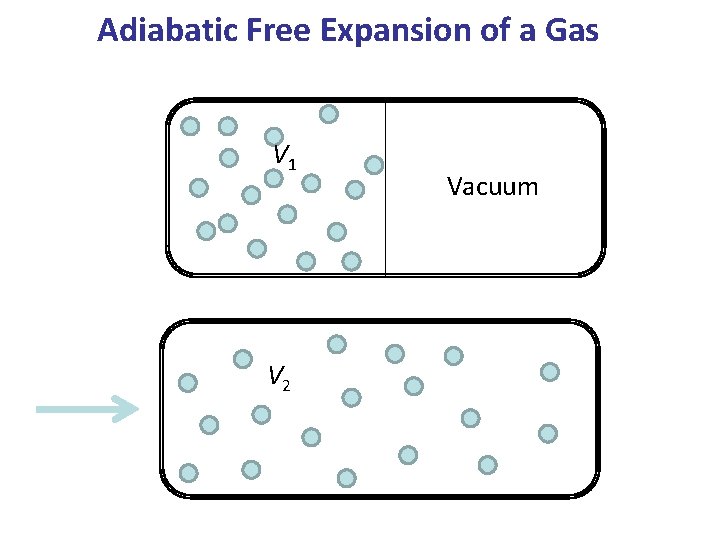
Adiabatic Free Expansion of a Gas V 1 V 2 Vacuum
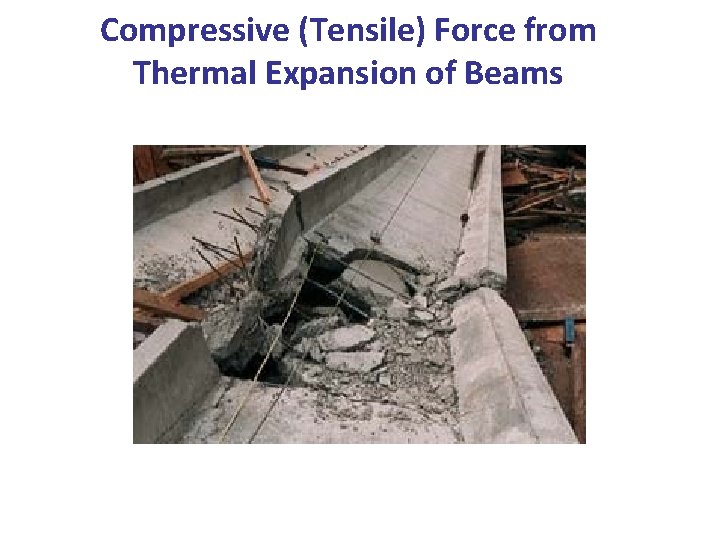
Compressive (Tensile) Force from Thermal Expansion of Beams
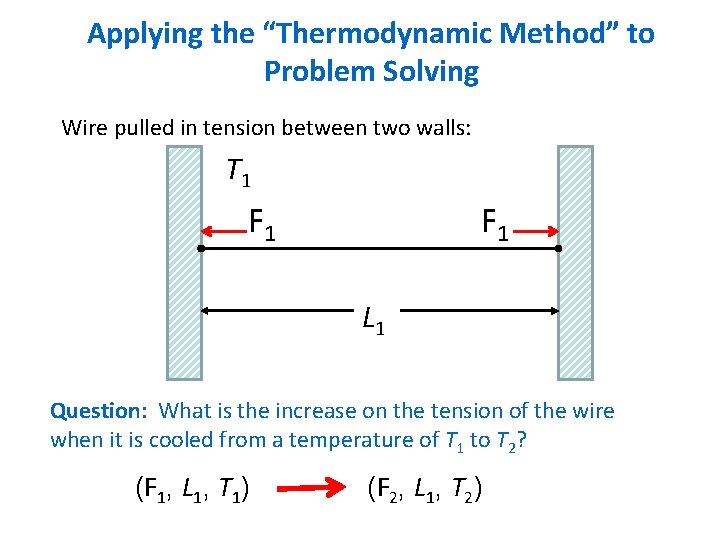
Applying the “Thermodynamic Method” to Problem Solving Wire pulled in tension between two walls: T 1 F 1 L 1 Question: What is the increase on the tension of the wire when it is cooled from a temperature of T 1 to T 2? (F 1, L 1, T 1) (F 2, L 1, T 2)