
PHY 101 Lecture 8 8 1 Rotational Motion
- Slides: 24
PHY 101: Lecture 8 • • • 8. 1 Rotational Motion and Angular Displacement 8. 2 Angular Velocity and Angular Acceleration 8. 3 The Equations of Rotational Kinematics 8. 4 Angular Variables and Tangential Variables 8. 5 Centripetal Acceleration and Tangential Acceleration • 8. 6 Rolling Motion • 8. 7 Vector Nature of Angular Variables
PHY 101: Lecture 8 Rotational Kinematics 8. 1 Rotational Motion and Angular Displacement
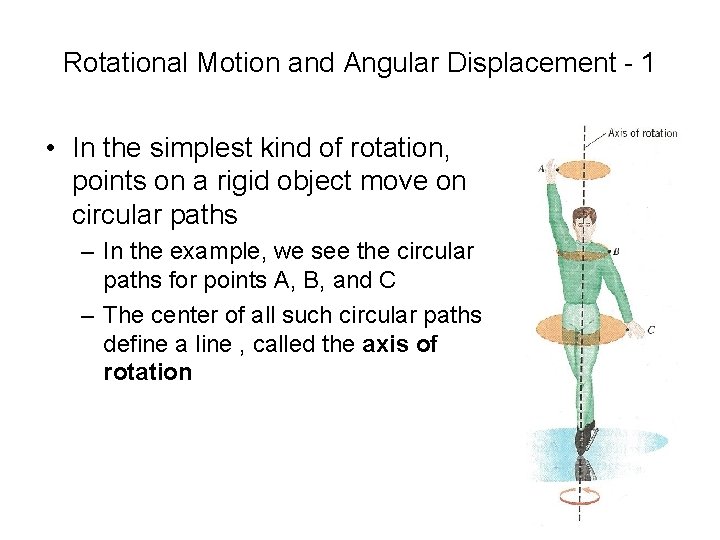
Rotational Motion and Angular Displacement - 1 • In the simplest kind of rotation, points on a rigid object move on circular paths – In the example, we see the circular paths for points A, B, and C – The center of all such circular paths define a line , called the axis of rotation
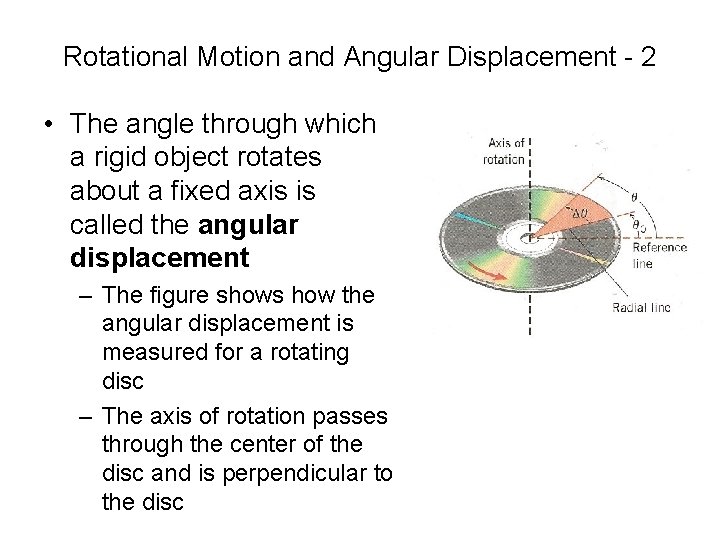
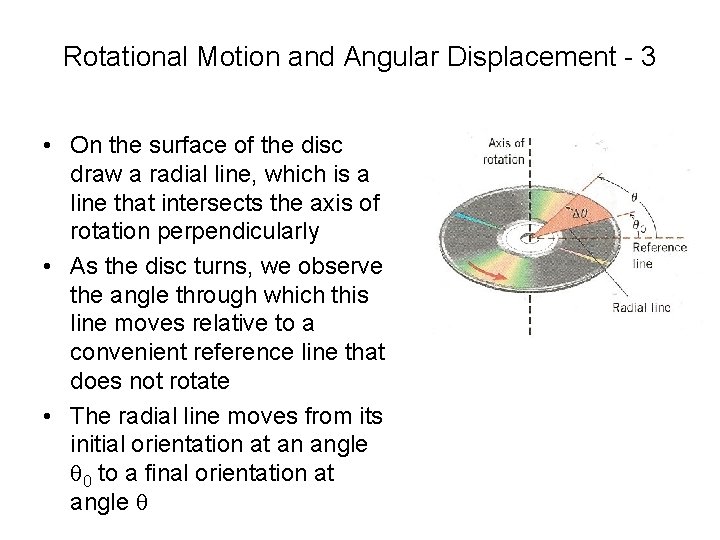
Rotational Motion and Angular Displacement - 2 • The angle through which a rigid object rotates about a fixed axis is called the angular displacement – The figure shows how the angular displacement is measured for a rotating disc – The axis of rotation passes through the center of the disc and is perpendicular to the disc
Rotational Motion and Angular Displacement - 3 • On the surface of the disc draw a radial line, which is a line that intersects the axis of rotation perpendicularly • As the disc turns, we observe the angle through which this line moves relative to a convenient reference line that does not rotate • The radial line moves from its initial orientation at an angle q 0 to a final orientation at angle q
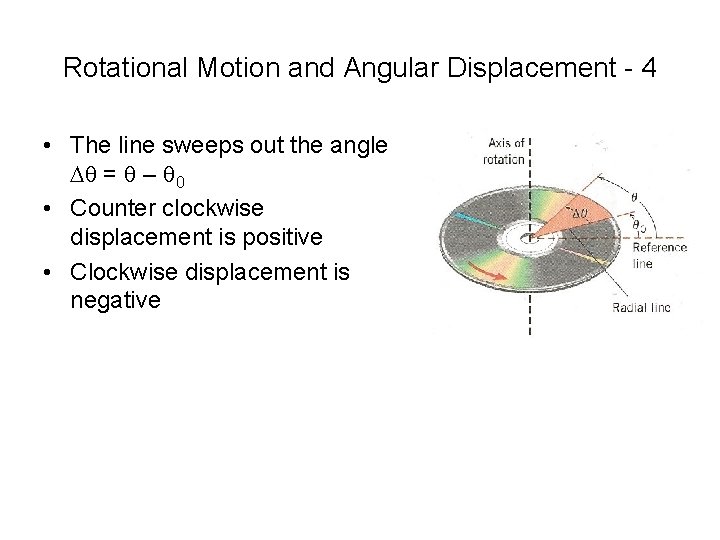
Rotational Motion and Angular Displacement - 4 • The line sweeps out the angle Dq = q – q 0 • Counter clockwise displacement is positive • Clockwise displacement is negative
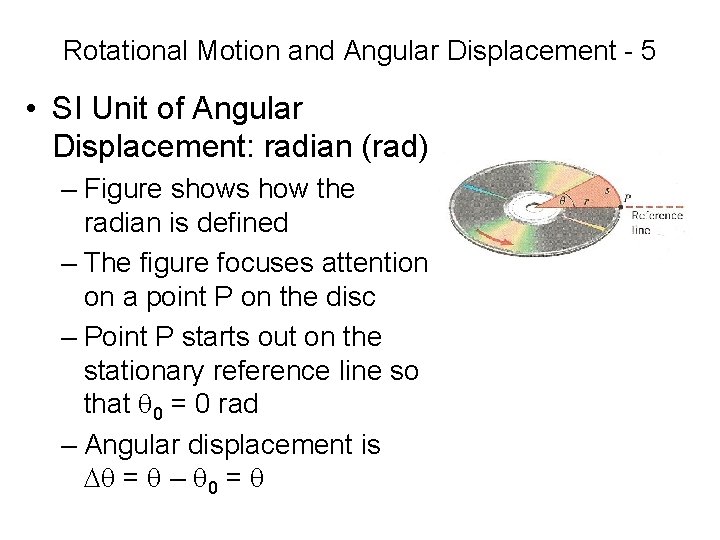
Rotational Motion and Angular Displacement - 5 • SI Unit of Angular Displacement: radian (rad) – Figure shows how the radian is defined – The figure focuses attention on a point P on the disc – Point P starts out on the stationary reference line so that q 0 = 0 rad – Angular displacement is Dq = q – q 0 = q
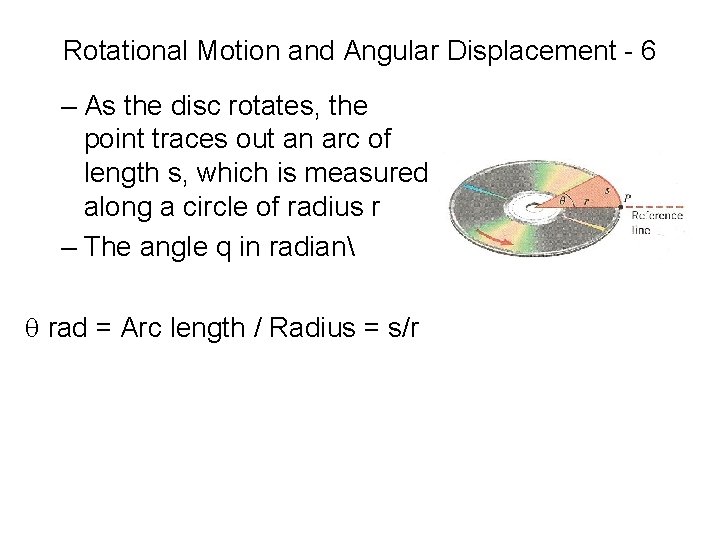
Rotational Motion and Angular Displacement - 6 – As the disc rotates, the point traces out an arc of length s, which is measured along a circle of radius r – The angle q in radian q rad = Arc length / Radius = s/r
Rotational Motion and Angular Displacement - 7 • To find number of radians in a full circle take circumference 2 pr and divide by radius to get 2 p radians • To convert from degrees to radians Øradians = degrees x (2 p / 360) • To convert from radians to degrees Ødegrees = radians x (360 / 2 p)
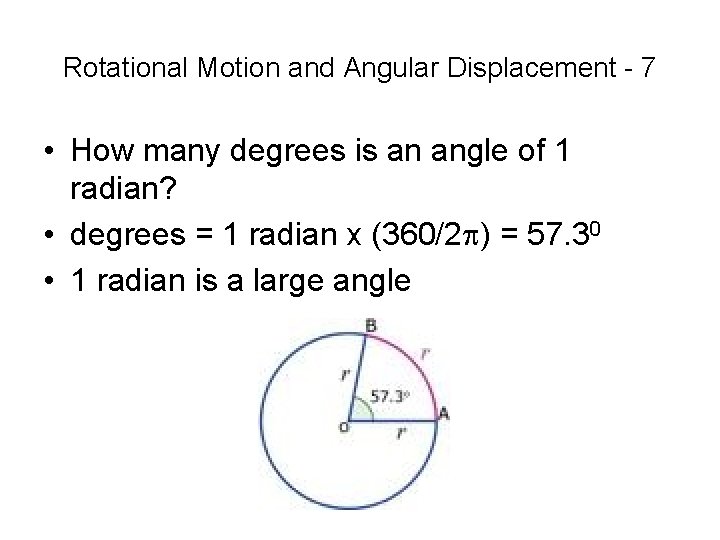
Rotational Motion and Angular Displacement - 7 • How many degrees is an angle of 1 radian? • degrees = 1 radian x (360/2 p) = 57. 30 • 1 radian is a large angle
Example 1 • How many radians is an angle of 300? Øradians = 300 x (2 p/360) = 0. 52 radians
Example 2 • The bob of a pendulum that is 0. 80 m long swings through an angle of 0. 2 radians • Find length of arc through which it swings ØAn angle of 1 radian has an arc length on the circle equal to the radius of the circle ØIf you take the arc length and divide by the radius, you get the number of radians Øradians = 0. 20 = d / 0. 80 radius Ød = 0. 16 m
PHY 101: Lecture 8 Rotational Kinematics 8. 2 Angular Velocity and Angular Acceleration
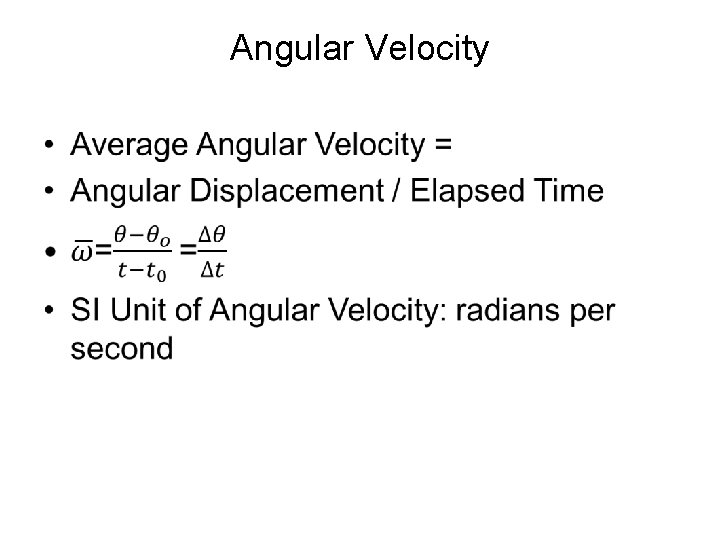
Angular Velocity •
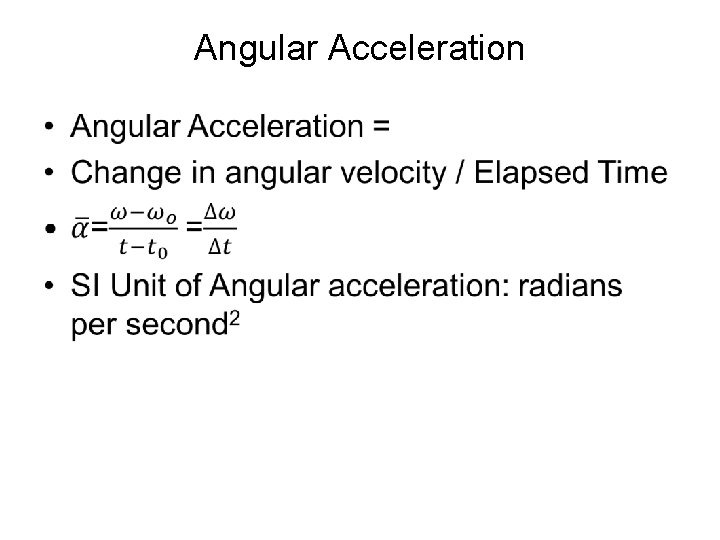
Angular Acceleration •
PHY 101: Lecture 8 Rotational Kinematics 8. 3 Equations of Rotational Kinematics
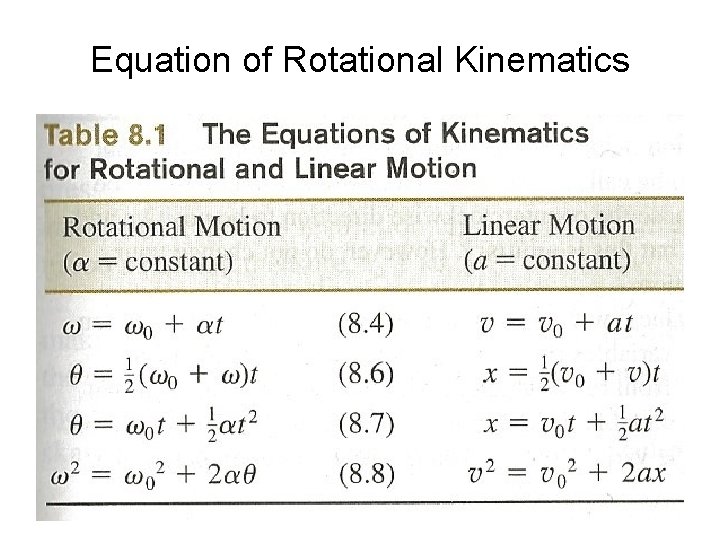
Equation of Rotational Kinematics
PHY 101: Lecture 8 Rotational Kinematics 8. 4 Angular Variables and Tangential Variables
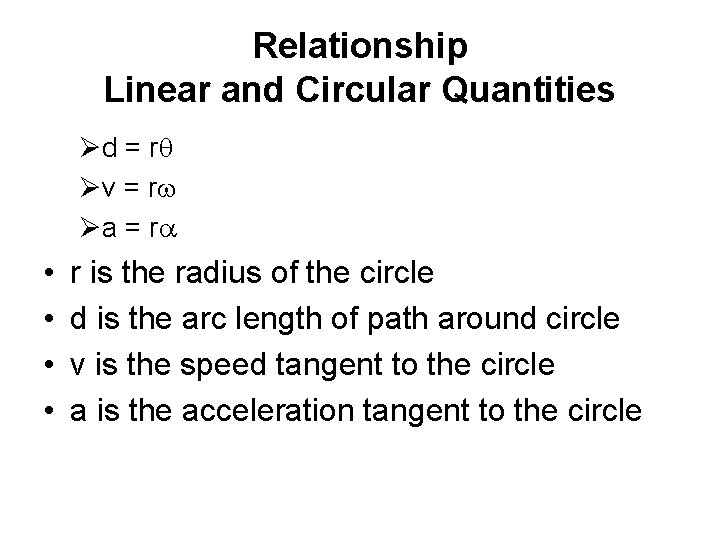
Relationship Linear and Circular Quantities Ød = rq Øv = rw Øa = ra • • r is the radius of the circle d is the arc length of path around circle v is the speed tangent to the circle a is the acceleration tangent to the circle
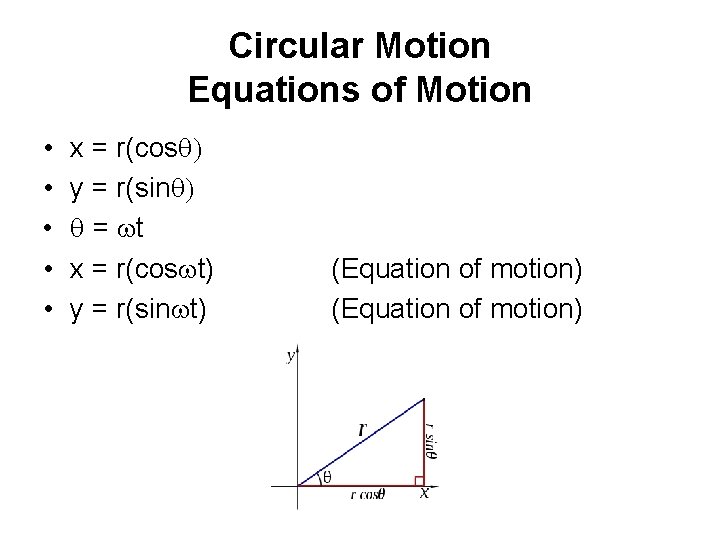
Circular Motion Equations of Motion • • • x = r(cosq) y = r(sinq) q = wt x = r(coswt) y = r(sinwt) (Equation of motion)
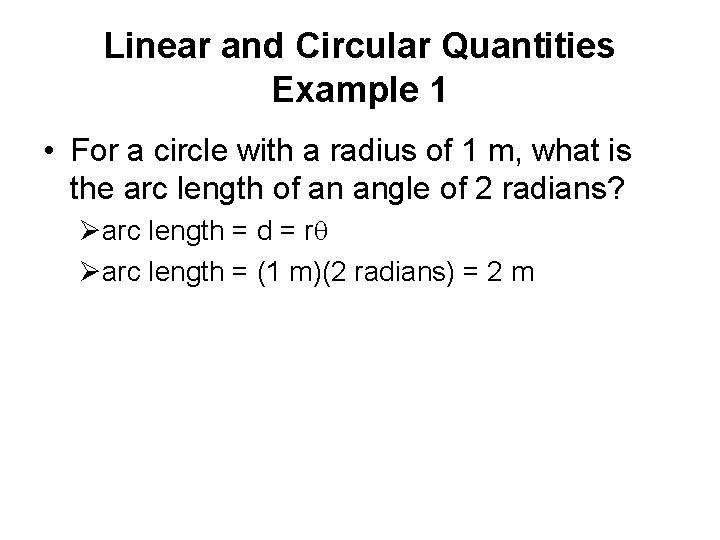
Linear and Circular Quantities Example 1 • For a circle with a radius of 1 m, what is the arc length of an angle of 2 radians? Øarc length = d = rq Øarc length = (1 m)(2 radians) = 2 m
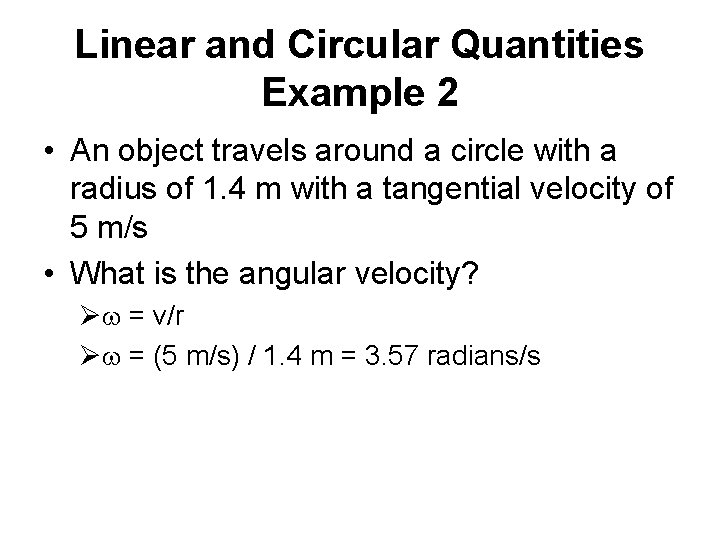
Linear and Circular Quantities Example 2 • An object travels around a circle with a radius of 1. 4 m with a tangential velocity of 5 m/s • What is the angular velocity? Øw = v/r Øw = (5 m/s) / 1. 4 m = 3. 57 radians/s
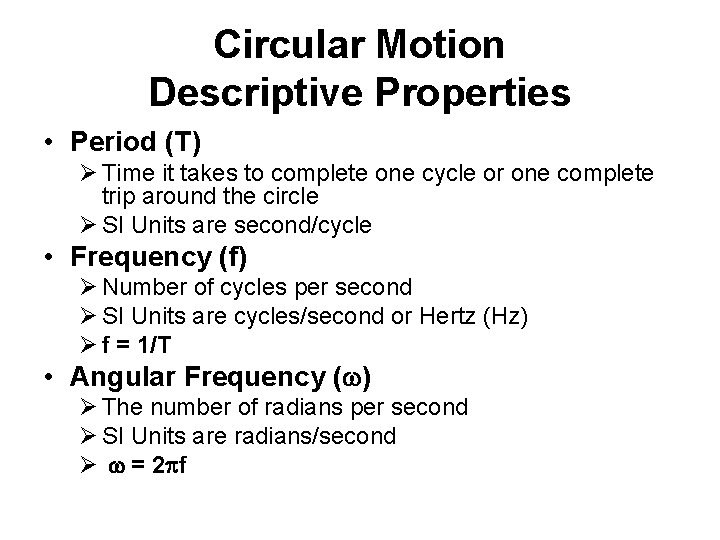
Circular Motion Descriptive Properties • Period (T) Ø Time it takes to complete one cycle or one complete trip around the circle Ø SI Units are second/cycle • Frequency (f) Ø Number of cycles per second Ø SI Units are cycles/second or Hertz (Hz) Ø f = 1/T • Angular Frequency (w) Ø The number of radians per second Ø SI Units are radians/second Ø w = 2 pf
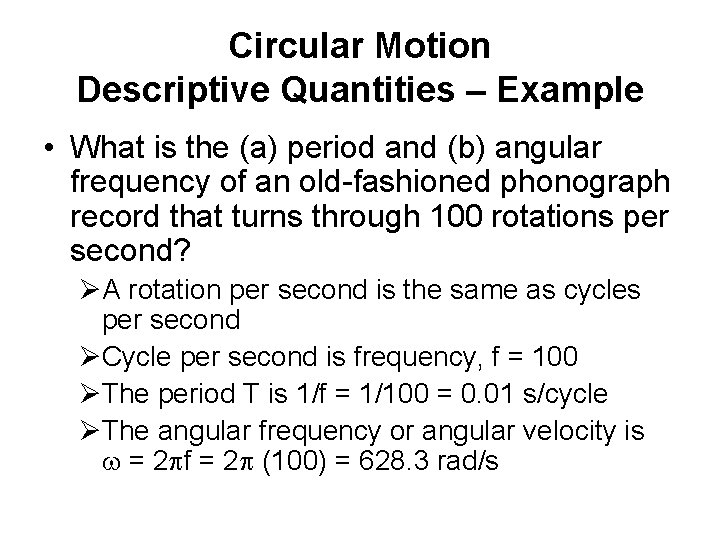
Circular Motion Descriptive Quantities – Example • What is the (a) period and (b) angular frequency of an old-fashioned phonograph record that turns through 100 rotations per second? ØA rotation per second is the same as cycles per second ØCycle per second is frequency, f = 100 ØThe period T is 1/f = 1/100 = 0. 01 s/cycle ØThe angular frequency or angular velocity is w = 2 pf = 2 p (100) = 628. 3 rad/s