
PHY 101 Lecture 6 6 1 Work Done


- Slides: 45
PHY 101: Lecture 6 • • • 6. 1 Work Done by a Constant Force 6. 2 The Work-Energy Theorem and Kinetic Energy 6. 3 Gravitational Potential Energy 6. 4 Conservation Versus Nonconservative Forces 6. 5 The Conservation of Mechanical Energy 6. 6 Nonconservative Forces and the Work-Energy Theorem • 6. 7 Power
PHY 101: Lecture 6 Work and Energy 6. 1 Work Done by a Constant Force
Work vs. Energy • Energy is a property of matter ØMass and Inertia are other properties • Matter that has energy can do work by means of a force • Work transfers or changes energy
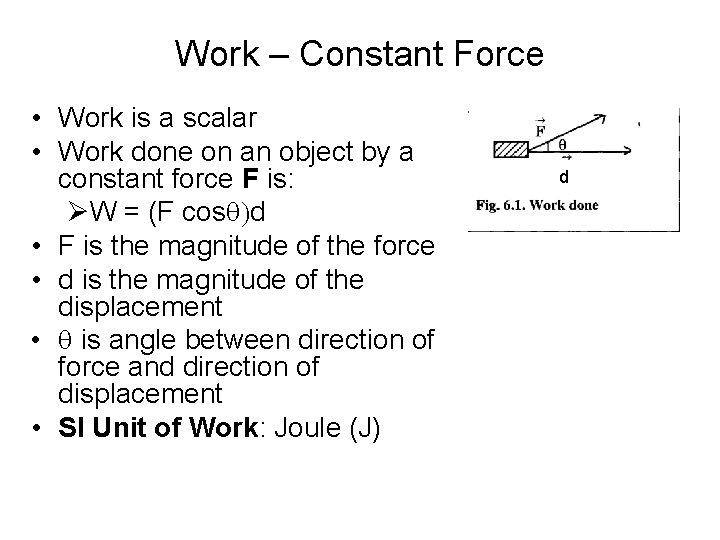
Work – Constant Force • Work is a scalar • Work done on an object by a constant force F is: ØW = (F cosq)d • F is the magnitude of the force • d is the magnitude of the displacement • q is angle between direction of force and direction of displacement • SI Unit of Work: Joule (J) d
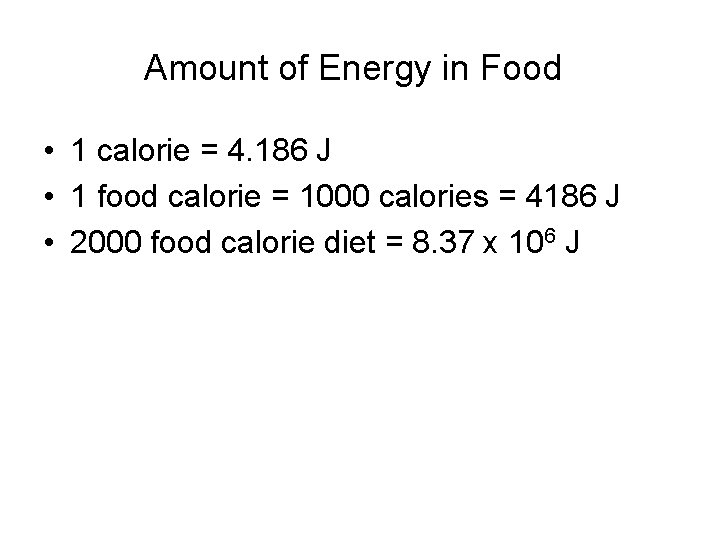
Amount of Energy in Food • 1 calorie = 4. 186 J • 1 food calorie = 1000 calories = 4186 J • 2000 food calorie diet = 8. 37 x 106 J
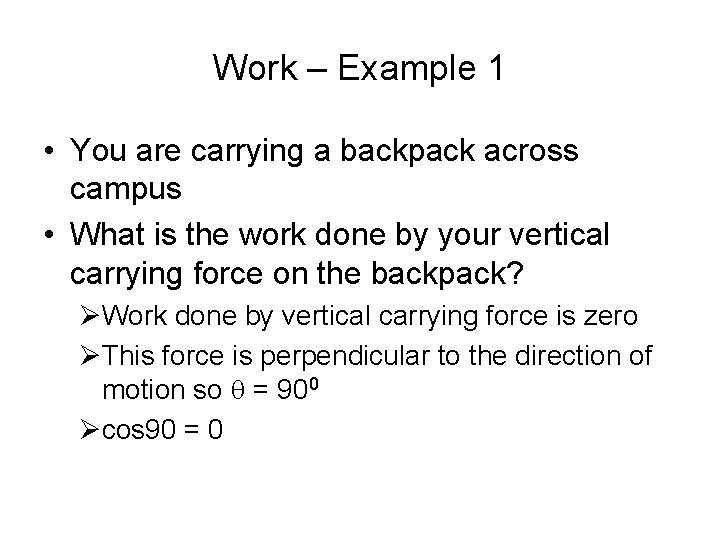
Work – Example 1 • You are carrying a backpack across campus • What is the work done by your vertical carrying force on the backpack? ØWork done by vertical carrying force is zero ØThis force is perpendicular to the direction of motion so q = 900 Øcos 90 = 0
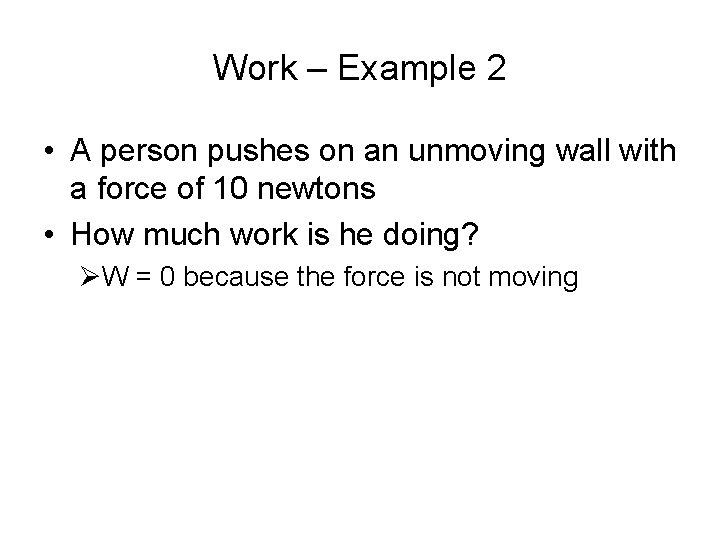
Work – Example 2 • A person pushes on an unmoving wall with a force of 10 newtons • How much work is he doing? ØW = 0 because the force is not moving
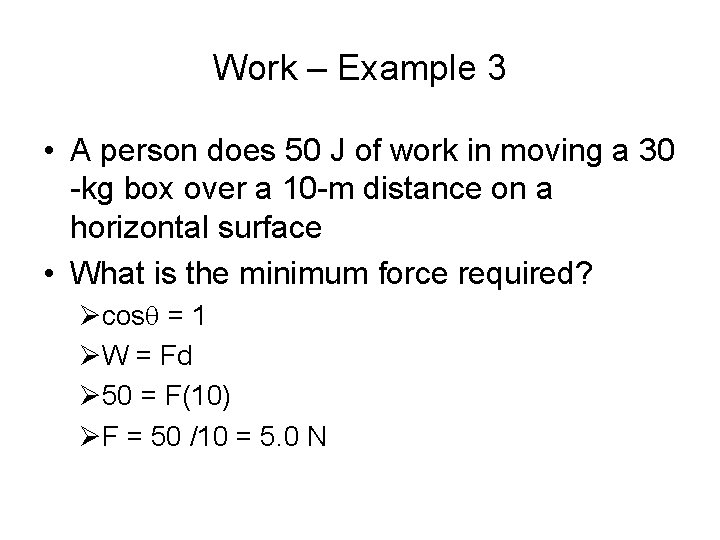
Work – Example 3 • A person does 50 J of work in moving a 30 -kg box over a 10 -m distance on a horizontal surface • What is the minimum force required? Øcosq = 1 ØW = Fd Ø 50 = F(10) ØF = 50 /10 = 5. 0 N
Work – Example 4 • An object is being pulled along the ground by a 75 -N force directed 280 above the horizontal • How much work does the force do in pulling the object 8. 0 m? ØW = Fdcosq = 75 N (8. 0 m) cos 28 = 530 J
Work – Example 5 • A 5. 0 -kg box slides a 10 -m distance on ice • The coefficient of kinetic friction is 0. 20 • What is the work done by the friction force Ø fk = mk. N Ø W = -fkd Ø The sign is minus because the force is in the opposite direction from the motion, q = 1800 Ø In vertical direction, we have N – mg = ma = 0 Ø N = mg Ø W = -(0. 20)(5 x 9. 8)(10) = - 98 J
Work – Example 6 a • • A 5 -kg hammer moves at 8 m/sec The hammer drives a nail 0. 04 m into a piece of wood Ability to do work comes from motion of hammer What is the force applied to the nail? Ø Ø Ø Ø vf 2 = vi 2 + 2 a(xf – xi) 02 = 82 + 2 a(0. 04) -64 =. 08 a a = - 800 m/s 2 F = force on hammer = ma = 5 kg x (-800) = - 4000 N F = force on nail = + 4000 N Work done by hammer = Fd = 4000(0. 040 = 160 J
Work – Example 6 b • A 5 -kg hammer moves at 8 m/sec • The hammer drives a nail 0. 01 m into a piece of wood • a = -3200 m/s 2 • F = -16000 n • F = 16000 n • W = Fd = 16000 x 0. 01 = 160 J • Work comes from motion of hammer which is the same in parts a and b of the problem
PHY 101: Lecture 6 Work and Energy 6. 2 The Work-Energy Theorem and Kinetic Energy
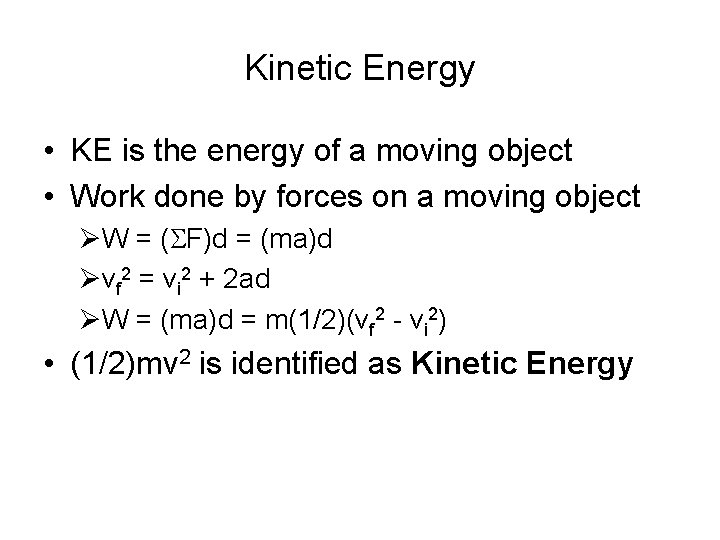
Kinetic Energy • KE is the energy of a moving object • Work done by forces on a moving object ØW = (SF)d = (ma)d Øvf 2 = vi 2 + 2 ad ØW = (ma)d = m(1/2)(vf 2 - vi 2) • (1/2)mv 2 is identified as Kinetic Energy
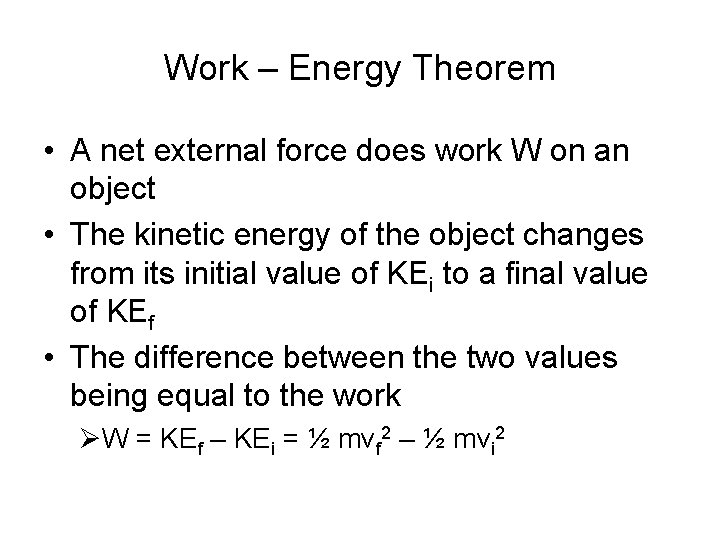
Work – Energy Theorem • A net external force does work W on an object • The kinetic energy of the object changes from its initial value of KEi to a final value of KEf • The difference between the two values being equal to the work ØW = KEf – KEi = ½ mvf 2 – ½ mvi 2
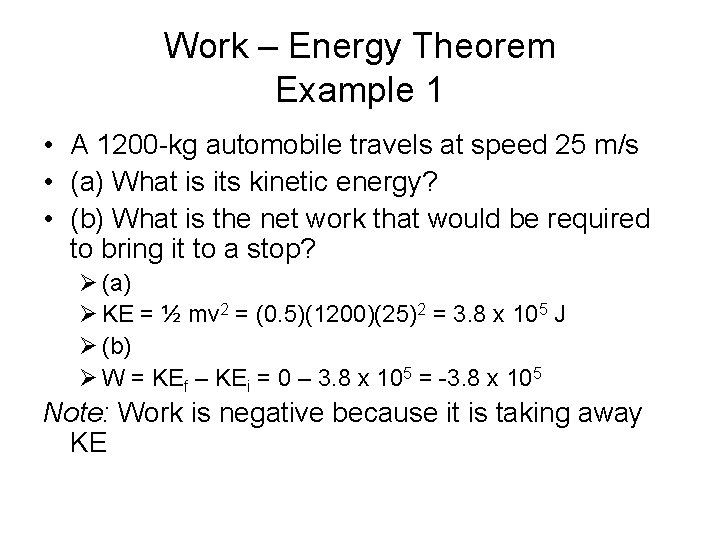
Work – Energy Theorem Example 1 • A 1200 -kg automobile travels at speed 25 m/s • (a) What is its kinetic energy? • (b) What is the net work that would be required to bring it to a stop? Ø (a) Ø KE = ½ mv 2 = (0. 5)(1200)(25)2 = 3. 8 x 10⁵ J Ø (b) Ø W = KEf – KEi = 0 – 3. 8 x 105 = -3. 8 x 10⁵ Note: Work is negative because it is taking away KE
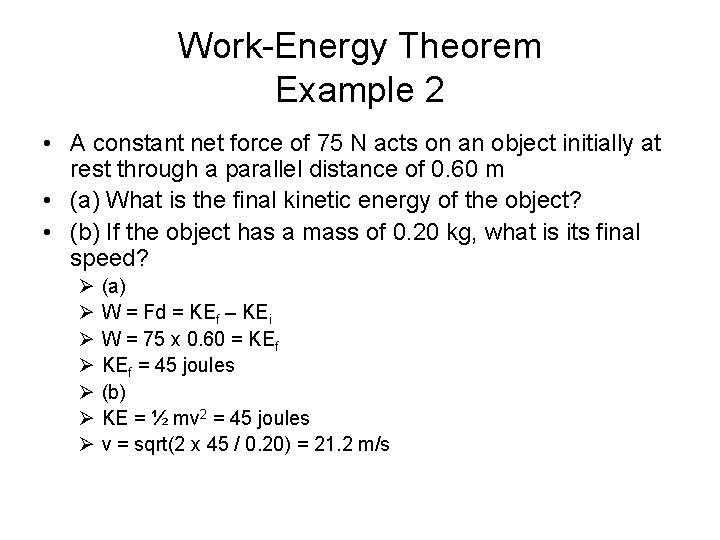
Work-Energy Theorem Example 2 • A constant net force of 75 N acts on an object initially at rest through a parallel distance of 0. 60 m • (a) What is the final kinetic energy of the object? • (b) If the object has a mass of 0. 20 kg, what is its final speed? Ø Ø Ø Ø (a) W = Fd = KEf – KEi W = 75 x 0. 60 = KEf = 45 joules (b) KE = ½ mv 2 = 45 joules v = sqrt(2 x 45 / 0. 20) = 21. 2 m/s
PHY 101: Lecture 6 Work and Energy 6. 3 Gravitational Potential Energy
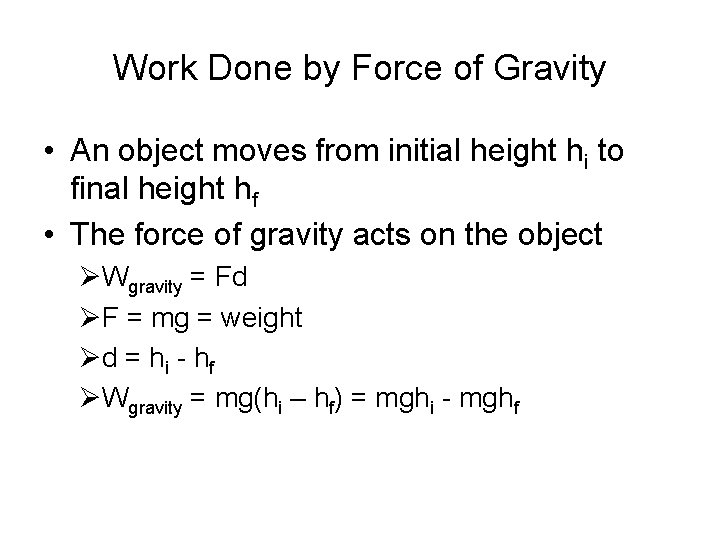
Work Done by Force of Gravity • An object moves from initial height hi to final height hf • The force of gravity acts on the object ØWgravity = Fd ØF = mg = weight Ød = h i - h f ØWgravity = mg(hi – hf) = mghi - mghf
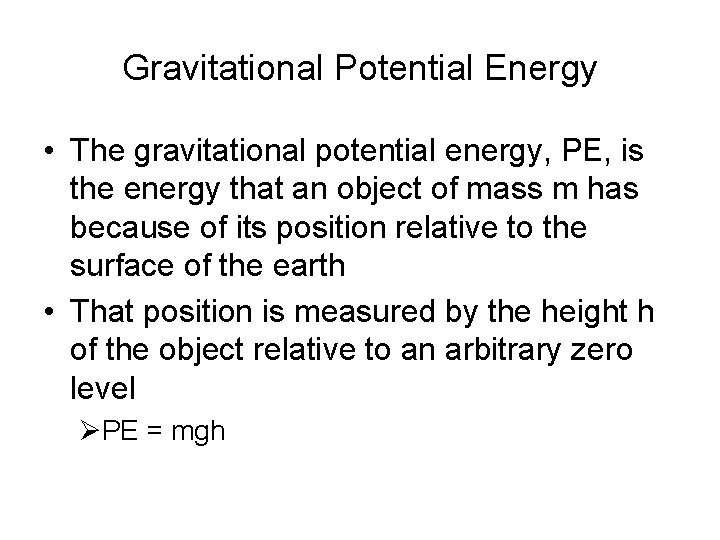
Gravitational Potential Energy • The gravitational potential energy, PE, is the energy that an object of mass m has because of its position relative to the surface of the earth • That position is measured by the height h of the object relative to an arbitrary zero level ØPE = mgh
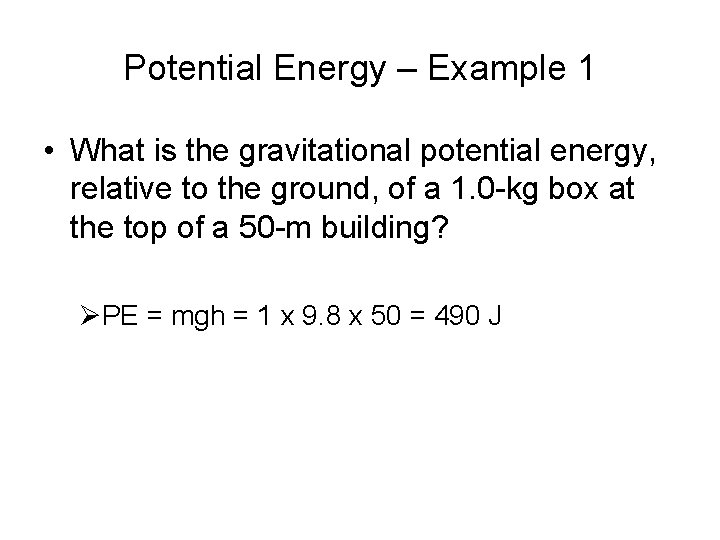
Potential Energy – Example 1 • What is the gravitational potential energy, relative to the ground, of a 1. 0 -kg box at the top of a 50 -m building? ØPE = mgh = 1 x 9. 8 x 50 = 490 J
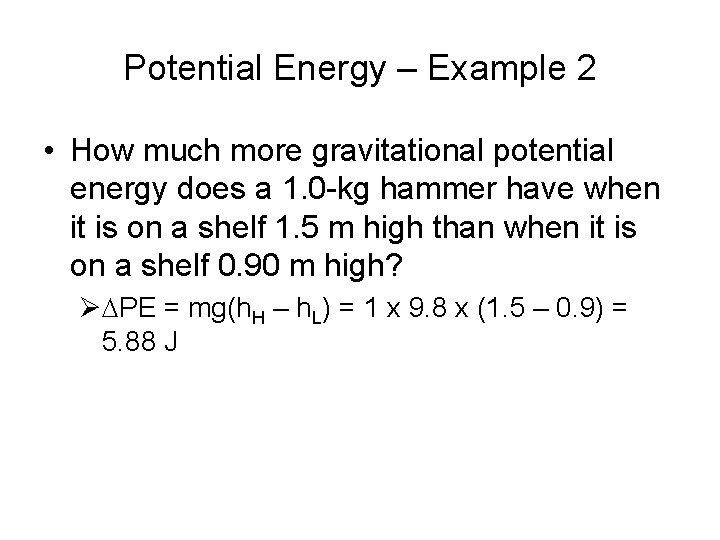
Potential Energy – Example 2 • How much more gravitational potential energy does a 1. 0 -kg hammer have when it is on a shelf 1. 5 m high than when it is on a shelf 0. 90 m high? ØDPE = mg(h. H – h. L) = 1 x 9. 8 x (1. 5 – 0. 9) = 5. 88 J
PHY 101: Lecture 6 Work and Energy 6. 4 Conservative Versus Nonconservative Force
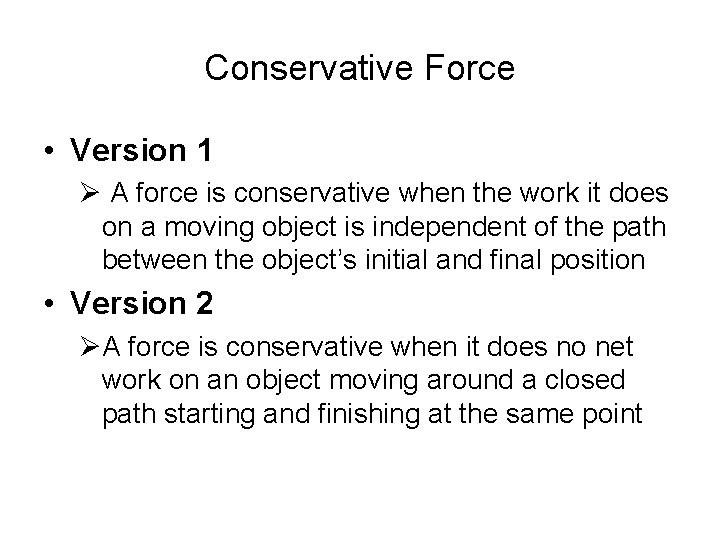
Conservative Force • Version 1 Ø A force is conservative when the work it does on a moving object is independent of the path between the object’s initial and final position • Version 2 ØA force is conservative when it does no net work on an object moving around a closed path starting and finishing at the same point
Conservative Forces Nonconservative Forces • Conservative Forces ØGravity ØSpring force ØElectrostatic force ØMagnetic force • Nonconservative Forces ØFriction ØAir resistance
Demonstration Gravity is Conservative Force • A 10 -kg mass rises 20 m • The 10 -kg mass is then lowered 20 m to it’s starting position • How much work is done by gravity? ØRaise ØW = mg(hi – hf) = 10(9. 8)(0 – 20) = -1960 J ØLower ØW = mg(hi – hf) = 10(9. 8)(20 – 0) = +1960 J ØTotal Work = -1960 + 1960 = 0 J
Conservative Force Example • While testing a cannon, a 1. 0 -kg ball is fired straight up into the air • The cannon ball rises 22. 5 m and then falls back to the height at which it was launched • What is amount of work done on ball by gravity? Ø Gravity is a conservative force Ø Work only depends on the end points of the path Ø The starting and ending points are the same Ø Work of gravity = 0
Work Done by Gravity Path Independence 1 • Mount Everest is 9000 m high • How much work is done against gravity by a 70 kg person climbing straight up to the top of Mount Everest? ØW = mg(hi – hf)=70(9. 8)(-9000)=-6. 17 x 106 N
Work Done by Gravity Path Independence 2 • How much work is done against gravity by a 70 kg person climbing a ramp to the top of Mt. Everest? Ø Because of the angle q Ø Force along ramp = -mgsinq Ø Distance moved, d, is along ramp Ø Angle between F and d is 0 degrees Ø W = Fdsinq Ø h/d = sinq Ø W = -mg(h/d)d = -mgh Ø Same work as climbing straight up • Note: This shows that path doesn’t matter when gravity is the force
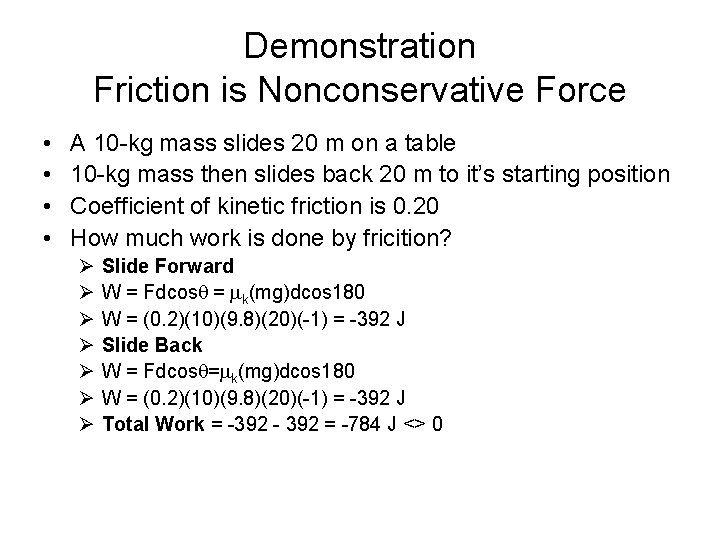
Demonstration Friction is Nonconservative Force • • A 10 -kg mass slides 20 m on a table 10 -kg mass then slides back 20 m to it’s starting position Coefficient of kinetic friction is 0. 20 How much work is done by fricition? Ø Ø Ø Ø Slide Forward W = Fdcosq = mk(mg)dcos 180 W = (0. 2)(10)(9. 8)(20)(-1) = -392 J Slide Back W = Fdcosq=mk(mg)dcos 180 W = (0. 2)(10)(9. 8)(20)(-1) = -392 J Total Work = -392 - 392 = -784 J <> 0
PHY 101: Lecture 6 Work and Energy 6. 5 The Conservation of Mechanical Energy
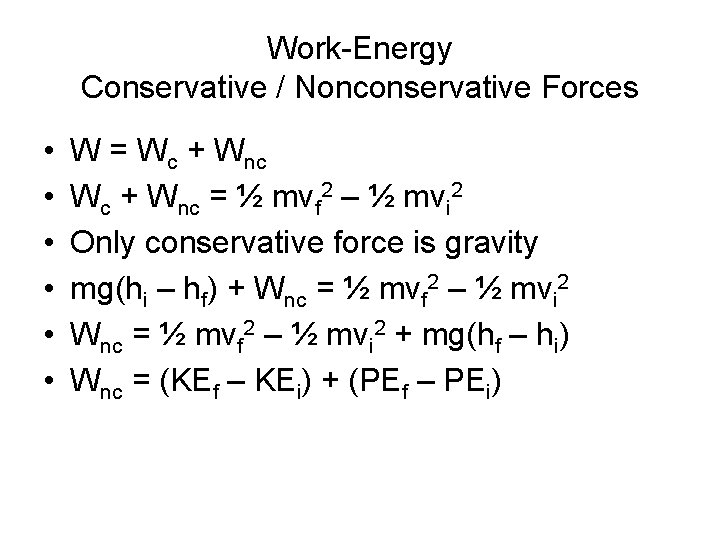
Work-Energy Conservative / Nonconservative Forces • • • W = Wc + Wnc = ½ mvf 2 – ½ mvi 2 Only conservative force is gravity mg(hi – hf) + Wnc = ½ mvf 2 – ½ mvi 2 + mg(hf – hi) Wnc = (KEf – KEi) + (PEf – PEi)
Derivation Conservation of Mechanical Energy • Suppose that the net work Wnc done by external nonconservative forces is zero ØWnc = 0 J Ø 0 = (KEf – KEi) + (PEf – PEi) Ø(KEf – KEi) = -(PEf – PEi) Ø(KEf + PEf) = (KEi + PEi) ؽ mvf 2 + mghf = ½ mvi 2 + mghi ØMechanical Energy = E = ½ mv 2 + mgh ØE f = E i
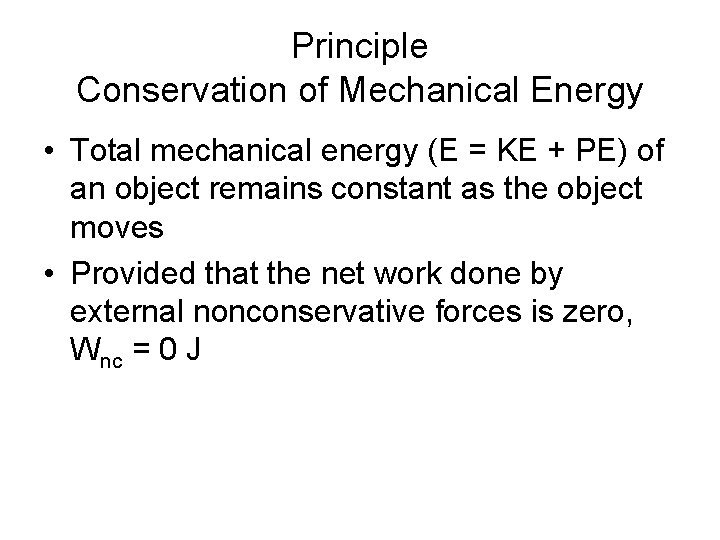
Principle Conservation of Mechanical Energy • Total mechanical energy (E = KE + PE) of an object remains constant as the object moves • Provided that the net work done by external nonconservative forces is zero, Wnc = 0 J
Kinetic Energy vs. Potential Energy • The sum of the kinetic and potential energies at any point is conserved • Kinetic and Potential Energies may be converted or transformed into one another
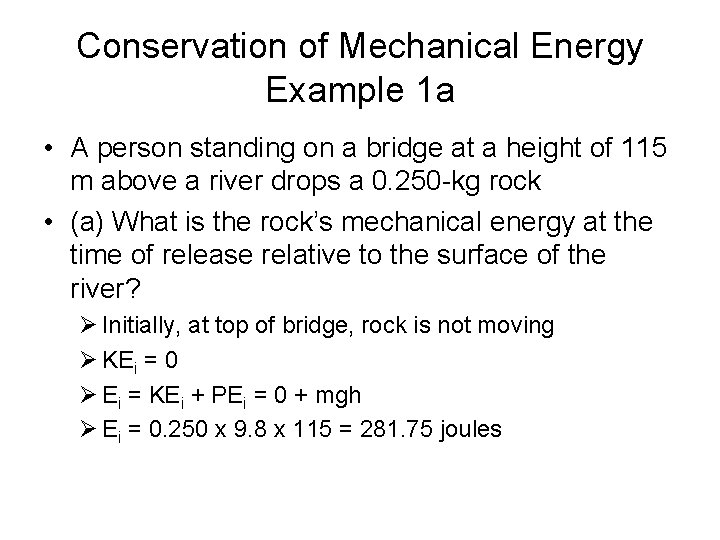
Conservation of Mechanical Energy Example 1 a • A person standing on a bridge at a height of 115 m above a river drops a 0. 250 -kg rock • (a) What is the rock’s mechanical energy at the time of release relative to the surface of the river? Ø Initially, at top of bridge, rock is not moving Ø KEi = 0 Ø Ei = KEi + PEi = 0 + mgh Ø Ei = 0. 250 x 9. 8 x 115 = 281. 75 joules
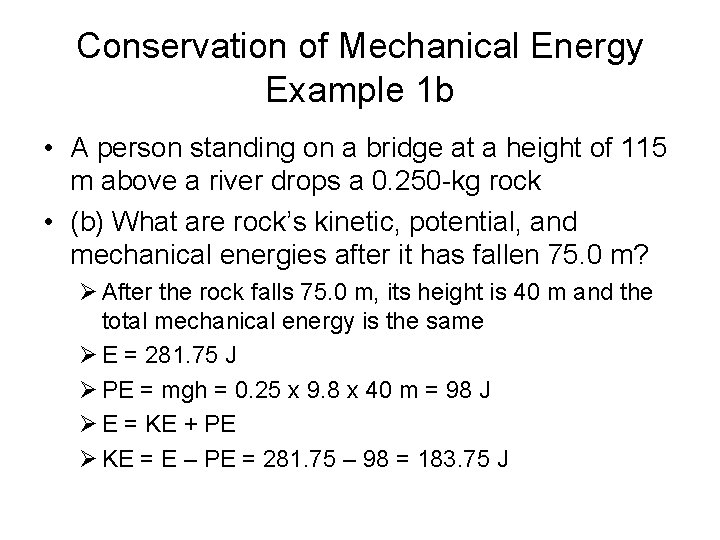
Conservation of Mechanical Energy Example 1 b • A person standing on a bridge at a height of 115 m above a river drops a 0. 250 -kg rock • (b) What are rock’s kinetic, potential, and mechanical energies after it has fallen 75. 0 m? Ø After the rock falls 75. 0 m, its height is 40 m and the total mechanical energy is the same Ø E = 281. 75 J Ø PE = mgh = 0. 25 x 9. 8 x 40 m = 98 J Ø E = KE + PE Ø KE = E – PE = 281. 75 – 98 = 183. 75 J
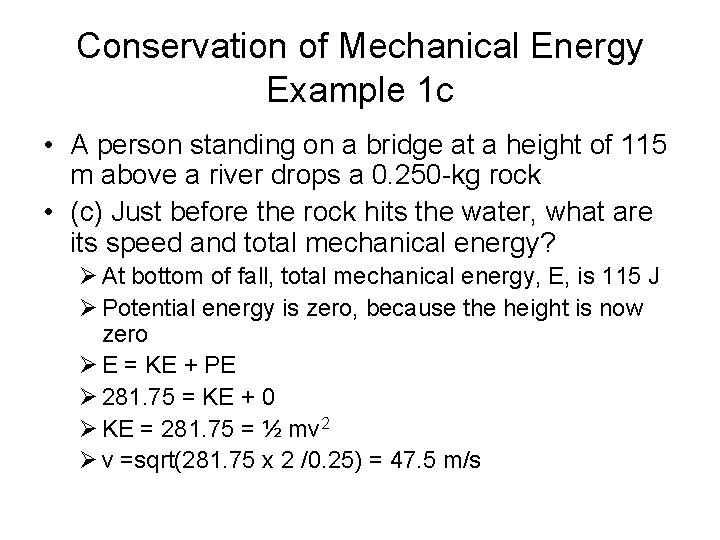
Conservation of Mechanical Energy Example 1 c • A person standing on a bridge at a height of 115 m above a river drops a 0. 250 -kg rock • (c) Just before the rock hits the water, what are its speed and total mechanical energy? Ø At bottom of fall, total mechanical energy, E, is 115 J Ø Potential energy is zero, because the height is now zero Ø E = KE + PE Ø 281. 75 = KE + 0 Ø KE = 281. 75 = ½ mv 2 Ø v =sqrt(281. 75 x 2 /0. 25) = 47. 5 m/s
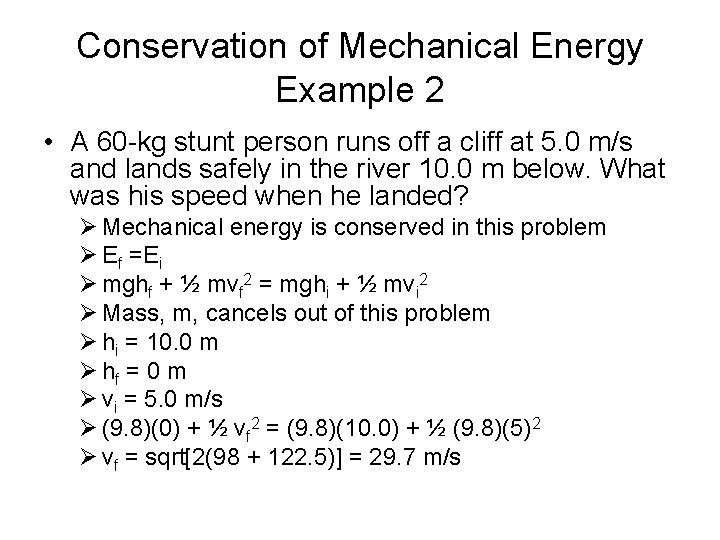
Conservation of Mechanical Energy Example 2 • A 60 -kg stunt person runs off a cliff at 5. 0 m/s and lands safely in the river 10. 0 m below. What was his speed when he landed? Ø Mechanical energy is conserved in this problem Ø Ef =Ei Ø mghf + ½ mvf 2 = mghi + ½ mvi 2 Ø Mass, m, cancels out of this problem Ø hi = 10. 0 m Ø hf = 0 m Ø vi = 5. 0 m/s Ø (9. 8)(0) + ½ vf 2 = (9. 8)(10. 0) + ½ (9. 8)(5)2 Ø vf = sqrt[2(98 + 122. 5)] = 29. 7 m/s
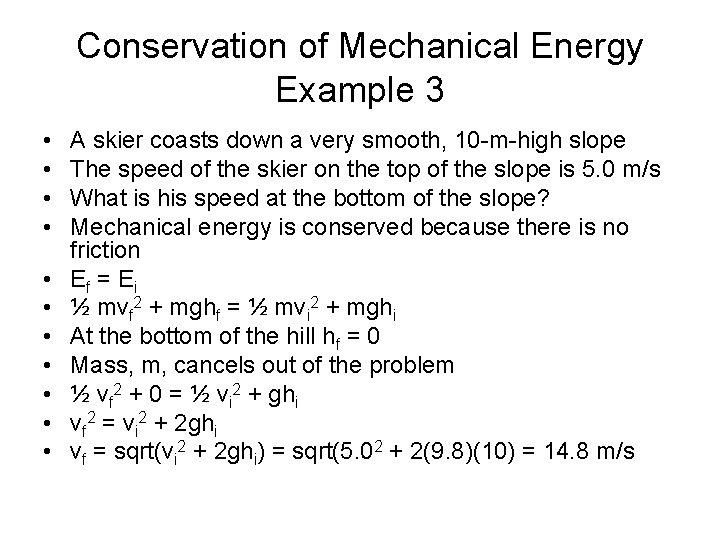
Conservation of Mechanical Energy Example 3 • • • A skier coasts down a very smooth, 10 -m-high slope The speed of the skier on the top of the slope is 5. 0 m/s What is his speed at the bottom of the slope? Mechanical energy is conserved because there is no friction Ef = E i ½ mvf 2 + mghf = ½ mvi 2 + mghi At the bottom of the hill hf = 0 Mass, m, cancels out of the problem ½ vf 2 + 0 = ½ vi 2 + ghi vf 2 = vi 2 + 2 ghi vf = sqrt(vi 2 + 2 ghi) = sqrt(5. 02 + 2(9. 8)(10) = 14. 8 m/s
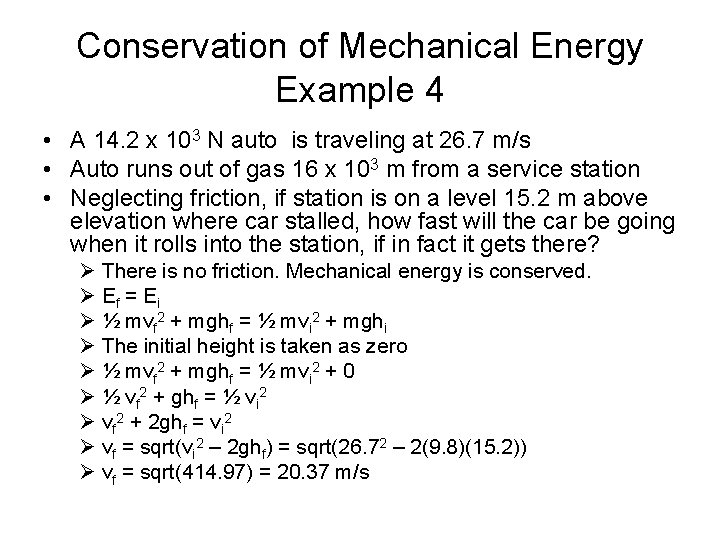
Conservation of Mechanical Energy Example 4 • A 14. 2 x 10³ N auto is traveling at 26. 7 m/s • Auto runs out of gas 16 x 103 m from a service station • Neglecting friction, if station is on a level 15. 2 m above elevation where car stalled, how fast will the car be going when it rolls into the station, if in fact it gets there? Ø There is no friction. Mechanical energy is conserved. Ø Ef = E i Ø ½ mvf 2 + mghf = ½ mvi 2 + mghi Ø The initial height is taken as zero Ø ½ mvf 2 + mghf = ½ mvi 2 + 0 Ø ½ vf 2 + ghf = ½ vi 2 Ø vf 2 + 2 ghf = vi 2 Ø vf = sqrt(vi 2 – 2 ghf) = sqrt(26. 72 – 2(9. 8)(15. 2)) Ø vf = sqrt(414. 97) = 20. 37 m/s
PHY 101: Lecture 6 Work and Energy 6. 6 Nonconservative Forces and the Work-Energy Theorem Skipped
PHY 101: Lecture 6 Work and Energy 6. 7 Power
Average Power • Average rate at which work W is done • It is obtained by dividing W by time required to perform the work ØP = Work / time = W / t • SI Unit of Power: joules/s = watt (W) ØP = W / t = Fd / t = F(d / t) = Fv
Average Power - Example • How much power does it take to raise an object weighing 100 N a distance of 20. 0 m in 50. 0 s • It begins at rest and ends at rest? ØBecause the object starts at rest and ends at rest, work only changes potential energy ØW = mgh = 100(20) = 2000 J ØPower = W/t = 2000/50. 0 = 40 W