
PHSD transport calculations Wolfgang Cassing Elena Bratkovskaya ITP
PHSD transport calculations Wolfgang Cassing Elena Bratkovskaya ITP Frankfurt GSI 09. 03. 2009
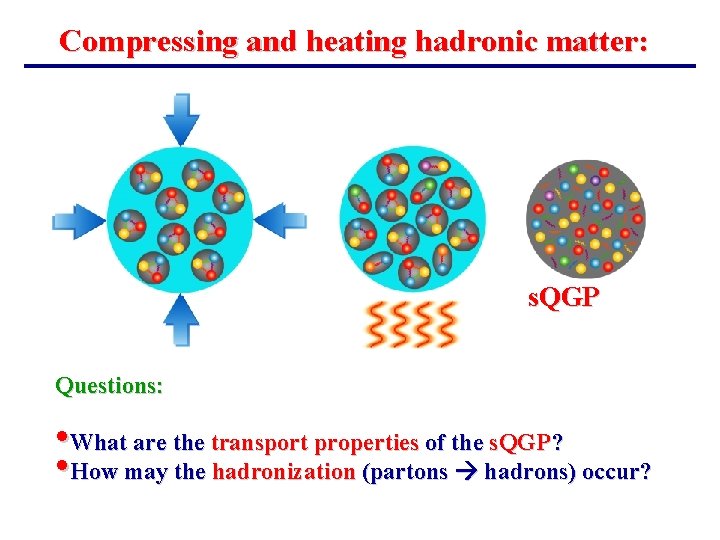
Compressing and heating hadronic matter: s. QGP Questions: • What are the transport properties of the s. QGP? • How may the hadronization (partons hadrons) occur?
From hadrons to partons In order to study of the phase transition from hadronic to partonic matter – Quark-Gluon-Plasma – we need a consistent dynamical description with Øexplicit parton-parton interactions (i. e. between quarks and gluons) Øexplicit phase transition from hadronic to partonic degrees of freedom ØQCD equation of state (Eo. S) for the partonic phase Transport theory: off-shell Kadanoff-Baym equations for the Green-functions G<h(x, p) in phase-space representation for the partonic and hadronic phase Parton-Hadron-String-Dynamics (PHSD) QGP phase described by input from the Dynamical Quasi. Particle Model (DQPM) DQPM
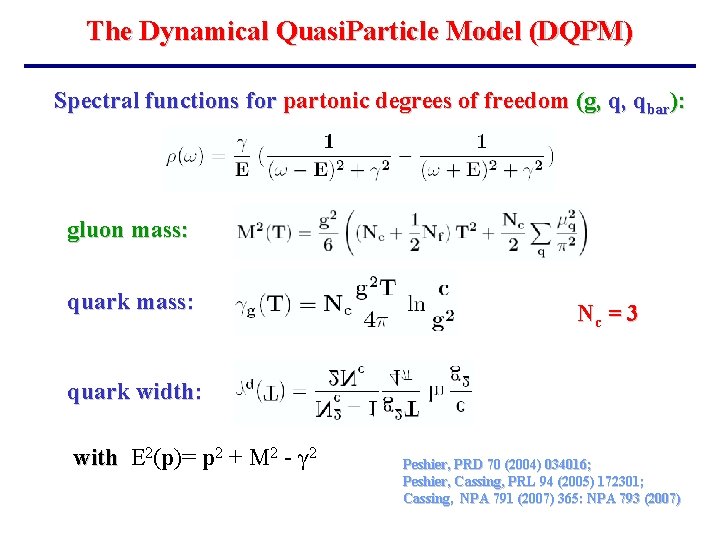
The Dynamical Quasi. Particle Model (DQPM) Spectral functions for partonic degrees of freedom (g, q, qbar): gluon mass: quark mass: Nc = 3 quark width: with E 2(p)= p 2 + M 2 - γ 2 Peshier, PRD 70 (2004) 034016; Peshier, Cassing, PRL 94 (2005) 172301; Cassing, NPA 791 (2007) 365: NPA 793 (2007)

The running coupling g 2 l. QCD: O. Kaczmarek et, PRD 72 (2005) 059903 3 parameters: Ts/Tc=0. 46; c=28. 8; l=2. 42 fit to lattice (l. QCD) entropy density: quasiparticle properties (Nf=3; Tc = 0. 185 Ge. V) large width for gluons (and quarks)!
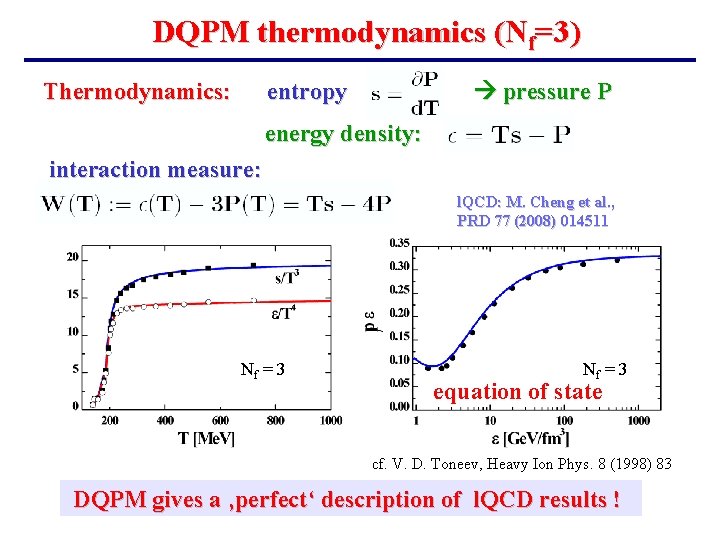
DQPM thermodynamics (Nf=3) Thermodynamics: pressure P entropy energy density: interaction measure: l. QCD: M. Cheng et al. , PRD 77 (2008) 014511 Nf = 3 equation of state cf. V. D. Toneev, Heavy Ion Phys. 8 (1998) 83 DQPM gives a ‚perfect‘ description of l. QCD results !
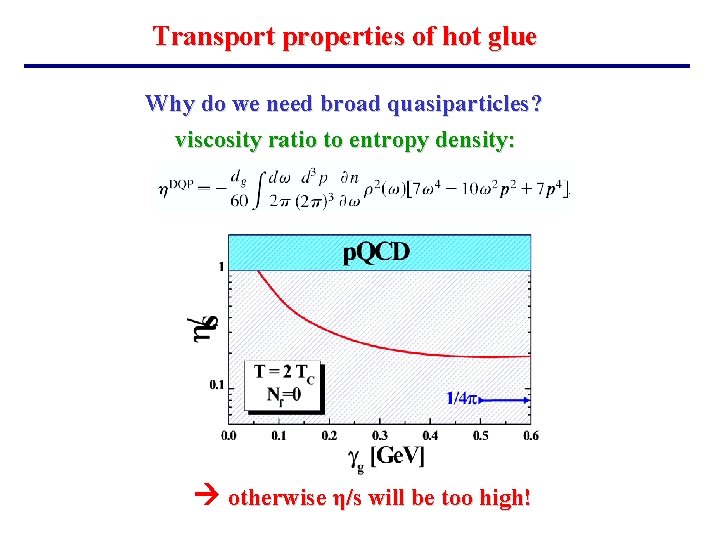
Transport properties of hot glue Why do we need broad quasiparticles? viscosity ratio to entropy density: otherwise η/s will be too high!
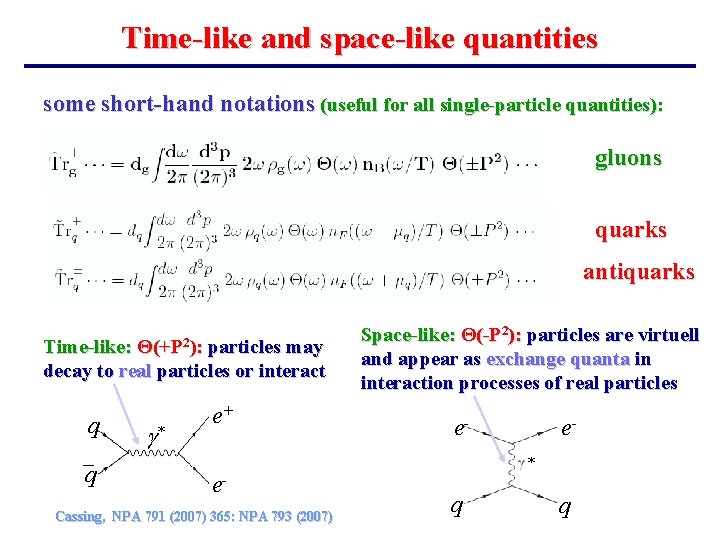
Time-like and space-like quantities some short-hand notations (useful for all single-particle quantities): gluons quarks antiquarks Θ(+P 2): Time-like: particles may decay to real particles or interact q q g * e+ e- Cassing, NPA 791 (2007) 365: NPA 793 (2007) Space-like: Θ(-P 2): particles are virtuell and appear as exchange quanta in interaction processes of real particles e- e* q q
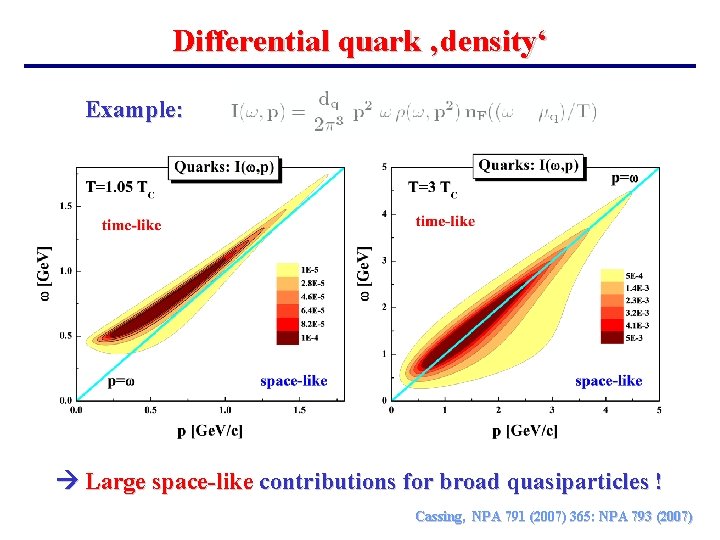
Differential quark ‚density‘ Example: Large space-like contributions for broad quasiparticles ! Cassing, NPA 791 (2007) 365: NPA 793 (2007)
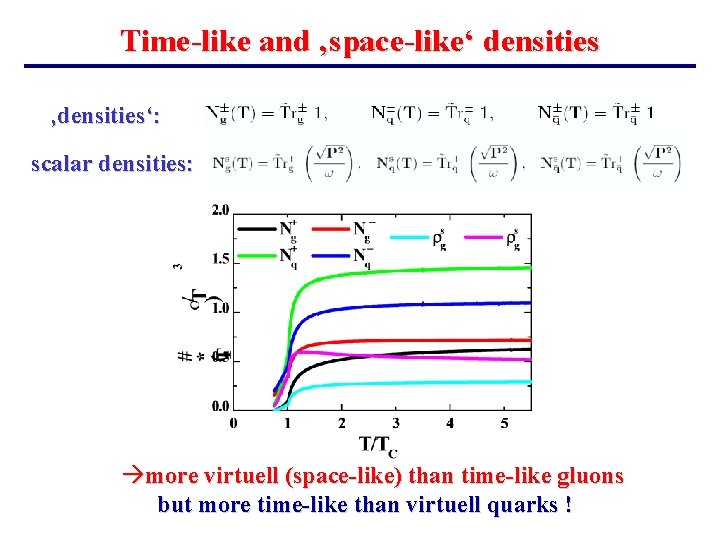
Time-like and ‚space-like‘ densities ‚densities‘: scalar densities: àmore virtuell (space-like) than time-like gluons but more time-like than virtuell quarks !
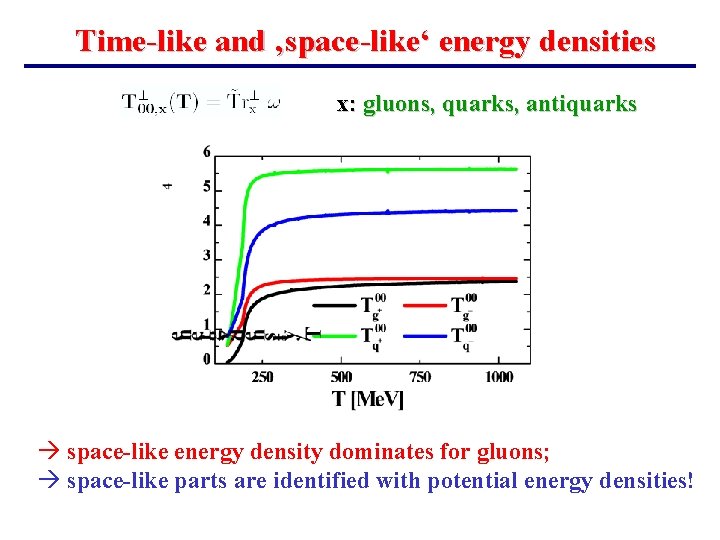
Time-like and ‚space-like‘ energy densities x: gluons, quarks, antiquarks à space-like energy density dominates for gluons; à space-like parts are identified with potential energy densities!
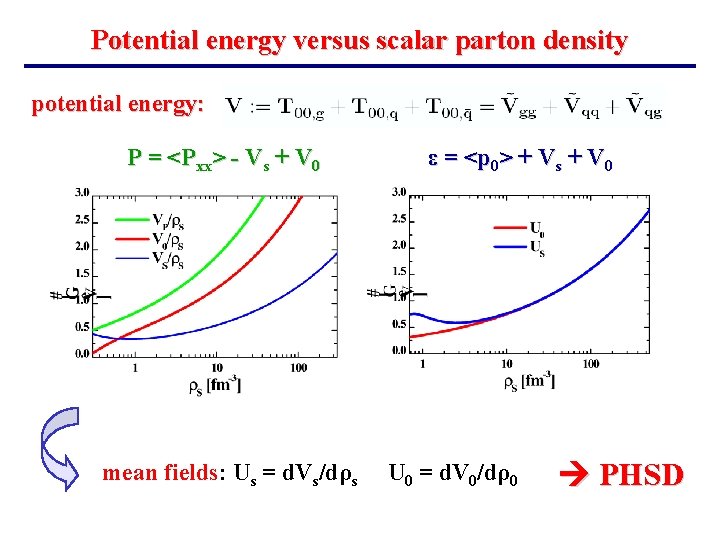
Potential energy versus scalar parton density potential energy: P = <Pxx> - Vs + V 0 mean fields: Us = d. Vs/dρs ε = <p 0> + Vs + V 0 U 0 = d. V 0/dρ0 PHSD
Summary of part I • The dynamical quasiparticle model (DQPM) well matches l. QCD (with only 3 parameters) ! • DQPM allows to extrapolate to finite quark chemical potentials • DQPM separates lime-like quantities from space-like (interaction) regions (needed for off-shell transport) • DQPM provides mean-fields for gluons and quarks as well as effective 2 -body interactions PHSD
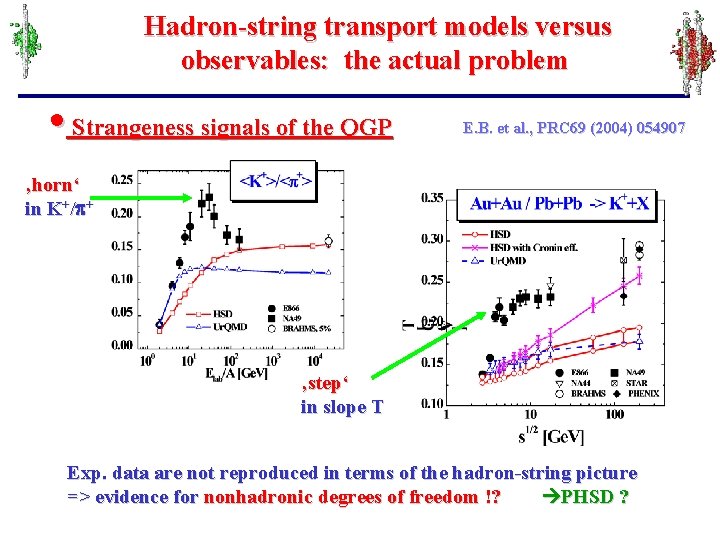
Hadron-string transport models versus observables: the actual problem • Strangeness signals of the QGP E. B. et al. , PRC 69 (2004) 054907 ‚horn‘ in K+/p+ ‚step‘ in slope T Exp. data are not reproduced in terms of the hadron-string picture => evidence for nonhadronic degrees of freedom !? PHSD ?
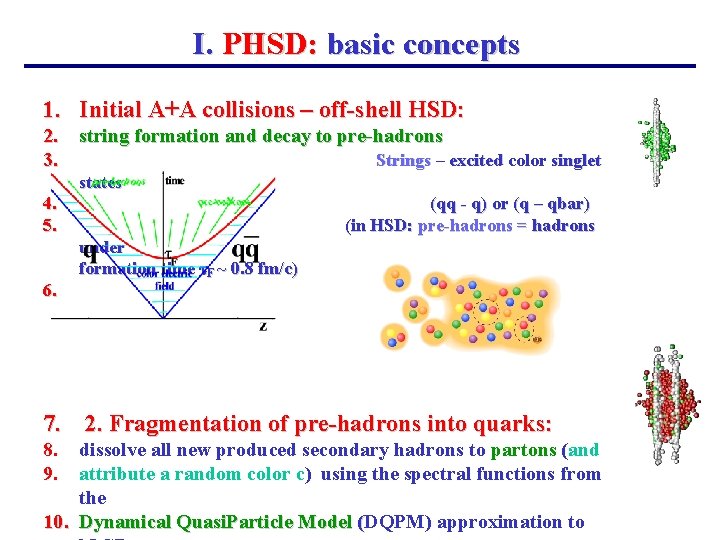
I. PHSD: basic concepts 1. Initial A+A collisions – off-shell HSD: 2. string formation and decay to pre-hadrons 3. Strings – excited color singlet states 4. 5. 6. (qq - q) or (q – qbar) (in HSD: pre-hadrons = hadrons under formation time t. F ~ 0. 8 fm/c) 7. 2. Fragmentation of pre-hadrons into quarks: 8. 9. dissolve all new produced secondary hadrons to partons (and attribute a random color c) using the spectral functions from the 10. Dynamical Quasi. Particle Model (DQPM) approximation to (
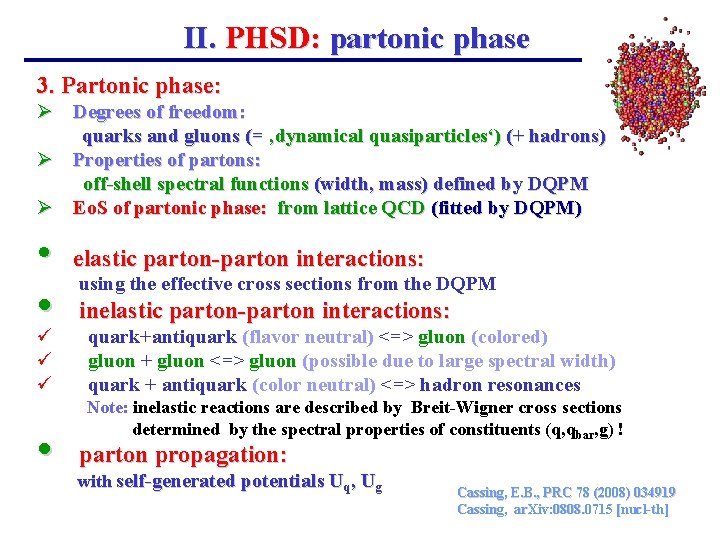
II. PHSD: partonic phase 3. Partonic phase: Ø Degrees of freedom: quarks and gluons (= ‚dynamical quasiparticles‘) (+ hadrons) Ø Properties of partons: off-shell spectral functions (width, mass) defined by DQPM Ø Eo. S of partonic phase: from lattice QCD (fitted by DQPM) • elastic parton-parton interactions: • inelastic parton-parton interactions: ü ü ü • using the effective cross sections from the DQPM quark+antiquark (flavor neutral) <=> gluon (colored) gluon + gluon <=> gluon (possible due to large spectral width) quark + antiquark (color neutral) <=> hadron resonances Note: inelastic reactions are described by Breit-Wigner cross sections determined by the spectral properties of constituents (q, qbar, g) ! parton propagation: with self-generated potentials Uq, Ug Cassing, E. B. , PRC 78 (2008) 034919 Cassing, ar. Xiv: 0808. 0715 [nucl-th]
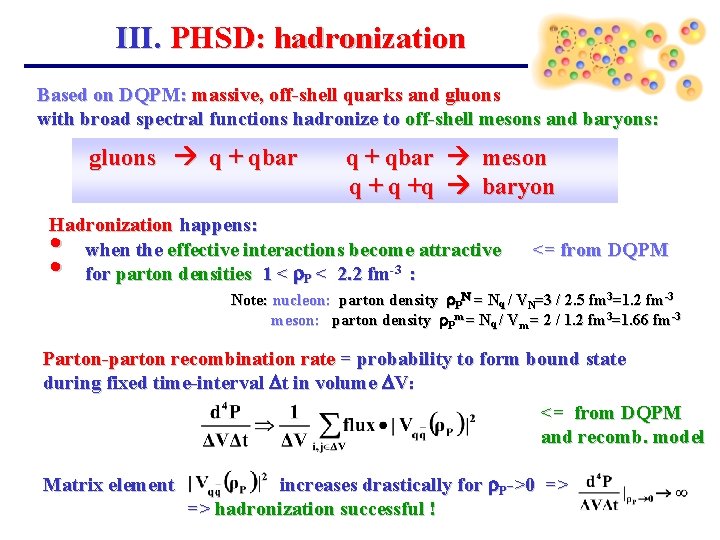
III. PHSD: hadronization Based on DQPM: massive, off-shell quarks and gluons with broad spectral functions hadronize to off-shell mesons and baryons: gluons q + qbar meson q +q baryon Hadronization happens: when the effective interactions become attractive for parton densities 1 < r. P < 2. 2 fm-3 : • • <= from DQPM Note: nucleon: parton density r. PN = Nq / VN=3 / 2. 5 fm 3=1. 2 fm-3 meson: parton density r. Pm = Nq / Vm = 2 / 1. 2 fm 3=1. 66 fm-3 Parton-parton recombination rate = probability to form bound state during fixed time-interval Dt in volume DV: <= from DQPM and recomb. model Matrix element increases drastically for r. P->0 => => hadronization successful !
IV. PHSD: hadronization Conservation lows: v 4 -momentum conservation invariant mass and momentum of meson v flavor current conservation quark-antiquark content of meson v color + anticolor neutrality • large parton masses dominant production of vector mesons or baryon resonances (of finite/large width) • resonance state (or string) is determined by the weight of its spectral function at given invariant mass M • hadronic resonances are propagated in HSD (and finally decay to the groundstates by emission of pions, kaons, etc. ) Since the partons are massive the formed states are very heavy (strings) entropy production in the hadronization phase ! 5. Hadronic phase: hadron-string interactions –> off-shell transport in HSD
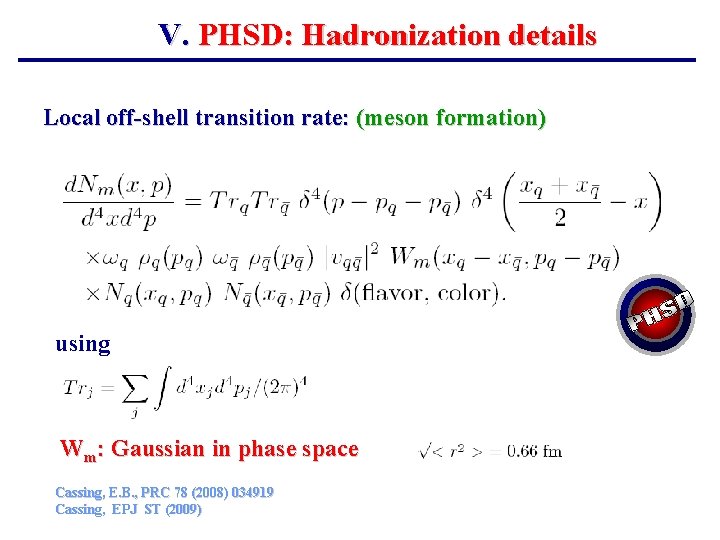
V. PHSD: Hadronization details Local off-shell transition rate: (meson formation) using Wm: Gaussian in phase space Cassing, E. B. , PRC 78 (2008) 034919 Cassing, EPJ ST (2009)
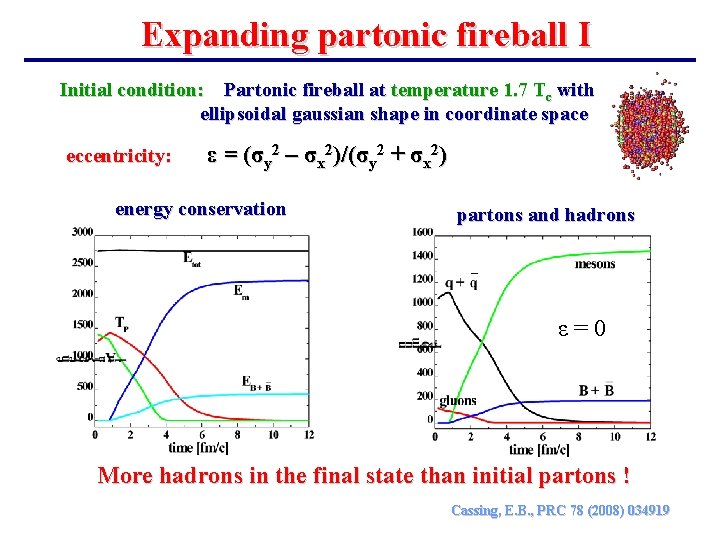
Expanding partonic fireball I Initial condition: Partonic fireball at temperature 1. 7 Tc with ellipsoidal gaussian shape in coordinate space eccentricity: ε = (σy 2 – σx 2)/(σy 2 + σx 2) energy conservation partons and hadrons ε=0 More hadrons in the final state than initial partons ! Cassing, E. B. , PRC 78 (2008) 034919
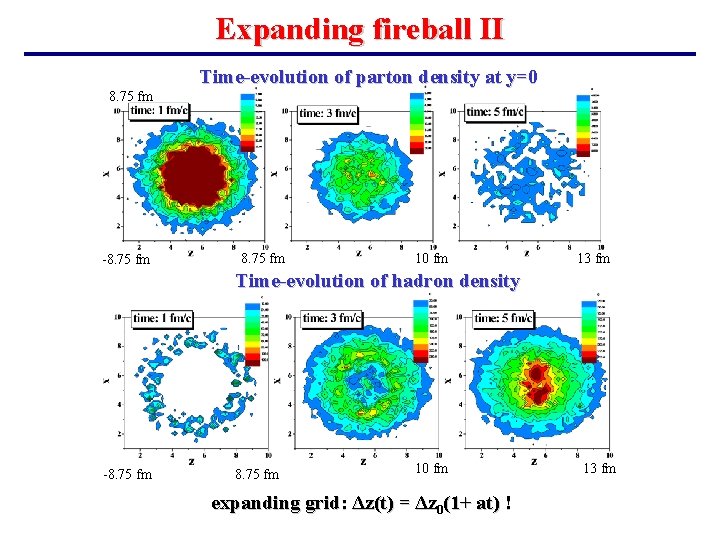
Expanding fireball II Time-evolution of parton density at y=0 8. 75 fm -8. 75 fm 10 fm 13 fm Time-evolution of hadron density -8. 75 fm 10 fm expanding grid: Δz(t) = Δz 0(1+ at) ! 13 fm
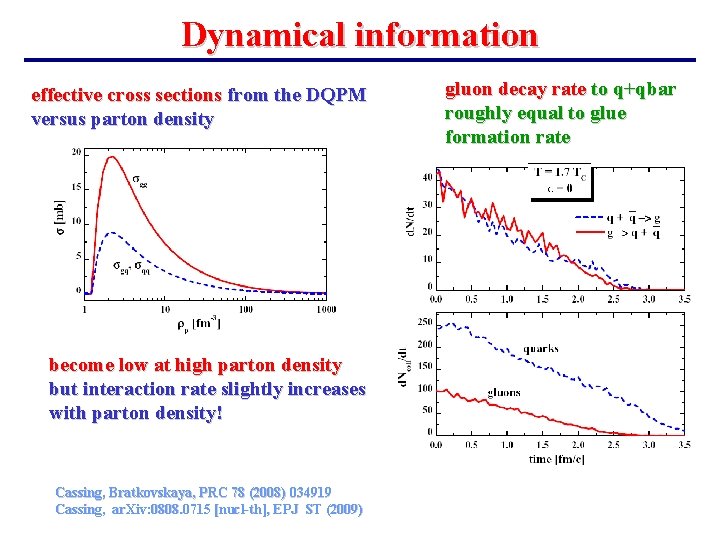
Dynamical information effective cross sections from the DQPM versus parton density become low at high parton density but interaction rate slightly increases with parton density! Cassing, Bratkovskaya, PRC 78 (2008) 034919 Cassing, ar. Xiv: 0808. 0715 [nucl-th], EPJ ST (2009) gluon decay rate to q+qbar roughly equal to glue formation rate
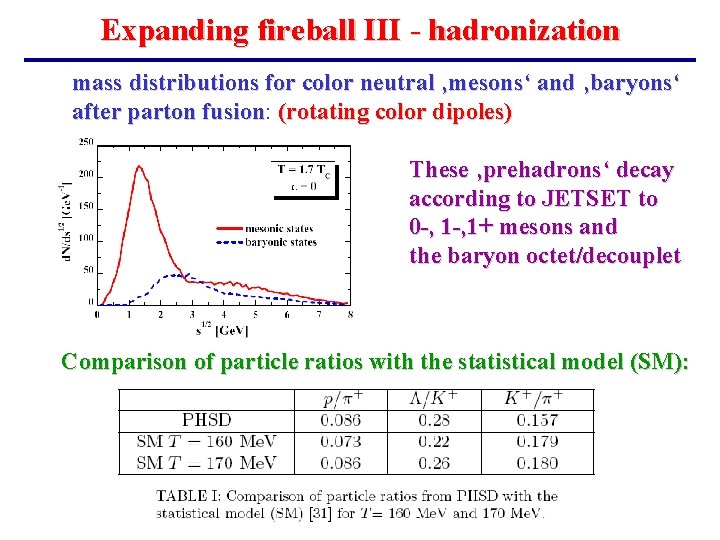
Expanding fireball III - hadronization mass distributions for color neutral ‚mesons‘ and ‚baryons‘ after parton fusion: fusion (rotating color dipoles) These ‚prehadrons‘ decay according to JETSET to 0 -, 1+ mesons and the baryon octet/decouplet Comparison of particle ratios with the statistical model (SM):
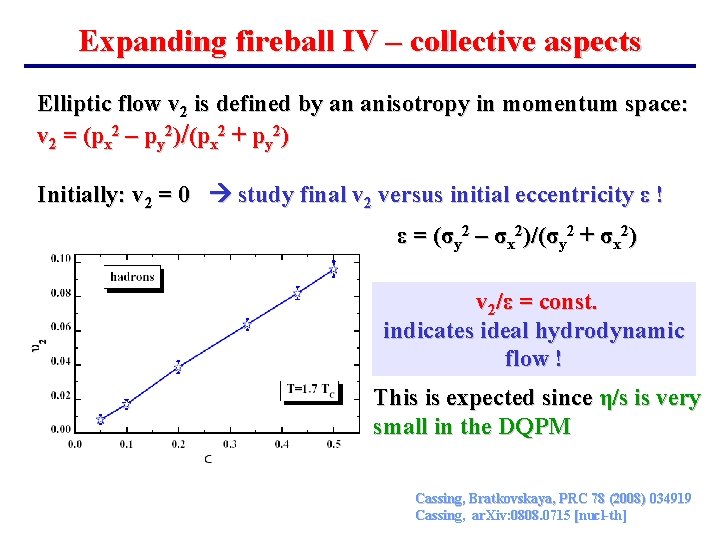
Expanding fireball IV – collective aspects Elliptic flow v 2 is defined by an anisotropy in momentum space: v 2 = (px 2 – py 2)/(px 2 + py 2) Initially: v 2 = 0 study final v 2 versus initial eccentricity ε ! ε = (σy 2 – σx 2)/(σy 2 + σx 2) v 2/ε = const. indicates ideal hydrodynamic flow ! This is expected since η/s is very small in the DQPM Cassing, Bratkovskaya, PRC 78 (2008) 034919 Cassing, ar. Xiv: 0808. 0715 [nucl-th]
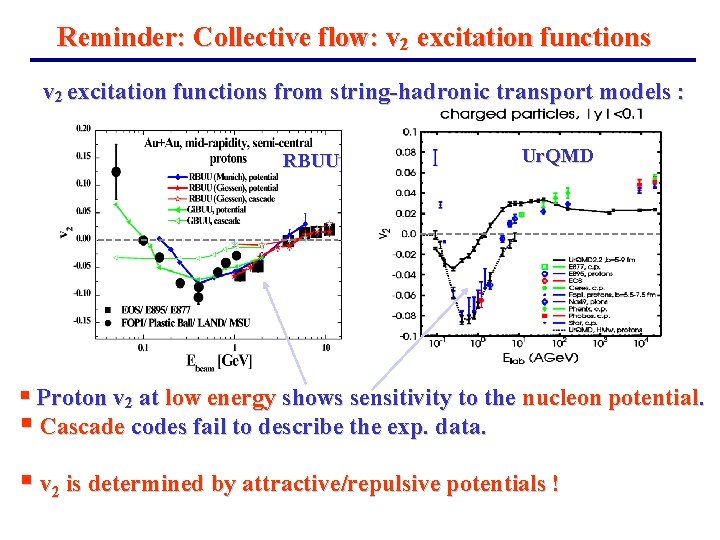
Reminder: Collective flow: v 2 excitation functions from string-hadronic transport models : RBUU Ur. QMD § Proton v 2 at low energy shows sensitivity to the nucleon potential. § Cascade codes fail to describe the exp. data. § v 2 is determined by attractive/repulsive potentials !
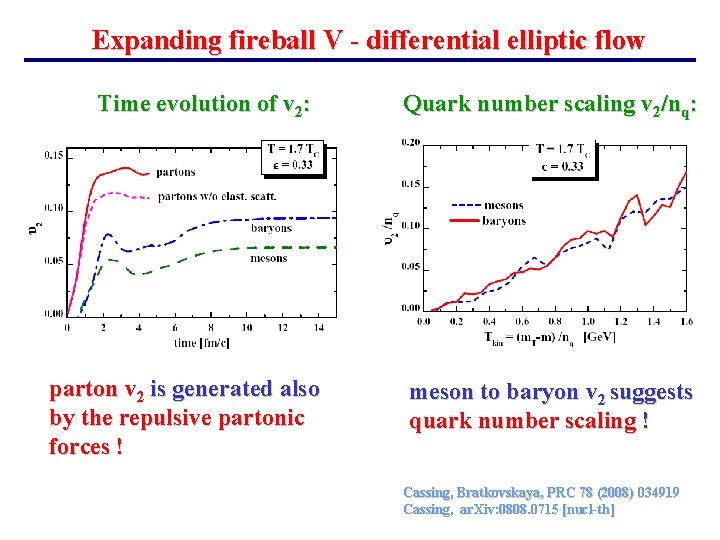
Expanding fireball V - differential elliptic flow Time evolution of v 2: parton v 2 is generated also by the repulsive partonic forces ! Quark number scaling v 2/nq: meson to baryon v 2 suggests quark number scaling ! Cassing, Bratkovskaya, PRC 78 (2008) 034919 Cassing, ar. Xiv: 0808. 0715 [nucl-th]
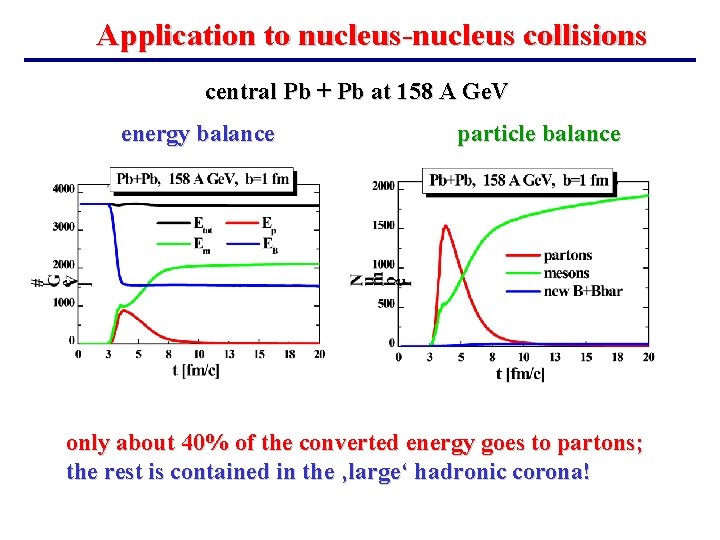
Application to nucleus-nucleus collisions central Pb + Pb at 158 A Ge. V energy balance particle balance only about 40% of the converted energy goes to partons; the rest is contained in the ‚large‘ hadronic corona!
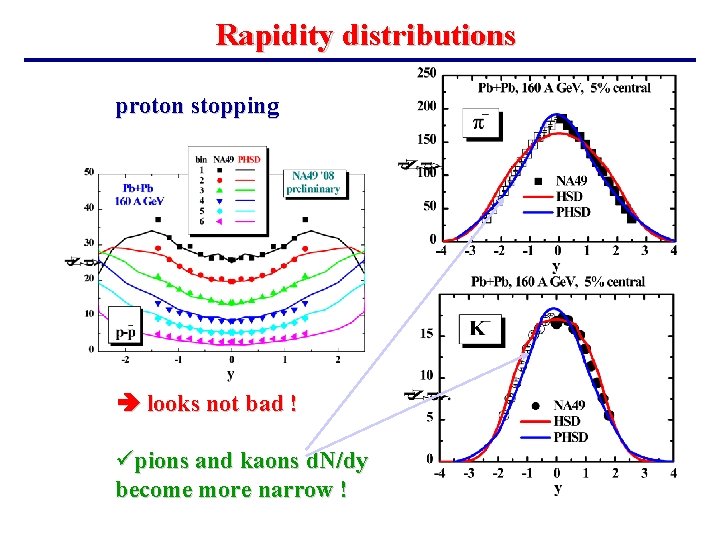
Rapidity distributions proton stopping looks not bad ! üpions and kaons d. N/dy become more narrow !
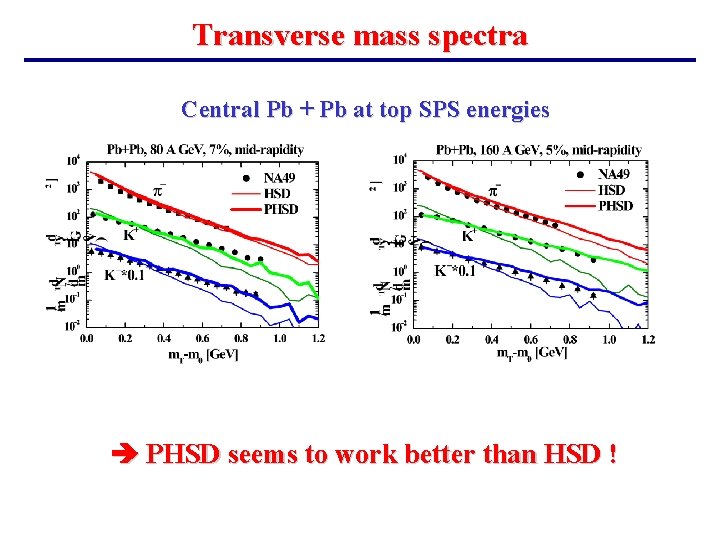
Transverse mass spectra Central Pb + Pb at top SPS energies PHSD seems to work better than HSD !
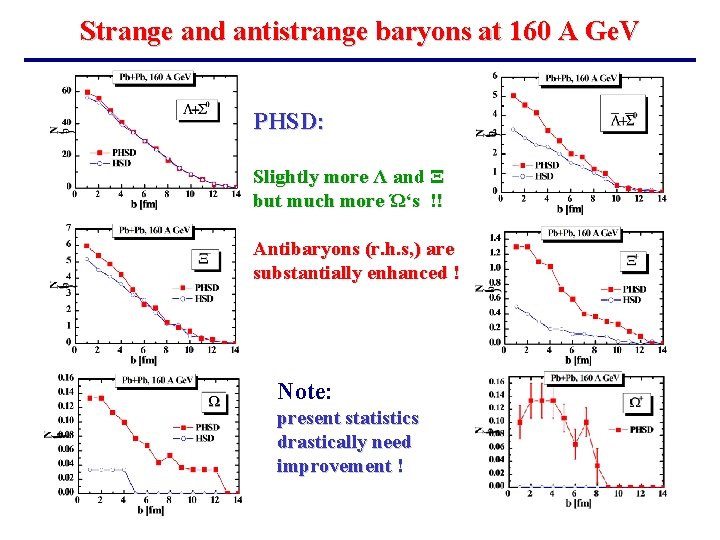
Strange and antistrange baryons at 160 A Ge. V PHSD: Slightly more Λ and Ξ but much more Ώ‘s !! Antibaryons (r. h. s, ) are substantially enhanced ! Note: present statistics drastically need improvement !
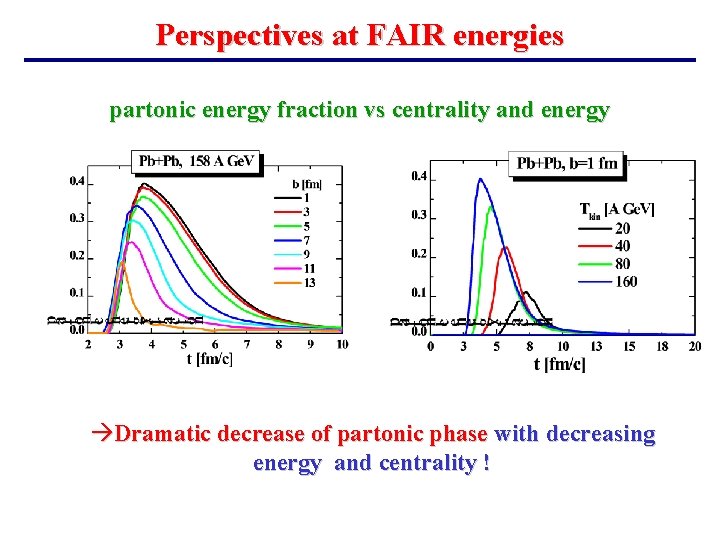
Perspectives at FAIR energies partonic energy fraction vs centrality and energy àDramatic decrease of partonic phase with decreasing energy and centrality !
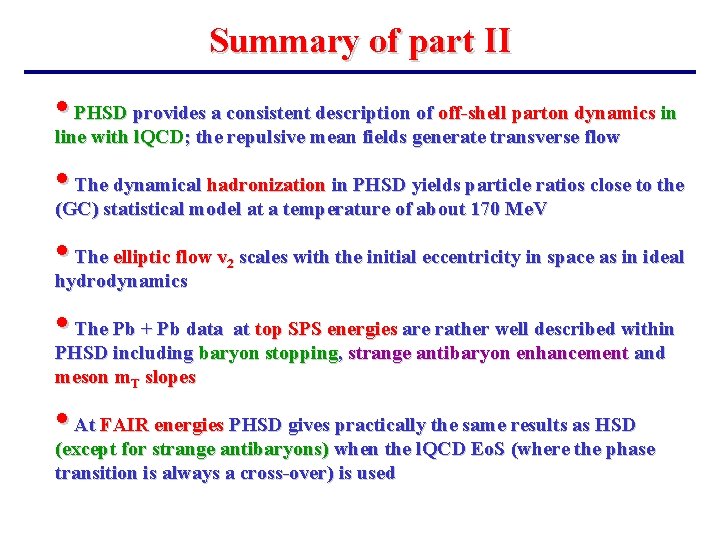
Summary of part II • PHSD provides a consistent description of off-shell parton dynamics in line with l. QCD; the repulsive mean fields generate transverse flow • The dynamical hadronization in PHSD yields particle ratios close to the (GC) statistical model at a temperature of about 170 Me. V • The elliptic flow v scales with the initial eccentricity in space as in ideal hydrodynamics 2 • The Pb + Pb data at top SPS energies are rather well described within PHSD including baryon stopping, strange antibaryon enhancement and meson m. T slopes • At FAIR energies PHSD gives practically the same results as HSD (except for strange antibaryons) when the l. QCD Eo. S (where the phase transition is always a cross-over) is used
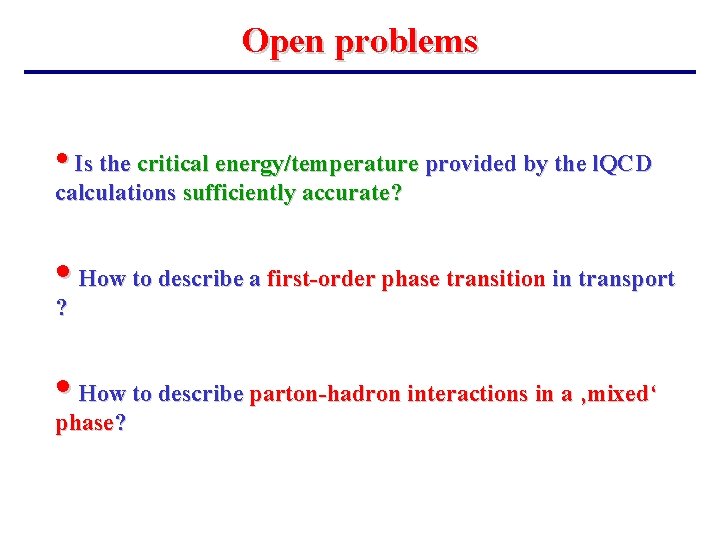
Open problems • Is the critical energy/temperature provided by the l. QCD calculations sufficiently accurate? • How to describe a first-order phase transition in transport ? • How to describe parton-hadron interactions in a ‚mixed‘ phase?
Thanks in particular to Sascha Juchem (off-shell transport) Andre Peshier (DQPM) and the numerous experimental friends and collegues !
- Slides: 34