
Phrases Clauses Conjunctions and Sentence types What is
- Slides: 11
Phrases, Clauses, Conjunctions, and Sentence types What is the difference between phrases and clauses? How are conjunctions used to create different sentence types?
Phrases and Clauses –Building blocks of sentences � Phrase - a group of words that act as a part of speech but cannot stand alone as a sentence. � Clause - Clauses are groups of words that have a subject and a verb. Independent clauses express a complete thought and can stand alone as a sentence but subordinate clauses depend on other parts of the sentence to express a complete thought.
Two types of Clauses � An independent clause contains a subject, a verb, and a complete thought. � A dependent clause contains a subject and a verb, but no complete thought. � Examples – � Independent – I ate cookies. � Dependent – Since I ate fries � **What is wrong with the second clause?
Using clauses in sentences �A SIMPLE SENTENCE has one independent clause. � A COMPOUND SENTENCE has two independent clauses joined by a conjunction. � Examples – � Simple – I ate a hamburger. � Compound – I ate a hamburger, and I drank a milkshake. � **What do you notice in the second sentence?
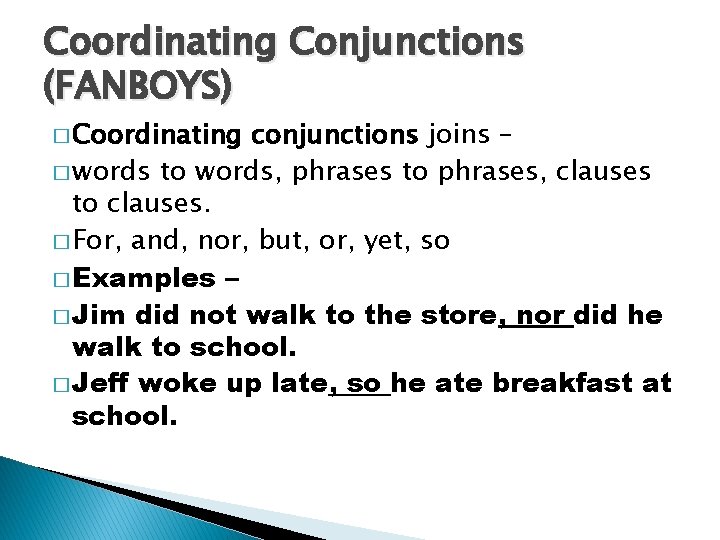
Coordinating Conjunctions (FANBOYS) � Coordinating conjunctions joins – � words to words, phrases to phrases, clauses to clauses. � For, and, nor, but, or, yet, so � Examples – � Jim did not walk to the store, nor did he walk to school. � Jeff woke up late, so he ate breakfast at school.
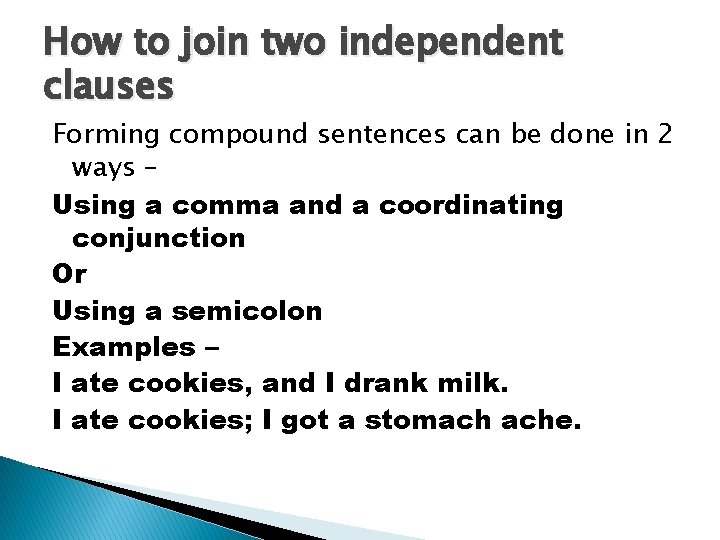
How to join two independent clauses Forming compound sentences can be done in 2 ways – Using a comma and a coordinating conjunction Or Using a semicolon Examples – I ate cookies, and I drank milk. I ate cookies; I got a stomach ache.
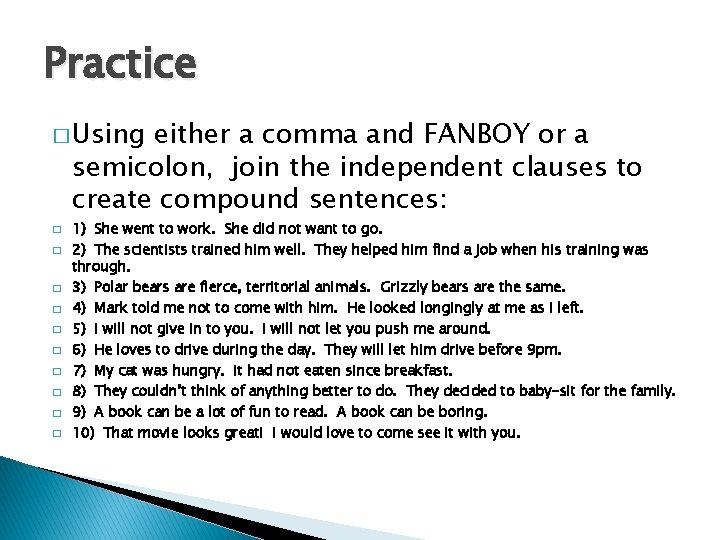
Practice � Using either a comma and FANBOY or a semicolon, join the independent clauses to create compound sentences: � � � � � 1) She went to work. She did not want to go. 2) The scientists trained him well. They helped him find a job when his training was through. 3) Polar bears are fierce, territorial animals. Grizzly bears are the same. 4) Mark told me not to come with him. He looked longingly at me as I left. 5) I will not give in to you. I will not let you push me around. 6) He loves to drive during the day. They will let him drive before 9 pm. 7) My cat was hungry. It had not eaten since breakfast. 8) They couldn’t think of anything better to do. They decided to baby-sit for the family. 9) A book can be a lot of fun to read. A book can be boring. 10) That movie looks great! I would love to come see it with you.
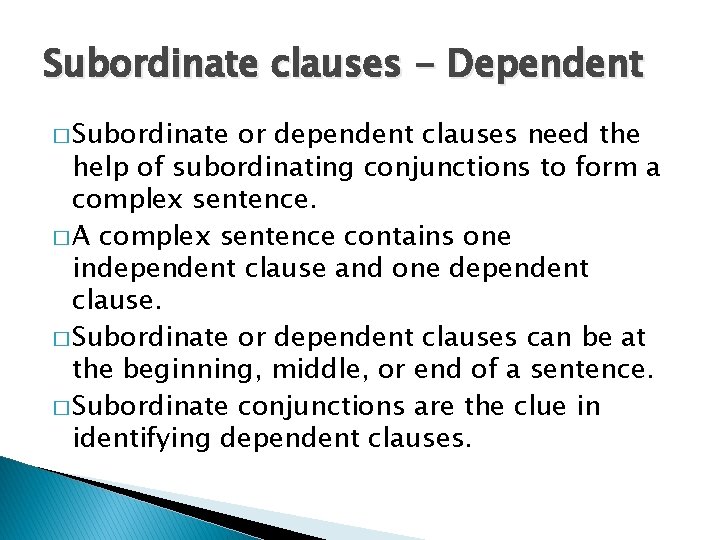
Subordinate clauses - Dependent � Subordinate or dependent clauses need the help of subordinating conjunctions to form a complex sentence. � A complex sentence contains one independent clause and one dependent clause. � Subordinate or dependent clauses can be at the beginning, middle, or end of a sentence. � Subordinate conjunctions are the clue in identifying dependent clauses.
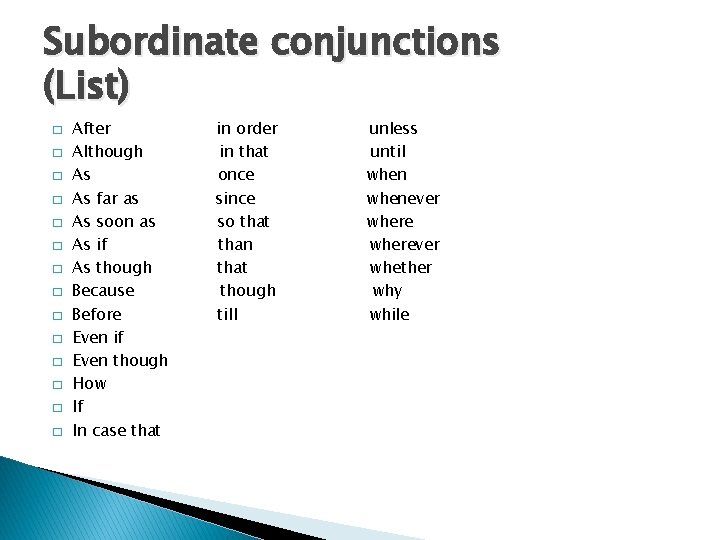
Subordinate conjunctions (List) � � � � After Although As As far as As soon as As if As though Because Before Even if Even though How If In case that in order in that once since so that than that though till unless until whenever wherever whether why while
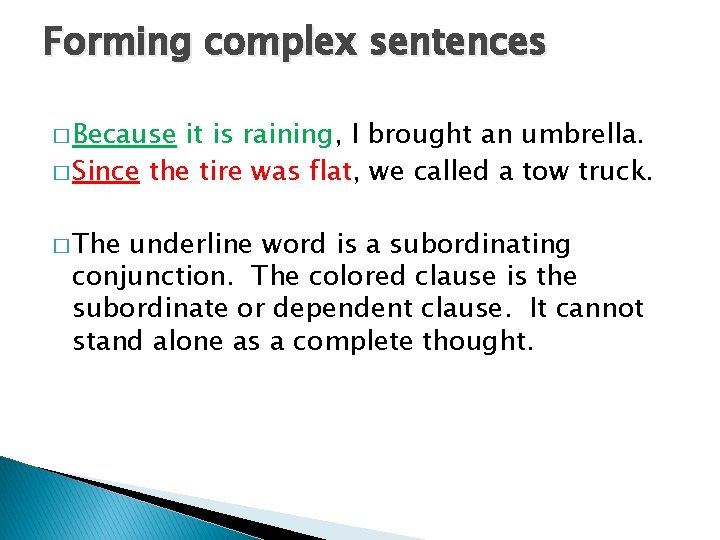
Forming complex sentences � Because it is raining, I brought an umbrella. � Since the tire was flat, we called a tow truck. � The underline word is a subordinating conjunction. The colored clause is the subordinate or dependent clause. It cannot stand alone as a complete thought.
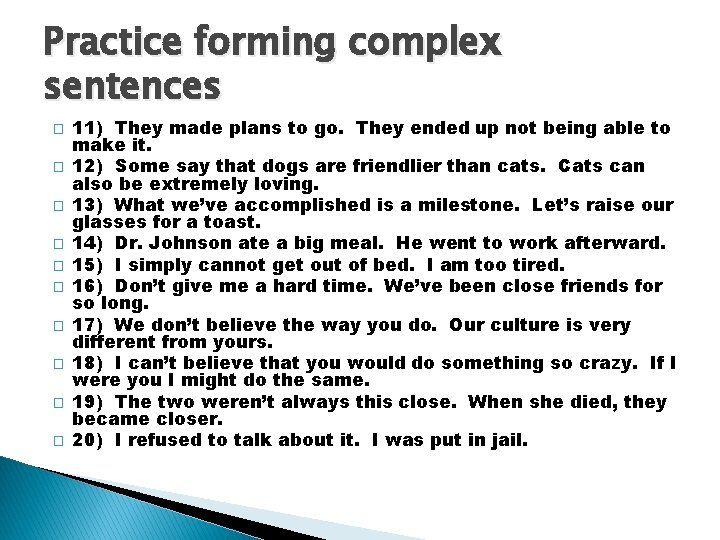
Practice forming complex sentences � � � � � 11) They made plans to go. They ended up not being able to make it. 12) Some say that dogs are friendlier than cats. Cats can also be extremely loving. 13) What we’ve accomplished is a milestone. Let’s raise our glasses for a toast. 14) Dr. Johnson ate a big meal. He went to work afterward. 15) I simply cannot get out of bed. I am too tired. 16) Don’t give me a hard time. We’ve been close friends for so long. 17) We don’t believe the way you do. Our culture is very different from yours. 18) I can’t believe that you would do something so crazy. If I were you I might do the same. 19) The two weren’t always this close. When she died, they became closer. 20) I refused to talk about it. I was put in jail.