
PHRASAL VERBS IDIOMS Phrasal Verbs Phrasal verbs are

PHRASAL VERBS & IDIOMS
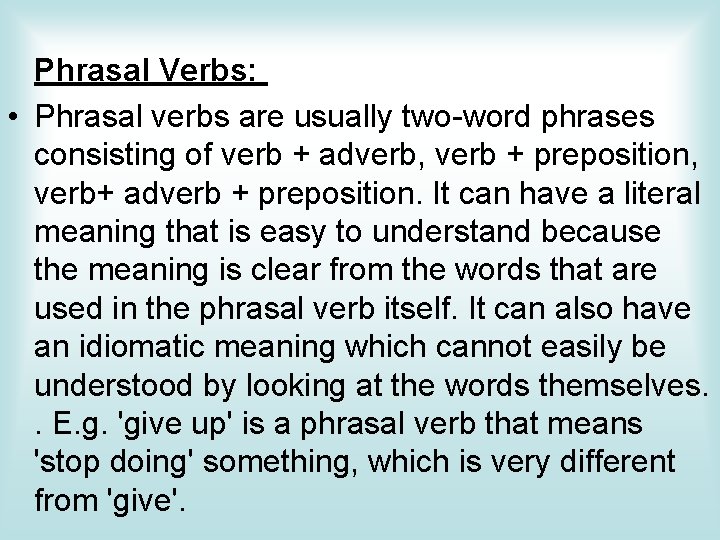
Phrasal Verbs: • Phrasal verbs are usually two-word phrases consisting of verb + adverb, verb + preposition, verb+ adverb + preposition. It can have a literal meaning that is easy to understand because the meaning is clear from the words that are used in the phrasal verb itself. It can also have an idiomatic meaning which cannot easily be understood by looking at the words themselves. . E. g. 'give up' is a phrasal verb that means 'stop doing' something, which is very different from 'give'.
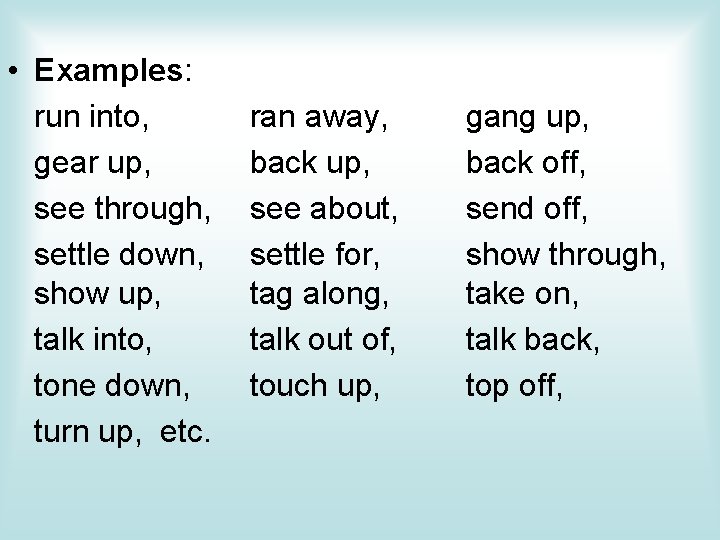
• Examples: run into, gear up, see through, settle down, show up, talk into, tone down, turn up, etc. ran away, back up, see about, settle for, tag along, talk out of, touch up, gang up, back off, send off, show through, take on, talk back, top off,
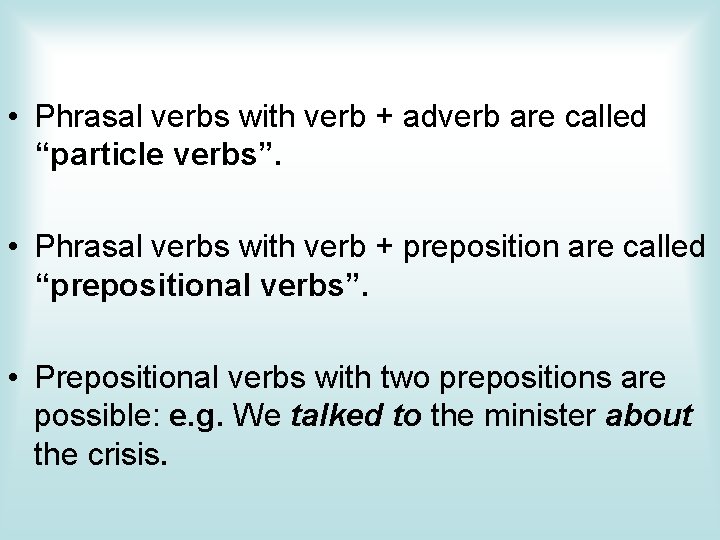
• Phrasal verbs with verb + adverb are called “particle verbs”. • Phrasal verbs with verb + preposition are called “prepositional verbs”. • Prepositional verbs with two prepositions are possible: e. g. We talked to the minister about the crisis.
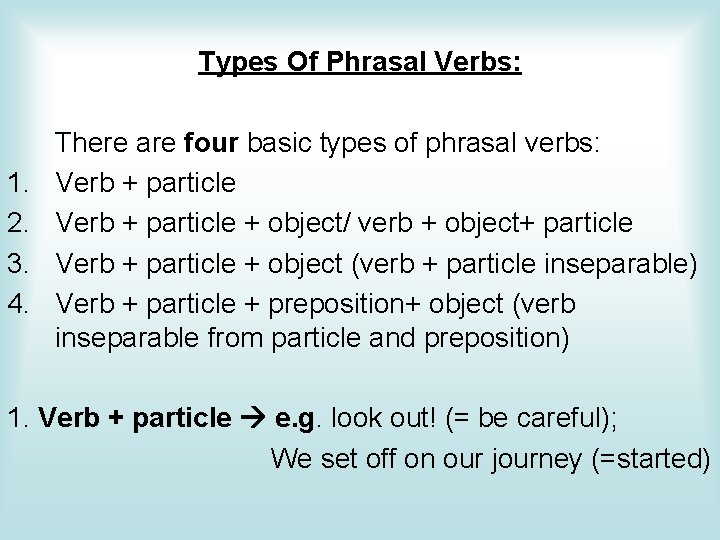
Types Of Phrasal Verbs: 1. 2. 3. 4. There are four basic types of phrasal verbs: Verb + particle + object/ verb + object+ particle Verb + particle + object (verb + particle inseparable) Verb + particle + preposition+ object (verb inseparable from particle and preposition) 1. Verb + particle e. g. look out! (= be careful); We set off on our journey (=started)
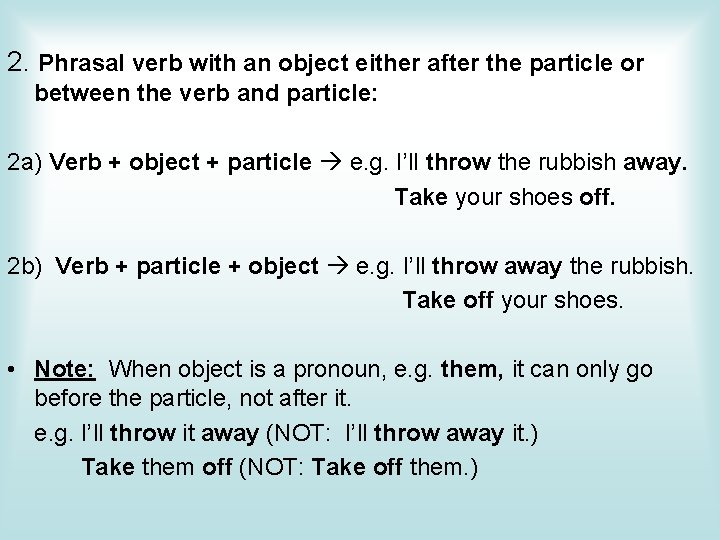
2. Phrasal verb with an object either after the particle or between the verb and particle: 2 a) Verb + object + particle e. g. I’ll throw the rubbish away. Take your shoes off. 2 b) Verb + particle + object e. g. I’ll throw away the rubbish. Take off your shoes. • Note: When object is a pronoun, e. g. them, it can only go before the particle, not after it. e. g. I’ll throw it away (NOT: I’ll throw away it. ) Take them off (NOT: Take off them. )
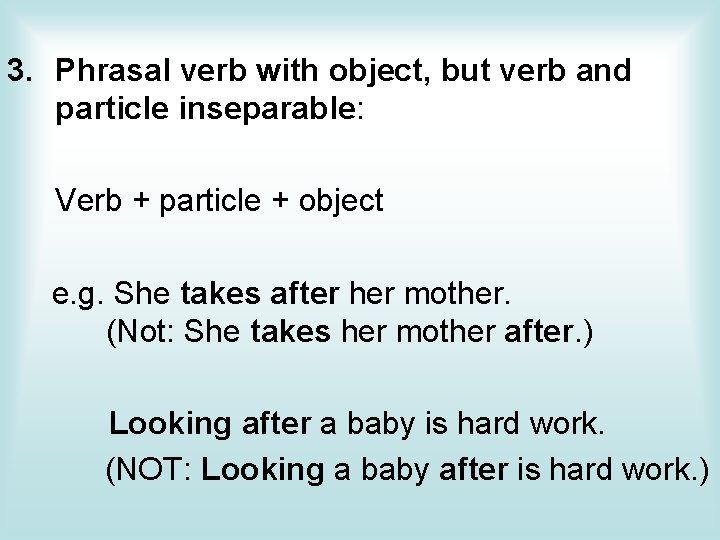
3. Phrasal verb with object, but verb and particle inseparable: Verb + particle + object e. g. She takes after her mother. (Not: She takes her mother after. ) Looking after a baby is hard work. (NOT: Looking a baby after is hard work. )
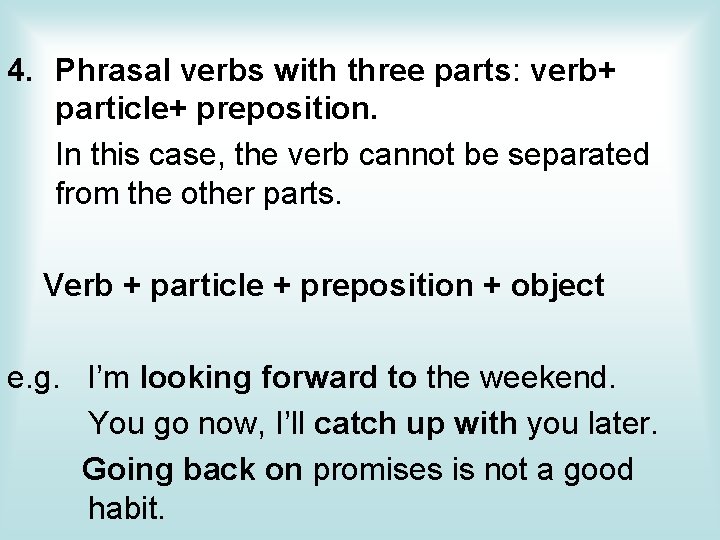
4. Phrasal verbs with three parts: verb+ particle+ preposition. In this case, the verb cannot be separated from the other parts. Verb + particle + preposition + object e. g. I’m looking forward to the weekend. You go now, I’ll catch up with you later. Going back on promises is not a good habit.
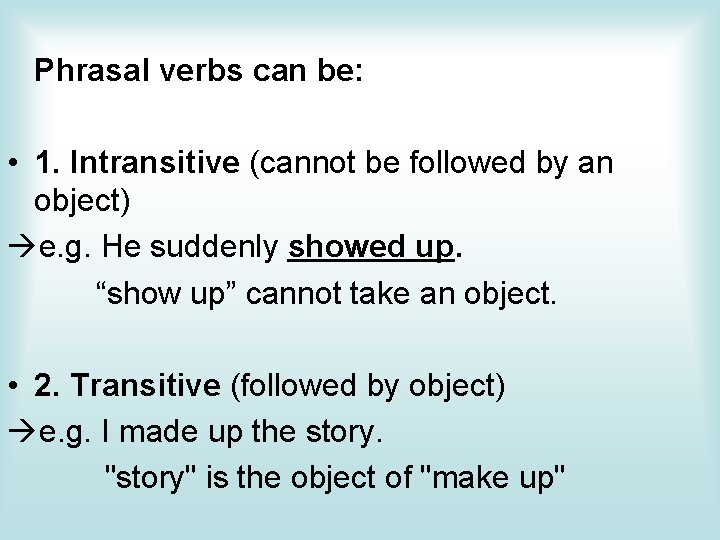
Phrasal verbs can be: • 1. Intransitive (cannot be followed by an object) e. g. He suddenly showed up. “show up” cannot take an object. • 2. Transitive (followed by object) e. g. I made up the story. "story" is the object of "make up"
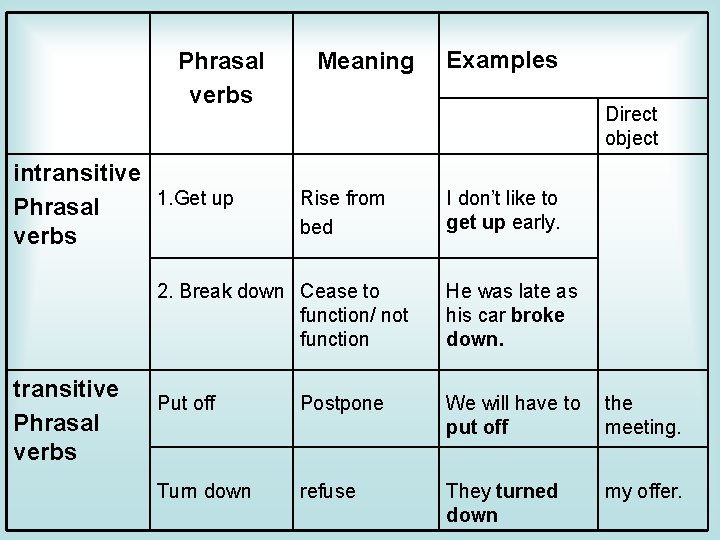
Phrasal verbs intransitive 1. Get up Phrasal verbs transitive Phrasal verbs Meaning Examples Direct object Rise from bed I don’t like to get up early. 2. Break down Cease to function/ not function He was late as his car broke down. Put off Postpone We will have to put off the meeting. Turn down refuse They turned down my offer.
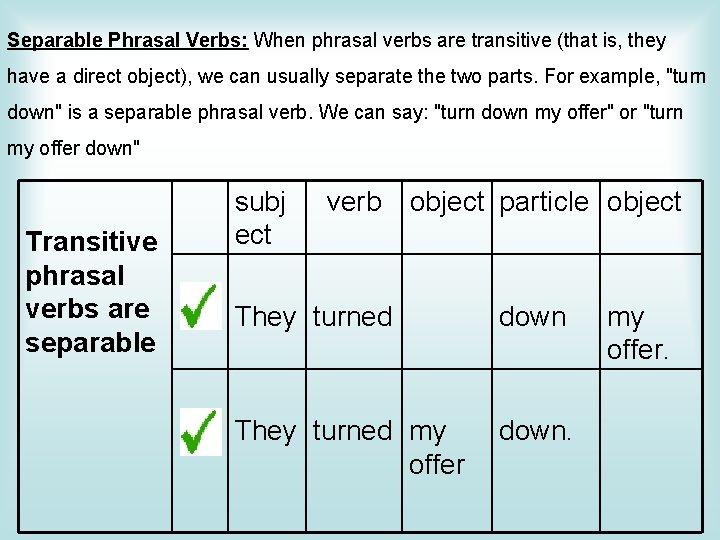
Separable Phrasal Verbs: When phrasal verbs are transitive (that is, they have a direct object), we can usually separate the two parts. For example, "turn down" is a separable phrasal verb. We can say: "turn down my offer" or "turn my offer down" Transitive phrasal verbs are separable subj ect verb object particle object They turned down They turned my offer down. my offer.
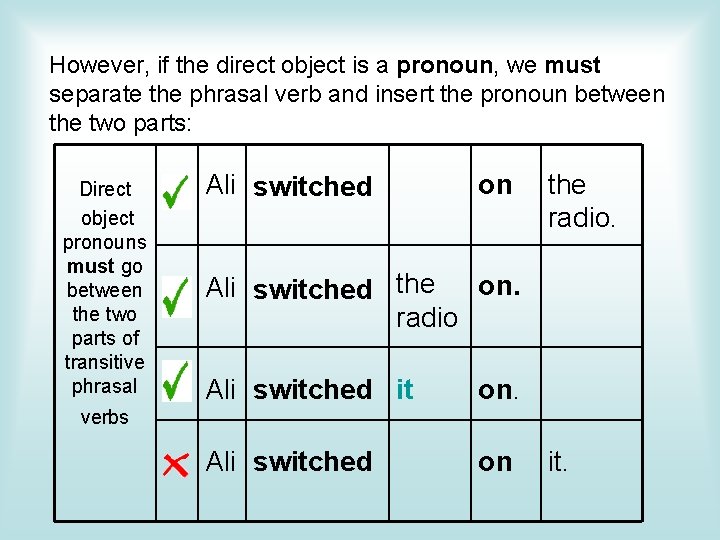
However, if the direct object is a pronoun, we must separate the phrasal verb and insert the pronoun between the two parts: Direct object pronouns must go between the two parts of transitive phrasal Ali switched on the radio. on. Ali switched the radio Ali switched it on. Ali switched on verbs it.
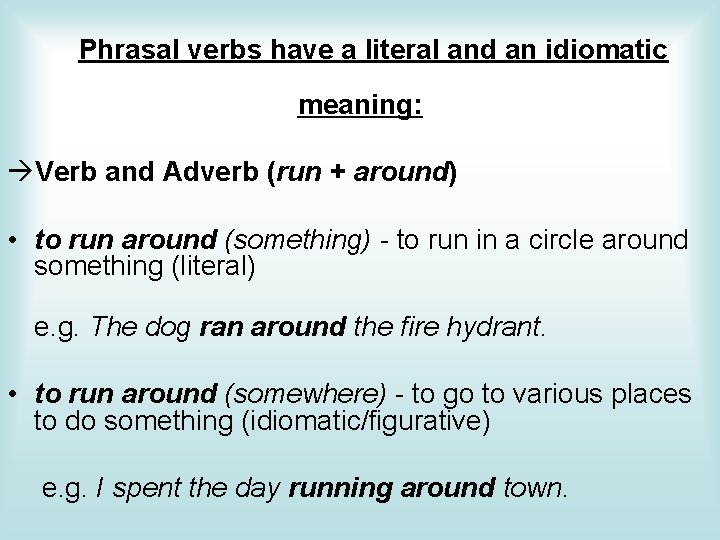
Phrasal verbs have a literal and an idiomatic meaning: Verb and Adverb (run + around) • to run around (something) - to run in a circle around something (literal) e. g. The dog ran around the fire hydrant. • to run around (somewhere) - to go to various places to do something (idiomatic/figurative) e. g. I spent the day running around town.
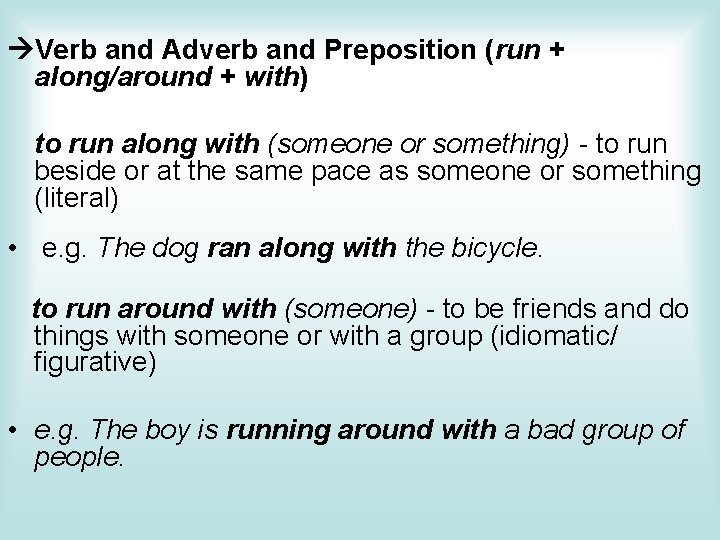
Verb and Adverb and Preposition (run + along/around + with) to run along with (someone or something) - to run beside or at the same pace as someone or something (literal) • e. g. The dog ran along with the bicycle. to run around with (someone) - to be friends and do things with someone or with a group (idiomatic/ figurative) • e. g. The boy is running around with a bad group of people.
Phrasal Verbs Exercises
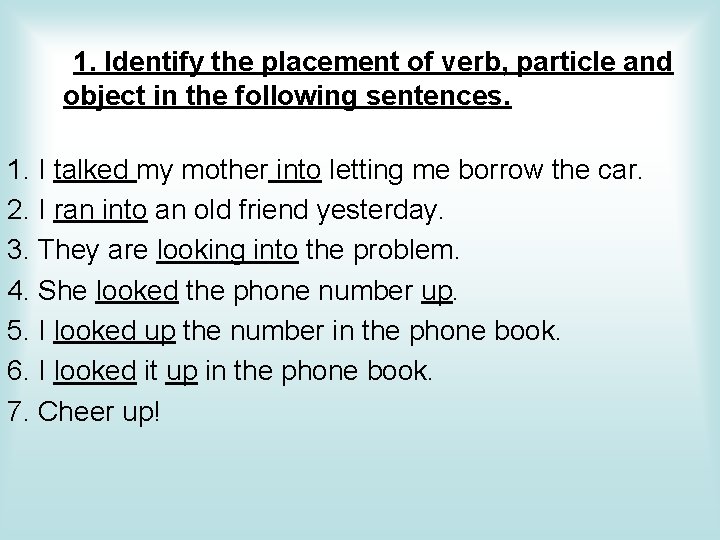
1. Identify the placement of verb, particle and object in the following sentences. 1. I talked my mother into letting me borrow the car. 2. I ran into an old friend yesterday. 3. They are looking into the problem. 4. She looked the phone number up. 5. I looked up the number in the phone book. 6. I looked it up in the phone book. 7. Cheer up!
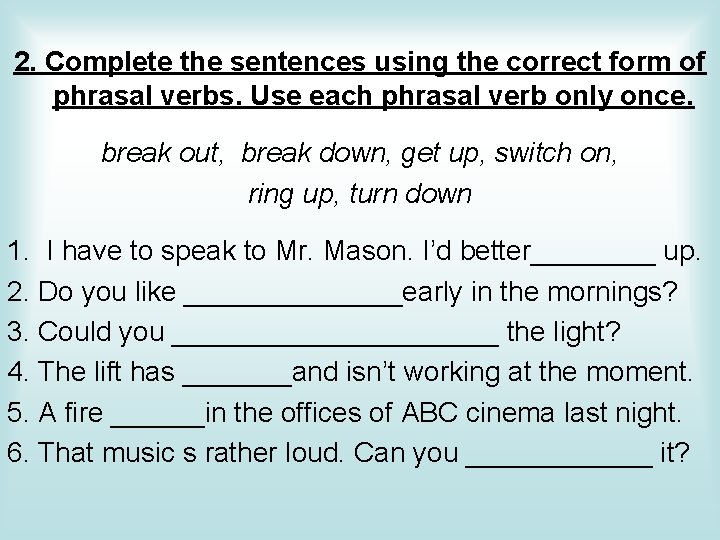
2. Complete the sentences using the correct form of phrasal verbs. Use each phrasal verb only once. break out, break down, get up, switch on, ring up, turn down 1. I have to speak to Mr. Mason. I’d better____ up. 2. Do you like _______early in the mornings? 3. Could you ___________ the light? 4. The lift has _______and isn’t working at the moment. 5. A fire ______in the offices of ABC cinema last night. 6. That music s rather loud. Can you ______ it?
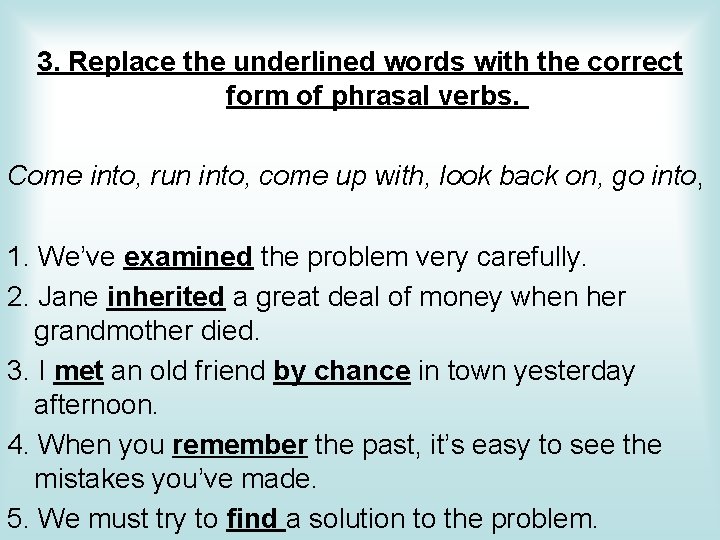
3. Replace the underlined words with the correct form of phrasal verbs. Come into, run into, come up with, look back on, go into, 1. We’ve examined the problem very carefully. 2. Jane inherited a great deal of money when her grandmother died. 3. I met an old friend by chance in town yesterday afternoon. 4. When you remember the past, it’s easy to see the mistakes you’ve made. 5. We must try to find a solution to the problem.
• • • Relevant links/ sources: http: //www. englishpage. com/prepositions/phras aldictionary. html http: //www. englishclub. com/ref/Phrasal_Verbs/i ndex. htm http: //www. idiomsite. com/ http: //www. usingenglish. com/reference/ phrasal-verbs/g. html Saadat Ali Shah. Exploring the World of English. Chapters 1 -6.

THE END
- Slides: 20