
Phrasal verbs Frazalni glagoli Frazalni glagoli ta su
Phrasal verbs Frazalni glagoli
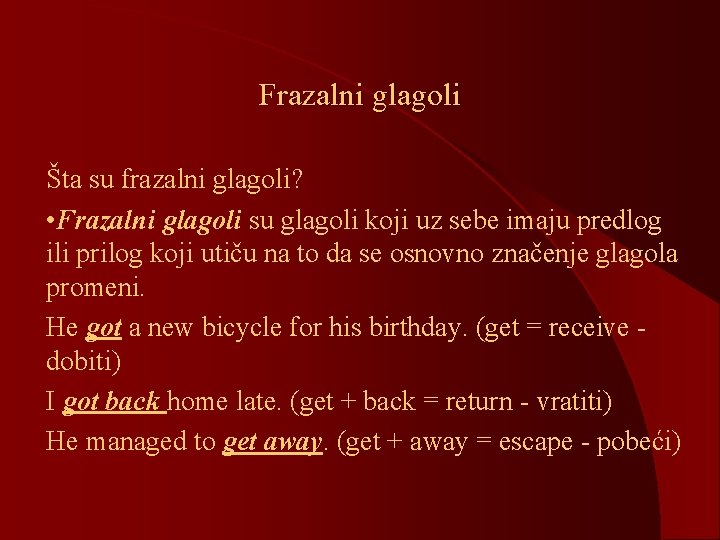
Frazalni glagoli • • • Šta su frazalni glagoli? • Frazalni glagoli su glagoli koji uz sebe imaju predlog ili prilog koji utiču na to da se osnovno značenje glagola promeni. He got a new bicycle for his birthday. (get = receive dobiti) I got back home late. (get + back = return - vratiti) He managed to get away. (get + away = escape - pobeći)
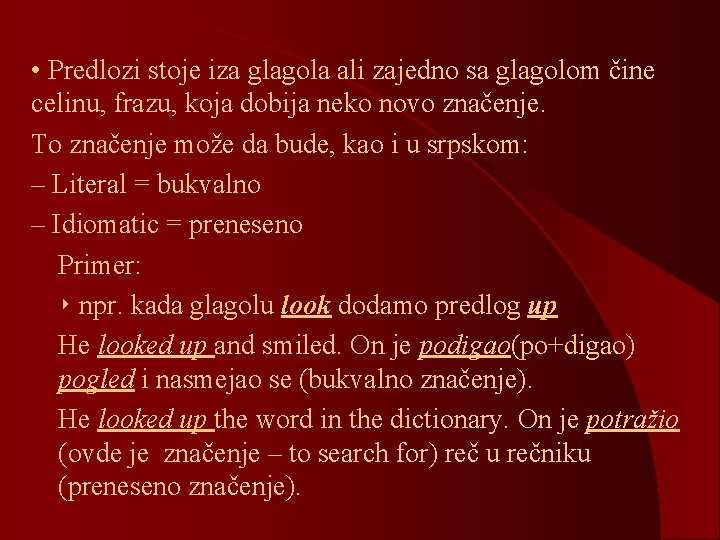
• Predlozi stoje iza glagola ali zajedno sa glagolom čine celinu, frazu, koja dobija neko novo značenje. To značenje može da bude, kao i u srpskom: – Literal = bukvalno – Idiomatic = preneseno l Primer: l ‣ npr. kada glagolu look dodamo predlog up l He looked up and smiled. On je podigao(po+digao) pogled i nasmejao se (bukvalno značenje). l He looked up the word in the dictionary. On je potražio (ovde je značenje – to search for) reč u rečniku (preneseno značenje).
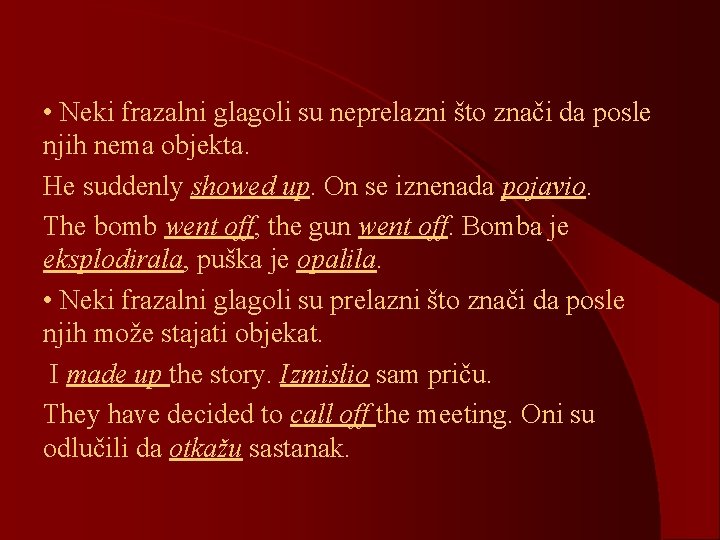
• Neki frazalni glagoli su neprelazni što znači da posle njih nema objekta. He suddenly showed up. On se iznenada pojavio. The bomb went off, the gun went off. Bomba je eksplodirala, puška je opalila. • Neki frazalni glagoli su prelazni što znači da posle njih može stajati objekat. I made up the story. Izmislio sam priču. They have decided to call off the meeting. Oni su odlučili da otkažu sastanak.
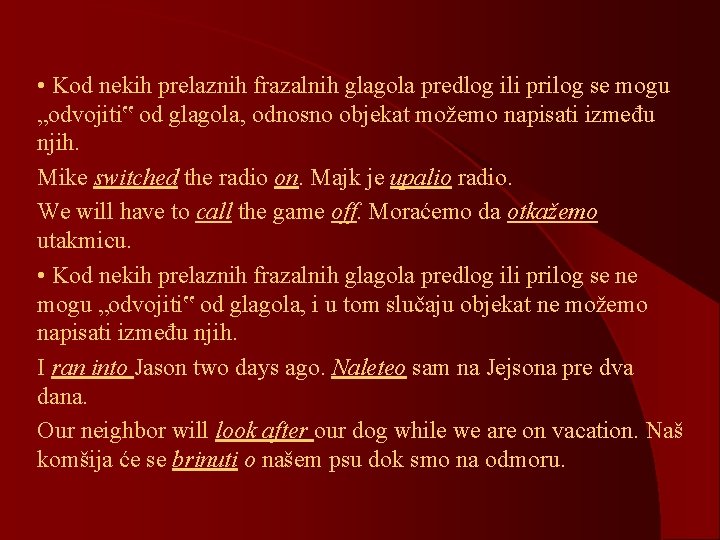
• Kod nekih prelaznih frazalnih glagola predlog ili prilog se mogu „odvojiti‟ od glagola, odnosno objekat možemo napisati između njih. Mike switched the radio on. Majk je upalio radio. We will have to call the game off. Moraćemo da otkažemo utakmicu. • Kod nekih prelaznih frazalnih glagola predlog ili prilog se ne mogu „odvojiti‟ od glagola, i u tom slučaju objekat ne možemo napisati između njih. I ran into Jason two days ago. Naleteo sam na Jejsona pre dva dana. Our neighbor will look after our dog while we are on vacation. Naš komšija će se brinuti o našem psu dok smo na odmoru.
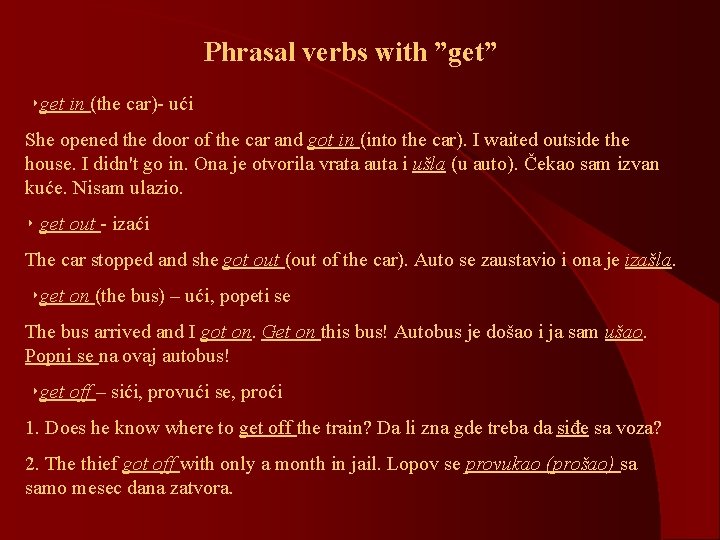
Phrasal verbs with ”get” ‣get in (the car)- ući She opened the door of the car and got in (into the car). I waited outside the house. I didn't go in. Ona je otvorila vrata auta i ušla (u auto). Čekao sam izvan kuće. Nisam ulazio. ‣ get out - izaći The car stopped and she got out (out of the car). Auto se zaustavio i ona je izašla. ‣get on (the bus) – ući, popeti se The bus arrived and I got on. Get on this bus! Autobus je došao i ja sam ušao. Popni se na ovaj autobus! ‣get off – sići, provući se, proći 1. Does he know where to get off the train? Da li zna gde treba da siđe sa voza? 2. The thief got off with only a month in jail. Lopov se provukao (prošao) sa samo mesec dana zatvora.
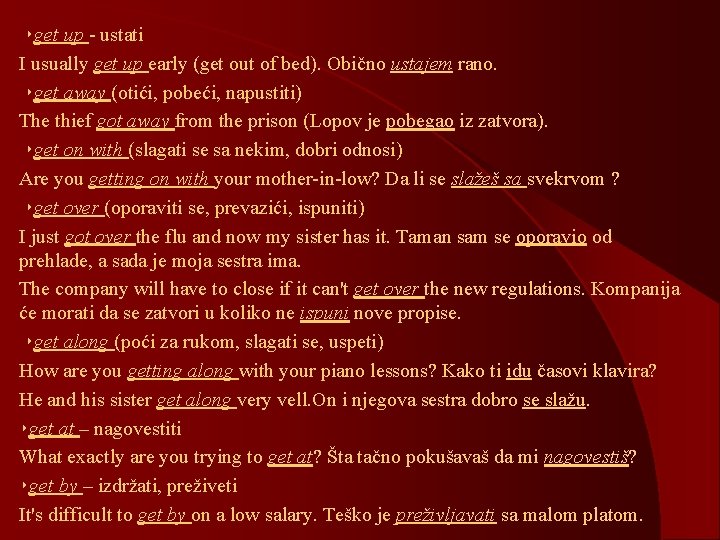
‣get up - ustati I usually get up early (get out of bed). Obično ustajem rano. ‣get away (otići, pobeći, napustiti) The thief got away from the prison (Lopov je pobegao iz zatvora). ‣get on with (slagati se sa nekim, dobri odnosi) Are you getting on with your mother-in-low? Da li se slažeš sa svekrvom ? ‣get over (oporaviti se, prevazići, ispuniti) I just got over the flu and now my sister has it. Taman sam se oporavio od prehlade, a sada je moja sestra ima. The company will have to close if it can't get over the new regulations. Kompanija će morati da se zatvori u koliko ne ispuni nove propise. ‣get along (poći za rukom, slagati se, uspeti) How are you getting along with your piano lessons? Kako ti idu časovi klavira? He and his sister get along very vell. On i njegova sestra dobro se slažu. ‣get at – nagovestiti What exactly are you trying to get at? Šta tačno pokušavaš da mi nagovestiš? ‣get by – izdržati, preživeti It's difficult to get by on a low salary. Teško je preživljavati sa malom platom.
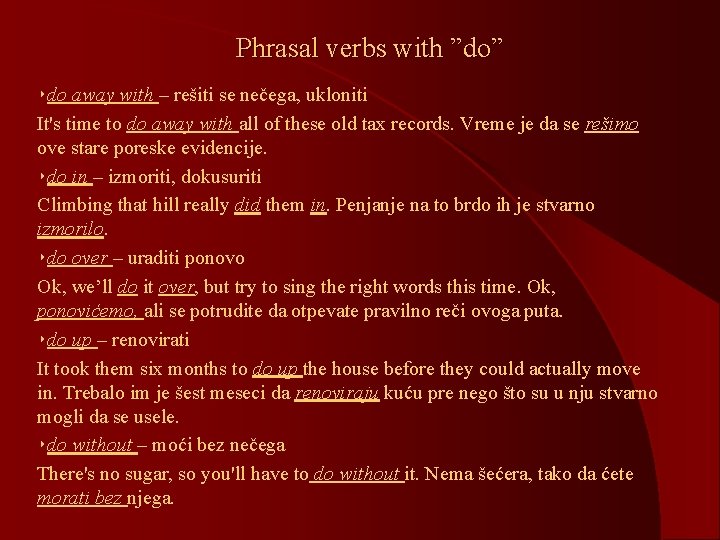
Phrasal verbs with ”do” ‣do away with – rešiti se nečega, ukloniti It's time to do away with all of these old tax records. Vreme je da se rešimo ove stare poreske evidencije. ‣do in – izmoriti, dokusuriti Climbing that hill really did them in. Penjanje na to brdo ih je stvarno izmorilo. ‣do over – uraditi ponovo Ok, we’ll do it over, but try to sing the right words this time. Ok, ponovićemo, ali se potrudite da otpevate pravilno reči ovoga puta. ‣do up – renovirati It took them six months to do up the house before they could actually move in. Trebalo im je šest meseci da renoviraju kuću pre nego što su u nju stvarno mogli da se usele. ‣do without – moći bez nečega There's no sugar, so you'll have to do without it. Nema šećera, tako da ćete morati bez njega.
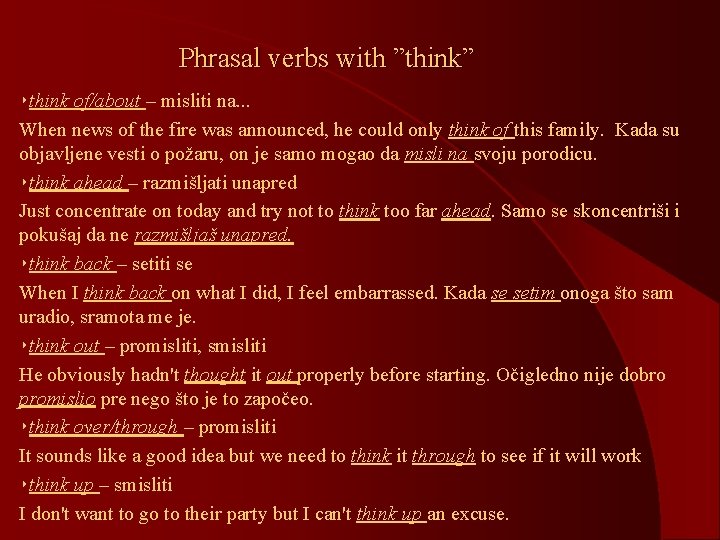
Phrasal verbs with ”think” ‣think of/about – misliti na. . . When news of the fire was announced, he could only think of this family. Kada su objavljene vesti o požaru, on je samo mogao da misli na svoju porodicu. ‣think ahead – razmišljati unapred Just concentrate on today and try not to think too far ahead. Samo se skoncentriši i pokušaj da ne razmišljaš unapred. ‣think back – setiti se When I think back on what I did, I feel embarrassed. Kada se setim onoga što sam uradio, sramota me je. ‣think out – promisliti, smisliti He obviously hadn't thought it out properly before starting. Očigledno nije dobro promislio pre nego što je to započeo. ‣think over/through – promisliti It sounds like a good idea but we need to think it through to see if it will work ‣think up – smisliti I don't want to go to their party but I can't think up an excuse.
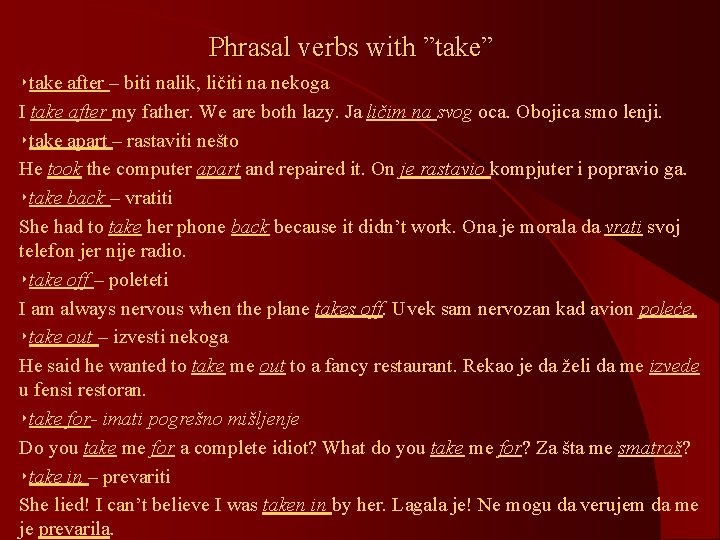
Phrasal verbs with ”take” ‣take after – biti nalik, ličiti na nekoga I take after my father. We are both lazy. Ja ličim na svog oca. Obojica smo lenji. ‣take apart – rastaviti nešto He took the computer apart and repaired it. On je rastavio kompjuter i popravio ga. ‣take back – vratiti She had to take her phone back because it didn’t work. Ona je morala da vrati svoj telefon jer nije radio. ‣take off – poleteti I am always nervous when the plane takes off. Uvek sam nervozan kad avion poleće. ‣take out – izvesti nekoga He said he wanted to take me out to a fancy restaurant. Rekao je da želi da me izvede u fensi restoran. ‣take for- imati pogrešno mišljenje Do you take me for a complete idiot? What do you take me for? Za šta me smatraš? ‣take in – prevariti She lied! I can’t believe I was taken in by her. Lagala je! Ne mogu da verujem da me je prevarila.
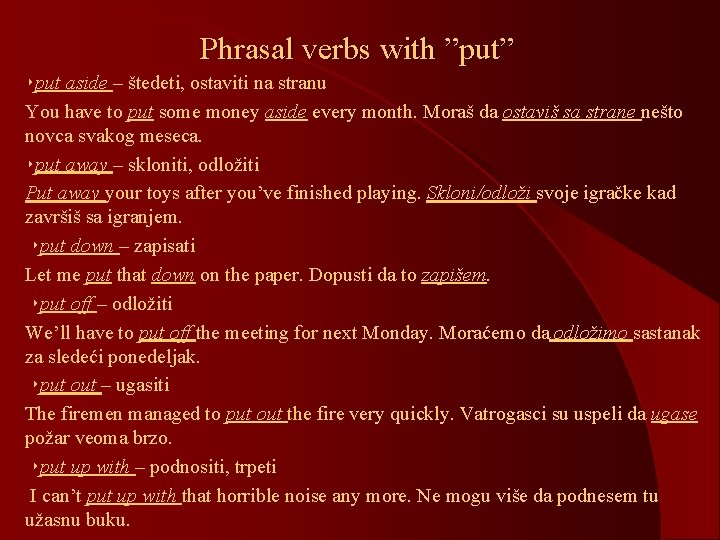
Phrasal verbs with ”put” ‣put aside – štedeti, ostaviti na stranu You have to put some money aside every month. Moraš da ostaviš sa strane nešto novca svakog meseca. ‣put away – skloniti, odložiti Put away your toys after you’ve finished playing. Skloni/odloži svoje igračke kad završiš sa igranjem. ‣put down – zapisati Let me put that down on the paper. Dopusti da to zapišem. ‣put off – odložiti We’ll have to put off the meeting for next Monday. Moraćemo da odložimo sastanak za sledeći ponedeljak. ‣put out – ugasiti The firemen managed to put out the fire very quickly. Vatrogasci su uspeli da ugase požar veoma brzo. ‣put up with – podnositi, trpeti I can’t put up with that horrible noise any more. Ne mogu više da podnesem tu užasnu buku.

Phrasal verbs with ”come” ‣ come across - slučajno naći nešto ili nabasati na nešto I came across some of my old photos. Slučajno sam našla svoje stare slike. ‣come over – ići kod nekoga kući Come over to my house tomorrow. Dodji kod mene sutra. ‣come to - doći sebi ili osvestiti se She came to at the hospital. Osvestila se u bolnici. ‣come up – iznenada se dogoditi Something came up at the last minute. Nešto se iznenada dogodilo u poslednjem trenutku. ‣come up with - osmisliti She came up with the perfect plan. Osmislila je savršen plan. ‣come true – ostvariti se His dream has finally come true. Njen san se konačno ostvario.
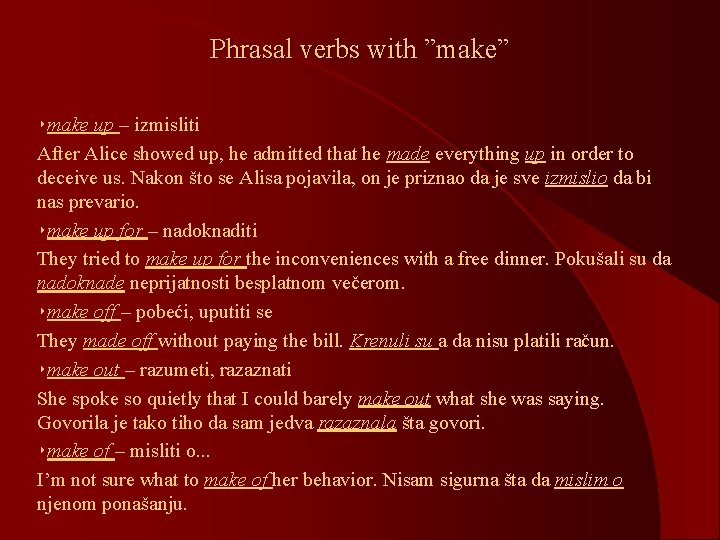
Phrasal verbs with ”make” ‣make up – izmisliti After Alice showed up, he admitted that he made everything up in order to deceive us. Nakon što se Alisa pojavila, on je priznao da je sve izmislio da bi nas prevario. ‣make up for – nadoknaditi They tried to make up for the inconveniences with a free dinner. Pokušali su da nadoknade neprijatnosti besplatnom večerom. ‣make off – pobeći, uputiti se They made off without paying the bill. Krenuli su a da nisu platili račun. ‣make out – razumeti, razaznati She spoke so quietly that I could barely make out what she was saying. Govorila je tako tiho da sam jedva razaznala šta govori. ‣make of – misliti o. . . I’m not sure what to make of her behavior. Nisam sigurna šta da mislim o njenom ponašanju.
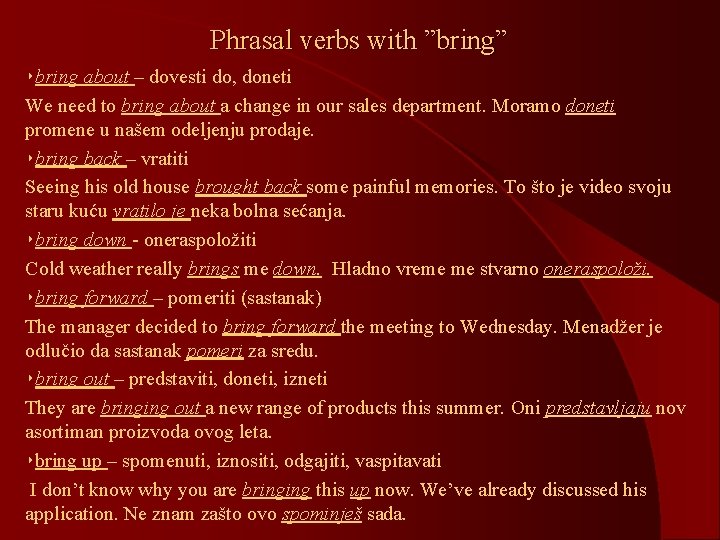
Phrasal verbs with ”bring” ‣bring about – dovesti do, doneti We need to bring about a change in our sales department. Moramo doneti promene u našem odeljenju prodaje. ‣bring back – vratiti Seeing his old house brought back some painful memories. To što je video svoju staru kuću vratilo je neka bolna sećanja. ‣bring down - oneraspoložiti Cold weather really brings me down. Hladno vreme me stvarno oneraspoloži. ‣bring forward – pomeriti (sastanak) The manager decided to bring forward the meeting to Wednesday. Menadžer je odlučio da sastanak pomeri za sredu. ‣bring out – predstaviti, doneti, izneti They are bringing out a new range of products this summer. Oni predstavljaju nov asortiman proizvoda ovog leta. ‣bring up – spomenuti, iznositi, odgajiti, vaspitavati I don’t know why you are bringing this up now. We’ve already discussed his application. Ne znam zašto ovo spominješ sada.
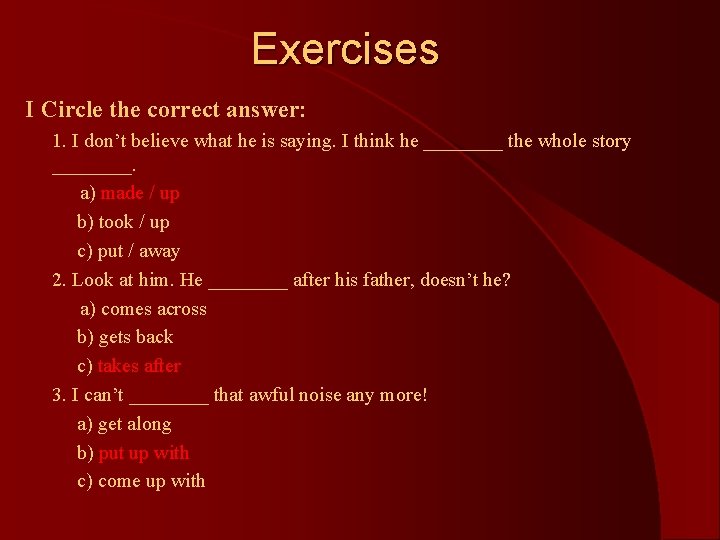
Exercises I Circle the correct answer: l l l l l 1. I don’t believe what he is saying. I think he ____ the whole story ____. a) made / up b) took / up c) put / away 2. Look at him. He ____ after his father, doesn’t he? a) comes across b) gets back c) takes after 3. I can’t ____ that awful noise any more! a) get along b) put up with c) come up with
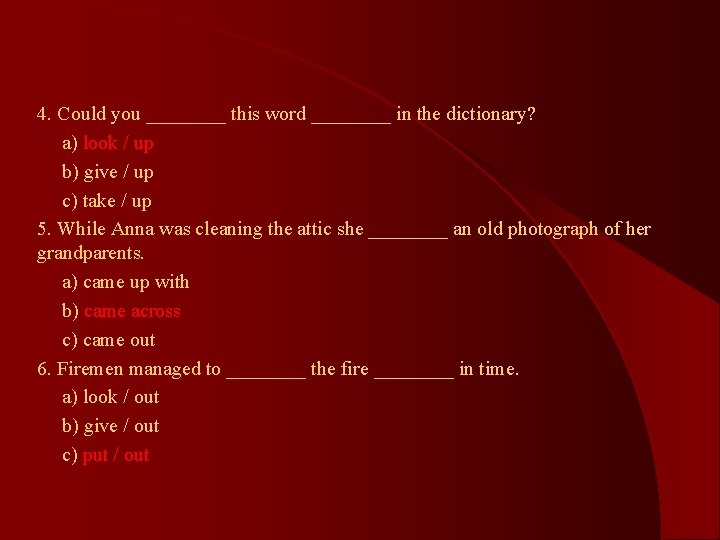
4. Could you ____ this word ____ in the dictionary? a) look / up b) give / up c) take / up 5. While Anna was cleaning the attic she ____ an old photograph of her grandparents. a) came up with b) came across c) came out 6. Firemen managed to ____ the fire ____ in time. a) look / out b) give / out c) put / out
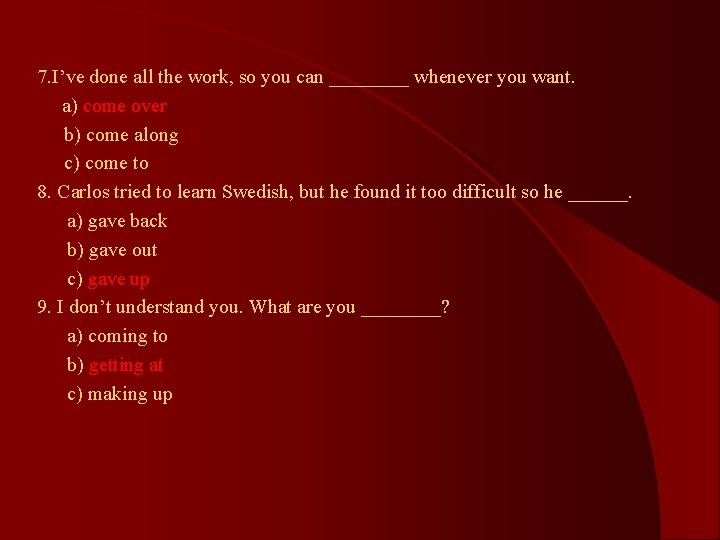
7. I’ve done all the work, so you can ____ whenever you want. a) come over l b) come along l c) come to 8. Carlos tried to learn Swedish, but he found it too difficult so he ______. a) gave back b) gave out c) gave up 9. I don’t understand you. What are you ____? a) coming to b) getting at c) making up
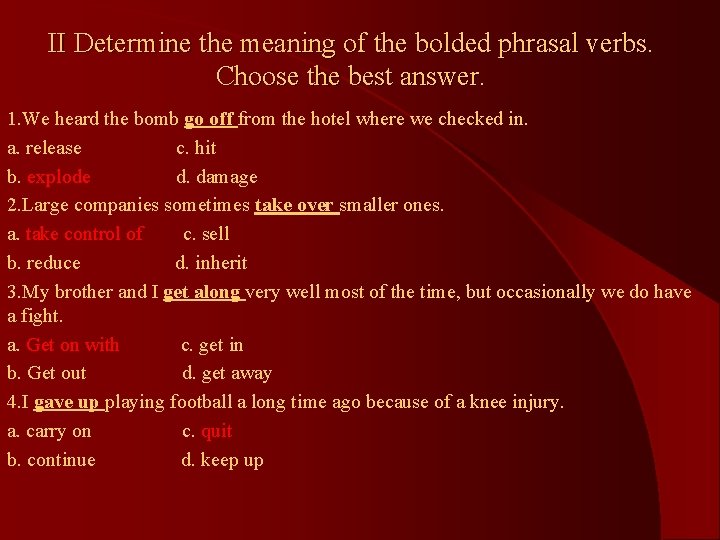
II Determine the meaning of the bolded phrasal verbs. Choose the best answer. 1. We heard the bomb go off from the hotel where we checked in. a. release c. hit b. explode d. damage 2. Large companies sometimes take over smaller ones. a. take control of c. sell b. reduce d. inherit 3. My brother and I get along very well most of the time, but occasionally we do have a fight. a. Get on with c. get in b. Get out d. get away 4. I gave up playing football a long time ago because of a knee injury. a. carry on c. quit b. continue d. keep up
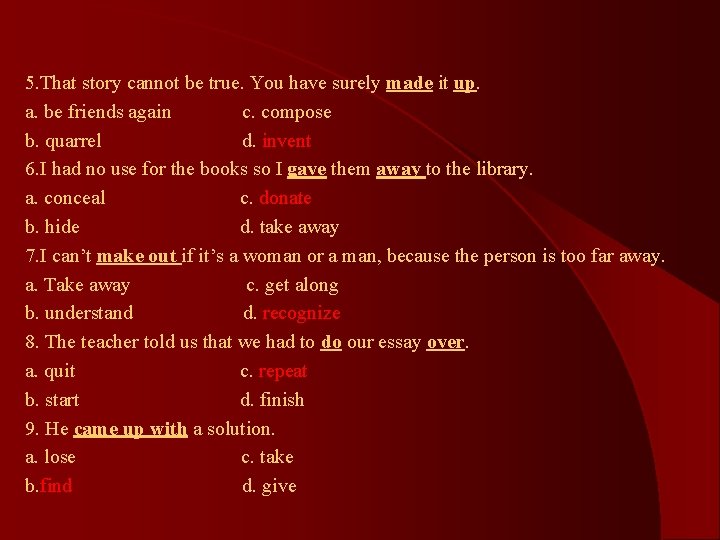
5. That story cannot be true. You have surely made it up. a. be friends again c. compose b. quarrel d. invent 6. I had no use for the books so I gave them away to the library. a. conceal c. donate b. hide d. take away 7. I can’t make out if it’s a woman or a man, because the person is too far away. a. Take away c. get along b. understand d. recognize 8. The teacher told us that we had to do our essay over. a. quit c. repeat b. start d. finish 9. He came up with a solution. a. lose c. take b. find d. give
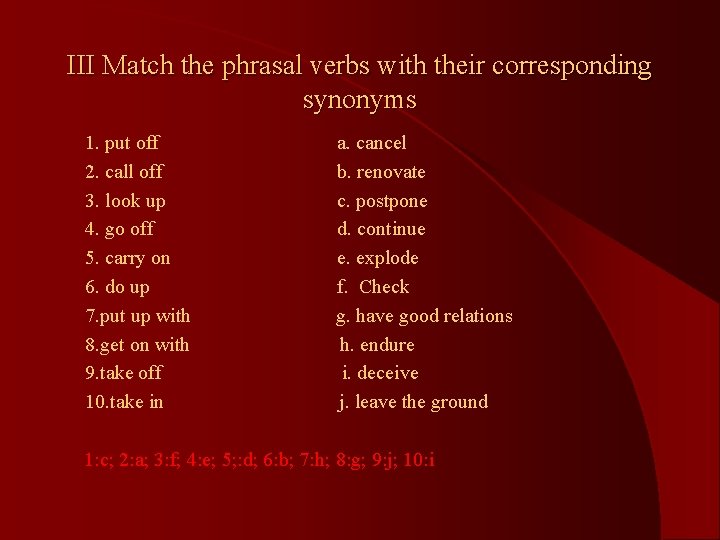
III Match the phrasal verbs with their corresponding synonyms 1. put off 2. 2. call off 3. 3. look up 4. 4. go off 5. 5. carry on 6. 6. do up 7. 7. put up with 8. 8. get on with 9. 9. take off 10. take in 1. a. cancel b. renovate c. postpone d. continue e. explode f. Check g. have good relations h. endure i. deceive j. leave the ground 1: c; 2: a; 3: f; 4: e; 5; : d; 6: b; 7: h; 8: g; 9: j; 10: i
- Slides: 20