
Photovoltaics for the Terawatt Challenge Christiana Honsberg Department
Photovoltaics for the Terawatt Challenge Christiana Honsberg Department of Electrical Computer and Energy Engineering Director, QESST ERC Arizona State University 1
Outline • Terawatt Challenge – What is it? – Photovoltaics for the TW challenges • Importance of rapid growth • Recent milestones in PV – But what about …. . • Myths of photovoltaics: land area; efficiency; energy payback time; materials availability; time to impact; duck curves, etc • Future prospects • Education ASU-UA-NAU Student Solar Conference 04/01/2014 C. Honsberg 2
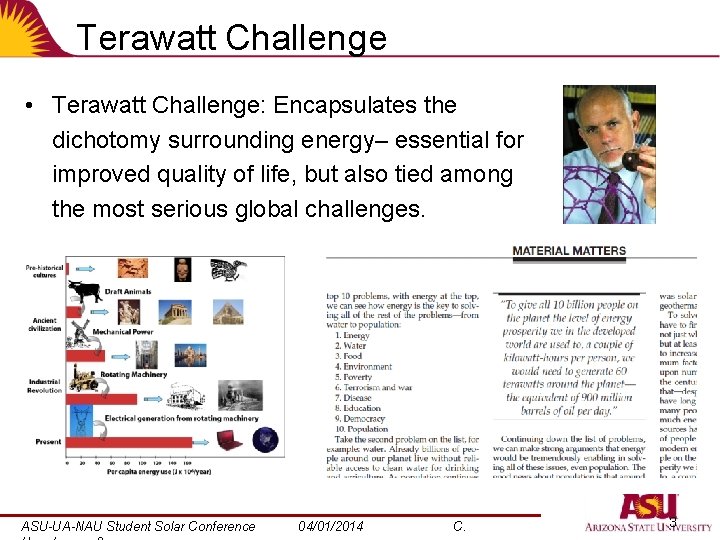
Terawatt Challenge • Terawatt Challenge: Encapsulates the dichotomy surrounding energy– essential for improved quality of life, but also tied among the most serious global challenges. ASU-UA-NAU Student Solar Conference 04/01/2014 C. 3
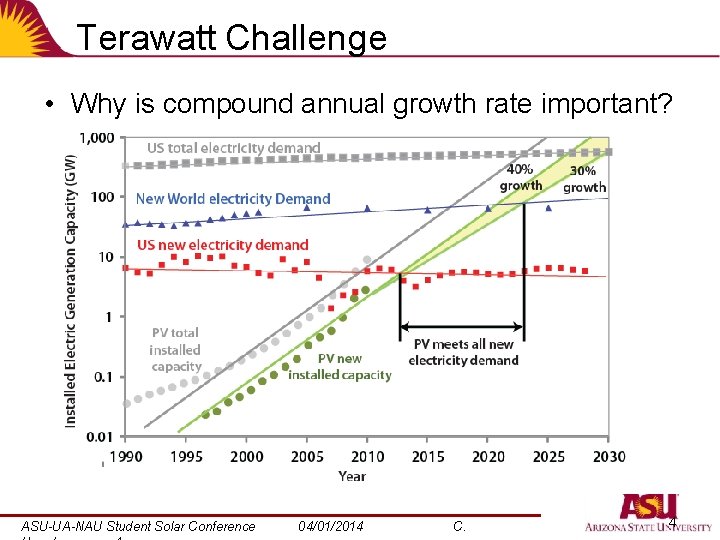
Terawatt Challenge • Why is compound annual growth rate important? ASU-UA-NAU Student Solar Conference 04/01/2014 C. 4
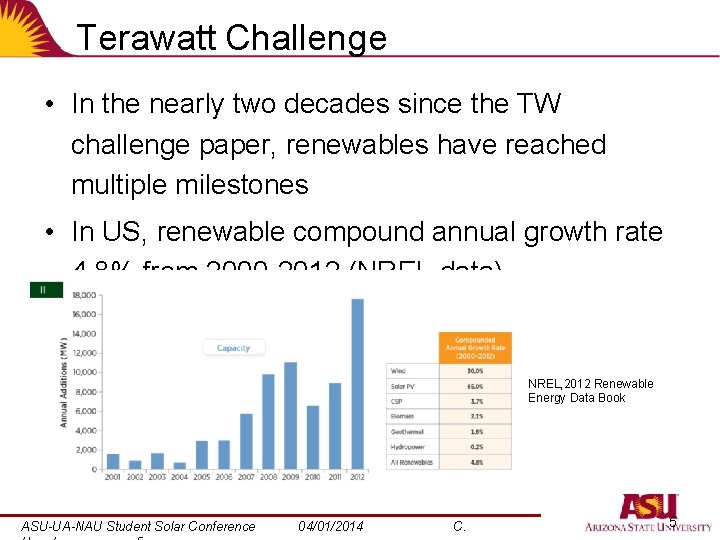
Terawatt Challenge • In the nearly two decades since the TW challenge paper, renewables have reached multiple milestones • In US, renewable compound annual growth rate 4. 8% from 2000 -2012 (NREL data) NREL, 2012 Renewable Energy Data Book ASU-UA-NAU Student Solar Conference 04/01/2014 C. 5
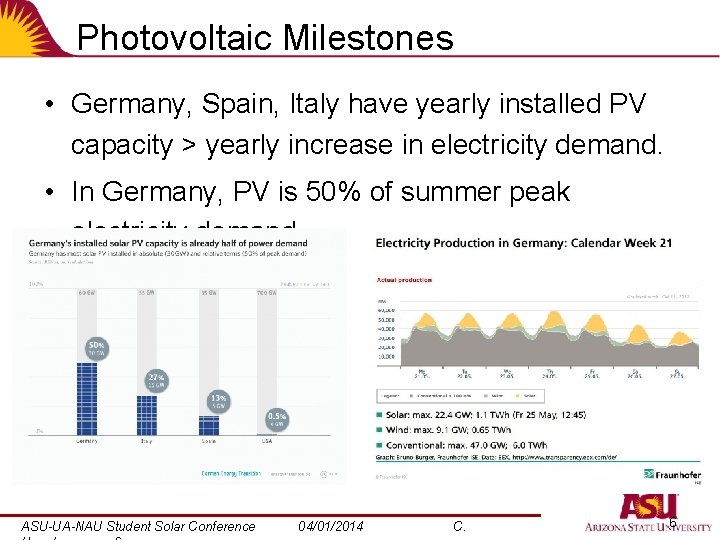
Photovoltaic Milestones • Germany, Spain, Italy have yearly installed PV capacity > yearly increase in electricity demand. • In Germany, PV is 50% of summer peak electricity demand ASU-UA-NAU Student Solar Conference 04/01/2014 C. 6
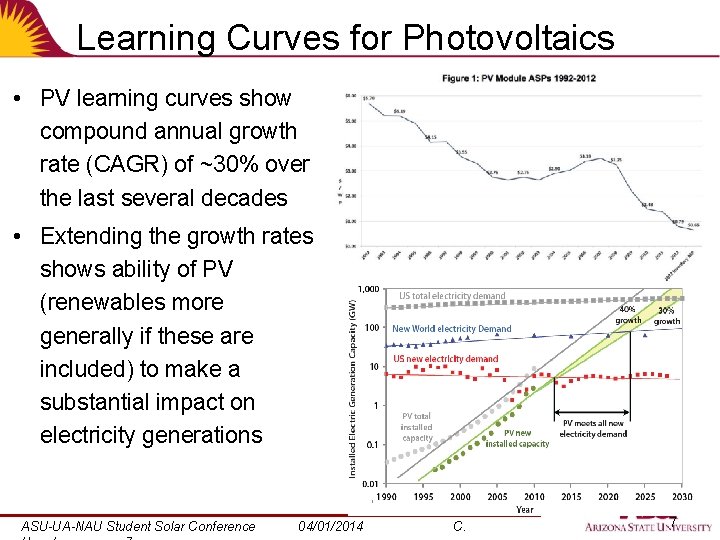
Learning Curves for Photovoltaics • PV learning curves show compound annual growth rate (CAGR) of ~30% over the last several decades • Extending the growth rates shows ability of PV (renewables more generally if these are included) to make a substantial impact on electricity generations ASU-UA-NAU Student Solar Conference 04/01/2014 C. 7
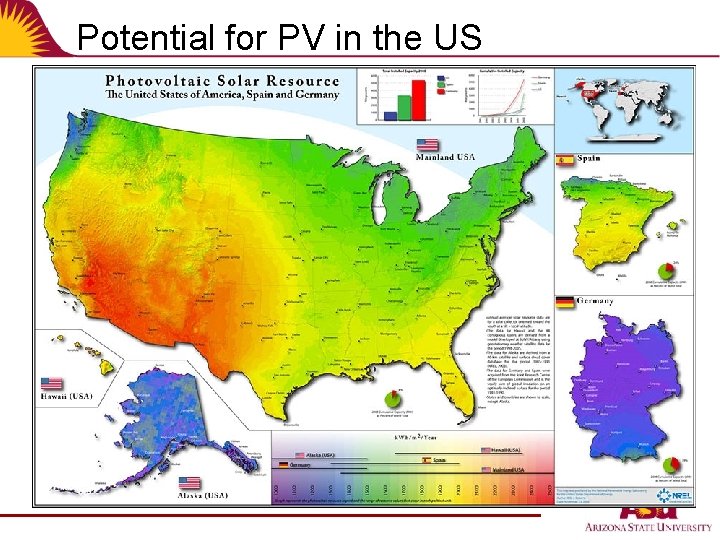
Potential for PV in the US
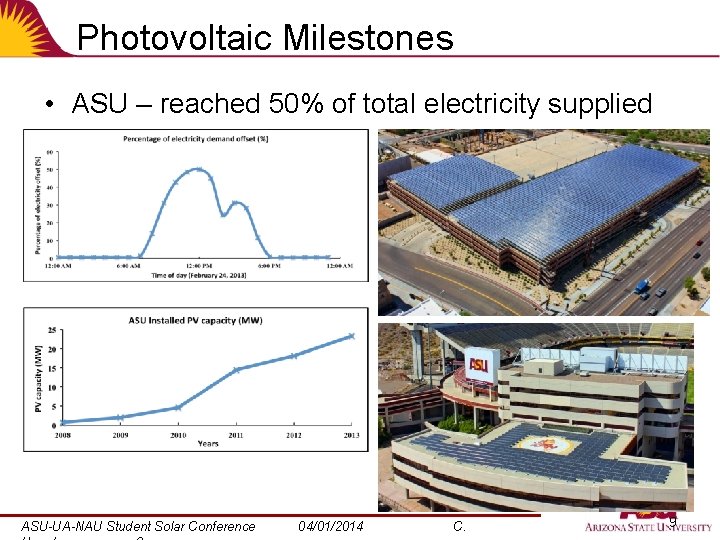
Photovoltaic Milestones • ASU – reached 50% of total electricity supplied by PV ASU-UA-NAU Student Solar Conference 04/01/2014 C. 9
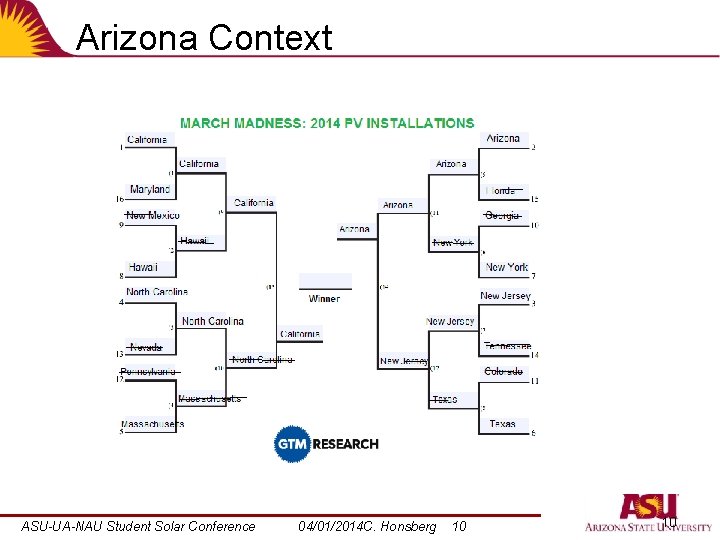
Arizona Context ASU-UA-NAU Student Solar Conference 04/01/2014 C. Honsberg 10 10
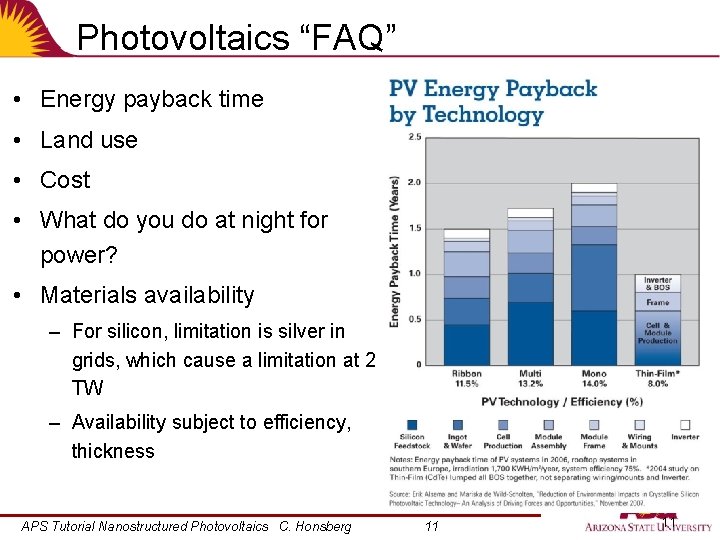
Photovoltaics “FAQ” • Energy payback time • Land use • Cost • What do you do at night for power? • Materials availability – For silicon, limitation is silver in grids, which cause a limitation at 2 TW – Availability subject to efficiency, thickness APS Tutorial Nanostructured Photovoltaics C. Honsberg 11 11
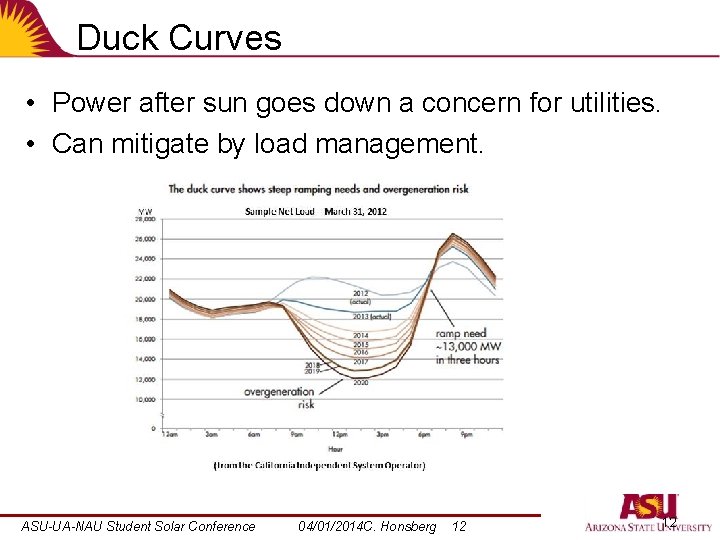
Duck Curves • Power after sun goes down a concern for utilities. • Can mitigate by load management. ASU-UA-NAU Student Solar Conference 04/01/2014 C. Honsberg 12 12
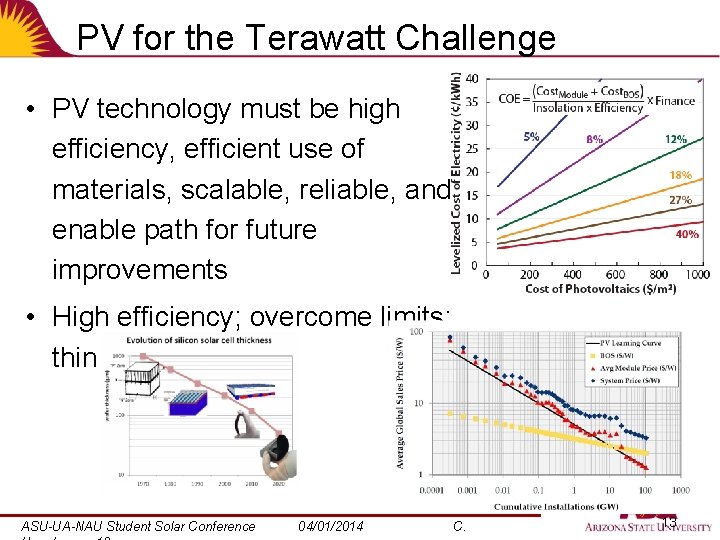
PV for the Terawatt Challenge • PV technology must be high efficiency, efficient use of materials, scalable, reliable, and enable path for future improvements • High efficiency; overcome limits; thin ASU-UA-NAU Student Solar Conference 04/01/2014 C. 13
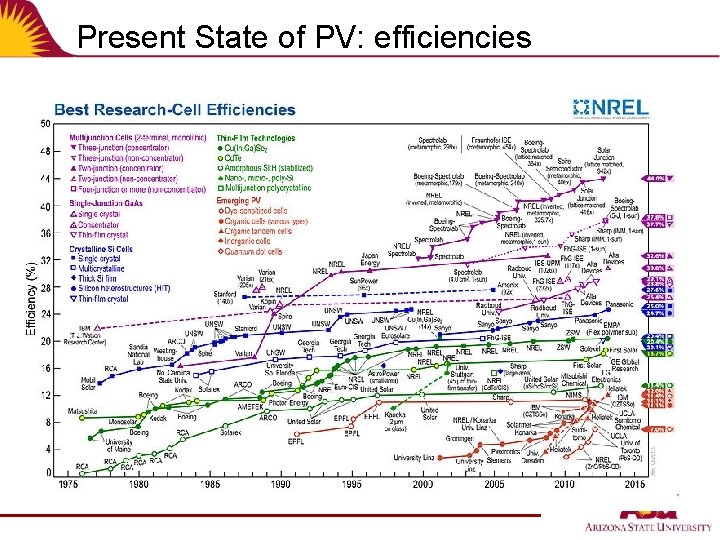
Present State of PV: efficiencies
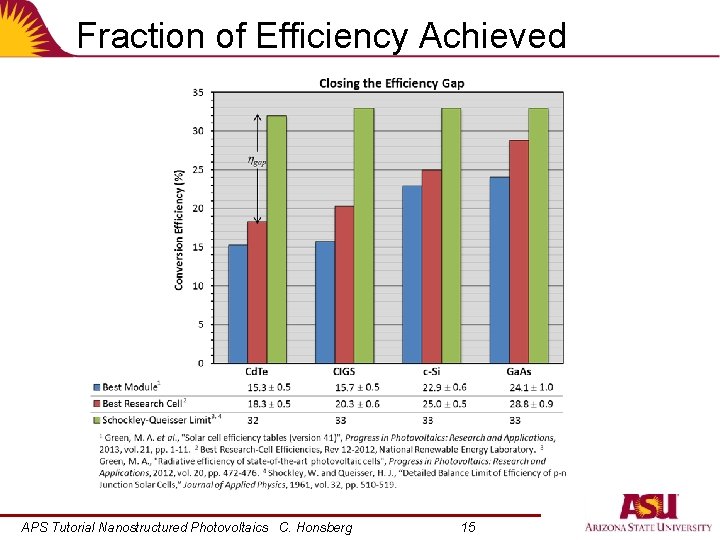
Fraction of Efficiency Achieved APS Tutorial Nanostructured Photovoltaics C. Honsberg 15
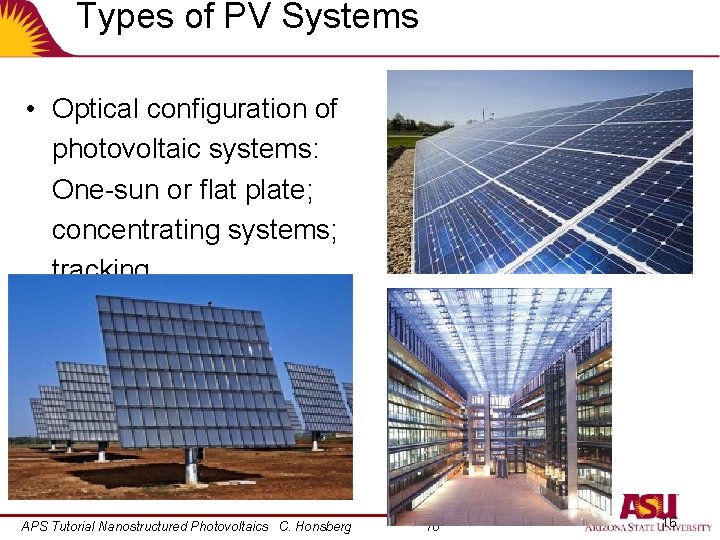
Types of PV Systems • Optical configuration of photovoltaic systems: One-sun or flat plate; concentrating systems; tracking APS Tutorial Nanostructured Photovoltaics C. Honsberg 16 16
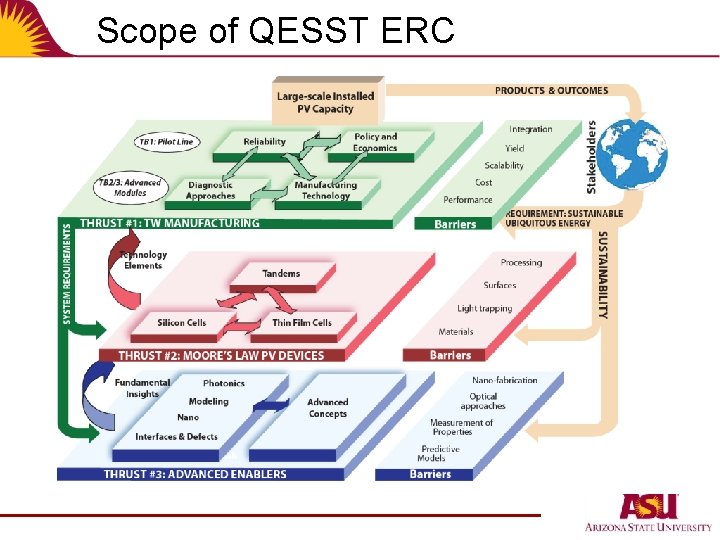
Scope of QESST ERC
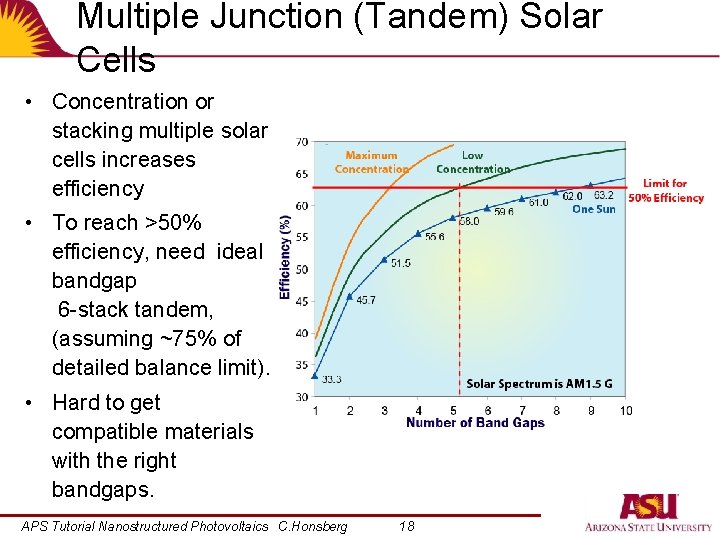
Multiple Junction (Tandem) Solar Cells • Concentration or stacking multiple solar cells increases efficiency • To reach >50% efficiency, need ideal bandgap 6 -stack tandem, (assuming ~75% of detailed balance limit). • Hard to get compatible materials with the right bandgaps. APS Tutorial Nanostructured Photovoltaics C. Honsberg 18
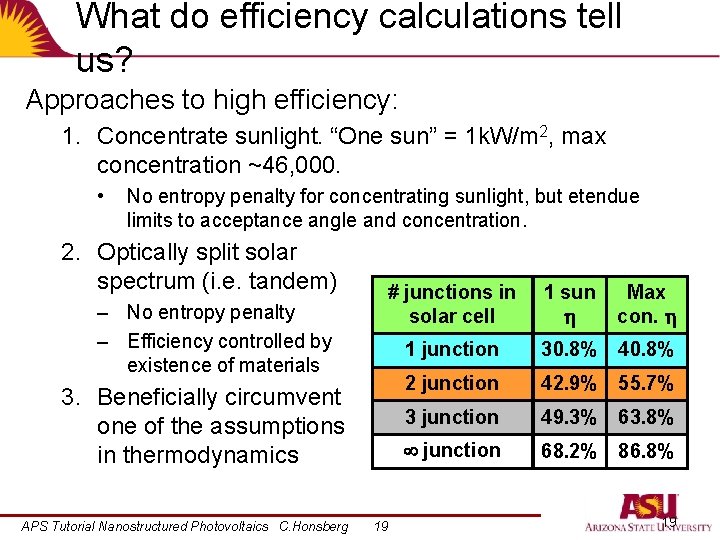
What do efficiency calculations tell us? Approaches to high efficiency: 1. Concentrate sunlight. “One sun” = 1 k. W/m 2, max concentration ~46, 000. • No entropy penalty for concentrating sunlight, but etendue limits to acceptance angle and concentration. 2. Optically split solar spectrum (i. e. tandem) – No entropy penalty – Efficiency controlled by existence of materials # junctions in solar cell 1 sun h Max con. h 1 junction 30. 8% 40. 8% 2 junction 42. 9% 55. 7% 3 junction 49. 3% 63. 8% junction 68. 2% 86. 8% 3. Beneficially circumvent one of the assumptions in thermodynamics APS Tutorial Nanostructured Photovoltaics C. Honsberg 19 19
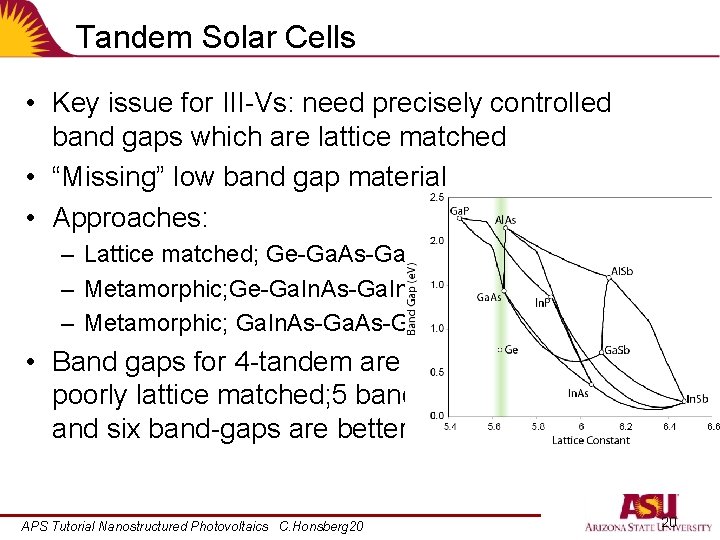
Tandem Solar Cells • Key issue for III-Vs: need precisely controlled band gaps which are lattice matched • “Missing” low band gap material • Approaches: – Lattice matched; Ge-Ga. As-Ga. In. P – Metamorphic; Ge-Ga. In. As-Ga. In. P – Metamorphic; Ga. In. As-Ga. In. P • Band gaps for 4 -tandem are poorly lattice matched; 5 band gaps and six band-gaps are better matched APS Tutorial Nanostructured Photovoltaics C. Honsberg 20 20
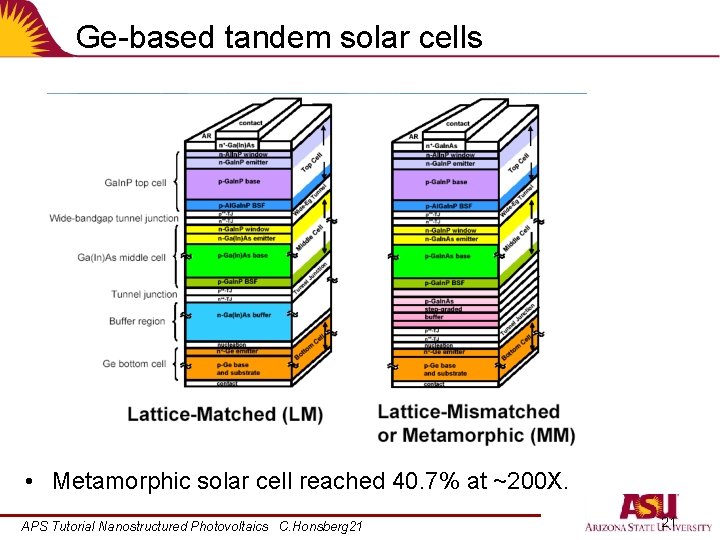
Ge-based tandem solar cells • Metamorphic solar cell reached 40. 7% at ~200 X. APS Tutorial Nanostructured Photovoltaics C. Honsberg 21 21
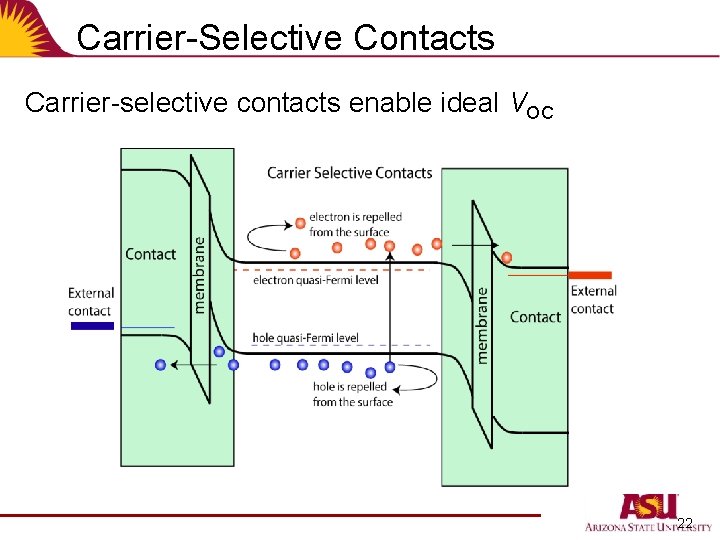
Carrier-Selective Contacts Carrier-selective contacts enable ideal VOC 22
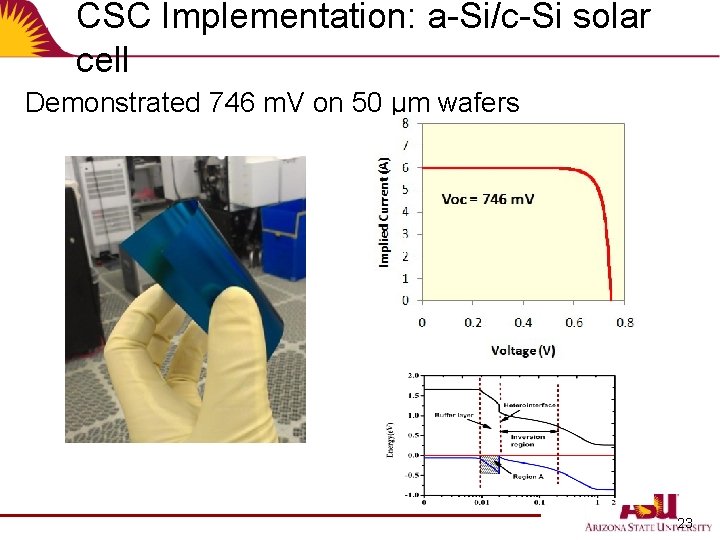
CSC Implementation: a-Si/c-Si solar cell Demonstrated 746 m. V on 50 µm wafers 23
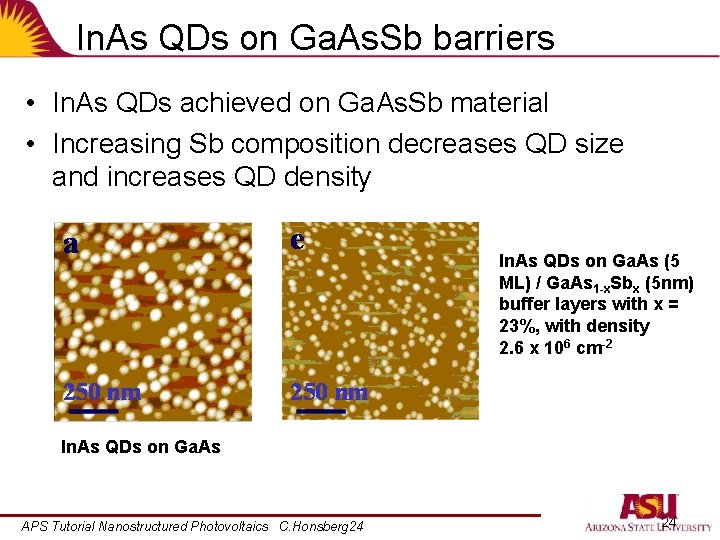
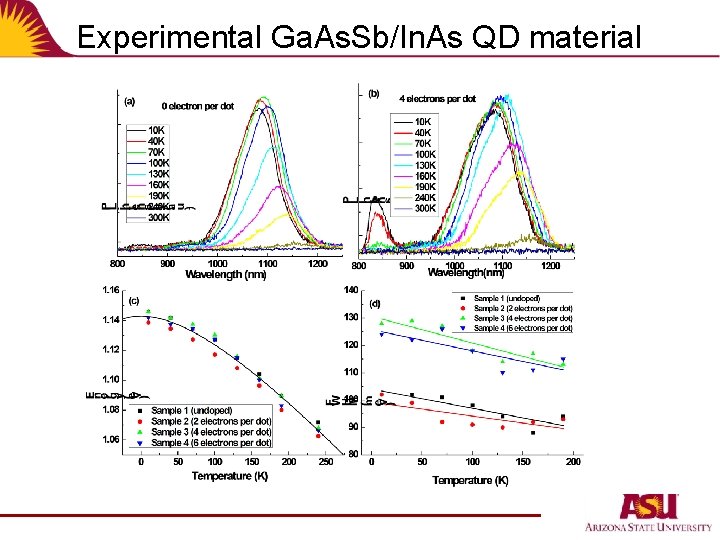
In. As QDs on Ga. As. Sb barriers • In. As QDs achieved on Ga. As. Sb material • Increasing Sb composition decreases QD size and increases QD density In. As QDs on Ga. As (5 ML) / Ga. As 1 -x. Sbx (5 nm) buffer layers with x = 23%, with density 2. 6 x 106 cm-2 In. As QDs on Ga. As APS Tutorial Nanostructured Photovoltaics C. Honsberg 24 24
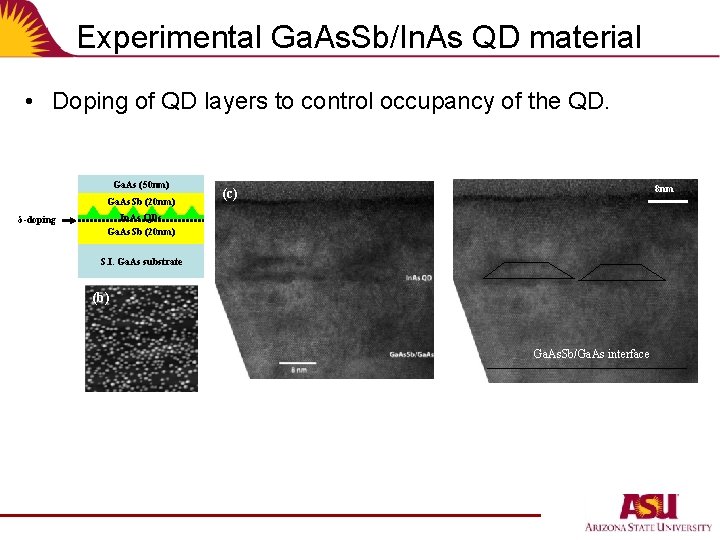
Experimental Ga. As. Sb/In. As QD material • Doping of QD layers to control occupancy of the QD. Ga. As (50 nm) Ga. As. Sb (20 nm) δ-doping 8 nm (c) In. As QDs Ga. As. Sb (20 nm) S. I. Ga. As substrate (b) Ga. As. Sb/Ga. As interface
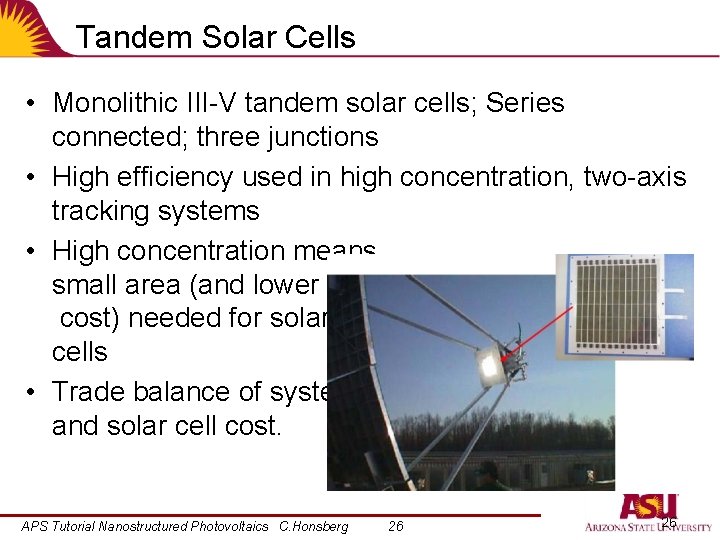
Tandem Solar Cells • Monolithic III-V tandem solar cells; Series connected; three junctions • High efficiency used in high concentration, two-axis tracking systems • High concentration means small area (and lower cost) needed for solar cells • Trade balance of systems and solar cell cost. APS Tutorial Nanostructured Photovoltaics C. Honsberg 26 26
Experimental Ga. As. Sb/In. As QD material
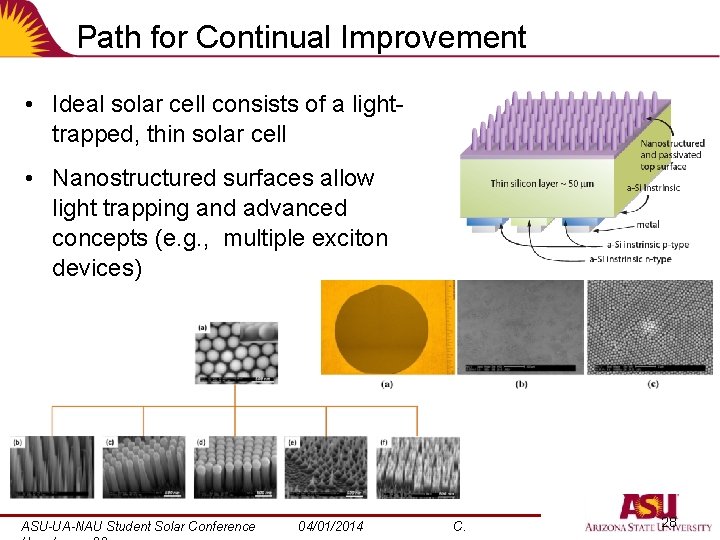
Path for Continual Improvement • Ideal solar cell consists of a lighttrapped, thin solar cell • Nanostructured surfaces allow light trapping and advanced concepts (e. g. , multiple exciton devices) ASU-UA-NAU Student Solar Conference 04/01/2014 C. 28
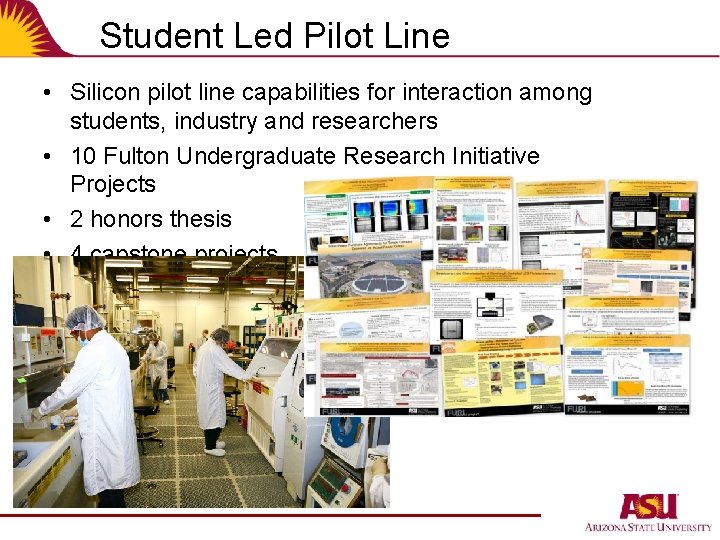
Student Led Pilot Line • Silicon pilot line capabilities for interaction among students, industry and researchers • 10 Fulton Undergraduate Research Initiative Projects • 2 honors thesis • 4 capstone projects
Questions? ASU-UA-NAU Student Solar Conference 04/01/2014 C. 30
- Slides: 30