
Photosynthesis White Light The conversion of light energy
- Slides: 4
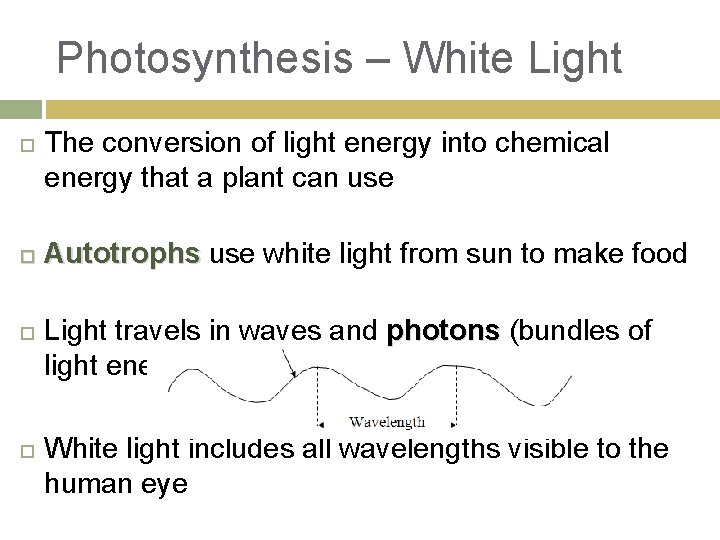
Photosynthesis – White Light The conversion of light energy into chemical energy that a plant can use Autotrophs use white light from sun to make food Light travels in waves and photons (bundles of light energy) White light includes all wavelengths visible to the human eye
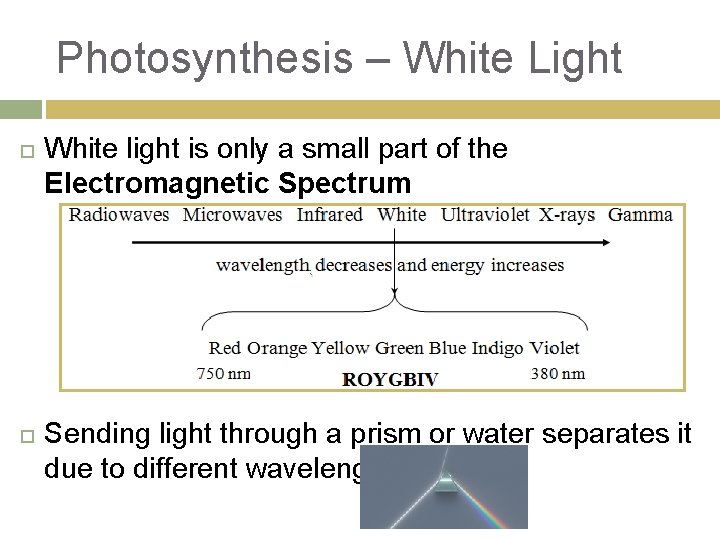
Photosynthesis – White Light White light is only a small part of the Electromagnetic Spectrum Sending light through a prism or water separates it due to different wavelengths
Photosynthesis – White Light There are two major reasons why most organisms use white light: 1. These wavelengths don’t change the atoms - Will NOT harm the cells 2. These wavelengths reach the earth the most - Others are filtered by the Ozone and O 2 You can see colors only because an object will absorb some wavelengths and reflect others � If an object is blue, it reflects the blue wavelength and
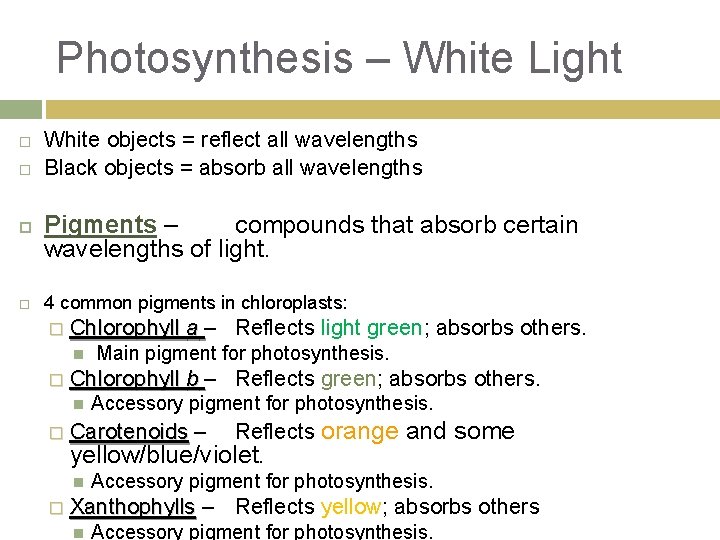
Photosynthesis – White Light White objects = reflect all wavelengths Black objects = absorb all wavelengths Pigments – compounds that absorb certain wavelengths of light. 4 common pigments in chloroplasts: � Chlorophyll a – Reflects light green; absorbs others. � Chlorophyll b – Reflects green; absorbs others. � Accessory pigment for photosynthesis. Carotenoids – Reflects orange and some yellow/blue/violet. � Main pigment for photosynthesis. Accessory pigment for photosynthesis. Xanthophylls – Reflects yellow; absorbs others Accessory pigment for photosynthesis.