
Photosynthesis What is photosynthesis Conversion of light energy
- Slides: 33
Photosynthesis
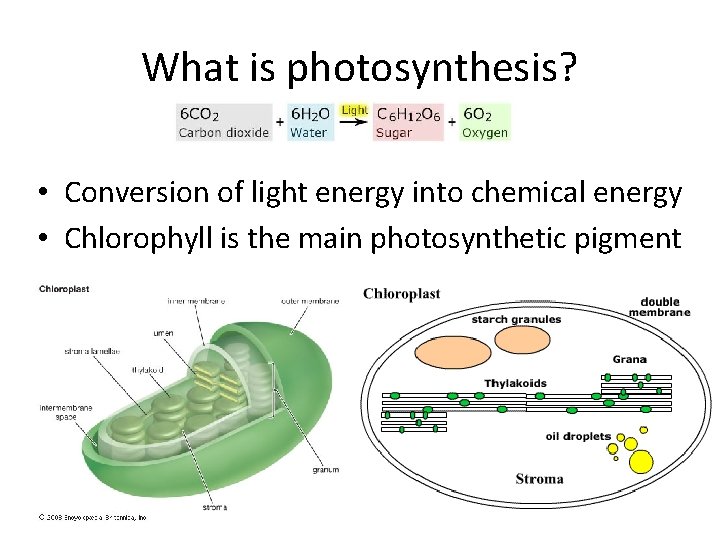
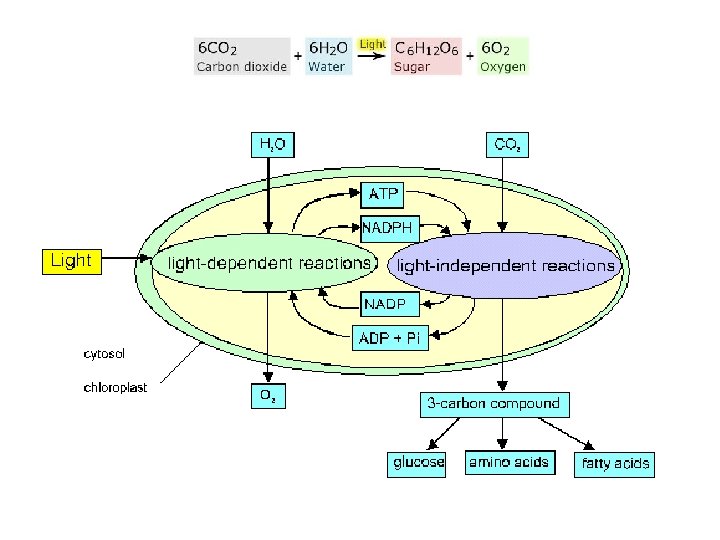
What is photosynthesis? • Conversion of light energy into chemical energy • Chlorophyll is the main photosynthetic pigment
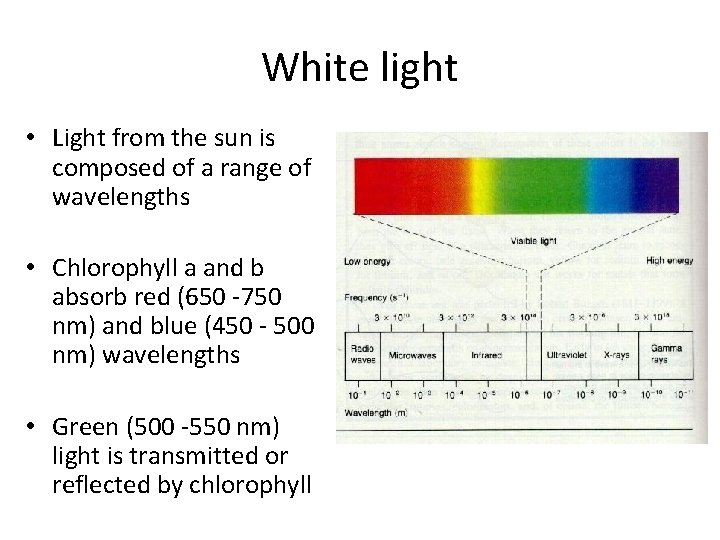
White light • Light from the sun is composed of a range of wavelengths • Chlorophyll a and b absorb red (650 -750 nm) and blue (450 - 500 nm) wavelengths • Green (500 -550 nm) light is transmitted or reflected by chlorophyll
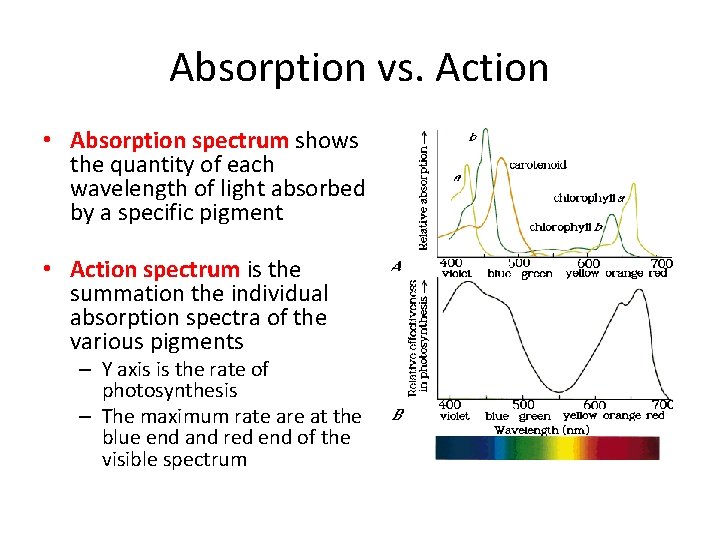
Absorption vs. Action • Absorption spectrum shows the quantity of each wavelength of light absorbed by a specific pigment • Action spectrum is the summation the individual absorption spectra of the various pigments – Y axis is the rate of photosynthesis – The maximum rate are at the blue end and red end of the visible spectrum
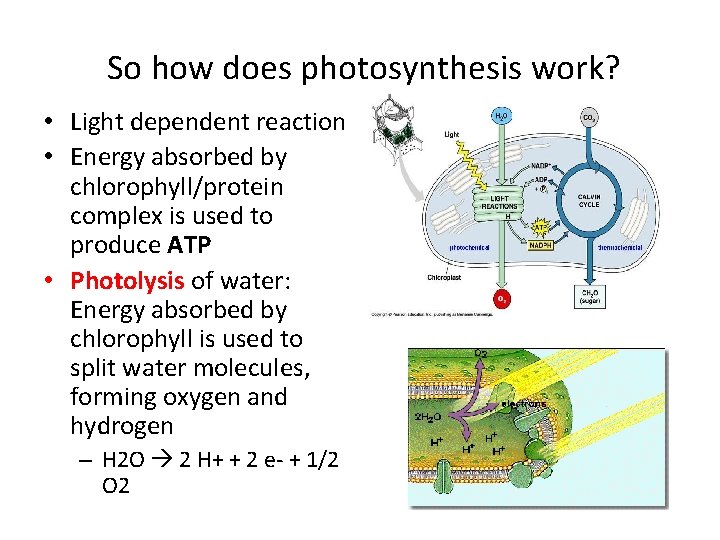
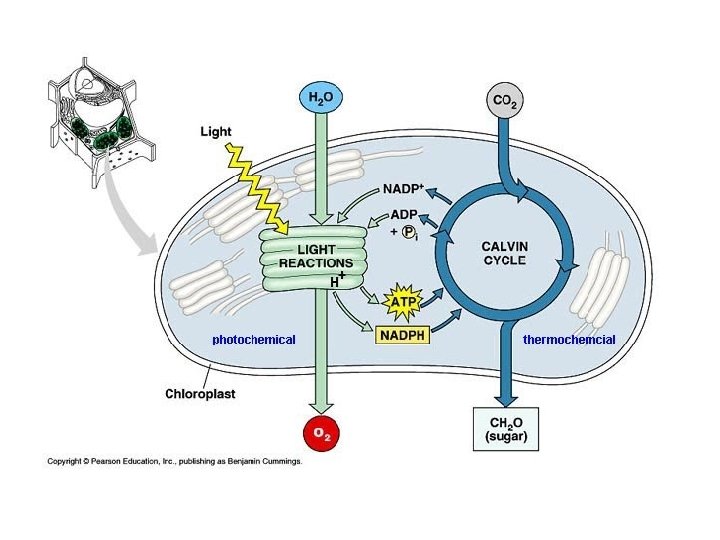
So how does photosynthesis work? • Light dependent reaction • Energy absorbed by chlorophyll/protein complex is used to produce ATP • Photolysis of water: Energy absorbed by chlorophyll is used to split water molecules, forming oxygen and hydrogen – H 2 O 2 H+ + 2 e- + 1/2 O 2
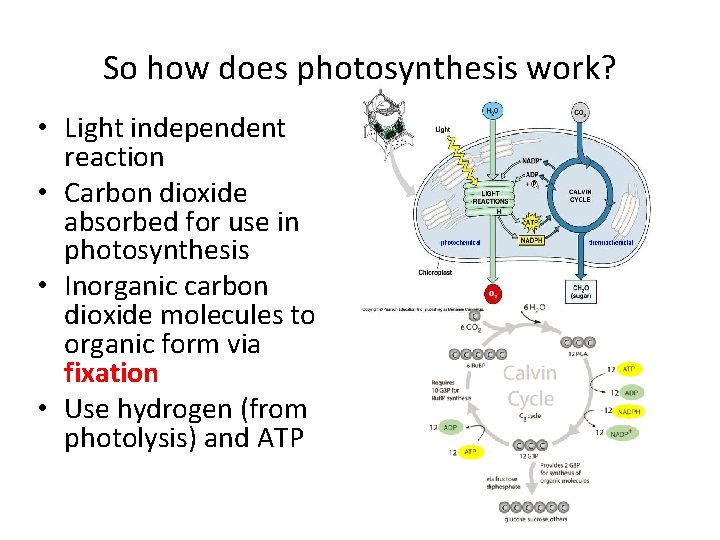
So how does photosynthesis work? • Light independent reaction • Carbon dioxide absorbed for use in photosynthesis • Inorganic carbon dioxide molecules to organic form via fixation • Use hydrogen (from photolysis) and ATP
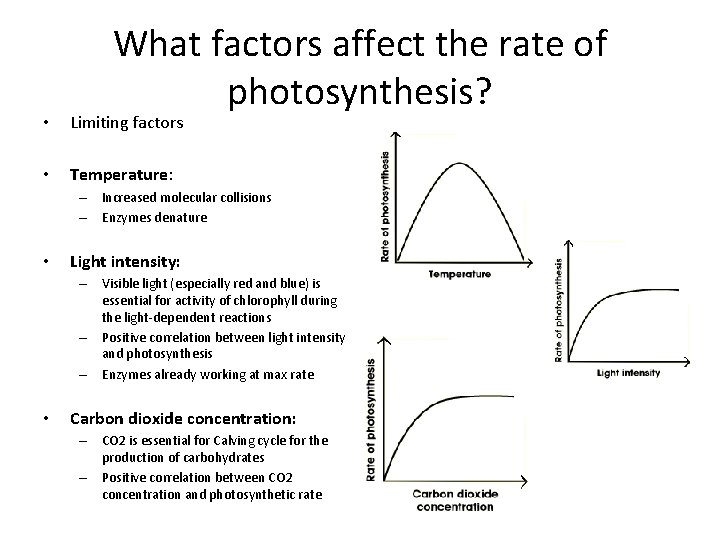
What factors affect the rate of photosynthesis? • Limiting factors • Temperature: – Increased molecular collisions – Enzymes denature • Light intensity: – Visible light (especially red and blue) is essential for activity of chlorophyll during the light-dependent reactions – Positive correlation between light intensity and photosynthesis – Enzymes already working at max rate • Carbon dioxide concentration: – CO 2 is essential for Calving cycle for the production of carbohydrates – Positive correlation between CO 2 concentration and photosynthetic rate
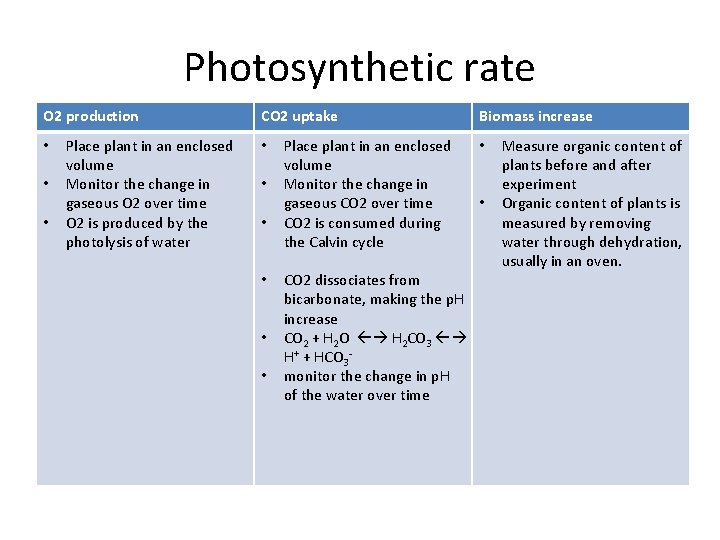
Photosynthetic rate O 2 production • • • Place plant in an enclosed volume Monitor the change in gaseous O 2 over time O 2 is produced by the photolysis of water CO 2 uptake • • • Place plant in an enclosed volume Monitor the change in gaseous CO 2 over time CO 2 is consumed during the Calvin cycle CO 2 dissociates from bicarbonate, making the p. H increase CO 2 + H 2 O H 2 CO 3 H+ + HCO 3 monitor the change in p. H of the water over time Biomass increase • • Measure organic content of plants before and after experiment Organic content of plants is measured by removing water through dehydration, usually in an oven.
To do today • How much energy do you use? Try the Ecological Footprint Survey here. http: //www. earthday. org/splash_page. php. We will compare the results with the class so take a screenshot of your responses, put them on a goolge doc and then in the Ecological Footprint folder. • Try the color of the light spectrum & growth. Which wavelength of light is the best for plant growth? http: //www. glencoe. com/sites/common_assets/science/virtu al_labs/LS 12. html • Next class: Mind Map Draft • Learning log: 3. 7 & 3. 8 (HL also: 7. 5, 8. 1, 8. 2) - May 23 rd.
HL ONLY: Light Dependent Reactions
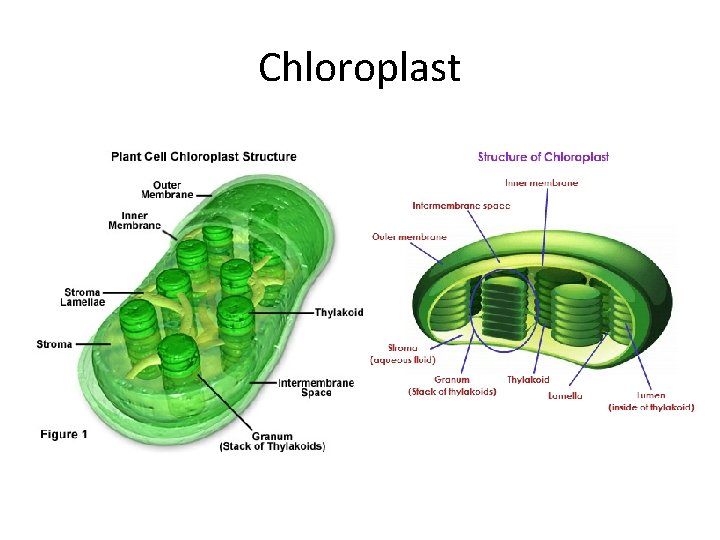
Chloroplast
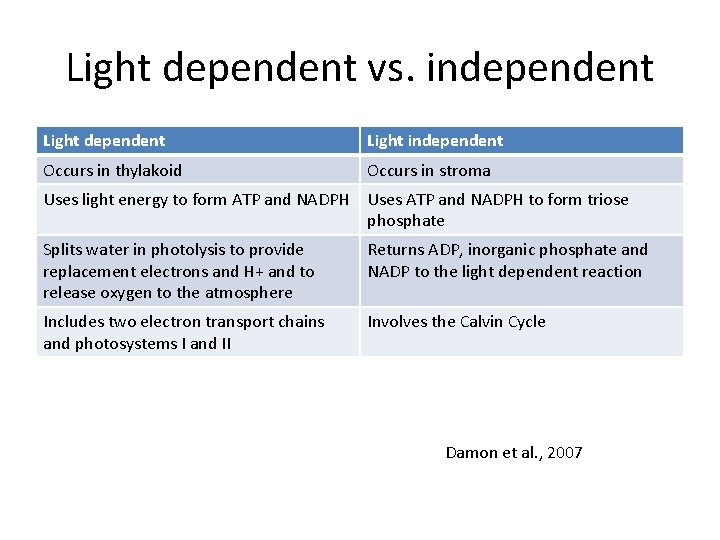
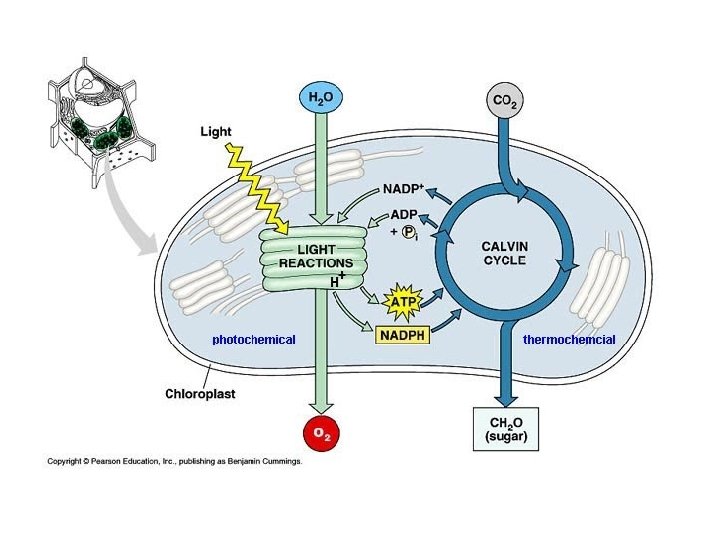
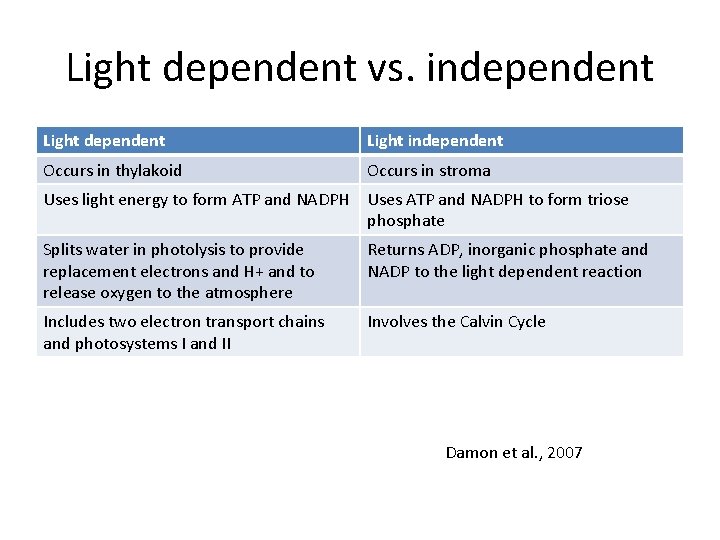
Light dependent vs. independent Light independent Occurs in thylakoid Occurs in stroma Uses light energy to form ATP and NADPH Uses ATP and NADPH to form triose phosphate Splits water in photolysis to provide replacement electrons and H+ and to release oxygen to the atmosphere Returns ADP, inorganic phosphate and NADP to the light dependent reaction Includes two electron transport chains and photosystems I and II Involves the Calvin Cycle Damon et al. , 2007
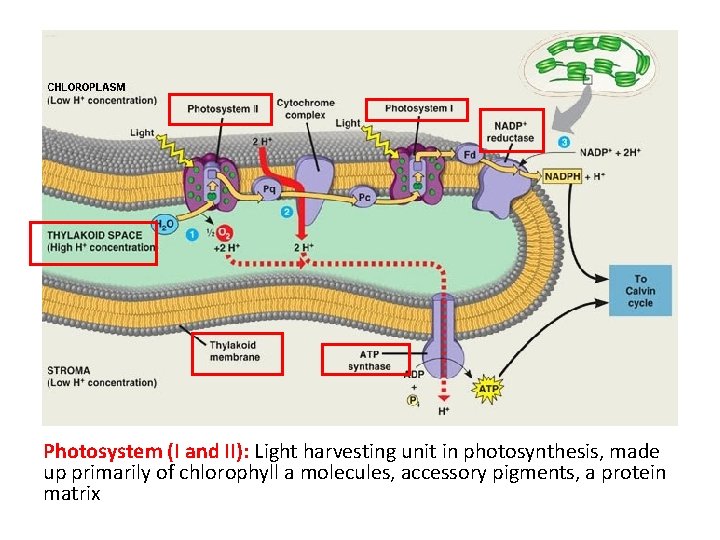
Photosystem (I and II): Light harvesting unit in photosynthesis, made up primarily of chlorophyll a molecules, accessory pigments, a protein matrix
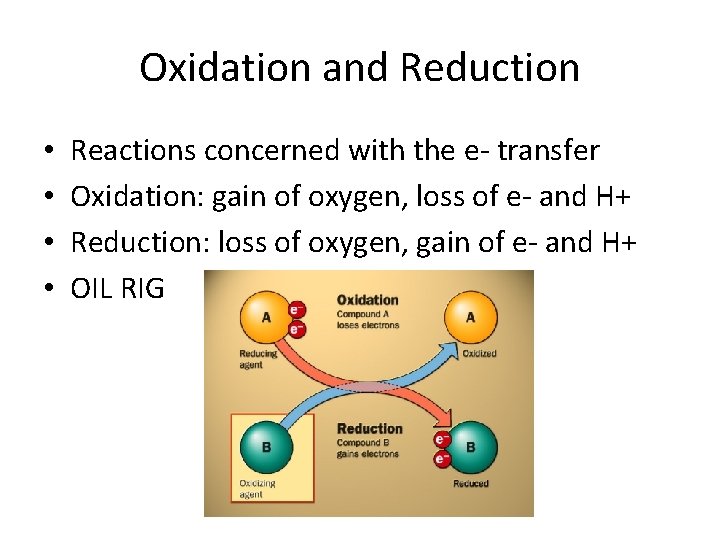
Oxidation and Reduction • • Reactions concerned with the e- transfer Oxidation: gain of oxygen, loss of e- and H+ Reduction: loss of oxygen, gain of e- and H+ OIL RIG
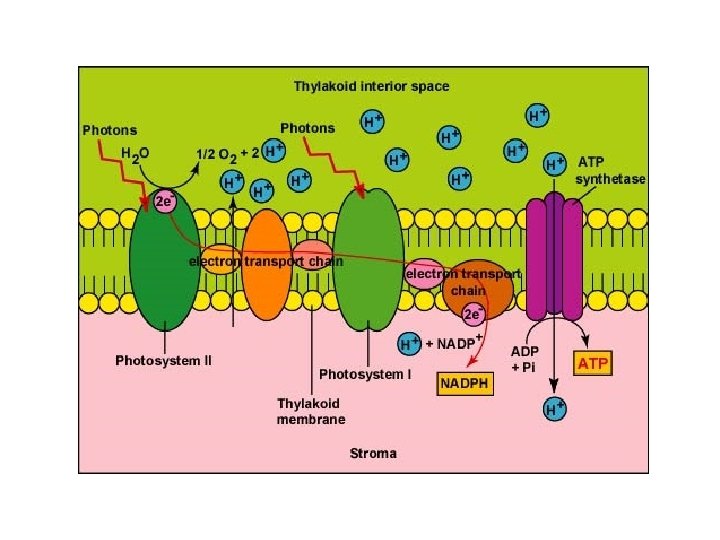
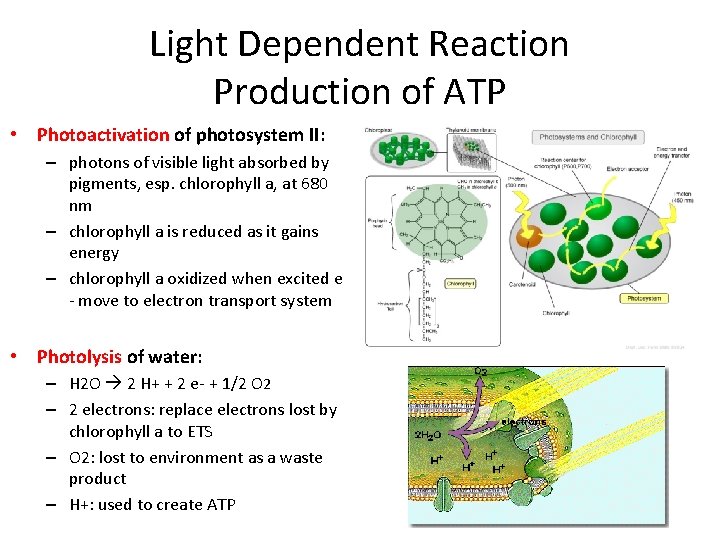
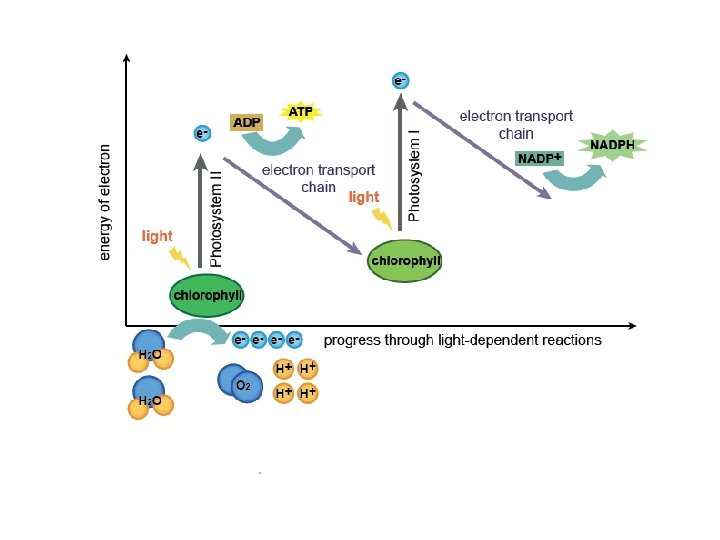
Light Dependent Reaction Production of ATP • Photoactivation of photosystem II: – photons of visible light absorbed by pigments, esp. chlorophyll a, at 680 nm – chlorophyll a is reduced as it gains energy – chlorophyll a oxidized when excited e - move to electron transport system • Photolysis of water: – H 2 O 2 H+ + 2 e- + 1/2 O 2 – 2 electrons: replace electrons lost by chlorophyll a to ETS – O 2: lost to environment as a waste product – H+: used to create ATP
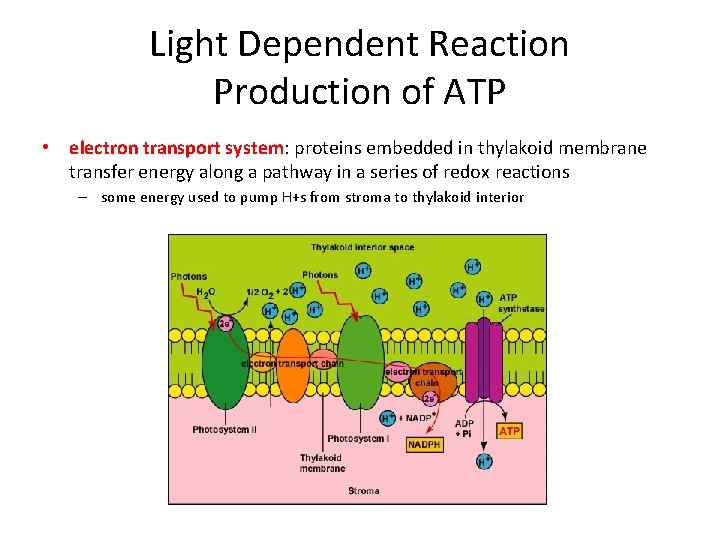
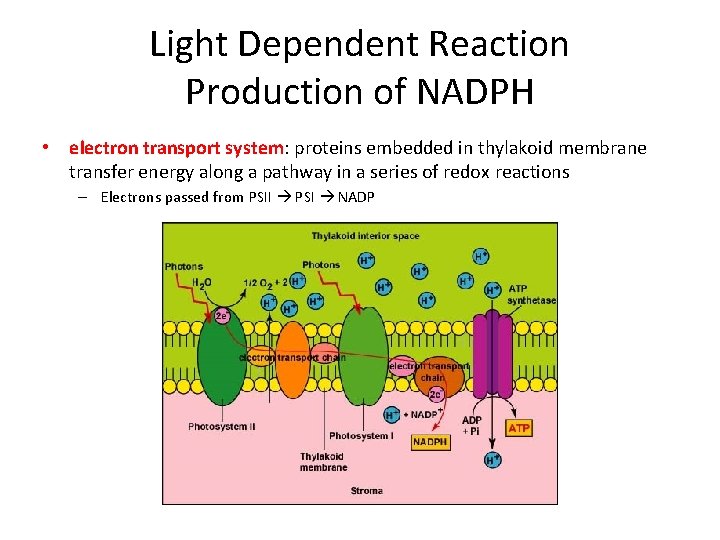
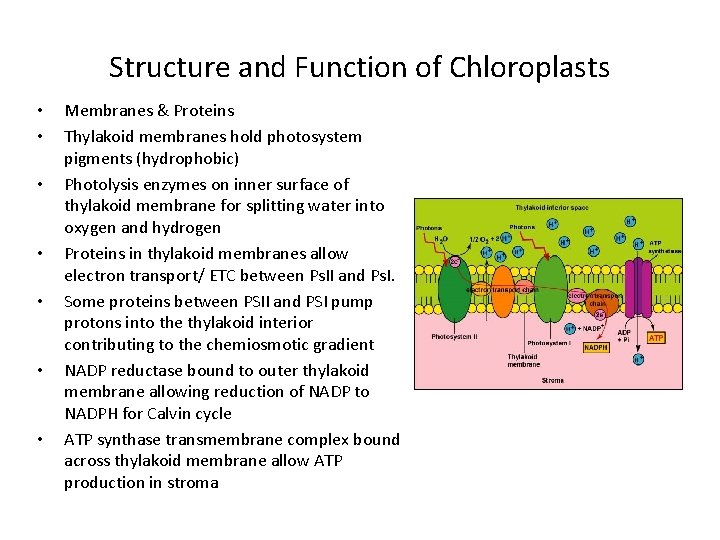
Light Dependent Reaction Production of ATP • electron transport system: proteins embedded in thylakoid membrane transfer energy along a pathway in a series of redox reactions – some energy used to pump H+s from stroma to thylakoid interior
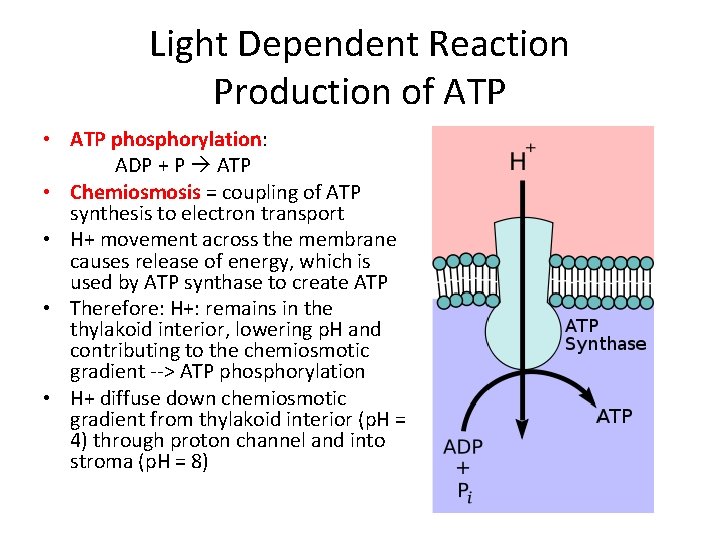
Light Dependent Reaction Production of ATP • ATP phosphorylation: ADP + P ATP • Chemiosmosis = coupling of ATP synthesis to electron transport • H+ movement across the membrane causes release of energy, which is used by ATP synthase to create ATP • Therefore: H+: remains in the thylakoid interior, lowering p. H and contributing to the chemiosmotic gradient --> ATP phosphorylation • H+ diffuse down chemiosmotic gradient from thylakoid interior (p. H = 4) through proton channel and into stroma (p. H = 8)
Light Dependent Reaction Production of NADPH • electron transport system: proteins embedded in thylakoid membrane transfer energy along a pathway in a series of redox reactions – Electrons passed from PSII PSI NADP
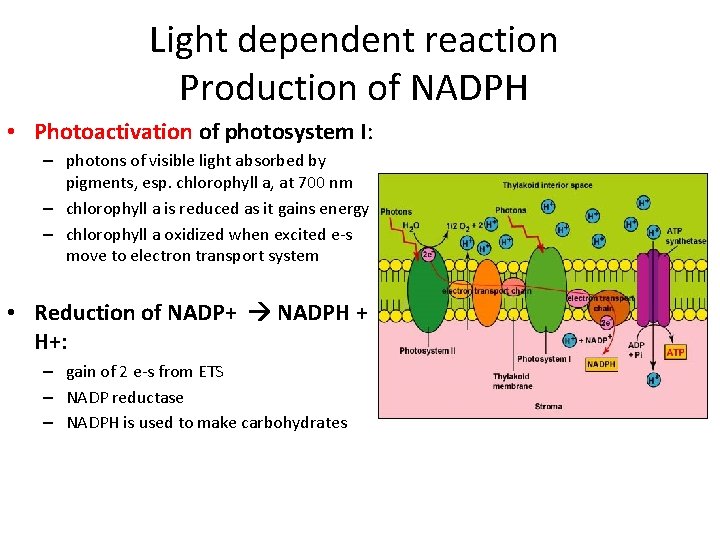
Light dependent reaction Production of NADPH • Photoactivation of photosystem I: – photons of visible light absorbed by pigments, esp. chlorophyll a, at 700 nm – chlorophyll a is reduced as it gains energy – chlorophyll a oxidized when excited e-s move to electron transport system • Reduction of NADP+ NADPH + H+: – gain of 2 e-s from ETS – NADP reductase – NADPH is used to make carbohydrates
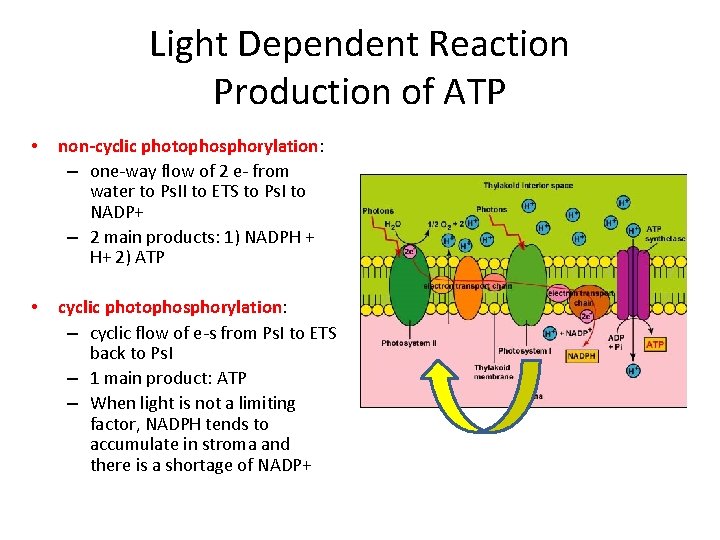
Light Dependent Reaction Production of ATP • non-cyclic photophosphorylation: – one-way flow of 2 e- from water to Ps. II to ETS to Ps. I to NADP+ – 2 main products: 1) NADPH + H+ 2) ATP • cyclic photophosphorylation: – cyclic flow of e-s from Ps. I to ETS back to Ps. I – 1 main product: ATP – When light is not a limiting factor, NADPH tends to accumulate in stroma and there is a shortage of NADP+
HL ONLY: Light Independent Reactions
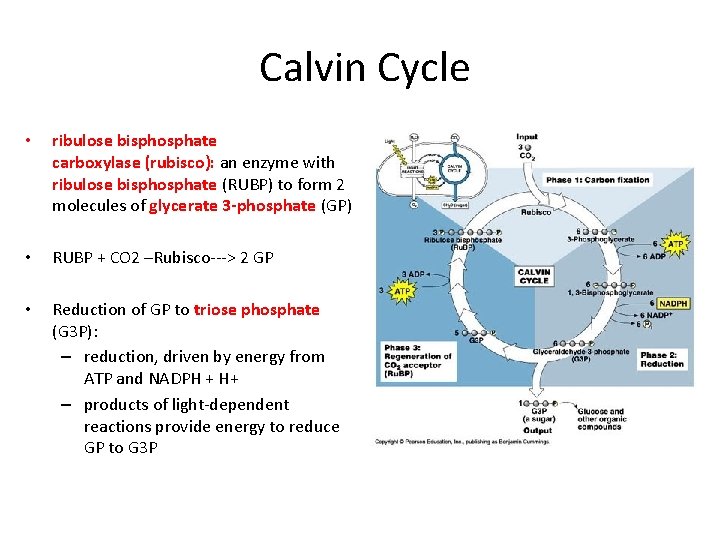
Calvin Cycle • ribulose bisphosphate carboxylase (rubisco): an enzyme with ribulose bisphosphate (RUBP) to form 2 molecules of glycerate 3 -phosphate (GP) • RUBP + CO 2 –Rubisco---> 2 GP • Reduction of GP to triose phosphate (G 3 P): – reduction, driven by energy from ATP and NADPH + H+ – products of light-dependent reactions provide energy to reduce GP to G 3 P
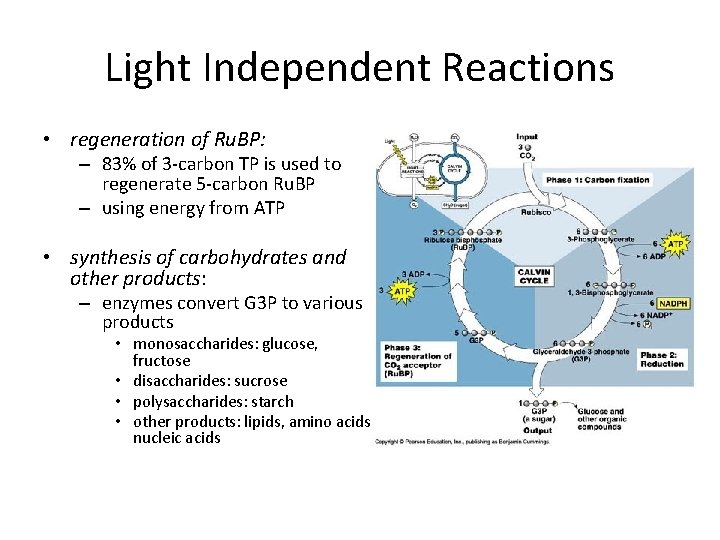
Light Independent Reactions • regeneration of Ru. BP: – 83% of 3 -carbon TP is used to regenerate 5 -carbon Ru. BP – using energy from ATP • synthesis of carbohydrates and other products: – enzymes convert G 3 P to various products • monosaccharides: glucose, fructose • disaccharides: sucrose • polysaccharides: starch • other products: lipids, amino acids, nucleic acids
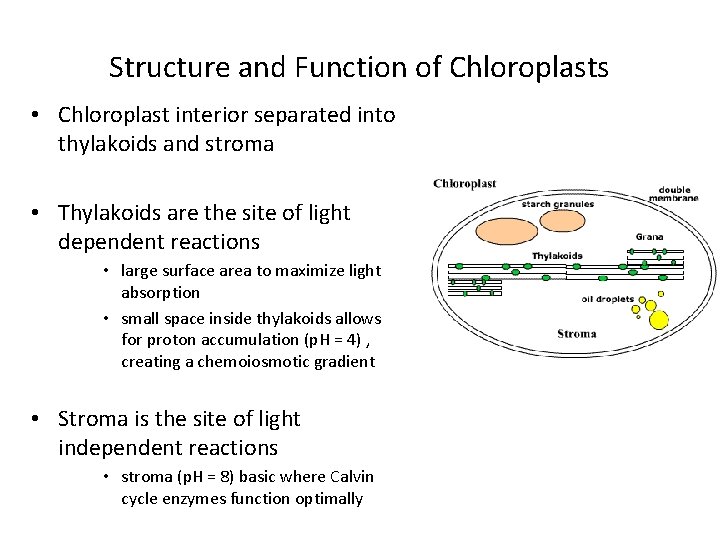
Structure and Function of Chloroplasts • Chloroplast interior separated into thylakoids and stroma • Thylakoids are the site of light dependent reactions • large surface area to maximize light absorption • small space inside thylakoids allows for proton accumulation (p. H = 4) , creating a chemoiosmotic gradient • Stroma is the site of light independent reactions • stroma (p. H = 8) basic where Calvin cycle enzymes function optimally
Structure and Function of Chloroplasts • • Membranes & Proteins Thylakoid membranes hold photosystem pigments (hydrophobic) Photolysis enzymes on inner surface of thylakoid membrane for splitting water into oxygen and hydrogen Proteins in thylakoid membranes allow electron transport/ ETC between Ps. II and Ps. I. Some proteins between PSII and PSI pump protons into the thylakoid interior contributing to the chemiosmotic gradient NADP reductase bound to outer thylakoid membrane allowing reduction of NADP to NADPH for Calvin cycle ATP synthase transmembrane complex bound across thylakoid membrane allow ATP production in stroma
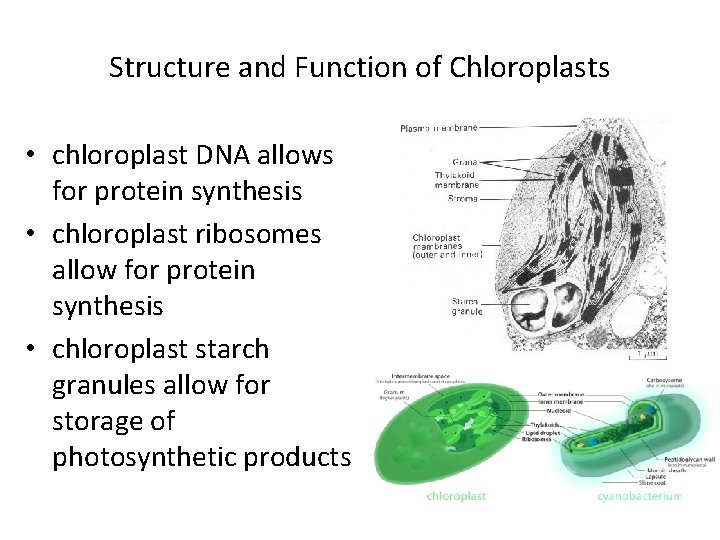
Structure and Function of Chloroplasts • chloroplast DNA allows for protein synthesis • chloroplast ribosomes allow for protein synthesis • chloroplast starch granules allow for storage of photosynthetic products
Light dependent vs. independent Light independent Occurs in thylakoid Occurs in stroma Uses light energy to form ATP and NADPH Uses ATP and NADPH to form triose phosphate Splits water in photolysis to provide replacement electrons and H+ and to release oxygen to the atmosphere Returns ADP, inorganic phosphate and NADP to the light dependent reaction Includes two electron transport chains and photosystems I and II Involves the Calvin Cycle Damon et al. , 2007
To do • Calvin’s Lollipop apparatus data base question p. 397 Q 1 -3 (section 8. 3 photosynthesis) • Watch photosynthesis animations here – https: //www. youtube. com/watch? v=jo. Z 1 Es. A 5_NY – https: //www. youtube. com/watch? v=g 78 utc. LQr. J 4 – https: //www. youtube. com/watch? v=s. QK 3 Yr 4 Sc_k