
Photosynthesis The process by which plants some bacteria
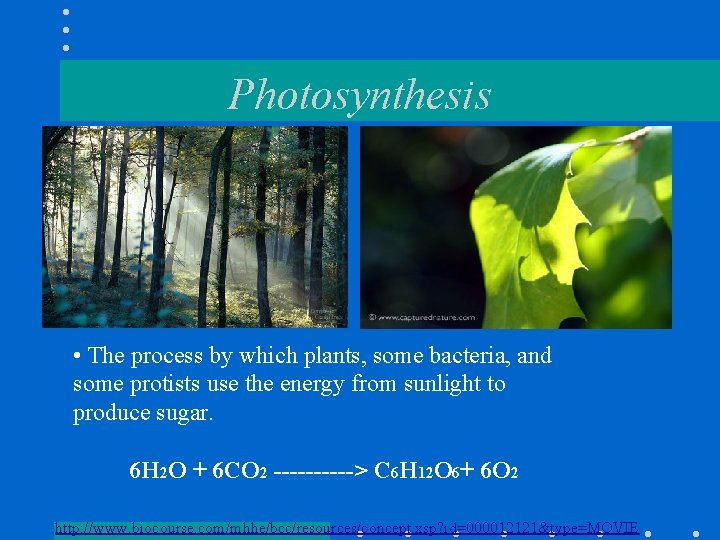
Photosynthesis • The process by which plants, some bacteria, and some protists use the energy from sunlight to produce sugar. 6 H 2 O + 6 CO 2 -----> C 6 H 12 O 6+ 6 O 2 http: //www. biocourse. com/mhhe/bcc/resources/concept. xsp? id=000012121&type=MOVIE
Photo = Light Synthesis = to make
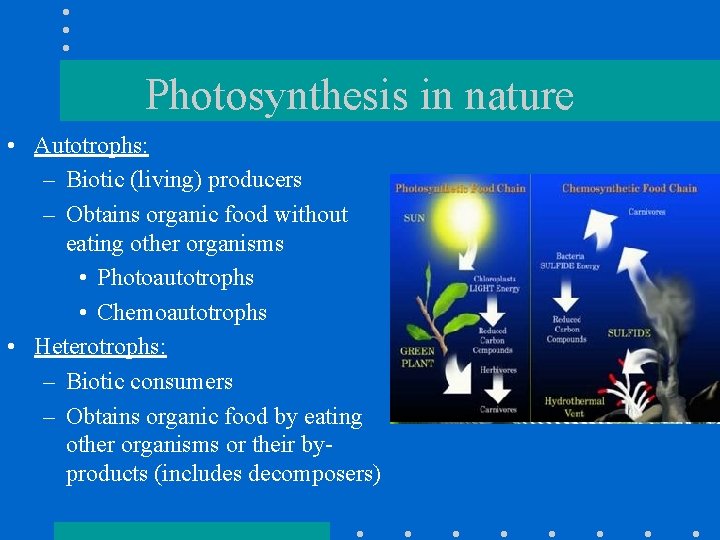
Photosynthesis in nature • Autotrophs: – Biotic (living) producers – Obtains organic food without eating other organisms • Photoautotrophs • Chemoautotrophs • Heterotrophs: – Biotic consumers – Obtains organic food by eating other organisms or their byproducts (includes decomposers)
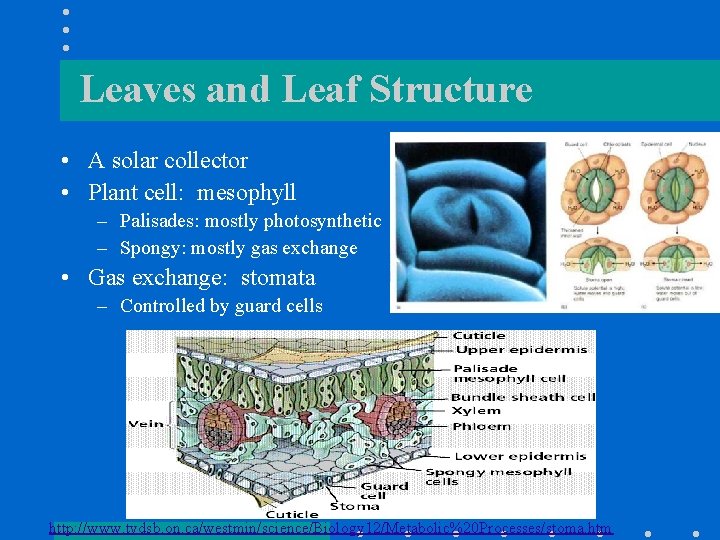
Leaves and Leaf Structure • A solar collector • Plant cell: mesophyll – Palisades: mostly photosynthetic – Spongy: mostly gas exchange • Gas exchange: stomata – Controlled by guard cells http: //www. tvdsb. on. ca/westmin/science/Biology 12/Metabolic%20 Processes/stoma. htm
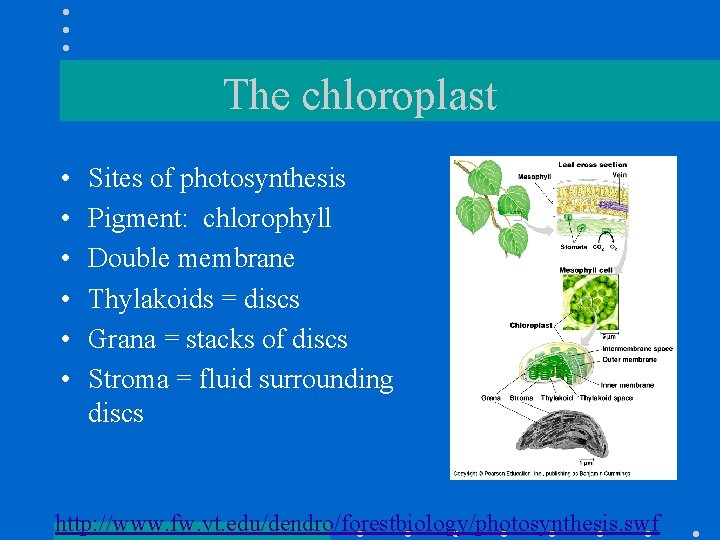
The chloroplast • • • Sites of photosynthesis Pigment: chlorophyll Double membrane Thylakoids = discs Grana = stacks of discs Stroma = fluid surrounding discs http: //www. fw. vt. edu/dendro/forestbiology/photosynthesis. swf
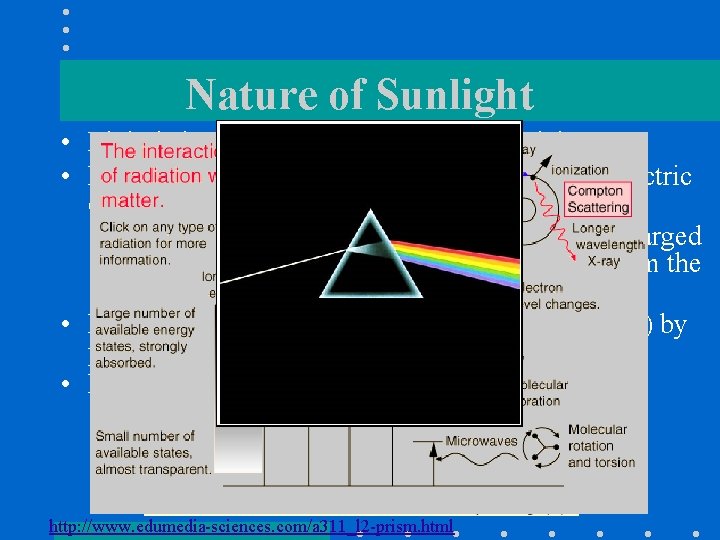
Nature of Sunlight • Light behaves both as a wave and a particle • Particle properties (photons) seen by the photoelectric effect. – Zinc exposed to ultraviolet light becomes + charged because light energy forces electrons away from the zinc. • Light separates into different colors (wavelengths) by passing through a prism. • E is inversely proportional to wavelength. – Longer wavelengths E < shorter ones http: //www. edumedia-sciences. com/a 311_l 2 -prism. html
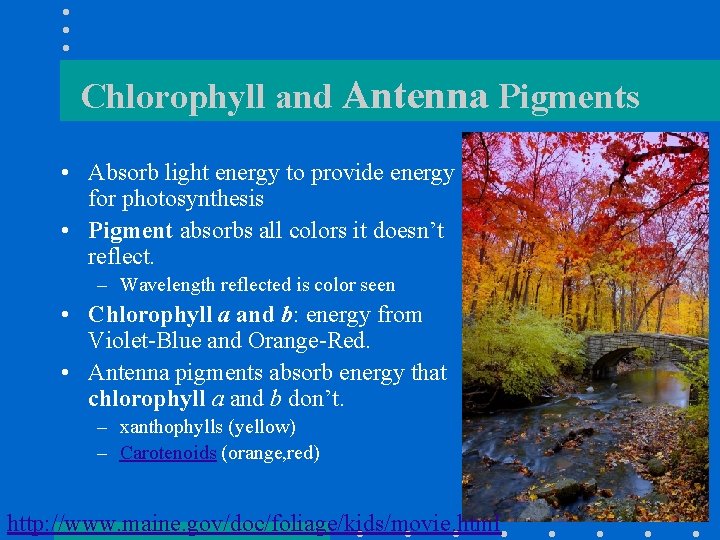
Chlorophyll and Antenna Pigments • Absorb light energy to provide energy for photosynthesis • Pigment absorbs all colors it doesn’t reflect. – Wavelength reflected is color seen • Chlorophyll a and b: energy from Violet-Blue and Orange-Red. • Antenna pigments absorb energy that chlorophyll a and b don’t. – xanthophylls (yellow) – Carotenoids (orange, red) http: //www. maine. gov/doc/foliage/kids/movie. html
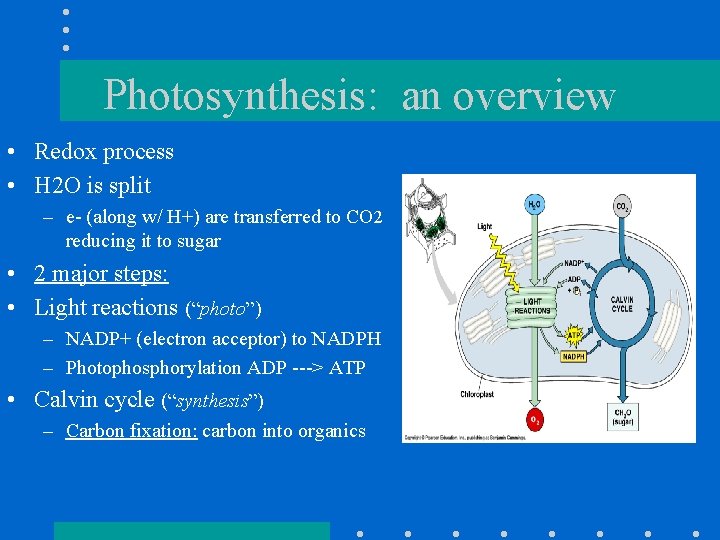
Photosynthesis: an overview • Redox process • H 2 O is split – e- (along w/ H+) are transferred to CO 2 reducing it to sugar • 2 major steps: • Light reactions (“photo”) – NADP+ (electron acceptor) to NADPH – Photophosphorylation ADP ---> ATP • Calvin cycle (“synthesis”) – Carbon fixation: carbon into organics
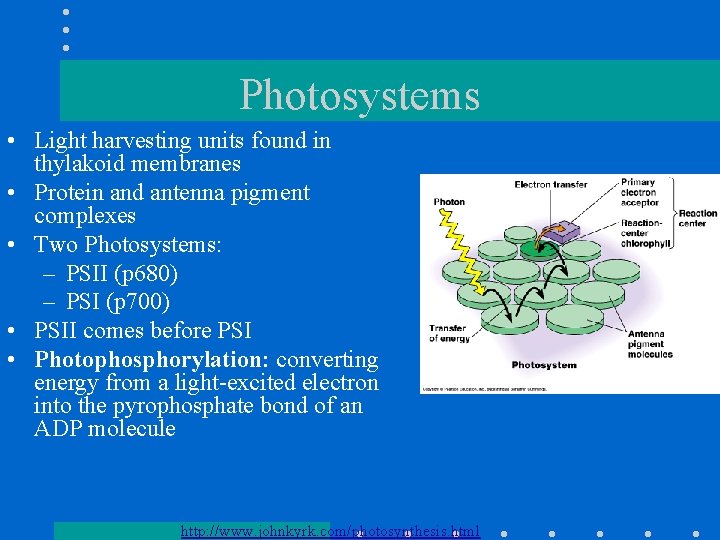
Photosystems • Light harvesting units found in thylakoid membranes • Protein and antenna pigment complexes • Two Photosystems: – PSII (p 680) – PSI (p 700) • PSII comes before PSI • Photophosphorylation: converting energy from a light-excited electron into the pyrophosphate bond of an ADP molecule http: //www. johnkyrk. com/photosynthesis. html
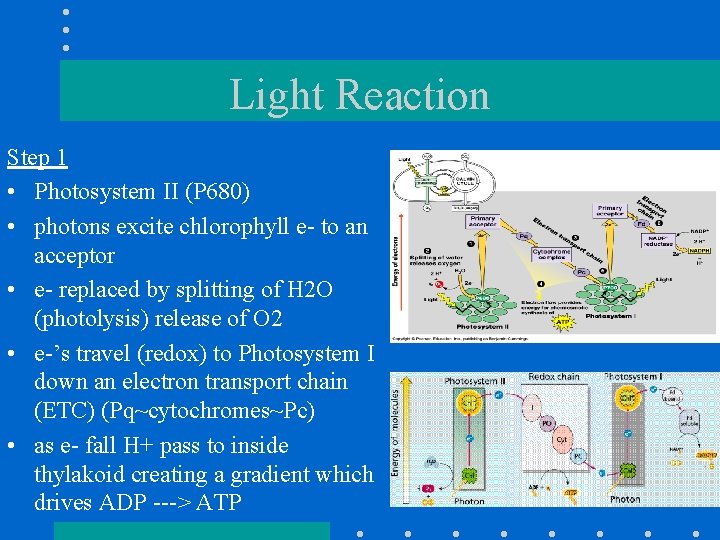
Light Reaction Step 1 • Photosystem II (P 680) • photons excite chlorophyll e- to an acceptor • e- replaced by splitting of H 2 O (photolysis) release of O 2 • e-’s travel (redox) to Photosystem I down an electron transport chain (ETC) (Pq~cytochromes~Pc) • as e- fall H+ pass to inside thylakoid creating a gradient which drives ADP ---> ATP
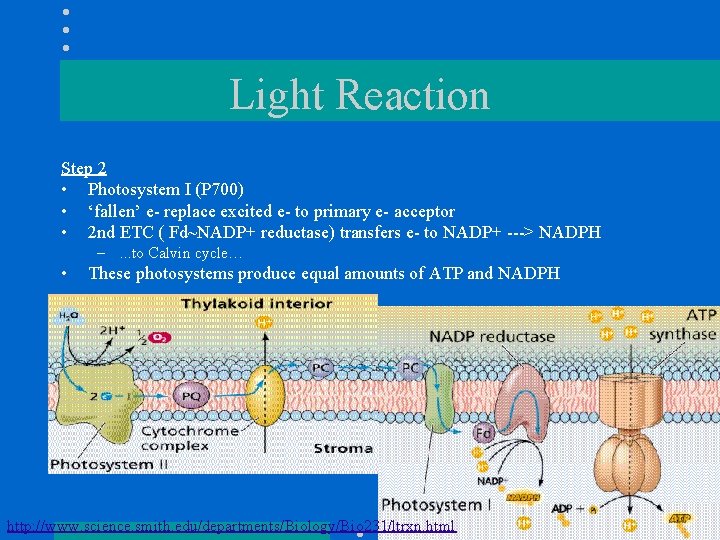
Light Reaction Step 2 • Photosystem I (P 700) • ‘fallen’ e- replace excited e- to primary e- acceptor • 2 nd ETC ( Fd~NADP+ reductase) transfers e- to NADP+ ---> NADPH –. . . to Calvin cycle… • These photosystems produce equal amounts of ATP and NADPH http: //www. science. smith. edu/departments/Biology/Bio 231/ltrxn. html
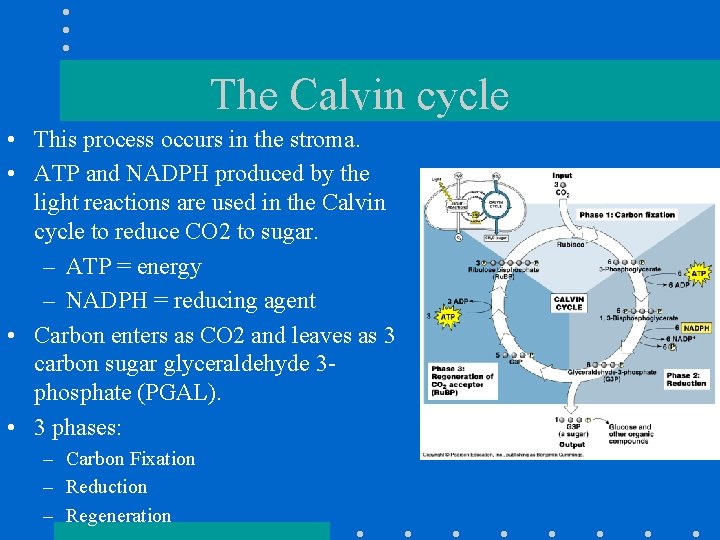
The Calvin cycle • This process occurs in the stroma. • ATP and NADPH produced by the light reactions are used in the Calvin cycle to reduce CO 2 to sugar. – ATP = energy – NADPH = reducing agent • Carbon enters as CO 2 and leaves as 3 carbon sugar glyceraldehyde 3 phosphate (PGAL). • 3 phases: – Carbon Fixation – Reduction – Regeneration
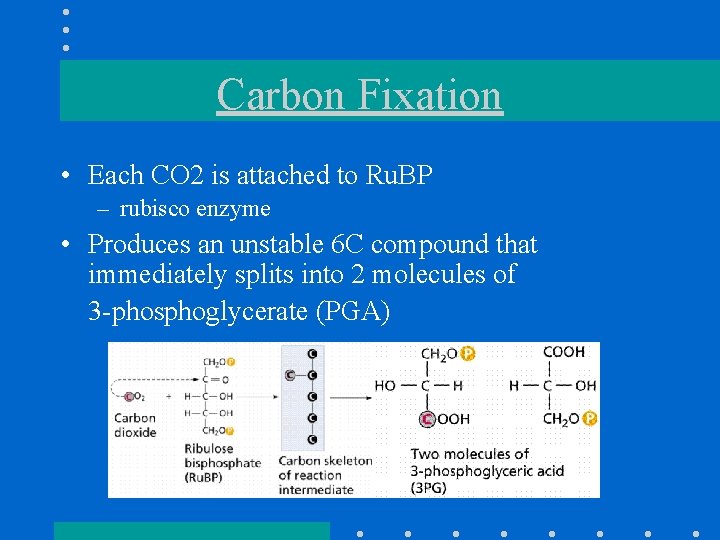
Carbon Fixation • Each CO 2 is attached to Ru. BP – rubisco enzyme • Produces an unstable 6 C compound that immediately splits into 2 molecules of 3 -phosphoglycerate (PGA)
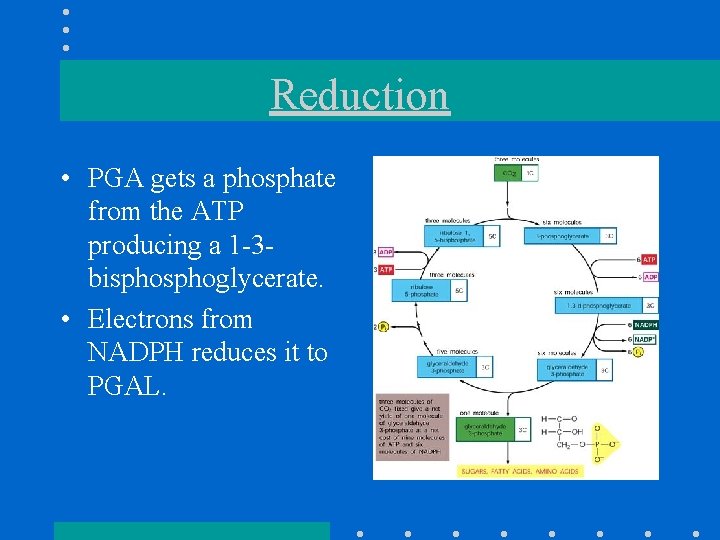
Reduction • PGA gets a phosphate from the ATP producing a 1 -3 bisphoglycerate. • Electrons from NADPH reduces it to PGAL.
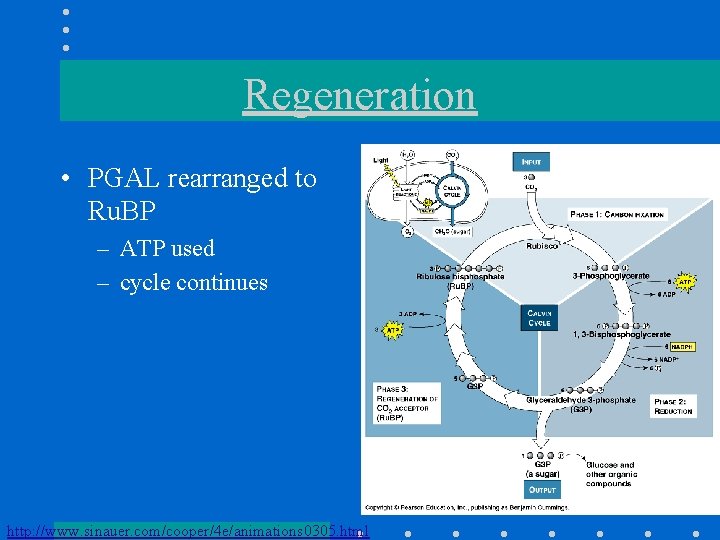
Regeneration • PGAL rearranged to Ru. BP – ATP used – cycle continues http: //www. sinauer. com/cooper/4 e/animations 0305. html
Calvin Cycle, net synthesis • For every 3 CO 2 there is one PGAL removed from the cycle • PGAL can then be used by the plant to make glucose and other organic compounds http: //www. science. smith. edu/departments/Biology/Bio 231/calvin. html
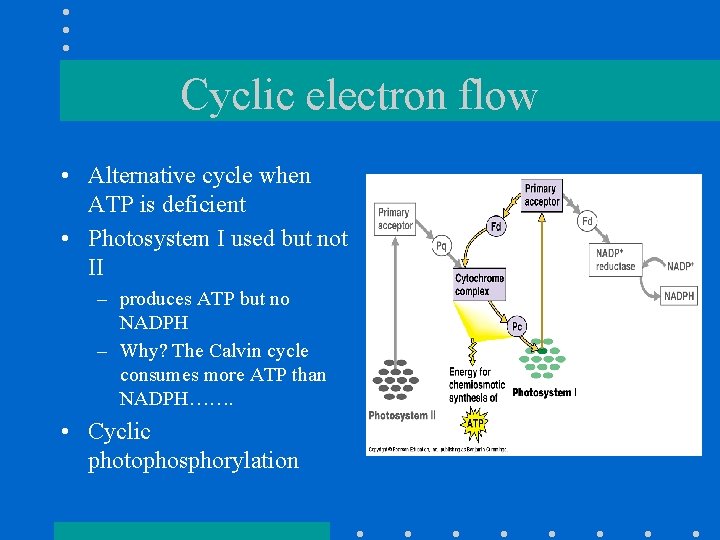
Cyclic electron flow • Alternative cycle when ATP is deficient • Photosystem I used but not II – produces ATP but no NADPH – Why? The Calvin cycle consumes more ATP than NADPH……. • Cyclic photophosphorylation
Photorespiration: • Hot/dry days • stomata close • CO 2 decrease, O 2 increase in leaves • O 2 added to rubisco results in the breakdown of the Calvin cycle (no bueno) • no ATP or food generated
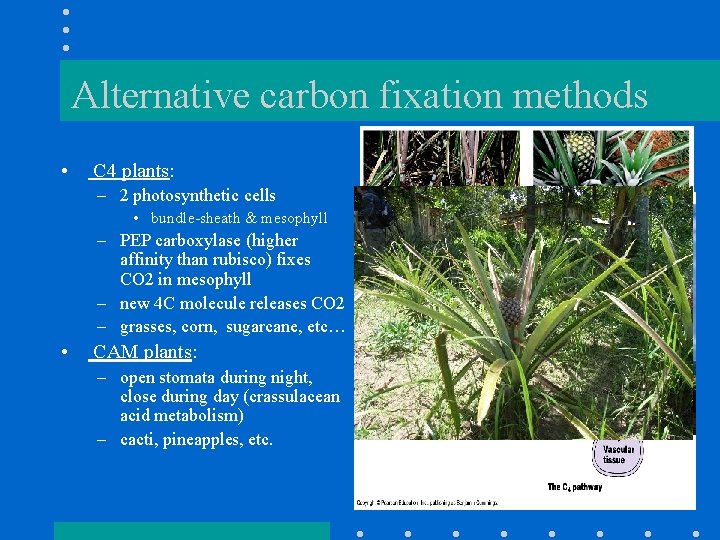
Alternative carbon fixation methods • C 4 plants: – 2 photosynthetic cells • bundle-sheath & mesophyll – PEP carboxylase (higher affinity than rubisco) fixes CO 2 in mesophyll – new 4 C molecule releases CO 2 – grasses, corn, sugarcane, etc… • CAM plants: – open stomata during night, close during day (crassulacean acid metabolism) – cacti, pineapples, etc.
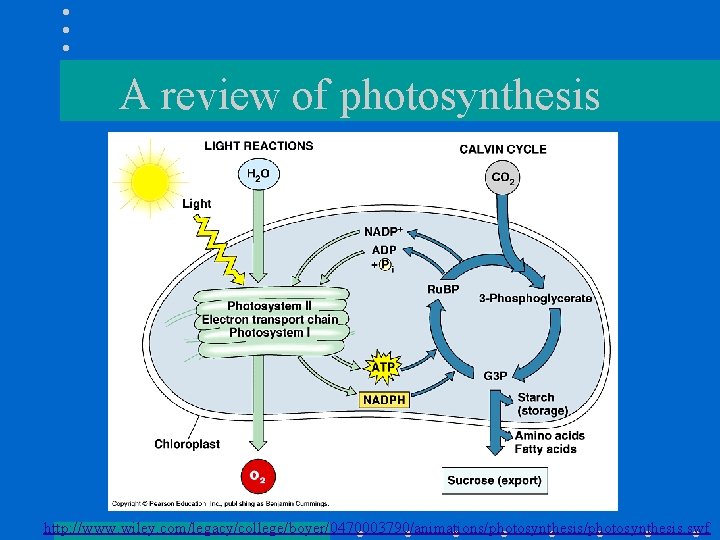
A review of photosynthesis http: //www. wiley. com/legacy/college/boyer/0470003790/animations/photosynthesis. swf
- Slides: 20