
Photosynthesis Saving for a Rainy Day Suppose you

- Slides: 21
Photosynthesis
Saving for a Rainy Day Suppose you earned extra money by having a parttime job. At first, you might be tempted to spend all of the money, but then you decide to open a bank account. 1. What are the benefits of having a bank account? 2. What do you have to do if you need some of this money? 3. What might your body do when it has more energy than it needs to carry out its activities? 4. What does your body do when it needs energy?
Vocabulary Autotrophorganism that can capture energy from sunlight or chemicals and use it to produce its own food from inorganic compounds; also called a producer Heterotrophorganism that obtains energy from the foods it consumes; also called a consumer Adenosine triphosphate (ATP) – one of the principal chemical compounds that living things use to store energy.
Energy and Life 1. Autotrophs and Heterotrophs a. Autotrophs: organisms, like plants, that use light energy from the sun to produce their own food Because plants can “manufacture” their own energy directly, they are self-sufficient. b. Heterotrophs: organisms that obtain energy from foods they consume All other forms of life, such as humans, animals, insects and even bacteria, depend on other living things for sustenance.
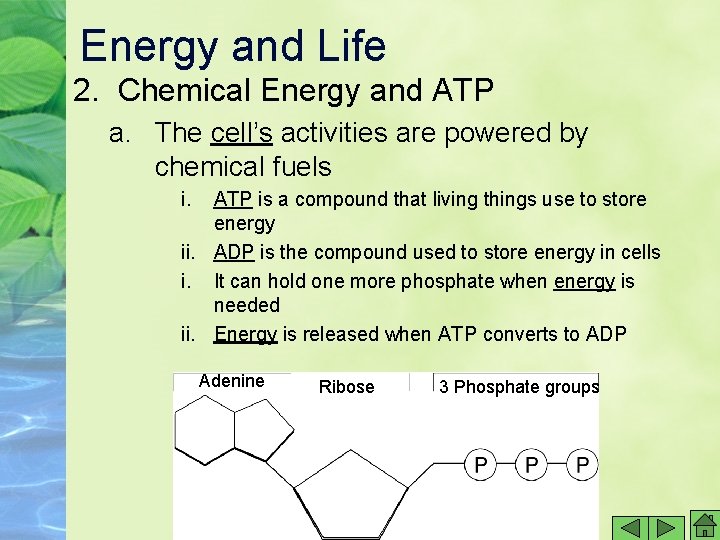
Energy and Life 2. Chemical Energy and ATP a. The cell’s activities are powered by chemical fuels i. ATP is a compound that living things use to store energy ii. ADP is the compound used to store energy in cells i. It can hold one more phosphate when energy is needed ii. Energy is released when ATP converts to ADP Adenine Ribose 3 Phosphate groups
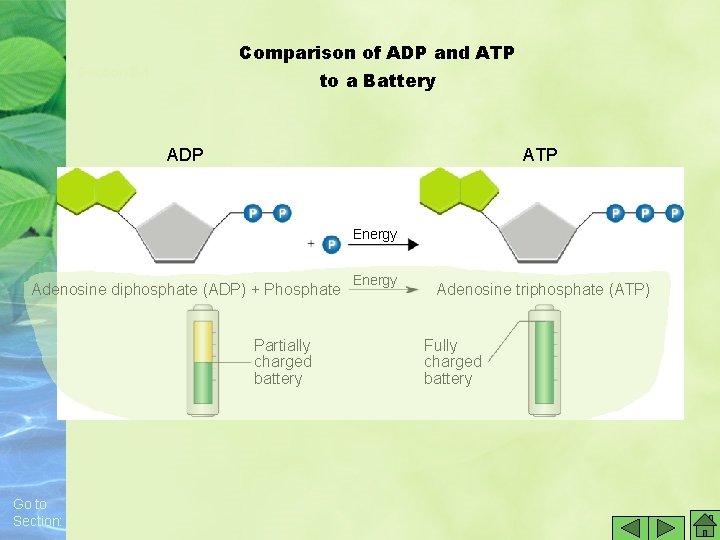
Comparison of ADP and ATP Section 8 -1 to a Battery ADP ATP Energy Adenosine diphosphate (ADP) + Phosphate Partially charged battery Go to Section: Energy Adenosine triphosphate (ATP) Fully charged battery
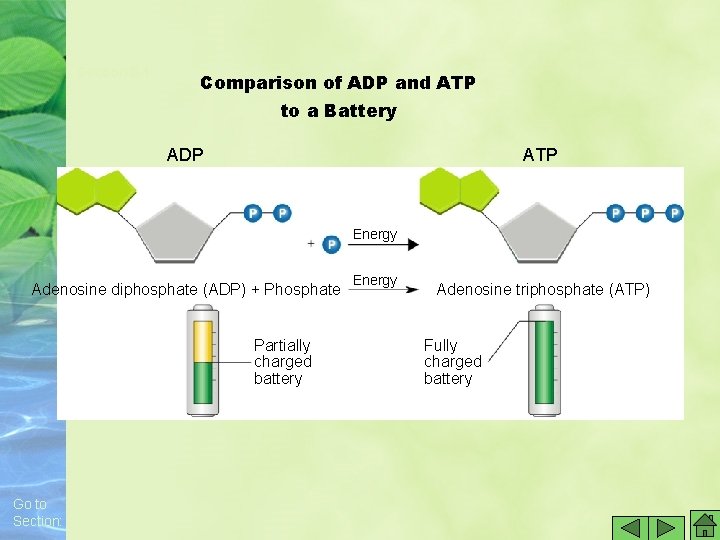
Section 8 -1 Comparison of ADP and ATP to a Battery ADP ATP Energy Adenosine diphosphate (ADP) + Phosphate Partially charged battery Go to Section: Energy Adenosine triphosphate (ATP) Fully charged battery
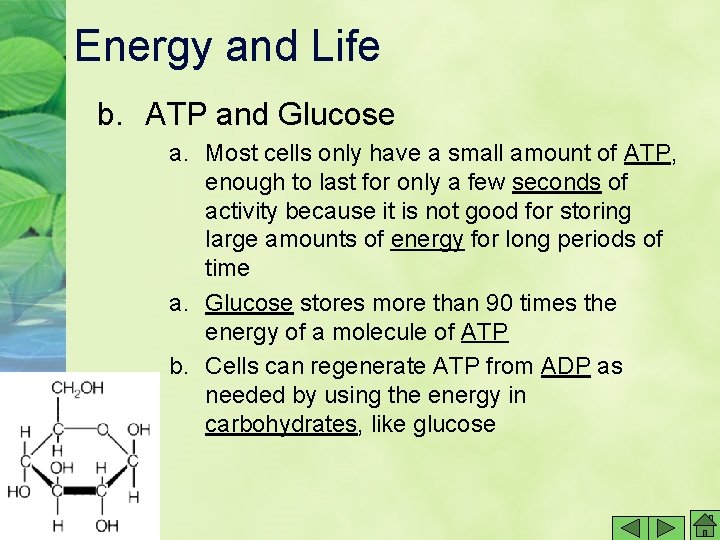
Energy and Life b. ATP and Glucose a. Most cells only have a small amount of ATP, enough to last for only a few seconds of activity because it is not good for storing large amounts of energy for long periods of time a. Glucose stores more than 90 times the energy of a molecule of ATP b. Cells can regenerate ATP from ADP as needed by using the energy in carbohydrates, like glucose
Think about this: Have you ever used a solar-powered calculator? No matter where you go, as long as you have a light source, the calculator works. You never have to put batteries in it. 1. A solar-powered calculator uses solar cells that are found in rows along the top of the calculator. Into what kind of energy is the light energy converted so that the calculator works? 2. Recall that plants use light energy from the sun to make food. Into what kind of energy is the light energy converted by plants? 3. Most plants, no matter what size or shape they are, have some parts that are green. Which parts of a plant are usually green? 4. What does the green color have to do with the plant’s ability to convert light energy into the energy found in the food it makes?
Vocabulary Photosynthesisprocess by which plants and some other organisms use light energy to power chemical reactions that convert water and carbon dioxide into oxygen and high-energy carbohydrates such as sugar and starches. Pigmentlight-absorbing colored molecule Chlorophyllprincipal pigment of plants and other photosynthetic organisms; capture light energy Thylakoid. Saclike body in chloroplasts made of photosynthetic membranes that contain photosystems.
Photosynthesis Notes 1. The Photosynthesis Equation a. Photosynthesis uses the energy of sunlight to convert carbon dioxide and water into high -energy sugar and oxygen i. 6 C 02 + 6 H 2 O C 6 H 12 O 6 +602 ü Chemically: Green Plant 6 C 02 + 6 H 2 O ( Carbon dioxide + Water Light Energy C 6 H 12 O 6 +602 Sugar + Oxygen) ü Written: “Six molecules of carbon dioxide plus six molecules of water combine in the presence of a green plant and light energy to form one molecule of sugar and six molecules of oxygen. ”
Photosynthesis 2. Light and Pigments a. In addition to water and carbon dioxide, photosynthesis requires light and chlorophyll, a molecule in chloroplasts b. Plants gather the sun’s energy with lightabsorbing molecules called pigments a. The principal pigment is chlorophyll b. Energy molecules released from the reaction are ATP & NADPH
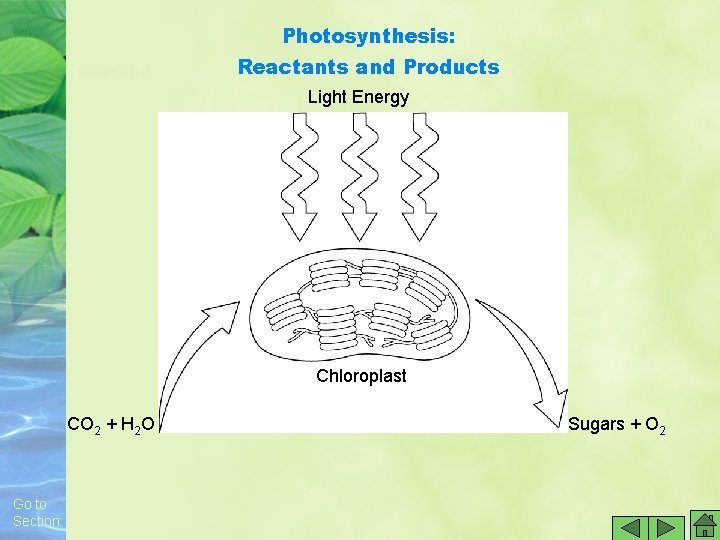
Photosynthesis: Section 8 -2 Reactants and Products Light Energy Chloroplast CO 2 + H 2 O Go to Section: Sugars + O 2
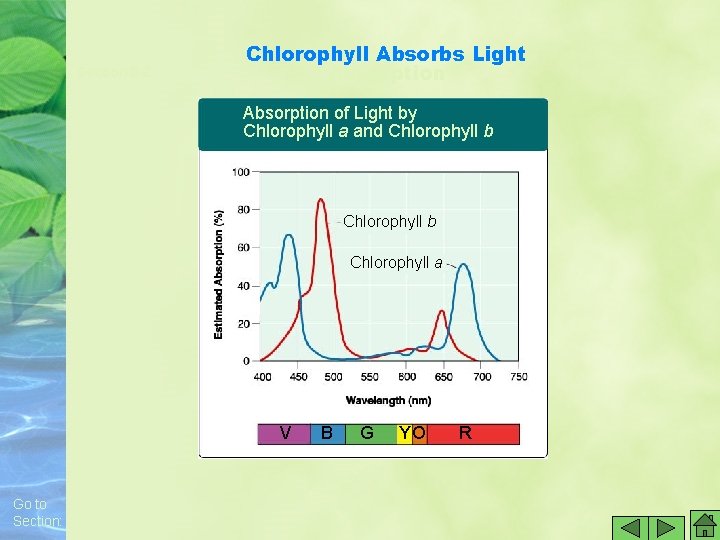
Section 8 -2 Chlorophyll Absorbs Light Absorption of Light by Chlorophyll a and Chlorophyll b Chlorophyll a V Go to Section: B G YO R
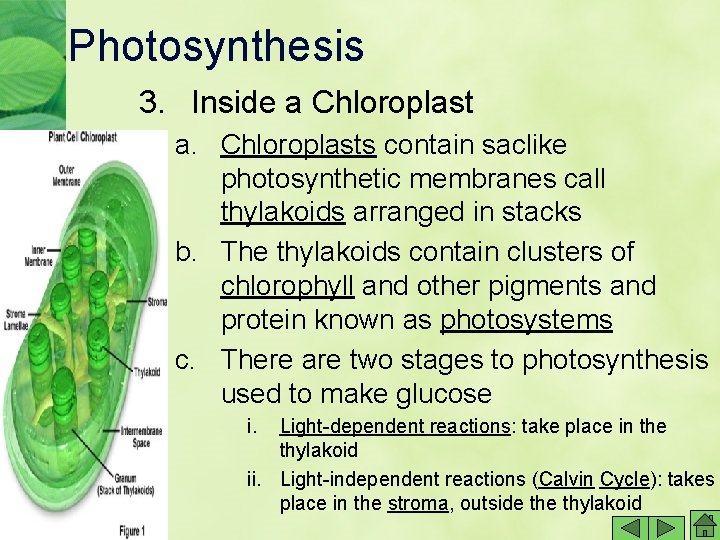
Photosynthesis 3. Inside a Chloroplast a. Chloroplasts contain saclike photosynthetic membranes call thylakoids arranged in stacks b. The thylakoids contain clusters of chlorophyll and other pigments and protein known as photosystems c. There are two stages to photosynthesis used to make glucose i. Light-dependent reactions: take place in the thylakoid ii. Light-independent reactions (Calvin Cycle): takes place in the stroma, outside thylakoid
Vocabulary Thylakoidsaclike body in chloroplasts made of photosynthetic membranes that contain photosystems Stromaregion outside thylakoid membranes in chloroplasts NADP+ (Nicotinamide adenine dinucleotide) – one of the carrier molecules that transfer highenergy electrons from chlorophyll to other molecules.
Vocabulary Light-dependent reactions of photosynthesis that use energy from light to produce ATP and NADPH ATP synthaselarge protein that uses energy from H+ ions to bind ADP and a phosphate group together to produce ATP Calvin Cyclereactions of photosynthesis in which energy from ATP and NADPH is used to build high-energy compounds such as sugars.
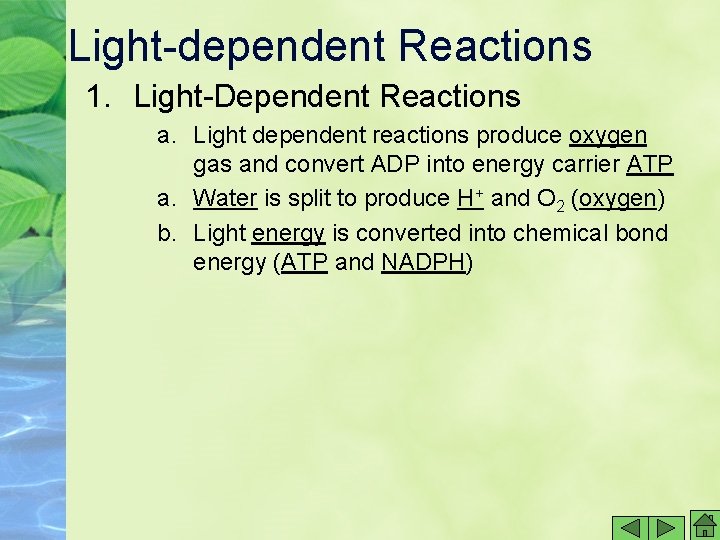
Light-dependent Reactions 1. Light-Dependent Reactions a. Light dependent reactions produce oxygen gas and convert ADP into energy carrier ATP a. Water is split to produce H+ and O 2 (oxygen) b. Light energy is converted into chemical bond energy (ATP and NADPH)
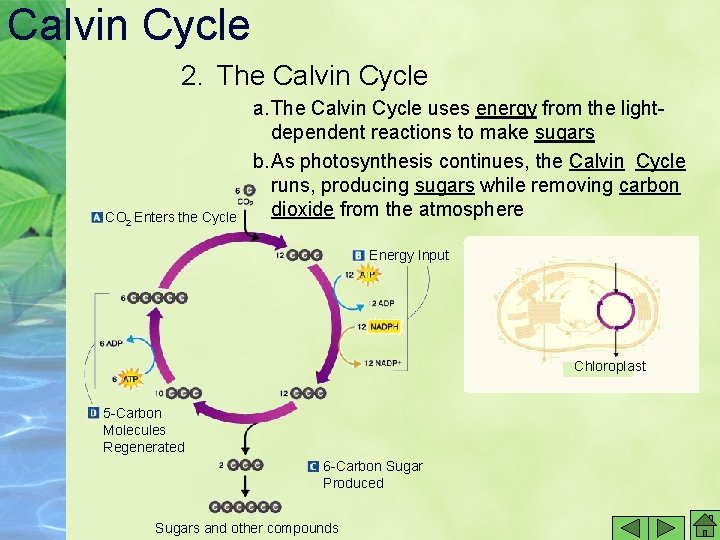
Calvin Cycle 2. The Calvin Cycle CO 2 Enters the Cycle a. The Calvin Cycle uses energy from the lightdependent reactions to make sugars b. As photosynthesis continues, the Calvin Cycle runs, producing sugars while removing carbon dioxide from the atmosphere Energy Input Chlorop. Iast 5 -Carbon Molecules Regenerated 6 -Carbon Sugar Produced Sugars and other compounds
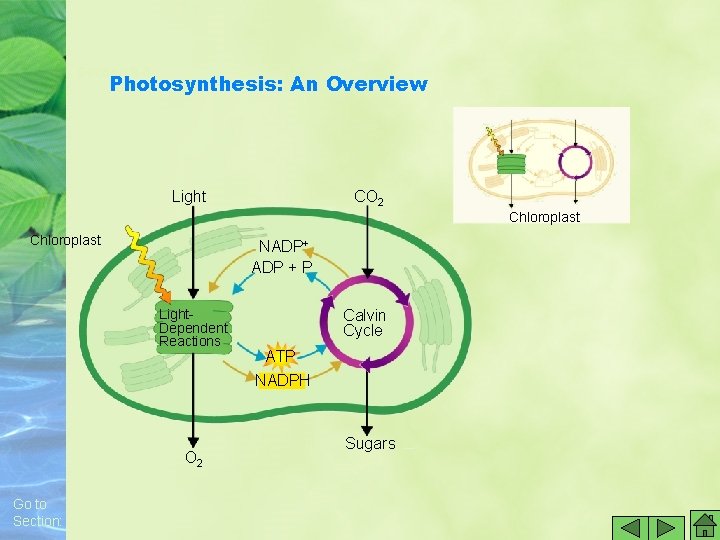
Section 8 -3 Photosynthesis: An Overview Light CO 2 Chloroplast NADP+ ADP + P Light. Dependent Reactions O 2 Go to Section: Calvin Cycle ATP NADPH Sugars
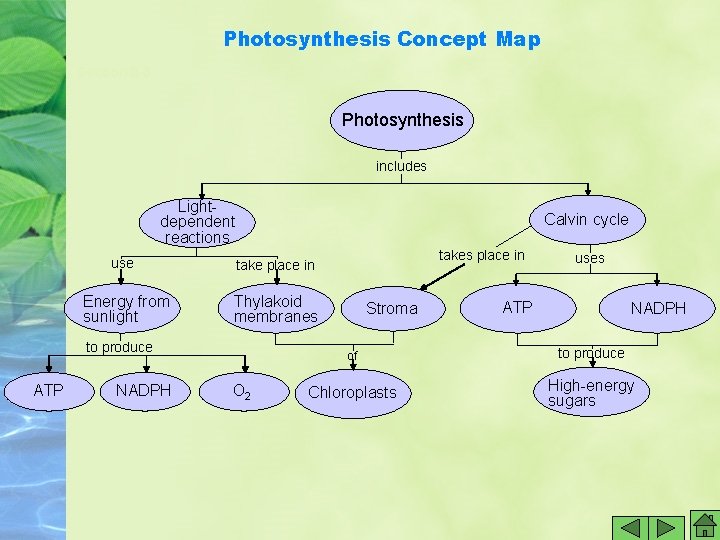
Photosynthesis Concept Map Section 8 -3 Photosynthesis includes Lightdependent reactions Calvin cycle use take place in Energy from sunlight Thylakoid membranes to produce ATP NADPH O 2 takes place in Stroma uses ATP NADPH of to produce Chloroplasts High-energy sugars