
Photosynthesis Reaction 2 Major Stages of Photosynthesis Light
- Slides: 7
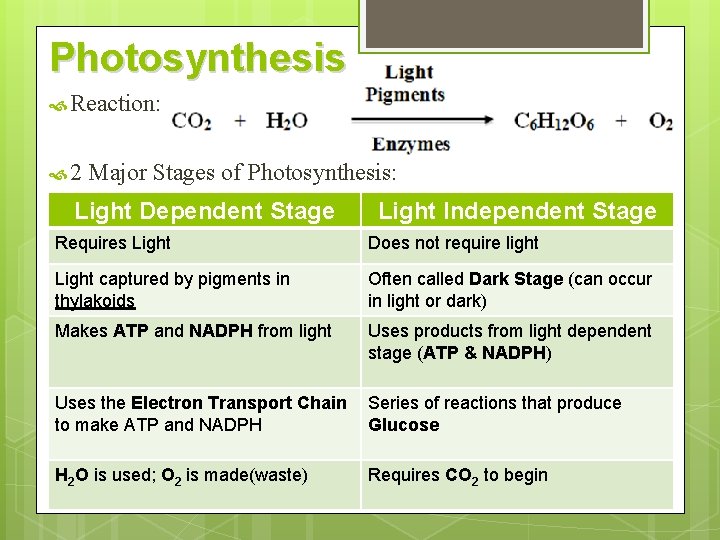
Photosynthesis Reaction: 2 Major Stages of Photosynthesis: Light Dependent Stage Light Independent Stage Requires Light Does not require light Light captured by pigments in thylakoids Often called Dark Stage (can occur in light or dark) Makes ATP and NADPH from light Uses products from light dependent stage (ATP & NADPH) Uses the Electron Transport Chain to make ATP and NADPH Series of reactions that produce Glucose H 2 O is used; O 2 is made(waste) Requires CO 2 to begin
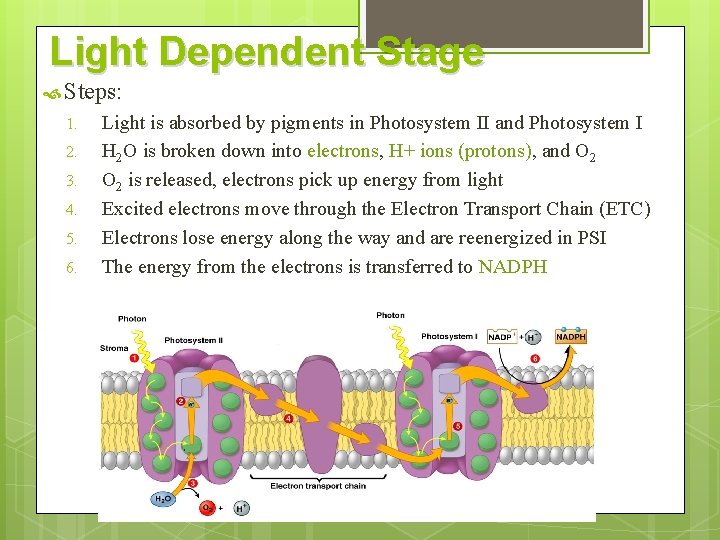
Light Dependent Stage Steps: 1. 2. 3. 4. 5. 6. Light is absorbed by pigments in Photosystem II and Photosystem I H 2 O is broken down into electrons, H+ ions (protons), and O 2 is released, electrons pick up energy from light Excited electrons move through the Electron Transport Chain (ETC) Electrons lose energy along the way and are reenergized in PSI The energy from the electrons is transferred to NADPH
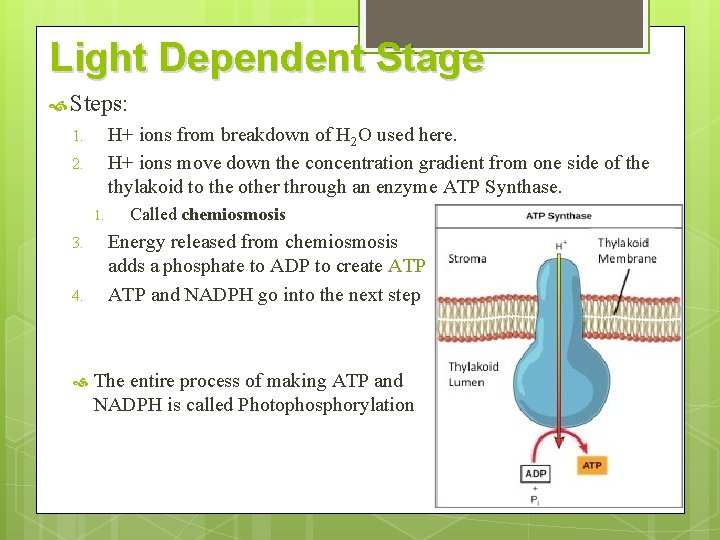
Light Dependent Stage Steps: H+ ions from breakdown of H 2 O used here. H+ ions move down the concentration gradient from one side of the thylakoid to the other through an enzyme ATP Synthase. 1. 2. 1. 3. 4. Called chemiosmosis Energy released from chemiosmosis adds a phosphate to ADP to create ATP and NADPH go into the next step The entire process of making ATP and NADPH is called Photophosphorylation
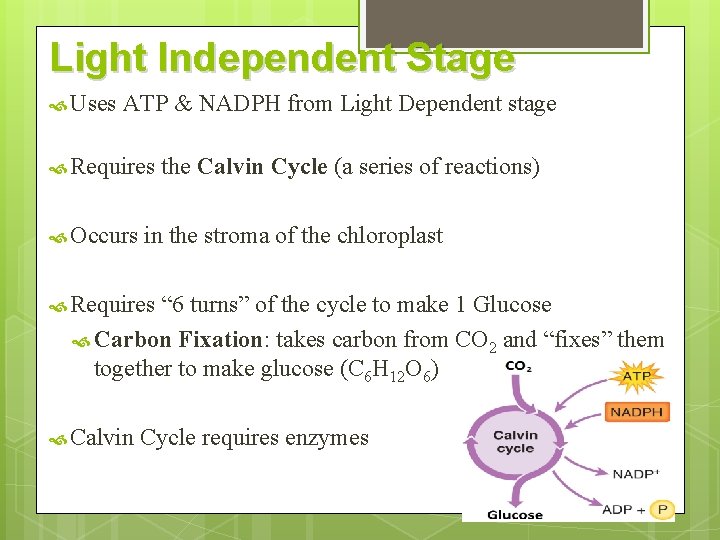
Light Independent Stage Uses ATP & NADPH from Light Dependent stage Requires Occurs the Calvin Cycle (a series of reactions) in the stroma of the chloroplast Requires “ 6 turns” of the cycle to make 1 Glucose Carbon Fixation: takes carbon from CO 2 and “fixes” them together to make glucose (C 6 H 12 O 6) Calvin Cycle requires enzymes
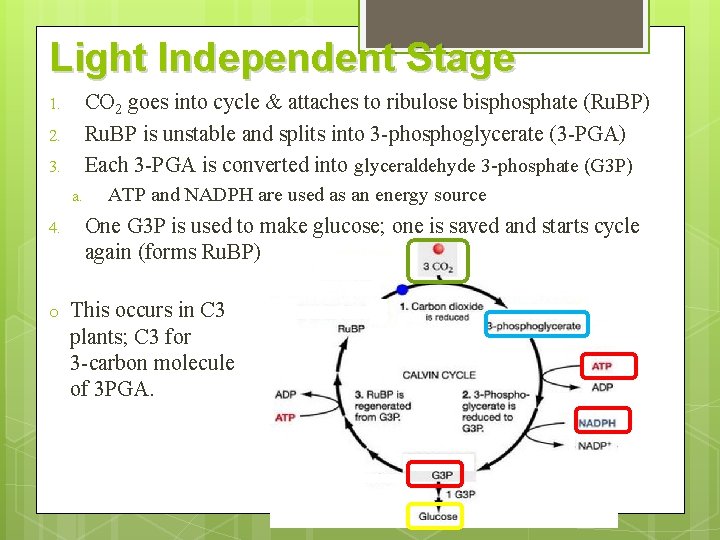
Light Independent Stage CO 2 goes into cycle & attaches to ribulose bisphosphate (Ru. BP) Ru. BP is unstable and splits into 3 -phosphoglycerate (3 -PGA) Each 3 -PGA is converted into glyceraldehyde 3 -phosphate (G 3 P) 1. 2. 3. a. 4. o ATP and NADPH are used as an energy source One G 3 P is used to make glucose; one is saved and starts cycle again (forms Ru. BP) This occurs in C 3 plants; C 3 for 3 -carbon molecule of 3 PGA.
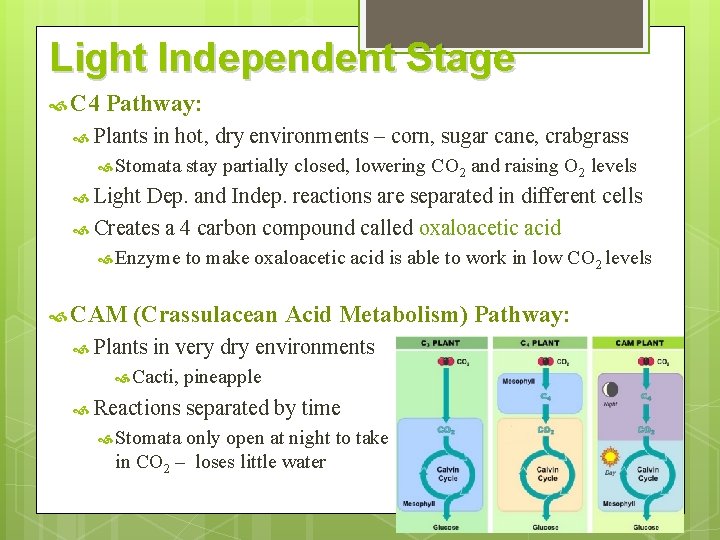
Light Independent Stage C 4 Pathway: Plants in hot, dry environments – corn, sugar cane, crabgrass Stomata stay partially closed, lowering CO 2 and raising O 2 levels Light Dep. and Indep. reactions are separated in different cells Creates a 4 carbon compound called oxaloacetic acid Enzyme CAM to make oxaloacetic acid is able to work in low CO 2 levels (Crassulacean Acid Metabolism) Pathway: Plants in very dry environments Cacti, Reactions Stomata pineapple separated by time only open at night to take in CO 2 – loses little water
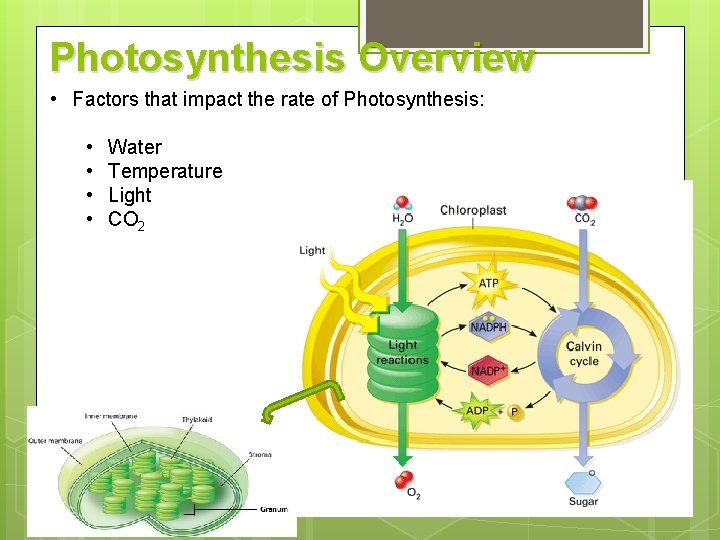
Photosynthesis Overview • Factors that impact the rate of Photosynthesis: • • Water Temperature Light CO 2