
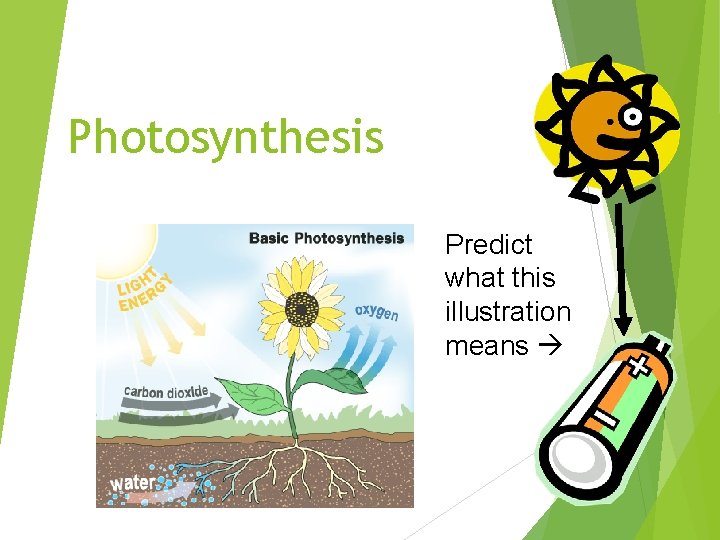
Photosynthesis Predict what this illustration means Important Root
- Slides: 21
Photosynthesis Predict what this illustration means
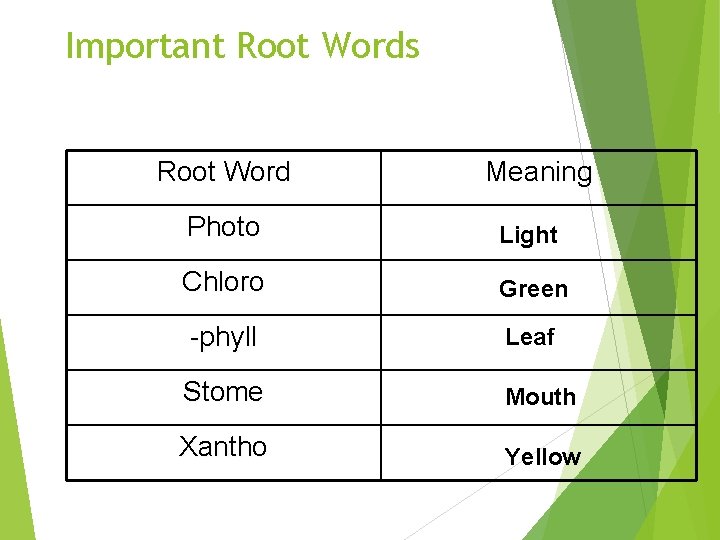
Important Root Words Root Word Meaning Photo Light Chloro Green -phyll Leaf Stome Mouth Xantho Yellow
Comprehension Check How many characteristics of living things can you remember? Which characteristic is related to this chapter?
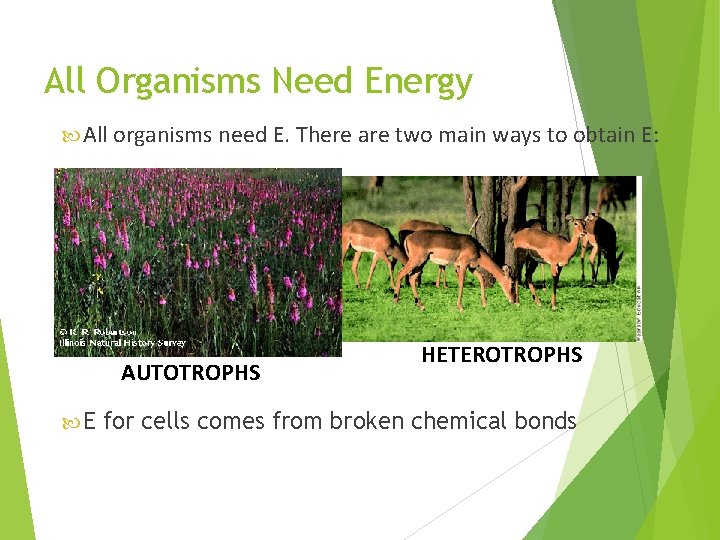
All Organisms Need Energy All organisms need E. There are two main ways to obtain E: AUTOTROPHS E HETEROTROPHS for cells comes from broken chemical bonds
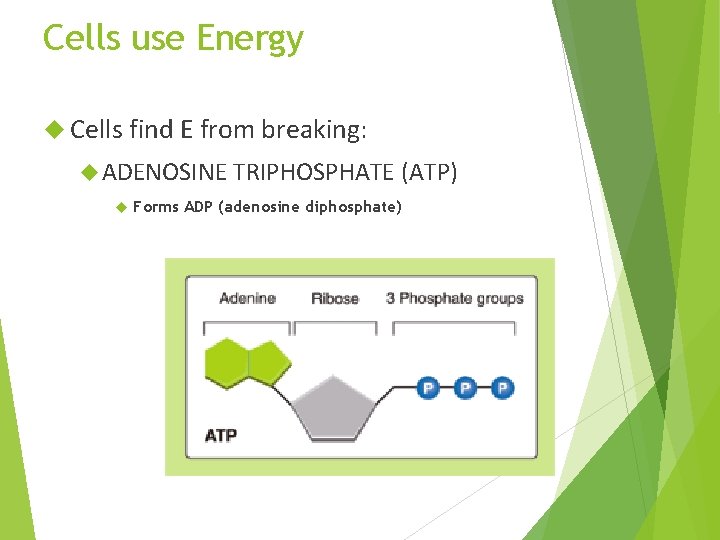
Cells use Energy Cells find E from breaking: ADENOSINE TRIPHOSPHATE (ATP) Forms ADP (adenosine diphosphate)
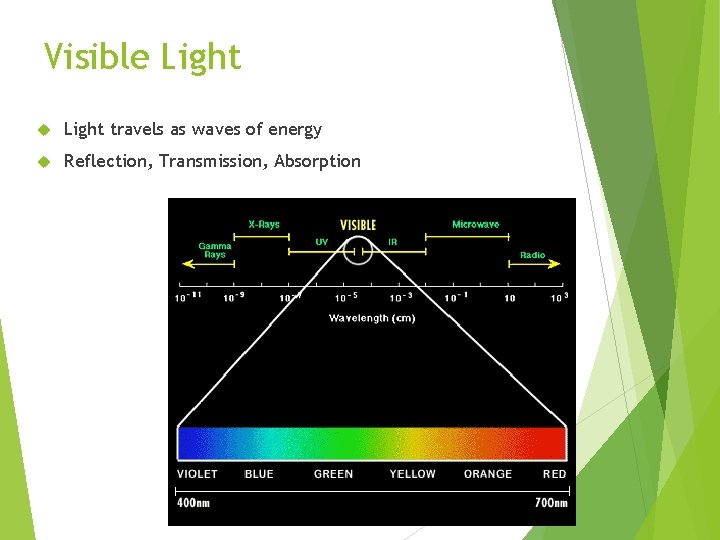
Visible Light travels as waves of energy Reflection, Transmission, Absorption
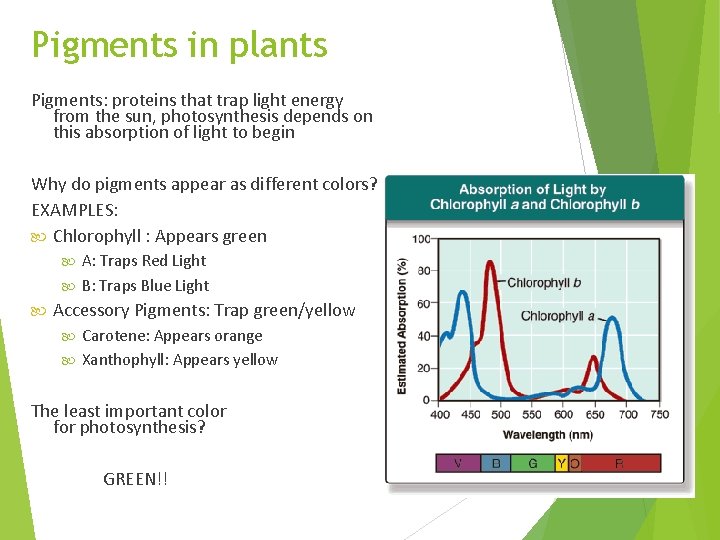
Pigments in plants Pigments: proteins that trap light energy from the sun, photosynthesis depends on this absorption of light to begin Why do pigments appear as different colors? EXAMPLES: Chlorophyll : Appears green A: Traps Red Light B: Traps Blue Light Accessory Pigments: Trap green/yellow Carotene: Appears orange Xanthophyll: Appears yellow The least important color for photosynthesis? GREEN!!
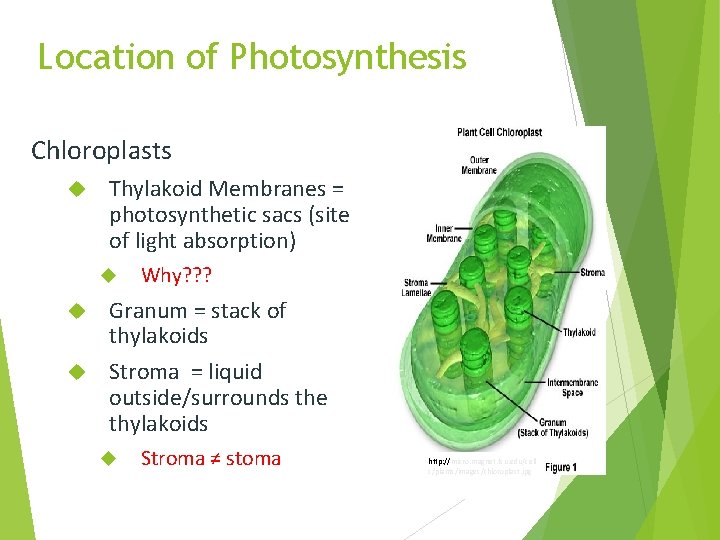
Location of Photosynthesis Chloroplasts Thylakoid Membranes = photosynthetic sacs (site of light absorption) Why? ? ? Granum = stack of thylakoids Stroma = liquid outside/surrounds the thylakoids Stroma ≠ stoma http: //micro. magnet. fsu. edu/cell s/plants/images/chloroplast. jpg
Comprehension Check This weekend your teacher went to the store and bought a new, hitech, green colored plant growth light. She placed a plant underneath this light inside of the fume hood and closed it tightly. Will the plant be able to undergo photosynthesis?
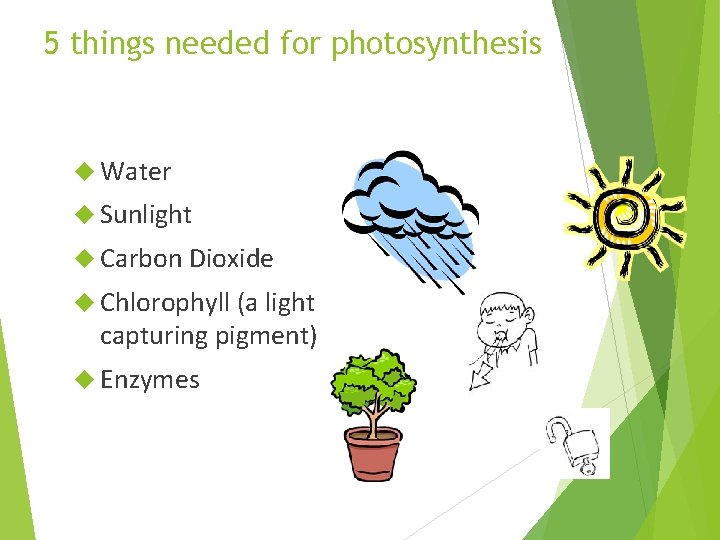
5 things needed for photosynthesis Water Sunlight Carbon Dioxide Chlorophyll (a light capturing pigment) Enzymes
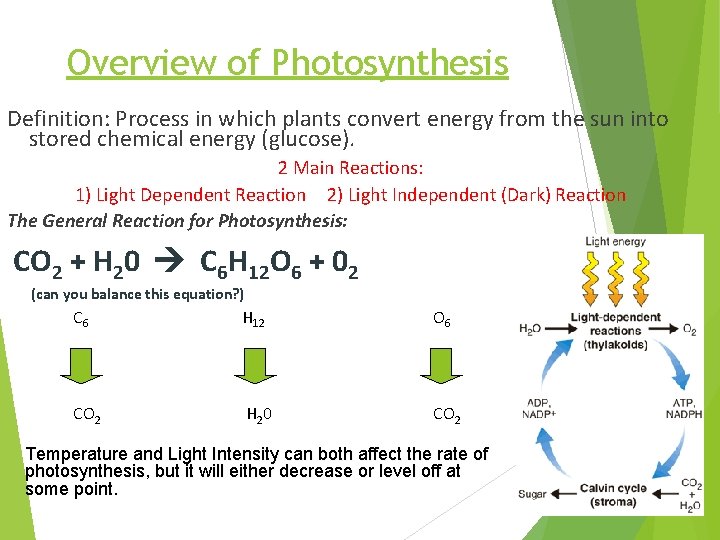
Overview of Photosynthesis Definition: Process in which plants convert energy from the sun into stored chemical energy (glucose). 2 Main Reactions: 1) Light Dependent Reaction 2) Light Independent (Dark) Reaction The General Reaction for Photosynthesis: CO 2 + H 20 C 6 H 12 O 6 + 02 (can you balance this equation? ) C 6 H 12 O 6 CO 2 H 20 CO 2 Temperature and Light Intensity can both affect the rate of photosynthesis, but it will either decrease or level off at some point.
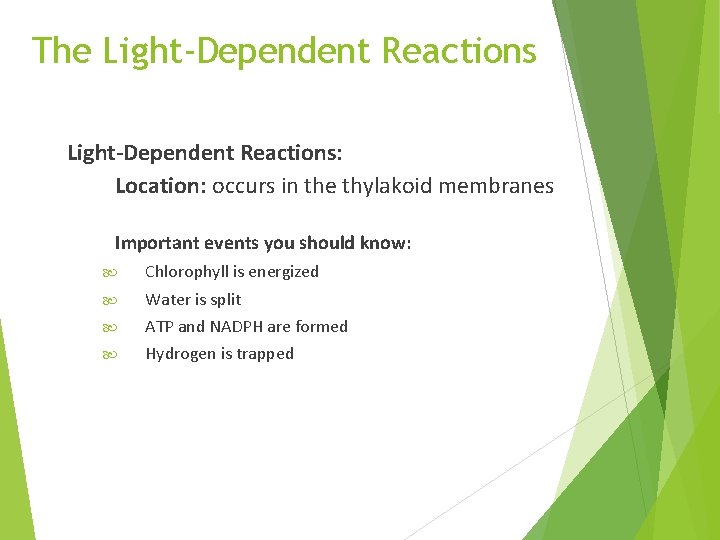
The Light-Dependent Reactions: Location: occurs in the thylakoid membranes Important events you should know: Chlorophyll is energized Water is split ATP and NADPH are formed Hydrogen is trapped
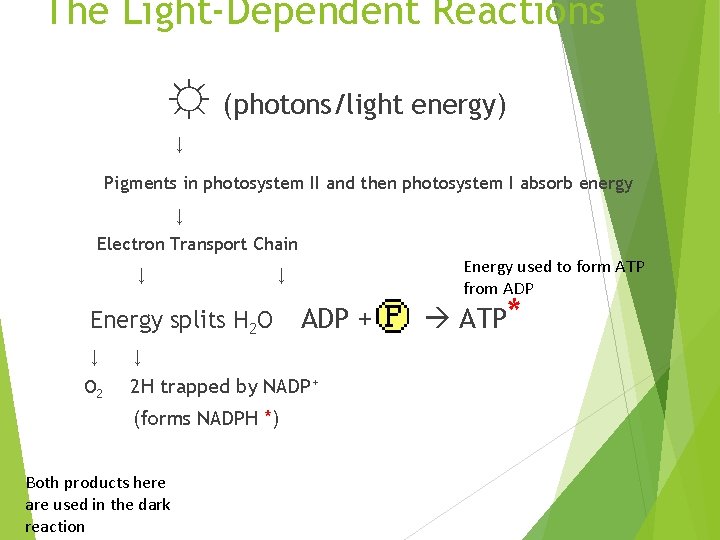
The Light-Dependent Reactions ☼ (photons/light energy) ↓ Pigments in photosystem II and then photosystem I absorb energy ↓ Electron Transport Chain ↓ Energy splits H 2 O ↓ O 2 Energy used to form ATP from ADP ↓ ADP + ↓ 2 H trapped by NADP+ (forms NADPH *) Both products here are used in the dark reaction ATP*
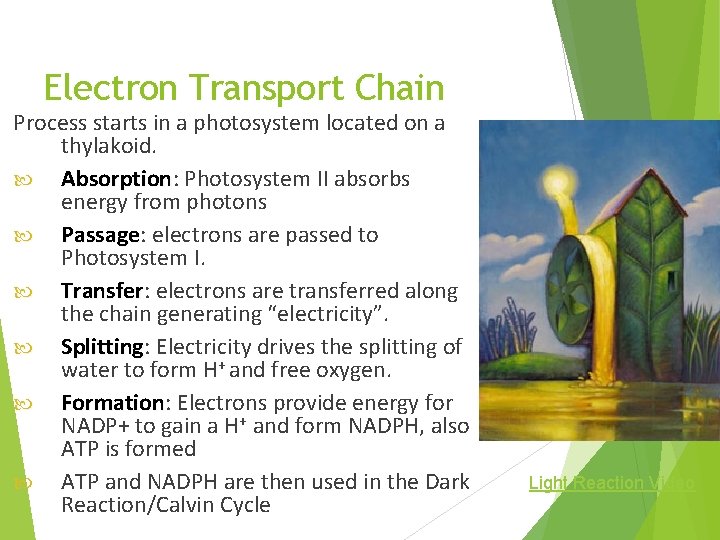
Electron Transport Chain Process starts in a photosystem located on a thylakoid. Absorption: Absorption Photosystem II absorbs energy from photons Passage: Passage electrons are passed to Photosystem I. Transfer: Transfer electrons are transferred along the chain generating “electricity”. Splitting: Splitting Electricity drives the splitting of water to form H+ and free oxygen. Formation: Formation Electrons provide energy for NADP+ to gain a H+ and form NADPH, also ATP is formed ATP and NADPH are then used in the Dark Reaction/Calvin Cycle Light Reaction Video
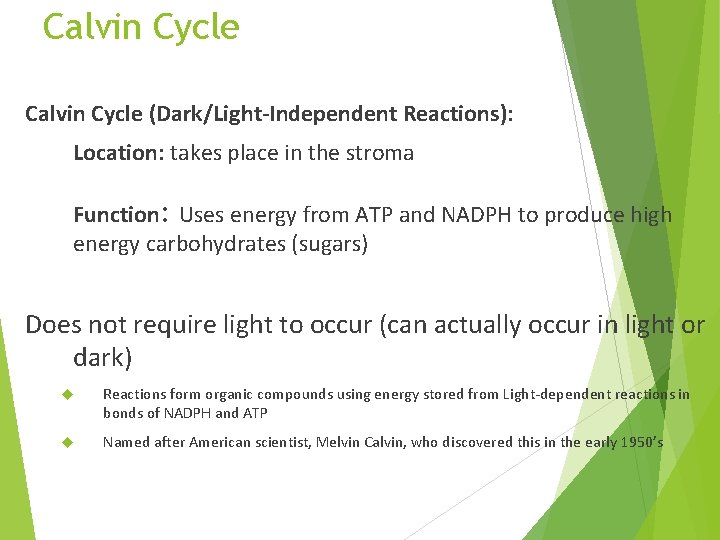
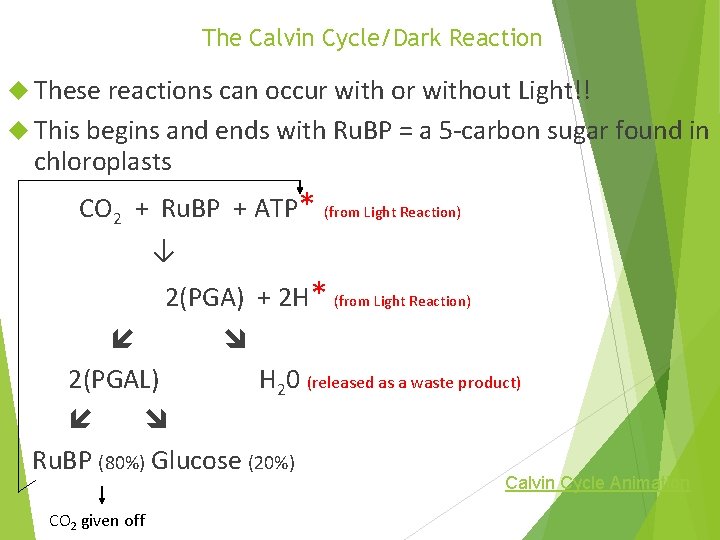
Calvin Cycle (Dark/Light-Independent Reactions): Location: takes place in the stroma Function: Uses energy from ATP and NADPH to produce high energy carbohydrates (sugars) Does not require light to occur (can actually occur in light or dark) Reactions form organic compounds using energy stored from Light-dependent reactions in bonds of NADPH and ATP Named after American scientist, Melvin Calvin, who discovered this in the early 1950’s
The Calvin Cycle/Dark Reaction These reactions can occur with or without Light!! This begins and ends with Ru. BP = a 5 -carbon sugar found in chloroplasts CO 2 + Ru. BP + ATP* (from Light Reaction) ↓ 2(PGA) + 2 H* (from Light Reaction) 2(PGAL) H 20 (released as a waste product) Ru. BP (80%) Glucose (20%) Calvin Cycle Animation CO 2 given off
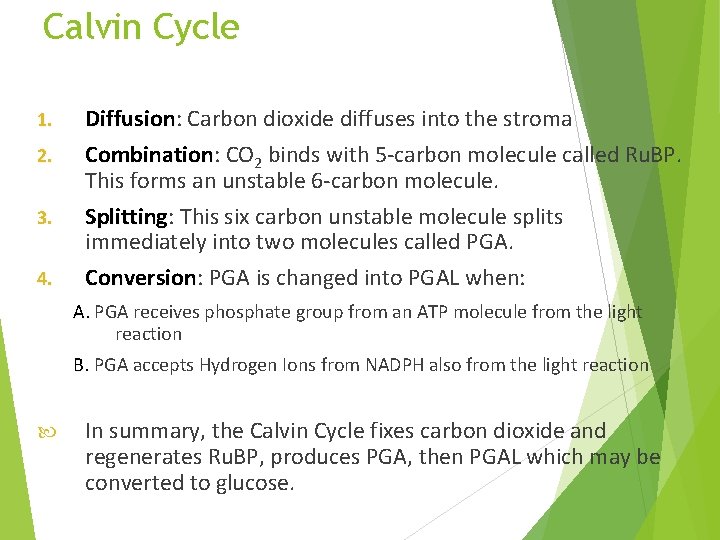
Calvin Cycle 1. 2. 3. 4. Diffusion: Diffusion Carbon dioxide diffuses into the stroma Combination: Combination CO 2 binds with 5 -carbon molecule called Ru. BP. This forms an unstable 6 -carbon molecule. Splitting: Splitting This six carbon unstable molecule splits immediately into two molecules called PGA. Conversion: Conversion PGA is changed into PGAL when: A. PGA receives phosphate group from an ATP molecule from the light reaction B. PGA accepts Hydrogen Ions from NADPH also from the light reaction In summary, the Calvin Cycle fixes carbon dioxide and regenerates Ru. BP, produces PGA, then PGAL which may be converted to glucose.
Comprehension Check Which parts of the process of photosynthesis can occur in the light? Which parts of the process can occur in the dark? How is the structure of the chloroplast related to its function? http: //www. pbs. org/wgbh/nova/m ethuselah/photosynthesis. html
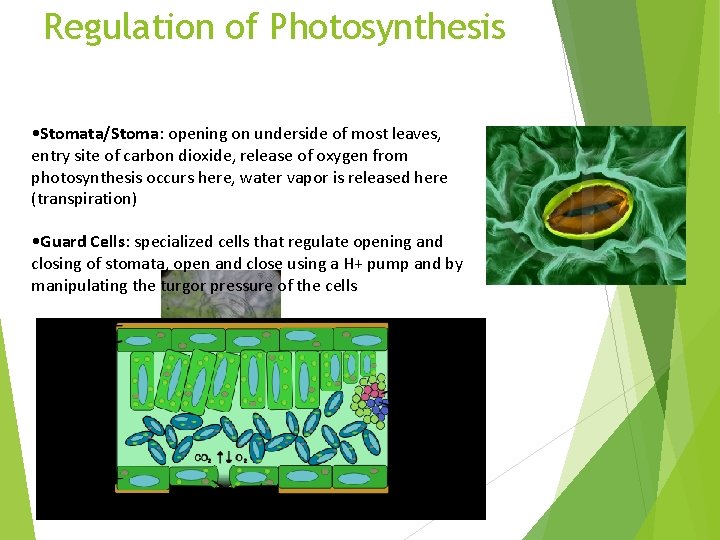
Regulation of Photosynthesis • Stomata/Stoma: opening on underside of most leaves, entry site of carbon dioxide, release of oxygen from photosynthesis occurs here, water vapor is released here (transpiration) • Guard Cells: specialized cells that regulate opening and closing of stomata, open and close using a H+ pump and by manipulating the turgor pressure of the cells