
PHOTOSYNTHESIS Photosynthesis The synthesis of Glucose by autotrophs
PHOTOSYNTHESIS
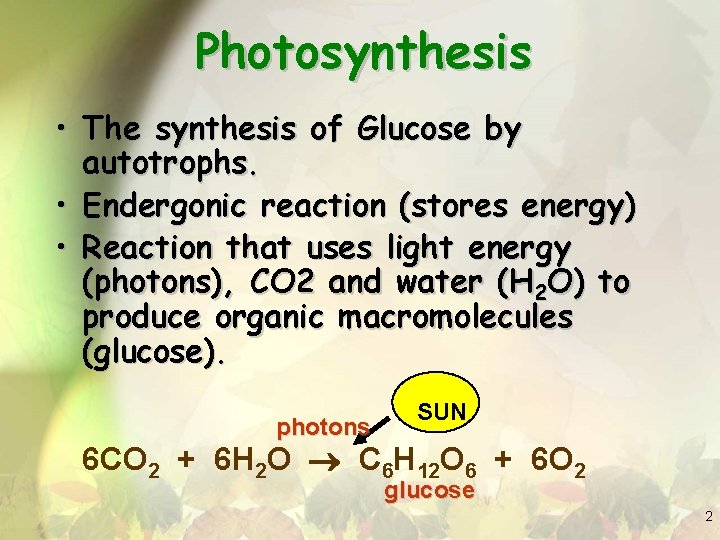
Photosynthesis • The synthesis of Glucose by autotrophs. • Endergonic reaction (stores energy) • Reaction that uses light energy (photons), CO 2 and water (H 2 O) to produce organic macromolecules (glucose). photons SUN 6 CO 2 + 6 H 2 O C 6 H 12 O 6 + 6 O 2 glucose 2
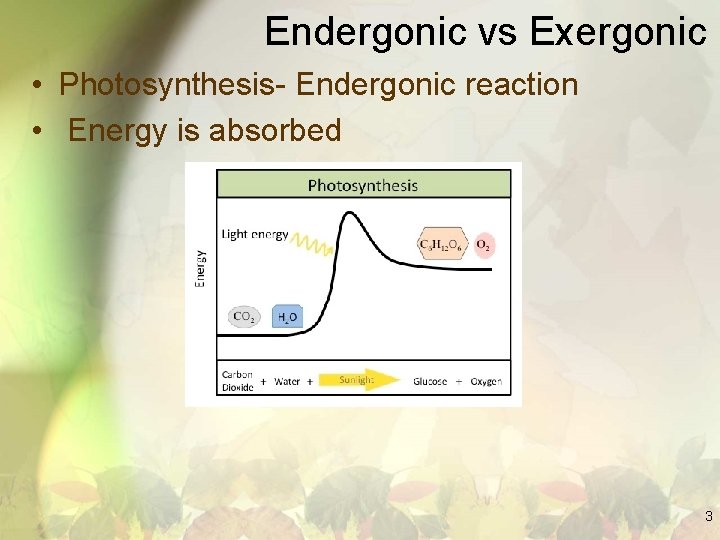
Endergonic vs Exergonic • Photosynthesis- Endergonic reaction • Energy is absorbed 3
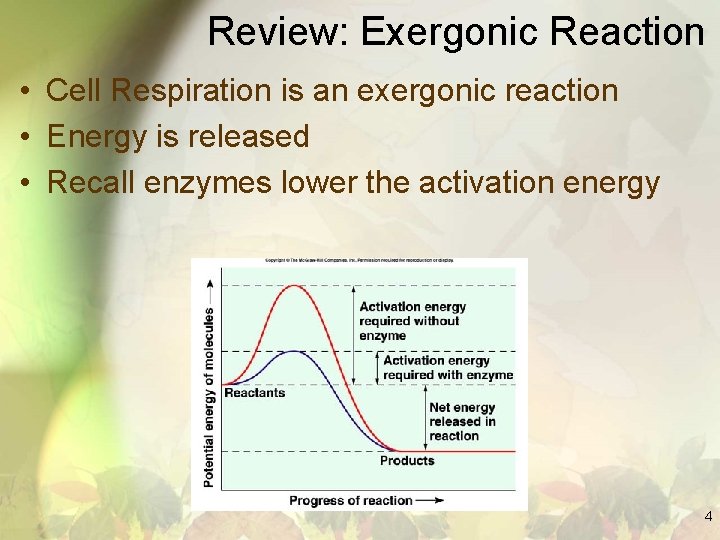
Review: Exergonic Reaction • Cell Respiration is an exergonic reaction • Energy is released • Recall enzymes lower the activation energy 4
Question: Where does photosynthesis take place? 5
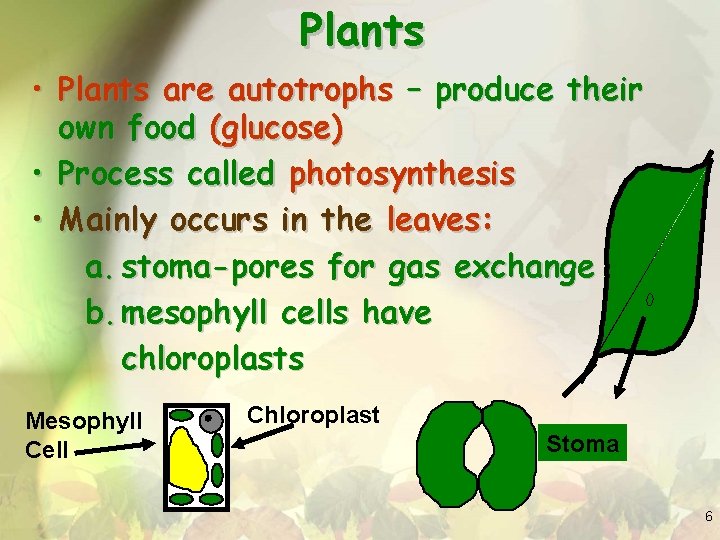
Plants • Plants are autotrophs – produce their own food (glucose) • Process called photosynthesis • Mainly occurs in the leaves: a. stoma-pores for gas exchange b. mesophyll cells have chloroplasts Mesophyll Cell Chloroplast Stoma 6
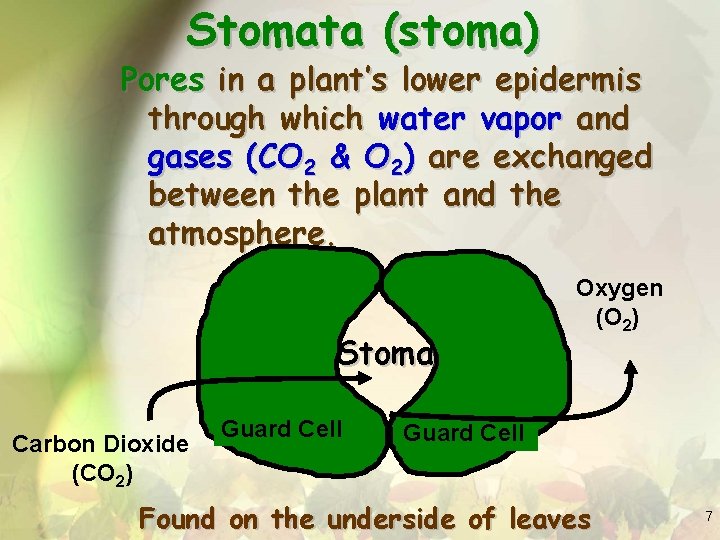
Stomata (stoma) Pores in a plant’s lower epidermis through which water vapor and gases (CO 2 & O 2) are exchanged between the plant and the atmosphere. Stoma Carbon Dioxide (CO 2) Guard Cell Oxygen (O 2) Guard Cell Found on the underside of leaves 7
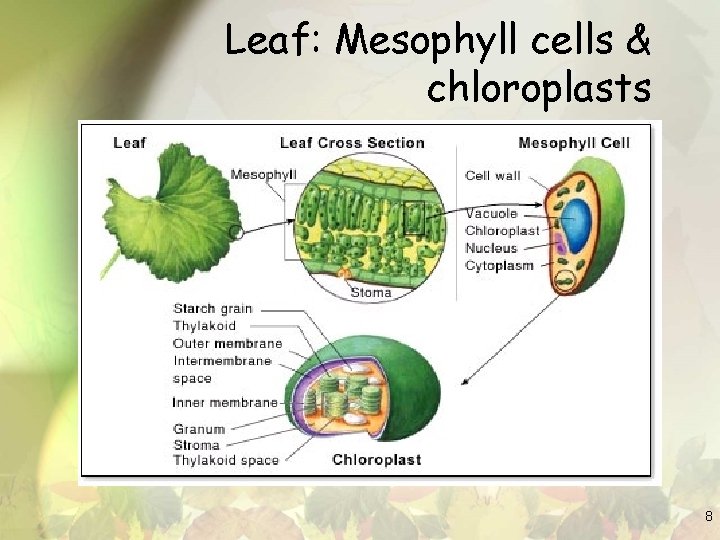
Leaf: Mesophyll cells & chloroplasts 8
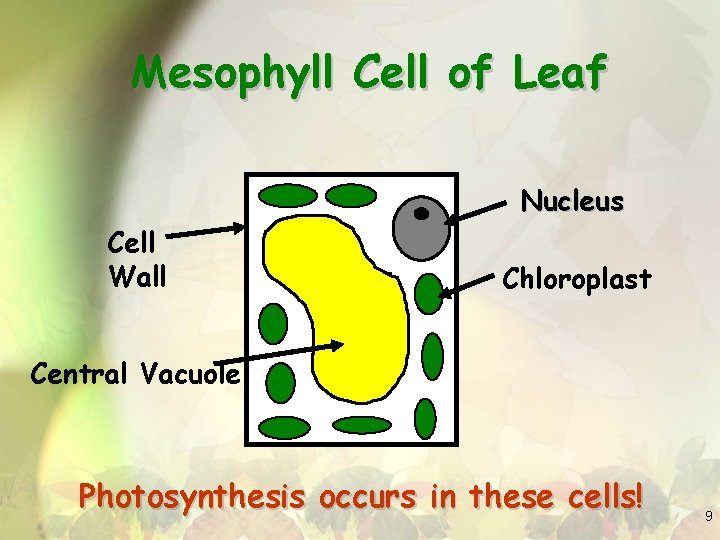
Mesophyll Cell of Leaf Nucleus Cell Wall Chloroplast Central Vacuole Photosynthesis occurs in these cells! 9
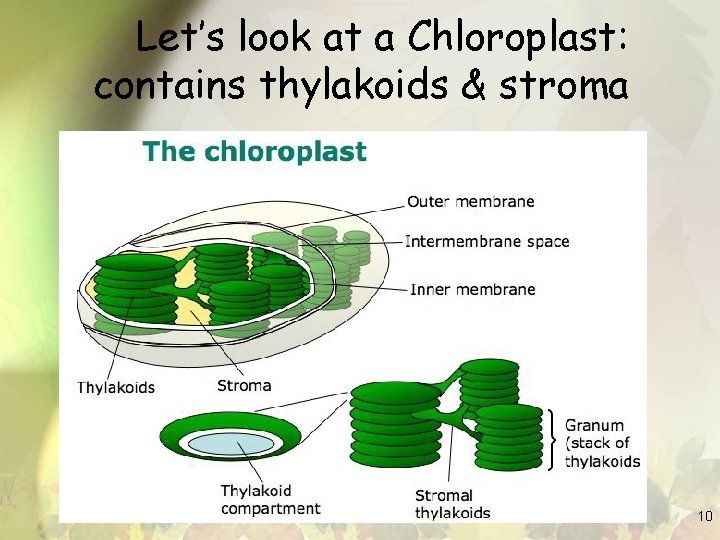
Let’s look at a Chloroplast: contains thylakoids & stroma 10
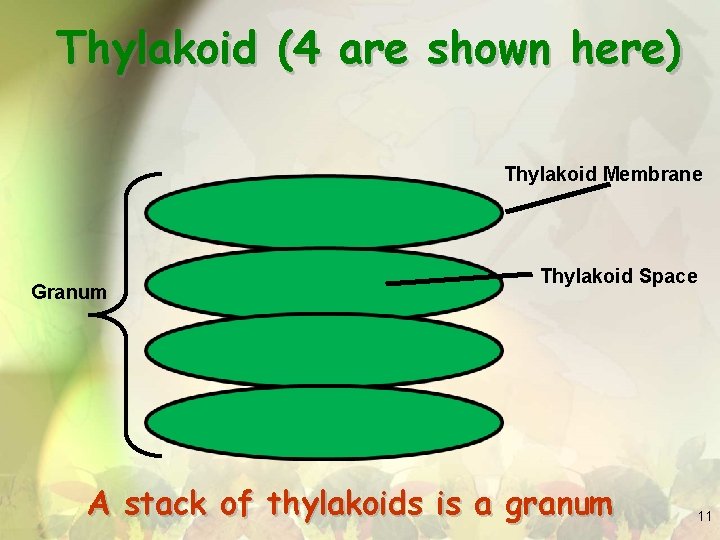
Thylakoid (4 are shown here) Thylakoid Membrane Granum Thylakoid Space A stack of thylakoids is a granum 11
Question: Why are plants green? 12
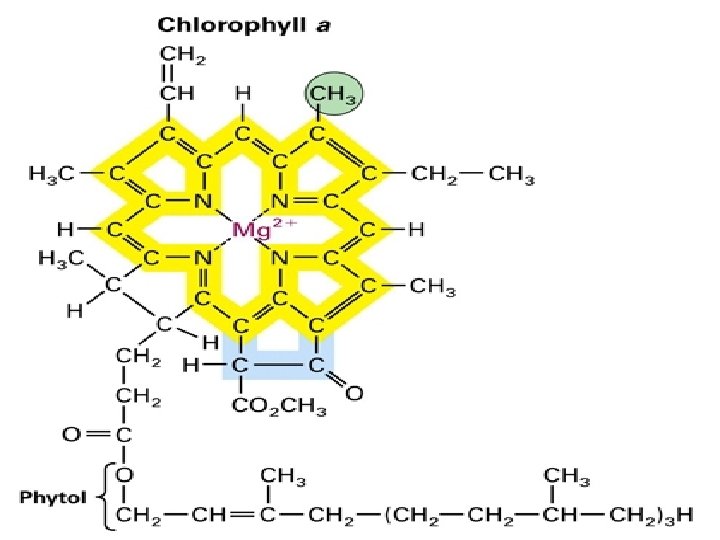
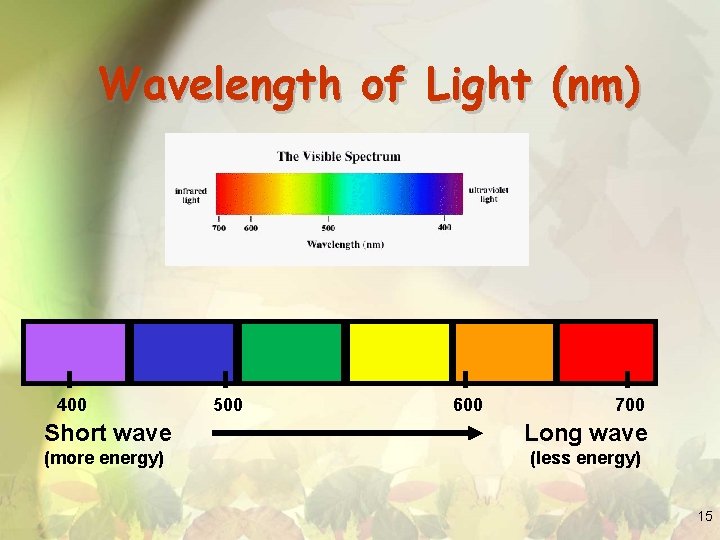
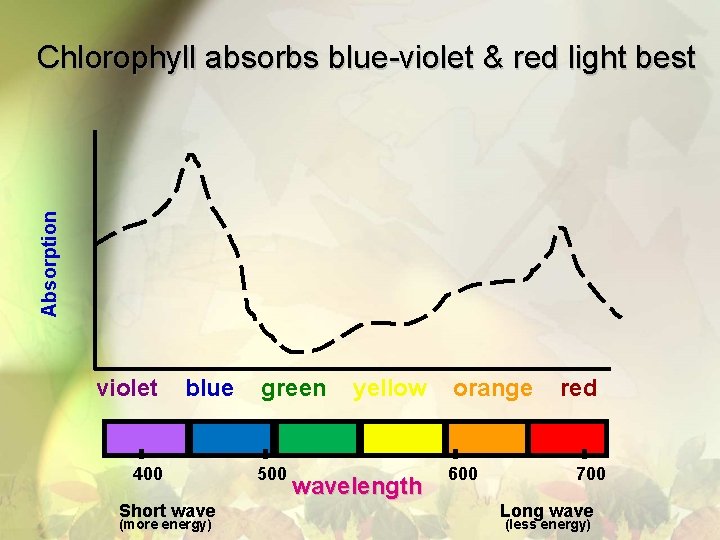
Chlorophyll Molecules • Located in the thylakoid membranes • Chlorophyll molecules harvest energy by absorbing photons of sunlight • Chlorophyll pigments absorb certain wavelengths of light. Blue (~420 nm) and Red (~660 nm) are most important • Plants are green because the green wavelength is reflected, not absorbed • *most common chlorophyll is called chlorophyll a 13
14
Wavelength of Light (nm) 400 500 600 700 Short wave Long wave (more energy) (less energy) 15
Absorption Chlorophyll absorbs blue-violet & red light best violet blue 400 Short wave (more energy) green 500 yellow wavelength orange 600 red 700 Long wave (less energy)
Question: During the fall, what causes the leaves to change colors? 17
Fall Colors • In addition to the chlorophyll pigments, there are other pigments present • During the fall, the green chlorophyll pigments are greatly reduced revealing the other pigments • Carotenoids and xanthophyll are pigments that are either red, orange, or yellow 18
Question: What do cells use for energy? 19
Energy for Life on Earth • Sunlight is the ULTIMATE energy for all life on Earth • Plants store energy in the chemical bonds of sugars • Organisms use ATP to power chemical reactions. 20
Review of ATP 21
Structure of ATP • ATP stands for adenosine triphosphate • It is composed of the nitrogen base ADENINE, the pentose (5 C) sugar RIBOSE, and three PHOSPHATE groups • The LAST phosphate group’s bond can be BROKEN to release ENERGY for CELLS to use to do work 22
Removing a Phosphate from ATP Breaking the LAST PHOSPHATE bond from ATP, will --– Release ENERGY for cells to use – Form ADP – Produce a FREE PHOSPHATE GROUP 23
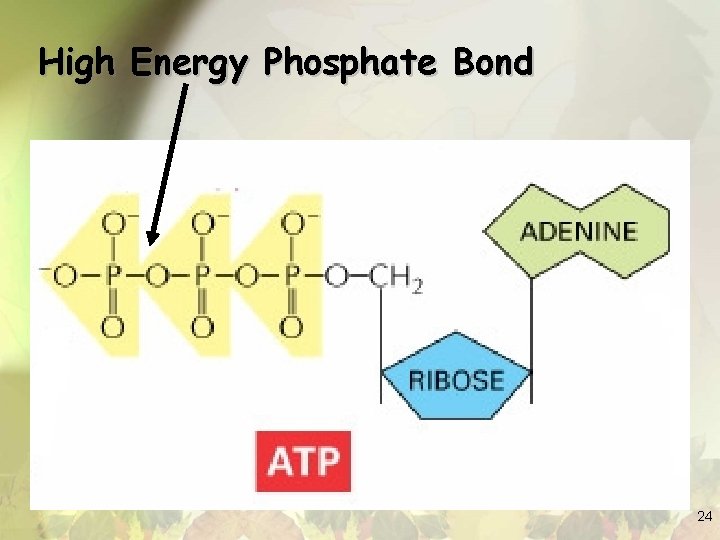
High Energy Phosphate Bond 24
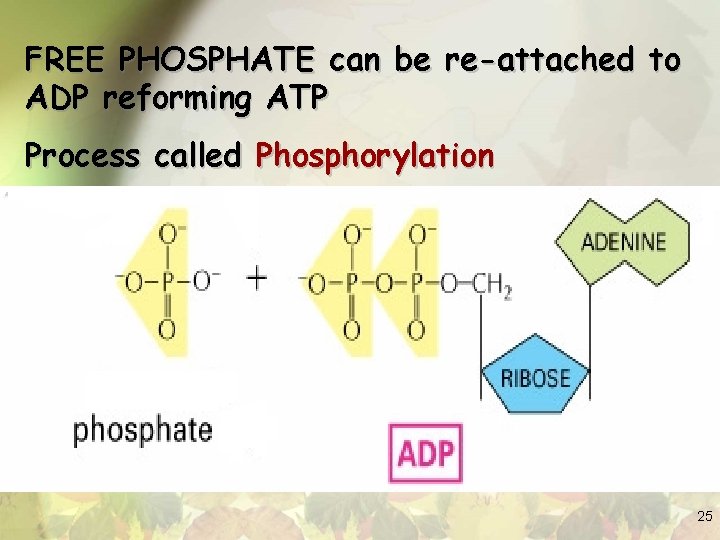
FREE PHOSPHATE can be re-attached to ADP reforming ATP Process called Phosphorylation 25
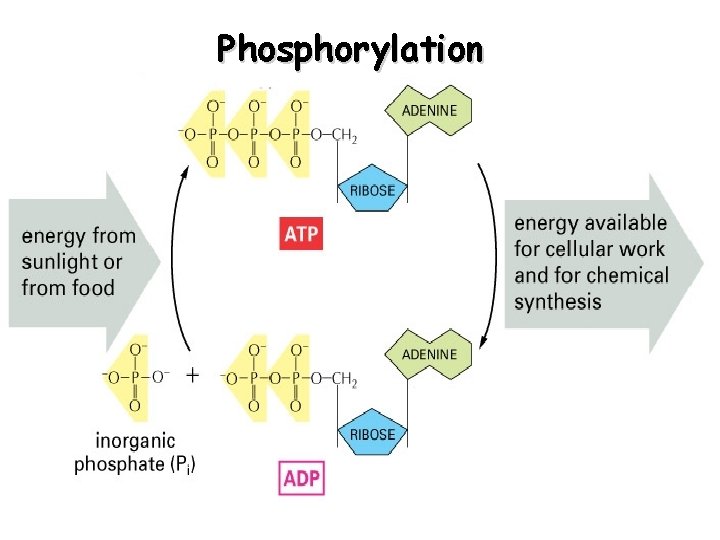
Phosphorylation 26
Parts of Photosynthesis 27
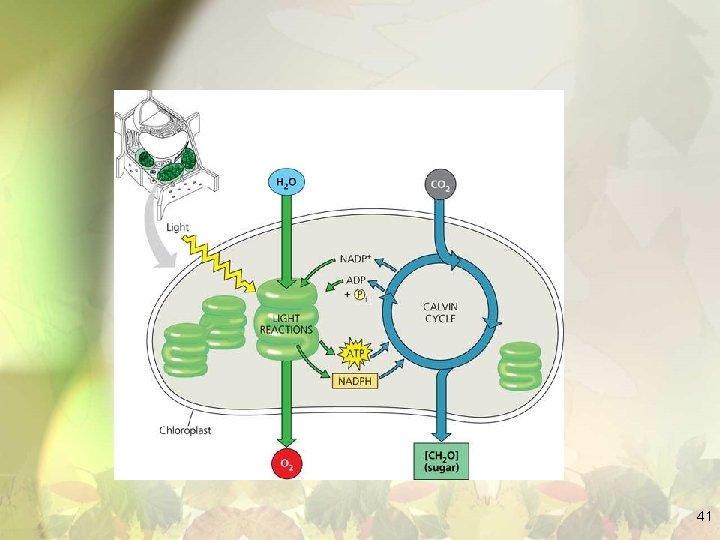
Two Parts of Photosynthesis Two reactions make up photosynthesis: 1. Light Reaction or Light Dependent Reaction – TWO MAJOR THINGS HAPPEN a- Water is split into H’s, Oxygen and electrons. b- Produces energy from solar power (photons) in the form of ATP and NADPH. SUN 28
Two Parts of Photosynthesis 2. Calvin Cycle or Light Independent Reaction. Does NOT need sunlight • Also called Carbon Fixation or C 3 Fixation • Uses energy (ATP and NADPH) from light reaction to MAKE SUGAR (glucose). • Occurs AFTER Light reaction 29
Light Reaction (Electron Flow) • Light MUST be present. Occurs in the Thylakoid membranes • During the light reaction, sun energy is absorbed and water is split to make ATP and NADPH (electron and H carrier…. just like NADH did in respiration) 30
How is ATP made? • First, water is split into H’s, electrons and O. • For every 2 water’s that are split, O 2 is made and released as waste thru stomata. • The electrons and H‘s are picked up by NADP & become NADPH. (similar to NADH in respiration) 31
How is ATP made? Electron Transport Chain • Just like in respiration, there are Electron Transport Chains (ETC) • Powers ATP synthesis through chemiosmosis • Takes place across the thylakoid membrane • Uses ETC and ATP synthase (enzyme) to make ATP…just like respiration • H+ move down their concentration gradient through channels of ATP synthase forming ATP (from ADP+P) 32
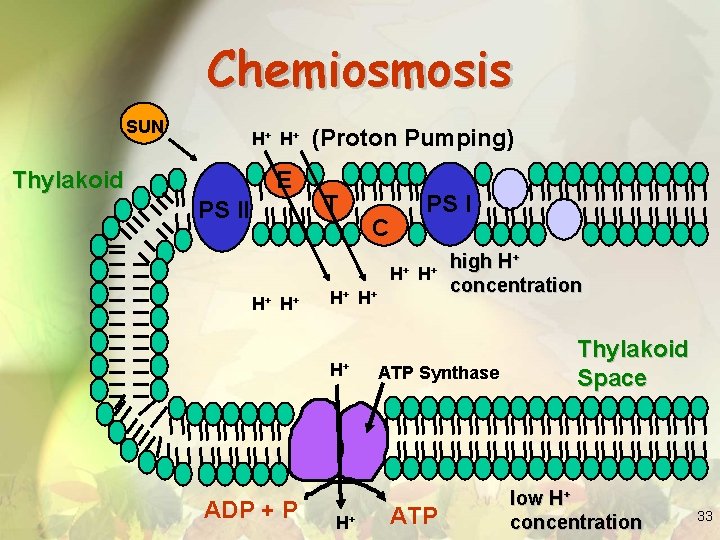
Chemiosmosis SUN H+ H + Thylakoid E PS II (Proton Pumping) T PS I C H+ H+ H + H+ ADP + P H+ H+ high H+ concentration ATP Synthase ATP Thylakoid Space low H+ concentration 33
Big things to know from light dependent reactions • 1. Light splits water. O 2 released • 2. H’s & e- are picked up by NADP & NADPH is produced • 3. ATP is produced by ETC • **ATP and NADPH go to the next stage- Light Independent Reactions (Calvin Cycle) in the STROMA 34
Calvin Cycle- Part 2 of P’syn • Carbon Fixation (light independent reaction- NO LIGHT REQUIRED) • Uses CO 2 (comes in thru stomata) to produce GLUCOSE. An enzyme called Rubisco ‘fixes’ the CO 2 to enter cycle. • Also uses ATP and NADPH from Light Reactions • Occurs in the stroma • 6 CO 2 + 6 H 2 O C 6 H 12 O 6 + 6 O 2 Calvin Light Rxn 35
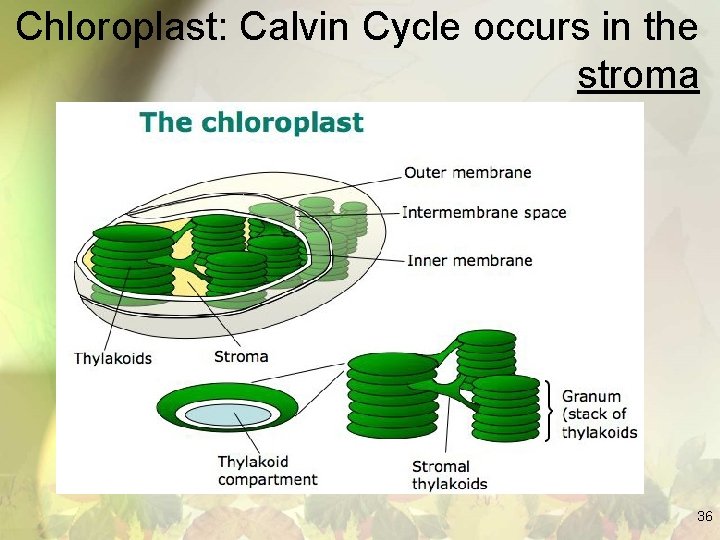
Chloroplast: Calvin Cycle occurs in the stroma 36
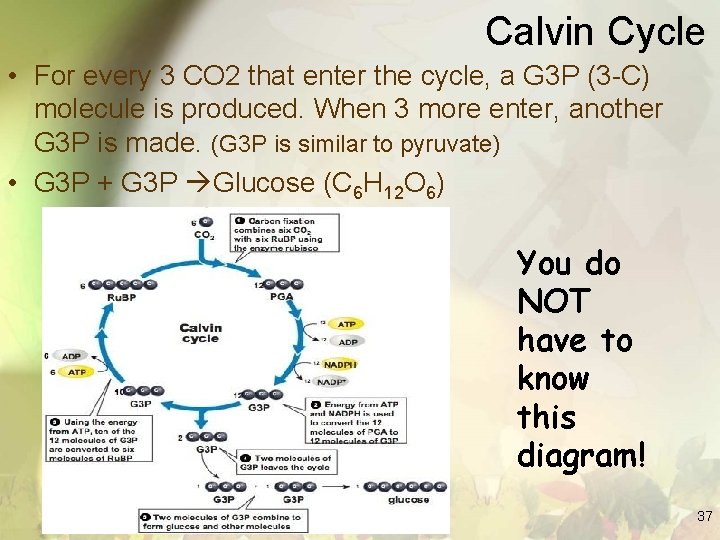
Calvin Cycle • For every 3 CO 2 that enter the cycle, a G 3 P (3 -C) molecule is produced. When 3 more enter, another G 3 P is made. (G 3 P is similar to pyruvate) • G 3 P + G 3 P Glucose (C 6 H 12 O 6) You do NOT have to know this diagram! 37
Big things to know: Calvin Cycle • Light INDEPENDENT reactions are in stroma of chloroplast • CO 2 enters thru the stomata • ATP and NADPH enter from Light Reactions. This provides the energy, H’s and electrons to build high energy Glucose. • **KNOW THIS: Plants use the glucose for respiration. Remember, ALL organisms respire! 38
photorespiration • Occurs if plants have to close their stomata on hot days to conserve water • This causes CO 2 not to be able to get in and causes Oxygen to build up in plant. • Calvin cycle tries to put O 2 thru the cycle instead of CO 2. • What do you think happens? ? 39
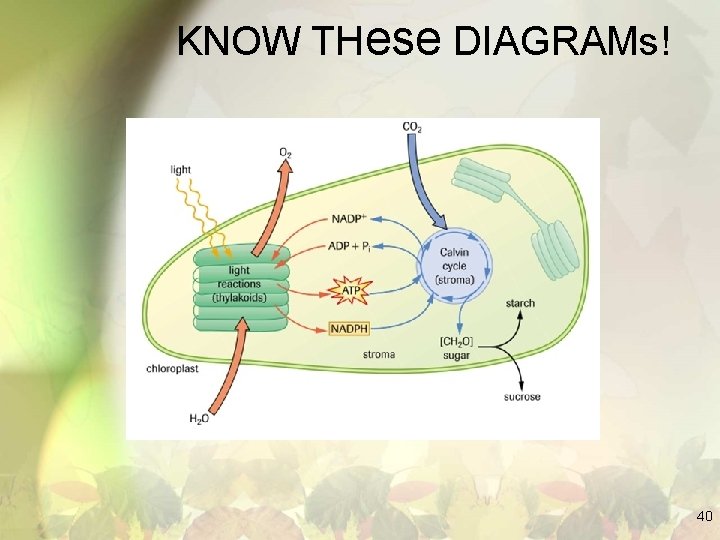
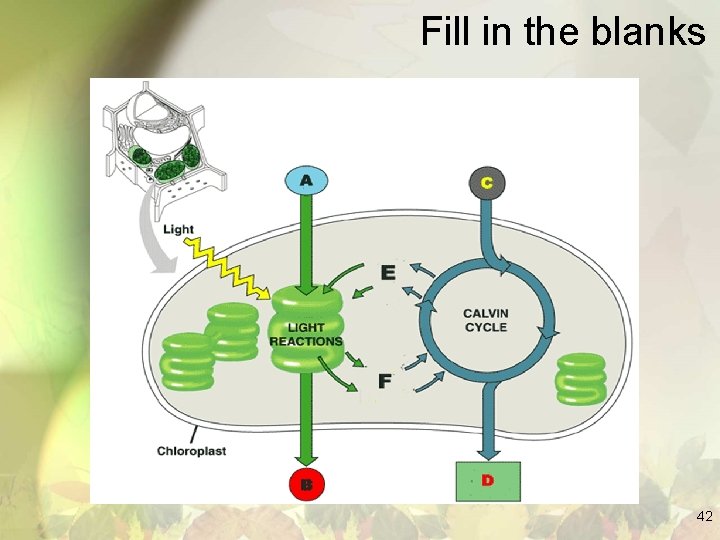
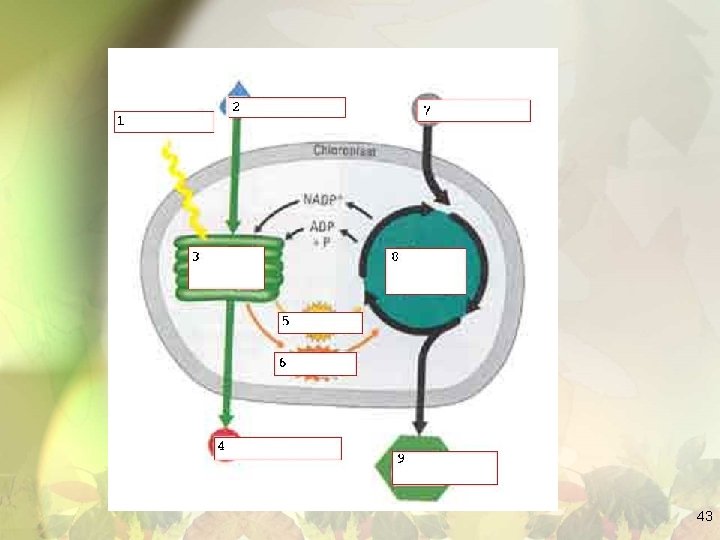
KNOW THese DIAGRAMs! 40
41
Fill in the blanks 42
43
- Slides: 43