
PHOTOSYNTHESIS Photosynthesis Photosynthesis is an Anabolic because it
PHOTOSYNTHESIS
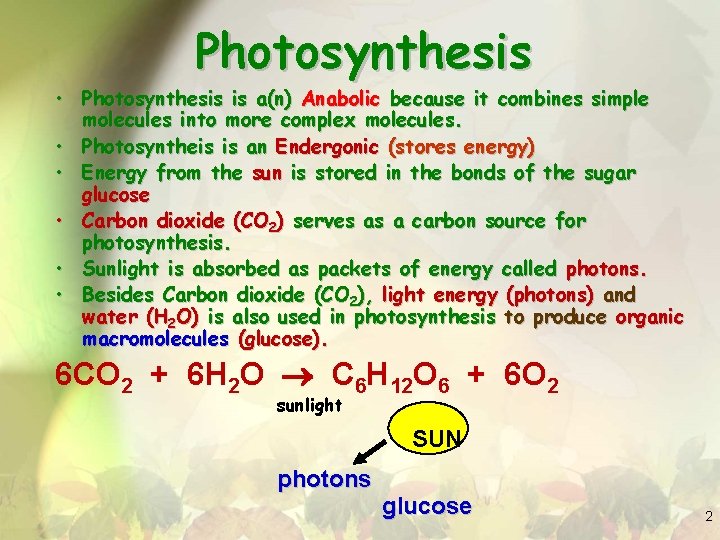
Photosynthesis • Photosynthesis is a(n) Anabolic because it combines simple molecules into more complex molecules. • Photosyntheis is an Endergonic (stores energy) • Energy from the sun is stored in the bonds of the sugar glucose • Carbon dioxide (CO 2) serves as a carbon source for photosynthesis. • Sunlight is absorbed as packets of energy called photons. • Besides Carbon dioxide (CO 2), light energy (photons) and water (H 2 O) is also used in photosynthesis to produce organic macromolecules (glucose). 6 CO 2 + 6 H 2 O C 6 H 12 O 6 + 6 O 2 sunlight SUN photons glucose 2
Question: Where does photosynthesis take place? 3
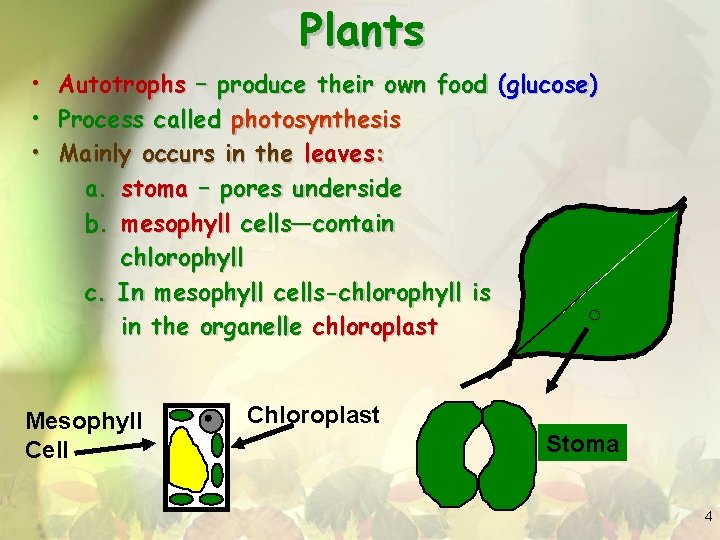
Plants • • • Autotrophs – produce their own food (glucose) Process called photosynthesis Mainly occurs in the leaves: a. stoma – pores underside b. mesophyll cells—contain chlorophyll c. In mesophyll cells-chlorophyll is in the organelle chloroplast Mesophyll Cell Chloroplast Stoma 4
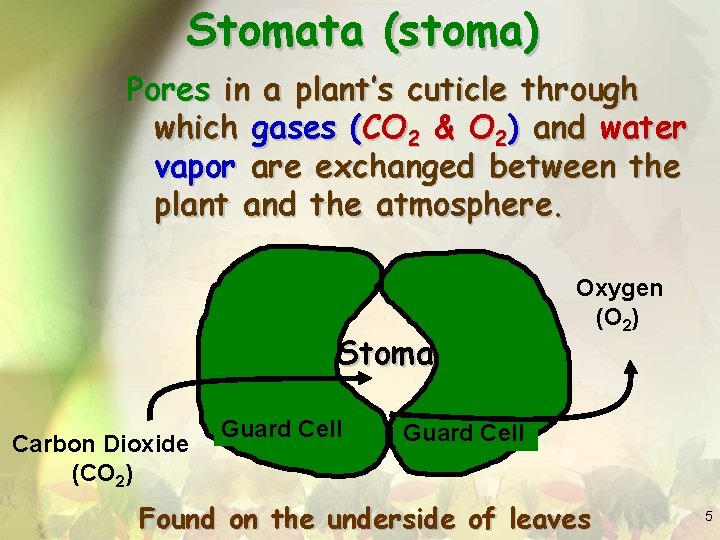
Stomata (stoma) Pores in a plant’s cuticle through which gases (CO 2 & O 2) and water vapor are exchanged between the plant and the atmosphere. Stoma Carbon Dioxide (CO 2) Guard Cell Oxygen (O 2) Guard Cell Found on the underside of leaves 5
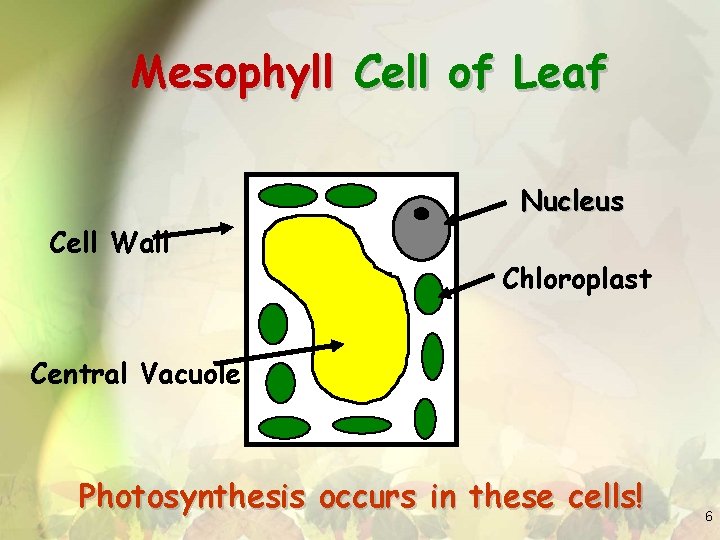
Mesophyll Cell of Leaf Nucleus Cell Wall Chloroplast Central Vacuole Photosynthesis occurs in these cells! 6
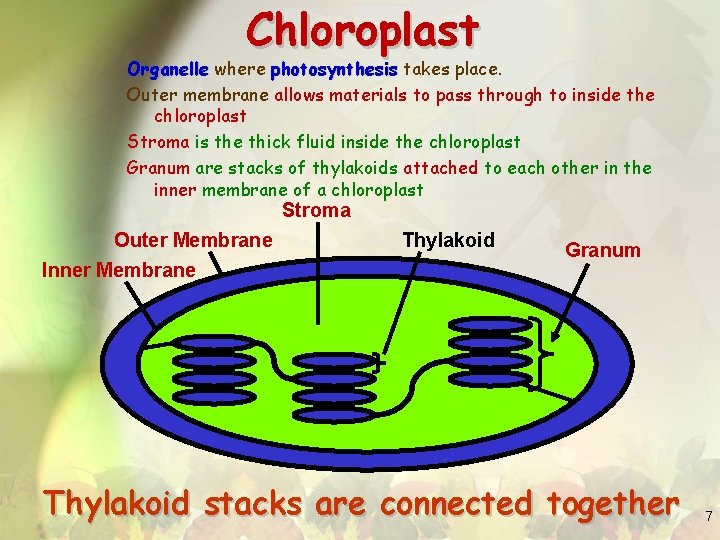
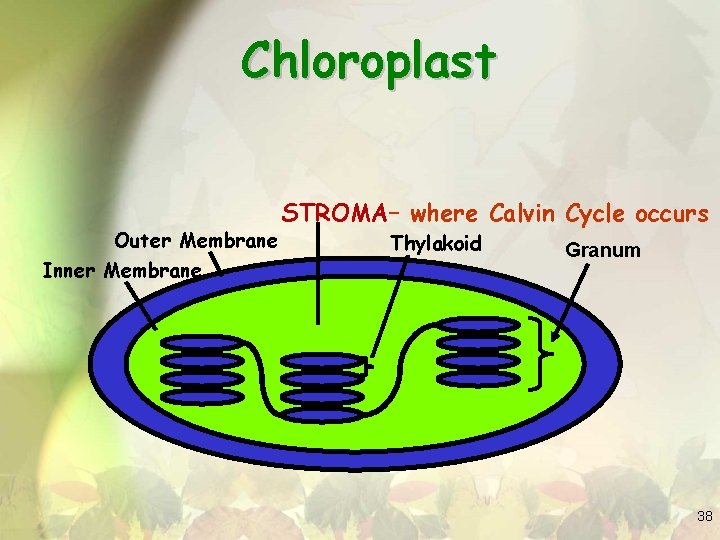
Chloroplast Organelle where photosynthesis takes place. Outer membrane allows materials to pass through to inside the chloroplast Stroma is the thick fluid inside the chloroplast Granum are stacks of thylakoids attached to each other in the inner membrane of a chloroplast Stroma Outer Membrane Inner Membrane Thylakoid Granum Thylakoid stacks are connected together 7
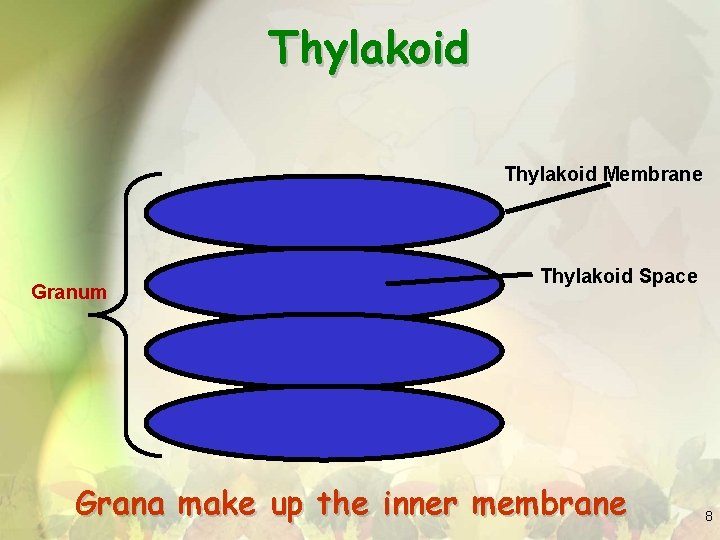
Thylakoid Membrane Granum Thylakoid Space Grana make up the inner membrane 8
Question: Why are plants green? 9
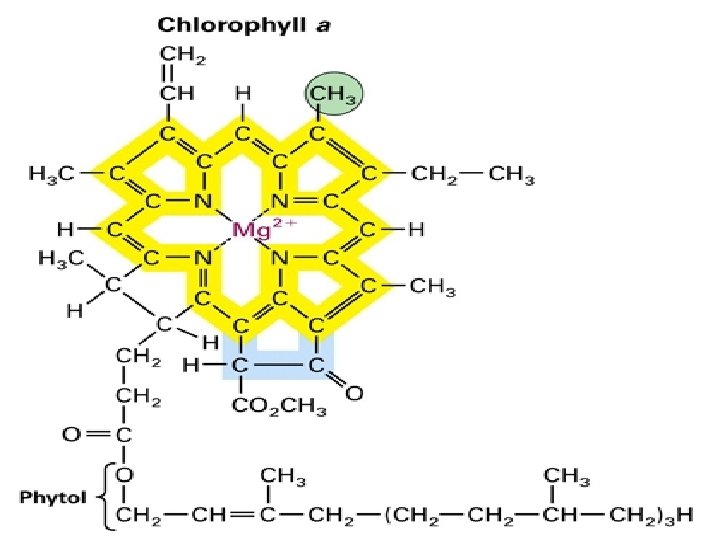
Chlorophyll Molecules • Plants are green because the green wavelength is reflected, not absorbed • Located in the thylakoid membranes • Chlorophyll pigments harvest light energy (photons) by absorbing certain • Chlorophyll have Mg+ in the center • wavelengths (blue-420 nm and red-660 nm are most important) 10
11
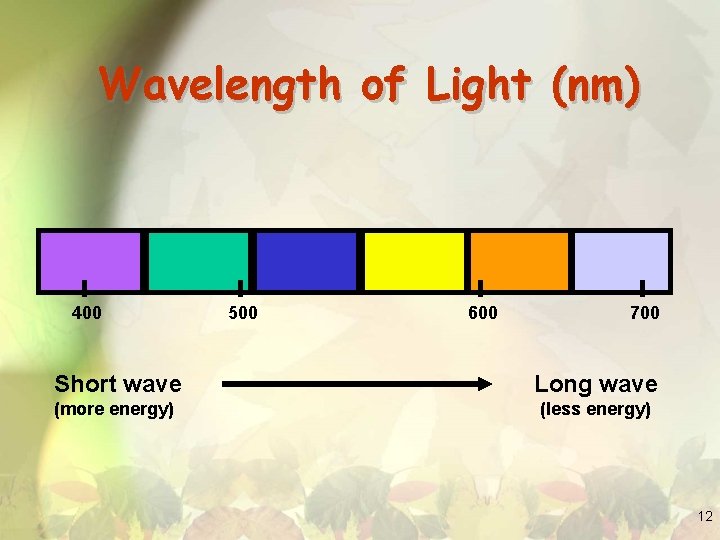
Wavelength of Light (nm) 400 500 600 700 Short wave Long wave (more energy) (less energy) 12
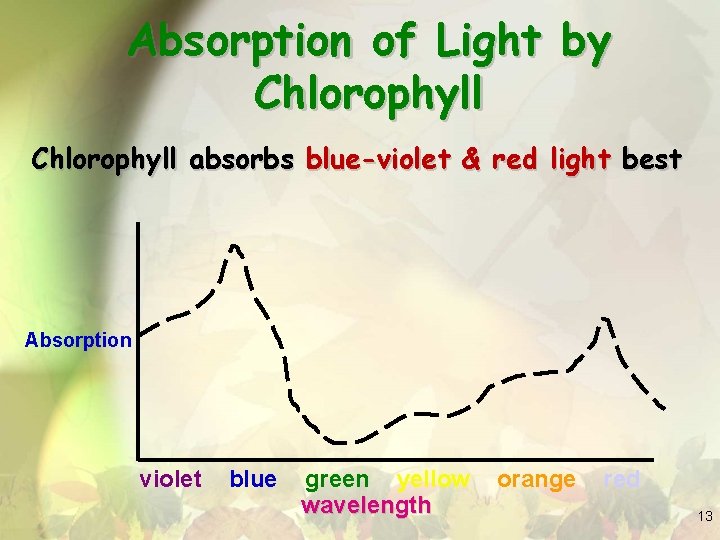
Absorption of Light by Chlorophyll absorbs blue-violet & red light best Absorption violet blue green yellow wavelength orange red 13
Question: During the fall, what causes the leaves to change colors? 14
Fall Colors • In addition to the chlorophyll pigments, there are other pigments present • During the fall, the green chlorophyll pigments are greatly reduced revealing the other pigments • Carotenoids are pigments that are either red, orange, or yellow 15
Why do leaves turn Colors in the Fall? • Number 27: • Due to the earth’s tilt on its axis, in the fall: • 1. The sunlight has indirect rays and thus less energy to be absorbed by the plants. Plants are reflecting different colors than green. • 2. The amount of sunlight is less each day = less photosynthesis 16
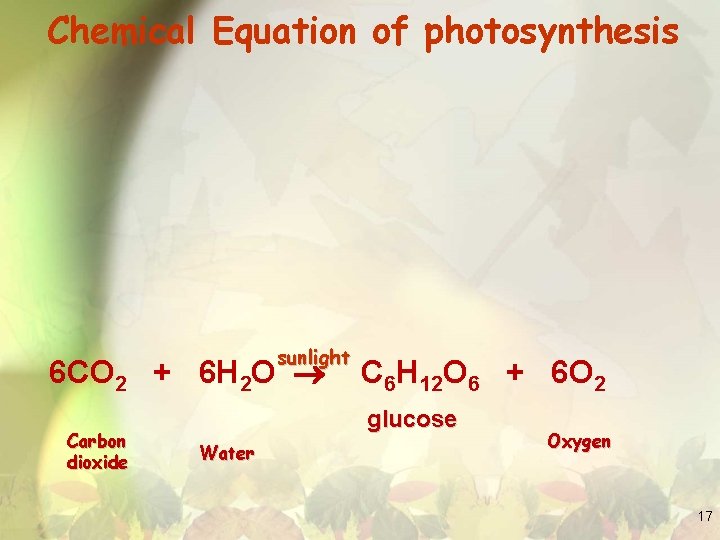
Chemical Equation of photosynthesis sunlight 6 CO 2 + 6 H 2 O Carbon dioxide C 6 H 12 O 6 + 6 O 2 glucose Water Oxygen 17
Question: What do cells use for energy? 18
Energy for Life on Earth • Sunlight is the ULTIMATE energy for all life on Earth • Plants store energy in the chemical bonds of sugars • Chemical energy is released during cellular respiration as ATP 19
Structure of ATP • ATP stands for adenosine triphosphate • It is composed of the • 1. nitrogen base ADENINE, • 2. the pentose (5 C) sugar RIBOSE, 3. 3 PHOSPHATE groups • The LAST phosphate group is bonded with a HIGH ENERGY chemical bond • This bond can be BROKEN to release ENERGY for CELLS to use 20
Removing a Phosphate from ATP Breaking the LAST PHOSPHATE bond from ATP, will --– 1. Release ENERGY for cells to use – 2. Form ADP – 3. Produce a FREE PHOSPHATE GROUP 21
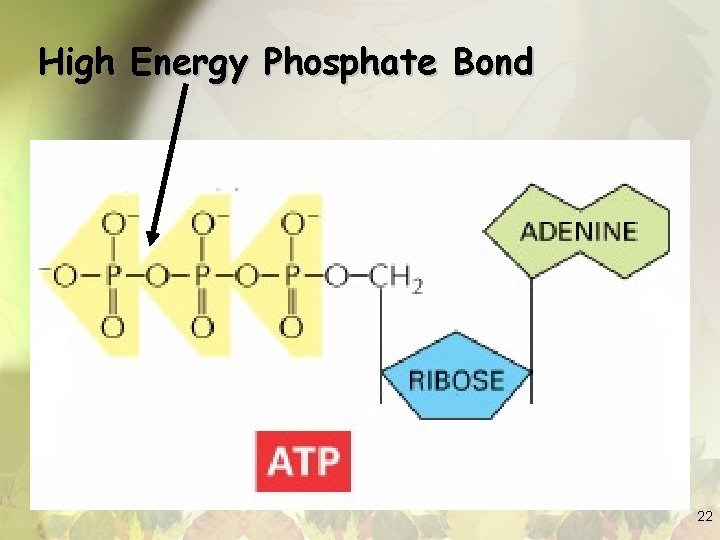
High Energy Phosphate Bond 22
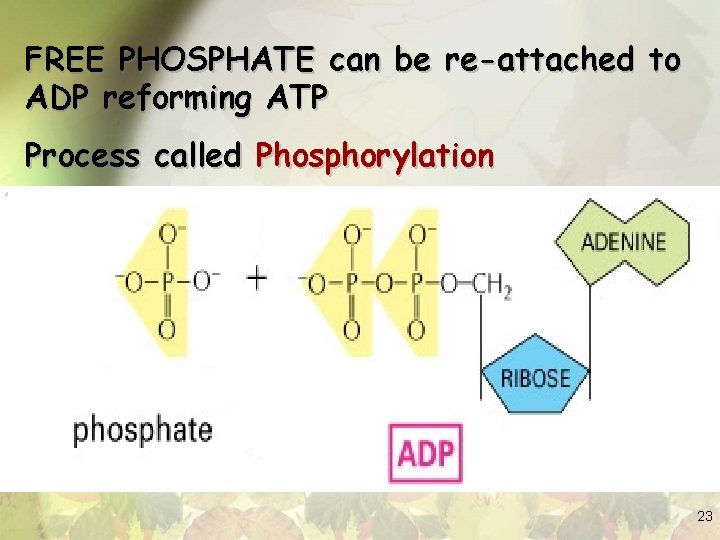
FREE PHOSPHATE can be re-attached to ADP reforming ATP Process called Phosphorylation 23
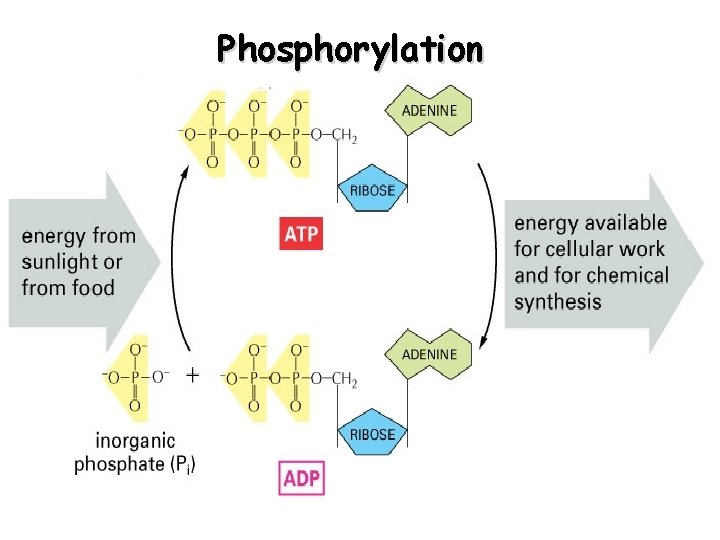
Phosphorylation 24
Number 38: • Energy released from this is available for cellular work. 25
Parts of Photosynthesis 26
Two Parts of Photosynthesis Two reactions make up photosynthesis: SUN 1. Light Reaction or Light Dependent Reaction Produces energy from solar power (photons) to produce ATP and the energy carrier NADPH. 27
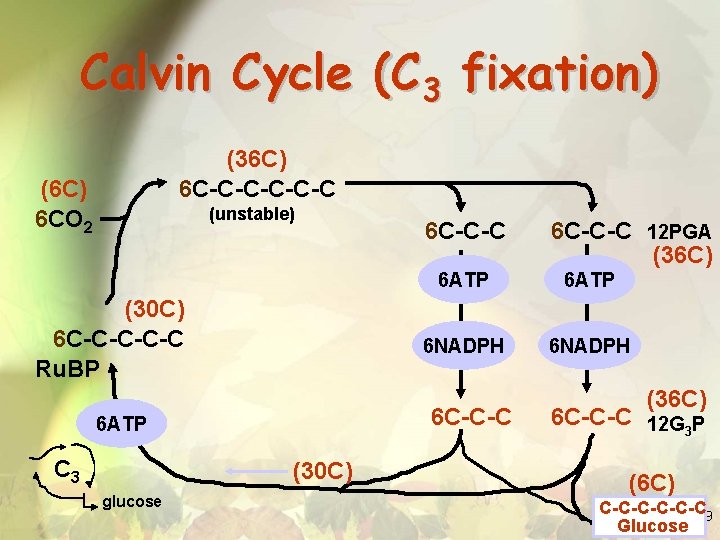
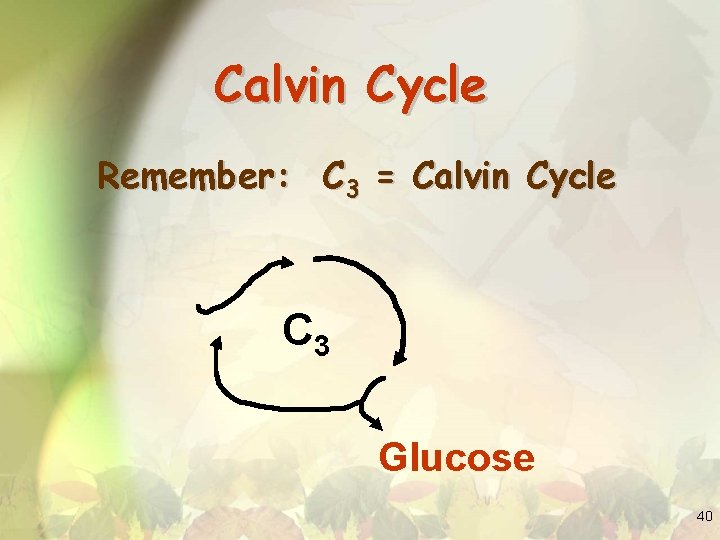
Two Parts of Photosynthesis 2. Calvin Cycle or Light Independent Reaction (Dark Reactions). • Uses energy (ATP and NADPH) from light reaction to make sugar (glucose)—not directly from the sun. • Also called Carbon Fixation or C 3 pathway • 28
Light Reaction (Electron Flow) • Occurs in the Thylakoid membranes • During the light reaction, there are two possible routes for electron flow: A. Cyclic Electron Flow B. Non-cyclic Electron Flow 29
Cyclic Electron Flow • • Occurs in the thylakoid membrane. Uses Photosystem I only P 700 reaction center- chlorophyll a Uses Electron Transport Chain (ETC) and ATP Synthase • Generates ATP only P ADP + ATP 30

31
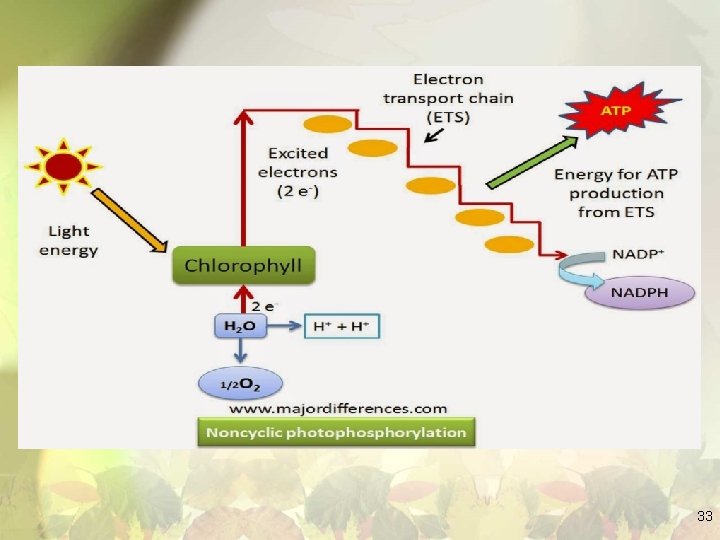
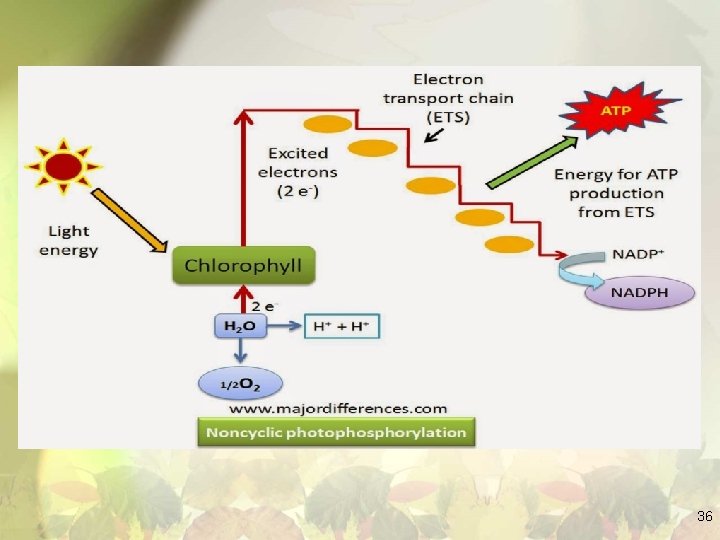
Noncyclic Electron Flow • • • ADP + P ATP NADP+ + H NADPH Oxygen made by plants comes from the splitting of H 2 O (number 47), not CO 2 H 2 O 1/2 O 2 + 2 H+ 32
33
Number 46: • Water is split in Noncyclic, while NADPH is made in Electron Transport chain (ETC) (from previous slide). 34
Number 48: • Electron Transport Chain (ETC) powers ATP Synthesis in plants. (see illustration on next slide). • Number 49: ATP is made using the electron transport chain and the enzyme NADP. 35
36
(#50 to 53 Answers) • Calvin Cycle • Carbon Fixation (light independent reaction/Dark Reactions—does not require light energy) • C 3 plants (80% of plants on earth) • Occurs in the stroma • Uses ATP and NADPH from light reaction as energy • Uses CO 2 • To produce glucose: it takes 6 turns and uses 18 ATP and 12 NADPH. 37
Chloroplast Outer Membrane Inner Membrane STROMA– where Calvin Cycle occurs Thylakoid Granum 38
Calvin Cycle (C 3 fixation) (36 C) 6 C-C-C-C (6 C) 6 CO 2 (unstable) (30 C) 6 C-C-C Ru. BP (30 C) glucose 6 C-C-C 12 PGA (36 C) 6 ATP 6 NADPH 6 C-C-C 6 ATP C 3 6 C-C-C (36 C) 6 C-C-C 12 G 3 P (6 C) C-C-C-C 39 Glucose
Calvin Cycle Remember: C 3 = Calvin Cycle C 3 Glucose 40
Question: Why do some plants close their stoma during the day? 41
Some plants close their stoma in the hottest part of the day to conserve water
Some Plants • Hot, dry environments • 5% of plants (cactus and ice plants) • Stoma (#54) closed during day • Stoma open during the night • Light reaction - occurs during the day • Calvin Cycle - occurs when CO 2 is present 43
- Slides: 43