
Photosynthesis Photosynthesis nourishes almost all life on the

- Slides: 57
Photosynthesis
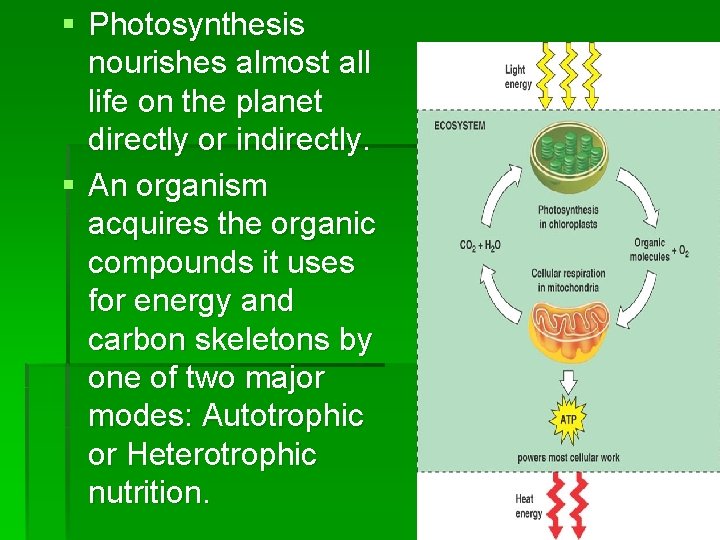
§ Photosynthesis nourishes almost all life on the planet directly or indirectly. § An organism acquires the organic compounds it uses for energy and carbon skeletons by one of two major modes: Autotrophic or Heterotrophic nutrition.
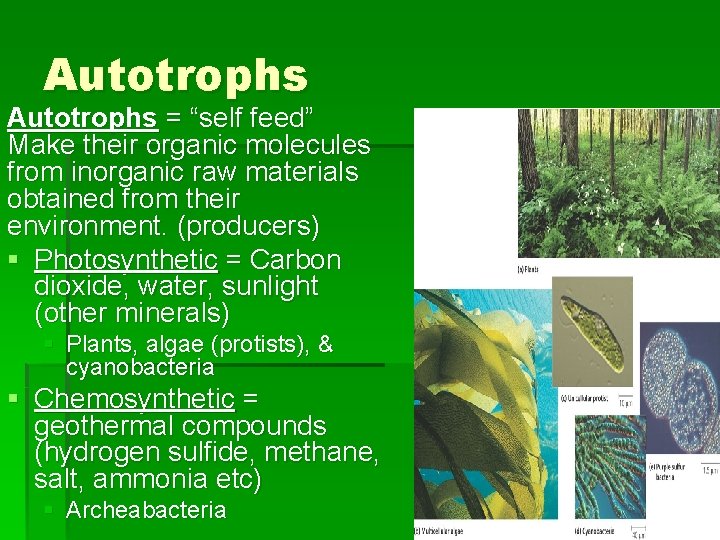
Autotrophs = “self feed” Make their organic molecules from inorganic raw materials obtained from their environment. (producers) § Photosynthetic = Carbon dioxide, water, sunlight (other minerals) § Plants, algae (protists), & cyanobacteria § Chemosynthetic = geothermal compounds (hydrogen sulfide, methane, salt, ammonia etc) § Archeabacteria
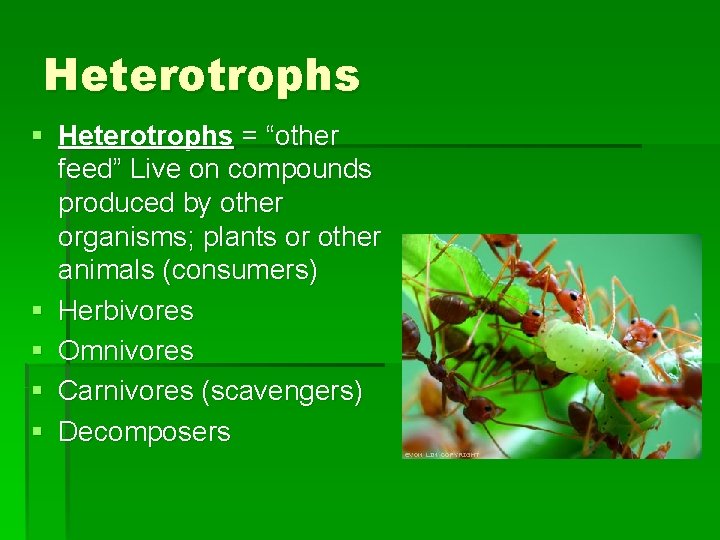
Heterotrophs § Heterotrophs = “other feed” Live on compounds produced by other organisms; plants or other animals (consumers) § Herbivores § Omnivores § Carnivores (scavengers) § Decomposers
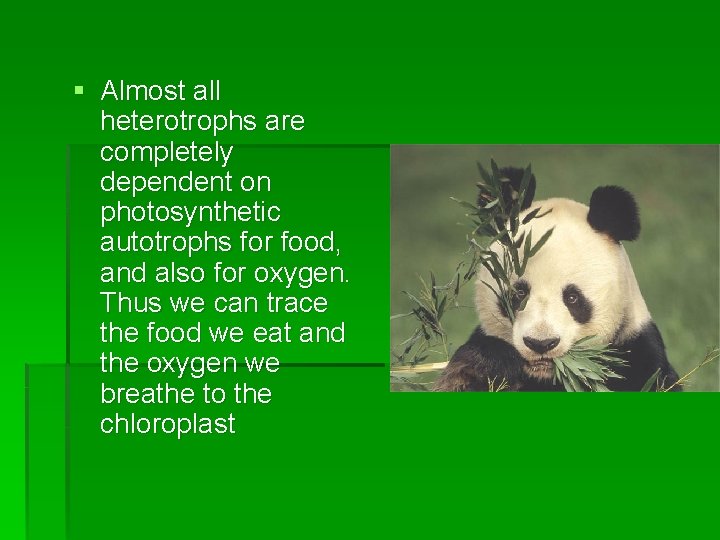
§ Almost all heterotrophs are completely dependent on photosynthetic autotrophs for food, and also for oxygen. Thus we can trace the food we eat and the oxygen we breathe to the chloroplast
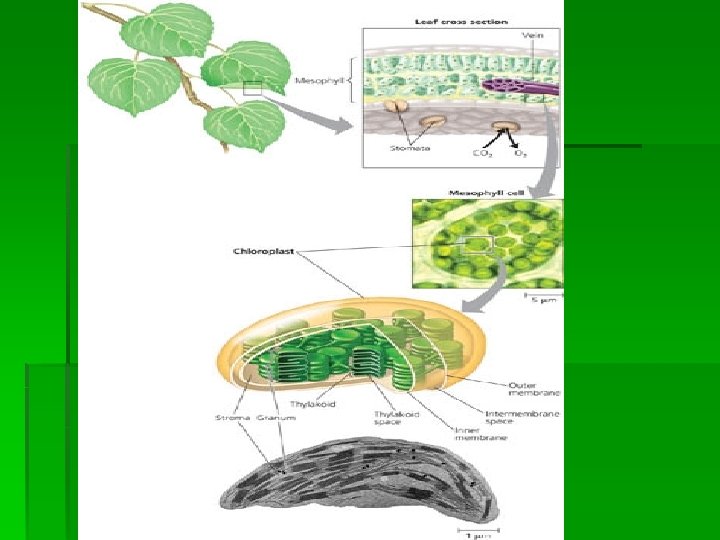
Chloroplast Location and Structure § All green parts of a plant have chloroplasts, but the leaves have the largest concentration. (500, 000 / mm 2) § CO 2 enters and O 2 exist the leaf via pores called stomata. § Found in cells of the leaf tissue called Mesophyll. § A typical mesophyll cell has 30 – 40 chloroplasts. § Chloroplasts are a double membraned organelle (outer and inner membrane).
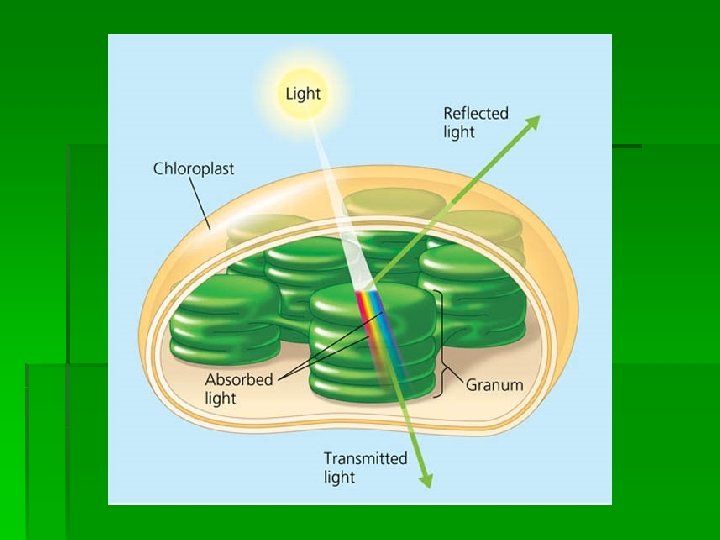
Chloroplast Location and Structure Cont. § Stroma = The dense fluid inside the inner membrane. § Grana = stacks of membrane sacks found bathed in the stroma. § Thylakoids = each individual membrane sac of the grana. Where the photosynthetic pigment chlorophyll is found. ( green ) Absorbs the light energy that drives the synthesis of molecules in chloroplast.
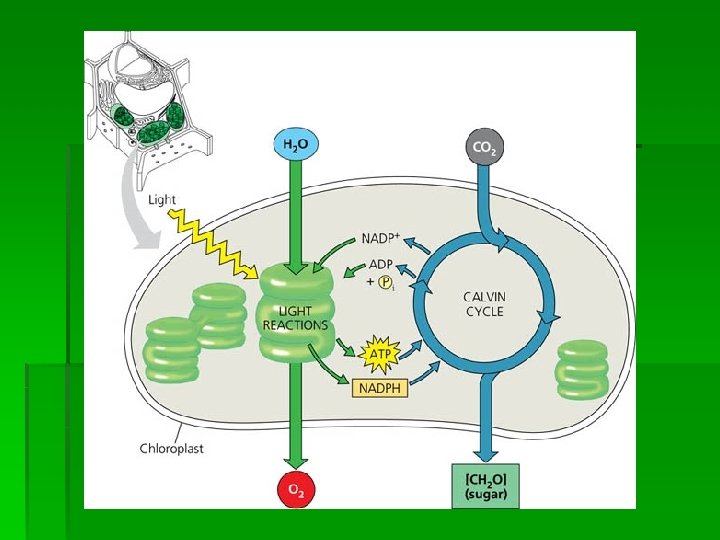
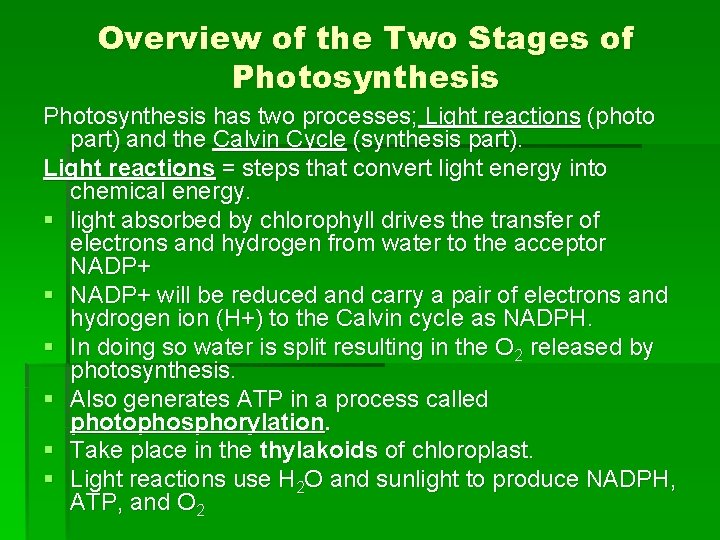
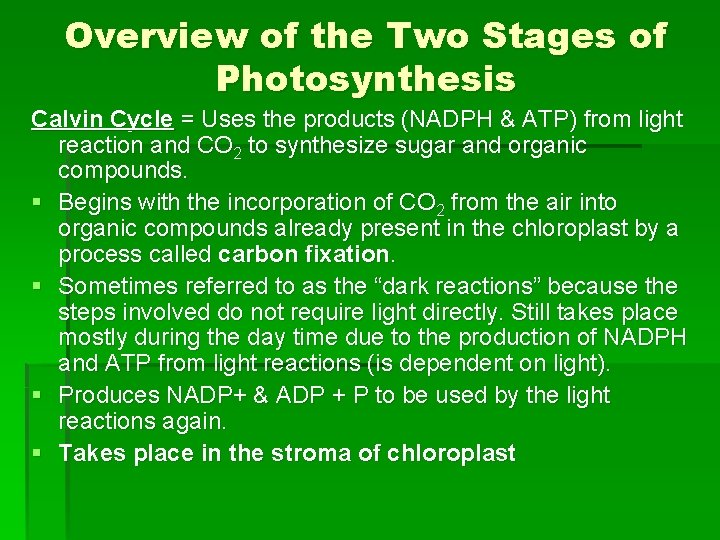
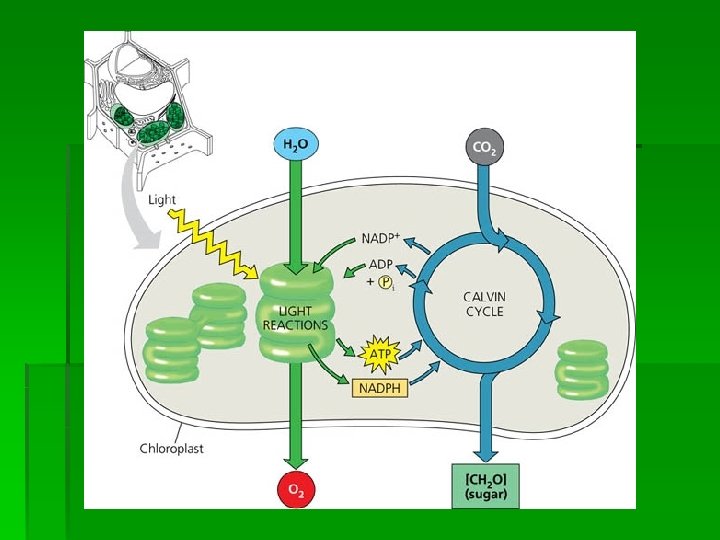
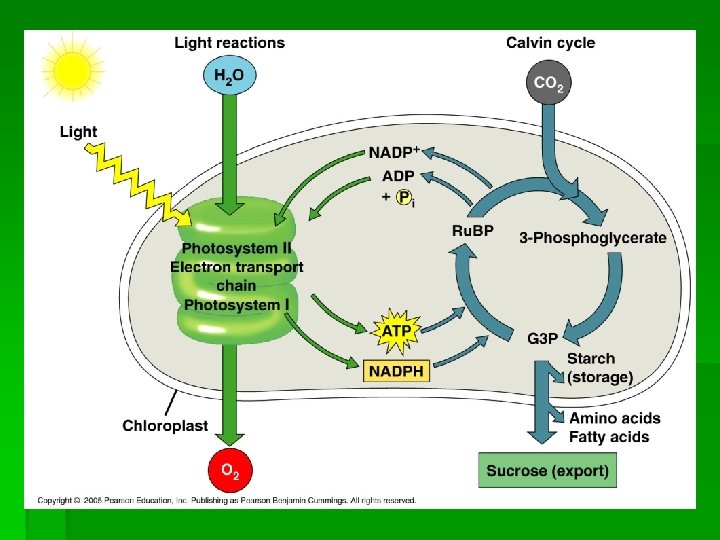
Overview of the Two Stages of Photosynthesis has two processes; Light reactions (photo part) and the Calvin Cycle (synthesis part). Light reactions = steps that convert light energy into chemical energy. § light absorbed by chlorophyll drives the transfer of electrons and hydrogen from water to the acceptor NADP+ § NADP+ will be reduced and carry a pair of electrons and hydrogen ion (H+) to the Calvin cycle as NADPH. § In doing so water is split resulting in the O 2 released by photosynthesis. § Also generates ATP in a process called photophosphorylation. § Take place in the thylakoids of chloroplast. § Light reactions use H 2 O and sunlight to produce NADPH, ATP, and O 2
Overview of the Two Stages of Photosynthesis Calvin Cycle = Uses the products (NADPH & ATP) from light reaction and CO 2 to synthesize sugar and organic compounds. § Begins with the incorporation of CO 2 from the air into organic compounds already present in the chloroplast by a process called carbon fixation. § Sometimes referred to as the “dark reactions” because the steps involved do not require light directly. Still takes place mostly during the day time due to the production of NADPH and ATP from light reactions (is dependent on light). § Produces NADP+ & ADP + P to be used by the light reactions again. § Takes place in the stroma of chloroplast
QOD § How do the reactant molecules of photosynthesis reach the chloroplasts in leaves? § Describe how the two stages of photosynthesis are dependent on each other.
QOD answers § CO 2 enters leaves via stomata, and water enters via roots and is carried to leaves through veins. § The Calvin cycle depends on the NADPH and ATP that the light reactions generate, and the light reactions depend on the NADP + and ADP and P that the Calvin cycle generates.
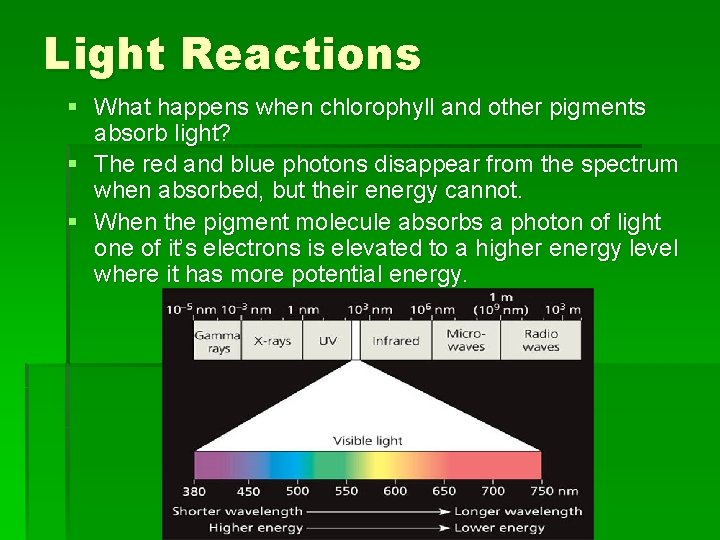
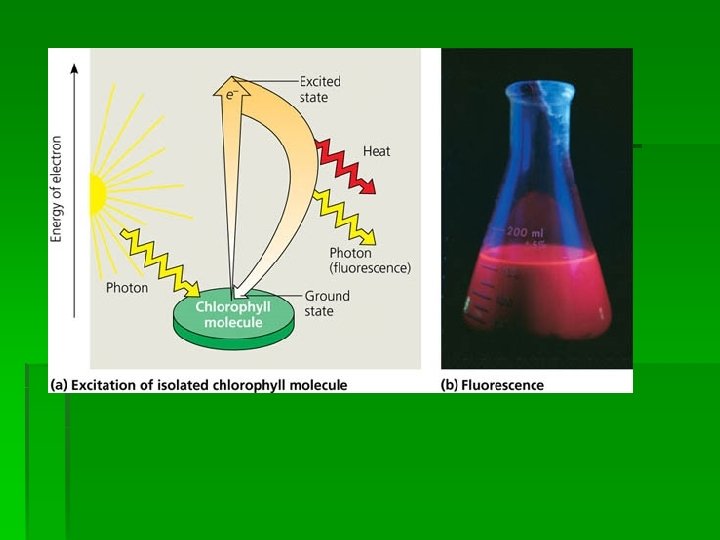
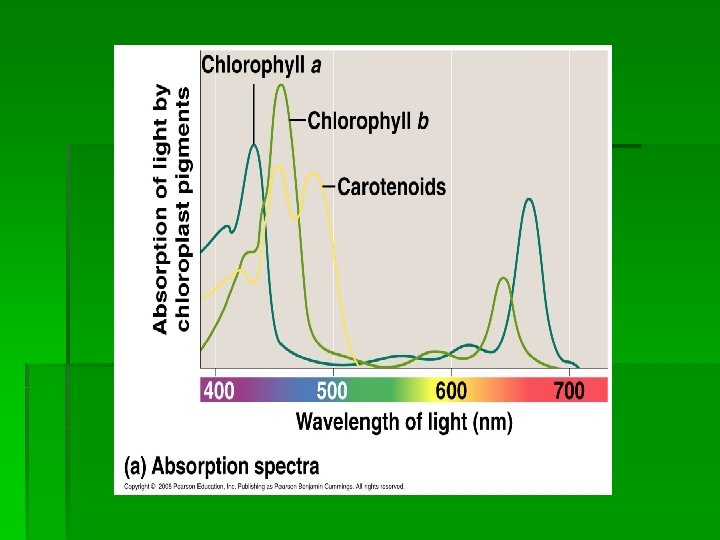
Light Reactions § What happens when chlorophyll and other pigments absorb light? § The red and blue photons disappear from the spectrum when absorbed, but their energy cannot. § When the pigment molecule absorbs a photon of light one of it’s electrons is elevated to a higher energy level where it has more potential energy.
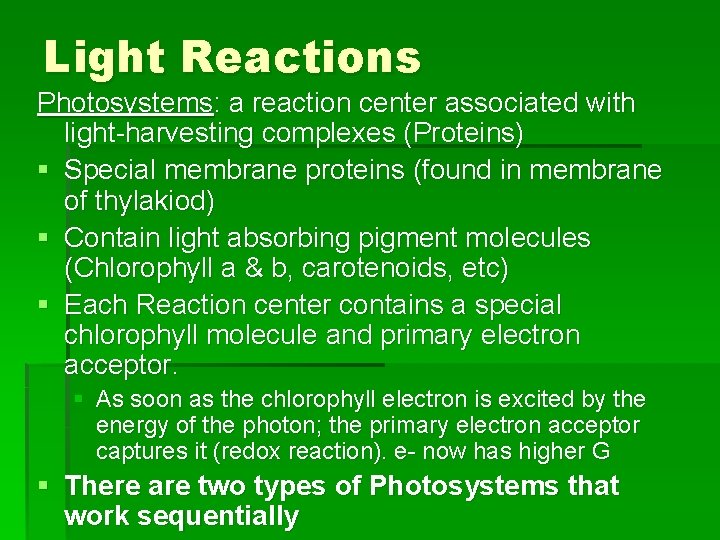
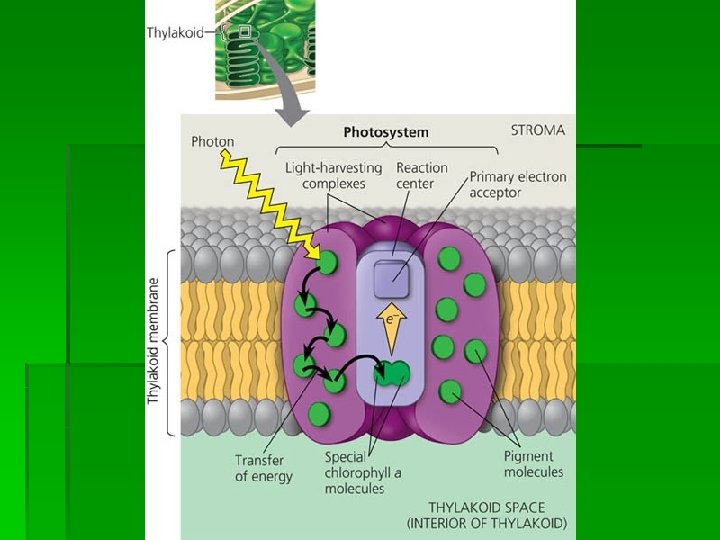
Light Reactions Photosystems: a reaction center associated with light-harvesting complexes (Proteins) § Special membrane proteins (found in membrane of thylakiod) § Contain light absorbing pigment molecules (Chlorophyll a & b, carotenoids, etc) § Each Reaction center contains a special chlorophyll molecule and primary electron acceptor. § As soon as the chlorophyll electron is excited by the energy of the photon; the primary electron acceptor captures it (redox reaction). e- now has higher G § There are two types of Photosystems that work sequentially
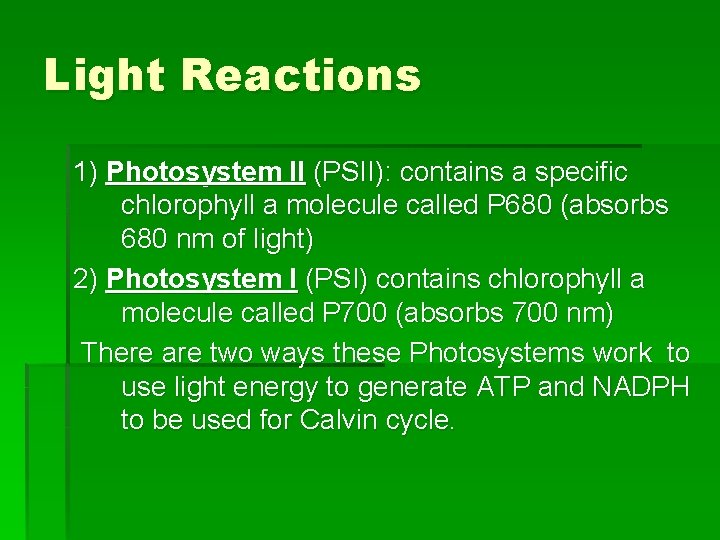
Light Reactions 1) Photosystem II (PSII): contains a specific chlorophyll a molecule called P 680 (absorbs 680 nm of light) 2) Photosystem I (PSI) contains chlorophyll a molecule called P 700 (absorbs 700 nm) There are two ways these Photosystems work to use light energy to generate ATP and NADPH to be used for Calvin cycle.
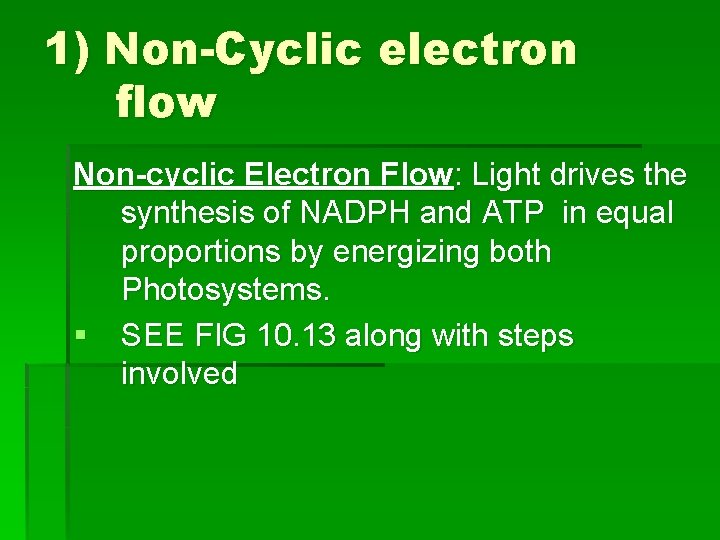
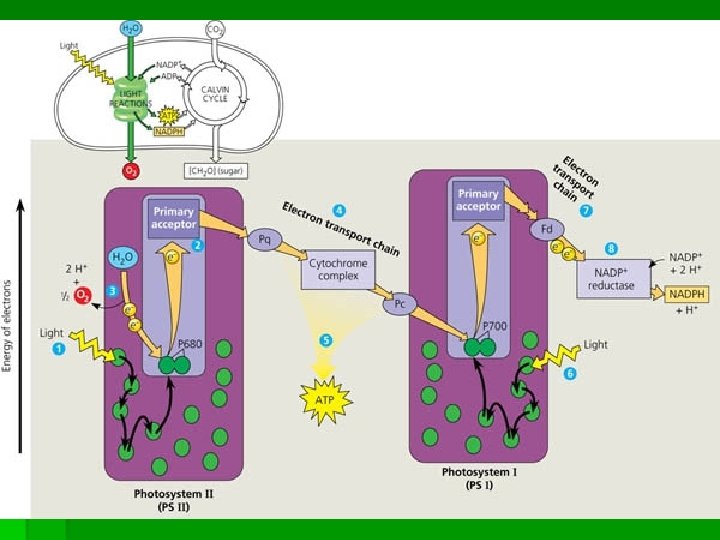
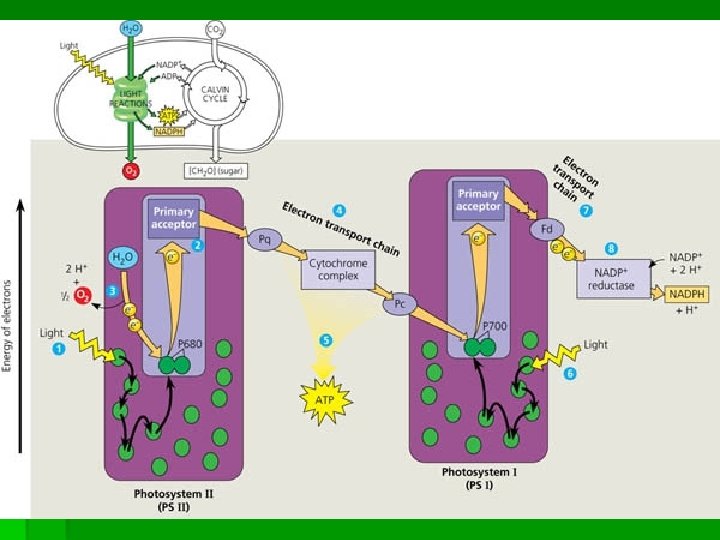
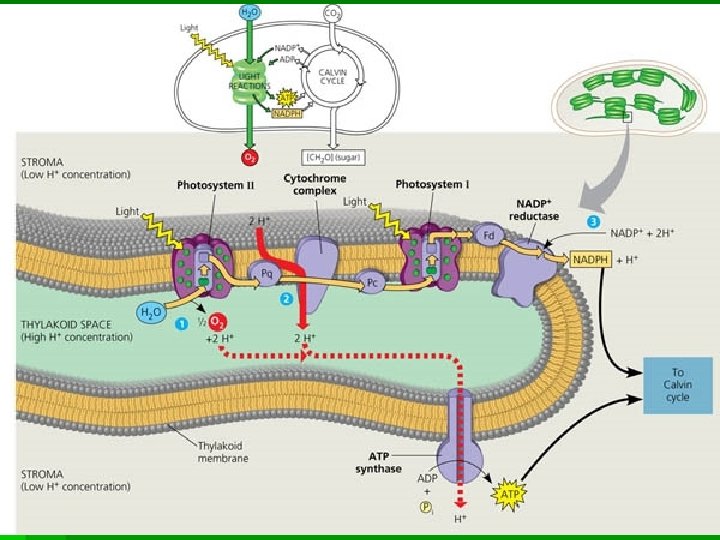
1) Non-Cyclic electron flow Non-cyclic Electron Flow: Light drives the synthesis of NADPH and ATP in equal proportions by energizing both Photosystems. § SEE FIG 10. 13 along with steps involved
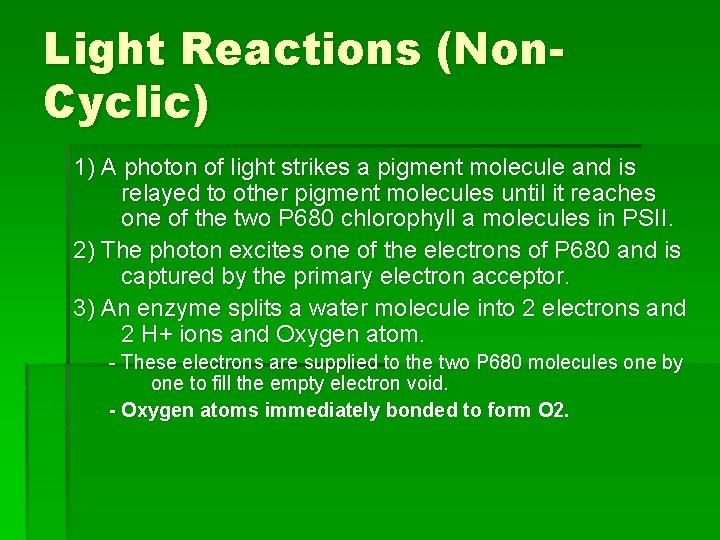
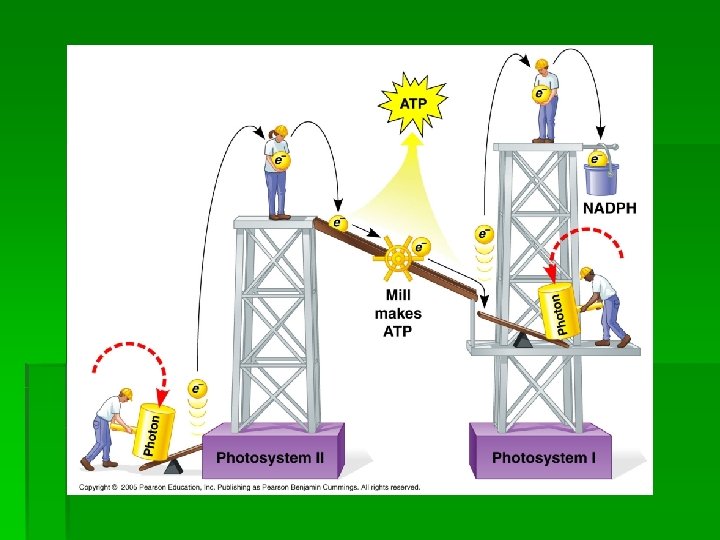
Light Reactions (Non. Cyclic) 1) A photon of light strikes a pigment molecule and is relayed to other pigment molecules until it reaches one of the two P 680 chlorophyll a molecules in PSII. 2) The photon excites one of the electrons of P 680 and is captured by the primary electron acceptor. 3) An enzyme splits a water molecule into 2 electrons and 2 H+ ions and Oxygen atom. - These electrons are supplied to the two P 680 molecules one by one to fill the empty electron void. - Oxygen atoms immediately bonded to form O 2.
Light Reactions (Non. Cyclic) 4) Each photoexcited electron passes from the primary electron acceptor of PS II to PSI via an electron transport chain. The chain is made up of electron carriers (which are proteins in the thylakoid membrane) Pq, Cytochrome complex, and Pc. 5) The exergonic “fall” of electrons to a lower energy state provides energy for the synthesis of ATP (discussed later)
Light Reactions (Non. Cyclic) 6) Light energy was transferred to the PSI exciting an electron of one of the two P 700 chlorophyll a molecules. That photoexcited electron is captured by PSI’s primary electron acceptor. - The hole in P 700 is then filled by electrons coming from PS II via electron transport system. 7) Photoexcited electrons are passed from PSI’s primary electron acceptor down a second electron transport chain by the electron carrier Fd 8) The enzyme NADP+ reductase transfers electrons from Fd to NADP+ (2 electrons are required) resulting in NADPH.
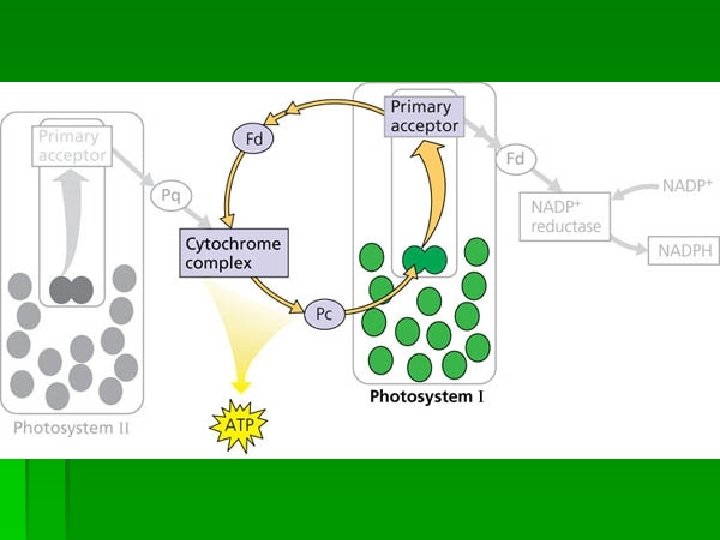
2) Cyclic electron flow Cyclic Electron Flow: Under certain conditions photoexcited electrons take this alternative path which uses PS I but not PS II. § See Fig 10. 15 § Short circuit: the electrons cycle back from Fd to the cytrocrome complex and from there continue on to a P 700 in the PS I. § No production of NADPH and no release of Oxygen § Produces ATP
Light Reactions (Cyclic) Why cyclic? Noncyclic produces ATP and NADPH in equal quantities, but the Calvin cycle consumes more ATP than NADPH. Cyclic electron flow makes up the difference. § The rise and fall of NADPH in chloroplast may stimulate a shift from cyclic to noncyclic electron flow. Review: light reactions use solar energy to generate ATP and NADPH which provide chemical energy and reducing power to the sugar-making reactions of the Calvin cycle
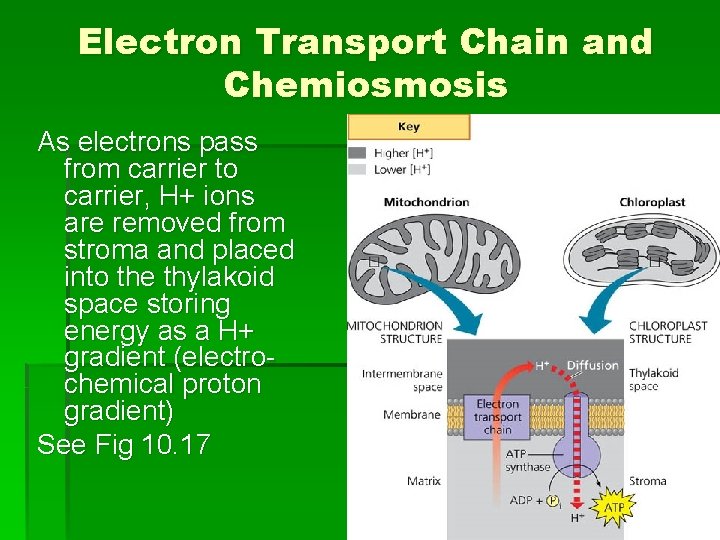
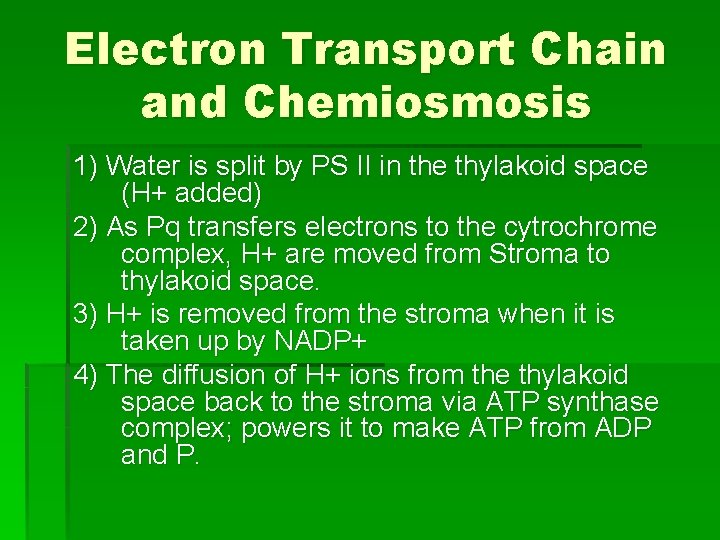
Electron Transport Chain and Chemiosmosis As electrons pass from carrier to carrier, H+ ions are removed from stroma and placed into the thylakoid space storing energy as a H+ gradient (electrochemical proton gradient) See Fig 10. 17
Electron Transport Chain and Chemiosmosis 1) Water is split by PS II in the thylakoid space (H+ added) 2) As Pq transfers electrons to the cytrochrome complex, H+ are moved from Stroma to thylakoid space. 3) H+ is removed from the stroma when it is taken up by NADP+ 4) The diffusion of H+ ions from the thylakoid space back to the stroma via ATP synthase complex; powers it to make ATP from ADP and P.
QOD 1. What color of light is least effective in driving photosynthesis? Explain. 2. In the light reactions, what is the electron donor? Where do the electrons end up? 3. Explain the method of transport the cytochrome complex uses to move H+ across the thylakoid membrane.
QOD answers § Green, because green light is mostly transmitted and reflected—not absorbed —by photosynthetic pigments § Water (H 2 O) is the electron donor; NADP + accepts electrons at the end of the electron transport chain, becoming reduced to NADPH. § Active transport, energy from exergonic “fall” of electrons used to move H+ from low (stroma) to high (Thylakiod space).
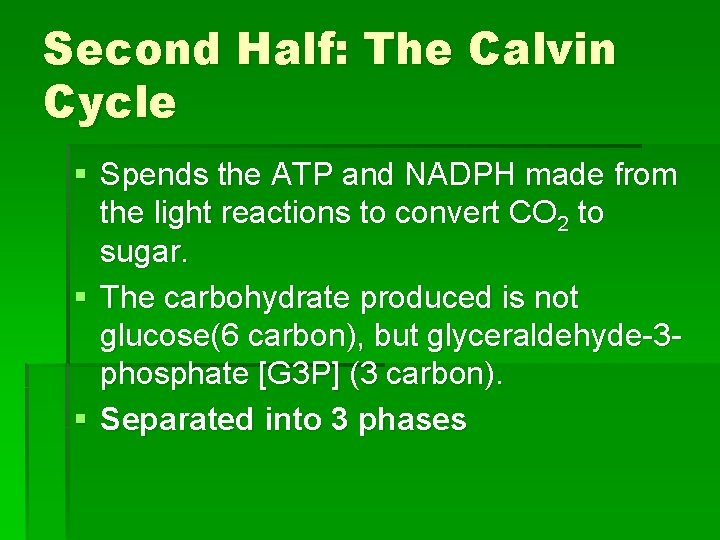
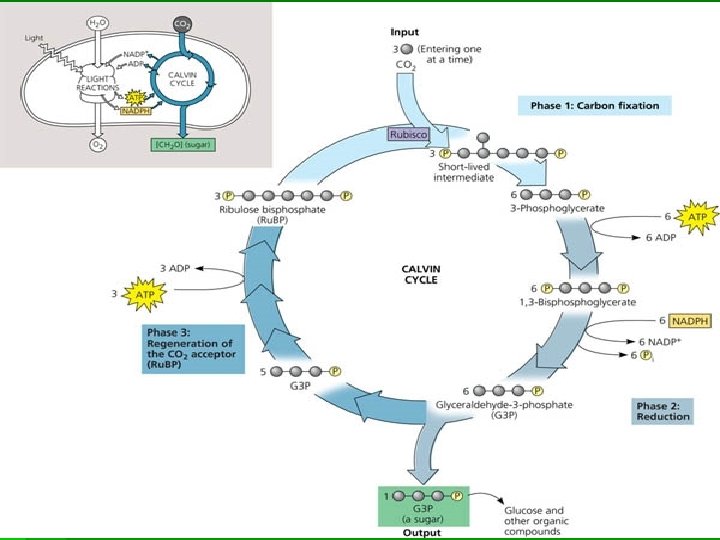
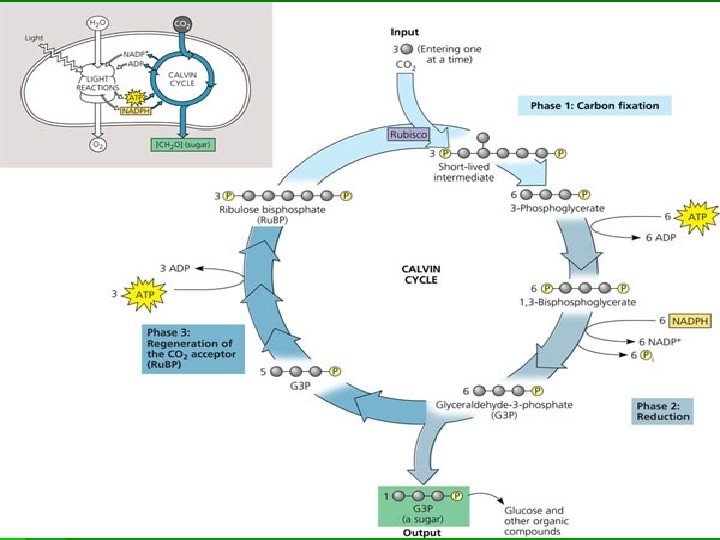
Second Half: The Calvin Cycle § Spends the ATP and NADPH made from the light reactions to convert CO 2 to sugar. § The carbohydrate produced is not glucose(6 carbon), but glyceraldehyde-3 phosphate [G 3 P] (3 carbon). § Separated into 3 phases
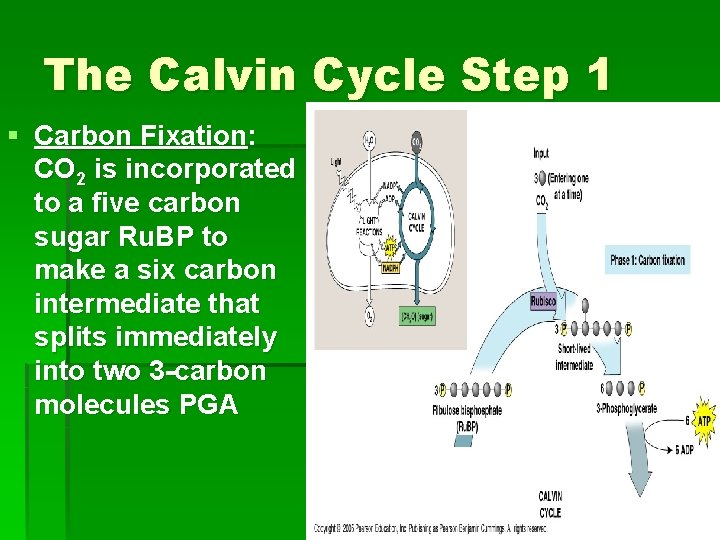
The Calvin Cycle Step 1 § Carbon Fixation: CO 2 is incorporated to a five carbon sugar Ru. BP to make a six carbon intermediate that splits immediately into two 3 -carbon molecules PGA
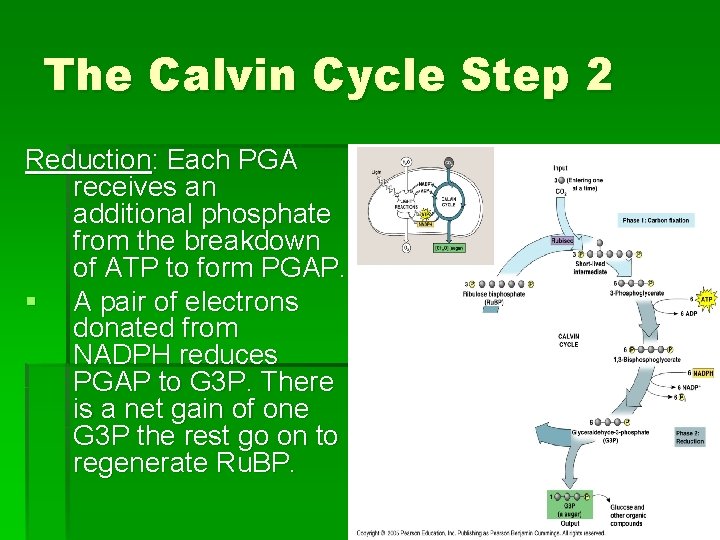
The Calvin Cycle Step 2 Reduction: Each PGA receives an additional phosphate from the breakdown of ATP to form PGAP. § A pair of electrons donated from NADPH reduces PGAP to G 3 P. There is a net gain of one G 3 P the rest go on to regenerate Ru. BP.
The Calvin Cycle Step 3 Regeneration of Ru. BP: a complex series of reactions where the left over G 3 P’s are rearranged into 3 molecules of Ru. BP. § To accomplish this 3 ATP’s are spent. § Ru. BP is now ready to receive CO 2 again and the cycle continues.
Modes of Photosynthesis: C 3 Plants C 3 plants = initial fixation of carbon occurs via rubisco, the Calvin cycle enzyme that adds CO 2 to Ru. BP to make a 3 -carbon compound (named? ) § most plants (rice, wheat, soy) Trade-offs § On hot dry days these types of plants close their stomata to prevent the loss of water. § This results in less sugar production due to the lack of CO 2.
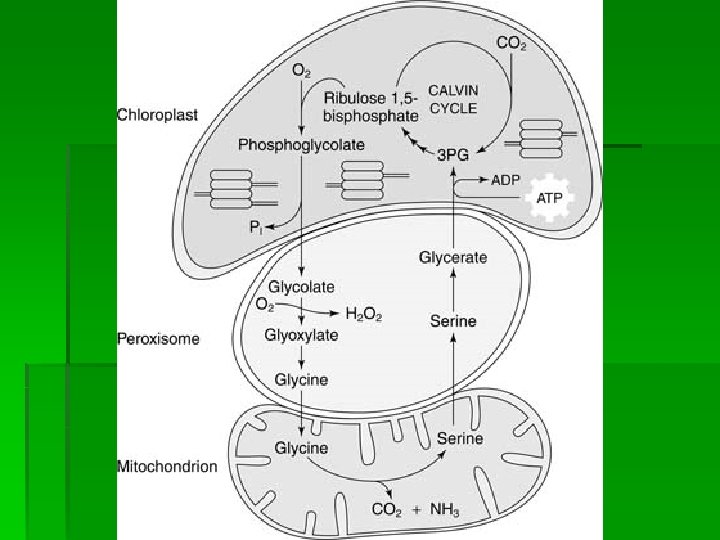
Modes of Photosynthesis: C 3 Plants § When this happens rubisco will bind O 2 to the Calvin cycle in place of CO 2. § This makes a 2 -carbon compound which leaves the chloroplast and is broken down in the mitochondria, releasing CO 2. § This process is called Photorespiration. (photo) happens in the light, (respiration) because it consumes O 2 and releases CO 2
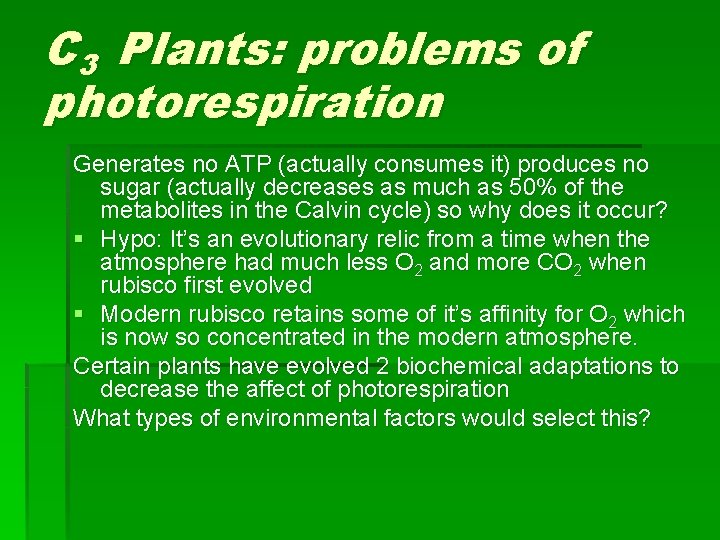
C 3 Plants: problems of photorespiration Generates no ATP (actually consumes it) produces no sugar (actually decreases as much as 50% of the metabolites in the Calvin cycle) so why does it occur? § Hypo: It’s an evolutionary relic from a time when the atmosphere had much less O 2 and more CO 2 when rubisco first evolved § Modern rubisco retains some of it’s affinity for O 2 which is now so concentrated in the modern atmosphere. Certain plants have evolved 2 biochemical adaptations to decrease the affect of photorespiration What types of environmental factors would select this?
Modes of Photosynthesis: C 4 Plants § C 4 plants: preface the Calvin cycle with an alternate form of carbon fixation that makes a 4 carbon compound as its first product. § Corn, grasses
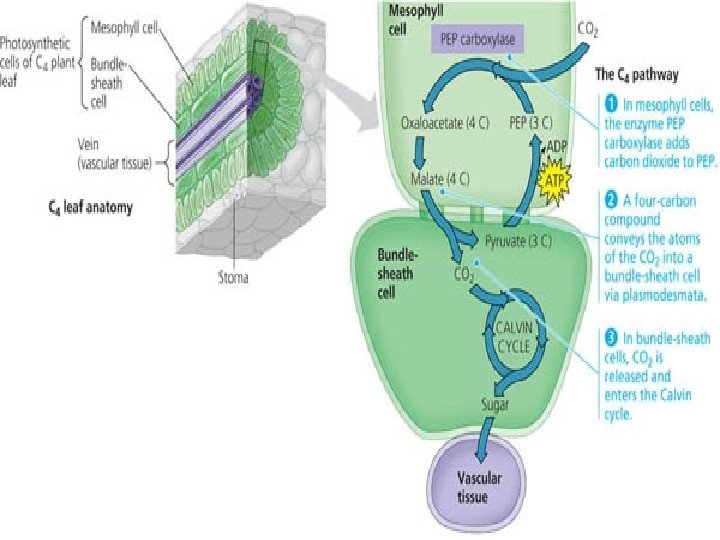
Modes of Photosynthesis: C 4 Plants Two types of photosynthetic cells in C 4 plants § Bundle-sheath Cells: tightly packed around leaf veins. Where the Calvin cycle is confined to (has chloroplasts too). § Mesophyll Cells: just outside of bundle sheath cells and leaf surface. Intermediate cycle before Calvin happens in the chloroplasts here. (C 3 and CAM plants only use these cells for photosynthesis)
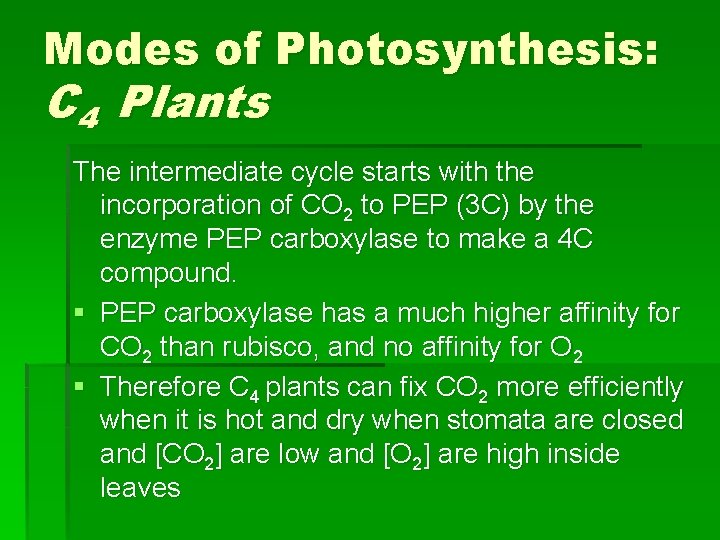
Modes of Photosynthesis: C 4 Plants The intermediate cycle starts with the incorporation of CO 2 to PEP (3 C) by the enzyme PEP carboxylase to make a 4 C compound. § PEP carboxylase has a much higher affinity for CO 2 than rubisco, and no affinity for O 2 § Therefore C 4 plants can fix CO 2 more efficiently when it is hot and dry when stomata are closed and [CO 2] are low and [O 2] are high inside leaves
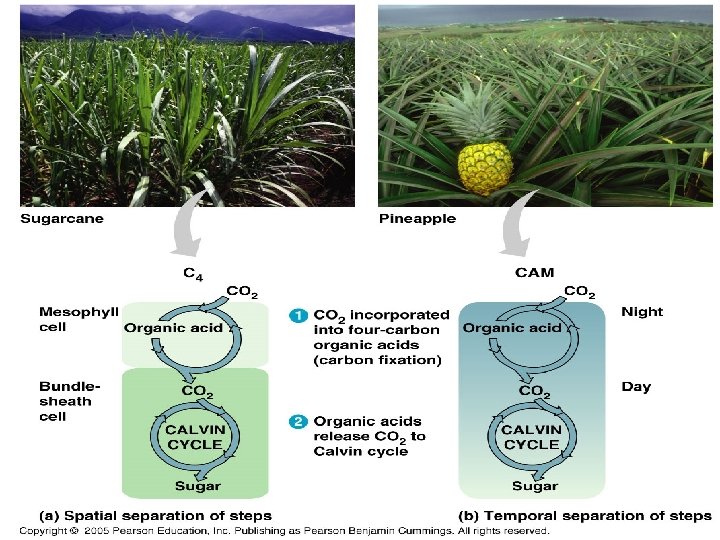
Modes of Photosynthesis: C 4 Plants § The 4 -carbon molecule enters the bundle sheath cells and releases CO 2 to the Calvin cycle which carries on as discussed before. § The remainder 3 carbon compound is then converted back into PEP to begin the cycle anew. § This adaptation is advantageous in hot regions w/ high light intensity, where C 4 plants evolved and thrive today.
Modes of Photosynthesis: CAM Plants § CAM plants: These succulent water storing plants have evolved a temporal solution to photorespiration in arid conditions. § Jade, cacti, pineapples
Modes of Photosynthesis: CAM Plants § Open their stomata during the night and close them during the day. § Closed stomata during the day helps them conserve water but prevents CO 2 from entering. § At night, they take up CO 2 and go thorough the same intermediate carbon fixation as C 4 plants except that it all takes place in Mesophyll cells. (bundle-sheath cells do not have any photosynthetic functions)
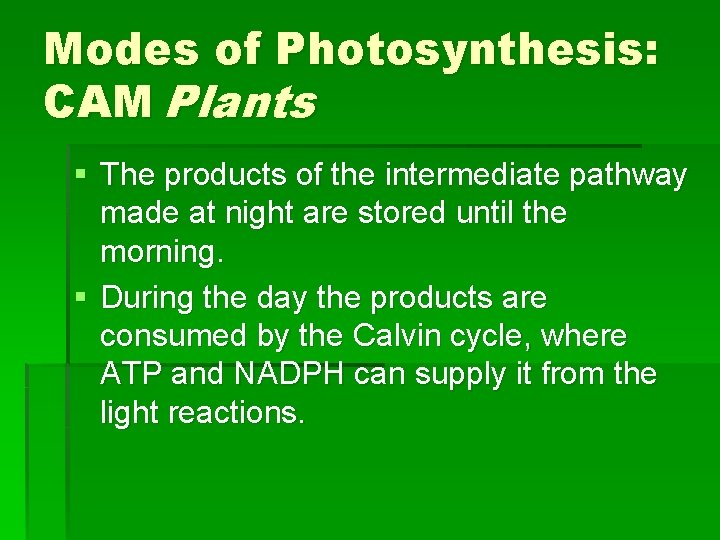
Modes of Photosynthesis: CAM Plants § The products of the intermediate pathway made at night are stored until the morning. § During the day the products are consumed by the Calvin cycle, where ATP and NADPH can supply it from the light reactions.
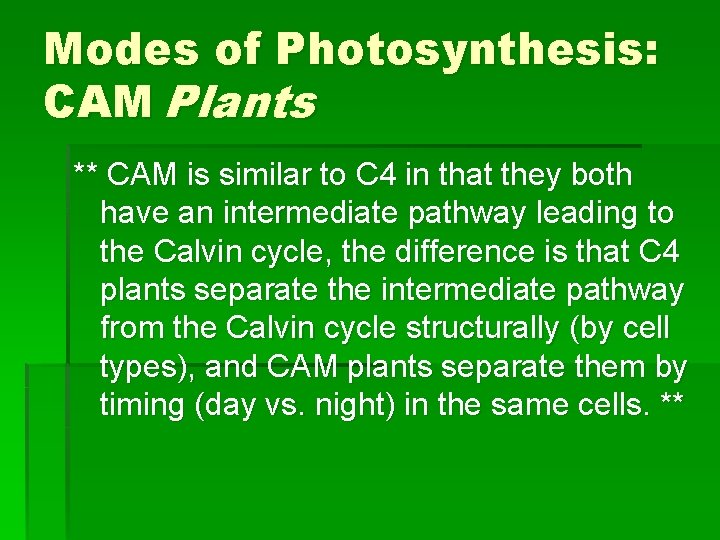
Modes of Photosynthesis: CAM Plants ** CAM is similar to C 4 in that they both have an intermediate pathway leading to the Calvin cycle, the difference is that C 4 plants separate the intermediate pathway from the Calvin cycle structurally (by cell types), and CAM plants separate them by timing (day vs. night) in the same cells. **